

Kiribati flag picture
Remember: a golden bird above a 17-ray sun, red sky above blue-and-white waves, and a rectangle twice as long as it is high.


| Country | KiribatiAn island country in the central Pacific Ocean. |
|---|---|
| Design | Frigatebird, sun, and wavesA golden bird and sun on red above a wavy blue-and-white sea. |
| Adopted | July 12, 1979The date of independence from the United Kingdom. |
| Proportions | 1:2 (height:length)The length is twice the height. |
| Main colors | Red, gold, blue, and whiteThe reference artwork also uses fine black outlines. |
| Bird | FrigatebirdWings raised; head facing the hoist. |
| Sun | 17 visible raysCommonly linked to the 16 Gilbert Islands and Banaba. |
| Waves | Three white and three blue bandsThe lower edge is blue. |
| Origins | Colonial arms granted in 1937The national flag was adopted later, in 1979. |
| Emoji | 🇰🇮Regional indicators K + I; appearance varies by platform. |
The flag’s scene brings together sky, sunlight, a seabird, and the Pacific Ocean.
Explore this flag guide
What is the flag of Kiribati?
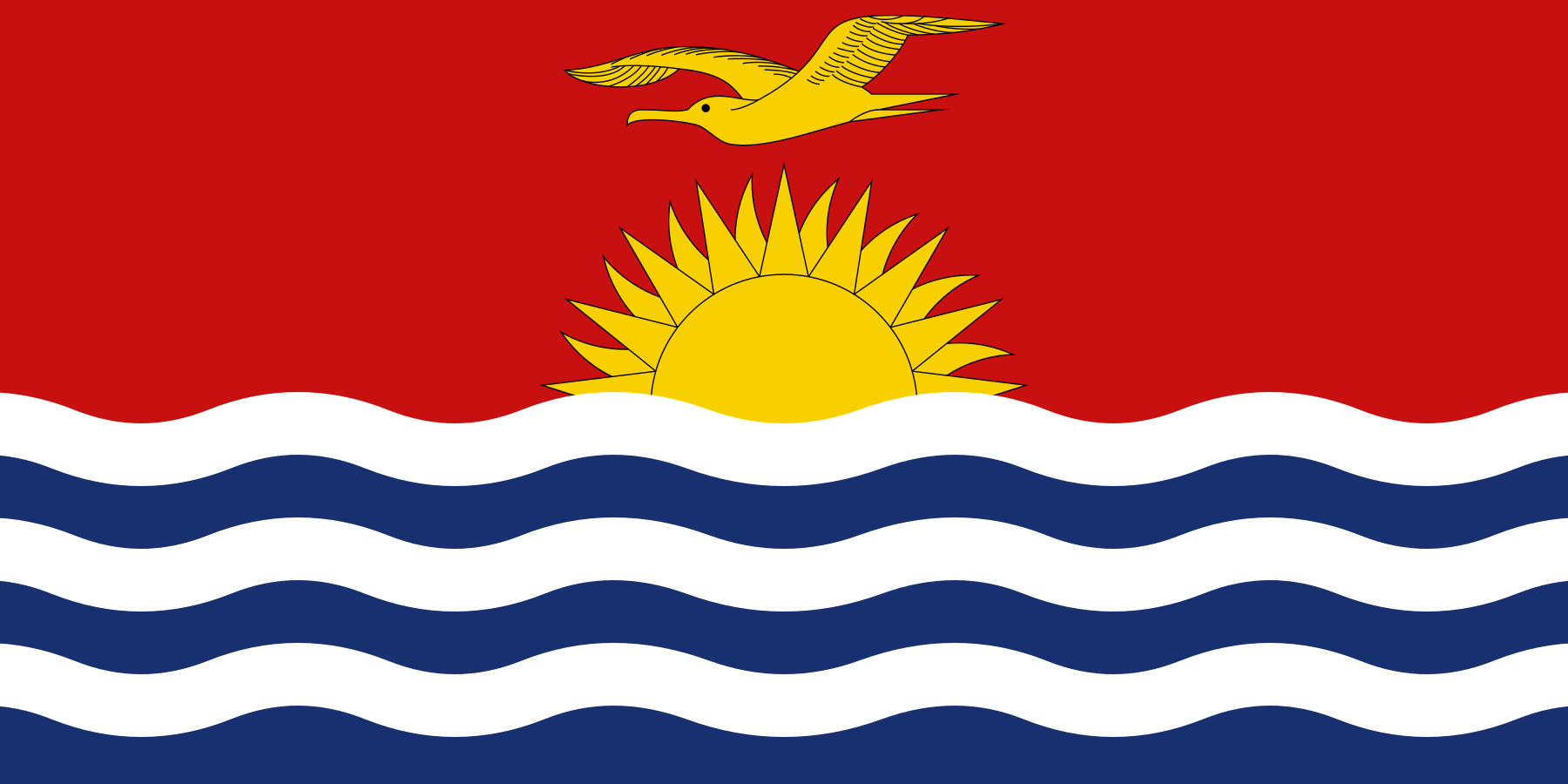
Kiribati’s national flag shows a golden frigatebird flying above a golden rising sun on a red field. Blue and white waves fill the lower part. The flag was adopted on July 12, 1979, when Kiribati became independent. Its height-to-length ratio is 1:2, so the rectangle is twice as long as it is high.
The design brings together the sky, the sun, a seabird, and the Pacific Ocean. The hoist is the edge attached to the pole; the fly is the free edge. Explore other national designs in World Flags.
How are the bird, sun, and waves arranged?
The frigatebird occupies the upper red area and faces the hoist. Beneath it, a golden sun rises from the waves. Three white wavy bands alternate with three blue bands across the lower area, ending with blue along the bottom edge. The sun and the wave pattern are centered across the flag.
The red area represents a sky above the sea. The wavy boundary is part of the design; it should not be replaced by straight horizontal stripes. Preserve the frigatebird’s distinctive outline when scaling the artwork.
What are Kiribati’s flag colors and HEX codes?
Kiribati’s flag has four main colors: red, gold or yellow, blue, and white. The downloadable artwork on this page uses red #C81010, gold #F8D000, blue #183070, and white #FFFFFF. Fine black outlines add detail to the bird and sun. These HEX values describe this digital artwork rather than a statutory digital color standard.
| Color | HEX | RGB | Location |
|---|---|---|---|
| Red | #C81010 | 200, 16, 16 | Upper field |
| Gold | #F8D000 | 248, 208, 0 | Frigatebird and sun |
| Blue | #183070 | 24, 48, 112 | Wavy bands and lower edge |
| White | #FFFFFF | 255, 255, 255 | Three wavy bands |
| Black detail | #000000 | 0, 0, 0 | Fine outlines in the reference vector |

The National Identity Act describes colors through physical color references. Screen colors, print inks, and dyed cloth use different systems, so these HEX values should not be presented as legal conversions of those references.
What does Kiribati’s flag symbolize?
The design links Kiribati with its Pacific setting and national identity. The official explanation of the shared national-emblem motifs associates the frigatebird with power, freedom, and cultural dance patterns, the sun with the tropical equatorial location, and the sea with the Pacific Ocean. A common additional interpretation connects the waves with Kiribati’s three island groups.

Some familiar explanations concern the national emblem, whose central motifs also appear on the flag. The island-group and sun-ray interpretations are widely used explanations; they should be distinguished from the legal description of how the flag is drawn.
What is the bird on Kiribati’s flag?
The bird is a frigatebird, shown in gold with its wings raised. It flies above the rising sun and faces the hoist, which is on the viewer’s left in a standard front view. The official national-emblem explanation connects the frigatebird with power and freedom and with Kiribati’s cultural dance patterns.
Gold is its heraldic color in the design. The flag does not suggest that a real frigatebird has golden plumage, and replacing it with a generic gull would change the national design.
What does the rising sun represent?
The golden rising sun reflects Kiribati’s tropical location around the equator. It appears below the frigatebird, emerging above the waves. Its disc and rays form a single central motif. The sun’s placement connects the red sky with the blue-and-white sea beneath it.
Why does the sun have 17 rays?
The sun on Kiribati’s flag has 17 visible rays. A common interpretation links them to the 16 Gilbert Islands and Banaba. This is not a count of every island in modern Kiribati, which also includes the Phoenix and Line groups. The ray pattern is a defining detail that should be preserved in a flag drawing.
Do not substitute a generic sunburst with an arbitrary number of points. The reference artwork alternates straight and wavy ray shapes, with a straight ray at the top.
What do the blue and white waves mean?
The blue and white waves represent the Pacific Ocean. The lower part of the flag contains three white wavy bands alternating with three blue bands, with blue at the bottom. The three white bands are commonly associated with the Gilbert, Phoenix, and Line island groups.
The waves are an ocean motif, not six separate island groups. They extend across the full length of the flag, and their curved shape should remain clear at smaller display sizes.
Which island groups are represented on the flag?
The three island groups commonly linked to the flag’s waves are the Gilbert Islands, Phoenix Islands, and Line Islands. Kiribati consists of 32 atolls and the raised coral island of Banaba, making 33 islands in total. The three-group interpretation of the waves is separate from the 17-ray interpretation of the sun.
| Feature | Common interpretation | Remember |
|---|---|---|
| Three white wave bands | Gilbert, Phoenix, and Line groups | Three groups, not three individual islands |
| Seventeen sun rays | Sixteen Gilbert Islands and Banaba | Not a count of all 33 islands |
| Blue-and-white sea | The Pacific Ocean | Kiribati’s ocean setting |
What does the red area represent?
The flag’s legal description presents the upper red area as the sky, containing the rising sun and frigatebird. It forms the background for the two golden symbols. Red should not automatically be given a meaning borrowed from another country’s flag, such as a particular independence battle or sacrifice.
Read the design as a complete scene: a red sky above an ocean, a rising sun at the horizon, and a frigatebird overhead.
What is the Kiribati flag’s ratio?
Kiribati’s flag has a height-to-length ratio of 1:2. Equivalently, its length is twice its height. A flag 60 centimeters high would therefore be 120 centimeters long. The same relationship applies to digital images: a 900-pixel-high flag should be 1800 pixels wide.
How do you draw Kiribati’s flag accurately?
Start with a rectangle twice as long as it is high. Use the complete reference design for the red field, golden frigatebird and sun, and alternating blue-and-white waves. Keep the bird facing the hoist and preserve the sun’s 17 visible rays. Scale every part together so that the symbols and wave spacing remain consistent.
- Set the canvas to a 1:2 height-to-length ratio.
- Place the red sky above the wavy sea, ending with blue along the bottom.
- Keep the rising sun centered below the frigatebird.
- Use the detailed frigatebird from the reference vector.
- Resize the complete SVG proportionally, without stretching or cropping.
The diagram explains overall proportions. For the actual bird outline, ray shapes, and wave curves, use the plain SVG flag as a complete vector illustration.
Which flag dimensions preserve the correct proportions?
Any dimensions with a height-to-length ratio of 1:2 preserve Kiribati’s overall flag proportions. Examples include 30 by 60 centimeters, 60 by 120 centimeters, and 90 by 180 centimeters. Digital examples include 300 by 600 pixels and 900 by 1800 pixels, with the height listed first.
| Height | Length | Use |
|---|---|---|
| 30 cm | 60 cm | Example physical size |
| 60 cm | 120 cm | Example physical size |
| 90 cm | 180 cm | Example physical size |
| 300 px | 600 px | Example digital size |
| 900 px | 1800 px | Plain PNG download |

When was Kiribati’s national flag adopted?
Kiribati adopted its national flag on July 12, 1979, the day it became independent from the United Kingdom. The bird, sun, and wave imagery was older, having appeared in colonial heraldry. The date of national adoption should be distinguished from both the earlier coat of arms and the National Identity Act of 1989.
Remember the three dates: 1937 for the colonial grant of arms, 1979 for the national flag at independence, and 1989 for the National Identity Act.
How did Kiribati’s national flag develop?
Kiribati’s flag developed from earlier heraldic imagery used in the Gilbert and Ellice Islands. The colony received arms in 1937 with a frigatebird, rising sun, and sea. At independence in 1979, these motifs became the national flag of Kiribati. The flag is an armorial banner: the shield’s design is extended across a rectangular flag.
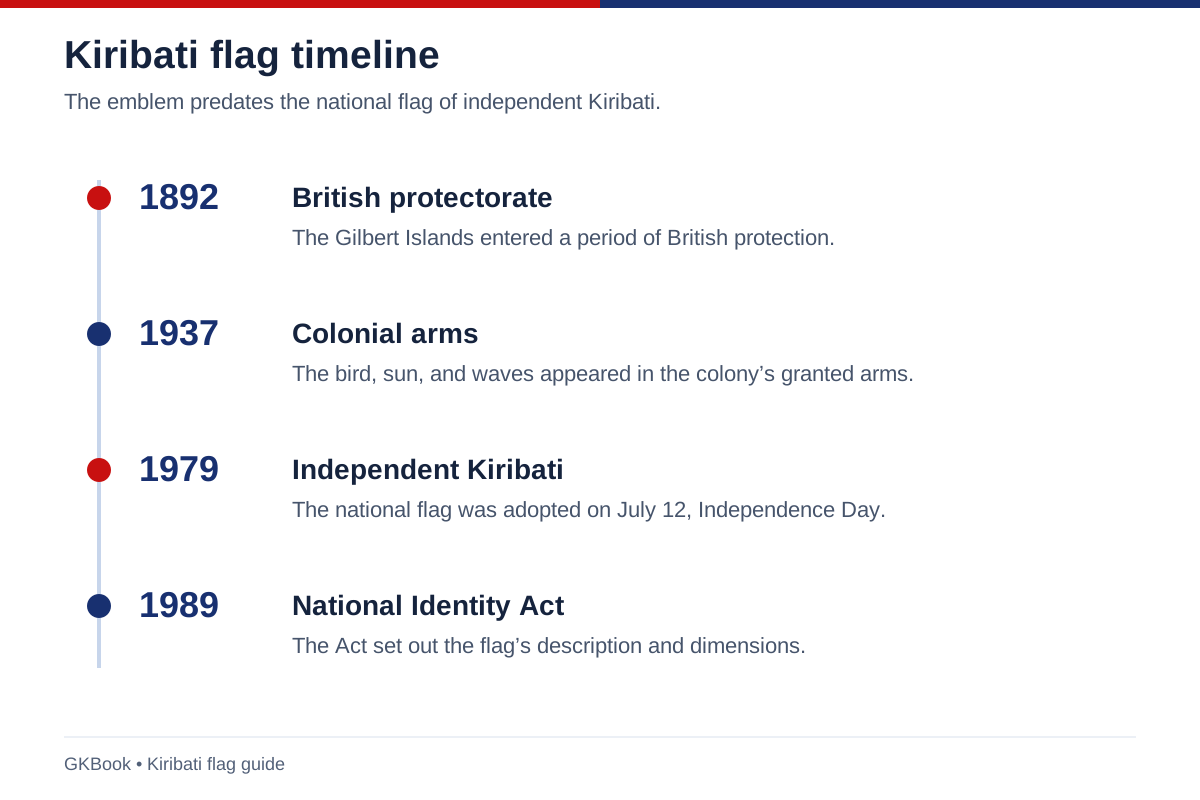
1892
British protectorate
The Gilbert Islands entered a period of British protection.
1937
Colonial arms
The bird, sun, and waves appeared in the colony’s granted arms.
1979
Independent Kiribati
The national flag was adopted on July 12, Independence Day.
1989
National Identity Act
The Act set out the flag’s description and dimensions.
Who designed Kiribati’s flag?
The flag’s bird, sun, and wave design derives from the earlier Gilbert and Ellice Islands badge and coat of arms. Sir Arthur Grimble is associated with the earlier colonial badge design. It is more accurate to describe this design ancestry than to claim that he personally produced the final national flag adopted in 1979.
The history involves an earlier badge, a formal grant of arms, and a later national flag. Those stages should not be collapsed into a single modern design date.
How is the flag connected with Independence Day?
July 12 is Kiribati’s Independence Day and the anniversary of the national flag’s adoption in 1979. The flag marks the country’s sovereignty and is associated with national celebrations. Independence Day is the relevant annual anniversary; a separate recurring Flag Day should not be assumed without a specific official declaration.
For a historical caption, use “National flag adopted July 12, 1979.” For the annual observance, use “Independence Day, July 12.”
Where is the flag’s official design described?
Kiribati’s National Identity Act 1989 describes the national flag in its First Schedule. The description covers its proportions, colors, frigatebird, rising sun, and waves. The Act’s Second Schedule concerns the national emblem and includes explanations of its shared motifs. The Act’s year is not the flag’s adoption year.
The legal length-to-height ratio of 2:1 means exactly the same shape as the 1:2 height-to-length ratio used on this page. Always state which dimension comes first.
Is Kiribati’s flag the same as its coat of arms?
Kiribati’s flag and coat of arms share the frigatebird, sun, and wave imagery, but they are different national symbols. The flag spreads the design across a 1:2 rectangle. The coat of arms presents the design on a shield and includes a motto scroll. The national flag has neither a shield outline nor a motto scroll.
An armorial banner turns the design of a shield into a flag. It does not mean placing the complete coat of arms in the center of a plain background.
Which way should the bird face on Kiribati’s flag?
The frigatebird faces the hoist, or pole side. In the standard front view, the hoist is on the viewer’s left, so the bird faces left. Viewed from the reverse side of a physical flag, the whole design appears mirrored and the hoist is on the viewer’s right. Keep the red sky above the waves.

Do not flip only the bird while leaving the rest of the reference artwork unchanged. A reverse view mirrors the entire flag, including its asymmetric details.
How should a Kiribati flag image be displayed?
For an accurate horizontal display, keep the red sky at the top, the blue lower edge at the bottom, and the frigatebird facing the hoist. Preserve the 1:2 proportions and show the complete national design. Leave captions, labels, logos, and measurement marks outside the plain flag image.
Keep the design clear
- Use a 1:2 rectangle.
- Show the complete bird and sun.
- Keep all three white wave bands visible.
- Allow enough space around the image.
Avoid artwork errors
- Do not crop the fly or hoist.
- Do not stretch the flag into a square.
- Do not add a shield or motto scroll.
- Do not replace curved waves with straight stripes.
How should a Kiribati flag image be prepared for printing?
Use the SVG for scalable printing and keep its 1:2 proportions. The PNG download is 1800 pixels wide by 900 pixels high; at 300 pixels per inch it prints at 6 by 3 inches. Check a proof for the bird’s fine details, the sun rays, the wave spacing, and the separation between red, gold, blue, and white.
The SVG is preferable when a printer accepts vector artwork. For color-critical work, agree on physical color references and production settings with the printer. The downloadable RGB palette is intended for these digital images, and print output can vary with paper, ink, and fabric.
How can a physical Kiribati flag be cared for?
Follow the manufacturer’s instructions for the flag’s fabric, seams, and fittings. Keep it dry before storage, inspect worn edges, and replace damaged attachments. Fold or roll it without trapping moisture. These are general fabric-care suggestions; the best cleaning method depends on the material and its colorfastness.
Before public display, check that wear has not removed the thin white waves, damaged the bird, or faded the red and blue so severely that the design becomes unclear.
What is the Kiribati flag emoji?
The Kiribati flag emoji is 🇰🇮. It is formed from the regional indicator symbols K and I, using Unicode code points U+1F1F0 and U+1F1EE. Its appearance depends on the device, browser, and font. Some environments display the letter pair instead of a colored flag.
🇰🇮 Copy the emoji: 🇰🇮. For a consistent illustrated design on a website or in print, use the downloadable SVG or PNG.
Which Kiribati flag mistakes should be avoided?
Avoid changing the 1:2 ratio, drawing the bird as a generic gull, using a sun with an arbitrary number of rays, or replacing the waves with straight stripes. Keep the 17-ray explanation separate from the country’s total of 33 islands. Do not confuse the 1937 arms, the 1979 flag adoption, and the 1989 National Identity Act.
| Mistake | Accurate version |
|---|---|
| “The flag is 2:3.” | It is 1:2 when height is listed first. |
| “The bird is a golden species.” | Gold is the heraldic color of the frigatebird. |
| “The rays count all of Kiribati’s islands.” | The common explanation is 16 Gilbert Islands plus Banaba. |
| “The waves are straight stripes.” | They are alternating wavy blue and white bands. |
| “The flag was adopted in 1989.” | It was adopted on July 12, 1979. |
| “The flag includes a motto.” | The motto scroll belongs to the coat of arms. |
Which Kiribati flag pictures can be downloaded?
The downloads include a plain Kiribati flag as an SVG and an 1800-by-900-pixel PNG. The picture gallery also includes diagrams of proportions, colors, symbolism, the bird and sun, history, orientation, and example sizes. The plain flag files have no watermark, caption, pole, or measurement marks.
| Download | Format | Purpose |
|---|---|---|
| Plain Kiribati flag | SVG | Scalable national flag artwork |
| Kiribati flag, 1800 × 900 | PNG | Opaque raster image |
| Kiribati flag picture gallery | SVG | Eight flag and diagram subjects |
The diagrams include labels and display aids for learning. These additions are part of the explanatory illustrations, not part of the national flag.
Kiribati flag pictures
The plain 1:2 national flag with a frigatebird, rising sun, and waves.
Public-domain flag vector via Wikimedia Commons; SKopp, Hanzlan and contributors.Download image
The flag’s length is twice its height, with the hoist and fly labeled.
GKBook illustration using the public-domain flag reference.Download image
The red, gold, blue, and white HEX and RGB values used in these downloads.
GKBook illustration using the public-domain flag reference.Download image
The meanings of the frigatebird, rising sun, and ocean waves.
GKBook illustration using the public-domain flag reference.Download image
An enlarged design detail with the hoist-facing bird and 17-ray sun.
GKBook illustration using the public-domain flag reference.Download image
Four historical milestones, from British protection to the National Identity Act.
GKBook illustration using the public-domain flag reference.Download image
The bird faces the hoist on both sides of the flag.
GKBook illustration using the public-domain flag reference.Download image
Physical and pixel dimensions that preserve the 1:2 ratio.
GKBook illustration using the public-domain flag reference.Download imageFrequently asked questions
What is the flag of Kiribati?
Kiribati’s national flag shows a golden frigatebird flying above a golden rising sun on a red field. Blue and white waves fill the lower part. The flag was adopted on July 12, 1979, when Kiribati became independent. Its height-to-length ratio is 1:2, so the rectangle is twice as long as it is high.
How are the bird, sun, and waves arranged?
The frigatebird occupies the upper red area and faces the hoist. Beneath it, a golden sun rises from the waves. Three white wavy bands alternate with three blue bands across the lower area, ending with blue along the bottom edge. The sun and the wave pattern are centered across the flag.
What are Kiribati’s flag colors and HEX codes?
Kiribati’s flag has four main colors: red, gold or yellow, blue, and white. The downloadable artwork on this page uses red #C81010, gold #F8D000, blue #183070, and white #FFFFFF. Fine black outlines add detail to the bird and sun. These HEX values describe this digital artwork rather than a statutory digital color standard.
What does Kiribati’s flag symbolize?
The design links Kiribati with its Pacific setting and national identity. The official explanation of the shared national-emblem motifs associates the frigatebird with power, freedom, and cultural dance patterns, the sun with the tropical equatorial location, and the sea with the Pacific Ocean. A common additional interpretation connects the waves with Kiribati’s three island groups.
What is the bird on Kiribati’s flag?
The bird is a frigatebird, shown in gold with its wings raised. It flies above the rising sun and faces the hoist, which is on the viewer’s left in a standard front view. The official national-emblem explanation connects the frigatebird with power and freedom and with Kiribati’s cultural dance patterns.
What does the rising sun represent?
The golden rising sun reflects Kiribati’s tropical location around the equator. It appears below the frigatebird, emerging above the waves. Its disc and rays form a single central motif. The sun’s placement connects the red sky with the blue-and-white sea beneath it.
Why does the sun have 17 rays?
The sun on Kiribati’s flag has 17 visible rays. A common interpretation links them to the 16 Gilbert Islands and Banaba. This is not a count of every island in modern Kiribati, which also includes the Phoenix and Line groups. The ray pattern is a defining detail that should be preserved in a flag drawing.
What do the blue and white waves mean?
The blue and white waves represent the Pacific Ocean. The lower part of the flag contains three white wavy bands alternating with three blue bands, with blue at the bottom. The three white bands are commonly associated with the Gilbert, Phoenix, and Line island groups.
Which island groups are represented on the flag?
The three island groups commonly linked to the flag’s waves are the Gilbert Islands, Phoenix Islands, and Line Islands. Kiribati consists of 32 atolls and the raised coral island of Banaba, making 33 islands in total. The three-group interpretation of the waves is separate from the 17-ray interpretation of the sun.
What does the red area represent?
The flag’s legal description presents the upper red area as the sky, containing the rising sun and frigatebird. It forms the background for the two golden symbols. Red should not automatically be given a meaning borrowed from another country’s flag, such as a particular independence battle or sacrifice.
What is the Kiribati flag’s ratio?
Kiribati’s flag has a height-to-length ratio of 1:2. Equivalently, its length is twice its height. A flag 60 centimeters high would therefore be 120 centimeters long. The same relationship applies to digital images: a 900-pixel-high flag should be 1800 pixels wide.
How do you draw Kiribati’s flag accurately?
Start with a rectangle twice as long as it is high. Use the complete reference design for the red field, golden frigatebird and sun, and alternating blue-and-white waves. Keep the bird facing the hoist and preserve the sun’s 17 visible rays. Scale every part together so that the symbols and wave spacing remain consistent.
Which flag dimensions preserve the correct proportions?
Any dimensions with a height-to-length ratio of 1:2 preserve Kiribati’s overall flag proportions. Examples include 30 by 60 centimeters, 60 by 120 centimeters, and 90 by 180 centimeters. Digital examples include 300 by 600 pixels and 900 by 1800 pixels, with the height listed first.
When was Kiribati’s national flag adopted?
Kiribati adopted its national flag on July 12, 1979, the day it became independent from the United Kingdom. The bird, sun, and wave imagery was older, having appeared in colonial heraldry. The date of national adoption should be distinguished from both the earlier coat of arms and the National Identity Act of 1989.
How did Kiribati’s national flag develop?
Kiribati’s flag developed from earlier heraldic imagery used in the Gilbert and Ellice Islands. The colony received arms in 1937 with a frigatebird, rising sun, and sea. At independence in 1979, these motifs became the national flag of Kiribati. The flag is an armorial banner: the shield’s design is extended across a rectangular flag.
Who designed Kiribati’s flag?
The flag’s bird, sun, and wave design derives from the earlier Gilbert and Ellice Islands badge and coat of arms. Sir Arthur Grimble is associated with the earlier colonial badge design. It is more accurate to describe this design ancestry than to claim that he personally produced the final national flag adopted in 1979.
How is the flag connected with Independence Day?
July 12 is Kiribati’s Independence Day and the anniversary of the national flag’s adoption in 1979. The flag marks the country’s sovereignty and is associated with national celebrations. Independence Day is the relevant annual anniversary; a separate recurring Flag Day should not be assumed without a specific official declaration.
Where is the flag’s official design described?
Kiribati’s National Identity Act 1989 describes the national flag in its First Schedule. The description covers its proportions, colors, frigatebird, rising sun, and waves. The Act’s Second Schedule concerns the national emblem and includes explanations of its shared motifs. The Act’s year is not the flag’s adoption year.
Is Kiribati’s flag the same as its coat of arms?
Kiribati’s flag and coat of arms share the frigatebird, sun, and wave imagery, but they are different national symbols. The flag spreads the design across a 1:2 rectangle. The coat of arms presents the design on a shield and includes a motto scroll. The national flag has neither a shield outline nor a motto scroll.
Which way should the bird face on Kiribati’s flag?
The frigatebird faces the hoist, or pole side. In the standard front view, the hoist is on the viewer’s left, so the bird faces left. Viewed from the reverse side of a physical flag, the whole design appears mirrored and the hoist is on the viewer’s right. Keep the red sky above the waves.
How should a Kiribati flag image be displayed?
For an accurate horizontal display, keep the red sky at the top, the blue lower edge at the bottom, and the frigatebird facing the hoist. Preserve the 1:2 proportions and show the complete national design. Leave captions, labels, logos, and measurement marks outside the plain flag image.
How should a Kiribati flag image be prepared for printing?
Use the SVG for scalable printing and keep its 1:2 proportions. The PNG download is 1800 pixels wide by 900 pixels high; at 300 pixels per inch it prints at 6 by 3 inches. Check a proof for the bird’s fine details, the sun rays, the wave spacing, and the separation between red, gold, blue, and white.
How can a physical Kiribati flag be cared for?
Follow the manufacturer’s instructions for the flag’s fabric, seams, and fittings. Keep it dry before storage, inspect worn edges, and replace damaged attachments. Fold or roll it without trapping moisture. These are general fabric-care suggestions; the best cleaning method depends on the material and its colorfastness.
What is the Kiribati flag emoji?
The Kiribati flag emoji is 🇰🇮. It is formed from the regional indicator symbols K and I, using Unicode code points U+1F1F0 and U+1F1EE. Its appearance depends on the device, browser, and font. Some environments display the letter pair instead of a colored flag.
Which Kiribati flag mistakes should be avoided?
Avoid changing the 1:2 ratio, drawing the bird as a generic gull, using a sun with an arbitrary number of rays, or replacing the waves with straight stripes. Keep the 17-ray explanation separate from the country’s total of 33 islands. Do not confuse the 1937 arms, the 1979 flag adoption, and the 1989 National Identity Act.
Which Kiribati flag pictures can be downloaded?
The downloads include a plain Kiribati flag as an SVG and an 1800-by-900-pixel PNG. The picture gallery also includes diagrams of proportions, colors, symbolism, the bird and sun, history, orientation, and example sizes. The plain flag files have no watermark, caption, pole, or measurement marks.
Explore all general-knowledge topics and the A-to-Z lists.

We Value Your Opinion Comments