

Kazakhstan flag picture
Remember: 32 rays around the sun, an eagle beneath it, and a gold ornament beside the pole.

| Country | KazakhstanThe Republic of Kazakhstan, in Central Asia. |
|---|---|
| Design | Sky blue and goldA sun, soaring eagle, and national ornament. |
| Adopted | June 4, 1992After independence on December 16, 1991. |
| Designer | Shaken NiyazbekovThe Kazakh artist credited in official accounts. |
| Proportions | 1:2 height:lengthThe long dimension is twice the short dimension. |
| Sun | 32 raysGrain-shaped rays accompany the gold disk. |
| Ornament | At the hoistThe gold band represents Kazakh cultural traditions. |
| Symbols Day | June 4An annual celebration of the national symbols. |
| Flag emoji | 🇰🇿Regional indicator symbols K + Z. |
| Explore | World FlagsDiscover more national flags and their meanings. |
Two colors unite the background and three gold features.
Explore this flag guide
What is the flag of Kazakhstan?
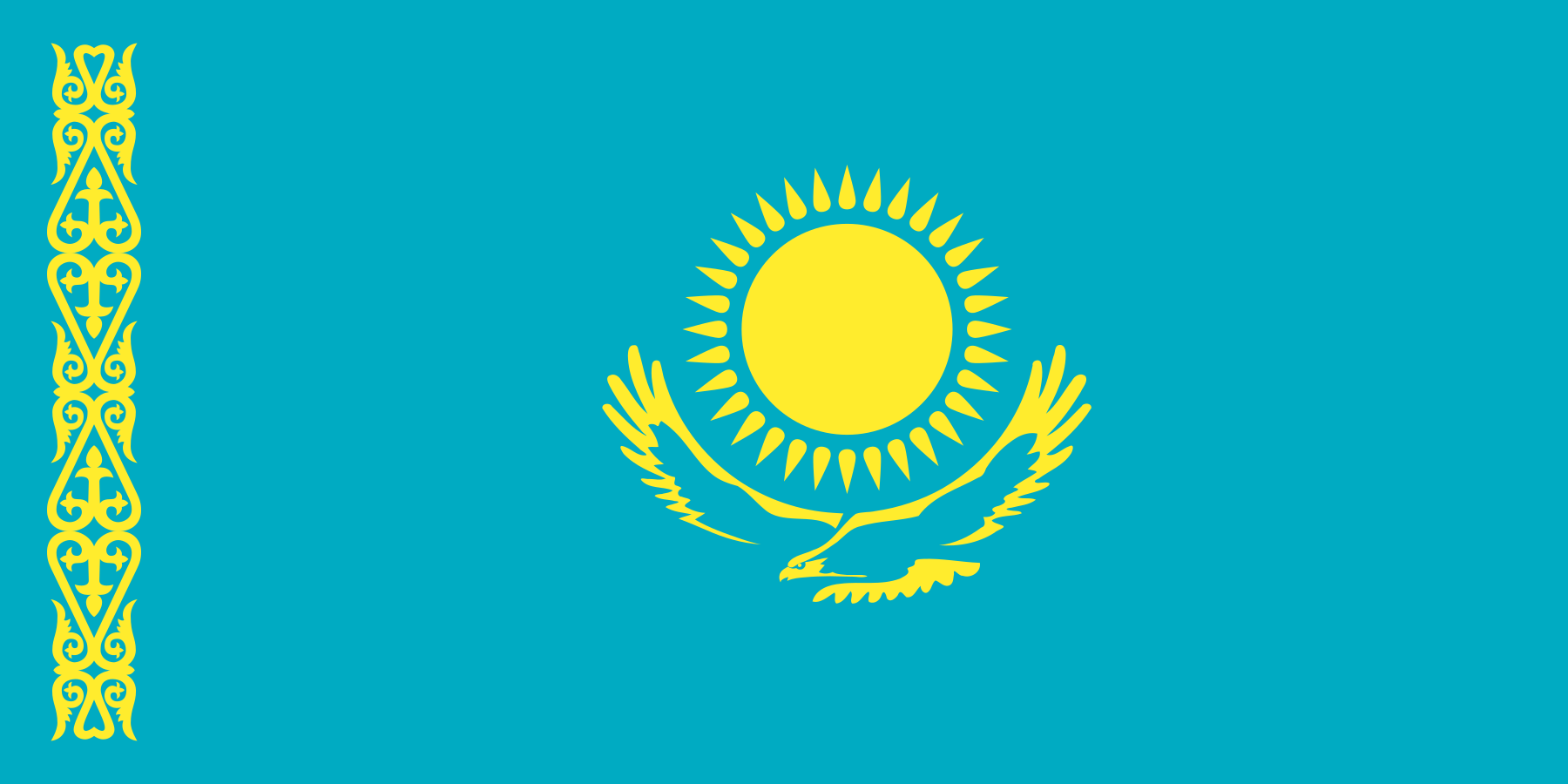
Kazakhstan’s national flag has a sky-blue field with a gold sun, a soaring eagle below it, and a gold ornamental band beside the flagpole. The sun has 32 rays. Adopted on June 4, 1992, the flag is twice as long as it is high and was designed by Shaken Niyazbekov.
The hoist is the edge attached to the pole. In the standard front view shown here, the ornament runs down the left side. The sun, eagle, and ornament are all part of the national design. Explore other countries in World Flags.
Do Kazakhstan and Qazaqstan refer to the same flag?
Kazakhstan is the familiar English country name; Qazaqstan is another Latin-script rendering of its Kazakh name. Both refer to the same state and national flag. The formal English name is the Republic of Kazakhstan. A different spelling in a caption does not indicate a separate version of the blue-and-gold national design.
| Name | Meaning |
|---|---|
| Kazakhstan | Common English country name |
| Republic of Kazakhstan | Formal English country name |
| Qazaqstan | Latin-script rendering of the Kazakh name |
| Қазақстан Республикасының Мемлекеттік Туы | State Flag of the Republic of Kazakhstan |
What are the main features of Kazakhstan’s flag?
The blue background is uninterrupted by stripes. A gold sun with 32 rays sits above a stylized eagle with outspread wings. A vertical gold ornament stands close to the hoist. The complete design has no lettering, border, crescent, or separate star, and its details should remain together when the flag is resized.
| Feature | Position |
|---|---|
| Sky-blue field | The entire rectangular background |
| Gold sun and rays | Above the eagle |
| Gold eagle | Below the sun, wings spread |
| Gold national ornament | Vertical band near the hoist |
| Plain flag boundary | A 2:1 rectangle without a decorative frame |
What is the Kazakhstan flag’s ratio?
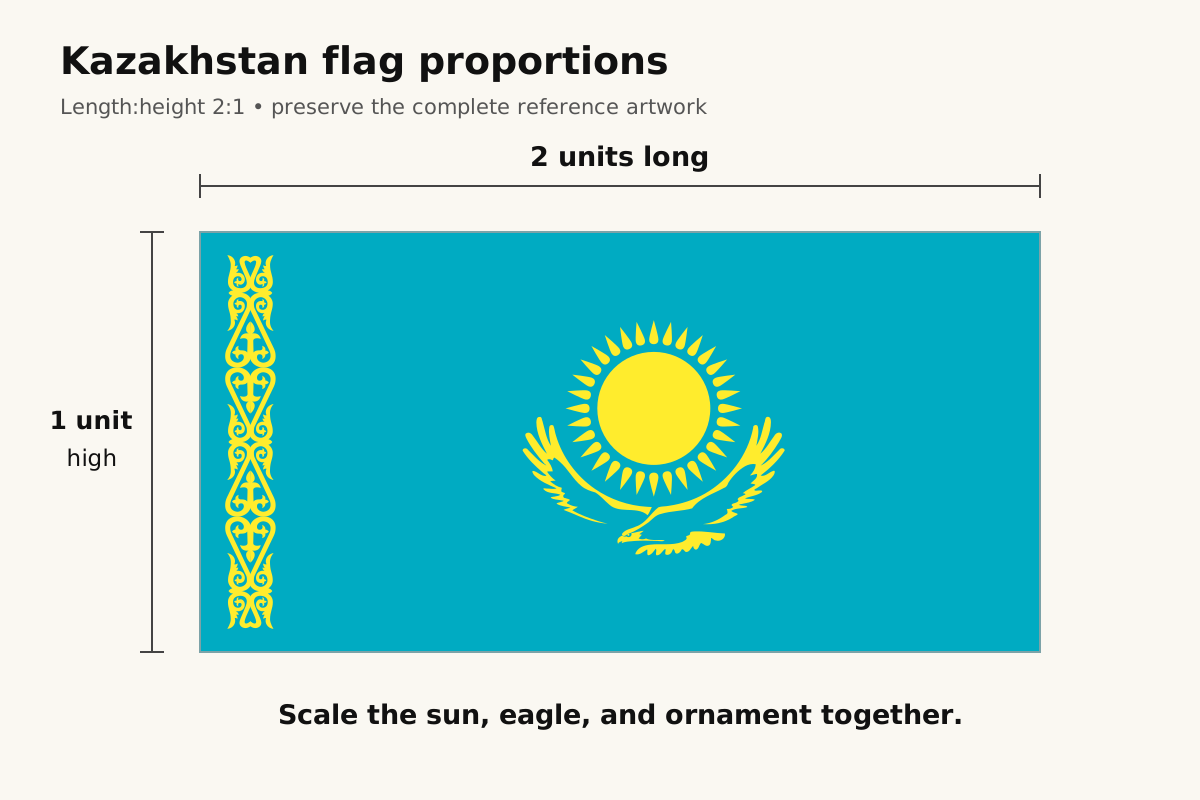
Kazakhstan’s flag has a 1:2 height-to-length ratio, or 2:1 when length is written first. A flag 50 centimeters high is therefore 100 centimeters long. Scale the ornament, sun, and eagle along with the background. Changing only the rectangle would stretch or compress the symbols and alter the design’s appearance.
This guide uses length for the long horizontal dimension and height for the shorter vertical one. Some official translations call that short dimension width. Always state the order when writing a ratio or a pair of measurements.
What are Kazakhstan’s flag colors and HEX codes?
The flag uses sky blue and gold. Kazakhstan’s Foreign Ministry publishes #00ABC2 for blue and #FFEC2D for gold, corresponding to RGB 0, 171, 194 and 255, 236, 45. Those are the values used in these downloads. A screen palette still needs an appropriate production reference when transferred to ink or fabric.
| Color | HEX | RGB | Published Pantone reference |
|---|---|---|---|
| Sky blue | #00ABC2 | 0, 171, 194 | 3125 U |
| Gold | #FFEC2D | 255, 236, 45 | 102 U |
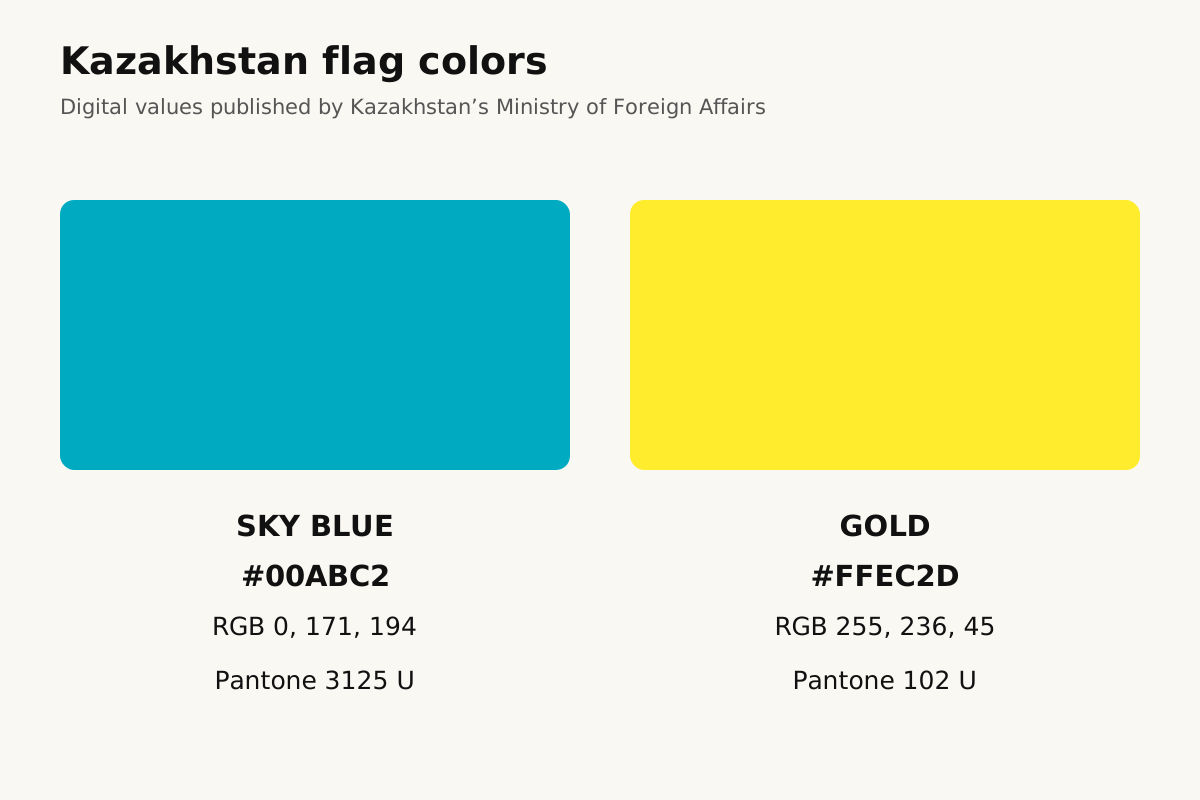
The gold elements are represented by a flat yellow-gold fill in these digital files. A photograph of metallic thread, folded cloth, or a flag in shadow will not reproduce the same apparent color as a flat screen image.
What does the blue field symbolize?
Official Kazakh explanations connect sky blue with a clear sky, peace, well-being, honesty, and fidelity. The single-color background also expresses national unity. These meanings belong to the flag’s cultural interpretation; the blue rectangle is not a map, and its area does not divide the country into geographical or political regions.

What does the sun on Kazakhstan’s flag mean?
The sun represents life, energy, wealth, and abundance in official accounts of the national flag. It is drawn as a gold disk surrounded by separate rays, above the eagle. The disk and its rays form one recognizable element, so an accurate reproduction should keep both instead of substituting a plain circle.
A useful identification exercise is to locate the sun first, then the bird beneath it, and finally the ornament near the pole. Those three gold features distinguish the complete flag more reliably than its background color alone.
How many rays does Kazakhstan’s flag sun have?
The sun has 32 rays. Official explanations describe their shapes as grains, linking the sun with prosperity and abundance. The rays are separate from the central disk and repeat around it. Count the full circle when checking a drawing; a small preview can make neighboring rays appear to merge together.
The supplied SVG preserves the reference vector’s repeated ray construction. The numbers, labels, and enlarged crops in the explanatory image are not additions to the plain national flag.
What bird appears on Kazakhstan’s flag?
A stylized soaring eagle appears beneath the sun. Kazakhstan’s official English description calls it a steppe eagle and associates it with sovereignty, independence, freedom, and ambitious goals. Its wings spread widely across the blue field. The emblem is a designed silhouette, so its outline should be preserved when preparing a flag image.
The eagle is gold, like the sun and ornament. A generic bird icon will change details of the wings, head, and tail. Use the complete reference artwork for a faithful illustration rather than replacing the bird with a clip-art silhouette.
What is the pattern beside the flagpole?
The gold band near the hoist is a traditional Kazakh ornament, commonly identified with the ram’s-horn motif, or qoshqar müyiz. It represents cultural heritage and artistic traditions. The curling shapes are decorative forms, not a sentence or an inscription. Their placement beside the pole is an identifying part of the flag.
The ornament is separated from the flag’s outer edge by blue space. Preserve the entire band when cropping or adding a pole sleeve. The supplied vector keeps the reference motif’s curves and repeated forms instead of approximating them with a different pattern.
How do you draw Kazakhstan’s flag accurately?
Begin with a rectangle twice as long as it is high, then use complete reference artwork for the gold sun, eagle, and ornament. Scale all parts together to retain their sizes and positions. The intricate emblem and pattern are better preserved as vector paths than recreated from approximate circles or strokes.
- Set the visible rectangle to length = 2 × height.
- Keep the sky-blue field and gold artwork together.
- Preserve the 32 rays and the detailed eagle and ornamental paths.
- Resize proportionally; do not crop the hoist or free edge.
- Use the applicable technical standard for certified physical production.
The construction diagram explains the overall ratio. It does not invent component measurements or claim to reproduce every tolerance in ST RK 988-2007.
Which dimensions keep the correct flag shape?
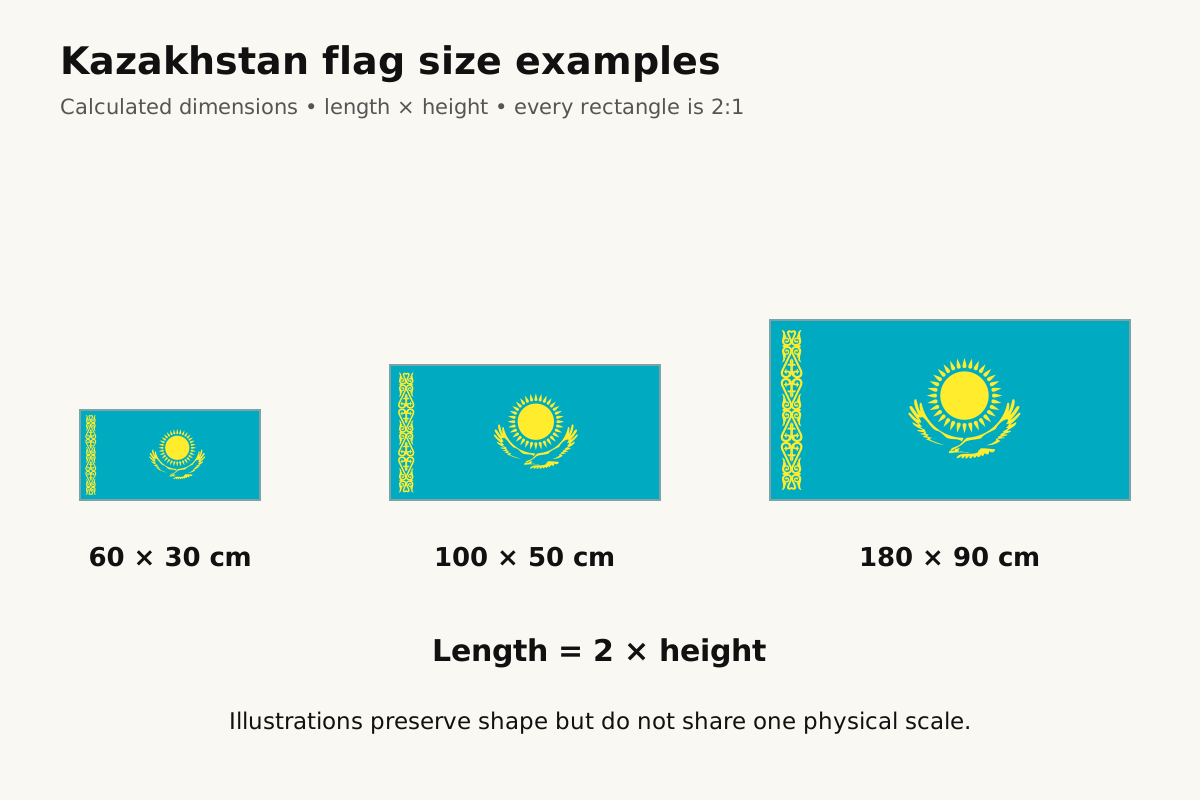
Any artwork dimensions with a 2:1 length-to-height ratio preserve the flag’s outer shape. Examples include 60 by 30 centimeters, 100 by 50 centimeters, and 180 by 90 centimeters. The full design must scale with that rectangle. These are calculated examples, not a list of officially required manufactured flag sizes.
| Length × height | Ratio | How to scale |
|---|---|---|
| 60 × 30 cm | 2:1 | Resize the complete artwork |
| 100 × 50 cm | 2:1 | Resize the complete artwork |
| 180 × 90 cm | 2:1 | Resize the complete artwork |
| 1800 × 900 pixels | 2:1 | Supplied PNG dimensions |
Who designed the Kazakhstan flag?
Kazakh artist Shaken Niyazbekov designed the national flag adopted in 1992. Kazakhstan’s official presidential and government descriptions identify him as its author. The design combines a blue field with a gold sun, eagle, and traditional ornament. Credit for the national design is distinct from credit for a later digital vector reconstruction.
The downloadable images retain the reference vector’s detailed artwork. Their captions credit the state-flag design to Niyazbekov and identify the vector reference separately, while the explanatory layouts and labels were prepared for this guide.
When was Kazakhstan’s national flag adopted?
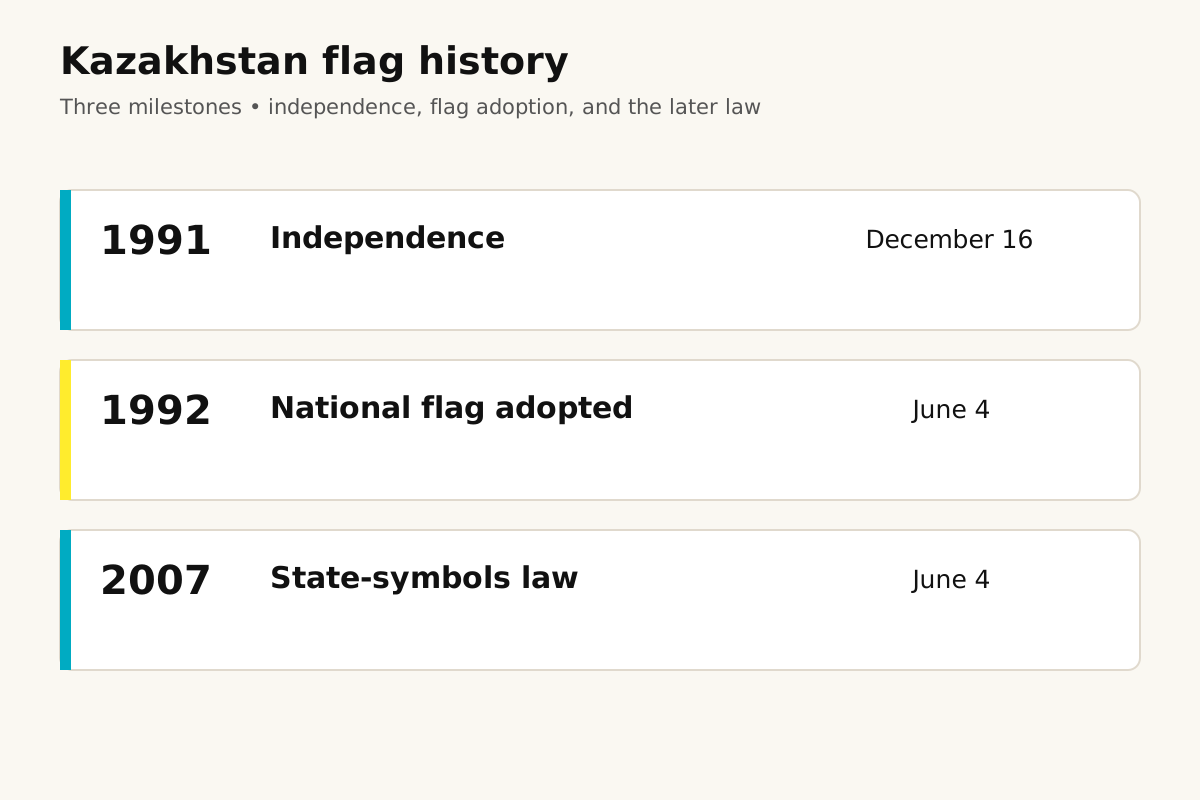
Kazakhstan adopted its national flag on June 4, 1992. That date follows the country’s independence on December 16, 1991. A later constitutional law on state symbols dates from June 4, 2007. These dates mark different events, so the 2007 law should not be presented as the flag’s first adoption.
| Date | Milestone |
|---|---|
| December 16, 1991 | Kazakhstan becomes independent |
| June 4, 1992 | National flag adopted |
| June 4, 2007 | Constitutional law on state symbols |
How did Kazakhstan’s national flag develop?
The present national flag belongs to Kazakhstan’s early period of independence. The country selected new state symbols in 1992, with Shaken Niyazbekov’s flag becoming the adopted design. Archival accounts document the development process. The flag’s historical story should distinguish independence, selection of national symbols, and the later legal framework governing their use.
Independence
Kazakhstan becomes independent on December 16.
National flag adopted
The June 4 adoption establishes the independent country’s flag.
State-symbols law
The June 4 constitutional law is a later legal milestone.
Was the current flag adopted on Independence Day?
No. Kazakhstan’s independence date is December 16, 1991, while the national flag was adopted on June 4, 1992. The two events are connected through the creation of the independent state, but their dates are different. Independence Day and State Symbols Day therefore provide separate occasions for displaying and discussing the national flag.
A short caption can say “Kazakhstan flag, adopted June 4, 1992.” Use December 16 for the independence anniversary. Keeping those labels distinct makes historical timelines and classroom materials clearer.
Which law and standard describe Kazakhstan’s flag?
Kazakhstan’s constitutional law on state symbols, dated June 4, 2007, describes the flag and addresses its use. The national technical standard ST RK 988-2007 concerns the flag’s production requirements. A legal description, a digital illustration, and a manufacturing standard serve related purposes, but they are not interchangeable documents for every production decision.
This guide uses official descriptions and a detailed vector reference for educational artwork. Its ratio diagram does not reproduce the full technical standard. A manufacturer should work from the applicable standard and required production documentation.
When is Kazakhstan’s State Symbols Day?
Kazakhstan observes State Symbols Day on June 4. The occasion celebrates the country’s national symbols, including the flag, and recalls their significance in national life. It shares the calendar date of the flag’s 1992 adoption. The observance is broader than a flag-only celebration and is separate from Independence Day in December.
Use June 4 for State Symbols Day and December 16 for Independence Day. The flag can be part of both celebrations without changing its adoption date.
Which side should the ornament appear on?
In the standard front view, the ornamental band appears on the left, beside the pole. Viewed from the back, it appears on the right because the entire design is reversed. The band still belongs at the hoist. Mirroring the complete flag is different from moving only the ornament or redrawing the eagle.

The eagle’s head and the ornament’s details reverse along with the rest of a back view. The sun remains above the bird. A legitimate reverse view should not be mistaken for an upside-down flag.
How should Kazakhstan’s flag be displayed vertically?
Kazakhstan’s Ministry of Culture and Information specifies that the national ornament belongs at the top in a vertical display. Preserve the complete artwork when changing its orientation. Rotating the front view clockwise places the hoist ornament above the sun and eagle, while retaining the flag’s proportions and the relationship between its elements.
For an illustration, a 100 × 50 centimeter horizontal flag becomes a 50 × 100 centimeter vertical rectangle. Rotate the symbols together with the cloth; do not stretch the eagle into a new shape or rebuild the ornament as unrelated decoration.
Where can Kazakhstan’s national flag be displayed?
The flag appears at public institutions, ceremonies, schools, and national celebrations, and Kazakhstan’s rules also provide for private display. A suitable installation keeps the design visible and the cloth in good condition. The mounting arrangement depends on the setting, so a building display and a hand-held event flag need different practical planning.
Check that the pole or bracket supports the flag securely and that the ornament is not hidden by the attachment. Official installations should follow the relevant institution’s arrangements; the artwork on this page supplies the national design rather than a building-specific mounting plan.
Can a flag image appear on sports clothing?
The Ministry of Culture and Information’s updated guidance permits a national flag image on sports clothing and athletes’ equipment. It distinguishes that use from treating the actual flag as clothing. For a sports graphic, reproduce the whole design clearly, including the hoist ornament and the eagle beneath the sun on the flag.
At small sizes, inspect a printed sample to see whether the ornament and sun rays remain distinct. Keep sufficient resolution and space around the image. A tiny, blurry patch may lose identifying details even when the blue and gold colors remain recognizable.
When is Kazakhstan’s flag flown at half-mast?
Kazakhstan’s law on state symbols provides for lowering the flag to half the flagpole’s height during national mourning. The mourning period and instructions determine when that display is used. It changes the flag’s position on the pole, not its artwork, colors, or proportions. A reference image therefore keeps the complete design unchanged.
For a particular event, use the announcement and instructions for that occasion. This article does not announce a current mourning period. A pole shown in an educational illustration is a display aid and is not part of the downloadable plain flag.
How should a Kazakhstan flag image be prepared for printing?
Use the SVG for scalable artwork or the supplied 1800-by-900-pixel PNG for a raster image. Preserve the 2:1 proportions and inspect the rays and ornament in a print proof. Keep the complete design inside the visible area, allowing for hems or mounting without accidentally cutting off the ornamental band beside the hoist.
At 300 pixels per inch, the PNG gives a 6 × 3 inch image without enlargement. The SVG can scale to larger dimensions. Ask the printer to confirm the intended blue and gold on the actual material rather than judging the result only on a monitor.
How can a physical Kazakhstan flag be cared for?
Keep the flag clean, dry, and securely attached, and inspect the fabric and seams after outdoor use. Follow the manufacturer’s cleaning instructions and replace material that is worn or faded. These practical steps help preserve the blue field and the fine gold details, which can become difficult to recognize on damaged cloth.
Dry the flag before storing it and avoid prolonged moisture. Check the attachment area so the ornament remains visible when rehung. The ministry’s guidance also emphasizes an undamaged, clean display; this guide does not prescribe a special folding ritual.
What is the Kazakhstan flag emoji?
The Kazakhstan flag emoji is 🇰🇿. It combines the regional indicator symbols K and Z, encoded as U+1F1F0 and U+1F1FF. Its appearance depends on the device and font, and some systems show letters instead. Use a labeled SVG or PNG when the eagle, ornament, colors, or proportions need to be clearly identifiable.
| Item | Value |
|---|---|
| Emoji | 🇰🇿 |
| Country-code letters | K + Z |
| Unicode sequence | U+1F1F0 U+1F1FF |
| Accessible label | Flag of Kazakhstan |
Does Kazakhstan’s flag contain its coat of arms?
No. The national flag’s sun, eagle, and ornament form its own design; they are not a copy of the state coat of arms. Kazakhstan’s national symbols have distinct visual forms. Do not place an additional seal, badge, or coat of arms over the plain flag when preparing an ordinary national flag reference.
The SVG and PNG here contain the flag alone. Gallery labels, dimensions, and captions sit outside the design in the explanatory illustrations. They should not be mistaken for extra elements on the national flag.
Which Kazakhstan flag mistakes should be avoided?
Common errors include omitting the ornament, using a generic bird, changing the number of sun rays, or stretching the rectangle. Historical mistakes include using 1991 or 2007 as the flag’s adoption year. Check the artwork, the ratio, and the meaning of each date before labeling a picture or preparing a printed design.
Keep the design accurate
- A sky-blue rectangle, twice as long as high.
- A gold sun with 32 rays.
- A gold eagle beneath the sun.
- A complete gold ornament at the hoist.
- All elements scaled together.
Keep the dates distinct
- December 16, 1991: independence.
- June 4, 1992: flag adoption.
- June 4, 2007: state-symbols law.
- June 4: annual State Symbols Day.
- A new file date is not a new flag adoption.
Which Kazakhstan flag pictures can be downloaded?
The downloads include a plain Kazakhstan flag in SVG and 1800-by-900-pixel PNG formats, plus diagrams of proportions, colors, symbolism, emblem details, history, orientation, and sizes. The plain files contain only the national design. Each illustrated guide adds its own explanatory labels and has a download link in the picture gallery below.
| Download | Format | Purpose |
|---|---|---|
| Plain Kazakhstan flag | SVG | Scalable flag artwork |
| Kazakhstan flag, 1800 × 900 | PNG | Opaque raster image |
| Kazakhstan flag picture gallery | SVG | Eight flag and diagram subjects |
Choose the plain image for an uncluttered flag reference. Measurement lines, text, and pole drawings in the diagrams explain the design or its display; none belongs on the national flag itself.
Kazakhstan flag pictures
Sky-blue field with a gold sun of 32 rays, a soaring eagle beneath, and a gold national ornament at the hoist. Length:height 2:1.
Flag design: Shaken Niyazbekov. Vector reference: Wikimedia Commons.Download image
The flag is twice as long as it is high. All reference artwork scales with the rectangle; the measurement lines are explanatory.
GKBook explanatory layout; flag design by Shaken Niyazbekov, vector reference via Wikimedia Commons.Download image
Blue #00ABC2, RGB 0, 171, 194; gold #FFEC2D, RGB 255, 236, 45. The ministry also lists Pantone 3125 U and 102 U.
GKBook explanatory layout; flag design by Shaken Niyazbekov, vector reference via Wikimedia Commons.Download image
The blue field expresses peace and unity; the sun, life and abundance; the eagle, independence and aspiration; the ornament, culture and traditions.
GKBook explanatory layout; flag design by Shaken Niyazbekov, vector reference via Wikimedia Commons.Download image
Enlarged views of the 32-ray sun and eagle, and the separate hoist ornament. These crops preserve the reference shapes and are not alternative flag designs.
GKBook explanatory layout; flag design by Shaken Niyazbekov, vector reference via Wikimedia Commons.Download image
December 16, 1991: independence. June 4, 1992: national flag adoption. June 4, 2007: constitutional law on state symbols.
GKBook explanatory layout; flag design by Shaken Niyazbekov, vector reference via Wikimedia Commons.Download image
In front view the ornament is on the left; in reverse view it is on the right. Both views keep it beside the pole and retain the sun above the eagle.
GKBook explanatory layout; flag design by Shaken Niyazbekov, vector reference via Wikimedia Commons.Download image
A 60 × 30 cm, 100 × 50 cm, or 180 × 90 cm rectangle preserves the flag’s 2:1 shape. These calculated examples are not an official size catalog.
GKBook explanatory layout; flag design by Shaken Niyazbekov, vector reference via Wikimedia Commons.Download imageFrequently asked questions
What is the flag of Kazakhstan?
Kazakhstan’s national flag has a sky-blue field with a gold sun, a soaring eagle below it, and a gold ornamental band beside the flagpole. The sun has 32 rays. Adopted on June 4, 1992, the flag is twice as long as it is high and was designed by Shaken Niyazbekov.
Do Kazakhstan and Qazaqstan refer to the same flag?
Kazakhstan is the familiar English country name; Qazaqstan is another Latin-script rendering of its Kazakh name. Both refer to the same state and national flag. The formal English name is the Republic of Kazakhstan. A different spelling in a caption does not indicate a separate version of the blue-and-gold national design.
What are the main features of Kazakhstan’s flag?
The blue background is uninterrupted by stripes. A gold sun with 32 rays sits above a stylized eagle with outspread wings. A vertical gold ornament stands close to the hoist. The complete design has no lettering, border, crescent, or separate star, and its details should remain together when the flag is resized.
What is the Kazakhstan flag’s ratio?
Kazakhstan’s flag has a 1:2 height-to-length ratio, or 2:1 when length is written first. A flag 50 centimeters high is therefore 100 centimeters long. Scale the ornament, sun, and eagle along with the background. Changing only the rectangle would stretch or compress the symbols and alter the design’s appearance.
What are Kazakhstan’s flag colors and HEX codes?
The flag uses sky blue and gold. Kazakhstan’s Foreign Ministry publishes #00ABC2 for blue and #FFEC2D for gold, corresponding to RGB 0, 171, 194 and 255, 236, 45. Those are the values used in these downloads. A screen palette still needs an appropriate production reference when transferred to ink or fabric.
What does the blue field symbolize?
Official Kazakh explanations connect sky blue with a clear sky, peace, well-being, honesty, and fidelity. The single-color background also expresses national unity. These meanings belong to the flag’s cultural interpretation; the blue rectangle is not a map, and its area does not divide the country into geographical or political regions.
What does the sun on Kazakhstan’s flag mean?
The sun represents life, energy, wealth, and abundance in official accounts of the national flag. It is drawn as a gold disk surrounded by separate rays, above the eagle. The disk and its rays form one recognizable element, so an accurate reproduction should keep both instead of substituting a plain circle.
How many rays does Kazakhstan’s flag sun have?
The sun has 32 rays. Official explanations describe their shapes as grains, linking the sun with prosperity and abundance. The rays are separate from the central disk and repeat around it. Count the full circle when checking a drawing; a small preview can make neighboring rays appear to merge together.
What bird appears on Kazakhstan’s flag?
A stylized soaring eagle appears beneath the sun. Kazakhstan’s official English description calls it a steppe eagle and associates it with sovereignty, independence, freedom, and ambitious goals. Its wings spread widely across the blue field. The emblem is a designed silhouette, so its outline should be preserved when preparing a flag image.
What is the pattern beside the flagpole?
The gold band near the hoist is a traditional Kazakh ornament, commonly identified with the ram’s-horn motif, or qoshqar müyiz. It represents cultural heritage and artistic traditions. The curling shapes are decorative forms, not a sentence or an inscription. Their placement beside the pole is an identifying part of the flag.
How do you draw Kazakhstan’s flag accurately?
Begin with a rectangle twice as long as it is high, then use complete reference artwork for the gold sun, eagle, and ornament. Scale all parts together to retain their sizes and positions. The intricate emblem and pattern are better preserved as vector paths than recreated from approximate circles or strokes.
Which dimensions keep the correct flag shape?
Any artwork dimensions with a 2:1 length-to-height ratio preserve the flag’s outer shape. Examples include 60 by 30 centimeters, 100 by 50 centimeters, and 180 by 90 centimeters. The full design must scale with that rectangle. These are calculated examples, not a list of officially required manufactured flag sizes.
Who designed the Kazakhstan flag?
Kazakh artist Shaken Niyazbekov designed the national flag adopted in 1992. Kazakhstan’s official presidential and government descriptions identify him as its author. The design combines a blue field with a gold sun, eagle, and traditional ornament. Credit for the national design is distinct from credit for a later digital vector reconstruction.
When was Kazakhstan’s national flag adopted?
Kazakhstan adopted its national flag on June 4, 1992. That date follows the country’s independence on December 16, 1991. A later constitutional law on state symbols dates from June 4, 2007. These dates mark different events, so the 2007 law should not be presented as the flag’s first adoption.
How did Kazakhstan’s national flag develop?
The present national flag belongs to Kazakhstan’s early period of independence. The country selected new state symbols in 1992, with Shaken Niyazbekov’s flag becoming the adopted design. Archival accounts document the development process. The flag’s historical story should distinguish independence, selection of national symbols, and the later legal framework governing their use.
Was the current flag adopted on Independence Day?
No. Kazakhstan’s independence date is December 16, 1991, while the national flag was adopted on June 4, 1992. The two events are connected through the creation of the independent state, but their dates are different. Independence Day and State Symbols Day therefore provide separate occasions for displaying and discussing the national flag.
Which law and standard describe Kazakhstan’s flag?
Kazakhstan’s constitutional law on state symbols, dated June 4, 2007, describes the flag and addresses its use. The national technical standard ST RK 988-2007 concerns the flag’s production requirements. A legal description, a digital illustration, and a manufacturing standard serve related purposes, but they are not interchangeable documents for every production decision.
When is Kazakhstan’s State Symbols Day?
Kazakhstan observes State Symbols Day on June 4. The occasion celebrates the country’s national symbols, including the flag, and recalls their significance in national life. It shares the calendar date of the flag’s 1992 adoption. The observance is broader than a flag-only celebration and is separate from Independence Day in December.
Which side should the ornament appear on?
In the standard front view, the ornamental band appears on the left, beside the pole. Viewed from the back, it appears on the right because the entire design is reversed. The band still belongs at the hoist. Mirroring the complete flag is different from moving only the ornament or redrawing the eagle.
How should Kazakhstan’s flag be displayed vertically?
Kazakhstan’s Ministry of Culture and Information specifies that the national ornament belongs at the top in a vertical display. Preserve the complete artwork when changing its orientation. Rotating the front view clockwise places the hoist ornament above the sun and eagle, while retaining the flag’s proportions and the relationship between its elements.
Where can Kazakhstan’s national flag be displayed?
The flag appears at public institutions, ceremonies, schools, and national celebrations, and Kazakhstan’s rules also provide for private display. A suitable installation keeps the design visible and the cloth in good condition. The mounting arrangement depends on the setting, so a building display and a hand-held event flag need different practical planning.
Can a flag image appear on sports clothing?
The Ministry of Culture and Information’s updated guidance permits a national flag image on sports clothing and athletes’ equipment. It distinguishes that use from treating the actual flag as clothing. For a sports graphic, reproduce the whole design clearly, including the hoist ornament and the eagle beneath the sun on the flag.
When is Kazakhstan’s flag flown at half-mast?
Kazakhstan’s law on state symbols provides for lowering the flag to half the flagpole’s height during national mourning. The mourning period and instructions determine when that display is used. It changes the flag’s position on the pole, not its artwork, colors, or proportions. A reference image therefore keeps the complete design unchanged.
How should a Kazakhstan flag image be prepared for printing?
Use the SVG for scalable artwork or the supplied 1800-by-900-pixel PNG for a raster image. Preserve the 2:1 proportions and inspect the rays and ornament in a print proof. Keep the complete design inside the visible area, allowing for hems or mounting without accidentally cutting off the ornamental band beside the hoist.
How can a physical Kazakhstan flag be cared for?
Keep the flag clean, dry, and securely attached, and inspect the fabric and seams after outdoor use. Follow the manufacturer’s cleaning instructions and replace material that is worn or faded. These practical steps help preserve the blue field and the fine gold details, which can become difficult to recognize on damaged cloth.
What is the Kazakhstan flag emoji?
The Kazakhstan flag emoji is 🇰🇿. It combines the regional indicator symbols K and Z, encoded as U+1F1F0 and U+1F1FF. Its appearance depends on the device and font, and some systems show letters instead. Use a labeled SVG or PNG when the eagle, ornament, colors, or proportions need to be clearly identifiable.
Does Kazakhstan’s flag contain its coat of arms?
No. The national flag’s sun, eagle, and ornament form its own design; they are not a copy of the state coat of arms. Kazakhstan’s national symbols have distinct visual forms. Do not place an additional seal, badge, or coat of arms over the plain flag when preparing an ordinary national flag reference.
Which Kazakhstan flag mistakes should be avoided?
Common errors include omitting the ornament, using a generic bird, changing the number of sun rays, or stretching the rectangle. Historical mistakes include using 1991 or 2007 as the flag’s adoption year. Check the artwork, the ratio, and the meaning of each date before labeling a picture or preparing a printed design.
Which Kazakhstan flag pictures can be downloaded?
The downloads include a plain Kazakhstan flag in SVG and 1800-by-900-pixel PNG formats, plus diagrams of proportions, colors, symbolism, emblem details, history, orientation, and sizes. The plain files contain only the national design. Each illustrated guide adds its own explanatory labels and has a download link in the picture gallery below.
Does Kazakhstan’s national flag have a crescent or star?
No. The plain national flag has a gold sun, a soaring eagle, and a traditional gold ornament on a blue field. The sun’s rays are not separate stars, and the design has no crescent. A correct reference should retain those actual elements instead of adding a different emblem.
Is the ornament part of the national flag?
Yes. The gold ornamental band beside the pole is an integral part of Kazakhstan’s flag. It is not a border added by a publisher or a caption written on the cloth. A blue rectangle showing only the sun and eagle leaves out a recognizable part of the complete national design.
Are the sun, eagle, and ornament the same color?
Yes. They are all gold in the national design. The supplied digital artwork uses the same #FFEC2D fill for each of them against a #00ABC2 blue field. Gradients, shadows, metallic highlights, or different gold shades may appear in decorative artwork or photographs, but are absent from this flat reference.
Are the plain Kazakhstan flag downloads transparent?
No. The SVG and PNG have an opaque blue background and gold artwork. The spaces around and within the ornament and eagle reveal the blue field, not transparency. The plain downloads contain no watermark, caption, pole, measurement lines, or extra canvas outside the rectangular national flag.
Explore all general-knowledge topics and the A-to-Z lists.

We Value Your Opinion Comments