
Jamaica flag picture
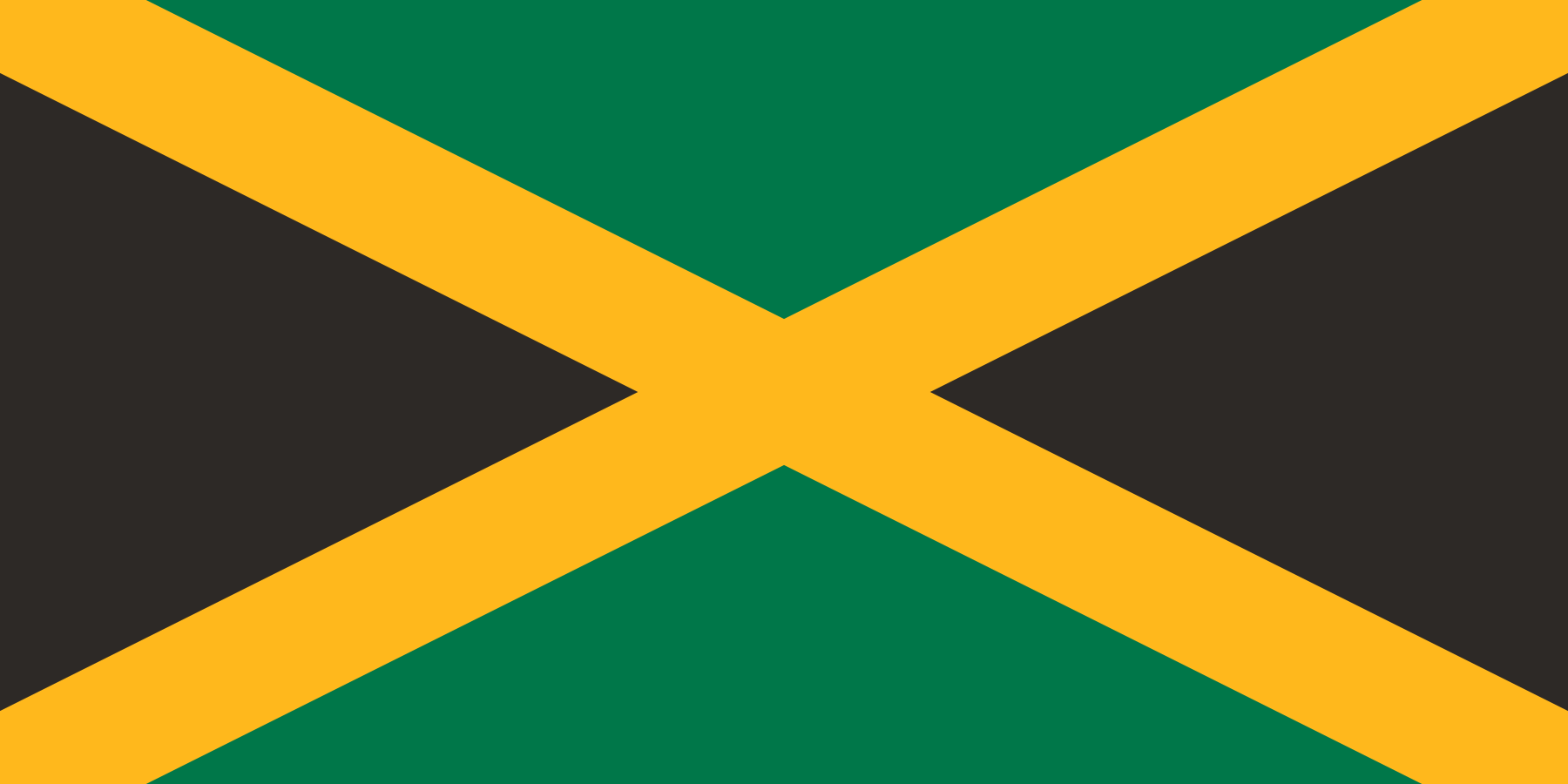
Remember the standard horizontal arrangement: green above and below, black at the sides, and gold across the diagonals.

| Country | JamaicaCaribbean; the national flag is black, green, and gold. |
|---|---|
| Design | Gold saltire and four trianglesGreen above and below; black at the hoist and fly. |
| First raised | August 6, 1962Jamaica’s Independence Day. |
| Proportions | 1:2 height:lengthEquivalent to 2:1 width:height. |
| Colors | Black · Green · GoldSelected digital palette: #2D2926 · #007749 · #FFB81C. |
| Design credit | Bipartisan parliamentary committeeThe official account credits the House of Representatives committee. |
| Emblem | No coat of arms on the flagThe national arms are a separate symbol. |
| Flag emoji | 🇯🇲Regional indicators J + M. |
| Annual occasion | Independence Day — August 6The anniversary of independence and the first raising. |
| Explore | World FlagsDiscover more national flags and their meanings. |
Three colors express the people, land, and promise of Jamaica.
Explore this flag guide
What is the flag of Jamaica?
Jamaica’s national flag has a gold diagonal cross separating four triangles: green above and below, and black at the left and right. It was first raised on August 6, 1962, the country’s Independence Day. The flag is twice as long as it is high and carries no coat of arms.
The gold X is called a saltire. The hoist is the edge attached to the pole, and the fly is the free edge. In the standard horizontal view, black touches both short ends while green touches the long top and bottom edges. Explore more designs in World Flags.
How are the Jamaican flag’s colors arranged?
The Jamaican flag’s gold saltire runs diagonally between the corners and meets at the center. It separates two green triangles along the upper and lower edges from two black triangles at the hoist and fly. The arrangement is fixed; moving the green panels to the sides changes the standard horizontal design.
| Part | Color and position |
|---|---|
| Diagonal cross | Gold; a continuous X between opposite corners |
| Upper and lower triangles | Green |
| Hoist and fly triangles | Black |
| Overall rectangle | 2 units wide for every 1 unit high |
| Extra emblems | No lettering, star, crown, or coat of arms |
What is the Jamaica flag’s ratio?
The Jamaican flag has a 1:2 height-to-length ratio, also written as 2:1 width-to-height. Its long edge is twice its short edge. A flag 90 centimeters high should therefore be 180 centimeters long. Always state the order of the dimensions so the same rectangle is not mistaken for a different format.
A square crop or a 3:2 rectangle does not preserve these proportions. Use uniform scaling to enlarge or reduce the complete flag. If a picture frame has another shape, leave space around the flag rather than stretching it to fill the frame.
What are the Jamaica flag colors and HEX codes?
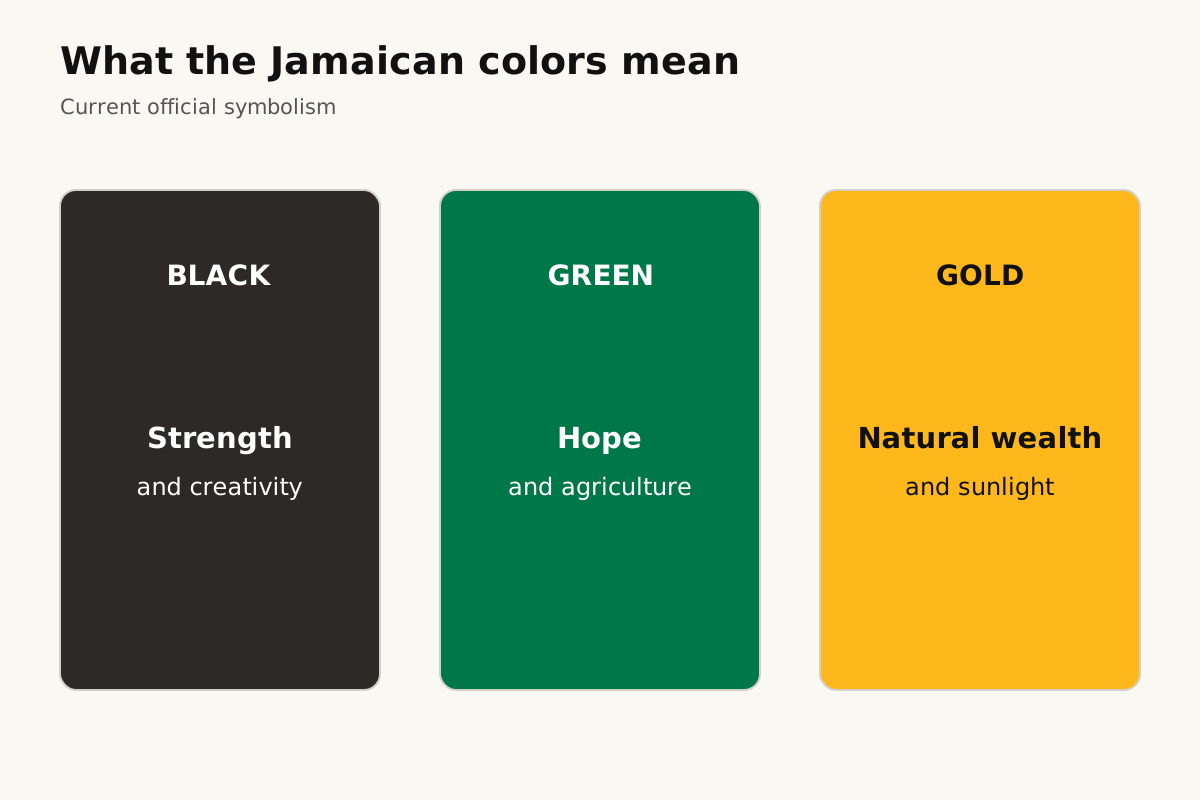
The Jamaican flag’s colors are black, green, and gold. The supplied digital artwork uses black #2D2926, green #007749, and gold #FFB81C. These values identify this image set. Printing specifications use named color references and depend on the material, so a screen color should not be treated as a universal manufacturing standard.
| Color | HEX | RGB | Flag element |
|---|---|---|---|
| Black | #2D2926 | 45, 41, 38 | Side triangles |
| Green | #007749 | 0, 119, 73 | Top and bottom triangles |
| Gold | #FFB81C | 255, 184, 28 | Diagonal cross |
The Jamaica Information Service color table lists Pantone Black C, gold 1235 C or 116 U, and green 3415 C or 3415 U. An Office of the Prime Minister page separately lists gold 109 U and green 355 U. These published tables differ; confirm the required specification for an official print or textile order.
What do black, green, and gold symbolize?
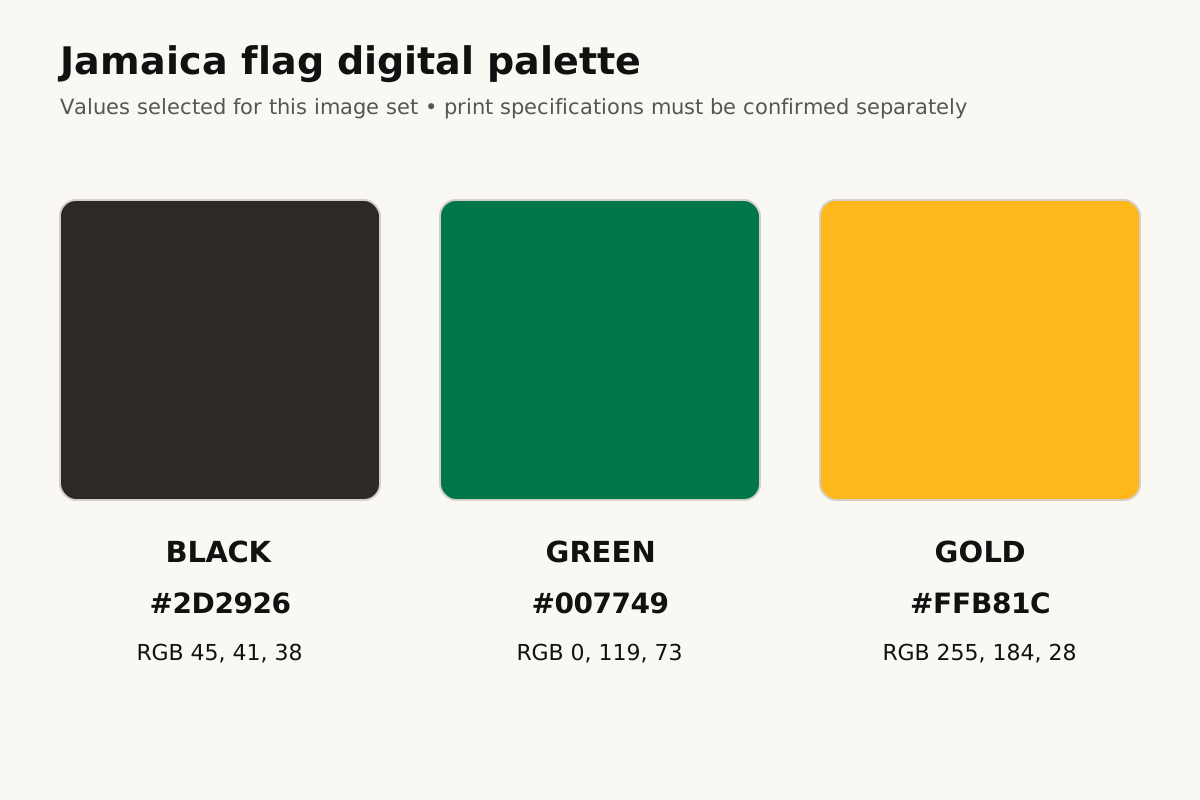
Black represents the strength and creativity of the Jamaican people. Green signifies hope and agricultural resources, while gold represents the country’s natural wealth and the beauty of sunlight. Together, the three colors express the people, land, and promise of Jamaica, rather than three separate regions or political parties.
Why do older sources give a different meaning for black?
Earlier explanations associated black with hardships that Jamaicans had overcome or would face. A 1996 review of national symbols favored a positive interpretation, reflected in today’s official explanation of black as strength and creativity. This changed the interpretation of the color, not the flag’s black-green-gold arrangement or diagonal design.
The National Library of Jamaica places this reconsideration in February 1996 and identifies the review committee chaired by Rex Nettleford. When describing the flag today, use the current meaning. The older explanation remains relevant when discussing the history of its symbolism.
Is the cross gold or yellow?
Official Jamaican descriptions call the cross gold. A digital illustration renders that color with a flat screen tone, which may look yellow or amber on different displays. The name gold does not require a metallic shine, texture, or gradient. For printing, use the color reference agreed for the intended material.
Keep the gold band visibly distinct from green and black. Do not sample its color from a shaded photograph of fabric: lighting, camera processing, and folds all affect the apparent shade. The color table above identifies the exact digital values of the supplied files.
How is the Jamaican flag drawn?
Begin with a rectangle twice as wide as it is high. Place green at the top and bottom and black at the two sides, then separate them with a continuous gold saltire. Keep the diagonals centered and evenly thick. Use the complete reference artwork so the cross and triangles scale together.
The supplied reference uses a 12-by-6 coordinate grid. Its diagonal gold arms have a perpendicular thickness of one grid unit and are clipped to the rectangle. This explains the included vector; it is not a substitute for an institution’s approved production drawing.
A diagonal band’s apparent width along the outer edge differs from its thickness measured at a right angle to the band. Comparing those two measurements directly can produce an unnecessarily thick or thin cross.
Which dimensions preserve the correct flag shape?
A Jamaican flag can be enlarged or reduced while keeping its length exactly twice its height. Examples include 30 by 15 centimeters, 90 by 45 centimeters, and 180 by 90 centimeters. These are calculated size examples, not a mandatory official size catalog; the saltire and triangles must scale with the rectangle.
| Length × height | Ratio | Use |
|---|---|---|
| 30 × 15 cm | 2:1 | Small reference display |
| 90 × 45 cm | 2:1 | Medium flag |
| 180 × 90 cm | 2:1 | Larger flag |
| 1800 × 900 pixels | 2:1 | PNG provided here |

How did the Jamaican flag develop?
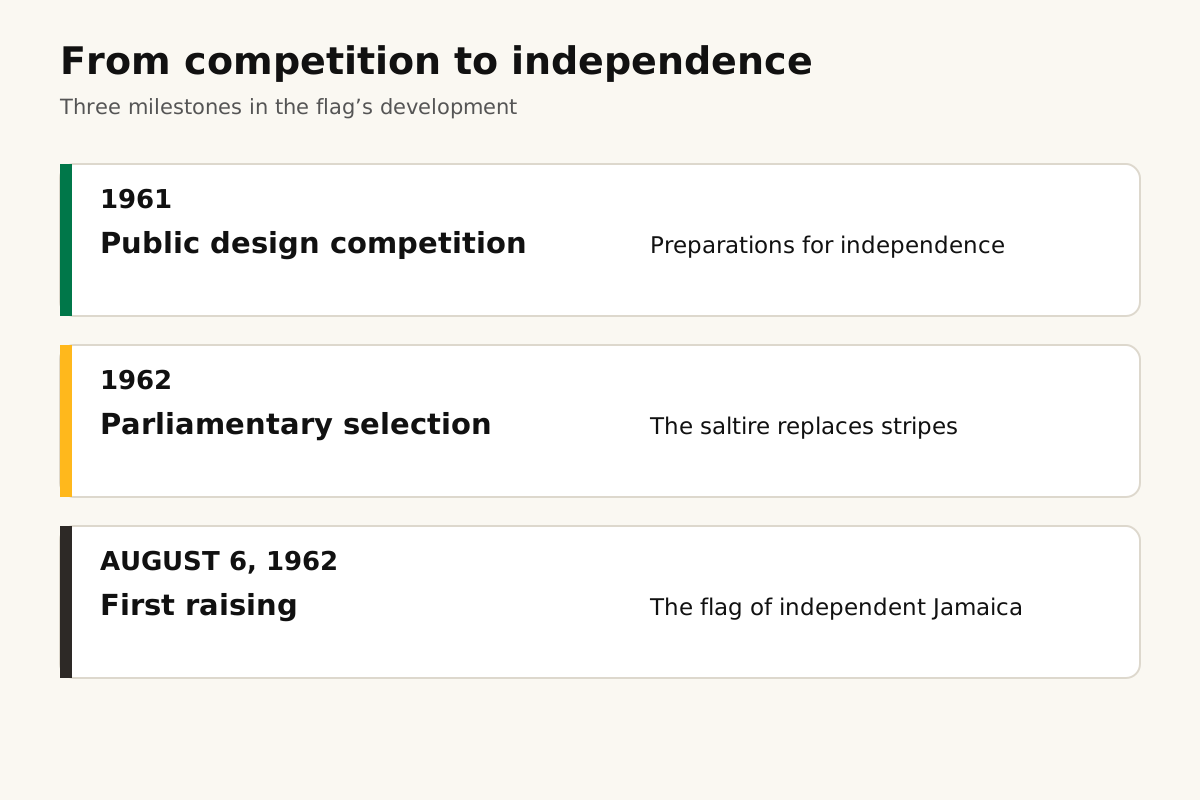
Jamaica organized a national flag competition in 1961 as it prepared for independence. The submitted designs did not produce the final choice, and a bipartisan parliamentary committee developed the flag. A horizontal proposal was replaced by the saltire design, which entered use at independence on August 6, 1962.
Design competition
A public competition forms part of the preparations for independence.
Parliamentary selection
The committee develops the black, green, and gold design, replacing horizontal bands with a saltire.
First raising
The flag is raised for independent Jamaica.
Who designed Jamaica’s national flag?
The Office of the Prime Minister attributes the Jamaican flag’s design to a bipartisan committee of the House of Representatives. The National Library describes the public competition and parliamentary selection process. This institutional attribution is more precise than crediting the entire national design to an unsupported single inventor or competition winner.
Design suggestions, committee decisions, and formal adoption are different stages. An account of one person contributing an idea does not, by itself, establish that the same person designed and approved every feature of the final flag.
Why was an earlier striped proposal changed?
An earlier Jamaican proposal used horizontal bands, but it was considered too similar to the flag of Tanganyika, now part of Tanzania. The final design retained the black, green, and gold color family while using a diagonal cross and triangular panels. The striped proposal should not be labeled the current national flag.
The history concerns a proposal during selection. It does not mean that today’s Jamaican flag is a modified Tanzanian flag. The two countries have their own national histories, and the modern flag of Tanzania is also distinct from the former Tanganyika design.
When was Jamaica’s flag first raised?
The Jamaican national flag was first raised on August 6, 1962, when Jamaica became independent. That date connects the emblem directly with the beginning of the independent nation. August 6 remains the annual Independence Day anniversary; the design competition and committee work occurred before that first official raising.
Use August 6, 1962 for the flag’s introduction in a factbox or historical caption. The 1996 revision of the color interpretation was a later discussion about meaning, not a new independence date or a replacement flag.
Can the Jamaican flag be flown upside down?
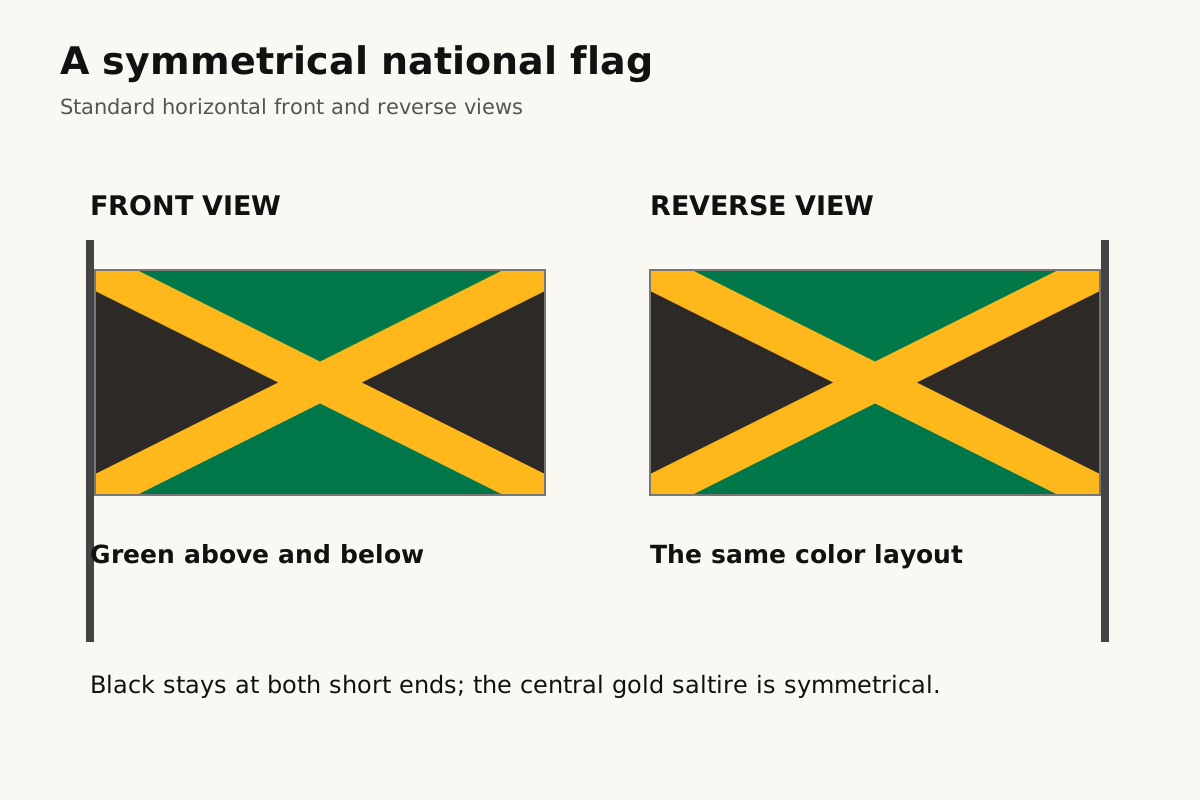
The plain Jamaican design is symmetrical from top to bottom and from left to right. A half-turn or a reverse view preserves its arrangement. In a standard horizontal display, check that green remains above and below and black remains at the sides. A quarter-turn produces a different, portrait-oriented display.
For a special vertical installation, confirm the organizer’s display requirements. A portrait arrangement should be clearly distinguished from the standard horizontal drawing. Added text or unofficial decoration can remove the visual symmetry, which is another reason to keep the national flag plain.
Where should the Jamaican flag be flown?
Jamaican guidance calls for the flag at government and municipal buildings and offices, generally on or near the main administrative building. It also provides for government-aided schools while in session and flag display at polling stations on election day. These are defined institutional uses, with their own practical arrangements.
Independence celebrations are a prominent occasion for display, but the flag is not limited to one annual day. Institutions should use the relevant flag code and any event-specific directions when arranging an installation.
What guidance applies to flags at Jamaican schools?
The flag should be flown at government-aided Jamaican schools while school is in session. Official guidance also describes special raising and lowering ceremonies at the beginning and end of each term, with the school pledge on those occasions. Schools may organize an additional ceremony for the anniversary of independence.
A school ceremony gives pupils a way to learn the flag’s meaning and respectful handling. The institution should arrange the flag, participants, and program in advance. A classroom illustration is a learning resource; the physical ceremony follows the school’s own implementation of the code.
When should the flag be raised and lowered?
For public buildings, Jamaican guidance recommends raising the flag at 8 a.m. and lowering it at sunset where possible. The National Library also describes night display when the flag is clearly illuminated by a focused light. Follow the applicable institution’s arrangements rather than assuming one schedule covers every setting.
Lighting should make the flag visible without changing its colors. Check the mounting and weather conditions as part of routine care. A special mourning instruction may add dates or procedures to the normal display schedule.
How is the Jamaican flag flown at half-mast?
Jamaican mourning guidance places the flag about one flag-height below the top of the pole, rather than halfway down the mast. First raise it to the peak, then lower it to the mourning position. Raise it to the peak again before taking it down, following the relevant official instruction.

The Office of the Prime Minister declares official mourning and determines its period. The diagram explains the general positioning rule and does not announce a current mourning order. An old dated notice should not be treated as an instruction still in effect.
Where should Jamaica’s flag stand among other flags?
Jamaican guidance gives the national flag the position of honor and says it should not be smaller than another flag displayed with it. The right-hand position is described from the building looking outward, which is the viewer’s left when facing the building. Foreign diplomatic premises have stated exceptions.
Identify the viewing direction before arranging the poles. International displays also require attention to equal national dignity; the National Library notes the peacetime convention against placing one country’s flag above another. The organizer should plan the complete arrangement before the flags are raised.
How should people behave during a flag ceremony?
The Jamaican flag code directs people to face the flag and stand at attention during raising or lowering, or when it passes in a parade or review. Uniformed participants salute, and the published guidance tells men to remove their hats. The flag should be handled carefully and kept off the ground.
For a procession, the code places the national flag on the marching right alongside other flags, or in front of the center of a line of flags. The marching right is the participants’ right, which may look like the opposite side to a spectator facing them.
Can the Jamaican flag be displayed on a private building?
The published Jamaican code permits flag display on private buildings for national and state occasions. It also specifies display during official visits by the Governor-General or Prime Minister. Respectful private display should preserve the complete design and follow the relevant handling and positioning guidance for the particular occasion.
Choose a secure mounting and a flag appropriate to the available space. Displaying the national colors as a decorative scheme is different from reproducing the national flag itself. If an event needs a formal protocol decision, the Office of the Prime Minister is the identified authority.
Can the flag be draped over vehicles or used on clothing?
Jamaican guidance restricts draping the national flag over vehicles to military, police, and state occasions. It also advises against using the flag as decorative patches or adornments on clothing and headgear. Wearing the national colors is a different question from using the complete flag as a disposable or decorative object.
The code separately provides for certain official vehicles and representations on government-owned transport. These specific uses should not be treated as permission to copy every possible flag decoration onto a private vehicle or product.
Does Jamaica’s flag include a coat of arms?
Jamaica’s ordinary national flag does not contain its coat of arms, a crocodile, lettering, or another central emblem. The arms are a separate national symbol. A seal, institutional badge, or special official flag should be identified separately instead of being added to the plain black, green, and gold national design.
The downloadable SVG and PNG therefore contain only the saltire and four colored panels. Captions and explanatory labels sit outside the flag in the diagrams; the plain flag files do not include a watermark or caption.
How should the Jamaican flag be prepared for printing?
Use a complete vector master when the flag needs to scale, and preserve its 2:1 width-to-height ratio. Keep the saltire centered, the green panels above and below, and the black panels at the sides. Confirm the intended print colors and material, then inspect a proof before producing the finished items.
The PNG supplied here is 1800 × 900 pixels. At 300 pixels per inch, it gives a 6 × 3 inch image without enlargement. The SVG can scale to larger sizes. Hem allowances and pole sleeves should not distort the visible rectangle or clip away part of the design.
What should be checked before reproducing the flag on products?
The Jamaican flag code calls for official sanction from the Office of the Prime Minister before using an image or representation of the national flag. Its Chancery and Protocol Division handles permission for national symbols. A downloadable drawing does not itself provide that authorization or determine whether a proposed product is acceptable.
For a commercial design or trademark application, confirm the proposed use with the relevant Jamaican authority. The public-domain status of simple flag geometry and the national rules about how the emblem may be used address different questions.
How should a Jamaican flag be cared for and retired?
Keep the flag clean, dry, securely fastened, and clear of the ground. Replace cloth that is torn, badly faded, or otherwise unsuitable for display. Jamaican guidance calls for dignified retirement and identifies private burning as a preferred method; an institution should arrange appropriate handling rather than repurposing a worn flag.
Follow the fabric manufacturer’s cleaning instructions and dry the flag before storage. Inspect seams and fittings after bad weather. The reference material reviewed here does not establish one compulsory everyday folding sequence, so a decorative fold should not be presented as a national rule.
What is the Jamaica flag emoji?
The Jamaica flag emoji is 🇯🇲. It combines the regional indicator symbols for J and M, encoded as U+1F1EF and U+1F1F2. Its appearance depends on the device and font; some systems display letters instead. For a precise flag illustration or print master, use the supplied SVG or PNG rather than an emoji.
| Item | Value |
|---|---|
| Emoji | 🇯🇲 |
| Country-code letters | J + M |
| Unicode code points | U+1F1EF U+1F1F2 |
| Accessible description | Flag of Jamaica: gold saltire, green top and bottom, black sides |
Which Jamaican flag mistakes should be avoided?
Common mistakes include placing green at the sides in a horizontal image, stretching the rectangle, adding a coat of arms, or drawing uneven gold diagonals. Other errors are treating an old explanation of black as the current meaning, confusing half-mast with the pole’s midpoint, and assuming screen colors are exact textile specifications.
Keep the design accurate
- Length twice the height.
- Green above and below.
- Black at both short ends.
- A continuous, centered gold saltire.
- No added emblem or lettering.
Keep the context clear
- Use the current positive meaning of black.
- State whether ratios begin with height or length.
- Follow Jamaican mourning guidance.
- Confirm printing and reproduction requirements.
- Distinguish a historical proposal from the adopted flag.
Which Jamaica flag pictures can be downloaded?
The download set includes a plain Jamaican flag in SVG and 1800-by-900-pixel PNG formats, plus illustrations of construction, colors, symbolism, history, orientation, half-mast display, and sizes. The plain flag contains no labels. The diagrams add explanatory text outside the design and have individual download links in the picture gallery.
| Download | Format | Purpose |
|---|---|---|
| Plain Jamaica flag | SVG | Scalable flag artwork |
| Jamaica flag, 1800 × 900 | PNG | Opaque raster image |
| Jamaica flag picture gallery | SVG | Eight flag and diagram subjects |
Choose the plain flag for a clean reference and the diagrams for explanations. Each gallery caption describes what is shown, including any measurements or schematic display elements that are not part of the national flag.
Jamaica flag pictures
A gold saltire separates green top and bottom triangles from black side triangles. The rectangle is twice as wide as it is high.
GKBook rendering; underlying simple flag geometry, public domain.Download image
The downloadable reference uses a 12-by-6 grid, with one-unit perpendicular gold strokes clipped to the outer rectangle.
Original GKBook explanatory illustration.Download image
The selected digital colors are black #2D2926, green #007749, and gold #FFB81C. This is an image palette, not a universal textile color standard.
Original GKBook explanatory illustration.Download image
Black represents the strength and creativity of the people, green hope and agriculture, and gold natural wealth and sunlight. Labels are explanatory additions.
Original GKBook explanatory illustration.Download image
A 1961 competition preceded parliamentary design work in 1962. The adopted flag was first raised on August 6, 1962.
Original GKBook explanatory illustration.Download image
The plain Jamaican flag has the same layout from front and back: green above and below, black at both short ends, and a centered gold saltire.
Original GKBook explanatory illustration.Download image
Leave approximately one flag-height below the masthead. The schematic illustrates general Jamaican guidance and is not a current mourning order.
Original GKBook explanatory illustration.Download image
A 30 × 15 cm, 90 × 45 cm, or 180 × 90 cm flag preserves the same shape. These calculated examples are not an official size catalog.
Original GKBook explanatory illustration.Download imageFrequently asked questions
What is the flag of Jamaica?
Jamaica’s national flag has a gold diagonal cross separating four triangles: green above and below, and black at the left and right. It was first raised on August 6, 1962, the country’s Independence Day. The flag is twice as long as it is high and carries no coat of arms.
How are the Jamaican flag’s colors arranged?
The Jamaican flag’s gold saltire runs diagonally between the corners and meets at the center. It separates two green triangles along the upper and lower edges from two black triangles at the hoist and fly. The arrangement is fixed; moving the green panels to the sides changes the standard horizontal design.
What is the Jamaica flag’s ratio?
The Jamaican flag has a 1:2 height-to-length ratio, also written as 2:1 width-to-height. Its long edge is twice its short edge. A flag 90 centimeters high should therefore be 180 centimeters long. Always state the order of the dimensions so the same rectangle is not mistaken for a different format.
What are the Jamaica flag colors and HEX codes?
The Jamaican flag’s colors are black, green, and gold. The supplied digital artwork uses black #2D2926, green #007749, and gold #FFB81C. These values identify this image set. Printing specifications use named color references and depend on the material, so a screen color should not be treated as a universal manufacturing standard.
What do black, green, and gold symbolize?
Black represents the strength and creativity of the Jamaican people. Green signifies hope and agricultural resources, while gold represents the country’s natural wealth and the beauty of sunlight. Together, the three colors express the people, land, and promise of Jamaica, rather than three separate regions or political parties.
Why do older sources give a different meaning for black?
Earlier explanations associated black with hardships that Jamaicans had overcome or would face. A 1996 review of national symbols favored a positive interpretation, reflected in today’s official explanation of black as strength and creativity. This changed the interpretation of the color, not the flag’s black-green-gold arrangement or diagonal design.
Is the cross gold or yellow?
Official Jamaican descriptions call the cross gold. A digital illustration renders that color with a flat screen tone, which may look yellow or amber on different displays. The name gold does not require a metallic shine, texture, or gradient. For printing, use the color reference agreed for the intended material.
How is the Jamaican flag drawn?
Begin with a rectangle twice as wide as it is high. Place green at the top and bottom and black at the two sides, then separate them with a continuous gold saltire. Keep the diagonals centered and evenly thick. Use the complete reference artwork so the cross and triangles scale together.
Which dimensions preserve the correct flag shape?
A Jamaican flag can be enlarged or reduced while keeping its length exactly twice its height. Examples include 30 by 15 centimeters, 90 by 45 centimeters, and 180 by 90 centimeters. These are calculated size examples, not a mandatory official size catalog; the saltire and triangles must scale with the rectangle.
How did the Jamaican flag develop?
Jamaica organized a national flag competition in 1961 as it prepared for independence. The submitted designs did not produce the final choice, and a bipartisan parliamentary committee developed the flag. A horizontal proposal was replaced by the saltire design, which entered use at independence on August 6, 1962.
Who designed Jamaica’s national flag?
The Office of the Prime Minister attributes the Jamaican flag’s design to a bipartisan committee of the House of Representatives. The National Library describes the public competition and parliamentary selection process. This institutional attribution is more precise than crediting the entire national design to an unsupported single inventor or competition winner.
Why was an earlier striped proposal changed?
An earlier Jamaican proposal used horizontal bands, but it was considered too similar to the flag of Tanganyika, now part of Tanzania. The final design retained the black, green, and gold color family while using a diagonal cross and triangular panels. The striped proposal should not be labeled the current national flag.
When was Jamaica’s flag first raised?
The Jamaican national flag was first raised on August 6, 1962, when Jamaica became independent. That date connects the emblem directly with the beginning of the independent nation. August 6 remains the annual Independence Day anniversary; the design competition and committee work occurred before that first official raising.
Can the Jamaican flag be flown upside down?
The plain Jamaican design is symmetrical from top to bottom and from left to right. A half-turn or a reverse view preserves its arrangement. In a standard horizontal display, check that green remains above and below and black remains at the sides. A quarter-turn produces a different, portrait-oriented display.
Where should the Jamaican flag be flown?
Jamaican guidance calls for the flag at government and municipal buildings and offices, generally on or near the main administrative building. It also provides for government-aided schools while in session and flag display at polling stations on election day. These are defined institutional uses, with their own practical arrangements.
What guidance applies to flags at Jamaican schools?
The flag should be flown at government-aided Jamaican schools while school is in session. Official guidance also describes special raising and lowering ceremonies at the beginning and end of each term, with the school pledge on those occasions. Schools may organize an additional ceremony for the anniversary of independence.
When should the flag be raised and lowered?
For public buildings, Jamaican guidance recommends raising the flag at 8 a.m. and lowering it at sunset where possible. The National Library also describes night display when the flag is clearly illuminated by a focused light. Follow the applicable institution’s arrangements rather than assuming one schedule covers every setting.
How is the Jamaican flag flown at half-mast?
Jamaican mourning guidance places the flag about one flag-height below the top of the pole, rather than halfway down the mast. First raise it to the peak, then lower it to the mourning position. Raise it to the peak again before taking it down, following the relevant official instruction.
Where should Jamaica’s flag stand among other flags?
Jamaican guidance gives the national flag the position of honor and says it should not be smaller than another flag displayed with it. The right-hand position is described from the building looking outward, which is the viewer’s left when facing the building. Foreign diplomatic premises have stated exceptions.
How should people behave during a flag ceremony?
The Jamaican flag code directs people to face the flag and stand at attention during raising or lowering, or when it passes in a parade or review. Uniformed participants salute, and the published guidance tells men to remove their hats. The flag should be handled carefully and kept off the ground.
Can the Jamaican flag be displayed on a private building?
The published Jamaican code permits flag display on private buildings for national and state occasions. It also specifies display during official visits by the Governor-General or Prime Minister. Respectful private display should preserve the complete design and follow the relevant handling and positioning guidance for the particular occasion.
Can the flag be draped over vehicles or used on clothing?
Jamaican guidance restricts draping the national flag over vehicles to military, police, and state occasions. It also advises against using the flag as decorative patches or adornments on clothing and headgear. Wearing the national colors is a different question from using the complete flag as a disposable or decorative object.
Does Jamaica’s flag include a coat of arms?
Jamaica’s ordinary national flag does not contain its coat of arms, a crocodile, lettering, or another central emblem. The arms are a separate national symbol. A seal, institutional badge, or special official flag should be identified separately instead of being added to the plain black, green, and gold national design.
How should the Jamaican flag be prepared for printing?
Use a complete vector master when the flag needs to scale, and preserve its 2:1 width-to-height ratio. Keep the saltire centered, the green panels above and below, and the black panels at the sides. Confirm the intended print colors and material, then inspect a proof before producing the finished items.
What should be checked before reproducing the flag on products?
The Jamaican flag code calls for official sanction from the Office of the Prime Minister before using an image or representation of the national flag. Its Chancery and Protocol Division handles permission for national symbols. A downloadable drawing does not itself provide that authorization or determine whether a proposed product is acceptable.
How should a Jamaican flag be cared for and retired?
Keep the flag clean, dry, securely fastened, and clear of the ground. Replace cloth that is torn, badly faded, or otherwise unsuitable for display. Jamaican guidance calls for dignified retirement and identifies private burning as a preferred method; an institution should arrange appropriate handling rather than repurposing a worn flag.
What is the Jamaica flag emoji?
The Jamaica flag emoji is 🇯🇲. It combines the regional indicator symbols for J and M, encoded as U+1F1EF and U+1F1F2. Its appearance depends on the device and font; some systems display letters instead. For a precise flag illustration or print master, use the supplied SVG or PNG rather than an emoji.
Which Jamaican flag mistakes should be avoided?
Common mistakes include placing green at the sides in a horizontal image, stretching the rectangle, adding a coat of arms, or drawing uneven gold diagonals. Other errors are treating an old explanation of black as the current meaning, confusing half-mast with the pole’s midpoint, and assuming screen colors are exact textile specifications.
Which Jamaica flag pictures can be downloaded?
The download set includes a plain Jamaican flag in SVG and 1800-by-900-pixel PNG formats, plus illustrations of construction, colors, symbolism, history, orientation, half-mast display, and sizes. The plain flag contains no labels. The diagrams add explanatory text outside the design and have individual download links in the picture gallery.
Does Jamaica’s national flag have red, white, or blue?
No. Jamaica’s national flag uses black, green, and gold. Red, white, and blue are not part of its plain design. A flag-themed product may add other colors, but that does not change the national flag. Use the complete three-color reference when identifying or illustrating the Jamaican emblem.
What is a saltire on a flag?
A saltire is a diagonal cross shaped like an X. On Jamaica’s flag, it is gold and separates the four triangular panels. It differs from an upright cross, whose arms run vertically and horizontally. The flag’s saltire should remain centered and scale evenly with the complete rectangle.
Did Jamaica change its flag in 1996?
The national design did not change in 1996. The review concerned the interpretation of its colors, particularly the earlier association of black with hardship. Current official explanations emphasize the strength and creativity of the people. The familiar gold saltire, green upper and lower triangles, and black sides remained.
Are the plain flag downloads transparent?
No. The supplied PNG is an opaque image, and the SVG fills the complete flag rectangle. The black panels are a deliberate part of the design rather than transparent spaces. The files do not include a background outside the rectangle, extra symbols, a watermark, or explanatory labels.
Explore all general-knowledge topics and the A-to-Z lists.


We Value Your Opinion Comments