
Italy flag picture
Explore the construction sheet, naval ensigns, and 1797 origin.
| Design | Green · white · redThree equal vertical bands; green at the hoist. |
|---|---|
| Proportion | 3:2 width:heightAlso written 2:3 when height is listed first. |
| Emblem | None on the national flagRoyal and maritime devices belong to distinct versions. |
| Tricolor origin | January 7, 1797Cispadane parliament at Reggio Emilia. |
| Republican design | June 19, 1946Plain flag provisionally established without the Savoy shield. |
| Constitution | Article 12 · effective January 1, 1948Green, white, red; equal vertical bands. |
| Textile colors | 17-6153 · 11-0601 · 18-1662Official Pantone textile references; digital files use their stated palette. |
| Flag Day | January 7Festa del Tricolore; a non-holiday observance. |
| Republic Day | June 2Public holiday commemorating the 1946 referendum. |
The national flag is a plain 3:2 rectangle with three equal vertical bands. Its colors developed through eighteenth-century revolutionary and military traditions; the republican design removed the royal shield in 1946. The meanings below distinguish historical roots from later patriotic interpretations.
What does Italy’s flag look like?
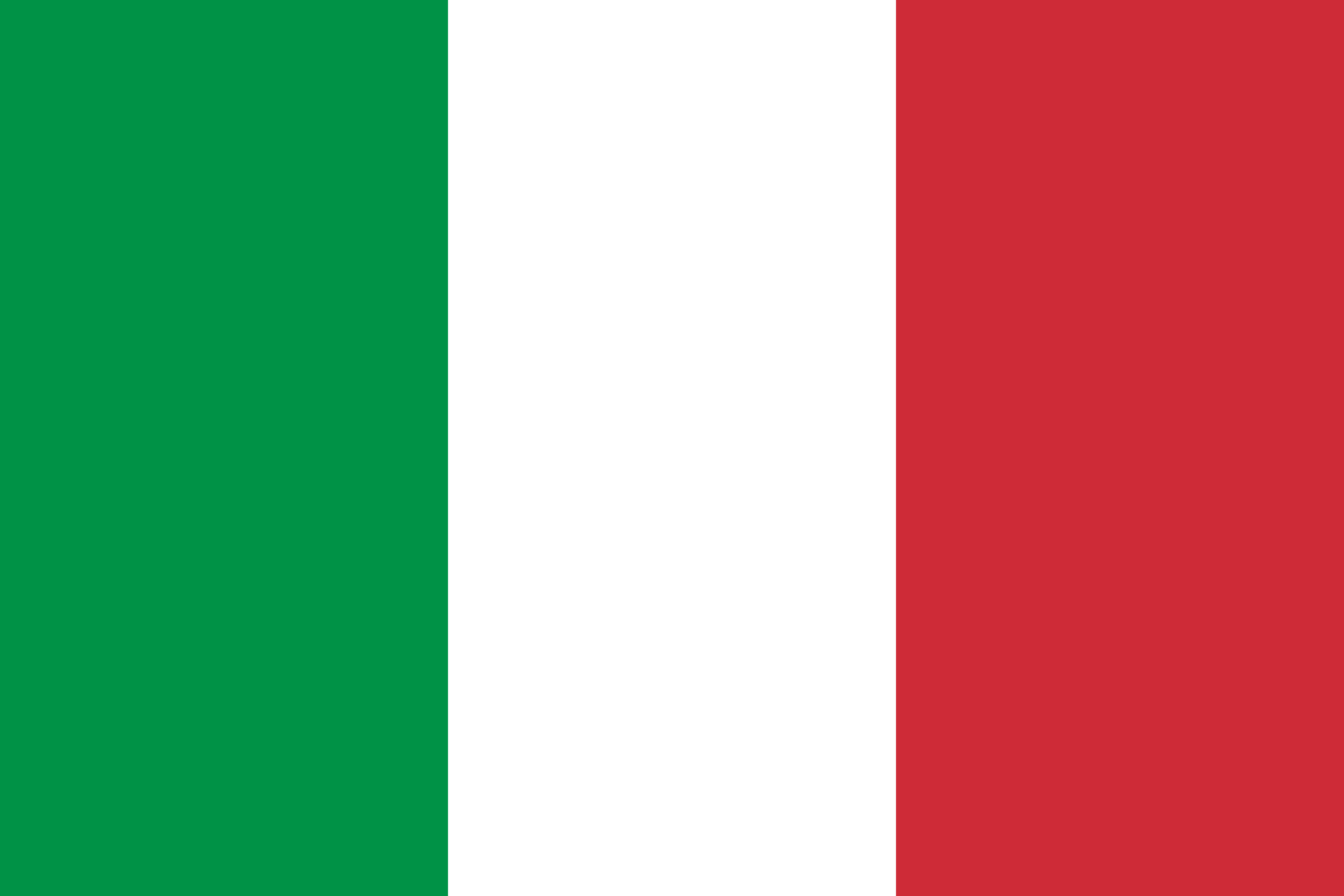
Italy’s national flag has three equal vertical bands: green beside the staff, white in the middle, and red at the free edge. The standard rectangle has a 3:2 width-to-height ratio. Known as il Tricolore, it carries no coat of arms, crown, star, lettering, or other central emblem.
The Italian name il Tricolore means “the tricolor.” In a conventional front view, with the staff on the left, the colors read green, white, red. The bands extend to all four edges; the white area is a stripe, not a shield or a border.
Why does Italy’s national flag have no coat of arms?
The present republican flag is a plain tricolor. The Savoy shield belonged to the royal flag and disappeared with the republican design established in June 1946. Italy also has a separate state emblem and several flags for specific official uses. Their symbols should not be added to an ordinary national flag.
The white band stays plain
Article 12 of the Constitution identifies three equal vertical bands and does not place a device in the white stripe. The national flag can therefore be recognized without an inscription or a badge. A crowned shield indicates a historical royal version; a quartered maritime shield indicates an ensign.
The emblem of the Republic, designed by Paolo Paschetto and established in 1948, contains a star, a cogwheel, olive and oak branches, and a ribbon. It is a different state symbol, discussed below.
What are Italy’s flag colors and their color codes?
Italy’s flag is green, white, and red. Official textile references are Pantone 17-6153, 11-0601, and 18-1662 respectively. The downloadable digital flag uses #009246, #FFFFFF, and #CE2B37. These HEX values describe the supplied artwork; they are not an assertion that the official textile specification mandates identical values on every screen.
| Color | Official textile reference | HEX in these files | RGB in these files |
|---|---|---|---|
| Green | 17-6153 | #009246 | 0, 146, 70 |
| White | 11-0601 | #FFFFFF | 255, 255, 255 |
| Red | 18-1662 | #CE2B37 | 206, 43, 55 |
Article 31 of the April 14, 2006 ceremonial decree specifies textile color references on polyester bunting. The government’s guide explains that other fabrics should produce the same chromatic result. A photograph, web image, or office printer is not a substitute for the approved physical reference.
Pantone textile numbers are not Pantone Solid Coated ink numbers. Converting a textile reference to RGB or CMYK depends on the color system, profile, substrate, and production process. No supposedly universal CMYK recipe is assigned here.
What do the green, white, and red colors mean?
The colors have historical roots in northern Italy: white and red appeared in Milan’s civic arms, while green was associated with its civic guard. Later writers gave the colors patriotic and moral meanings. Those interpretations enrich the flag’s cultural history, but Article 12 does not assign a separate official virtue to each stripe.
The Presidency traces the colors through military units formed during the Napoleonic campaigns. The Lombard Legion used green, white, and red; the Italian Legion recruited in Emilia and Romagna used them too. This institutional history is stronger evidence for the choice of colors than a modern mnemonic about scenery.
A 2006 presidential Flag Day message recalled Giosuè Carducci’s 1897 centenary speech: green was linked with nature and freedom, white with victory and prudence, and red with daring and valor. These are patriotic readings, not a color dictionary enacted by the Constitution.
Popular explanations involving hope, faith, charity, plains, Alpine snow, or the blood of patriots should likewise be identified as interpretations. They do not replace the documented history of the tricolor or establish manufacturing rules.
What is the aspect ratio of Italy’s flag?
Italy’s national flag has a 3:2 width-to-height ratio: its length is one and a half times its height. A source that lists height first writes 2:3. The three vertical bands have equal widths, so each band occupies one third of the total flag area. Proportional scaling preserves the complete design.
| Width | Height | Each band’s width |
|---|---|---|
| 150 cm | 100 cm | 50 cm |
| 300 cm | 200 cm | 100 cm |
| 450 cm | 300 cm | 150 cm |
| 3000 pixels | 2000 pixels | 1000 pixels |
| 6000 pixels | 4000 pixels | 2000 pixels |
Article 12 supplies the equal-band arrangement; government protocol guidance supplies the ordinary rectangular proportion. Do not describe a 2:1 image as the standard Italian national flag or stretch a 3:2 image to fit a different slot. Keep the flag proportional within the available space.
How can Italy’s flag be drawn accurately?
Draw a rectangle three units wide and two units high. Divide its width into three equal parts with vertical lines. Fill the first third green, the middle third white, and the final third red, with green at the hoist. Do not add outlines between the stripes or place a symbol in the center.
For the supplied 3000×2000 SVG, the green band occupies x=0–1000, white x=1000–2000, and red x=2000–3000. The same calculation works at any size: if the width is W, the height is 2W/3 and each stripe is W/3 wide.
An explanatory sheet may show guides, labels, and a thin boundary so white remains visible on a white page. Those teaching marks are outside the clean master. The downloadable national flag itself has no border, shadows, waves, or transparent holes.
Are there official examples of Italian flag sizes?
Government protocol guidance gives ordinary outdoor examples of 300×200 or 450×300 centimeters, and an indoor example of 150×100 centimeters. It presents them as practical size guidance, not a single compulsory dimension for every setting. All three examples preserve the national 3:2 ratio and keep the three colored bands equal.
| Setting | Flag size, width × height | Staff example in government guidance |
|---|---|---|
| Outdoor | 300×200 or 450×300 cm | 4 m balcony staff or 8 m ground pole |
| Indoor | 150×100 cm | 250 cm indoor staff |
A small desk flag and a large outdoor flag can both preserve the national geometry. Space, viewing distance, wind exposure, and the safety of the mounting affect the practical choice. Specialized military and maritime equipment may have separate specifications.
How did Italy’s flag develop over time?
Italy’s tricolor developed from revolutionary cockades and military colors into the Cispadane flag of 1797, a symbol of the Risorgimento, and the royal flag of united Italy. The republican design removed the Savoy shield in 1946. Constitutional confirmation, specialized maritime ensigns, public-display rules, and textile color standards followed in separate stages.
Tricolor cockades
Students involved in the Bologna revolutionary movement wore tricolor cockades. The government’s historical guide treats these as a precursor; a cockade is not the same object as the later rectangular national flag.
Military colors in northern Italy
The Lombard and Italian Legions used green, white, and red amid the Napoleonic campaigns. The tricolor arrangement drew on the revolutionary French model, while the chosen colors had local associations.
The Cispadane vote at Reggio Emilia
On Giuseppe Compagnoni’s proposal, the Cispadane parliament adopted the three colors for its flag and cockade. The early flag had horizontal red, white, and green bands and a republican emblem.
A square Napoleonic land flag
The Napoleonic Italian Republic used the red-square, white-diamond, green-square arrangement. Its design later inspired the presidential standard; it was not the present Italian Republic.
A symbol of the Risorgimento
The tricolor became associated with the movements for Italian liberty and national unity. Its meaning increasingly reached beyond individual ruling houses and regional states.
The Savoy shield on the tricolor
Carlo Alberto announced that his troops would carry the Savoy shield on the Italian tricolor. A blue border separated the red shield and white cross from the flag’s red and white bands.
The Kingdom of Italy
The new kingdom continued the Savoy tricolor by custom. The Presidency notes that the absence of a general statutory model led to variations in actual flags.
National and state models distinguished
The rules distinguished the national flag with the Savoy shield from the state flag with a royal crown above it. Royal residences, Parliament, government offices, and diplomatic premises used the state model.
The plain republican flag
Following the institutional referendum, a legislative decree established the provisional republican flag without the royal shield. This is separate from both the 1797 origin and the later constitutional guarantee.
Constitutional confirmation
The Constituent Assembly approved the flag wording on March 24, 1947. Article 12 became part of the Constitution, which entered into force on January 1, 1948.
Distinct maritime ensigns
A November 9 decree introduced the Navy and merchant ensigns, each using the maritime republics’ emblems. These special-use flags did not add a coat of arms to the ordinary national flag.
Flag Day, display rules, and textile colors
The 1996 law established January 7 Flag Day. The 1998 law and 2000 regulations organized public display, and the 2006 decree defined textile color references. Each measure addresses a different aspect of the national symbol.
Where and when did Italy’s national tricolor originate?
Italy traces the national tricolor’s birth to Reggio Emilia on January 7, 1797, when the parliament of the Cispadane Republic approved green, white, and red on Giuseppe Compagnoni’s proposal. That early flag had horizontal bands and a central emblem. The anniversary celebrates the national colors’ adoption, not an unchanged modern layout.
The original republican emblem described by the Presidency had a quiver containing four arrows, surrounded by laurel and a trophy of arms. The complete emblem is retained in the reconstruction shown here; it has not been replaced with a generic badge.
Earlier cockades and military standards explain why the 1797 decision did not emerge from nothing. Reggio Emilia’s parliamentary adoption gave the colors a national political role. The common label “first tricolor” refers to that context, not a claim that no earlier green, white, or red fabric existed.
Who designed Italy’s flag?
No single person designed every stage of Italy’s flag. Giuseppe Compagnoni proposed the Cispadane parliament’s adoption of the tricolor in 1797 and is closely associated with its national birth. Earlier military and civic traditions supplied the colors. Later political and constitutional decisions produced the plain vertical flag of the present republic.
Calling Compagnoni the father of the tricolor recognizes a documented political initiative. It does not mean that he invented the three colors, personally sewed every early flag, or specified the digital artwork used today.
The Savoy shield entered through Carlo Alberto’s 1848 decision. Its removal followed the establishment of the republic. Paolo Paschetto designed the separate republican emblem; he should not be credited as the designer of the plain national tricolor.
Was there a different Italian flag during the Napoleonic period?
Yes. The Napoleonic Italian Republic of 1802–1805 used a land flag with a red square, a white diamond, and a green square in the center. It retained the three national colors in a different arrangement. This historical design later inspired Italy’s presidential standard, but it is not the current national flag.
The Napoleonic Italian Republic and the republic established after the 1946 referendum are different states in different periods. The earlier republic was followed by the Napoleonic Kingdom of Italy. The succession of these regimes helps explain why historical Italian flags do not all have today’s three vertical bands.
The image is a modern reconstruction of the land flag. Maritime flags and military standards of the period could differ; a single square illustration should not be treated as every flag flown across Napoleonic Italy.
What did Italy’s flag look like under the monarchy?
The royal tricolor carried the Savoy shield: a white cross on a red shield outlined in blue. A crowned state version also existed. The 1925 rules distinguished the national model from the state model used at specified royal and government premises. These historical emblems disappeared from the plain republican national flag in 1946.
The blue edging had a practical visual purpose. Without it, parts of the white cross and red shield could merge into the adjacent white and red areas of the flag. The Presidency dates the tricolor-and-shield decision to Carlo Alberto’s proclamation of March 23, 1848.
The royal national flag continued through the kingdom’s later political history, including the Fascist period. Party flags, specialized military flags, and the flags of competing wartime authorities should not be conflated with one supposedly universal “Fascist flag of Italy.” The two reconstructions here identify their particular royal uses.
When was the current Italian flag adopted?
The plain republican flag was established provisionally by a legislative decree of June 19, 1946. The Constituent Assembly confirmed the flag wording on March 24, 1947, and Article 12 entered into force with the Constitution on January 1, 1948. These dates concern the modern republic, while January 7, 1797 marks the tricolor’s earlier national origin.
| Date | What it marks |
|---|---|
| January 7, 1797 | Cispadane adoption of the national tricolor |
| June 2, 1946 | Institutional referendum commemorated by Republic Day |
| June 19, 1946 | Provisional republican flag established |
| March 24, 1947 | Constituent Assembly approves flag wording |
| January 1, 1948 | Constitution, including Article 12, enters into force |
The constitutional description preserves the three colors and equal vertical bands. It does not prescribe a central republican emblem. Confusing the date of the referendum, the provisional decree, the Assembly vote, and the Constitution’s effective date produces misleading adoption summaries.
What should a maker preserve when producing an Italian flag?
A maker should preserve the 3:2 rectangle, equal vertical bands, green hoist, white center, and red fly. Official textile references guide the colors of cloth, while the government’s ordinary size examples help with planning. Suitable fabric, sound seams, and secure attachments support dignified display without changing the visible national design.
The 2006 color provision refers to polyester bunting and requires equivalent chromatic results when other fabrics are used. Agree a physical reference and suitable production process for textile work. The SVG is a precise geometric starting point, not a certification of dye, ink, or fabric matching.
Printed and sewn flags can both represent the design. Keep manufacturing allowances, sleeves, and reinforcements from visibly narrowing one color band. Select materials for their intended exposure and follow the maker’s cleaning instructions; no invented universal weave, thread count, or weather rating is imposed here.
Is Italy’s state emblem the same as its flag?
No. Italy’s state emblem is a separate design with a white star edged in red, a steel cogwheel, olive and oak branches, and a ribbon naming the republic. Paolo Paschetto designed it, and a decree established it on May 5, 1948. The ordinary national flag remains the plain green, white, and red tricolor.
The Presidency explains the olive branch as a wish for peace and the oak as strength and dignity. The cogwheel represents work, while the star belongs to the long iconographic tradition of Italy. Those meanings belong to the emblem; they are not secret devices hidden in the flag’s three stripes.
Official stationery, buildings, seals, and special standards can display the emblem. Its existence does not authorize adding it to the center of every national tricolor. Keep the flag, emblem, and presidential standard distinct when identifying an image.
What does Italy’s presidential standard look like?
Italy’s presidential standard is a square flag with a blue border, a red field, a white diamond, and a green square bearing the golden emblem of the Republic. The current design was introduced in 2000. It identifies the President’s presence and draws historical inspiration from the Napoleonic Italian Republic’s flag of 1802–1805.
The Presidency explains the square form and blue border in relation to the Armed Forces, of which the President is the head. The standard accompanies the President on official movements and appears on vehicles or at premises where the President is present under the relevant ceremonial arrangements.
Earlier presidential standards used different layouts, including a blue field with the emblem and a tricolor bordered in blue. The present standard was presented on November 4, 2000. Its role is personal and institutional; it is not another general-purpose national flag.
How is the Italian tricolor cockade related to the flag?
The tricolor cockade arranges the national colors in concentric areas: red outside, white between, and green at the center. The government’s historical guide connects cockades used in Bologna in 1794 with the flag’s early development. A cockade is a related national symbol, not a circular replacement for the rectangular national flag.
The guide follows the cockade into military headwear and aircraft identification. It also notes changes in particular aviation contexts, so a period aircraft marking should be identified by its own date and use. The teaching diagram shows the stated general color order without inventing official ring-width measurements.
When is Italy’s Flag Day?
Italy celebrates National Flag Day, commonly called Festa del Tricolore, on January 7. It commemorates the Cispadane parliament’s adoption of the tricolor at Reggio Emilia on January 7, 1797. Law No. 671 of December 31, 1996 established the observance and expressly made it a non-holiday celebration, distinct from Republic Day on June 2.
January 7 focuses on the historical origin of the national tricolor. Reggio Emilia’s role is therefore central to its commemoration. The observance does not imply that the 1797 horizontal flag and the modern vertical flag were identical.
March 17 is another relevant civic observance: the Day of National Unity, the Constitution, the Anthem, and the Flag, established by the 2012 law. It commemorates the 1861 proclamation of the Kingdom of Italy and is also a non-holiday observance.
How is Republic Day different from Flag Day?
Republic Day falls on June 2 and commemorates the 1946 referendum on Italy’s institutional form. It is a national public holiday. Flag Day falls on January 7 and recalls the tricolor’s 1797 origin. The two observances honor different stages of Italian history, although the national flag is prominent on both occasions.
The June referendum led to the republic; the subsequent June 19 decree dealt with its flag. Republic Day should therefore not be reduced to a flag-adoption anniversary. Conversely, January 7 should not be described as the day modern Italy became a republic.
April 25, Liberation Day, and November 4, National Unity and Armed Forces Day, also have important flag displays. Their historical subjects and calendar status differ. A ceremonial flag-flying date is not automatically a day off work.
What rules guide the public display of Italy’s flag?
Public-display rules require the flag to be in good condition, properly unfurled, and carried on its own staff. They prohibit adding figures, writing, or letters to the flag or its staff. The principal framework is Law No. 22 of 1998 and Presidential Decree No. 121 of 2000, with specialized military and international ceremonial rules preserved.
Respectful display
Use a complete, clean flag with sound attachments. Unfurl it correctly, give each flag its own staff, and apply the appropriate position of honor. Public bodies designate people responsible for checking their flags.
Problems to correct
Replace damaged or badly faded cloth. Correct a flag wrapped around its pole. Keep advertising, lettering, and unrelated badges off the national flag used for official display. Do not combine several flags on one staff.
These public rules coexist with additional regional arrangements and specialized service instructions. A military ceremony, diplomatic visit, merchant vessel, classroom, and private balcony need not share every procedural detail. The national flag’s design and dignity remain the starting points.
Where does Italy’s flag go beside the European Union flag?
In a paired display, Italy’s flag occupies the position of honor: the right from the building looking outward, which is the observer’s left when facing it. The Italian and European Union flags have equal dimensions and material on staffs at the same height. Italy’s flag is raised first and lowered last.
If two flags are displayed on a building with three fixed poles, the regulations leave the central pole empty. For an odd number of flags, the normal national place of honor is the center. The EU flag normally takes the second position, subject to specific ceremonial arrangements for the occasion.
Always state the viewpoint when giving left-and-right instructions. “On the right” without a viewpoint can put the national flag on the wrong side. International visits and multi-country groups require their particular protocol rather than a casual extension of a two-flag diagram.
What happens to the color order on the reverse of Italy’s flag?
With the staff on the left, the front view reads green, white, red. From the opposite side, the observer sees red, white, green and the staff on the right. Green still adjoins the hoist. A reversed photograph can therefore look different without showing a different flag or an incorrectly sewn tricolor.
Identify the staff or attachment edge before judging a photograph by left-to-right color order. Wind can fold the cloth and hide a stripe, while viewing from behind reverses the sequence naturally.
For a diagram or flat horizontal display, use the conventional front view with green on the left. A portrait-format decorative banner should not be mistaken for a new official proportion or a license to rearrange the bands; the construction reference remains the complete 3:2 national flag.
Where is the Italian flag required at public institutions?
The national and European Union flags are displayed at specified government, parliamentary, judicial, educational, and other public premises under the 1998 law and 2000 regulations. The rules also address polling places and designated official rooms. These institutional duties should not be mistaken for a requirement that every private home display a flag every day.
| Setting | Relevant distinction |
|---|---|
| State schools and universities | Display during teaching and examination days under the regulations |
| Polling places | From establishment of polling offices until counting operations close |
| Public offices | Display relates to institutional activity and applicable instructions |
| Specified official rooms and courtrooms | Indoor Italian and EU flags are provided for |
| Diplomatic and consular premises abroad | Foreign Ministry instructions apply |
| Regional and local institutions | Additional local rules operate within the national framework |
The regulations also list civic occasions for flag display at other public buildings, including January 7, April 25, May 1, May 9, June 2, and November 4. They provide for United Nations Day on October 24 with the UN flag and for additional instructions on particular occasions.
May Italy’s flag remain outside at night?
The public-display regulations normally associate raising and lowering with daylight, but they permit nighttime outdoor display when the location is adequately illuminated. The government’s guide also discusses continued illuminated display. This lighting condition is separate from the rules for mourning, position of honor, or the dates on which particular institutions must fly flags.
The regulation’s ordinary rule is not to raise flags before sunrise and to lower them at sunset, with specific treatment for election premises. Its nighttime permission requires adequate illumination. Do not turn a general daylight practice into an absolute ban on a lit flag after dark.
Where a flag remains outdoors, staff should continue to check its condition, attachments, and visibility. Lighting does not cure torn cloth, tangled bands, or an unsafe mounting.
When is Italy’s flag flown at half-mast?
Half-mast is the outdoor arrangement for public mourning. National mourning instructions come through the competent state authorities; local institutions control mourning for their own flags and should seek the relevant institutions’ agreement before lowering other flags. Indoor displays can use two black ribbons. A standing illustration of mourning does not announce a current mourning order.
| Context | Arrangement in the reviewed guidance |
|---|---|
| Outdoor public mourning | Flag at half-mast; black strips may also be attached at the upper hoist |
| Indoor mourning | Two black ribbons or strips may be added |
| Public funeral ceremony | Two black mourning strips are applied to carried flags |
| Local institution’s mourning | Its own decision does not automatically govern other institutions’ flags |
Follow the actual instruction for its start, end, buildings, and flags. The general regulation does not provide a permanent calendar of national mourning or a universal numerical drop for every pole. The diagram is schematic and does not prescribe one exact distance from the finial.
May private citizens fly the Italian flag?
Yes. The government’s protocol guidance says private flag display is not subject to a special authorization regime: individuals may choose to display the tricolor. They should respect its dignity and keep it in good condition. The duties applying to specified public institutions do not mean that every private balcony must also carry an EU flag.
The government FAQ permits the national flag by itself on private premises and stresses respectful use. It also distinguishes private display from a public institution’s flag arrangement. Foreign or business flags raise additional questions about setting and placement; they should not displace the national flag’s dignity.
A downloadable image supplies artwork, not official endorsement of a product or organization. Keep commercial logos separate from an unaltered national flag. The copyright status of the geometric design and the rules governing the use of a state symbol are different matters.
How should an Italian flag be cared for or retired?
Keep the flag clean, intact, recognizable, and properly unfurled. Replace cloth that is torn, badly faded, or otherwise unsuitable for dignified display. Clean and dry it according to its fabric instructions before storage. The general public-display sources reviewed here do not establish one compulsory civilian folding pattern or a universal flag-burning retirement ceremony.
Public institutions designate responsible staff to check the flags they display. Routine checks should include the fly edge, stitching, fasteners, discoloration, and whether the cloth wraps around its staff. These practical steps support the formal requirement of good condition.
A historic flag may deserve conservation and an archival record rather than ordinary disposal. Military or other specialist institutions may have their own procedures. Do not import a foreign country’s triangular fold or disposal ritual and present it as Italian national law.
How is Italy’s flag different from Ireland’s, Mexico’s, and Hungary’s?
Italy has a plain green-white-red vertical tricolor in a 3:2 rectangle. Ireland’s fly band is orange and its flag is 2:1. Mexico adds a central eagle-and-snake coat of arms and uses 7:4. Hungary arranges red, white, and green horizontally. Color order, orientation, emblem, and proportions together provide reliable identification.
| Flag | Width:height shown | Main distinction |
|---|---|---|
| Italy | 3:2 | Vertical green, white, red; no emblem |
| Ireland | 2:1 | Vertical green, white, orange |
| Mexico | 7:4 | Vertical green, white, red; full central coat of arms |
| Hungary | 2:1 | Horizontal red, white, green |
Mexico’s flag is not simply an Italian flag with a badge added: it has its own legal design, proportions, and emblem construction. The comparison keeps the complete Mexican arms and each source palette. Ireland’s orange should not be replaced with red, and Hungary’s stripes should not be rotated to imitate Italy.
What do the photographs show about Italy’s flag in use?
The photographs show a full-size flag flying at the Vittoriano in Rome in 2025 and Italian and U.S. desk flags at a diplomatic meeting in Rome in 2021. They illustrate outdoor and tabletop use. Both are genuine documented photographs with local downloads, preserved frames, and visible creator credits.

Andreas Liasis photographed the outdoor flag on April 21, 2025 and dedicated the image to the public domain. Ron Przysucha photographed the October 30, 2021 meeting of Antony Blinken and Luigi Di Maio for the U.S. Department of State. The latter caption identifies a dated event, without implying present officeholding.
Light, folds, and camera settings alter apparent colors. Use photographs to understand display and context, and use the clean flag and color-reference sheet for geometry and the stated digital palette.
What is the Italy flag emoji?
The Italy flag emoji is 🇮🇹. Its sequence combines regional indicator I, U+1F1EE, with regional indicator T, U+1F1F9. A platform may show a waving tricolor or the two letters. That small platform-dependent image identifies Italy in text; it is not a measurement or color standard for producing a national flag.
The corresponding two-letter country code is IT. For a scalable, undistorted reference, use the SVG; for a large raster picture, use the PNG. Emoji artwork may deliberately curve the outer edge or shade the bands.
Which Italy flag pictures are available to download?
The downloads include a clean 3:2 SVG, a 6000×4000 PNG, construction and color diagrams, historical flag reconstructions, maritime ensigns, the presidential standard, display illustrations, comparisons, and two photographs. Each gallery item has a local download and caption. The national master contains only the three equal colored bands, without labels or decorative effects.
| File | Use |
|---|---|
| italy-flag.svg | Scalable national flag, intrinsic size 3000×2000 |
| italy-flag.png | Large national flag, 6000×4000 pixels |
| Explanatory SVGs | Geometry, colors, display, comparisons, and observances |
| Historical and official-use SVGs | Clearly identified complete reference designs |
| WebP photographs | Documented outdoor and diplomatic settings |
| italy-flag-credits.txt | Local image titles, captions, and rights credits |
Download Italy flag SVG · Download large PNG · Download credits.
The 1200×630 social preview is a labeled article illustration, separate from the plain flag. Historical drawings are modern reconstructions, and the cockade’s ring widths are schematic. Those teaching graphics should not be mistaken for original archival objects or approved manufacturing samples.
Italy flag pictures

Italy’s national flag has three equal vertical bands: green at the hoist, white in the center, and red at the fly. Its width:height ratio is 3:2. The national design has no emblem.
GKBook explanatory composition, CC0; national flag geometry, public domain.Download image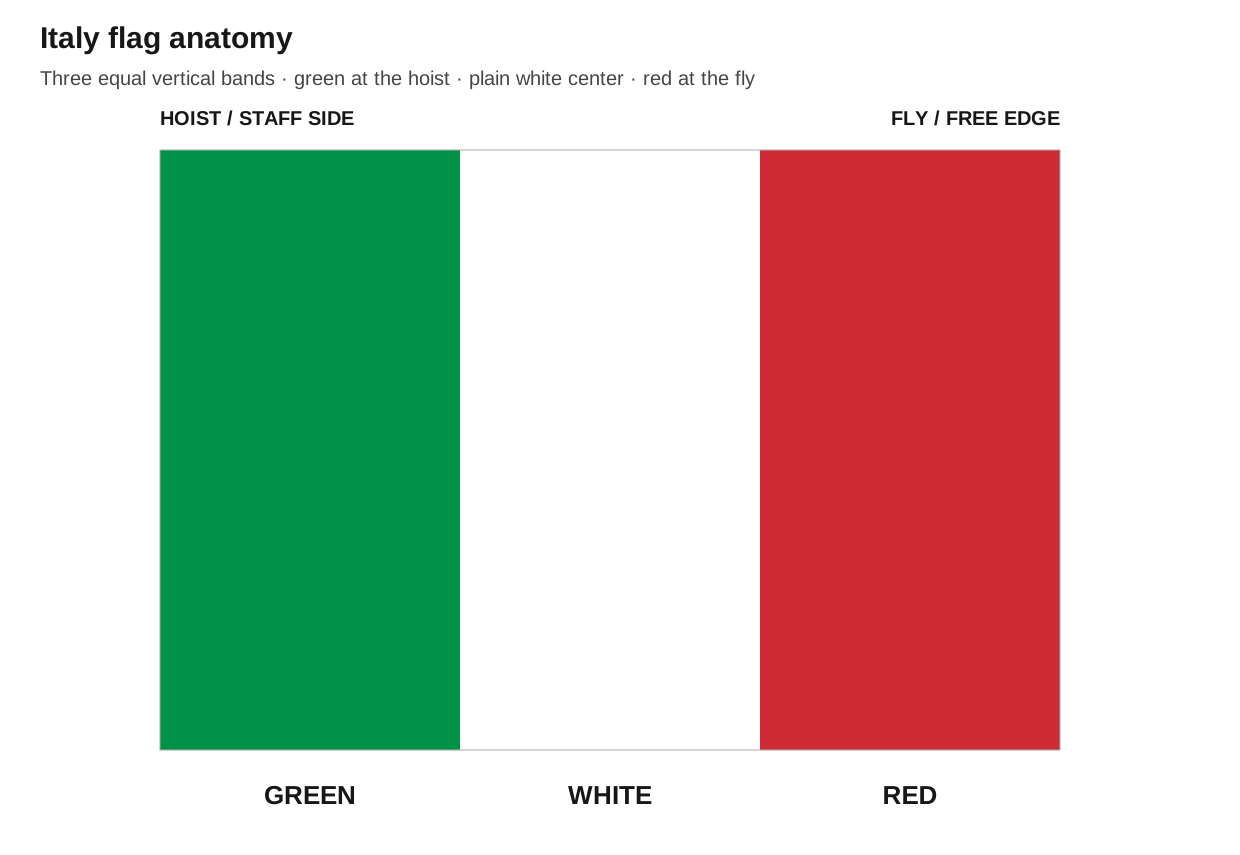
The three stripes have equal widths and cover the entire flag. Green adjoins the staff, white occupies the center, and red forms the free edge. No shield, crown, writing, or gold fringe belongs to the plain national reference.
GKBook explanatory composition, CC0; national flag geometry, public domain.Download image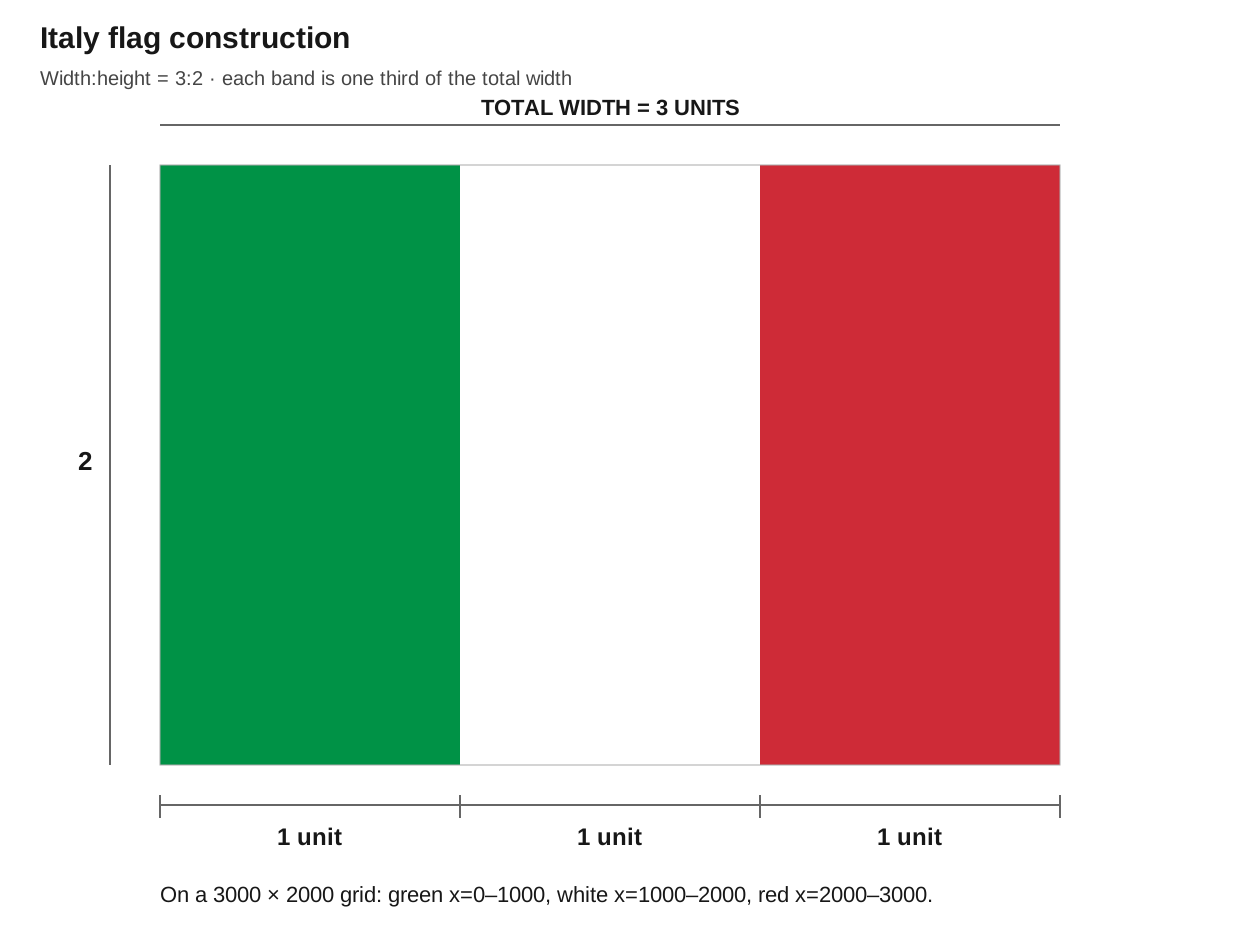
The 3:2 rectangle divides into three vertical bands, each one third of its width. On the supplied 3000×2000 SVG grid, the boundaries are x=1000 and x=2000. Each stripe is 1000 pixels wide and 2000 pixels high.
GKBook explanatory composition, CC0; national flag geometry, public domain.Download image
Official textile references are green 17-6153, white 11-0601, and red 18-1662. These files use #009246, #FFFFFF, and #CE2B37. The digital values identify the artwork; they are not a claim that the decree mandates those screen values.
GKBook explanatory composition, CC0; national flag geometry, public domain.Download image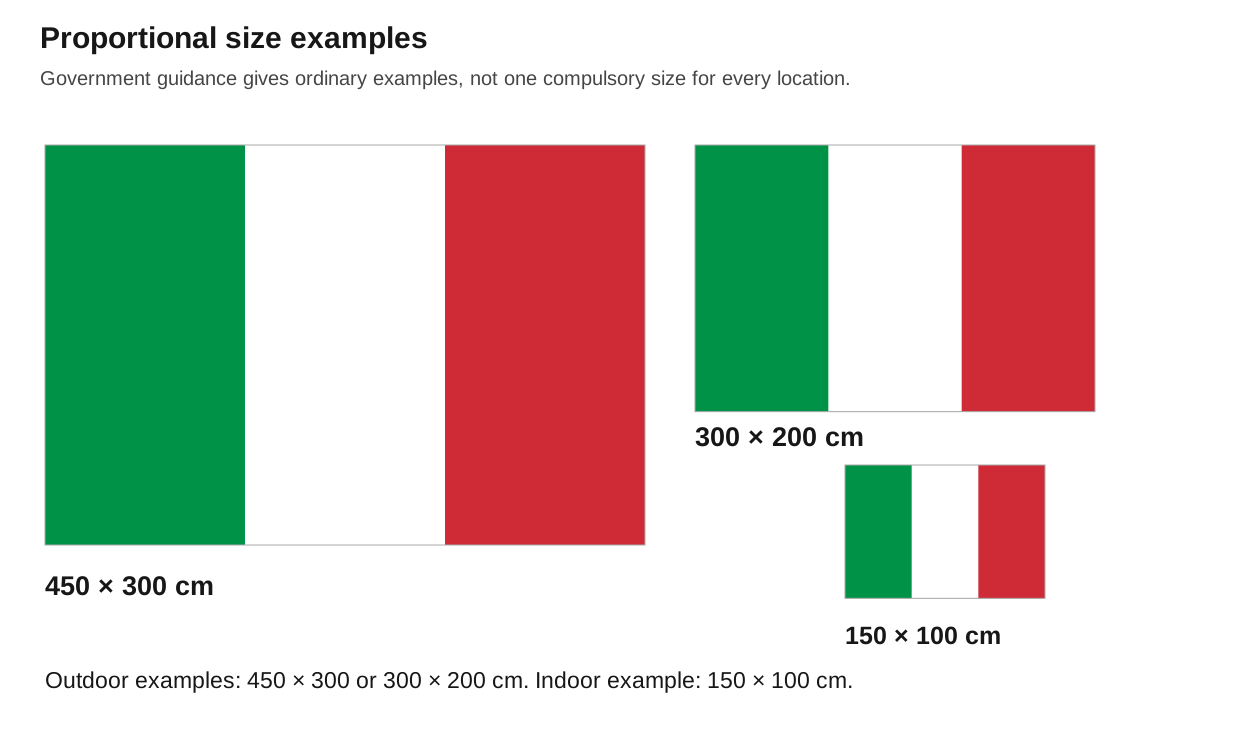
Government protocol guidance gives 300×200 or 450×300 centimeters as ordinary outdoor examples and 150×100 centimeters indoors. All preserve 3:2. The SVG is 3000×2000, and the large downloadable PNG is 6000×4000.
GKBook explanatory composition, CC0; national flag geometry, public domain.Download image
Modern reconstruction of the Cispadane Republic’s 1797 flag: horizontal red, white, and green bands with the central republican emblem. It illustrates an early tricolor, not the modern vertical national flag. The square format follows this reference reconstruction.
Wikimedia Commons contributors, CC0. Historical flag reconstruction; complete emblem retained.Download image
Modern reconstruction of the Napoleonic Italian Republic’s land flag: a red square, a white diamond, and a central green square. This historical Italian Republic preceded the present republic by more than a century.
Gennaro Prota and Wikimedia Commons contributors. Public-domain geometric flag reconstruction.Download image
Modern reconstruction of the Kingdom of Italy’s national flag with the blue-bordered Savoy shield. The plain national model is shown without a royal crown; the crowned state model is a separate historical variant.
F l a n k e r and Wikimedia Commons contributors. Public-domain historical flag reference.Download image
Modern reconstruction of the royal state flag, with a crown above the Savoy shield. The 1925 rules distinguished this state model from the uncrowned national flag. It is not the present republican flag.
F l a n k e r and Wikimedia Commons contributors. Public-domain historical flag reconstruction.Download image
The Italian Navy’s ensign carries the four maritime republics’ emblems and a naval crown. The Venetian lion holds a sword. This complete reference depicts the form revised in 2012; it is distinct from the plain national flag.
F l a n k e r and Wikimedia Commons contributors. Public domain; complete naval ensign reference.Download image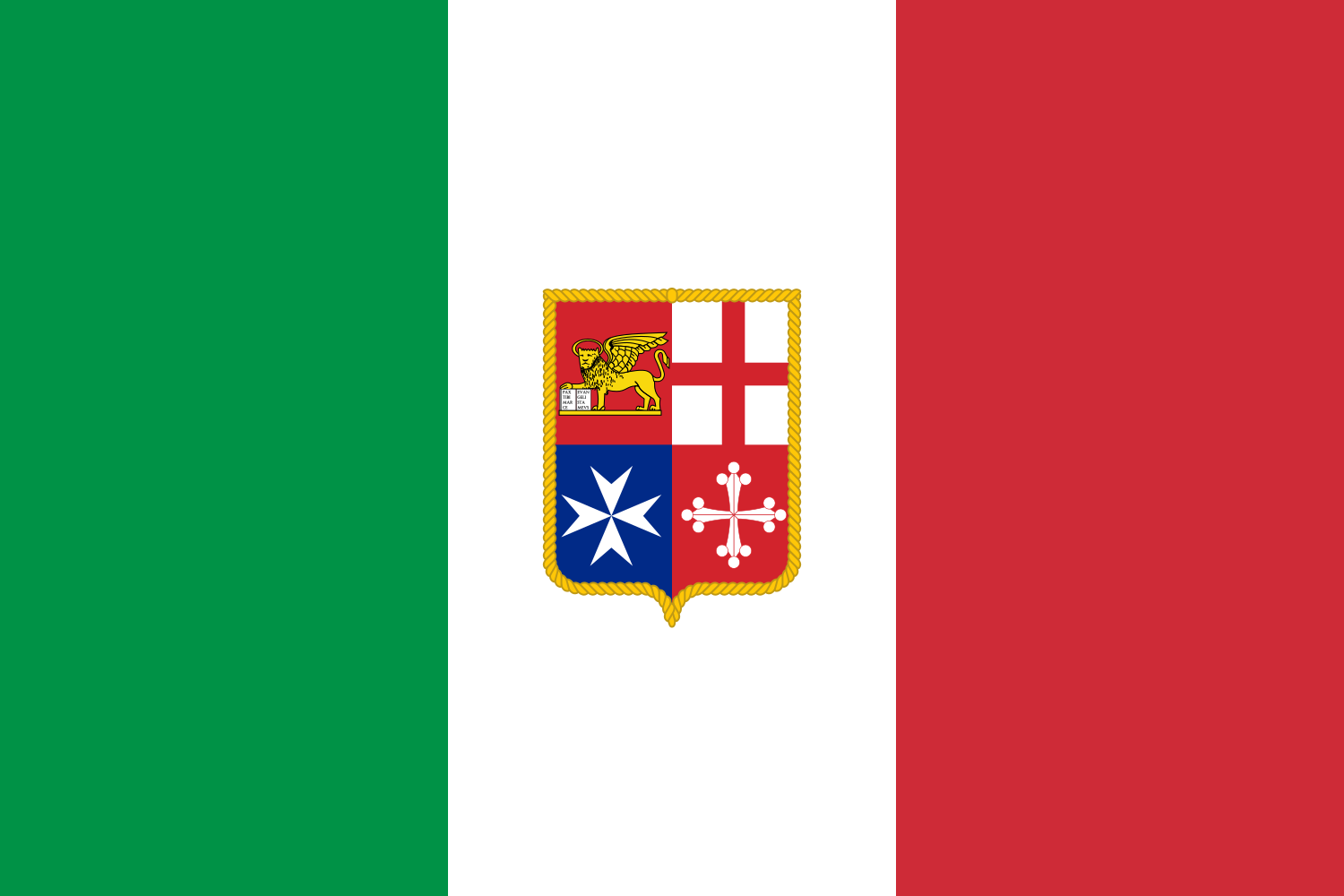
The merchant ensign carries the four maritime republics’ emblems without the naval crown. Its Venetian lion has an open book rather than the Navy’s sword. This complete reference is a maritime flag, not the plain national tricolor.
Denelson83 and Wikimedia Commons contributors. Public domain; complete merchant ensign reference.Download image
The presidential standard is square, with a blue border, a red field, a white diamond, and a green square bearing the golden emblem of the Republic. The current design was introduced in 2000 and recalls the land flag of 1802–1805.
F l a n k e r and Wikimedia Commons contributors. Public-domain official-symbol reference.Download image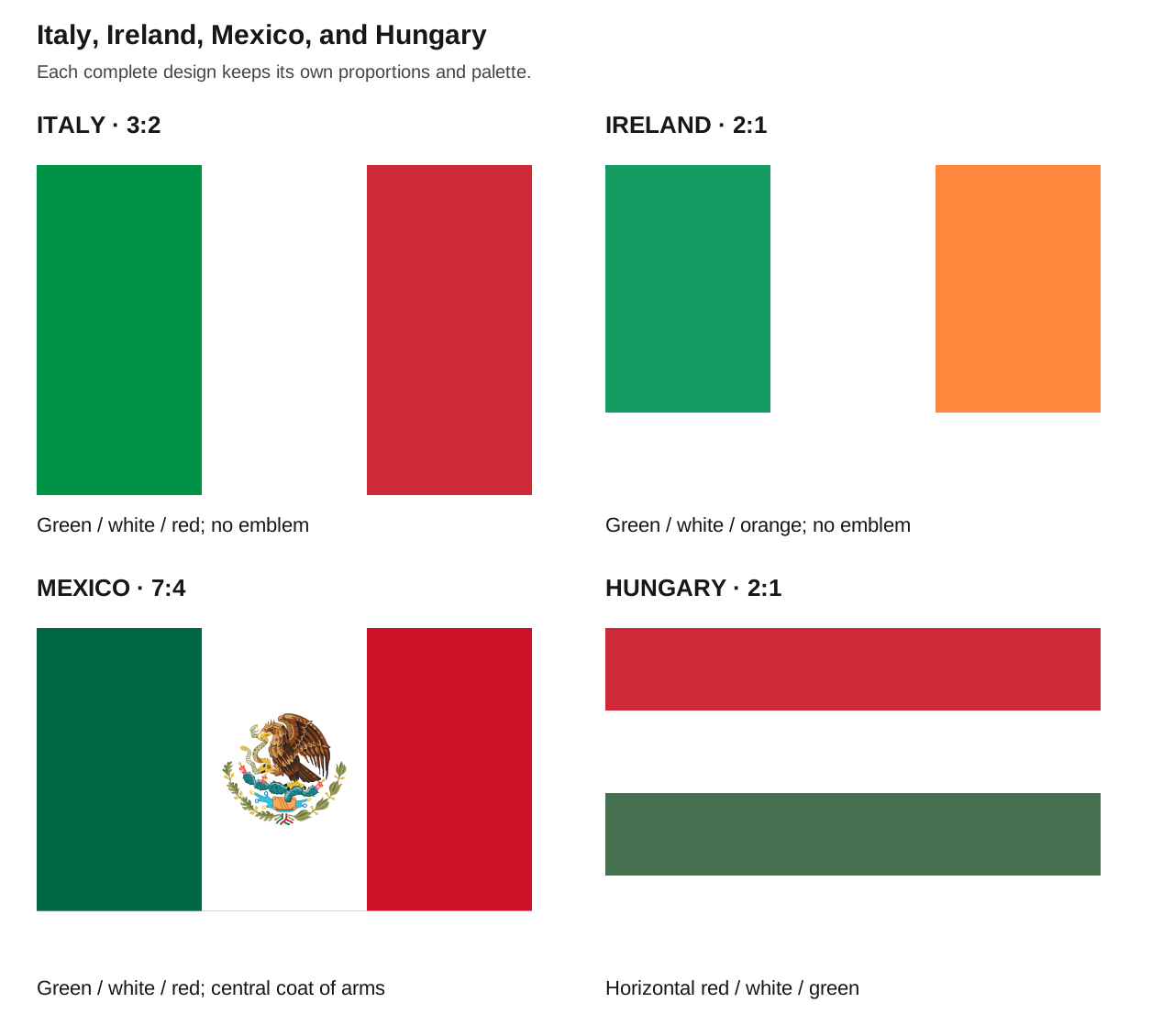
Italy has a plain 3:2 vertical tricolor. Ireland has an orange fly band and a 2:1 ratio. Mexico has a central eagle-and-snake coat of arms and a 7:4 ratio. Hungary uses horizontal red, white, and green bands. The full Mexican emblem is retained.
GKBook explanatory composition, CC0; national flag geometry, public domain.Download image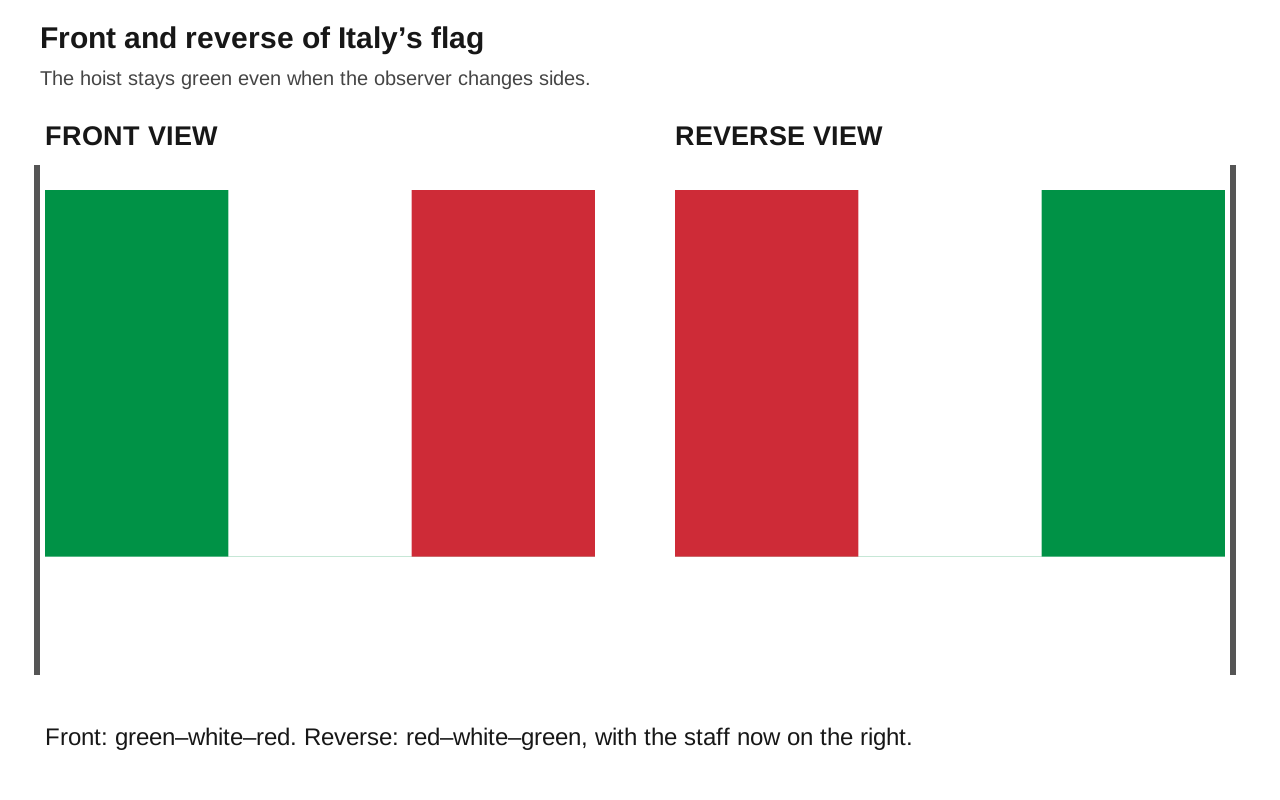
From the front with the staff on the left, Italy’s flag reads green, white, red. From the opposite side, the observer sees red, white, green and the staff on the right. The cloth has not changed: green still adjoins its hoist.
GKBook explanatory composition, CC0; national flag geometry, public domain.Download image
January 7 is National Flag Day, marking the 1797 Cispadane adoption. March 17 marks national unity, the Constitution, anthem, and flag. These are non-holiday civic observances. June 2, Republic Day, is a public holiday commemorating the 1946 institutional referendum.
GKBook explanatory composition, CC0; national flag geometry, public domain.Download image
In a paired display facing a building, the Italian flag occupies the observer’s left and the EU flag the right. The two flags have equal dimensions and material and stand at equal heights. Italy is raised first and lowered last.
GKBook explanatory composition, CC0; national flag geometry, public domain.Download image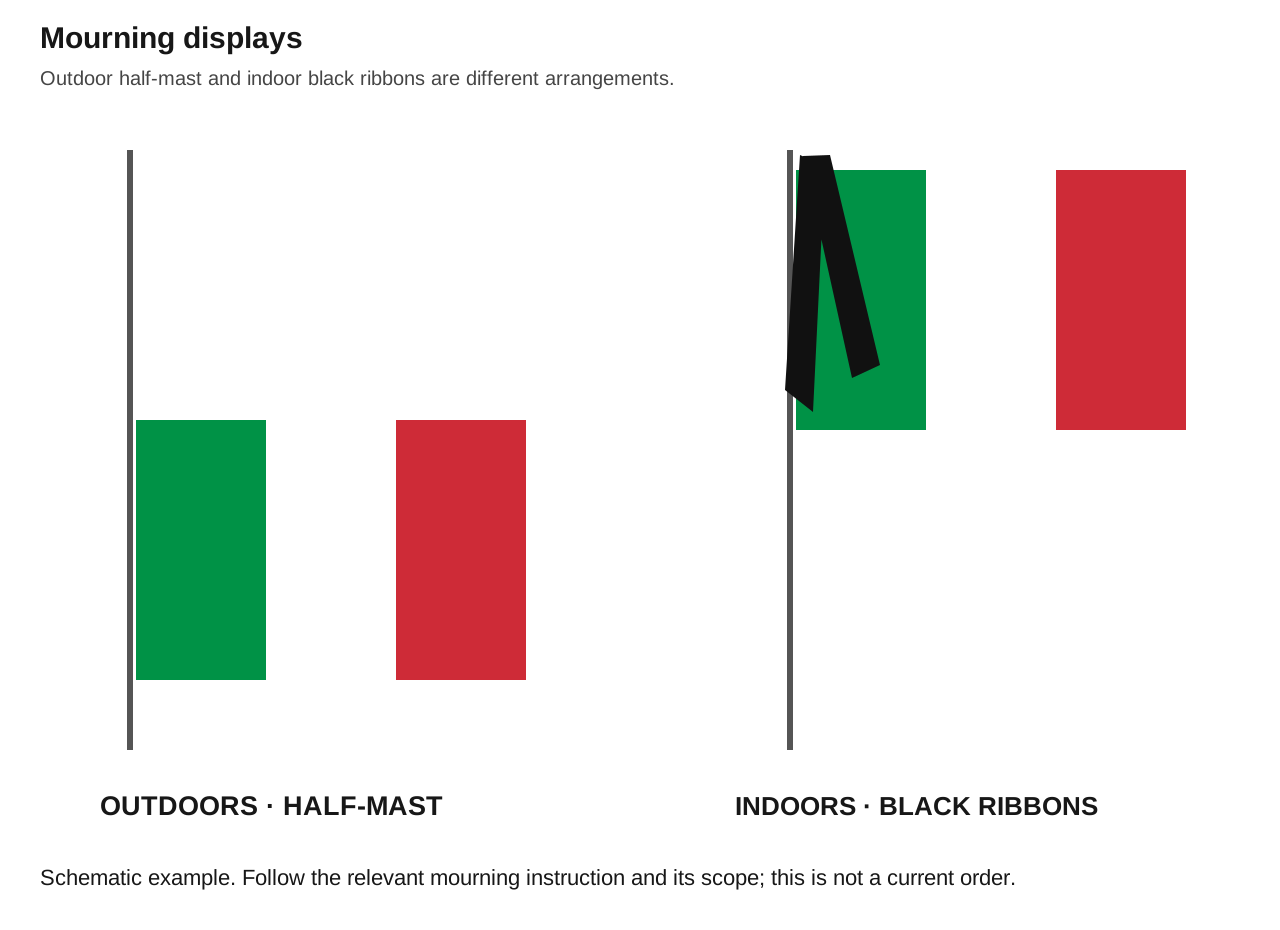
For public mourning, flags outside are displayed at half-mast. Indoor flags can carry two black ribbons. Official funeral processions use black mourning strips. A local institution’s decision about its own flag does not automatically authorize lowering other institutions’ flags.
GKBook explanatory composition, CC0; national flag geometry, public domain.Download image
The government’s historical guide describes the tricolor cockade with red outside, white between, and green at the center. Cockades were used before the national flag’s 1797 adoption. Ring widths in this teaching illustration are schematic, not official measurements.
GKBook explanatory composition, CC0; national flag geometry, public domain.Download image
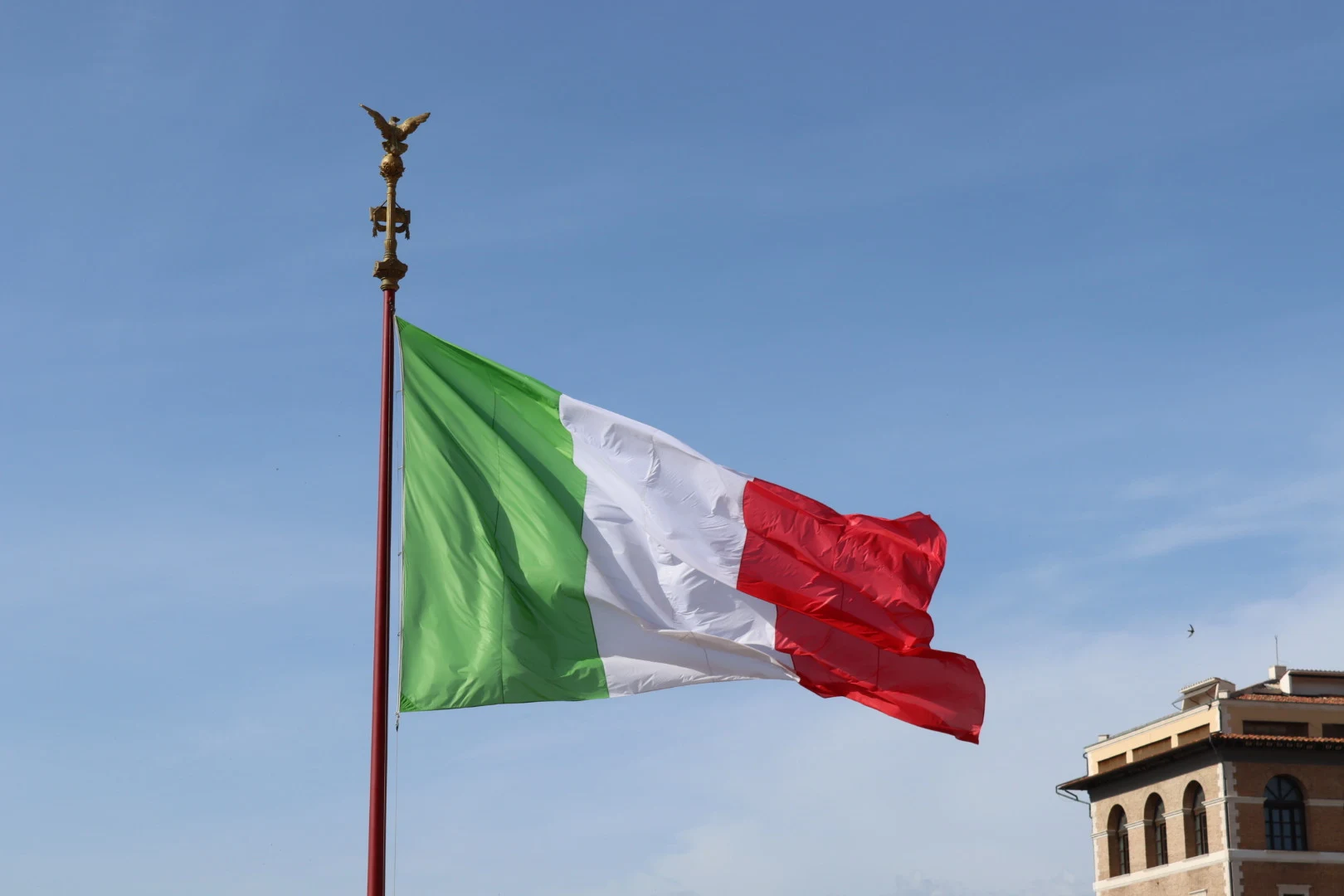
An Italian flag flies at the Vittoriano in Rome on April 21, 2025. The photographer’s full frame shows the green band attached to the staff and the red band at the free edge.
Andreas Liasis. CC0 public-domain dedication.Download image
Italian and U.S. desk flags appear at Antony Blinken’s meeting with Luigi Di Maio in Rome on October 30, 2021.
Ron Przysucha, U.S. Department of State. Public domain, U.S. government work.Download imageFrequently asked questions
What does Italy’s flag look like?
Italy’s national flag has three equal vertical bands: green beside the staff, white in the middle, and red at the free edge. The standard rectangle has a 3:2 width-to-height ratio. Known as il Tricolore, it carries no coat of arms, crown, star, lettering, or other central emblem.
Why does Italy’s national flag have no coat of arms?
The present republican flag is a plain tricolor. The Savoy shield belonged to the royal flag and disappeared with the republican design established in June 1946. Italy also has a separate state emblem and several flags for specific official uses. Their symbols should not be added to an ordinary national flag.
What are Italy’s flag colors and their color codes?
Italy’s flag is green, white, and red. Official textile references are Pantone 17-6153, 11-0601, and 18-1662 respectively. The downloadable digital flag uses #009246, #FFFFFF, and #CE2B37. These HEX values describe the supplied artwork; they are not an assertion that the official textile specification mandates identical values on every screen.
What do the green, white, and red colors mean?
The colors have historical roots in northern Italy: white and red appeared in Milan’s civic arms, while green was associated with its civic guard. Later writers gave the colors patriotic and moral meanings. Those interpretations enrich the flag’s cultural history, but Article 12 does not assign a separate official virtue to each stripe.
What is the aspect ratio of Italy’s flag?
Italy’s national flag has a 3:2 width-to-height ratio: its length is one and a half times its height. A source that lists height first writes 2:3. The three vertical bands have equal widths, so each band occupies one third of the total flag area. Proportional scaling preserves the complete design.
How can Italy’s flag be drawn accurately?
Draw a rectangle three units wide and two units high. Divide its width into three equal parts with vertical lines. Fill the first third green, the middle third white, and the final third red, with green at the hoist. Do not add outlines between the stripes or place a symbol in the center.
Are there official examples of Italian flag sizes?
Government protocol guidance gives ordinary outdoor examples of 300×200 or 450×300 centimeters, and an indoor example of 150×100 centimeters. It presents them as practical size guidance, not a single compulsory dimension for every setting. All three examples preserve the national 3:2 ratio and keep the three colored bands equal.
How did Italy’s flag develop over time?
Italy’s tricolor developed from revolutionary cockades and military colors into the Cispadane flag of 1797, a symbol of the Risorgimento, and the royal flag of united Italy. The republican design removed the Savoy shield in 1946. Constitutional confirmation, specialized maritime ensigns, public-display rules, and textile color standards followed in separate stages.
Where and when did Italy’s national tricolor originate?
Italy traces the national tricolor’s birth to Reggio Emilia on January 7, 1797, when the parliament of the Cispadane Republic approved green, white, and red on Giuseppe Compagnoni’s proposal. That early flag had horizontal bands and a central emblem. The anniversary celebrates the national colors’ adoption, not an unchanged modern layout.
Who designed Italy’s flag?
No single person designed every stage of Italy’s flag. Giuseppe Compagnoni proposed the Cispadane parliament’s adoption of the tricolor in 1797 and is closely associated with its national birth. Earlier military and civic traditions supplied the colors. Later political and constitutional decisions produced the plain vertical flag of the present republic.
Was there a different Italian flag during the Napoleonic period?
Yes. The Napoleonic Italian Republic of 1802–1805 used a land flag with a red square, a white diamond, and a green square in the center. It retained the three national colors in a different arrangement. This historical design later inspired Italy’s presidential standard, but it is not the current national flag.
What did Italy’s flag look like under the monarchy?
The royal tricolor carried the Savoy shield: a white cross on a red shield outlined in blue. A crowned state version also existed. The 1925 rules distinguished the national model from the state model used at specified royal and government premises. These historical emblems disappeared from the plain republican national flag in 1946.
When was the current Italian flag adopted?
The plain republican flag was established provisionally by a legislative decree of June 19, 1946. The Constituent Assembly confirmed the flag wording on March 24, 1947, and Article 12 entered into force with the Constitution on January 1, 1948. These dates concern the modern republic, while January 7, 1797 marks the tricolor’s earlier national origin.
What should a maker preserve when producing an Italian flag?
A maker should preserve the 3:2 rectangle, equal vertical bands, green hoist, white center, and red fly. Official textile references guide the colors of cloth, while the government’s ordinary size examples help with planning. Suitable fabric, sound seams, and secure attachments support dignified display without changing the visible national design.
How do Italy’s naval and merchant flags differ?
Both maritime ensigns place the emblems of Venice, Genoa, Amalfi, and Pisa in the white band. The Italian Navy’s ensign has a naval crown and a Venetian lion holding a sword. The merchant ensign has no crown and shows the lion with an open book. Neither replaces the plain national flag for general use.
Is Italy’s state emblem the same as its flag?
No. Italy’s state emblem is a separate design with a white star edged in red, a steel cogwheel, olive and oak branches, and a ribbon naming the republic. Paolo Paschetto designed it, and a decree established it on May 5, 1948. The ordinary national flag remains the plain green, white, and red tricolor.
What does Italy’s presidential standard look like?
Italy’s presidential standard is a square flag with a blue border, a red field, a white diamond, and a green square bearing the golden emblem of the Republic. The current design was introduced in 2000. It identifies the President’s presence and draws historical inspiration from the Napoleonic Italian Republic’s flag of 1802–1805.
How is the Italian tricolor cockade related to the flag?
The tricolor cockade arranges the national colors in concentric areas: red outside, white between, and green at the center. The government’s historical guide connects cockades used in Bologna in 1794 with the flag’s early development. A cockade is a related national symbol, not a circular replacement for the rectangular national flag.
When is Italy’s Flag Day?
Italy celebrates National Flag Day, commonly called Festa del Tricolore, on January 7. It commemorates the Cispadane parliament’s adoption of the tricolor at Reggio Emilia on January 7, 1797. Law No. 671 of December 31, 1996 established the observance and expressly made it a non-holiday celebration, distinct from Republic Day on June 2.
How is Republic Day different from Flag Day?
Republic Day falls on June 2 and commemorates the 1946 referendum on Italy’s institutional form. It is a national public holiday. Flag Day falls on January 7 and recalls the tricolor’s 1797 origin. The two observances honor different stages of Italian history, although the national flag is prominent on both occasions.
What rules guide the public display of Italy’s flag?
Public-display rules require the flag to be in good condition, properly unfurled, and carried on its own staff. They prohibit adding figures, writing, or letters to the flag or its staff. The principal framework is Law No. 22 of 1998 and Presidential Decree No. 121 of 2000, with specialized military and international ceremonial rules preserved.
Where does Italy’s flag go beside the European Union flag?
In a paired display, Italy’s flag occupies the position of honor: the right from the building looking outward, which is the observer’s left when facing it. The Italian and European Union flags have equal dimensions and material on staffs at the same height. Italy’s flag is raised first and lowered last.
What happens to the color order on the reverse of Italy’s flag?
With the staff on the left, the front view reads green, white, red. From the opposite side, the observer sees red, white, green and the staff on the right. Green still adjoins the hoist. A reversed photograph can therefore look different without showing a different flag or an incorrectly sewn tricolor.
Where is the Italian flag required at public institutions?
The national and European Union flags are displayed at specified government, parliamentary, judicial, educational, and other public premises under the 1998 law and 2000 regulations. The rules also address polling places and designated official rooms. These institutional duties should not be mistaken for a requirement that every private home display a flag every day.
May Italy’s flag remain outside at night?
The public-display regulations normally associate raising and lowering with daylight, but they permit nighttime outdoor display when the location is adequately illuminated. The government’s guide also discusses continued illuminated display. This lighting condition is separate from the rules for mourning, position of honor, or the dates on which particular institutions must fly flags.
When is Italy’s flag flown at half-mast?
Half-mast is the outdoor arrangement for public mourning. National mourning instructions come through the competent state authorities; local institutions control mourning for their own flags and should seek the relevant institutions’ agreement before lowering other flags. Indoor displays can use two black ribbons. A standing illustration of mourning does not announce a current mourning order.
May private citizens fly the Italian flag?
Yes. The government’s protocol guidance says private flag display is not subject to a special authorization regime: individuals may choose to display the tricolor. They should respect its dignity and keep it in good condition. The duties applying to specified public institutions do not mean that every private balcony must also carry an EU flag.
How should an Italian flag be cared for or retired?
Keep the flag clean, intact, recognizable, and properly unfurled. Replace cloth that is torn, badly faded, or otherwise unsuitable for dignified display. Clean and dry it according to its fabric instructions before storage. The general public-display sources reviewed here do not establish one compulsory civilian folding pattern or a universal flag-burning retirement ceremony.
How is Italy’s flag different from Ireland’s, Mexico’s, and Hungary’s?
Italy has a plain green-white-red vertical tricolor in a 3:2 rectangle. Ireland’s fly band is orange and its flag is 2:1. Mexico adds a central eagle-and-snake coat of arms and uses 7:4. Hungary arranges red, white, and green horizontally. Color order, orientation, emblem, and proportions together provide reliable identification.
What do the photographs show about Italy’s flag in use?
The photographs show a full-size flag flying at the Vittoriano in Rome in 2025 and Italian and U.S. desk flags at a diplomatic meeting in Rome in 2021. They illustrate outdoor and tabletop use. Both are genuine documented photographs with local downloads, preserved frames, and visible creator credits.
What is the Italy flag emoji?
The Italy flag emoji is 🇮🇹. Its sequence combines regional indicator I, U+1F1EE, with regional indicator T, U+1F1F9. A platform may show a waving tricolor or the two letters. That small platform-dependent image identifies Italy in text; it is not a measurement or color standard for producing a national flag.
Which Italy flag pictures are available to download?
The downloads include a clean 3:2 SVG, a 6000×4000 PNG, construction and color diagrams, historical flag reconstructions, maritime ensigns, the presidential standard, display illustrations, comparisons, and two photographs. Each gallery item has a local download and caption. The national master contains only the three equal colored bands, without labels or decorative effects.
Explore all general-knowledge topics and the A-to-Z lists.

We Value Your Opinion Comments