
Iraq flag picture
Explore the Arabic inscription, 2008 change, and construction sheet.
| Design | Red · white · blackThree equal horizontal bands with green Arabic words. |
|---|---|
| Proportion | 3:2 width:heightAlso written 2:3 with height first. |
| Current design | 2008Parliament approved it January 22; Law 9 was issued January 29. |
| Inscription | Allahu akbarCommonly translated as “God is great.” |
| Script | KuficSpecified in the 2008 amendment. |
| Stars | NoneThe former three green stars were removed in 2008. |
| Digital palette | #CD1125 · #FFFFFF · #000000 · #017B3DValues in the supplied reference, not statutory HEX codes. |
| National Day | October 3Associated with League of Nations admission in 1932. |
Iraq’s flag is a 3:2 rectangle with three equal horizontal bands. Green Kufic lettering occupies the white field. The current design dates to the 2008 removal of the former three stars.
What does the flag of Iraq look like?
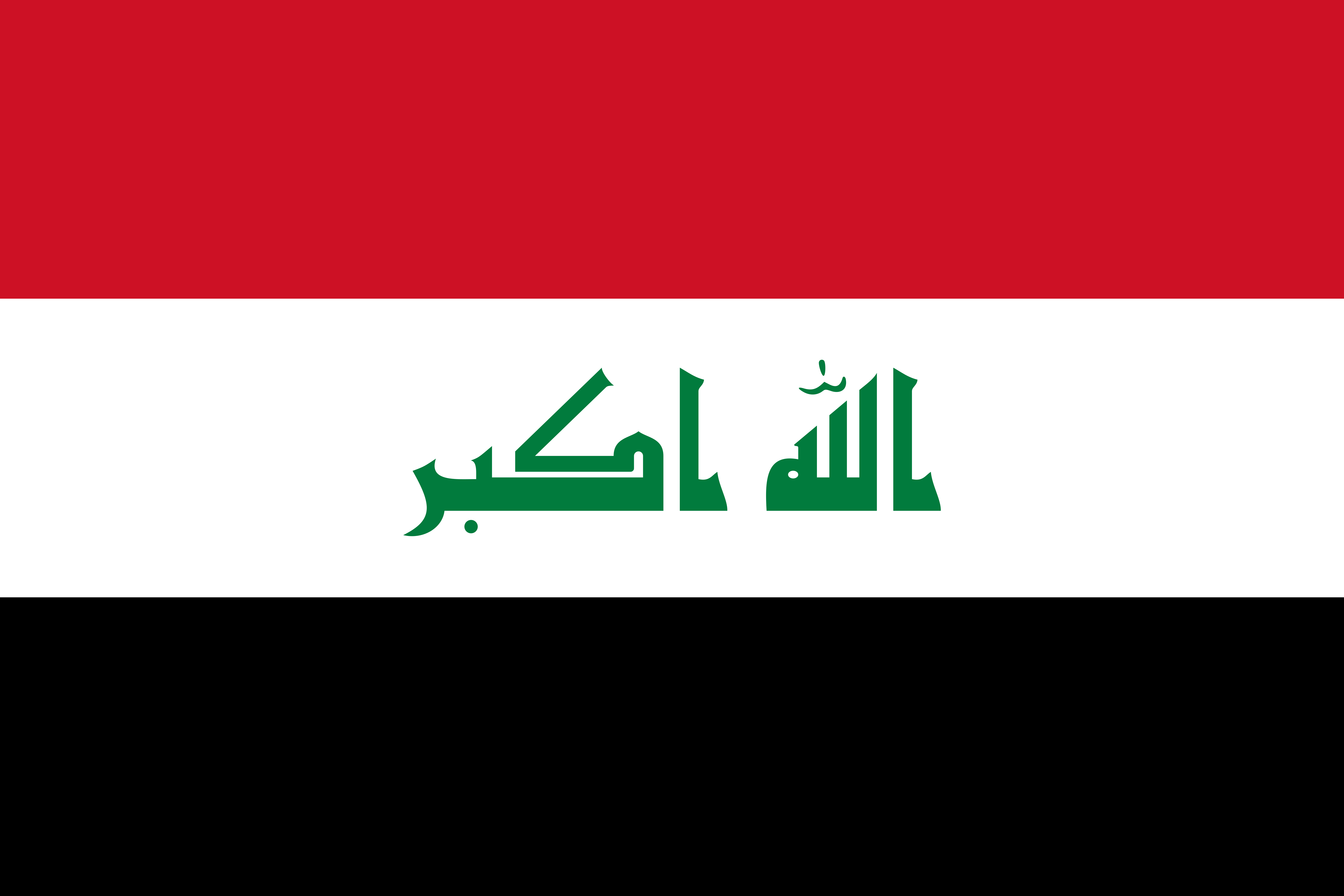
Iraq’s national flag has three equal horizontal bands: red at the top, white in the middle, and black at the bottom. A green Arabic inscription, Allahu akbar, sits in the white band. The current design has no stars. Its width-to-height ratio is 3:2, also written 2:3 when height comes first.
The inscription is the easiest way to distinguish Iraq’s flag from a plain red-white-black tricolor. It is a single phrase in an angular calligraphic style, not a row of decorative symbols. Both the lettering and the absence of stars matter when identifying the current design.
What are Iraq’s flag colors and their HEX or RGB values?
Iraq’s flag uses red, white, black, and green. The supplied digital drawing uses red #CD1125, white #FFFFFF, black #000000, and green #017B3D. Their RGB values are 205,17,37; 255,255,255; 0,0,0; and 1,123,61. These are file-specific screen values; the reviewed flag laws do not identify them as universal statutory HEX codes.
| Color | HEX in this artwork | RGB in this artwork | Position |
|---|---|---|---|
| Red | #CD1125 | 205, 17, 37 | Upper band |
| White | #FFFFFF | 255, 255, 255 | Middle band |
| Black | #000000 | 0, 0, 0 | Lower band |
| Green | #017B3D | 1, 123, 61 | Arabic inscription |
A photograph is affected by lighting, exposure, fabric, and shadows, so its sampled pixels are not a national color specification. The historical drawings also retain their own reference shades. Differences between those files should not be presented as a legally enacted palette change.
For printing or cloth production, obtain the approved physical color and manufacturing requirements from the commissioning authority. A conversion from RGB to CMYK or a nearest-match Pantone swatch does not establish official equivalence.
What do the colors and inscription of Iraq’s flag mean?
The 2008 amendment says that Iraq’s flag colors represent the colors of Islamic banners. It gives that collective explanation rather than assigning a separate modern meaning to each stripe. The green inscription is a religious declaration, Allahu akbar. The amendment also removed the three stars and their meanings from the earlier flag.
Descriptions such as courage, peace, or the defeat of oppression appear in popular explanations of many flags. They should not be silently substituted for this law’s actual collective statement. The statute does not provide a current red-equals-one-idea, white-equals-another key.
Earlier Iraqi laws did give more detailed meanings to their own designs. The 1959 law explained its colors, star, and disk; the 1986 law associated its three stars with unity, freedom, and socialism. Those historical interpretations belong to the versions described by those laws. The current starless flag should not inherit removed star symbolism.
What do the Arabic words on Iraq’s flag say?
The green words say Allahu akbar, commonly translated as “God is great” or “God is greatest.” In ordinary Arabic writing, the phrase is الله أكبر. It is read from right to left. Iraq’s flag displays the phrase once in the white band, using the Kufic script specified in the 2008 law.
The flag’s central identifying feature
The phrase in ordinary text is الله أكبر. Its appearance on the flag comes from the chosen calligraphic drawing. Letter forms, connecting strokes, dots, and marks above the letters belong to that drawing and should remain intact.
The phrase is sometimes called the takbir. It is religious wording, not the country’s name in Arabic. The central device is lettering; there is no eagle, sun, crescent-and-star badge, or national coat of arms on the current flag.
Why does Iraq’s flag use Kufic script?
Law 9 of 2008 expressly specifies Kufic script for the phrase Allahu akbar. It removes the earlier legal reference to Saddam Hussein’s handwriting. A Kufic form had already been used in practice after 2004, but the 2008 amendment states the requirement in law. Script style and the continued presence of the religious words are separate details.
This distinction explains why a photograph from 2005 can show angular lettering and still show three stars. The move away from the earlier handwriting and the removal of the stars were not simply one simultaneous visual change in every real-world flag.
To reproduce the supplied reference, use its complete vector calligraphy. Selecting a computer font with “Kufic” in its name and typing the phrase can produce different letter proportions, spacing, or marks. The close-up therefore enlarges the actual artwork rather than substituting typed text.
What is the aspect ratio of Iraq’s flag?
Iraq’s flag is three units wide for every two units high. The law describes the shorter dimension as two-thirds of the longer one. The red, white, and black bands have equal height, so each occupies one-third of the whole flag. A 150-centimeter-wide example would therefore be 100 centimeters high.
| Width | Height | Height of each band |
|---|---|---|
| 900 units | 600 units | 200 units |
| 150 cm | 100 cm | 33⅓ cm |
| 90 cm | 60 cm | 20 cm |
| 3000 pixels | 2000 pixels | 666⅔ pixels |
| 6000 pixels | 4000 pixels | 1333⅓ pixels |
Fractional band boundaries in a raster export can be antialiased; they do not change the underlying vector’s equal thirds. Keep width and height linked during resizing. Turning the flag into a square, or stretching only one dimension, distorts both its rectangle and its lettering.
How can Iraq’s flag be drawn accurately?
Start with a 3:2 rectangle and divide its height into three equal bands: red, white, and black. Place the complete green Kufic inscription in the central white field, with no stars. Preserve the calligraphy’s shape when scaling. The construction diagram explains the overall grid; legal placement wording and approved production artwork require separate attention.
On the 900×600 teaching grid, the band boundaries are y=200 and y=400, and the geometric center is (450,300). The downloadable master is a uniform enlargement of a complete public-domain national reference. Its lettering has not been redrawn in a generic font.
Article 2 of the 2008 amendment describes the inscription as occupying the middle third of the white rectangle lengthwise and its middle two quarters across the shorter dimension. That is a placement provision in the law. This reference and its teaching grid are not represented as a certified factory drawing that resolves every calligraphic contour or manufacturing tolerance.
Do not leave dimension lines, axes, labels, or a decorative border in the clean national flag. Those additions belong only to the separately labeled explanatory sheets.
What sizes can an Iraqi flag have?
The 3:2 proportion can be used at many sizes: 150×100 centimeters, 90×60 centimeters, and 30×20 centimeters are examples with width first. These are calculated illustrations, not an official size schedule. Whatever the scale, keep the bands equal and preserve the inscription. For an official commission, use the applicable approved pattern and institutional requirements.
A vector can be enlarged without losing its geometric definition. A raster image has a fixed number of pixels, so enlarging a small icon can blur the inscription. The large PNG supplied here is 6000×4000 pixels; the SVG is preferable when a workflow supports scalable artwork.
Cloth, printing, embroidery, fittings, and exposure conditions affect production choices. The reviewed legal description alone does not justify inventing a prescribed fabric, weight, pole size, or commercial manufacturing license procedure. Those practical requirements should be confirmed for the intended use.
How has Iraq’s flag changed over time?
Iraq’s flag history includes a royal horizontal tricolor, a distinctive republican vertical tricolor, and several red-white-black designs. The three green stars introduced in 1963 were later joined by a religious inscription, then removed in 2008. Changes in government, script, legislation, and actual use need separate dates rather than a single simplified sequence.
Royal flag takes its established form
Historical research identifies the trapezoid and two-star arrangement as part of the flag’s development in the 1920s.
Royal flag restated constitutionally
The amendment described black-white-green bands, a red trapezoid, and two white seven-pointed stars.
Republic flag enters use
Law 102 of 1959 set this start date for the vertical tricolor with an eight-pointed star and yellow disk.
Three-star tricolor
Law 28 introduced red-white-black bands and three green stars, with a planned Arab union in its rationale.
Flag law reorganized
Law 33 restated design and protocol; its original explanation linked the stars to unity, freedom, and socialism.
Allahu akbar added
Law 6 added the green phrase and referred to Saddam Hussein’s handwriting.
Kufic lettering used in practice
The three stars remained in the version illustrated for 2004–2008.
Parliamentary approval
Contemporary reporting records the vote to remove the stars and retain the religious inscription.
Law 9 issued
The amendment specified Kufic lettering; it was published in Gazette 4059 on February 5.
Duration extended in law
Law 32 of 2009 removed the one-year limit, took effect from January 29, 2009, and was published January 25, 2010.
What did the royal flag of Iraq look like?
The royal flag type had horizontal black, white, and green bands, a red trapezoid at the hoist, and two white seven-pointed stars. The 1943 constitutional amendment described a rectangle twice as long as it was high. The illustration is a modern reconstruction of that historical type, not an archival photograph or the current national flag.
The royal design grew out of the Arab Revolt flag tradition during the formation of the Iraqi state in the 1920s. Historical research identifies 1924 as the point when the trapezoid and two-star arrangement was fixed. The later 1943 constitutional text provides the detailed dimensions used to explain the illustrated type here.
The red trapezoid’s longer vertical side occupied the flag’s full height at the staff. Its shorter parallel side equaled the height of one band, and its depth was one-quarter of the flag’s length. The two stars were arranged vertically inside it.
The 1943 text is a precise surviving constitutional description; it is not proof that every royal flag before that date had identical construction details. The later 1959 law expressly replaced the earlier flag legislation and set July 14, 1959 as the date to begin using the new republic design.
What was Iraq’s flag from 1959 to 1963?
The 1959 republic flag used vertical black, white, and green bands within a 2:1 rectangle. A dark red eight-pointed star filled the center, enclosing a yellow disk with a white ring. Law 102 of 1959 prescribed the design and directed that its use begin on July 14, 1959, a year after the revolution it commemorated.
Article 2 associated the dark red star and yellow circle with Arabs and Kurds as constituents of the Iraqi people. The law also connected dark red with the July 14, 1958 revolution and the Arab banner in Andalusia, and yellow with Saladin’s banner. These are historical meanings assigned to this particular flag.
| Element | Dimension relative to total flag height H |
|---|---|
| Overall length | 2H |
| Width of each vertical band | 2H ÷ 3 |
| Star outer radius | 0.250H |
| Star inner radius | 0.135H |
| White ring outer radius | 0.125H |
| Yellow disk radius | 0.100H |
The eight equally spaced outer points are 45 degrees apart. The reconstruction uses the law’s numeric dimensions, while its screen shades are illustrative. This keeps a primary geometric specification separate from a modern digital color choice.
What did the three stars on older Iraqi flags mean?
The three green stars first appeared in the 1963 red-white-black design. That law’s rationale referred to a planned federal union of Egypt, Syria, and Iraq. The 1986 law later associated the stars with unity, freedom, and socialism. The 2008 amendment removed both the stars and their meanings, so they do not belong on today’s flag.
The stars were five-pointed and arranged horizontally across the white band. Their upper points faced upward. In the version before the religious wording was added, the three stars were the only devices in that central field.
The legal dates also deserve care. Law 28 of 1963 was signed on April 30, and the reviewed legal archive records publication on June 8. Its text made publication the effective step. The article therefore uses 1963 for the design’s introduction rather than converting a different date in an image catalog into an unverified enactment date.
When was Allahu akbar added to Iraq’s flag?
The green phrase Allahu akbar was added under Law 6 of 1991. The amendment retained the three stars and placed the words between them, explicitly referring to Saddam Hussein’s handwriting. The phrase itself survived later revisions, but that handwriting reference and the stars were removed from the law in 2008, which specified Kufic script instead.
The 1991 text placed the word Allah after the first star and akbar after the second in its stated arrangement. This explains the more crowded appearance of the older central band. It is different from the starless, centered inscription on the modern design.
The law number and year provide a sound documentary anchor. Historical photographs should retain their actual date and caption: removing their stars or replacing their script would turn evidence of an earlier flag into an edited image.
What happened to Iraq’s flag in 2004?
A Kufic form of the inscription came into use after 2004 while the three green stars remained. A separate white flag proposal with a pale blue crescent and blue-and-yellow bands was also announced that year but did not become the enduring national design. These were different developments and should not be merged into one supposedly adopted flag.
Contemporary BBC reporting described the Governing Council’s proposed design and named architect Rifat al-Chaderchi, commonly rendered Rifat Chadirji, as its designer. The blue lines represented the Tigris and Euphrates, and the yellow strip represented the Kurdish minority in that proposal’s explanation.
The later Reuters account described the 2004 replacement attempt as rejected and the calligraphic change on the existing tricolor as unofficial. The drawing shown here for 2004–2008 therefore illustrates the three-star tricolor used in practice, not the blue-crescent proposal. No individual designer of today’s complete flag is asserted on the strength of authorship of that separate proposal.
When was the current Iraqi flag adopted?
Parliament approved the current starless design on January 22, 2008. The Presidency Council issued Law 9 on January 29, and it appeared in the official gazette on February 5. The law removed the three stars, retained Allahu akbar, and specified Kufic script. Parliamentary approval, legal issuance, and publication are distinct dates.
| Event | Date | Documentary significance |
|---|---|---|
| Parliamentary vote | January 22, 2008 | Contemporary reporting of approval |
| Law 9 issued | January 29, 2008 | Date stated by the Presidency Council |
| Official Gazette 4059 | February 5, 2008 | Publication on printed pages 1–3 |
| Later extension | Law 32 of 2009 | Removed the original one-year limit |
January 22 is the familiar adoption date in summaries because it marks the parliamentary decision. The original Gazette copy makes clear that the law itself was issued a week later. Its Article 4 initially made it effective from issuance, while the later extension supplied a new effective-date clause.
The change preserved the existing three horizontal colors and the religious phrase. It therefore altered the identifying devices in the white band without replacing the basic tricolor rectangle.
Was Iraq’s 2008 flag only temporary?
The original 2008 law limited the arrangement to one year while a new flag law was expected. Law 32 of 2009 removed that deadline and continued it until a new flag law was issued. The amendment applied from January 29, 2009. Describing the current design as automatically expired after its first year misses that later legislation.
The extension was issued on December 20, 2009 and published in Official Gazette 4142 on January 25, 2010. Its retrospective effective date was January 29, 2009. Those three dates describe issuance, publication, and legal effect, not three separate redesigns.
The explanatory reasons explicitly recognized that the one-year period had passed without a replacement law and that the existing flag needed a continuing legal basis. The amendment changed the duration clause; it did not restore the stars or prescribe a new color arrangement.
Which laws define Iraq’s national flag?
The legal framework combines the constitutional requirement for a flag law with Law 33 of 1986 and its amendments. Law 6 of 1991 added the inscription; Law 9 of 2008 removed the stars and specified Kufic script; Law 32 of 2009 extended the arrangement. Reading only an older unamended description can produce the wrong flag.
| Document | Relevant contribution |
|---|---|
| Constitution, Article 12 | Flag, anthem, and emblem are to be regulated by law |
| Law 33 of 1986 | Underlying flag design and handling framework |
| Law 6 of 1991 | Added green Allahu akbar and named the earlier handwriting |
| Law 9 of 2008 | Removed stars and their meanings; specified Kufic wording |
| Law 32 of 2009 | Continued the design beyond the initial one-year period |
Article 12 says that regulation of these state symbols should express the components of the Iraqi people. The flag and national emblem are listed separately; the flag’s inscription should not be replaced with a coat of arms simply because both are national symbols.
Some online consolidated texts retain older wording in the design paragraph even while recording later amendments elsewhere. The original 2008 and 2009 gazette pages resolve the central issues: no three stars, Kufic lettering, and continuation beyond the original deadline.
When is Iraq’s National Day, and is it a Flag Day?
Iraq’s National Day is observed on October 3, associated with admission to the League of Nations on October 3, 1932. Official statements connect the occasion with sovereignty and national belonging. This is different from the 2008 flag change. The reviewed federal material did not establish a separate nationwide annual Flag Day for the current Iraqi flag.
The Foreign Ministry’s account identifies the League of Nations milestone in 1932. A 2025 official announcement directed ministries and governorates to mark October 3 with public celebrations and the raising of the Iraqi flag. Those records support the national anniversary without confusing it with a design-adoption date.
December 17 is associated with Kurdistan Flag Day in the Kurdistan Region. It should not be presented as a federal Iraqi Flag Day. Nor does an annual commemoration by itself establish the current legal holiday status of every workplace or institution.
Is the flag of the Kurdistan Region the same as Iraq’s national flag?
No. Iraq’s national flag is red, white, and black with green Arabic words. The Kurdistan Region’s flag uses red, white, and green with a yellow sun of 21 rays. They identify different levels of political community. Kurdistan Flag Day on December 17 is a regional observance and should not be assigned to the federal Iraqi flag.
The distinction is visible even at a distance: the Iraqi flag has a black lower band and an inscription, while the regional flag has a green lower band and a yellow sun. A caption should identify the flag actually pictured rather than using the names interchangeably.
The regional government’s published account describes the sun and the December 17 observance. This page’s clean national downloads depict the federal Iraqi design; the historical gallery also labels its earlier national types explicitly.
Which way should Iraq’s flag be displayed?
In the horizontal reference view, red is above white and black, and the green Arabic words remain upright and complete. Read the inscription from right to left. A photograph of thin cloth from its reverse may show mirrored lettering. For a vertical installation or a ceremonial arrangement, confirm the approved layout rather than assuming every rotation is equivalent.
The staff in the explanatory picture sits outside the 3:2 rectangle. It is a mounting illustration, not an additional stripe. The downloadable national master contains only the flag itself.
The Besmaya photograph shows why the viewing side matters: its cloth faces the camera from the reverse, so the inscription appears mirrored. The photo is preserved as documentary evidence. That appearance is not copied into the clean front-view reference, and the photograph has not been digitally flipped to hide it.
What does Iraq’s flag law say about official display?
The 1986 law gives the flag a place of honor and says that no other flag is raised above it in Iraq. It generally describes raising at sunrise and lowering at sunset, subject to exceptions set by regulation. It also leaves detailed building, ceremony, vehicle, and military arrangements to implementing rules rather than prescribing everything in the design clause.
| Topic | What the cited law establishes |
|---|---|
| Precedence | A place of honor; no other flag above it in Iraq |
| Ordinary hours | Sunrise to sunset, with regulatory exceptions |
| Buildings and ceremonies | Details delegated to regulation |
| Transport and military uses | Specific arrangements depend on implementing provisions |
| Condition | Faded, torn, or unfit flags are not to be displayed |
The underlying law and older implementing regulations contain institutional names and commemorations from their own periods. They should not be copied mechanically into a present-day event schedule. For an actual official display, obtain the applicable current instructions for that institution and occasion.
Practical preparation includes sound fastenings, intact seams, a clear inscription, and enough space to prevent snagging. These care recommendations help preserve the flag; they do not add an invented national salute, nighttime-lighting rule, or universal procession order.
Is Iraq’s flag flown at half-mast during mourning?
Article 3 of the 1986 law says that Iraq’s flag is not to be lowered or dipped on any occasion. Actual reported practice has not been entirely uniform: parliament held a brief lowering ceremony in March 2015. That documented event does not erase the statutory wording or establish a general half-mast schedule for every Iraqi institution.
Alsumaria’s contemporary report and photographs identify a March 16, 2015 ceremony at the parliament building for victims of the Speicher massacre, lasting about fifteen minutes. The report is evidence of that particular action. It is not a newly enacted replacement for Article 3.
For a current mourning ceremony, seek the responsible authority’s specific instructions and resolve the applicable protocol before changing the display. No fixed pole-height fraction, movement sequence, duration of mourning, or present lowering order is inferred here. The ordinary sunrise-to-sunset provision concerns daily raising and taking down, not a general authorization for ceremonial dipping.
How should an Iraqi flag be cared for or retired?
Article 11 of the 1986 law says not to display a flag whose colors are faded, whose fabric is torn, or whose condition is unsuitable. It calls for disposal outside public view in a way that preserves dignity. For routine care, follow the fabric maker’s cleaning directions, dry damp cloth, and protect it during storage.
The cited article does not prescribe burning as the single required method, and it does not set out a ceremonial triangular fold. Those details should not be imported from another country’s customs and labeled Iraqi law.
Check the lettering as well as the large color fields. Damage to small strokes can make an otherwise recognizable tricolor an inaccurate reproduction. Replace worn display flags appropriately, and seek conservation advice for historic cloth rather than applying ordinary washing instructions to an archival object.
What common mistakes should be avoided when drawing Iraq’s flag?
The most common identification errors are adding the old three stars, omitting the green inscription, reversing the red and black bands, or stretching the 3:2 rectangle. Other mistakes include typing an unrelated Arabic font, mirroring the front-view wording, and treating a historical proposal as the current flag. Keep teaching labels and dimension lines outside the clean master.
| Check | Correct current feature |
|---|---|
| Band order | Red, white, black from top to bottom |
| Band heights | Three equal horizontal thirds |
| Inscription | Complete green Allahu akbar in Kufic form |
| Stars | None on the current design |
| Ratio | 3:2 width:height |
| Historical examples | Clearly labeled by type and period |
| Palette claims | File-specific HEX values, without invented statutory equivalents |
A small thumbnail may make the inscription look like an indistinct emblem. Inspect an enlarged SVG before deciding it can be simplified. Preserve the small dots and upper marks, and use a dated caption whenever a real photograph shows an earlier design or a reverse-facing cloth.
How is Iraq’s flag different from Egypt, Yemen, and Sudan?
Iraq, Egypt, Yemen, and Sudan all use horizontal red-white-black bands in the references shown. Iraq has green Arabic words; Egypt has a gold-colored eagle; Yemen has no central device; and Sudan has a green triangle at the hoist. The first three references are 3:2, while Sudan’s is 2:1, with width stated first.
| Country | Width:height | Main identifying feature |
|---|---|---|
| Iraq | 3:2 | Green Allahu akbar inscription |
| Egypt | 3:2 | Gold-colored eagle in the white band |
| Yemen | 3:2 | Plain red-white-black tricolor |
| Sudan | 2:1 | Green triangle at the hoist |
Each comparison retains its complete source drawing and its own digital palette. The eagle in Egypt’s reference is not replaced with a generic bird, and the Iraqi phrase is not replaced with an arbitrary green mark. Shared color names alone do not make the flags interchangeable.
What do real photographs show about Iraq’s flag?
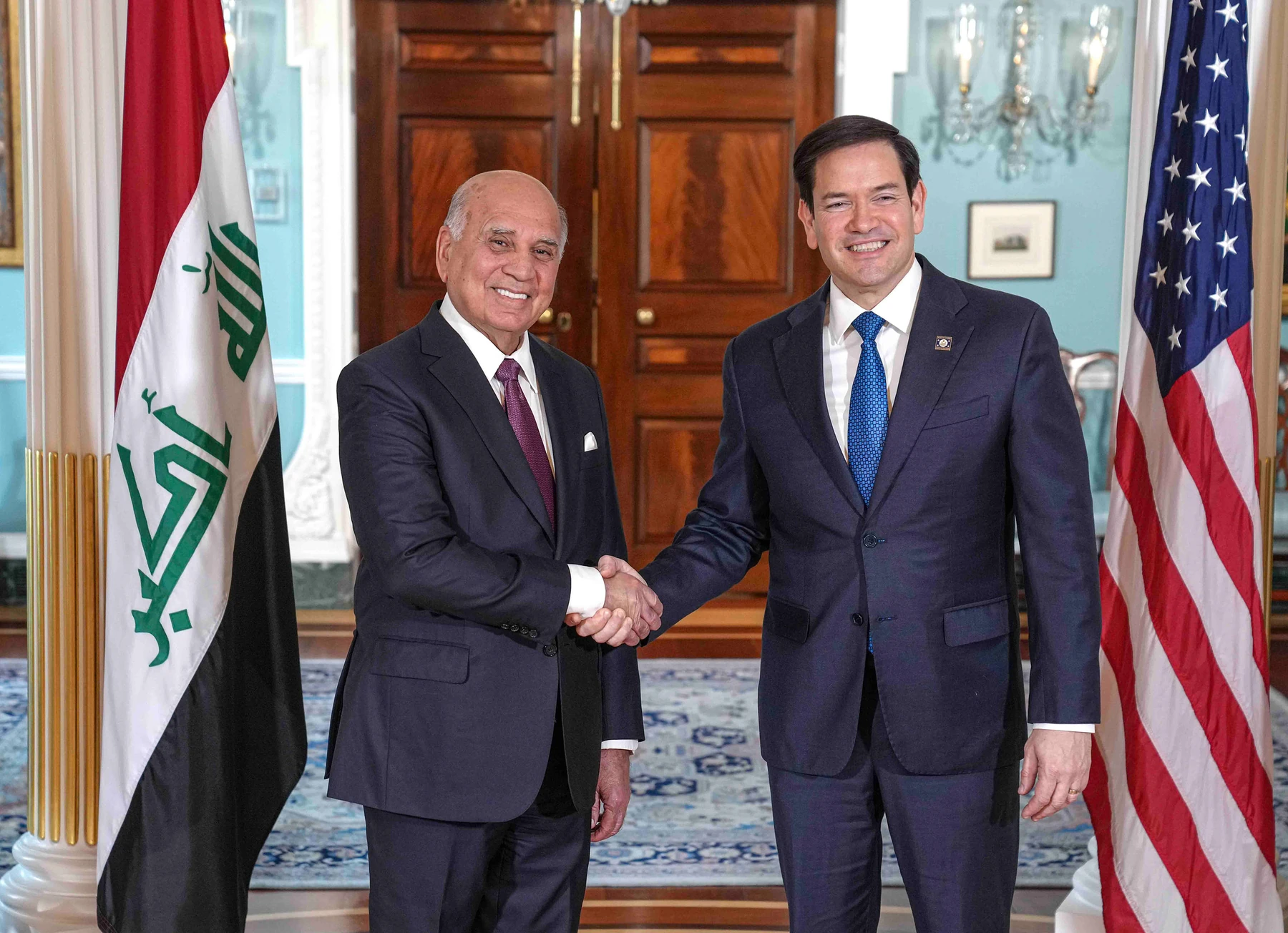
The photographs show the current design as cloth in two dated settings: a security-forces graduation at Besmaya in 2017 and a diplomatic meeting in Washington in 2025. Folds, lighting, and the viewing side affect its appearance. The pictures document those occasions; the flat national reference is better for examining the full inscription and exact proportions.
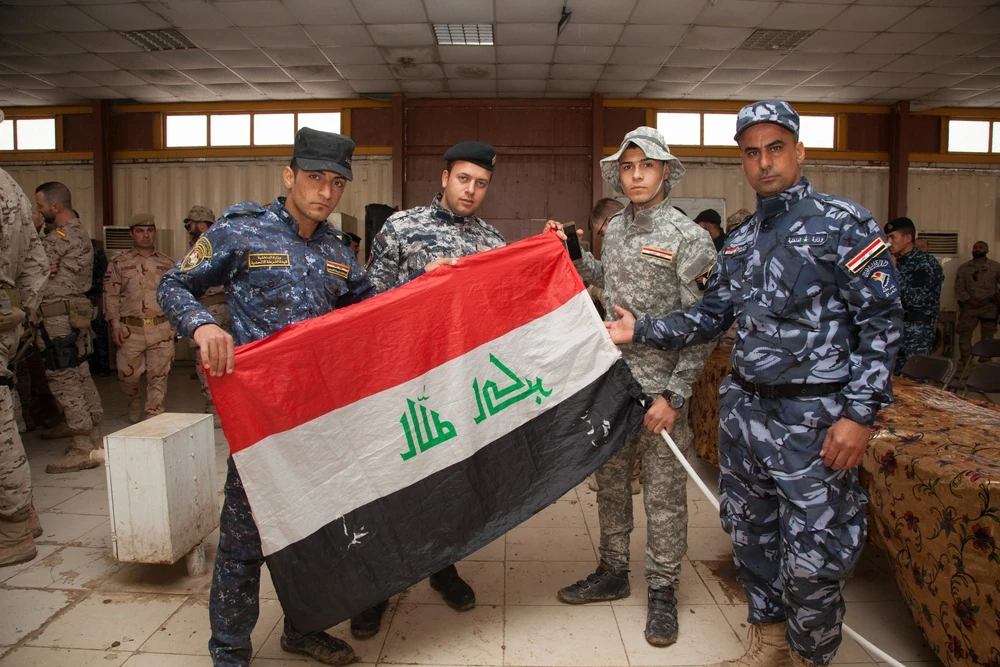
The graduation image is a public-domain U.S. Army photograph by Sgt. Joshua Wooten; the meeting image is an official U.S. Department of State photograph by Freddie Everett. Both retain their retrieved frames, with proportional WebP reductions and smaller responsive copies. Their captions describe the events at the time photographed, without implying endorsement.
What is the Iraq flag emoji?
The Iraq flag emoji is 🇮🇶. It combines the regional indicator symbols I and Q, with Unicode code points U+1F1EE and U+1F1F6. Depending on the platform, it may appear as a small flag or as letters. Its simplified presentation is useful in text but should not be treated as an accurate construction drawing.
The sequence corresponds to the country code IQ. At emoji scale, fine calligraphic details can disappear or vary between platforms. A small waving icon also does not provide a reliable way to measure the flag’s underlying rectangular ratio.
Use the full SVG or large PNG for a classroom sheet, reference drawing, or detailed comparison. Enlarging an emoji will not recover lettering that the platform’s tiny illustration omitted.
Which Iraq flag files can be downloaded here?
The downloads include a clean 3:2 SVG, a 6000×4000 PNG, inscription and construction diagrams, historical reconstructions, comparison sheets, and two documentary photographs. Each gallery item has a local download and an explanatory caption. The national master has no stars, borders, or teaching labels; historical and annotated images are identified separately.
| File type | Use |
|---|---|
| National SVG | Scalable current flag; 3000×2000 intrinsic dimensions |
| National PNG | 6000×4000 raster copy of the complete flag |
| Explanatory SVGs | Anatomy, calligraphy, proportions, history, and comparisons |
| Documentary WebP | Dated real-world photographs with credits |
| Credits text | Local filenames, captions, creators, and rights |
Download Iraq flag SVG · Download large PNG · Download credits.
The separate 1200×630 social preview includes a heading and descriptive text. It is a presentation graphic, not a replacement for the clean national master. Captions distinguish modern reconstructions from photographs and calculated size examples from statutory specifications.
Iraq flag pictures
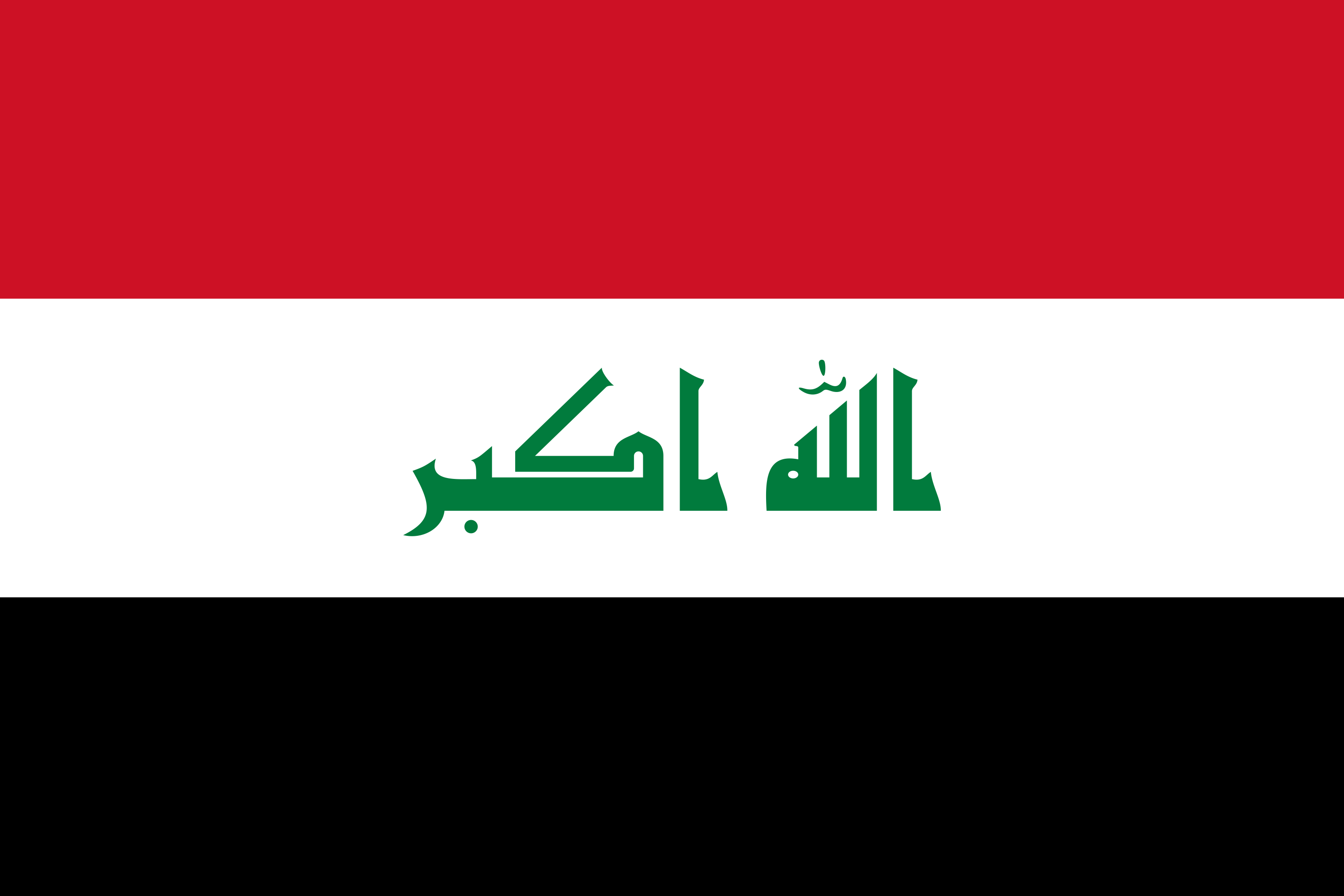
Iraq’s national flag has equal horizontal red, white, and black bands, with a green Allahu akbar inscription centered in the white band and no stars. Its width:height ratio is 3:2. This digital reference uses #CD1125, #FFFFFF, #000000, and #017B3D.
National design defined by Iraqi legislation; public-domain vector by Commons contributors including MapGrid. GKBook file preparation.Download image
The current design consists of red above white above black. Each horizontal band occupies one-third of the height. The green phrase in the white field distinguishes Iraq from a plain red-white-black tricolor.
GKBook composition, CC0; national flag reference geometry, public domain.Download image
Red #CD1125, white #FFFFFF, black #000000, and green #017B3D are the colors used in this reference. They are file-specific digital values, not a claim that the flag laws prescribe a universal computer or print palette.
GKBook composition, CC0; national flag reference geometry, public domain.Download image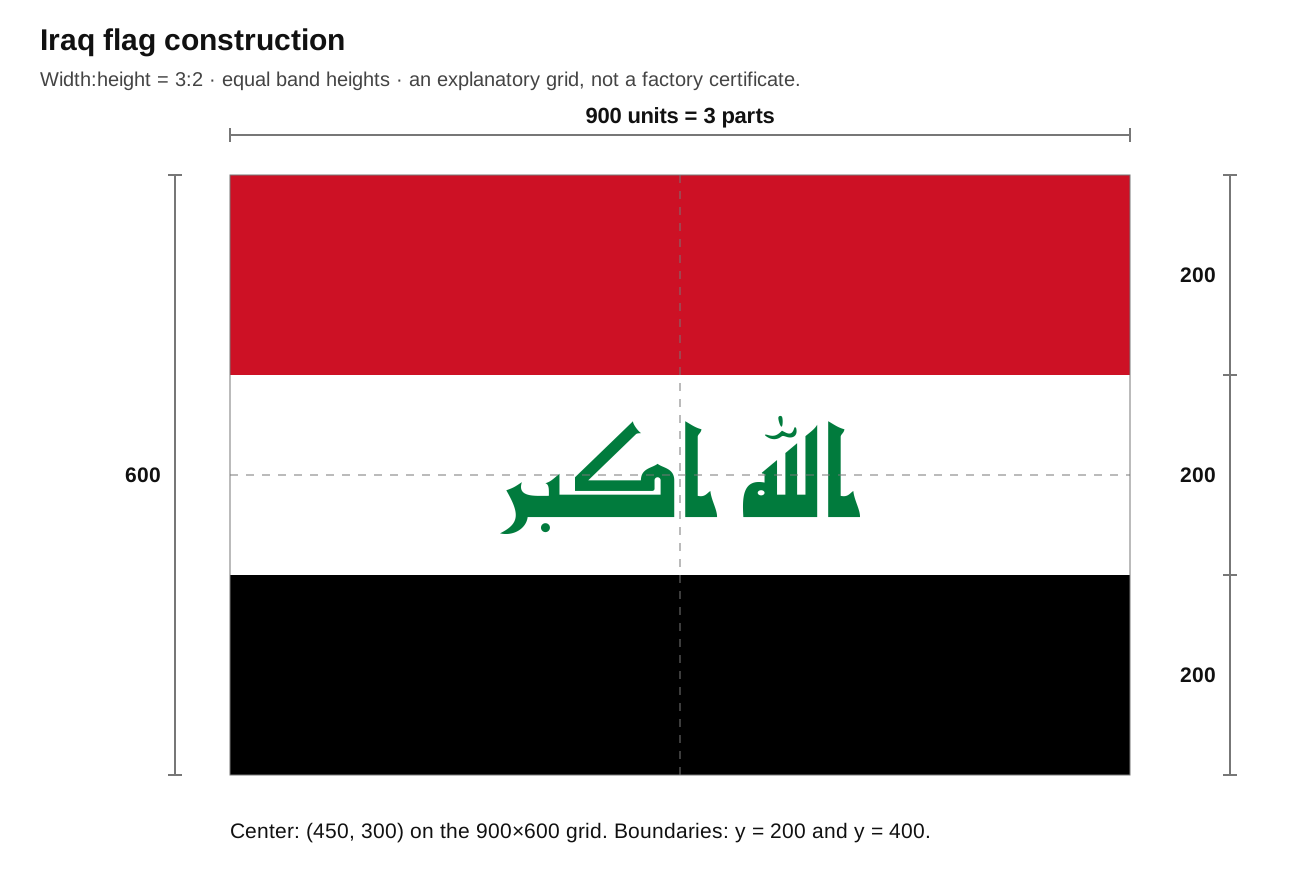
On a 900×600 teaching grid, each band is 200 units high and the geometric center is (450,300). The complete reference inscription is preserved. The grid explains overall proportions; the law’s placement wording and a manufacturer’s approved pattern must be checked separately.
GKBook composition, CC0; national flag reference geometry, public domain.Download image
The green Arabic words say Allahu akbar, commonly translated as “God is great.” The 2008 law specifies Kufic script. This detail reproduces the entire reference path, including its small marks, without replacing it with a modern text font.
GKBook composition, CC0; national flag reference geometry, public domain.Download image
Examples of 150×100, 90×60, and 30×20 centimeters all preserve the 3:2 width:height ratio. The pictures illustrate relative sizes. These are calculated examples rather than sizes assigned to official uses by Iraqi regulation.
GKBook composition, CC0; national flag reference geometry, public domain.Download image
The sequence separates the royal constitutional description, the 1959 republic flag, the three-star tricolor introduced in 1963, the inscription added in 1991, the Kufic form used after 2004, and the 2008 change with its later legal extension.
GKBook composition, CC0; national flag reference geometry, public domain.Download image
This modern reconstruction shows the royal type: a 2:1 rectangle with black-white-green horizontal bands, a red hoist trapezoid, and two white seven-pointed stars. The 1943 constitutional amendment describes these elements. It is not a photograph of an original royal flag.
GKBook composition, CC0; national flag reference geometry, public domain.Download image
An original modern reconstruction follows Law 102 of 1959: a 2:1 rectangle, equal vertical black-white-green bands, and a dark red eight-pointed star around a yellow disk with a white ring. The star and circle dimensions follow Article 3. Digital shades are illustrative, not statutory HEX codes.
GKBook reconstruction and annotations, CC0; based on the 1959 law.Download image
This modern reference illustrates the earlier red-white-black flag with three green five-pointed stars and no inscription. The 1963 law introduced that arrangement; the inscription was added under the 1991 amendment. This is a historical illustration, not the current national design.
GKBook composition, CC0; national flag reference geometry, public domain.Download image
The 2004–2008 reference has three stars with Kufic lettering; the current design has the lettering alone. Law 9 of 2008 expressly removed the stars and the reference to Saddam Hussein’s handwriting. The historical and current source palettes are retained independently.
GKBook composition, CC0; national flag reference geometry, public domain.Download image
Iraq’s National Day is observed on October 3, associated with its admission to the League of Nations on October 3, 1932. The anniversary is distinct from the current flag’s 2008 legal change. No separate nationwide Flag Day is asserted here.
GKBook composition, CC0; national flag reference geometry, public domain.Download image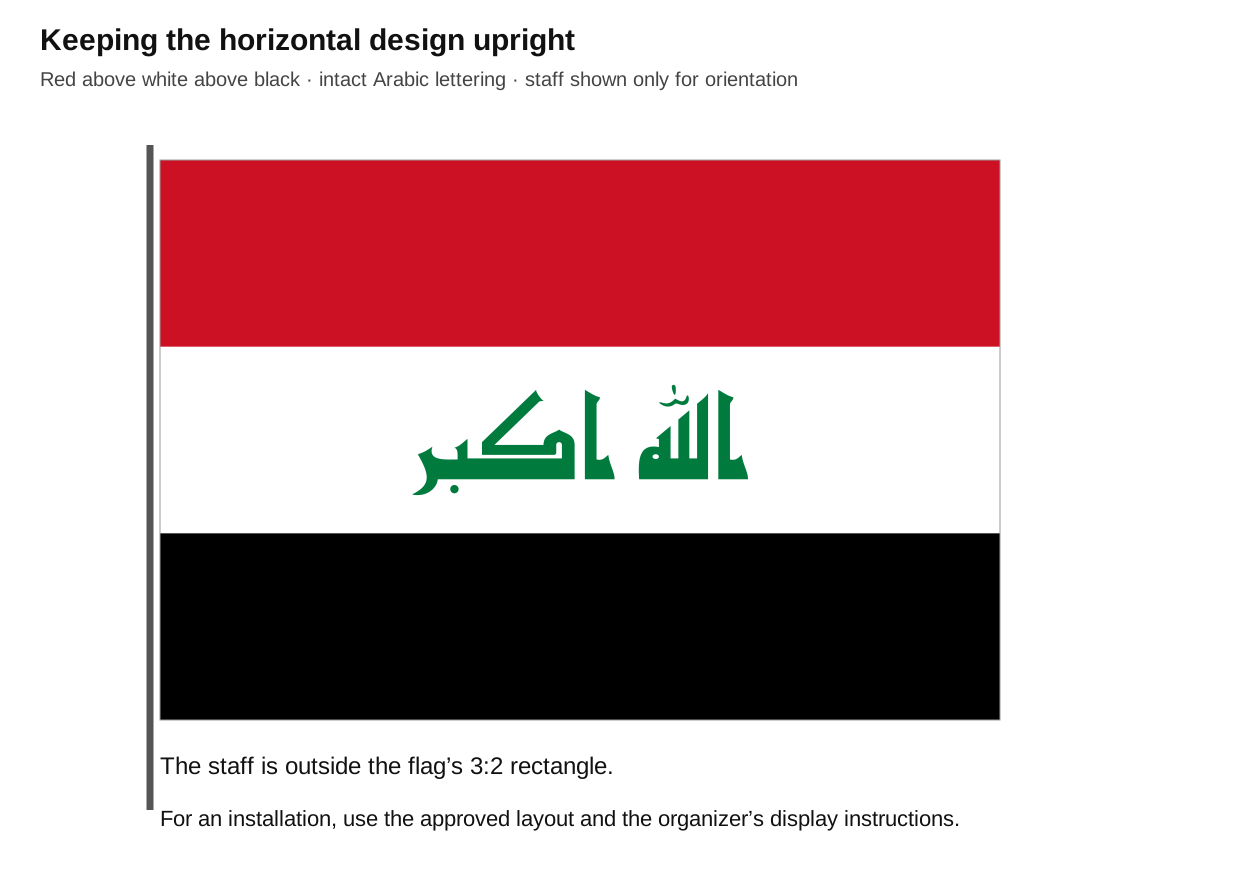
The horizontal reference keeps red at the top and black at the bottom, with the green inscription upright. The staff is an explanatory addition outside the national design. This illustration does not prescribe an unverified rule for all vertical displays, reverses, vehicles, or processions.
GKBook composition, CC0; national flag reference geometry, public domain.Download image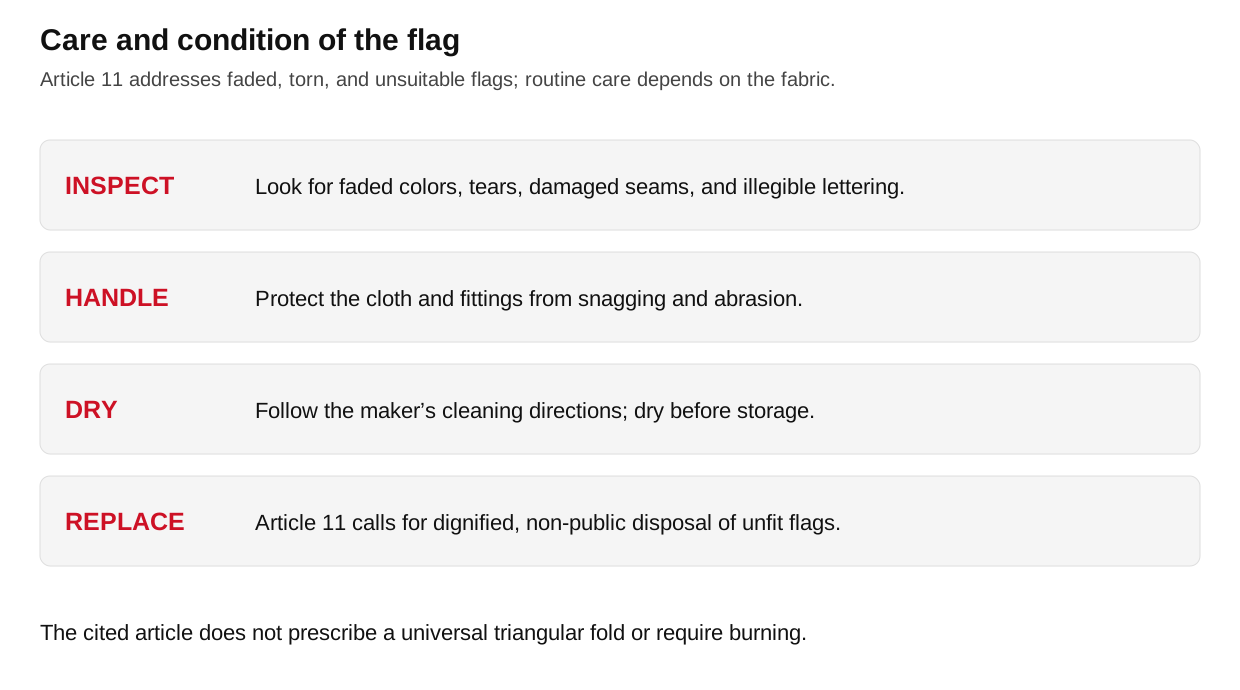
Article 11 of the 1986 law prohibits displaying flags that are faded, torn, or otherwise unfit and calls for disposal out of public view in a manner preserving dignity. Cleaning, drying, and protective storage are practical care advice; no mandatory burning method or special fold is inferred.
GKBook composition, CC0; national flag reference geometry, public domain.Download image
All four references use horizontal red-white-black bands. Iraq adds green words, Egypt has a gold-colored eagle, Yemen has no central device, and Sudan adds a green hoist triangle. The supplied width:height ratios are 3:2, 3:2, 3:2, and 2:1 respectively.
GKBook composition, CC0; national flag reference geometry, public domain.Download image
Iraqi security forces personnel hold an Iraqi flag at Besmaya Range Complex on March 23, 2017. The cloth faces the camera from its reverse, so its lettering appears mirrored.
Sgt. Joshua Wooten, U.S. Army. Public domain, U.S. government work. The appearance of U.S. Department of War (DoW) visual information does not imply or constitute DoW endorsement.Download image
Iraqi and U.S. flags stand beside Fuad Hussein and Marco Rubio during their meeting at the U.S. Department of State in Washington, D.C., on April 25, 2025.
Freddie Everett, U.S. Department of State. Public domain, U.S. government work.Download imageFrequently asked questions
What does the flag of Iraq look like?
Iraq’s national flag has three equal horizontal bands: red at the top, white in the middle, and black at the bottom. A green Arabic inscription, Allahu akbar, sits in the white band. The current design has no stars. Its width-to-height ratio is 3:2, also written 2:3 when height comes first.
What are Iraq’s flag colors and their HEX or RGB values?
Iraq’s flag uses red, white, black, and green. The supplied digital drawing uses red #CD1125, white #FFFFFF, black #000000, and green #017B3D. Their RGB values are 205,17,37; 255,255,255; 0,0,0; and 1,123,61. These are file-specific screen values; the reviewed flag laws do not identify them as universal statutory HEX codes.
What do the colors and inscription of Iraq’s flag mean?
The 2008 amendment says that Iraq’s flag colors represent the colors of Islamic banners. It gives that collective explanation rather than assigning a separate modern meaning to each stripe. The green inscription is a religious declaration, Allahu akbar. The amendment also removed the three stars and their meanings from the earlier flag.
What do the Arabic words on Iraq’s flag say?
The green words say Allahu akbar, commonly translated as “God is great” or “God is greatest.” In ordinary Arabic writing, the phrase is الله أكبر. It is read from right to left. Iraq’s flag displays the phrase once in the white band, using the Kufic script specified in the 2008 law.
Why does Iraq’s flag use Kufic script?
Law 9 of 2008 expressly specifies Kufic script for the phrase Allahu akbar. It removes the earlier legal reference to Saddam Hussein’s handwriting. A Kufic form had already been used in practice after 2004, but the 2008 amendment states the requirement in law. Script style and the continued presence of the religious words are separate details.
What is the aspect ratio of Iraq’s flag?
Iraq’s flag is three units wide for every two units high. The law describes the shorter dimension as two-thirds of the longer one. The red, white, and black bands have equal height, so each occupies one-third of the whole flag. A 150-centimeter-wide example would therefore be 100 centimeters high.
How can Iraq’s flag be drawn accurately?
Start with a 3:2 rectangle and divide its height into three equal bands: red, white, and black. Place the complete green Kufic inscription in the central white field, with no stars. Preserve the calligraphy’s shape when scaling. The construction diagram explains the overall grid; legal placement wording and approved production artwork require separate attention.
What sizes can an Iraqi flag have?
The 3:2 proportion can be used at many sizes: 150×100 centimeters, 90×60 centimeters, and 30×20 centimeters are examples with width first. These are calculated illustrations, not an official size schedule. Whatever the scale, keep the bands equal and preserve the inscription. For an official commission, use the applicable approved pattern and institutional requirements.
How has Iraq’s flag changed over time?
Iraq’s flag history includes a royal horizontal tricolor, a distinctive republican vertical tricolor, and several red-white-black designs. The three green stars introduced in 1963 were later joined by a religious inscription, then removed in 2008. Changes in government, script, legislation, and actual use need separate dates rather than a single simplified sequence.
What did the royal flag of Iraq look like?
The royal flag type had horizontal black, white, and green bands, a red trapezoid at the hoist, and two white seven-pointed stars. The 1943 constitutional amendment described a rectangle twice as long as it was high. The illustration is a modern reconstruction of that historical type, not an archival photograph or the current national flag.
What was Iraq’s flag from 1959 to 1963?
The 1959 republic flag used vertical black, white, and green bands within a 2:1 rectangle. A dark red eight-pointed star filled the center, enclosing a yellow disk with a white ring. Law 102 of 1959 prescribed the design and directed that its use begin on July 14, 1959, a year after the revolution it commemorated.
What did the three stars on older Iraqi flags mean?
The three green stars first appeared in the 1963 red-white-black design. That law’s rationale referred to a planned federal union of Egypt, Syria, and Iraq. The 1986 law later associated the stars with unity, freedom, and socialism. The 2008 amendment removed both the stars and their meanings, so they do not belong on today’s flag.
When was Allahu akbar added to Iraq’s flag?
The green phrase Allahu akbar was added under Law 6 of 1991. The amendment retained the three stars and placed the words between them, explicitly referring to Saddam Hussein’s handwriting. The phrase itself survived later revisions, but that handwriting reference and the stars were removed from the law in 2008, which specified Kufic script instead.
What happened to Iraq’s flag in 2004?
A Kufic form of the inscription came into use after 2004 while the three green stars remained. A separate white flag proposal with a pale blue crescent and blue-and-yellow bands was also announced that year but did not become the enduring national design. These were different developments and should not be merged into one supposedly adopted flag.
When was the current Iraqi flag adopted?
Parliament approved the current starless design on January 22, 2008. The Presidency Council issued Law 9 on January 29, and it appeared in the official gazette on February 5. The law removed the three stars, retained Allahu akbar, and specified Kufic script. Parliamentary approval, legal issuance, and publication are distinct dates.
Was Iraq’s 2008 flag only temporary?
The original 2008 law limited the arrangement to one year while a new flag law was expected. Law 32 of 2009 removed that deadline and continued it until a new flag law was issued. The amendment applied from January 29, 2009. Describing the current design as automatically expired after its first year misses that later legislation.
Which laws define Iraq’s national flag?
The legal framework combines the constitutional requirement for a flag law with Law 33 of 1986 and its amendments. Law 6 of 1991 added the inscription; Law 9 of 2008 removed the stars and specified Kufic script; Law 32 of 2009 extended the arrangement. Reading only an older unamended description can produce the wrong flag.
When is Iraq’s National Day, and is it a Flag Day?
Iraq’s National Day is observed on October 3, associated with admission to the League of Nations on October 3, 1932. Official statements connect the occasion with sovereignty and national belonging. This is different from the 2008 flag change. The reviewed federal material did not establish a separate nationwide annual Flag Day for the current Iraqi flag.
Is the flag of the Kurdistan Region the same as Iraq’s national flag?
No. Iraq’s national flag is red, white, and black with green Arabic words. The Kurdistan Region’s flag uses red, white, and green with a yellow sun of 21 rays. They identify different levels of political community. Kurdistan Flag Day on December 17 is a regional observance and should not be assigned to the federal Iraqi flag.
Which way should Iraq’s flag be displayed?
In the horizontal reference view, red is above white and black, and the green Arabic words remain upright and complete. Read the inscription from right to left. A photograph of thin cloth from its reverse may show mirrored lettering. For a vertical installation or a ceremonial arrangement, confirm the approved layout rather than assuming every rotation is equivalent.
What does Iraq’s flag law say about official display?
The 1986 law gives the flag a place of honor and says that no other flag is raised above it in Iraq. It generally describes raising at sunrise and lowering at sunset, subject to exceptions set by regulation. It also leaves detailed building, ceremony, vehicle, and military arrangements to implementing rules rather than prescribing everything in the design clause.
Is Iraq’s flag flown at half-mast during mourning?
Article 3 of the 1986 law says that Iraq’s flag is not to be lowered or dipped on any occasion. Actual reported practice has not been entirely uniform: parliament held a brief lowering ceremony in March 2015. That documented event does not erase the statutory wording or establish a general half-mast schedule for every Iraqi institution.
How should an Iraqi flag be cared for or retired?
Article 11 of the 1986 law says not to display a flag whose colors are faded, whose fabric is torn, or whose condition is unsuitable. It calls for disposal outside public view in a way that preserves dignity. For routine care, follow the fabric maker’s cleaning directions, dry damp cloth, and protect it during storage.
What common mistakes should be avoided when drawing Iraq’s flag?
The most common identification errors are adding the old three stars, omitting the green inscription, reversing the red and black bands, or stretching the 3:2 rectangle. Other mistakes include typing an unrelated Arabic font, mirroring the front-view wording, and treating a historical proposal as the current flag. Keep teaching labels and dimension lines outside the clean master.
How is Iraq’s flag different from Egypt, Yemen, and Sudan?
Iraq, Egypt, Yemen, and Sudan all use horizontal red-white-black bands in the references shown. Iraq has green Arabic words; Egypt has a gold-colored eagle; Yemen has no central device; and Sudan has a green triangle at the hoist. The first three references are 3:2, while Sudan’s is 2:1, with width stated first.
What do real photographs show about Iraq’s flag?
The photographs show the current design as cloth in two dated settings: a security-forces graduation at Besmaya in 2017 and a diplomatic meeting in Washington in 2025. Folds, lighting, and the viewing side affect its appearance. The pictures document those occasions; the flat national reference is better for examining the full inscription and exact proportions.
What is the Iraq flag emoji?
The Iraq flag emoji is 🇮🇶. It combines the regional indicator symbols I and Q, with Unicode code points U+1F1EE and U+1F1F6. Depending on the platform, it may appear as a small flag or as letters. Its simplified presentation is useful in text but should not be treated as an accurate construction drawing.
Which Iraq flag files can be downloaded here?
The downloads include a clean 3:2 SVG, a 6000×4000 PNG, inscription and construction diagrams, historical reconstructions, comparison sheets, and two documentary photographs. Each gallery item has a local download and an explanatory caption. The national master has no stars, borders, or teaching labels; historical and annotated images are identified separately.
Explore all general-knowledge topics and the A-to-Z lists.

We Value Your Opinion Comments