
Iran flag picture
Explore the central emblem, border calligraphy, and construction sheet.

| Design | Green · white · redThree equal horizontal bands with emblem and lettering. |
|---|---|
| Proportion | 7:4 width:heightAlso written 4:7 when height is first. |
| Modern design | 1980Emblem and complete-flag approvals were separate events. |
| Designer | Hamid NadimiCreator of the modern emblem and flag design. |
| Central emblem | Allah / divine onenessRed monogram with crescent forms and a central upright. |
| Border inscription | Allahu akbar · 22 times11 in green and 11 in red, recalling 22 Bahman. |
| Digital palette | #239F40 · #FFFFFF · #DA0000Values in this artwork, not statutory HEX specifications. |
| National Day | February 11Anniversary of the revolution’s victory in 1979. |
Iran’s 7:4 flag has three equal horizontal bands. The central monogram and two rows of eleven inscriptions identify the modern design, while the number 22 recalls 22 Bahman.
What does the flag of Iran look like?
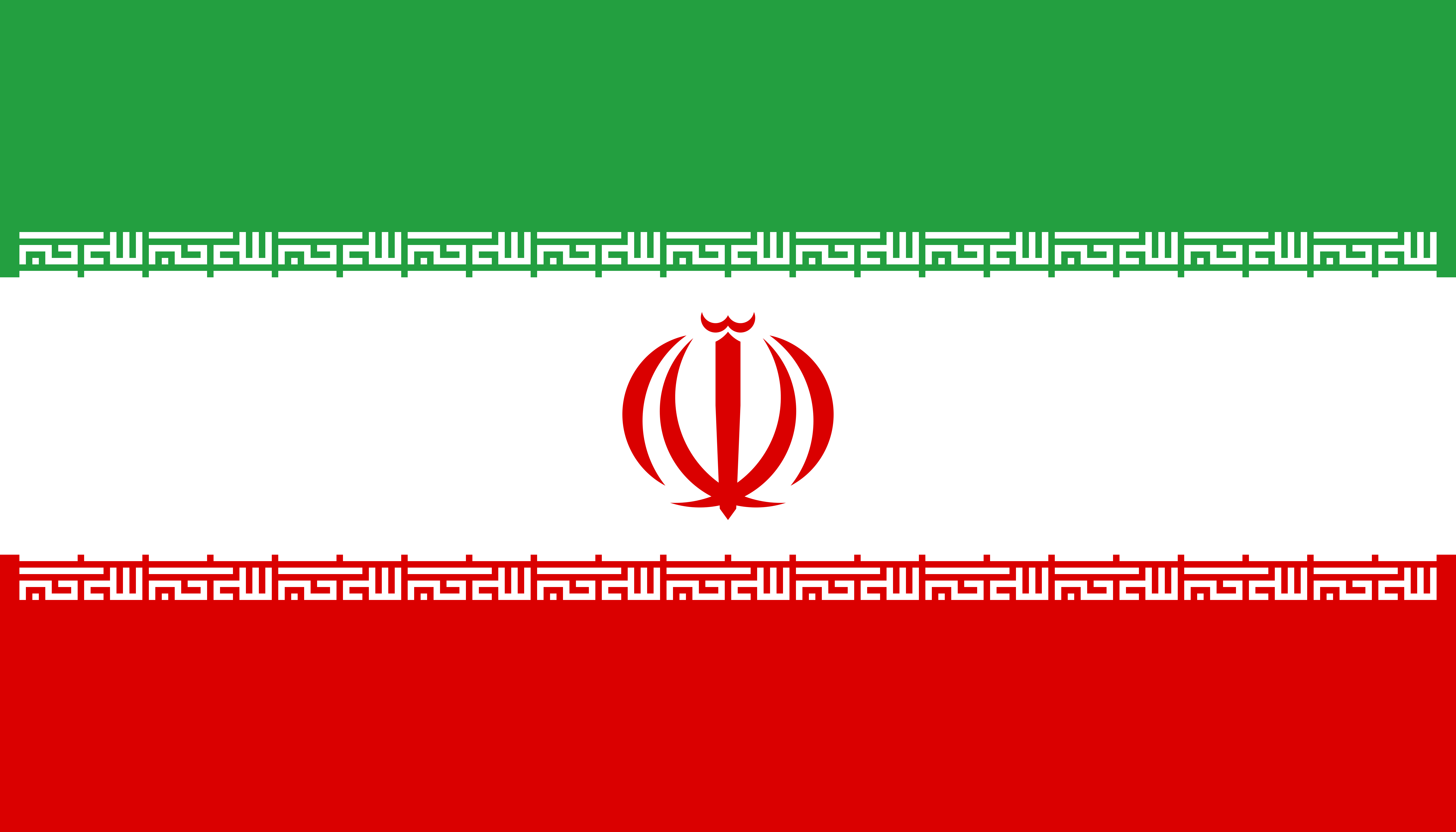
Iran’s national flag has three equal horizontal bands: green at the top, white in the middle, and red at the bottom. A red religious emblem occupies the center. White geometric inscriptions appear 11 times along each colored border beside the white band, making 22 repetitions. The width-to-height proportion is 7:4.
The central device and the border lettering are essential identifying features. A plain green-white-red tricolor leaves out both. The ordinary flag is a rectangle, while a photograph may show it folded, hanging, or moving in the wind.
What is the red symbol in the center of Iran’s flag?
The central red emblem is a stylized religious monogram associated with Allah and the declaration of divine oneness. It combines four crescent forms, a sword-like central upright, and a small shadda above. The design is symmetrical and was created by Hamid Nadimi. It should be reproduced as complete artwork, including its small upper mark.
One integrated emblem
The informative appendix to the national standard explains both the word Allah and the declaration commonly rendered “There is no god but God” within the design. These are explanations of its religious symbolism; the shape is not ordinary typeset Arabic.
The upright is commonly described as a sword. The curved forms, central element, and doubled mark work together, so replacing them with a generic crescent and star loses the distinctive design.
What are Iran’s flag colors and their RGB or HEX values?
Iran’s flag is green, white, and red. The downloadable digital reference uses green #239F40, white #FFFFFF, and red #DA0000. These correspond to RGB 35,159,64; 255,255,255; and 218,0,0. They are file-specific screen values: the reviewed 2016 national standard defines measured color ranges and a physical reference rather than universal HEX codes.
| Color | HEX in this artwork | RGB in this artwork |
|---|---|---|
| Green | #239F40 | 35, 159, 64 |
| White | #FFFFFF | 255, 255, 255 |
| Red | #DA0000 | 218, 0, 0 |
The standard’s color provisions use chromaticity coordinates, luminance limits, a reference illustration, and specified measurement conditions. A screen swatch cannot establish that a dyed or printed textile meets those requirements. No unverified Pantone or CMYK equivalent is presented as an official specification.
Photographic light and cloth folds can make green or red look darker. Select the clean master for a consistent digital presentation, and use the applicable physical standard when commissioning a flag that needs certified conformity.
What do the colors and emblem of Iran’s flag mean?
The standard’s informative appendix connects green with the high ideals of Islam, white with tawhid or divine oneness, and red with blood and struggle. The central emblem also expresses Allah and divine oneness. These are the interpretations followed here; broader popular descriptions such as hope or peace should not automatically replace this specific explanation.
The distinction between a design rule and an explanation matters. Equal band heights, a centered red emblem, and repeated white lettering describe measurable features. The appendix’s religious and revolutionary reading explains what those features mean within the official design tradition.
Different educational summaries may attach other familiar meanings to green, white, and red. Such descriptions can be discussed as interpretations, but they should be identified as such. The factbox and this section consistently use the informative appendix’s account.
Why is Iran’s national emblem symmetrical?
The emblem’s left and right sides mirror each other around a central vertical axis. The standard describes symmetry as part of the design and associates it with balance. Its informative explanation also relates the five principal parts to five fundamental religious principles; that wording should not be casually replaced with a different list of religious practices.
The mandatory construction appendix develops the design geometrically and completes the opposite half by reflection. The small mark above the upright is a shadda, a sign associated with doubling in Arabic writing; in the emblem it forms part of the integrated symbol.
The informative appendix also invokes a tulip in its poetic discussion of the declaration and martyrdom. That is symbolic language: the emblem remains a deliberately constructed monogram rather than a botanical illustration.
Counting the five principal elements is different from counting vector paths in a computer file. An illustrator may use several curves to draw a single meaningful element. File structure is a method of drawing, not an additional doctrine encoded in the flag.
What do the words on Iran’s flag say?
The repeated inscription is Allahu akbar, commonly translated as “God is greatest.” It is written in white using geometric Kufic Banna’i lettering along the edges of the green and red bands next to the white field. The words form two rows, and each row contains 11 repetitions of the same phrase.
The phrase in ordinary Arabic writing is الله أكبر. Its rectilinear appearance on the flag comes from a calligraphic construction associated with architectural inscriptions. The small shapes should therefore be preserved as lettering, not simplified into an arbitrary ornamental border.
The lettering joins the central white area. Its placement and connections are part of the design. Typing the phrase in an ordinary font and repeating it across the flag would not reproduce the prescribed geometric border.
Why is Allahu akbar repeated 22 times on Iran’s flag?
The 22 repetitions recall 22 Bahman, the revolution’s victory date in the Iranian Solar Hijri calendar. There are 11 inscriptions in the green band and 11 in the red band. Bahman is the calendar’s eleventh month, and the commemorated event occurred on February 11, 1979. The numbers connect the border directly with that date.
The July 1980 specification resolution explicitly relates the total to 22 Bahman. The design uses two complete rows, rather than 22 repetitions in each row. Counting only an isolated letter shape or a small border segment will give the wrong total.
When evaluating a digital drawing, check the entire width of both rows. At very small sizes, nearby white strokes can merge on a screen, so an enlarged detail is more reliable than a tiny emoji or thumbnail.
What is the aspect ratio of Iran’s flag?
Iran’s national flag has a length-to-height ratio of 7:4, also written 4:7 when height is listed first. A flag 175 centimeters long is therefore 100 centimeters high. The three main bands have equal height before the border lettering is added, so each occupies one-third of the basic rectangular field.
| Width or length | Height | Nominal height of each band |
|---|---|---|
| 630 units | 360 units | 120 units |
| 175 cm | 100 cm | 33⅓ cm |
| 3150 pixels | 1800 pixels | 600 pixels |
| 6300 pixels | 3600 pixels | 1200 pixels |
The order of dimensions explains why 7:4 and 4:7 can both describe the same flag. Throughout this page, width or length comes first. Preserve that relationship when resizing a file; stretching it into a square or a wide banner changes its proportions.
How can Iran’s flag be drawn accurately?
Begin with a 7:4 rectangle and divide it into three equal horizontal bands, green, white, and red. Center the complete red emblem in the white band. Then place the prescribed white calligraphy along both adjoining colored edges, with 11 repetitions per row. Use verified vector geometry for these details rather than improvising the letters or emblem.
The reference supplied here uses a 630×360 coordinate system: band boundaries lie at y=120 and y=240, and the flag’s center is (315,180). The clean SVG scales that complete drawing uniformly to 3150×1800. The PNG doubles those dimensions to 6300×3600.
The construction sheet explains overall placement. Detailed factory acceptance also involves the national standard’s geometric, sewing, material, and color requirements. The learning diagram is not a certificate of textile conformity, and its dimension lines do not belong on a flag being manufactured.
What flag sizes does Iran’s national standard list?
The reviewed 2016 standard lists 12 nominal flag sizes, from 262×150 millimeters to 3500×2000 millimeters, with length written first here. It also allows other sizes that preserve the 7:4 proportion and applicable sewing requirements. The smallest printed length is rounded: an exact 7:4 rectangle at 150 millimeters high would be 262.5 millimeters long.
| Size number | Length × height, millimeters |
|---|---|
| 1 | 262 × 150 |
| 2 | 840 × 480 |
| 3 | 1050 × 600 |
| 4 | 1225 × 700 |
| 5 | 1400 × 800 |
| 6 | 1575 × 900 |
| 7 | 1750 × 1000 |
| 8 | 2100 × 1200 |
| 9 | 2450 × 1400 |
| 10 | 2800 × 1600 |
| 11 | 3150 × 1800 |
| 12 | 3500 × 2000 |
The table is a dimensional list, not a schedule assigning each size to a particular official, building, or vehicle. The same standard discusses hems and sleeves. Select dimensions suited to the pole and setting while retaining the design and using suitable construction.
What does the standard say about flag fabric and manufacture?
The reviewed standard addresses more than the printed picture: it includes cloth, strength, colorfastness, sewing, dimensions, and the flag’s sleeve. It permits several fiber types and both woven and knitted construction. Material choices should suit the intended conditions, while the detailed emblem and inscriptions must remain recognizable and the specified proportions must be preserved.
The material provisions include cotton, silk, acrylic, polyester, and specified blends. For warm, humid conditions, the standard recommends polyester or acrylic. Testing and acceptance provisions address strength and the stability of color under relevant exposure conditions; these cannot be assessed from a downloaded image alone.
The dimensional clause allows a tolerance of ±2% for length and height and ±4% for the sleeve. A manufacturing tolerance is not a reason to deliberately distort the clean reference artwork. It describes the acceptance of a physical product within the reviewed standard’s framework.
How has Iran’s flag changed over time?
Iran’s green-white-red color tradition predates the Islamic Republic. The 1907 supplementary constitution specified those colors with the Lion and Sun emblem. After the 1979 revolution, the modern design introduced a different central emblem and repeated border inscriptions. The timeline distinguishes constitutional definitions, emblem approval, technical specifications, and later standard revisions instead of treating them as one event.
Constitutional Lion and Sun definition
Article 5 of the Supplementary Fundamental Laws specified green, white, and red with the Lion and Sun emblem.
Measurements restated
Encyclopaedia Iranica records a restatement of flag measurements and form before the revolution.
Revolution victory date
The date 22 Bahman later became the numerical reference for the 22 border inscriptions.
New constitutional definition
Article 18 identified the three colors, the Islamic Republic’s emblem, and Allahu akbar.
Emblem approval
The standard’s informative appendix records approval on 19 Ordibehesht 1359.
Flag specification resolution
The Revolution Council resolution specified the red emblem and the 11-plus-11 border inscriptions.
Earlier standard edition
The archived third edition provides a historical technical reference.
Second revision examined
The reviewed national standard covers the flag’s design, colors, textiles, sizing, and geometric construction.
What was the Lion and Sun flag of Iran?
The earlier Iranian tricolor carried a Lion and Sun emblem instead of the modern religious monogram and border inscriptions. The symbol’s history predates the Pahlavi dynasty, and its appearance varied across periods. The example shown here is a modern reconstruction of a historical flag type, not a surviving flag or a certified original construction drawing.
The 1907 constitutional provision names the Lion and Sun but does not turn every later illustration into an exact 1907 pattern. Historical flags can differ in drawing, accessories, shades, and proportions. A modern clean vector should not be captioned as a photograph of the original cloth.
The reconstruction included here preserves the full downloaded drawing and its own palette. Its contributors standardized this version in 2026. That modern preparation date is separate from the period represented by the older emblem.
When was the modern Iranian flag adopted?
The modern emblem-and-inscription design dates to 1980. The standard records approval of the emblem on May 9, while the Revolution Council’s flag specification resolution is dated July 6. These are separate milestones: approval of the central emblem, legal description of the complete flag, and later administrative publication should not be collapsed into a single undocumented event.
| Recorded event | Date | What it establishes |
|---|---|---|
| Emblem approval | May 9, 1980 · 19 Ordibehesht 1359 | The central symbol’s approval, recorded in the standard |
| Council resolution | July 6, 1980 · 15 Tir 1359 | The full flag description, including 22 inscriptions |
| Forwarding document | July 26, 1980 · 4 Mordad 1359 | Administrative communication, numbered 6930 |
| Gazette entry | August 25, 1980 · 3 Shahrivar 1359 | Publication identified as issue 10339 |
Many modern catalogs give July 29, 1980 as an adoption date. The primary resolution reproduced in the reviewed legal archive carries the earlier Council date. This page therefore uses 1980 for the concise adoption fact and supplies the documentary milestones rather than treating the catalog date as the resolution’s date.
Who designed Iran’s modern flag and emblem?
Hamid Nadimi, an Iranian architect and graphic designer, created the modern emblem and worked on the flag design. His account, reproduced in a 2017 report, describes submitting an emblem proposal and later being asked to develop the complete flag. His authorship concerns the modern design, not the origin of Iran’s older green-white-red color tradition.
The central monogram and its balanced geometry are the most distinctive parts of Nadimi’s design. His explanation connects the elements with religious concepts. Those intentions help explain the artwork, while the national standard provides the technical reference for drawing and manufacture.
Attributing a design to its creator is different from crediting the author of a modern digital file. The downloadable SVG preserves a later vector rendering of the national design; it is not presented as Nadimi’s original working file.
Which documents define Iran’s flag?
Article 18 of Iran’s constitution identifies the green, white, and red flag with the Islamic Republic’s emblem and Allahu akbar. The 1980 specification resolution describes the red central emblem and 22 white inscriptions. National Standard 1 supplies technical detail. This article examines its 2016 second revision without claiming that a later standards catalog has been exhaustively verified.
| Document | Role |
|---|---|
| Constitution, Article 18 | Basic constitutional identity of the flag |
| 1980 specification resolution | Placement, color, script, and count of the inscriptions |
| National Standard 1, 2016 second revision | Geometric construction, physical colors, materials, sewing, and sizes |
| Earlier archived standard, 1993 | Historical comparison; not silently substituted for the reviewed revision |
An online filename containing the word “official” is not itself evidence of conformity. For example, one circulating construction variant uses a 1000×572.2 canvas, which is close to but not exactly 7:4. The downloadable master here preserves the exact 7:4 rectangle stated in the reviewed standard.
This distinction is especially useful when comparing artwork from different dates. Check the actual dimensions and visible details, then identify the edition of the standard being applied.
When is Iran’s National Day, and how is it linked to the flag?
Iran’s National Day is listed as February 11 in diplomatic calendars. It commemorates the revolution’s victory on 22 Bahman 1357, corresponding to February 11, 1979. The flag’s 22 inscriptions refer to that Iranian-calendar date. The emblem’s May 9, 1980 approval is a different historical anniversary and should not be relabeled as National Day.
The Iranian date uses the Solar Hijri calendar, with Bahman as its eleventh month. The combination of the day number and the two groups of eleven explains why the border is arranged as it is.
This article uses National Day in the navigation because a separate nationwide statutory Flag Day was not established by the reviewed material. That is a limit of the evidence, not a claim that no local flag-related ceremony or commemoration ever occurs.
Which way should Iran’s flag face, and where is the sleeve?
In the standard’s ordinary front-view description, green is above white and red, and the sleeve is normally sewn on the right side unless otherwise agreed. Keep the emblem upright and the calligraphy intact. This construction convention should not be expanded into an invented universal rule for every wall display, procession, vehicle, or vertically hung banner.
The sleeve is the fabric channel used to attach the flag to a staff or cord arrangement. It sits alongside the flag design and does not create a fourth colored band. A drawing of a free-standing flag can omit that hardware while retaining the correct field.
When preparing a vertical installation, obtain the organizer’s applicable protocol and an approved layout. Rotating a rectangular graphic without checking the emblem and Arabic lettering can leave the design difficult to read. The horizontal master is the verified orientation supplied here.
How should an Iranian flag be prepared for a ceremony?
Prepare a correctly proportioned flag with a complete emblem, readable border lettering, sound seams, and secure fittings. Confirm the organizer’s instructions for the location, timing, raising, lowering, and any other flags present. The documents reviewed here establish design and manufacture; they do not justify importing another country’s complete ceremonial code into Iran’s flag guidance.
Before raising the flag, check that the cloth can move without catching on the building, pole fittings, or nearby branches. Keep it clean and handle it carefully. These practical steps protect the textile and help display the design clearly.
A photograph documents one occasion, not necessarily a rule for all occasions. Likewise, the dimensional standard alone does not establish universal sunrise-to-sunset hours, a nighttime lighting requirement, an order of precedence, or a mandatory salute. Use the applicable institutional directions for those decisions.
When is Iran’s flag flown at half-mast?
Iran’s flag can be lowered as a sign of official mourning. A documented example shows it at half-mast at the Iranian embassy in Jakarta on May 20, 2024, after the presidential helicopter crash. The applicable announcement and institution determine the occasion and arrangements; this historical example does not establish a permanent schedule or a current mourning order.
The accompanying illustration shows space between the flag and the top of the staff. Its position is explanatory, not a claim that Iranian rules prescribe a particular fraction of pole height or the exact movement sequence used in another country.
For an actual ceremony, follow the relevant authority’s directions and confirm when normal display resumes. The constitutional design provision and the technical manufacturing standard are not, by themselves, a comprehensive mourning protocol.
Why does Iran’s flag appear at embassies and diplomatic meetings?
A national flag identifies the state represented at an embassy or official meeting. The photographs here show Iranian flags at an embassy building in Budapest in 2008 and at a bilateral meeting in New York in 2015. Their dates and settings matter: they document particular displays and should not be treated as proof of every diplomatic protocol rule.
The building photograph shows a flag partially folded around its staff and obscured by branches. The meeting photograph places the Iranian design beside the U.S. flag. Together they illustrate how a flat national design appears in architectural and indoor ceremonial settings.
No current officeholder, current embassy address, or current diplomatic relationship is inferred from either image. The captions describe the people and locations at the time the photographs were made.
How should an Iranian flag be cleaned, folded, and stored?
Inspect the fabric, seams, fastenings, emblem, and small border lettering before display. Follow the maker’s cleaning instructions, allow damp cloth to dry, and store it in a clean, dry place. These are practical textile-care suggestions. The reviewed design standard does not establish a universal ceremonial folding sequence or a single mandatory method of retiring a worn flag.
The closely spaced calligraphy makes abrasion and poor printing particularly noticeable. Avoid handling that snags loose threads or damages the printed surface. If the flag becomes too worn for its intended display, replacement preserves a clearer representation of the national design.
Historic cloth requires specialist conservation. Ordinary washing, ironing, or storage advice for a modern commercial flag should not be applied automatically to a fragile museum object or an important ceremonial artifact.
What common mistakes should be avoided when drawing Iran’s flag?
Common errors include reversing green and red, stretching the 7:4 rectangle, leaving out the central emblem, using a generic crescent, and replacing the border words with decorative zigzags. Each row needs 11 complete inscriptions. The Lion and Sun belongs to an earlier flag tradition and should not be inserted into the modern design without clear historical labeling.
| Check | Correct feature |
|---|---|
| Band order | Green, white, red from top to bottom |
| Shape | 7:4 width:height |
| Central device | Complete red national monogram, upright and centered |
| Lettering | White Kufic Banna’i; 11 full repetitions per row |
| Historical label | Modern Lion and Sun reconstructions identified separately |
| Color claims | File-specific HEX distinguished from physical standard requirements |
Do not add slogans, watermarks, labels, or numbering to the clean flag master. The educational sheets place explanations around or over selected details for teaching and identify those overlays. They are separate from the unannotated national flag download.
How is Iran’s flag different from Hungary, Tajikistan, and Italy?
Iran uses horizontal green-white-red bands with its red emblem and 22 white inscriptions. Hungary has horizontal red-white-green bands without an emblem in the reference shown. Tajikistan also uses red-white-green, but its white band is wider and carries a crown with seven stars. Italy places green, white, and red in vertical bands.
| Country | Reference width:height | Main identifying feature |
|---|---|---|
| Iran | 7:4 | Central red emblem and two rows of inscriptions |
| Hungary | 2:1 | Red above white above green; plain field |
| Tajikistan | 2:1 | Wider white band; crown and seven stars |
| Italy | 3:2 | Vertical bands, green at the hoist |
These comparisons retain each reference’s own digital colors. Similar color names do not mean identical national color specifications. Orientation, stripe order, relative band widths, and symbols provide more dependable identification than the appearance of a shade on an uncalibrated screen.
What do real photographs show about Iran’s flag?
Real photographs show the flag as a physical object affected by folds, light, mounting, and surroundings. The two examples here document an embassy display in Budapest in 2008 and a diplomatic meeting in New York in 2015. Neither photograph is a color standard or a substitute for the flat drawing used to inspect proportions and small lettering.
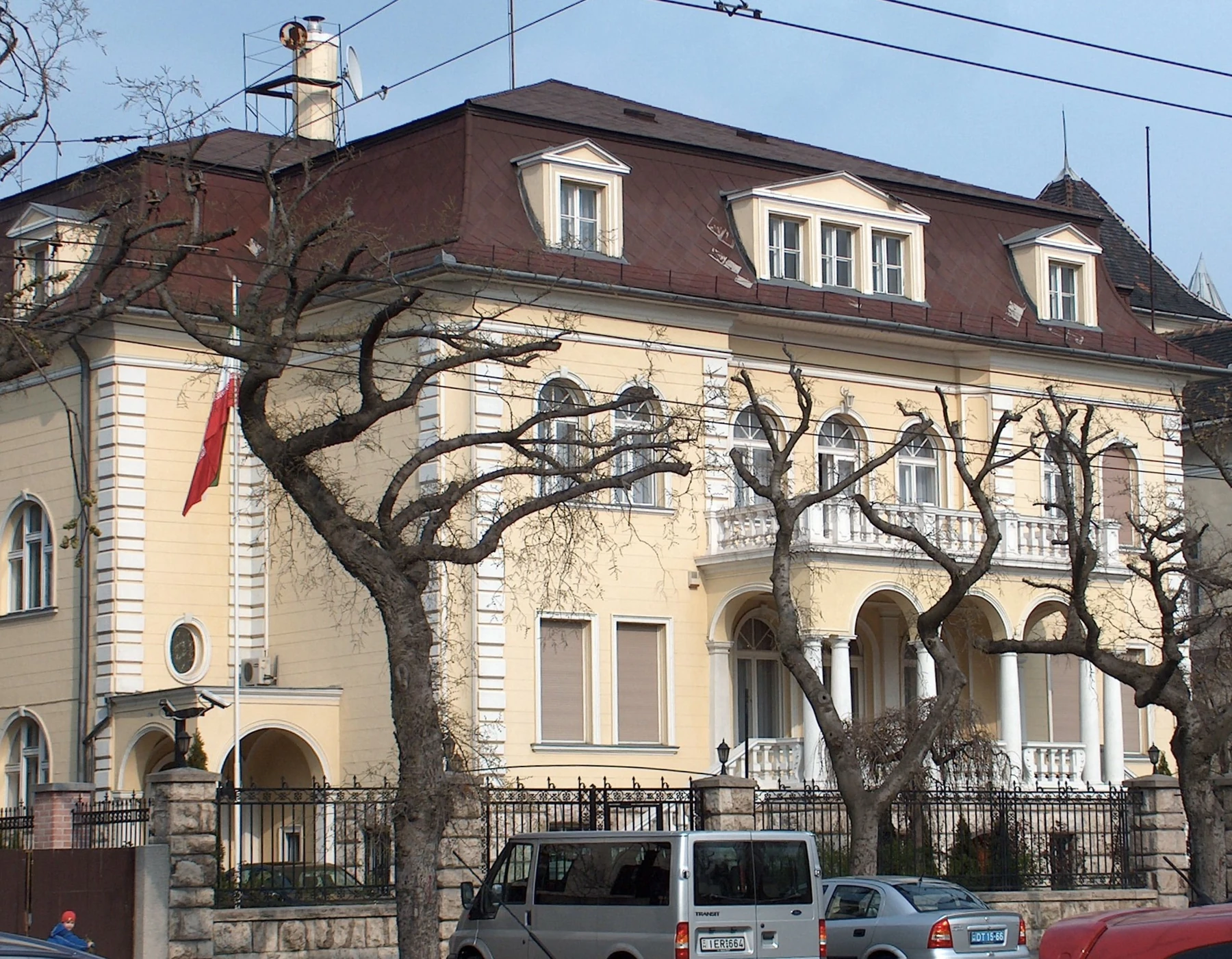
The local WebP images retain the full retrieved frames at reduced dimensions, with smaller proportional copies for responsive display. Credits identify the photographer or institution and the public-domain status. The earlier straightening of the embassy photograph is recorded in its credit and editorial provenance.
What is the Iran flag emoji?
The Iran flag emoji is 🇮🇷. It consists of the regional indicator symbols I and R, with Unicode code points U+1F1EE and U+1F1F7. Depending on the device, it may appear as a small waving flag or as letters. The platform’s stylized icon is not a precise construction drawing of the national flag.
The sequence corresponds to the country code IR. Small emoji artwork can simplify the central emblem and the closely spaced inscription rows. That makes it useful in short text, but unsuitable for checking the number or exact geometry of the letters.
Use the scalable SVG or large PNG for a worksheet, detailed comparison, or other task requiring the complete national design. A platform-specific emoji rendering should not be enlarged and treated as a production master.
Which Iran flag files can be downloaded here?
The downloads include a clean scalable SVG, a 6300×3600 PNG, detailed emblem and inscription diagrams, construction and size sheets, a historical reconstruction, country comparisons, and two documentary photographs. The main flag preserves the 7:4 ratio and all 22 inscriptions. Each gallery card links to its local file, with creators and rights recorded in the credits.
| File | Purpose |
|---|---|
| National SVG | Complete scalable 7:4 reference, 3150×1800 intrinsic size |
| National PNG | 6300×3600 raster image |
| Explanatory SVGs | Anatomy, emblem, calligraphy, history, sizes, and display illustrations |
| Photographs | Dated real-world displays, delivered as WebP |
| Credits | Plain-text descriptions, creators, and rights |
Download Iran flag SVG · Download large PNG · Download credits.
The labeled 1200×630 social preview is a separate presentation graphic. Use the clean flag file when the flag itself must keep exact proportions. The historical and explanatory images are identified in their captions so they are not confused with the current national master.
Iran flag pictures
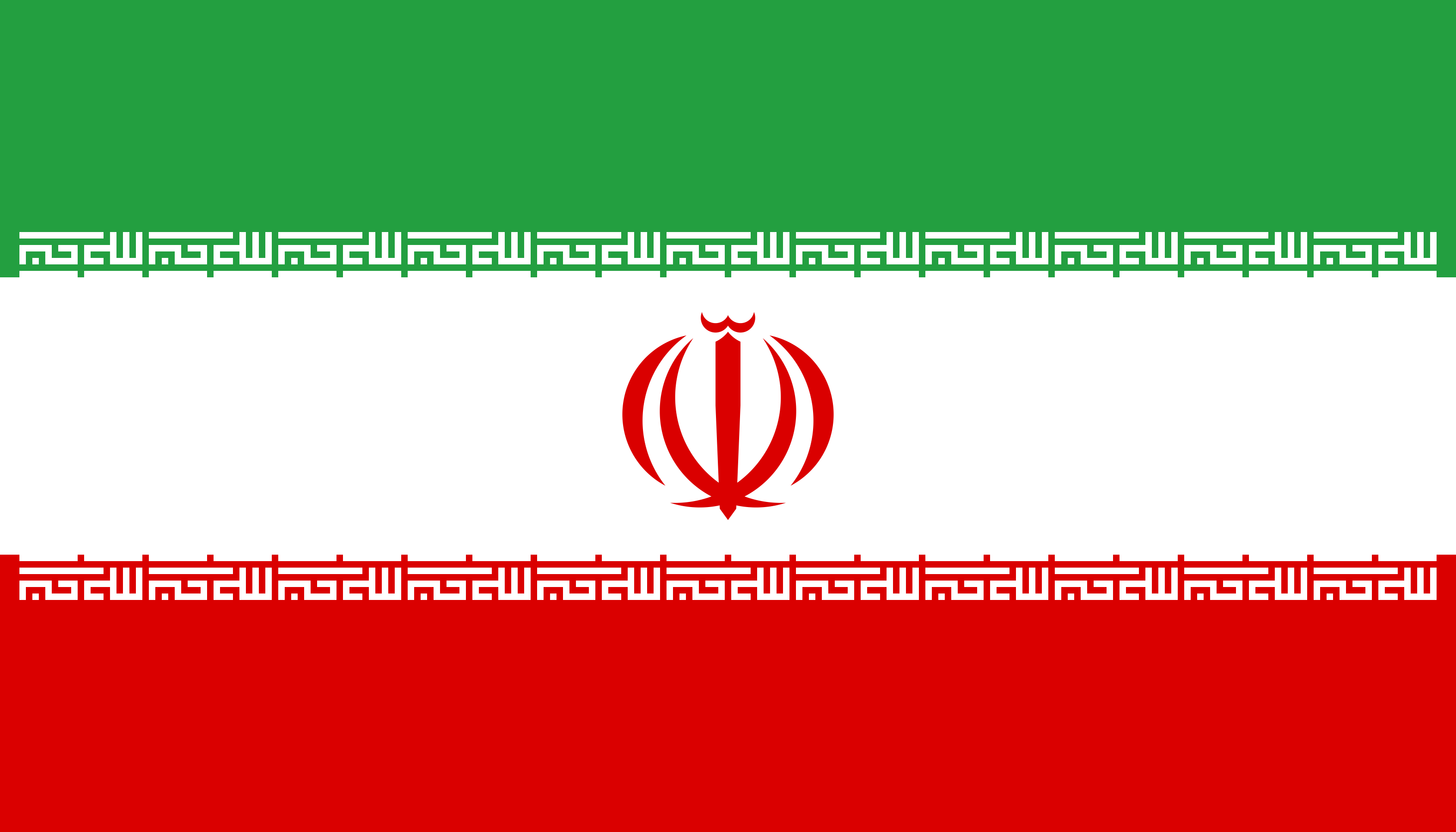
Iran’s national flag has equal horizontal green, white, and red bands, a red central emblem, and 22 white border inscriptions. The width:height ratio is 7:4. Colors in this digital reference are #239F40, #FFFFFF, and #DA0000; they are not statutory HEX specifications.
National design by Hamid Nadimi; public-domain reference vector by Commons contributors, including SiBr4 and JavadMarcouz. Uniformly scaled by GKBook.Download image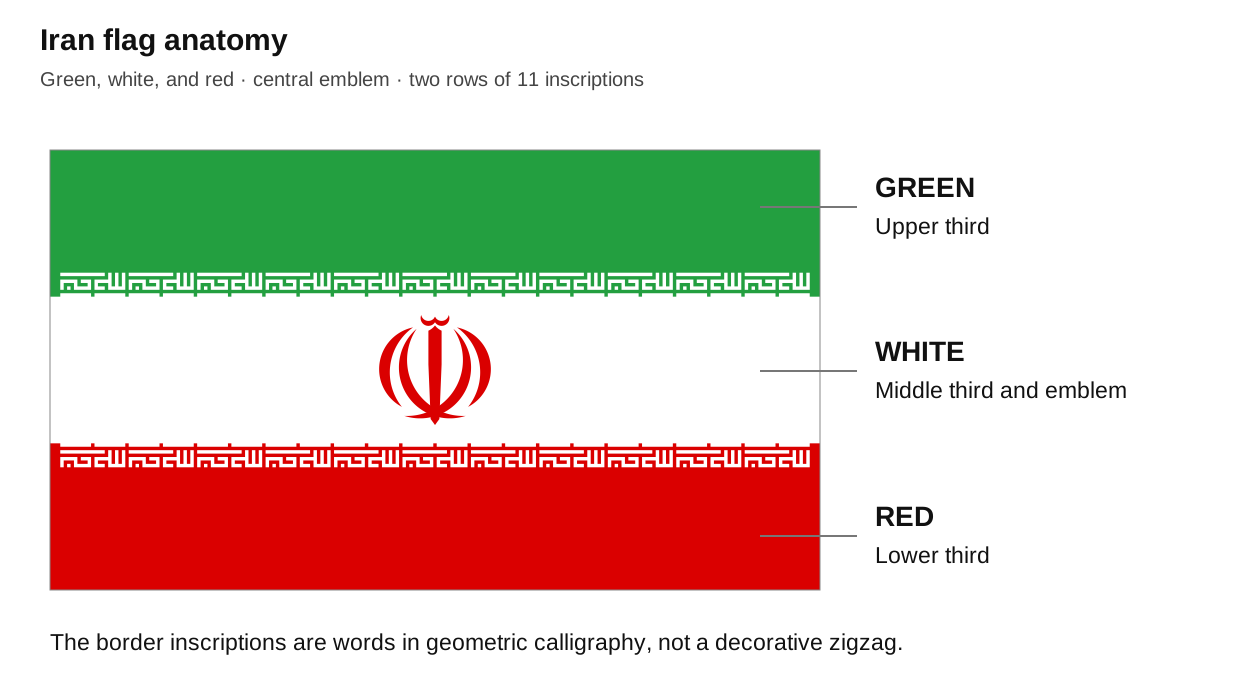
The three bands have equal nominal height. The red emblem sits at the center of the white band. White Kufic Banna’i inscriptions run along the bottom of the green band and the top of the red band, adjoining the white field.
GKBook composition, CC0; national flag reference geometry, public domain.Download image
This vector uses green #239F40 (35,159,64), white #FFFFFF (255,255,255), and red #DA0000 (218,0,0). The reviewed 2016 national standard specifies measured color ranges rather than universal RGB or HEX codes.
GKBook composition, CC0; national flag reference geometry, public domain.Download image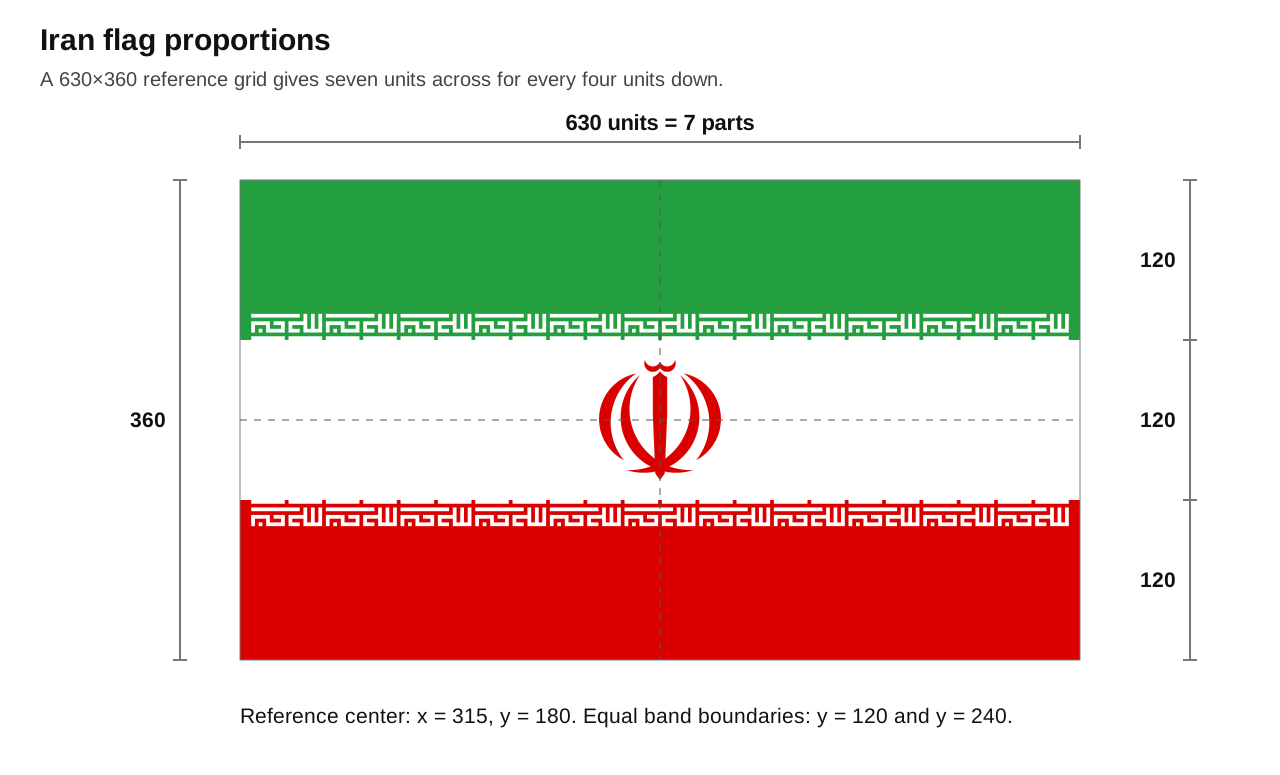
The standard’s 7:4 ratio is represented here on a 630×360 coordinate grid. Bands are 120 units high and the emblem is centered at (315,180). This explanatory grid is not a factory acceptance drawing for the detailed calligraphy or fabric.
GKBook composition, CC0; national flag reference geometry, public domain.Download image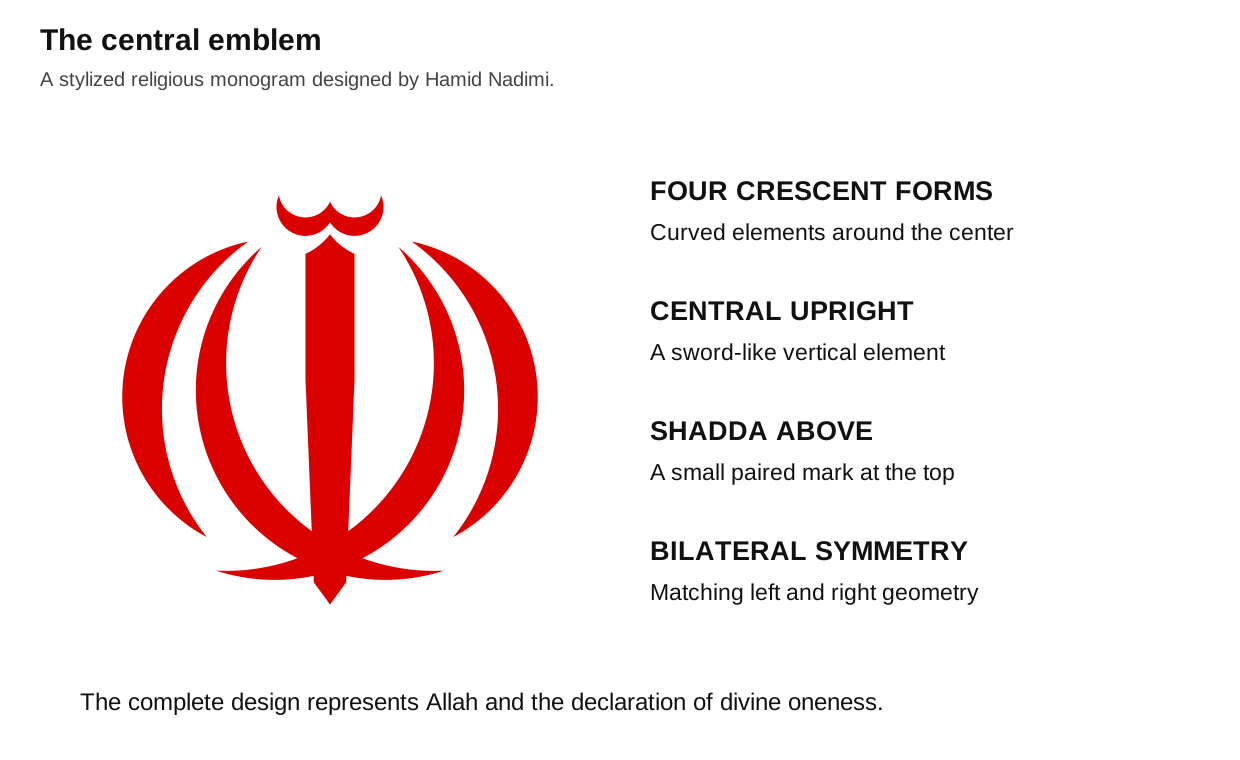
The complete red emblem combines four crescent forms, a central sword-like upright, and the shadda above. The standard’s informative appendix explains Allah and the declaration of divine oneness in the design. All source paths and the mirrored half are retained.
GKBook composition, CC0; national flag reference geometry, public domain.Download image
The two sides of the national emblem mirror each other across a vertical axis. The axis shown here is an explanatory overlay and is absent from the clean national flag. The shadda and curved elements remain part of the complete artwork.
GKBook composition, CC0; national flag reference geometry, public domain.Download image
Enlarged crops show three repetitions of Allahu akbar at each colored border. The geometric Kufic Banna’i letters are taken directly from the complete flag vector rather than replaced with a modern text font. The white lettering meets the central white field.
GKBook composition, CC0; national flag reference geometry, public domain.Download image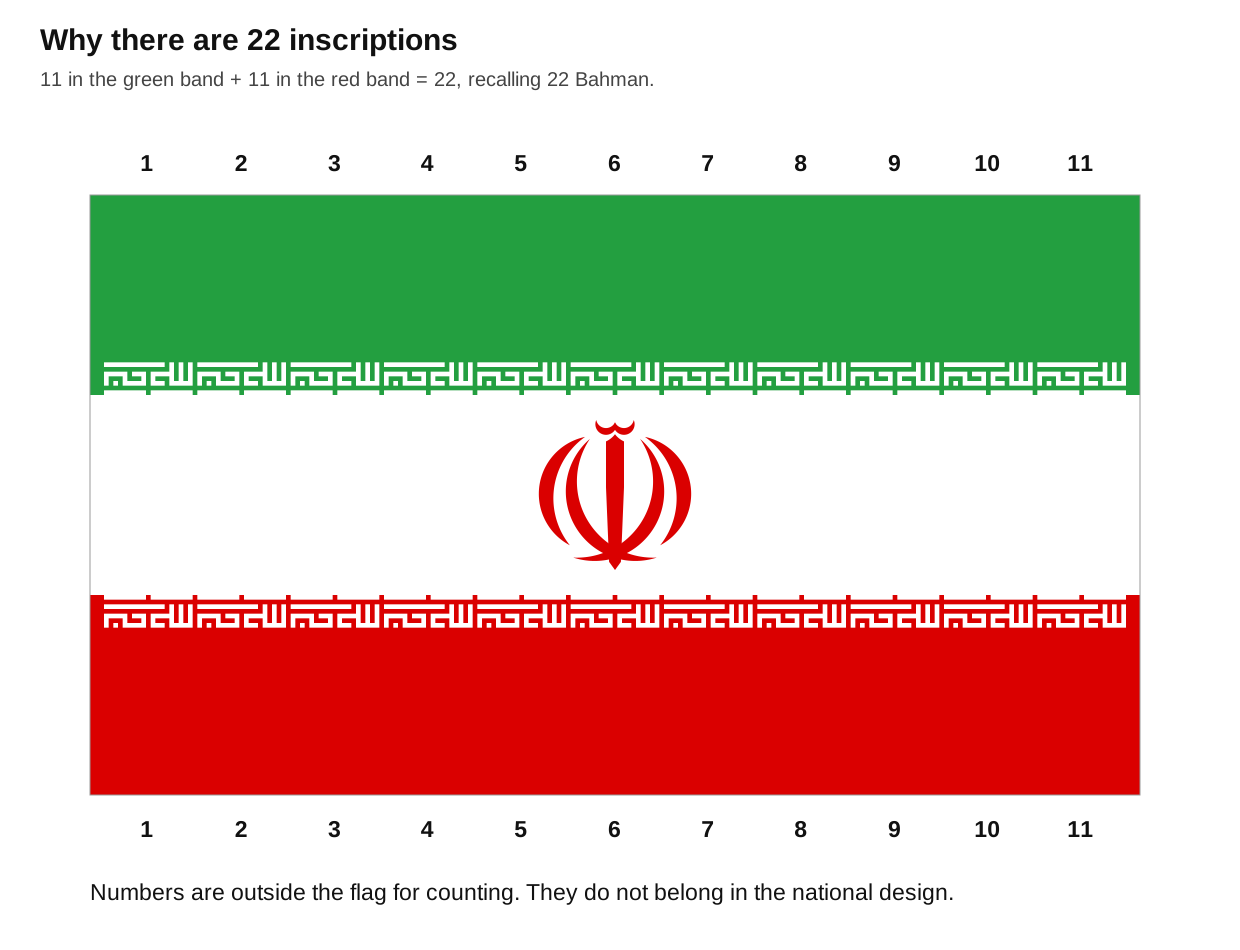
There are 11 complete inscriptions in each border row, for a total of 22. The 1980 resolution connects this number with 22 Bahman, the revolution’s victory date. The numbering is a teaching annotation outside the flag.
GKBook composition, CC0; national flag reference geometry, public domain.Download image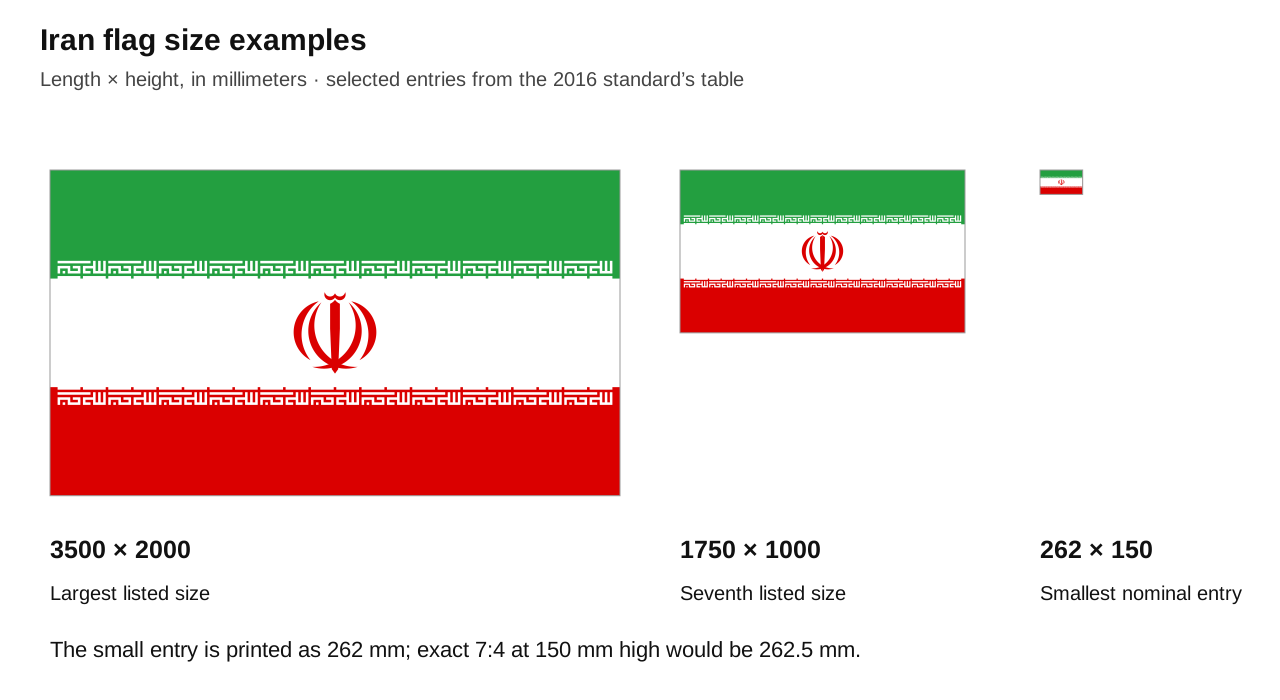
The 2016 standard lists 12 sizes from a nominal 262×150 mm to 3500×2000 mm. The smallest length is rounded as printed. Other sizes are permitted when the 7:4 proportion and applicable sewing requirements are maintained.
GKBook composition, CC0; national flag reference geometry, public domain.Download image
The timeline separates the 1907 constitutional Lion and Sun definition, the 1979 constitutional framework, emblem approval on May 9, 1980, the July 6, 1980 flag resolution, and later editions of the technical standard.
GKBook composition, CC0; national flag reference geometry, public domain.Download image
This is a modern reconstruction of the earlier green-white-red flag with a Lion and Sun emblem. The downloaded source incorporates a 2026 standardization by its contributors. It illustrates a historical type, not a certified drawing of every flag used from 1964 to 1980.
Modern reference by Trajan117, Sodacan, Pouya, Jooja, and ConflictFan. Public domain. GKBook layout and annotations, CC0.Download image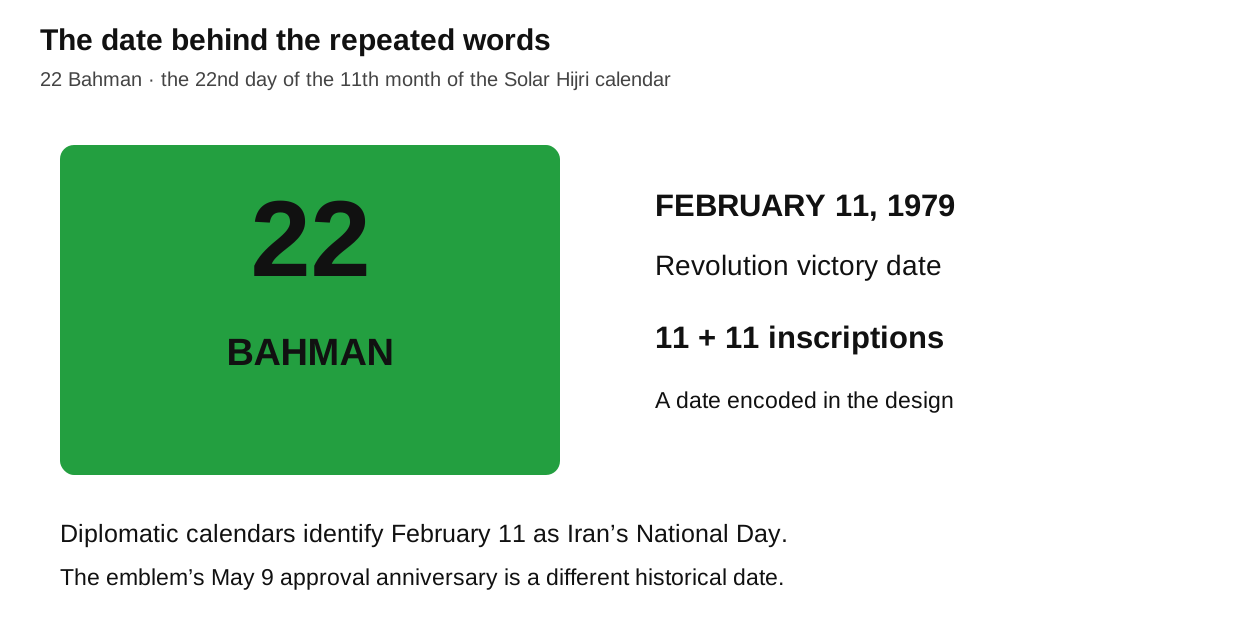
The flag’s 22 inscriptions refer to 22 Bahman, the revolution victory date of February 11, 1979. February 11 is listed as Iran’s National Day in the diplomatic calendar. This is distinct from the emblem’s approval anniversary in May 1980.
GKBook composition, CC0; national flag reference geometry, public domain.Download image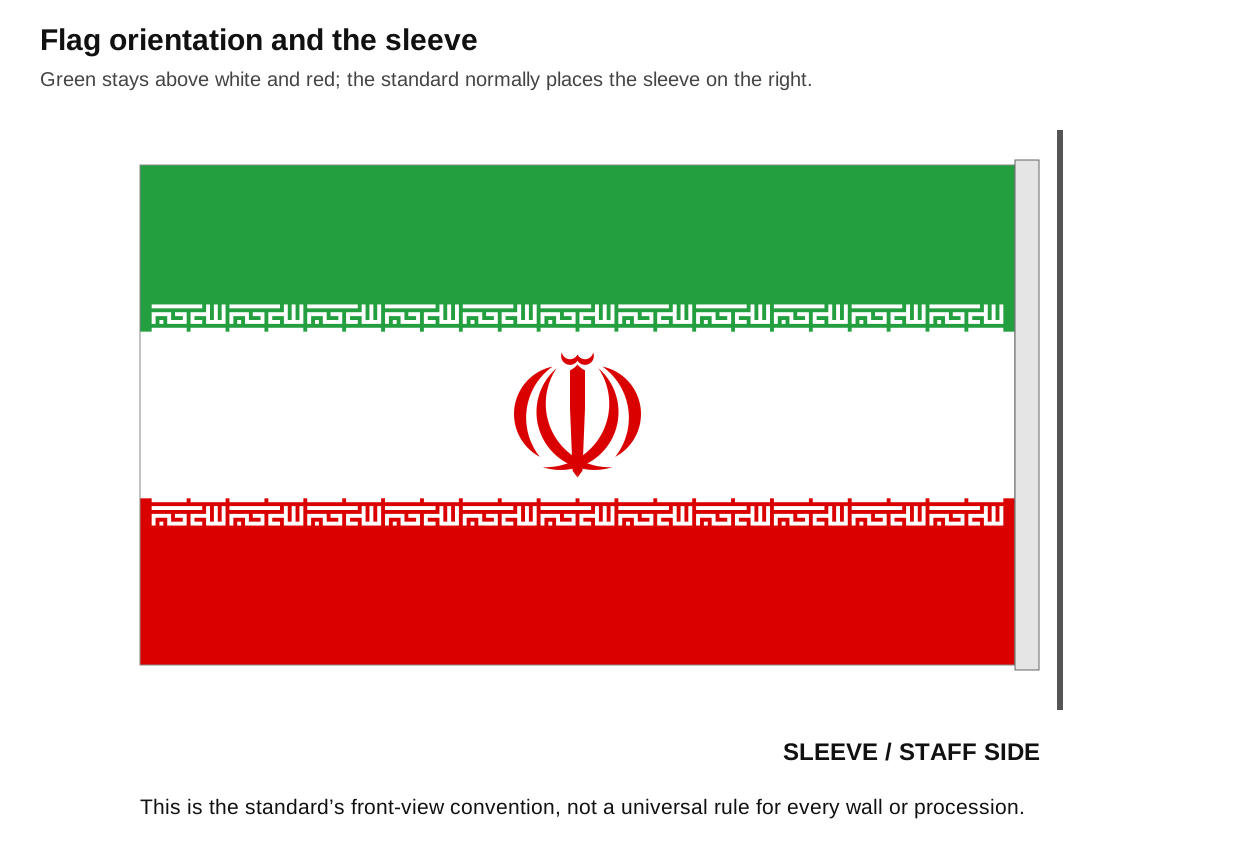
The 2016 standard says the sleeve is normally sewn on the right side, unless otherwise agreed. This front-view illustration keeps green above white and red and shows the sleeve outside the design. It does not establish rules for every vertical, wall, vehicle, or procession display.
GKBook composition, CC0; national flag reference geometry, public domain.Download image
A lowered Iranian flag was documented at the embassy in Jakarta on May 20, 2024, during mourning after the presidential helicopter crash. This diagram explains the visual idea only; its height is not a prescribed Iranian fraction or a current mourning instruction.
GKBook composition, CC0; national flag reference geometry, public domain.Download image
Inspect the cloth and its small lettering before display. Avoid snagging or dragging, dry damp fabric before storage, and follow its cleaning instructions. These are practical care recommendations, not a claim that the design standard mandates a particular folding or retirement ceremony.
GKBook composition, CC0; national flag reference geometry, public domain.Download image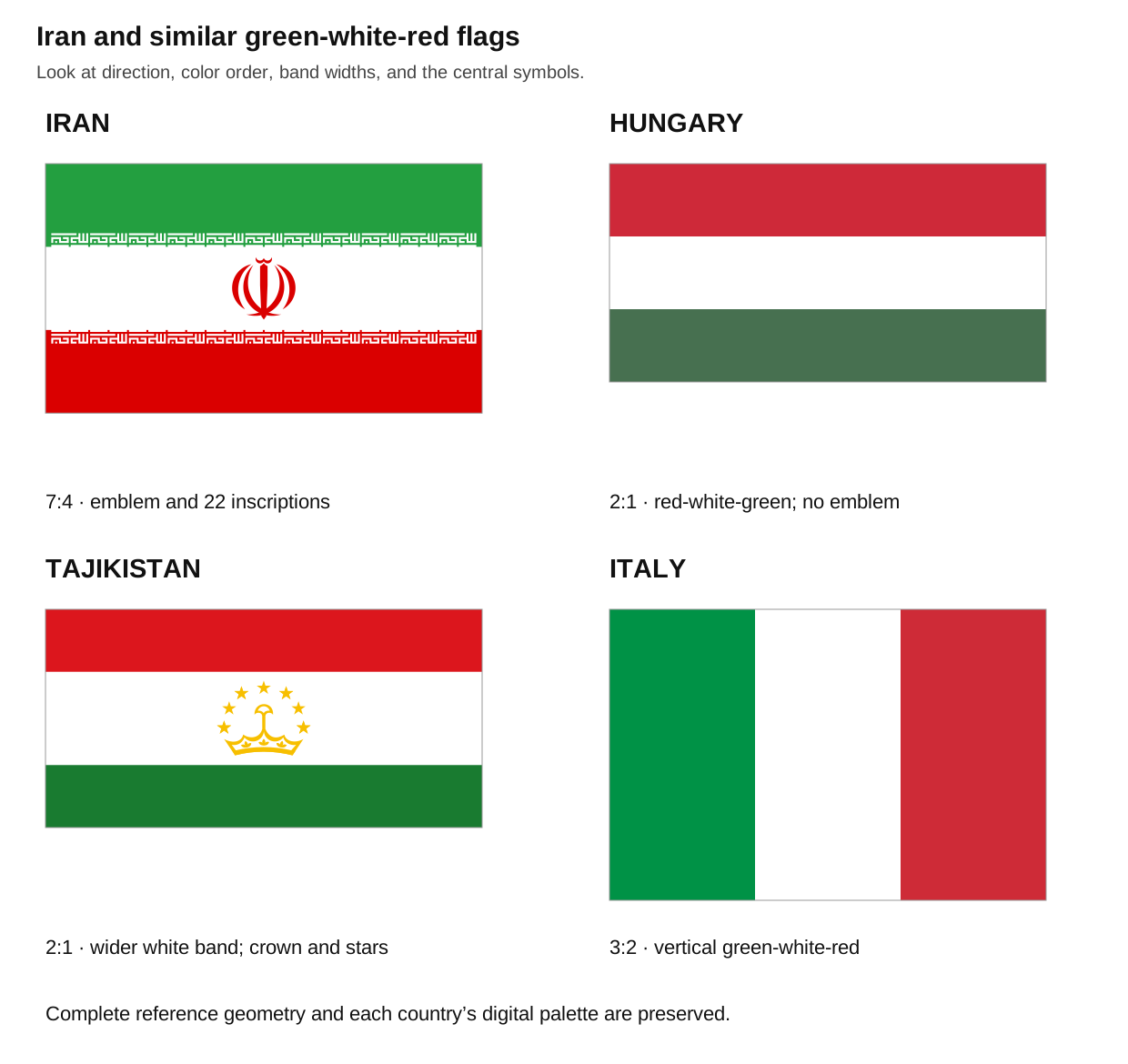
Iran has horizontal green-white-red bands with an emblem and inscriptions. Hungary reverses the outer colors and has no emblem in this reference. Tajikistan has a wider white band with a crown and seven stars. Italy’s bands run vertically. The supplied reference ratios are 7:4, 2:1, 2:1, and 3:2 respectively.
GKBook composition, CC0; national flag reference geometry, public domain.Download image
Iran’s flag hangs from a pole on the embassy building in Budapest in a photograph dated April 3, 2008. The folded cloth and surrounding branches partly obscure the design.
TheFlyingDutchman; straightened version by Polymagou. Public domain, released by the photographer; later straightening recorded.Download image
Iranian and U.S. flags stand behind Mohammad Javad Zarif and John Kerry before their bilateral meeting at United Nations headquarters in New York on September 26, 2015.
U.S. Department of State. Public domain, U.S. government work.Download imageFrequently asked questions
What does the flag of Iran look like?
Iran’s national flag has three equal horizontal bands: green at the top, white in the middle, and red at the bottom. A red religious emblem occupies the center. White geometric inscriptions appear 11 times along each colored border beside the white band, making 22 repetitions. The width-to-height proportion is 7:4.
What is the red symbol in the center of Iran’s flag?
The central red emblem is a stylized religious monogram associated with Allah and the declaration of divine oneness. It combines four crescent forms, a sword-like central upright, and a small shadda above. The design is symmetrical and was created by Hamid Nadimi. It should be reproduced as complete artwork, including its small upper mark.
What are Iran’s flag colors and their RGB or HEX values?
Iran’s flag is green, white, and red. The downloadable digital reference uses green #239F40, white #FFFFFF, and red #DA0000. These correspond to RGB 35,159,64; 255,255,255; and 218,0,0. They are file-specific screen values: the reviewed 2016 national standard defines measured color ranges and a physical reference rather than universal HEX codes.
What do the colors and emblem of Iran’s flag mean?
The standard’s informative appendix connects green with the high ideals of Islam, white with tawhid or divine oneness, and red with blood and struggle. The central emblem also expresses Allah and divine oneness. These are the interpretations followed here; broader popular descriptions such as hope or peace should not automatically replace this specific explanation.
Why is Iran’s national emblem symmetrical?
The emblem’s left and right sides mirror each other around a central vertical axis. The standard describes symmetry as part of the design and associates it with balance. Its informative explanation also relates the five principal parts to five fundamental religious principles; that wording should not be casually replaced with a different list of religious practices.
What do the words on Iran’s flag say?
The repeated inscription is Allahu akbar, commonly translated as “God is greatest.” It is written in white using geometric Kufic Banna’i lettering along the edges of the green and red bands next to the white field. The words form two rows, and each row contains 11 repetitions of the same phrase.
Why is Allahu akbar repeated 22 times on Iran’s flag?
The 22 repetitions recall 22 Bahman, the revolution’s victory date in the Iranian Solar Hijri calendar. There are 11 inscriptions in the green band and 11 in the red band. Bahman is the calendar’s eleventh month, and the commemorated event occurred on February 11, 1979. The numbers connect the border directly with that date.
What is the aspect ratio of Iran’s flag?
Iran’s national flag has a length-to-height ratio of 7:4, also written 4:7 when height is listed first. A flag 175 centimeters long is therefore 100 centimeters high. The three main bands have equal height before the border lettering is added, so each occupies one-third of the basic rectangular field.
How can Iran’s flag be drawn accurately?
Begin with a 7:4 rectangle and divide it into three equal horizontal bands, green, white, and red. Center the complete red emblem in the white band. Then place the prescribed white calligraphy along both adjoining colored edges, with 11 repetitions per row. Use verified vector geometry for these details rather than improvising the letters or emblem.
What flag sizes does Iran’s national standard list?
The reviewed 2016 standard lists 12 nominal flag sizes, from 262×150 millimeters to 3500×2000 millimeters, with length written first here. It also allows other sizes that preserve the 7:4 proportion and applicable sewing requirements. The smallest printed length is rounded: an exact 7:4 rectangle at 150 millimeters high would be 262.5 millimeters long.
What does the standard say about flag fabric and manufacture?
The reviewed standard addresses more than the printed picture: it includes cloth, strength, colorfastness, sewing, dimensions, and the flag’s sleeve. It permits several fiber types and both woven and knitted construction. Material choices should suit the intended conditions, while the detailed emblem and inscriptions must remain recognizable and the specified proportions must be preserved.
How has Iran’s flag changed over time?
Iran’s green-white-red color tradition predates the Islamic Republic. The 1907 supplementary constitution specified those colors with the Lion and Sun emblem. After the 1979 revolution, the modern design introduced a different central emblem and repeated border inscriptions. The timeline distinguishes constitutional definitions, emblem approval, technical specifications, and later standard revisions instead of treating them as one event.
What was the Lion and Sun flag of Iran?
The earlier Iranian tricolor carried a Lion and Sun emblem instead of the modern religious monogram and border inscriptions. The symbol’s history predates the Pahlavi dynasty, and its appearance varied across periods. The example shown here is a modern reconstruction of a historical flag type, not a surviving flag or a certified original construction drawing.
When was the modern Iranian flag adopted?
The modern emblem-and-inscription design dates to 1980. The standard records approval of the emblem on May 9, while the Revolution Council’s flag specification resolution is dated July 6. These are separate milestones: approval of the central emblem, legal description of the complete flag, and later administrative publication should not be collapsed into a single undocumented event.
Who designed Iran’s modern flag and emblem?
Hamid Nadimi, an Iranian architect and graphic designer, created the modern emblem and worked on the flag design. His account, reproduced in a 2017 report, describes submitting an emblem proposal and later being asked to develop the complete flag. His authorship concerns the modern design, not the origin of Iran’s older green-white-red color tradition.
Which documents define Iran’s flag?
Article 18 of Iran’s constitution identifies the green, white, and red flag with the Islamic Republic’s emblem and Allahu akbar. The 1980 specification resolution describes the red central emblem and 22 white inscriptions. National Standard 1 supplies technical detail. This article examines its 2016 second revision without claiming that a later standards catalog has been exhaustively verified.
When is Iran’s National Day, and how is it linked to the flag?
Iran’s National Day is listed as February 11 in diplomatic calendars. It commemorates the revolution’s victory on 22 Bahman 1357, corresponding to February 11, 1979. The flag’s 22 inscriptions refer to that Iranian-calendar date. The emblem’s May 9, 1980 approval is a different historical anniversary and should not be relabeled as National Day.
Which way should Iran’s flag face, and where is the sleeve?
In the standard’s ordinary front-view description, green is above white and red, and the sleeve is normally sewn on the right side unless otherwise agreed. Keep the emblem upright and the calligraphy intact. This construction convention should not be expanded into an invented universal rule for every wall display, procession, vehicle, or vertically hung banner.
How should an Iranian flag be prepared for a ceremony?
Prepare a correctly proportioned flag with a complete emblem, readable border lettering, sound seams, and secure fittings. Confirm the organizer’s instructions for the location, timing, raising, lowering, and any other flags present. The documents reviewed here establish design and manufacture; they do not justify importing another country’s complete ceremonial code into Iran’s flag guidance.
When is Iran’s flag flown at half-mast?
Iran’s flag can be lowered as a sign of official mourning. A documented example shows it at half-mast at the Iranian embassy in Jakarta on May 20, 2024, after the presidential helicopter crash. The applicable announcement and institution determine the occasion and arrangements; this historical example does not establish a permanent schedule or a current mourning order.
Why does Iran’s flag appear at embassies and diplomatic meetings?
A national flag identifies the state represented at an embassy or official meeting. The photographs here show Iranian flags at an embassy building in Budapest in 2008 and at a bilateral meeting in New York in 2015. Their dates and settings matter: they document particular displays and should not be treated as proof of every diplomatic protocol rule.
How should an Iranian flag be cleaned, folded, and stored?
Inspect the fabric, seams, fastenings, emblem, and small border lettering before display. Follow the maker’s cleaning instructions, allow damp cloth to dry, and store it in a clean, dry place. These are practical textile-care suggestions. The reviewed design standard does not establish a universal ceremonial folding sequence or a single mandatory method of retiring a worn flag.
What common mistakes should be avoided when drawing Iran’s flag?
Common errors include reversing green and red, stretching the 7:4 rectangle, leaving out the central emblem, using a generic crescent, and replacing the border words with decorative zigzags. Each row needs 11 complete inscriptions. The Lion and Sun belongs to an earlier flag tradition and should not be inserted into the modern design without clear historical labeling.
How is Iran’s flag different from Hungary, Tajikistan, and Italy?
Iran uses horizontal green-white-red bands with its red emblem and 22 white inscriptions. Hungary has horizontal red-white-green bands without an emblem in the reference shown. Tajikistan also uses red-white-green, but its white band is wider and carries a crown with seven stars. Italy places green, white, and red in vertical bands.
What do real photographs show about Iran’s flag?
Real photographs show the flag as a physical object affected by folds, light, mounting, and surroundings. The two examples here document an embassy display in Budapest in 2008 and a diplomatic meeting in New York in 2015. Neither photograph is a color standard or a substitute for the flat drawing used to inspect proportions and small lettering.
What is the Iran flag emoji?
The Iran flag emoji is 🇮🇷. It consists of the regional indicator symbols I and R, with Unicode code points U+1F1EE and U+1F1F7. Depending on the device, it may appear as a small waving flag or as letters. The platform’s stylized icon is not a precise construction drawing of the national flag.
Which Iran flag files can be downloaded here?
The downloads include a clean scalable SVG, a 6300×3600 PNG, detailed emblem and inscription diagrams, construction and size sheets, a historical reconstruction, country comparisons, and two documentary photographs. The main flag preserves the 7:4 ratio and all 22 inscriptions. Each gallery card links to its local file, with creators and rights recorded in the credits.
Explore all general-knowledge topics and the A-to-Z lists.

We Value Your Opinion Comments