
Hungary flag picture
Explore the construction sheet, the March 16 Flag and Coat of Arms Day, and the historical sequence.

| Design | Red–white–greenThree equal horizontal bands, red uppermost. |
|---|---|
| Main proportions | 2:1 width:heightMatches the public-building size schedule; 3:2 is documented for the civil ensign. |
| Constitutional meanings | Strength, fidelity, hopeRed, white, and green, respectively. |
| National colors | Recognized in 1848Act XXI of 1848 formally prescribed the national colors. |
| Plain modern form | 1957 milestoneThe constitutional amendment removed compulsory display of the arms on the flag. |
| Coat of arms | Absent from the plain flagArms-bearing versions are permitted in specified legal contexts. |
| Flag and Coat of Arms Day | March 16Designated in 2014; annual observance began in 2015. |
| National holidays | March 15 · August 20 · October 23Distinct from the March 16 flag observance. |
The Fundamental Law assigns strength to red, fidelity to white, and hope to green. The national colors’ 1848 recognition, the plain flag’s 1957 milestone, and the March 16 observance are distinct parts of the story.
What is the national flag of Hungary?
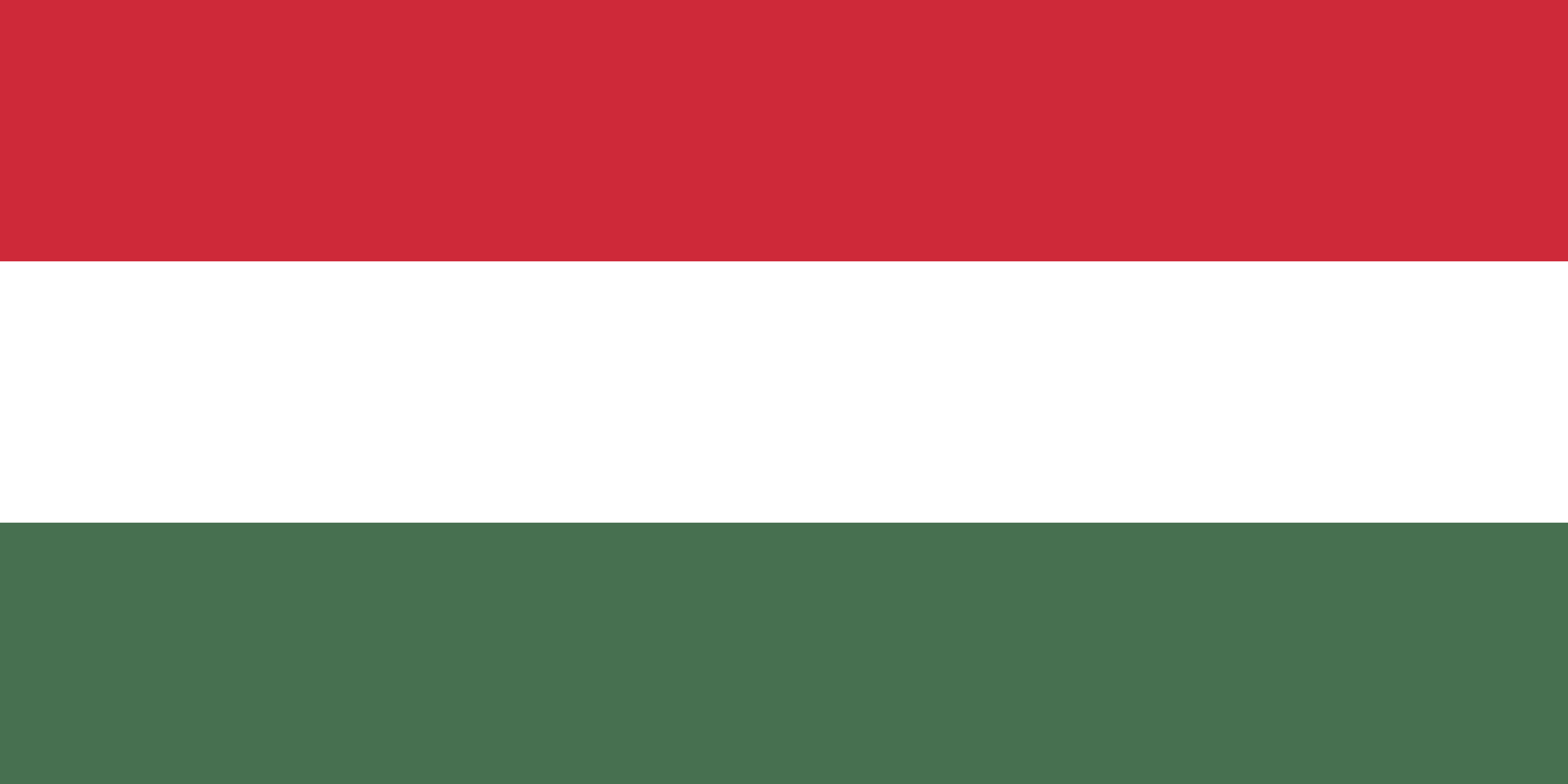
Hungary’s national flag has three equal horizontal bands: red at the top, white in the middle, and green at the bottom. The basic design contains no coat of arms, stars, or writing. Its familiar plain tricolor should be distinguished from historical flags and authorized versions that carry the national arms.
Hungary’s piros-fehér-zöld tricolor is immediately recognizable by its horizontal order. Its simplicity can conceal several different questions: when the colors became national symbols, when a central emblem stopped being compulsory, and which proportions apply to a particular use.
This article uses width:height throughout. The main picture is 2:1, while a separate 3:2 illustration explains the civil ensign reference. The gallery also labels historical flags, an arms-bearing variant, and the revolutionary flag with a hole so that each can be understood in context.
Explore the constitutional meanings, history, March 16 observance, and downloadable pictures.
How are the Hungarian flag’s bands arranged?
Each band occupies one-third of the flag’s height and runs across its full width. Red must be uppermost in a normal horizontal display, followed by white and green. The hoist is the attachment edge, usually drawn at the viewer’s left; the fly is the free edge opposite it.
The bands are equal in height, although their contrasting colors can make them appear unequal at a glance. The white area is a full band rather than empty space between two unrelated strips.
A flat reference normally puts the attachment edge on the left. The same flag viewed from the other side still has red at the top. A pole, sleeve, finial, fringe, or decorative ribbon lies outside the basic three-band field.
What digital colors are used in the Hungary flag downloads?
The main downloadable flag uses red #CE2939, white #FFFFFF, and green #477050. Their RGB values are 206, 41, 57; 255, 255, 255; and 71, 112, 80. These values describe this digital artwork. They are not hexadecimal codes written into Hungary’s Fundamental Law or a certificate of textile conformity.
| Band | HEX | RGB | Position |
|---|---|---|---|
| Red | #CE2939 | 206, 41, 57 | Top |
| White | #FFFFFF | 255, 255, 255 | Middle |
| Green | #477050 | 71, 112, 80 | Bottom |
The plain 3:2 illustration deliberately uses the same palette, allowing the difference in shape to be compared without a second color change. Historical and arms-bearing source artwork retains its own colors and should not be sampled as if every file were one certified production specification.
A screen emits light, printed inks reflect it, and fabric also changes appearance with weave, finish, weather, and lighting. A mathematical CMYK conversion can help a print workflow, but it cannot establish a legally prescribed printing recipe. For a commissioned physical flag, agree on a suitable material and approved color sample.
What do the red, white, and green colors mean?
Article I of Hungary’s Fundamental Law assigns the colors specific meanings: red represents strength, white fidelity, and green hope. These are constitutional meanings rather than merely popular explanations. Other symbolic stories may occur in general accounts, but they should not silently replace the wording of the country’s current constitutional description.
The distinction between an official description and later interpretation matters here. The constitutional text directly assigns erő, hűség, and remény to the three bands. In English, these are rendered here as strength, fidelity, and hope; fidelity may also be expressed as faithfulness.
Stories connecting red with sacrifice, white with purity, or green with the landscape appear in broader flag discussions. They can help explain popular associations, but the infobox and color strips on this page use the constitutional meanings consistently.
Does the Hungarian flag need a coat of arms?
The basic constitutional flag is a plain red-white-green tricolor and does not require the coat of arms. Hungary’s symbols law also permits arms-bearing flags in specified contexts, including certain occasional uses. An illustration with the arms can therefore be a lawful variant, while remaining distinct from the ordinary plain design.
Article I describes the national flag through its colors and equal horizontal bands. The coat of arms receives its own description. Separating those provisions prevents the arms from being treated as an element missing from an otherwise complete plain flag.
Section 11 of Act CCII of 2011 addresses specified occasional use and permits the national arms on the flag in those contexts. Thus, describing every arms-bearing tricolor as “illegal” would be misleading. Conversely, a file name calling one image a state flag does not prove that it is required on all state buildings.
The gallery includes a complete arms-bearing reference. Its caption identifies the variant, while the principal hero, infobox, and construction drawing all show the plain national flag.
What appears in Hungary’s coat of arms?
Hungary’s coat of arms combines red-and-silver horizontal divisions with a silver double cross above a gold crown on a green triple hill. The Holy Crown rests above the shield. These elements belong to the national arms; they are not mandatory features of every Hungarian flag or symbols that should be approximated with a generic crown.
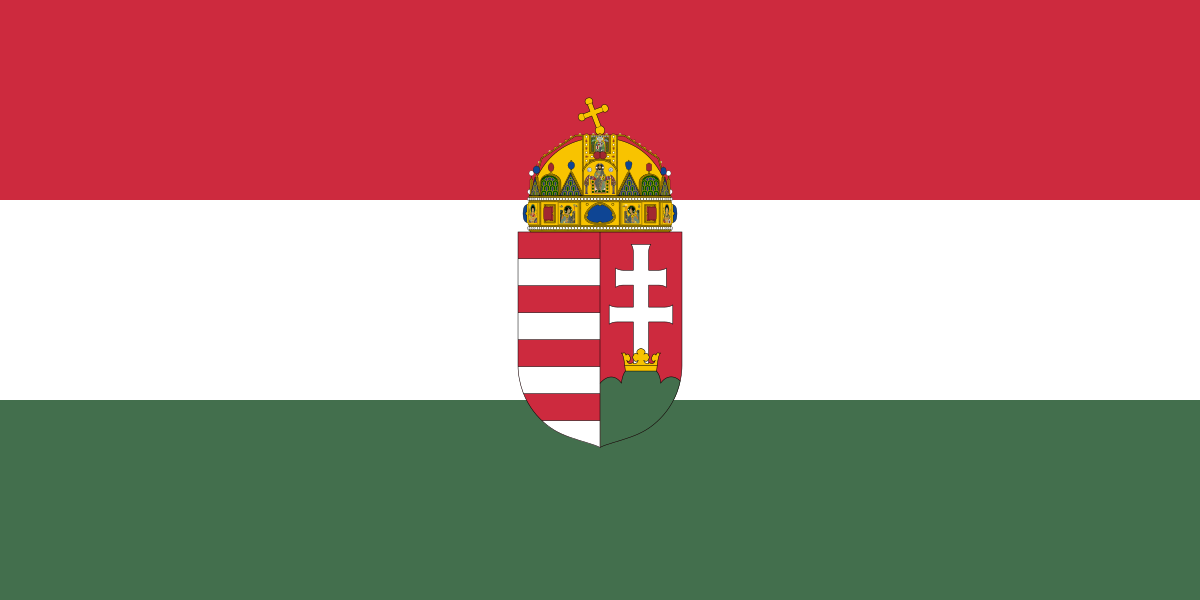
One half of the shield carries alternating red and silver divisions. The other has a silver double cross standing above a small gold crown on a green triple hill. A depiction of the Holy Crown sits above the shield.
In heraldry, right and left belong to the imagined shield-bearer, which reverses the viewer’s perspective. Describing visible elements is often clearer than calling a side “left” without identifying the viewpoint.
The crown is a historical national symbol used by the modern republic. Its presence does not mean that the current country is a monarchy. The detailed reference preserves the actual crown, shield, cross, and supporting heraldic forms.
Download the complete arms-bearing flag SVG. The original source paths are retained rather than replaced by a simplified crown icon.
What are the Hungarian flag’s proportions?
The main reference is twice as wide as it is high, written here as 2:1 width:height. That proportion matches the public-building sizes in Decree 132/2000. A 3:2 width:height proportion is separately documented for the civil ensign. Sources writing height first express the same two ratios as 1:2 and 2:3.
| Context | Width:height | Height:width | Example |
|---|---|---|---|
| Main public-building reference | 2:1 | 1:2 | 200 × 100 cm |
| Civil ensign reference | 3:2 | 2:3 | 150 × 100 cm |
The Fundamental Law specifies equal bands but does not put an overall numerical ratio in its flag sentence. The public-building decree’s annex supplies sizes that give the familiar 2:1 relationship. That scope matters: an institutional size schedule should not be presented as proof that every private, ceremonial, or maritime flag must have exactly the same rectangle.
The 1957 merchant-shipping decree describes the ensign’s height as two units for every three of length. Specialist references also document the civil ensign in 2:3 height:width form. This page supplies that shape separately without claiming to certify every present maritime requirement.
How can Hungary’s flag be drawn on a construction grid?
Draw a rectangle 600 units wide and 300 units high, divide it into three horizontal bands of 100 units each, and color them red, white, and green from top to bottom. This creates the supplied 2:1 reference. Scale the complete drawing uniformly and leave the plain national flag free of extra emblems.
| Element | Coordinate or calculation |
|---|---|
| Field | 600 units wide × 300 units high |
| Red band | y = 0 to 100 |
| White band | y = 100 to 200 |
| Green band | y = 200 to 300 |
| Band width | 600 units throughout |
| SVG master | 3000 × 1500 pixels |
| Large PNG | 6000 × 3000 pixels |
The SVG’s declared dimensions do not limit its resolution. Its paths remain vectors, so the entire field can be enlarged uniformly. The PNG instead records a fixed number of pixels and is convenient for software that does not accept SVG files.
For a 3:2 construction, use a 600-by-400 field and divide the 400-unit height into three equal parts. Each band is then 133⅓ units high. The equal-band rule stays the same while the outer rectangle changes.
What flag sizes are specified for public buildings?
Decree 132/2000 lists flags equivalent to 200 by 100, 300 by 150, and 400 by 200 centimeters when width is written first. Their corresponding staffs are 2.5, 3.5, and 4 meters long; their masts are 6, 9, and 12 meters high. These are public-building specifications, not every possible private flag size.
| Flag width × height | Corresponding staff | Corresponding mast | Band height |
|---|---|---|---|
| 200 × 100 cm | 2.5 m | 6 m | 33⅓ cm |
| 300 × 150 cm | 3.5 m | 9 m | 50 cm |
| 400 × 200 cm | 4 m | 12 m | 66⅔ cm |
The matching staff and mast columns describe alternative display arrangements, not two supports required for one flag. These are dimensions in a specific public-building regulation. They should not be described as the only permissible souvenir, desk, hand-held, or privately owned flag sizes.
Fabric cutting requires additional thought. A finished visible width is different from a cutting width that includes seam allowances, a sleeve, or reinforced attachment material. Specify the finished field before adding those fabrication details.
How did Hungary’s national flag develop?
Hungary’s national colors grew from older heraldic and ceremonial traditions, gained formal recognition in 1848, and appeared with different state emblems during later political changes. The 1956 uprising made the flag with a hole a powerful symbol. In 1957, a constitutional amendment removed the requirement to display the arms on the national flag.
Red and silver appear in Hungarian heraldry; the three colors also developed in ceremonial use.
Act XXI prescribed the national colors during the revolution-era reforms.
The supplied historical reference places the crownless shield on the tricolor.
A different political emblem occupied the center of the state flag.
Revolutionaries removed the political emblem; the resulting opening became a symbol of the uprising.
The constitutional amendment removed compulsory inclusion of the arms on the national flag.
The crowned coat of arms returned as a national symbol; this did not require it on every flag.
The public-building decree specified sizes and maintenance arrangements.
The Fundamental Law and symbols law set out the flag description, meanings, and uses.
Parliament designated March 16 in 2014, with observance beginning in 2015.
Are the Hungarian colors older than the modern tricolor?
Yes. Red and silver occur in older Hungarian heraldry, and red, white, and green appeared together in ceremonial details before the modern national flag was formally recognized. Those earlier uses help explain the colors’ historical roots. They do not establish that the present plain horizontal tricolor existed unchanged throughout medieval Hungarian history.
The national-symbols history describes a long development involving banners, heraldry, seal cords, and decorative borders. Red-and-silver heraldic forms are part of that background. References to medieval banners therefore belong to the ancestry of the colors rather than a continuous use of the exact present flag.
Green completed the familiar combination through later historical development. A seal cord in three colors, a military standard with colored border triangles, and a plain national tricolor are different objects, even when their palettes overlap.
This distinction also applies to the red-and-silver Árpád stripes. They are associated with an older heraldic tradition and appear within the national arms, but they are not interchangeable with the current three equal horizontal bands.
What happened to Hungary’s national colors in 1848?
Act XXI of 1848 formally prescribed Hungary’s national colors, according to the national-symbols history. This is the central nineteenth-century recognition milestone. It should be distinguished from the 1957 plain-flag amendment, the modern constitutional description, and March 16 Flag and Coat of Arms Day, which was designated much later as an annual observance.
The national-symbols account identifies Act XXI of 1848 as the first formal legal prescription of the national colors. The colors gained an especially strong place in national political identity during the revolution and struggle of 1848–1849.
The March 16 flag observance commemorates that historical recognition. Its existence does not, by itself, prove that every relevant nineteenth-century bill, enactment, or publication occurred on March 16. A modern commemorative date and an original legislative date must be established independently.
For an introductory caption, “national colors recognized in 1848” is more accurate than attaching every later emblem, ratio, or constitutional phrase to one adoption event.
Who designed Hungary’s flag?
The historical record examined describes a gradual development from heraldic colors and national political movements, followed by legal recognition in 1848. It does not securely identify one individual designer of the present plain tricolor. Artists who create modern vector files reproduce an established national symbol; they are not thereby its original historical designers.
A national symbol can emerge through repeated use before receiving legal recognition. In this case, the historical evidence points to inherited colors, evolving ceremonial practice, and national legislation rather than one securely documented person who invented all three bands.
Modern media credits serve a different purpose. They identify a particular drawing, historical reconstruction, or photograph. Crediting Orion 8, Thommy, or other reference-file contributors explains the artwork used here; it does not attribute the nineteenth-century national design to them.
What was the emblem on Hungary’s 1949–1956 flag?
The historical flag associated with 1949–1956 carried the Rákosi emblem in its center. Its design includes a red star, a hammer and ear of wheat, a wheat wreath, and a ribbon. This political emblem should not be confused with Hungary’s present crowned coat of arms or simplified into an unrelated hammer-and-sickle symbol.
The central emblem included a hammer crossed with an ear of wheat, enclosed by a wheat wreath and associated with a red star and ribbon. The details distinguish it from both Hungary’s crowned national arms and familiar emblems used by other socialist states.
The illustration is presented as historical material. Its existence does not mean that the central emblem belongs on a present-day plain Hungarian flag. Historical captions are especially important when an image is downloaded separately from the article.
Why did Hungary’s revolutionary flag have a hole?
During the 1956 uprising, revolutionaries cut the Rákosi emblem out of flags, leaving openings in the red-white-green cloth. The flag with a hole became a symbol of the uprising and rejection of that political emblem. Actual openings varied in shape; a modern schematic cannot establish one official outline for every revolutionary flag.
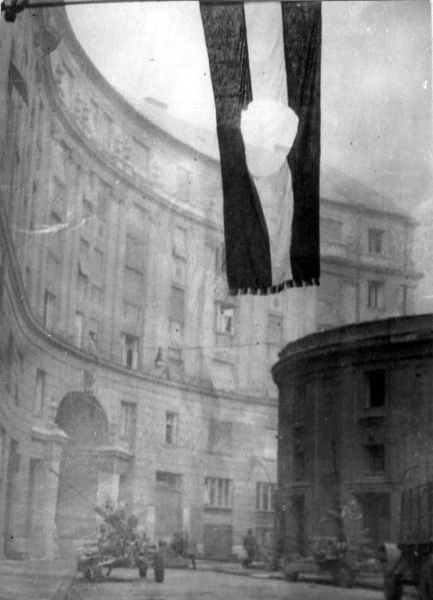
The national-symbols gallery identifies removal of the Rákosi emblem as part of the 1956 revolutionary flag story. Calls to restore the Kossuth arms also formed part of the period’s symbolism, so a hole was not the only flag-related expression of the uprising.
Actual people cut actual cloth. The openings could be rough, uneven, and different in size. A tidy white disk drawn in the middle of a flag would represent paint or fabric, not a missing section through which the background can be seen.
The accompanying archival photograph is a documentary example. Its monochrome reproduction is preserved, including the original frame; no artificial color has been added to turn it into a modern color reference.
What changed in the Hungarian flag in 1957?
Act II of 1957 changed the constitutional flag provision to describe the national flag simply as red-white-green. Its accompanying explanation expressly removed compulsory inclusion of the coat of arms. This was a change in the relationship between flag and state emblem, not the first appearance of Hungary’s three national colors.
The reproduced text of Act II of 1957 changes the flag provision to a simple red-white-green description. Its explanatory memorandum explicitly states that inclusion of the arms on the flag is no longer compulsory. The act also addresses the state emblem separately, illustrating why a country can change its arms without requiring every flag to carry them.
The historical transcription identifies publication on May 23, 1957. That is a legislative milestone for the plain modern form, while 1848 remains the earlier recognition milestone for the national colors.
During the political transition of 1956–1957, flags associated with the crownless Kossuth arms also appear in historical references. The downloadable historical image labels that transitional context rather than treating use throughout those years as uniform.
Which legal instruments govern Hungary’s flag?
The Fundamental Law describes the three equal bands and their meanings. Act CCII of 2011 governs national-symbol use, while Decree 132/2000 addresses specified public-building displays. Decree 237/2001 sets national-mourning arrangements, and Resolution 45/2014 establishes Flag and Coat of Arms Day. Each instrument covers a different part of the subject.
| Instrument | Main subject |
|---|---|
| Fundamental Law, Article I | Flag design, meanings, and coat of arms |
| Act CCII of 2011 | Use and respect of national symbols |
| Decree 132/2000 | Specified public-building displays and dimensions |
| Decree 237/2001 | National mourning and mourning displays |
| Resolution 45/2014 | March 16 Flag and Coat of Arms Day |
The constitutional text describes three equal horizontal bands in red, white, and green. The ordinary symbols law then addresses circumstances such as institutional display, private expression, occasional use, and certain protected commercial uses. The decrees add more specific provisions.
This layered structure helps resolve apparently conflicting short summaries. A constitutional definition, a public-building size schedule, a historic shipping provision, and a textile standard do not each purport to answer every question about a flag.
How do textile standards differ from digital colors?
No. A 2009 Hungarian Standards Institution explanatory article identifies textile color references 18-1660 for red and 18-6320 for green in MSZ 1361:2009. These are different from screen HEX values. The article also discusses measured color and fabric performance, so matching a monitor swatch alone does not demonstrate that cloth meets a standard.
The publisher’s explanatory article describes MSZ 1361:2009 and lists the red and green textile references as 18-1660 and 18-6320. It discusses color measurements, tolerances, and performance requirements rather than treating a screen color as a complete specification.
The public-building decree’s text retains a reference to MSZ 1361–1988. The 2009 article explains the older standard’s withdrawal and the development of its replacement. The full purchased standard and a current standards-catalog status were not examined here; the article is not a conformity certificate or proof of the latest edition.
Where and how is Hungary’s flag displayed publicly?
Act CCII of 2011 requires display at specified state and local public institutions, with details and exceptions in the law. It also provides a ceremonial national-flag raising before Parliament on national holidays. Night illumination and removal during extreme weather have particular scopes; neither should be generalized into a rule for every private flag.
Section 7 of the symbols law covers designated institutions, including state and local public bodies. Where an institution occupies several buildings, the law addresses the central building. It also contains particular rules for national holidays and public spaces.
Night illumination is specified for particular high-level institutions, including Parliament and the official buildings of the president and prime minister. The extreme-weather provision also contains exceptions. These details should not be converted into a blanket statement that every Hungarian household must illuminate a flag all night or follow one universal removal schedule.
For an actual official ceremony, the institution’s applicable arrangements determine the supports, grouping, placement, and honors. Keep decorative fittings distinct from the finished national flag field.
Can private individuals display Hungary’s flag?
Hungary’s symbols law recognizes private use to express national belonging, subject to its restrictions and respect for the symbol. It also permits specified occasional uses and arms-bearing versions in those contexts. This does not automatically settle trademark registration, product branding, or every commercial use, which are addressed separately by the legal framework.
Section 11 recognizes the flag as a way to express national belonging. It also covers occasional uses in specified commemorative, civic, political, economic, scientific, and military-honor settings. Section 12 requires national-symbol use to preserve the symbol’s dignity.
Trademark and design protection receive separate treatment. Downloading a public-domain image does not itself grant an official endorsement or settle registration of a mark incorporating a national symbol.
For ordinary personal display, choose a correctly arranged flag, attach it securely, and maintain its condition. A historical version should be labeled by period and purpose when presented as an educational illustration.
When is Hungary’s Flag and Coat of Arms Day?
Hungary observes Flag and Coat of Arms Day on March 16. Parliament designated the day in Resolution 45/2014, inviting institutions, organizations, and citizens to observe it beginning in 2015. The observance commemorates the national symbols and their 1848 recognition; it is separate from the March 15 national holiday.
Parliament adopted the resolution on December 16, 2014; its formal designation includes the publication date, December 17. The resolution invited participation beginning on March 16, 2015.
The name of the observance includes both the flag and the coat of arms. That does not make an arms-bearing tricolor compulsory or turn the separate constitutional symbols into a single mandatory combined image.
March 16 immediately follows the March 15 national holiday, so brief calendar summaries sometimes blur them. Keep the two dates separate in classroom materials, captions, and event announcements.
Which Hungarian national holidays are associated with the flag?
The Fundamental Law lists March 15 for the 1848–1849 revolution, August 20 for state foundation and Saint Stephen, and October 23 for the 1956 revolution. It identifies August 20 as the official state holiday. Flag and Coat of Arms Day on March 16 is a separate observance established by parliamentary resolution.
| Date | Commemoration | Distinction |
|---|---|---|
| March 15 | The 1848–1849 revolution | National holiday; separate from March 16 |
| August 20 | State foundation and Saint Stephen | The official state holiday named in the Fundamental Law |
| October 23 | The 1956 revolution | National holiday; separate from November 4 mourning |
| March 16 | Flag and Coat of Arms Day | A distinct observance established by resolution |
The symbols law provides for the national flag to be raised before Parliament with military honors on national holidays. Other public display arrangements depend on the legal provisions and local or institutional organization.
The dates commemorate different periods of national history. Calling all of them “Independence Day,” or treating any of them as the sole adoption date of every feature of the flag, would lose that distinction.
When is the Hungarian flag flown at half-mast?
The national-mourning decree designates October 6 and November 4 as recurring mourning days and allows additional declarations. It provides for the national flag before Parliament to be raised with military honors and lowered to half-mast. For specified public buildings, the arrangements distinguish flags on masts from mourning flags used with staff displays.
| Setting | Arrangement stated in the decree |
|---|---|
| Flag before Parliament | Raise with military honors, then lower to half-mast |
| Covered public building with a staff display | Display a mourning flag |
| Covered public building with mast displays | Lower the Hungarian and European flags to half-mast |
The decree identifies October 6 and November 4 as recurring national mourning days. It also permits additional mourning declarations. A notice for a particular event should therefore be read for its own timing and scope; this article is not a live instruction to lower flags today.
The difference between a staff-mounted flag and a rope-hoisted flag matters. Hungarian usage distinguishes zászló and lobogó in this practical context. A fixed staff display cannot automatically be treated as though it were a flag traveling up and down a mast.
How should Hungarian flags be maintained and replaced?
Decree 132/2000 requires the covered flags to be cleaned at least every three months and replaced at least annually. Visible deterioration calls for earlier replacement. These rules concern the public-building displays within the decree’s scope. A private owner should also follow the fabric’s care instructions and avoid displaying a damaged or dirty flag.
The public-building decree sets a minimum cleaning interval of three months and requires replacement at least annually. A visibly worn, frayed, or faded flag requires replacement sooner. The point is to preserve a clean, dignified display, rather than waiting for the calendar when damage is already obvious.
For other flags, follow material-specific washing and drying instructions, inspect attachment points, and store the cloth clean and dry. Repairs should preserve the three equal bands and the finished shape.
The sources examined do not establish one compulsory burning ceremony or folding sequence for every privately owned Hungarian flag. A documented ceremony at one institution would need its own context before being turned into a universal retirement rule.
Does Hungary’s flag look the same from behind?
Viewed from behind, the plain Hungarian tricolor still has red above white above green; only the attachment edge changes sides relative to the viewer. Turning it upside down is different and puts green uppermost. Arms-bearing versions require additional attention to their emblem, while a vertical display should follow the applicable institutional arrangement.
The plain design contains no text or off-center charge that becomes reversed when seen through the other side. Red therefore remains above white above green in a normal reverse view. The attachment edge appears on the opposite side of the viewer’s image.
Rotating the rectangle through 180 degrees instead makes green the upper band. Hanging a long banner vertically introduces another choice: a rotated horizontal flag, a vertical tricolor arrangement, and a specially manufactured institutional banner are not automatically equivalent. Follow the relevant display instructions rather than inferring a universal rule from one photograph.
What is Hungary’s civil ensign?
The documented Hungarian civil ensign is a plain horizontal red-white-green flag with a 3:2 width:height proportion. The historical merchant-shipping decree specifies equal bands and a height-to-length relationship of two to three. This shipping reference should be distinguished from the 2:1 public-building schedule and from special military colors or unit standards.
The historical decree concerns Hungarian seagoing merchant vessels. Its first section gives red-white-green equal horizontal bands and a two-to-three height-to-length relationship. The historical text was examined as a transcription; this article does not certify a complete current maritime regulatory consolidation.
The modern symbols law separately addresses national identification on Hungarian sea and river vessels in relation to applicable international agreements. That provision and the older numerical reference should be read in their respective contexts.
Are Hungarian military colors the same as the national tricolor?
No. Hungary’s historical military colors include designs with arms, decorative borders, and other features that differ from the plain horizontal national tricolor. The national-symbols gallery documents such military traditions separately. A unit color, ceremonial arms-bearing tricolor, civil ensign, and ordinary national flag should each be identified according to its actual context.
The national-symbols historical gallery includes military standards with distinctive borders, heraldic devices, and other ceremonial details. Its account of the 1990-pattern military color describes a white field and a separate traditional design lineage.
Those unit and ceremonial designs should not be silently substituted for the ordinary red-white-green flag. A photograph of a military event can include several different types of flag, and the event’s location alone does not identify every one as the country’s standard national design.
This article preserves that distinction without claiming to supply a complete inventory of military, naval, presidential, municipal, or unit flags.
How does Hungary’s flag differ from Bulgaria’s and Italy’s?
Hungary has horizontal red-white-green bands. Bulgaria has horizontal white-green-red bands, placing white at the top. Italy has vertical green-white-red bands from the hoist. The flags share familiar color names, but their arrangements and reference shades differ. Rotating or recoloring one country’s image is not a reliable substitute for the correct flag.
| Country | Band direction | Color order |
|---|---|---|
| Hungary | Horizontal, top to bottom | Red – white – green |
| Bulgaria | Horizontal, top to bottom | White – green – red |
| Italy | Vertical, hoist to fly | Green – white – red |
Direction and order provide a quick identification method. First ask whether the bands are horizontal or vertical; then locate the white band and identify the top or hoist color. Hungary has white in the horizontal center, Bulgaria has it at the top, and Italy has it in the vertical center.
Different reference shades are retained in the comparison. A common color name does not authorize recoloring every national reference to one shared green or red.
What do the documentary photographs show?
The photographs document the flag at a 2019 ceremony in Szentes, a 2010 flag raising in Kosovo, and a flag with its emblem cut out during the 1956 uprising in Budapest. Each caption identifies its context and credit. Photographic lighting, folds, and historical black-and-white reproduction cannot determine exact modern color specifications.

The Szentes photograph was taken on June 1, 2019 and published later that week. The Kosovo photograph’s source records November 11, 2010 as its capture date. A publication date, a caption date, and an embedded image identifier can differ; the captions follow the source’s stated event date.
The two recent photographs use their full publicly available frames, converted proportionately to WebP. The 1956 photograph appears in the revolution section and in the gallery. Its smaller native dimensions are preserved without enlargement or artificial colorization.
Credits accompany every placement. The two United States military photographs have public-domain source records and carry the required nonendorsement notice. The archival photograph is used under a separate attribution-only permission recorded on Wikimedia Commons, with the American Hungarian Federation credited.
What is the Hungary flag emoji?
The Hungary flag emoji is 🇭🇺, formed from the regional indicator symbols H and U. Its Unicode sequence is U+1F1ED followed by U+1F1FA. Some systems display a flag, while others show letters. The emoji is a text symbol; its platform-specific appearance is not a precise construction drawing or textile color reference.
The country sequence is HU: regional indicator H plus regional indicator U. It differs from Honduras’s HN sequence even though both country names begin with H.
Use the emoji in running text or compact labels where the receiving system supports flag display. For a printable image, accessible illustration, or precise ratio comparison, use the local SVG or PNG instead. Their geometry does not depend on the reader’s emoji font.
What mistakes should be avoided in a Hungary flag drawing?
Avoid unequal bands, green at the top, vertical stripes, and an emblem added to a drawing labeled as the plain national flag. Keep the 2:1 and 3:2 references clearly identified. Do not call a white painted patch a genuine cutout, or substitute a generic crown for the complete coat of arms.
Preserve the intended design
Keep three equal horizontal bands in the correct order. Label the rectangle’s ratio and the context of any emblem. Use the complete arms artwork when an arms-bearing reference is needed.
Avoid misleading substitutions
Do not identify every red-white-green flag as Hungary. Do not present a historical political emblem as current. Do not treat a schematic 1956 opening as the measured outline of a surviving flag.
Other errors concern dates and meaning: March 15 and March 16 are distinct; 1848 and 1957 answer different adoption questions; and strength, fidelity, and hope are the constitutional color meanings. Image accuracy includes the caption as well as the colored shapes.
Which Hungary flag files can be downloaded?
The gallery supplies the plain 2:1 national reference, a 3:2 proportion reference, historical flags, a complete arms-bearing version, diagrams, comparisons, and documentary photographs. A large PNG accompanies the scalable SVG master. Every download is local, and each gallery caption distinguishes current designs, historical material, original explanations, and the associated image rights.
| File | Format and size | Local download |
|---|---|---|
| Plain national reference | SVG · 3000 × 1500 | Download SVG |
| Large plain national image | PNG · 6000 × 3000 | Download PNG |
| Civil ensign proportion reference | SVG · 3000 × 2000 | Download 3:2 SVG |
| Complete arms-bearing reference | SVG · 1200 × 600 | Download arms-bearing SVG |
| Image credits | Plain text | Download credits |
The gallery below supplies the remaining images individually. Each tile identifies the subject, distinguishes historical material from current references, and provides a direct local download.
Use SVG for clean scaling and PNG for applications that need a conventional raster image. The documentary photographs retain their own dimensions and reuse conditions. Keep the American Hungarian Federation attribution with the archival 1956 photograph when reusing it.
Hungary flag pictures
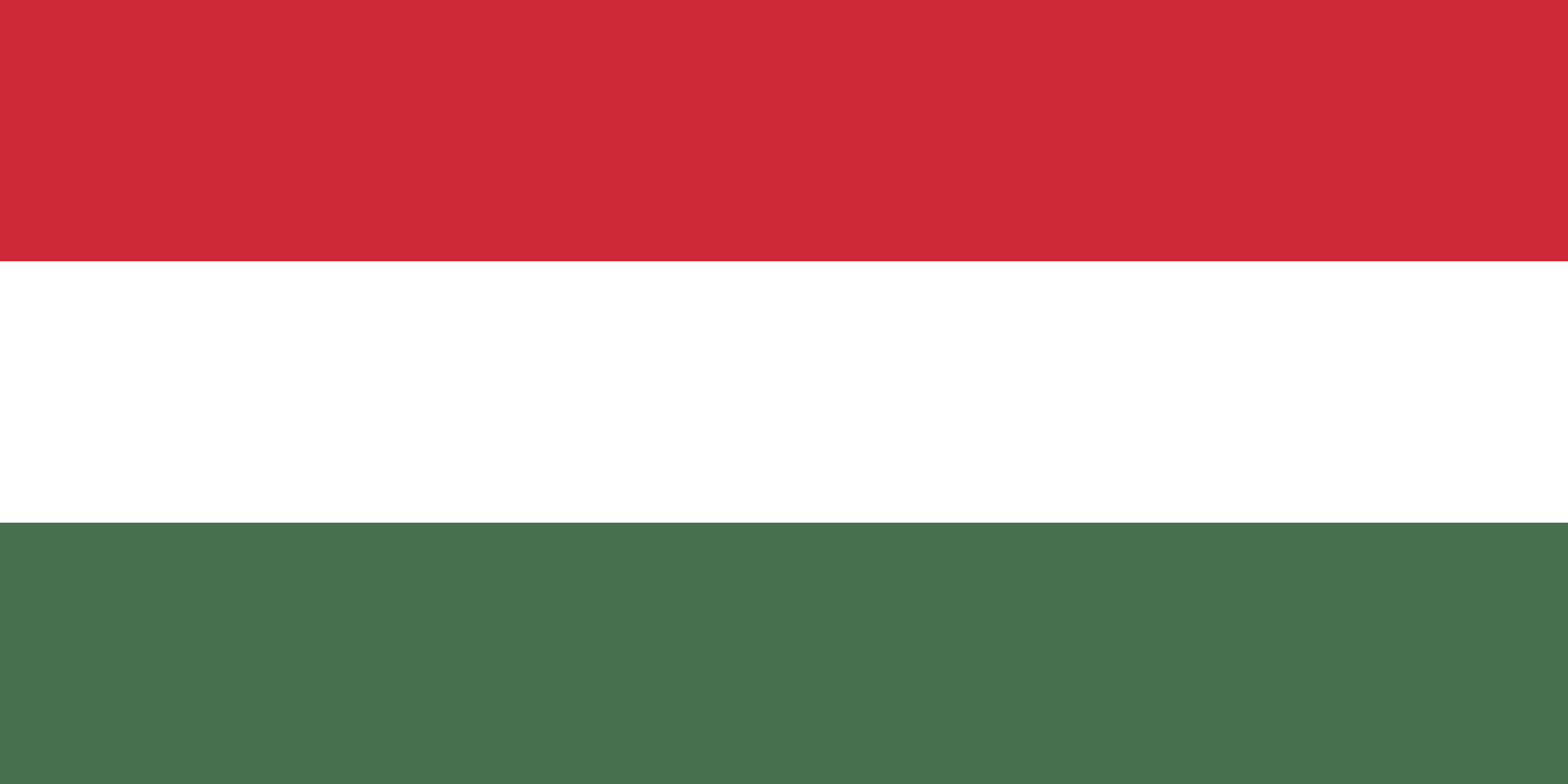
Hungary’s plain national flag has three equal horizontal bands: red above white above green. The 2:1 width:height drawing uses digital reference colors #CE2939, #FFFFFF, and #477050.
GKBook composition, CC0; underlying flag geometry, public domain; Commons contributors.Download image
A 3:2 width:height red-white-green reference with three equal horizontal bands, corresponding to the proportion documented for the civil ensign. This original drawing uses the same digital palette as the main flag for comparison.
GKBook composition, CC0; underlying flag geometry, public domain; Commons contributors.Download image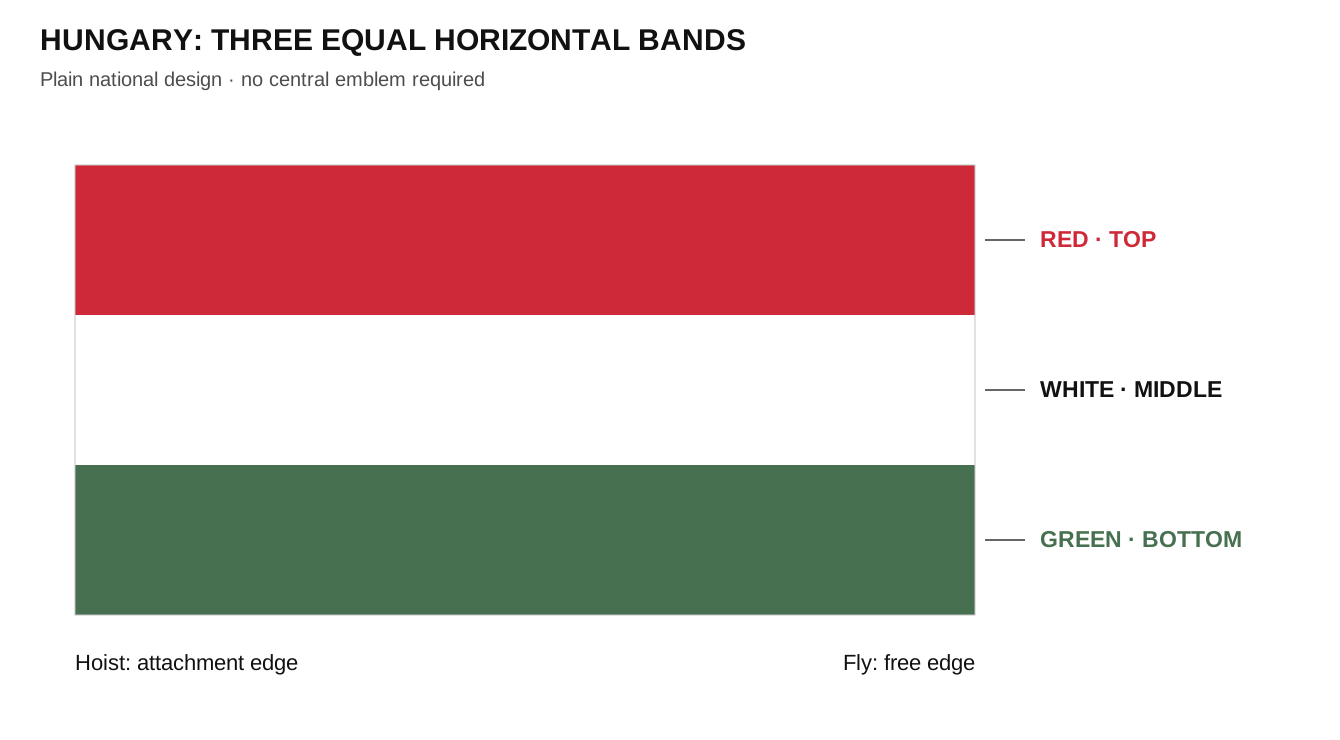
Three horizontal bands fill the rectangle equally. Red is at the top, white in the middle, and green at the bottom. Explanatory labels sit outside the flag. The ordinary national design is a plain tricolor.
GKBook composition, CC0; underlying flag geometry, public domain; Commons contributors.Download image
Red represents strength, white fidelity, and green hope in Article I of Hungary’s Fundamental Law. The supplied main reference uses #CE2939, #FFFFFF, and #477050. Screen values should not be confused with textile color specifications.
GKBook composition, CC0; underlying flag geometry, public domain; Commons contributors.Download image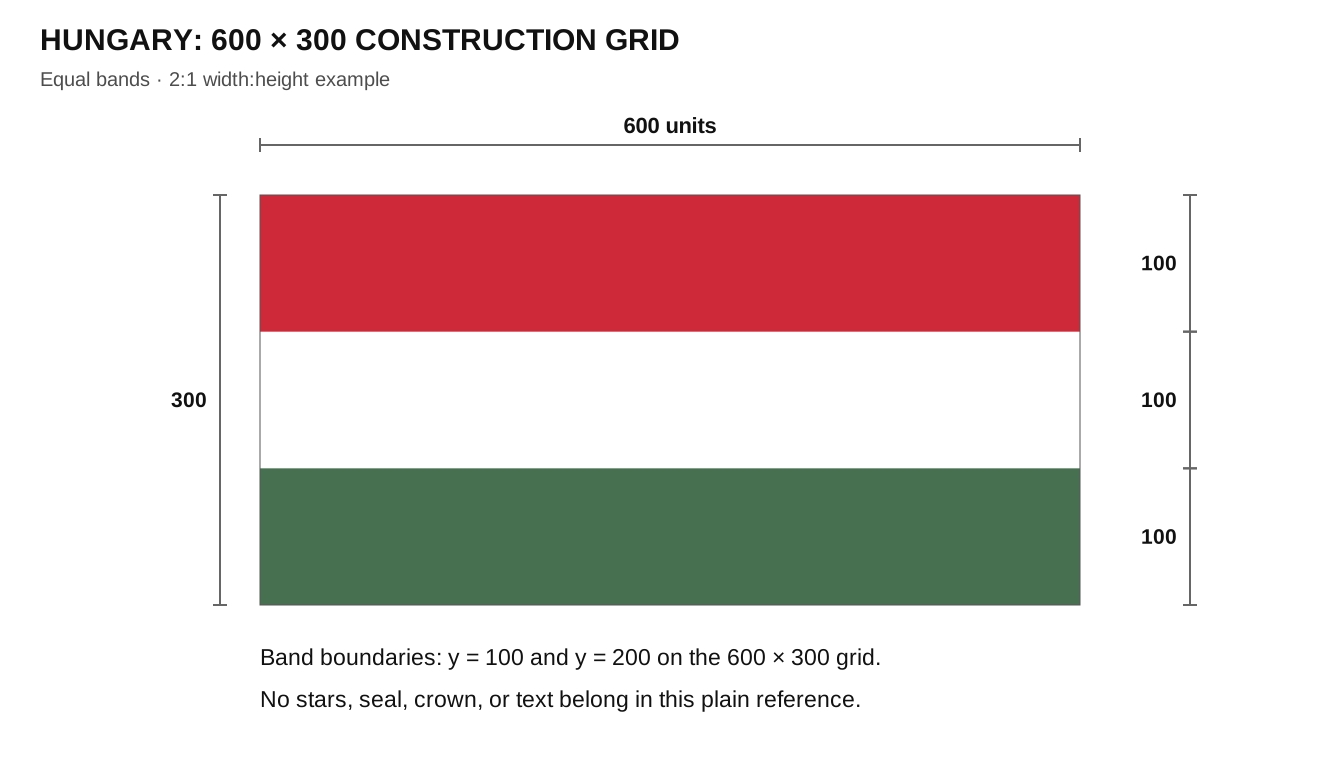
Draw a 600-unit-wide by 300-unit-high field. Divide its height at y = 100 and y = 200, producing three equal 100-unit bands. Fill the top red, middle white, and bottom green. This grid scales the 2:1 reference without adding an emblem.
GKBook composition, CC0; underlying flag geometry, public domain; Commons contributors.Download image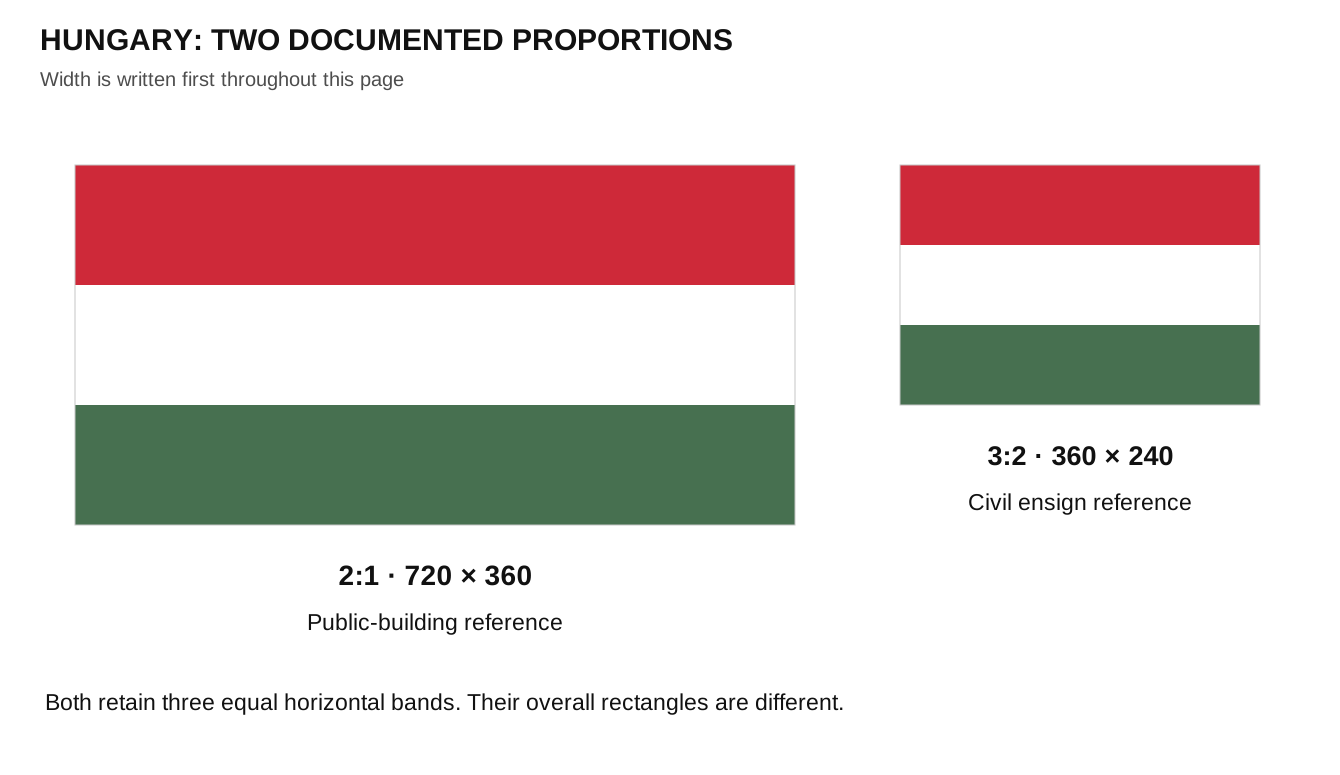
The public-building size schedule produces 2:1 width:height flags. A 3:2 proportion is documented for the civil ensign in the 1957 merchant-shipping decree. The diagrams compare rectangle shapes using one consistent palette; they do not assert that every possible flag use has the same ratio.
GKBook composition, CC0; underlying flag geometry, public domain; Commons contributors.Download image
For specified public-building displays, Decree 132/2000 lists flag sizes equivalent to 200 × 100, 300 × 150, and 400 × 200 centimeters when width is written first. The corresponding staffs are 2.5, 3.5, and 4 meters; the corresponding masts are 6, 9, and 12 meters.
GKBook composition, CC0; underlying flag geometry, public domain; Commons contributors.Download image
An arms-bearing Hungarian tricolor reference. The complete shield, double cross, triple hill, small crown, and Holy Crown are retained. The plain national flag remains the basic constitutional design; arms-bearing flags are permitted in the contexts specified by the symbols law.
Orion 8, based on Thommy9’s work; Hungarian national symbol, public domain. GKBook presentation, CC0.Download image
A historical reference with the crownless Kossuth coat of arms, associated with 1946–1949 and the 1956–1957 transition. It is a separate historical illustration, not the ordinary current plain flag. The complete source shield is retained.
Thommy / Wikimedia Commons; CC0 and public-domain Hungarian national symbol. GKBook presentation, CC0.Download image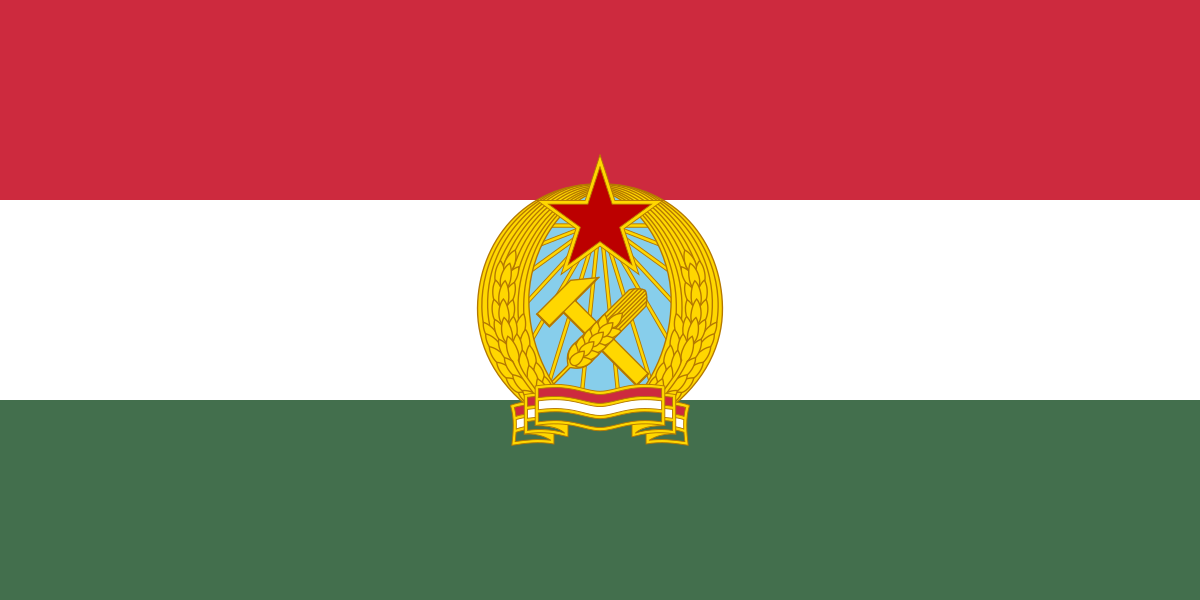
A historical red-white-green flag with the Rákosi emblem: a red star, hammer and ear of wheat, wheat wreath, and ribbon. This is the emblem removed from flags during the 1956 uprising. It does not belong on the ordinary current flag.
Thommy / Wikimedia Commons; CC0 and public-domain Hungarian national symbol. GKBook presentation, CC0.Download image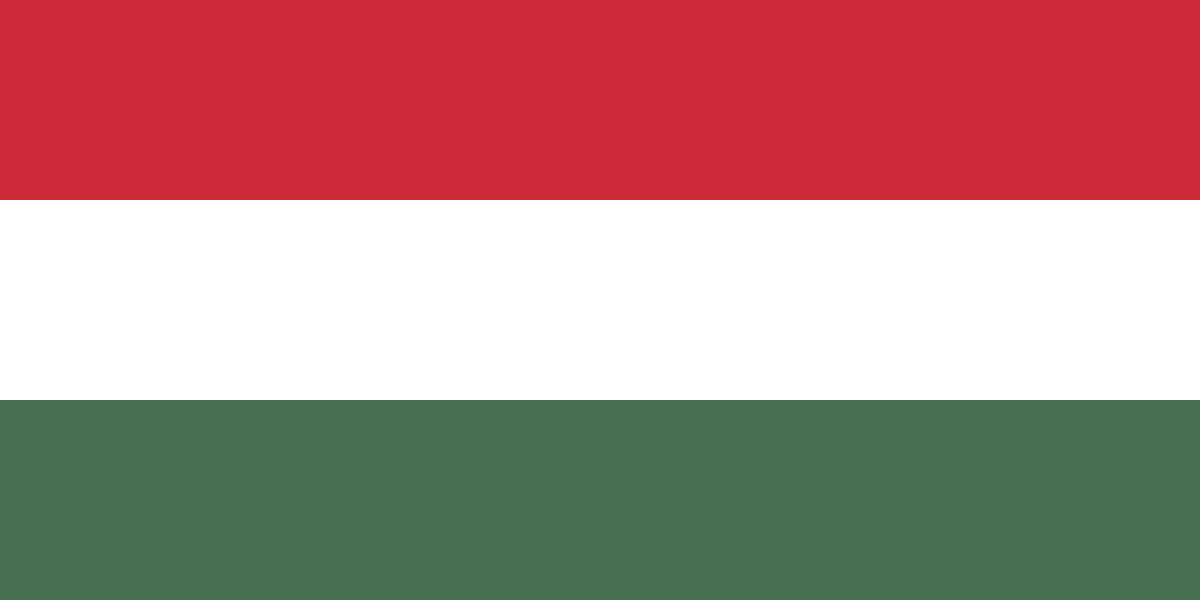
An original schematic of a Hungarian tricolor with a real transparent cutout where a political emblem was removed. The irregular opening represents the 1956 revolutionary symbol; its exact shape varied among actual flags and is not a standardized national design.
GKBook original schematic, CC0; no claim to reproduce a particular surviving flag.Download image
The selected sequence shows the crownless Kossuth arms reference, the Rákosi-emblem flag, and the later plain tricolor. Revolutionary flags with holes and revived Kossuth arms belong to the 1956 transition, so this compact selection is not a claim of uniform use at every moment.
GKBook composition, CC0; underlying flag geometry, public domain; Commons contributors.Download image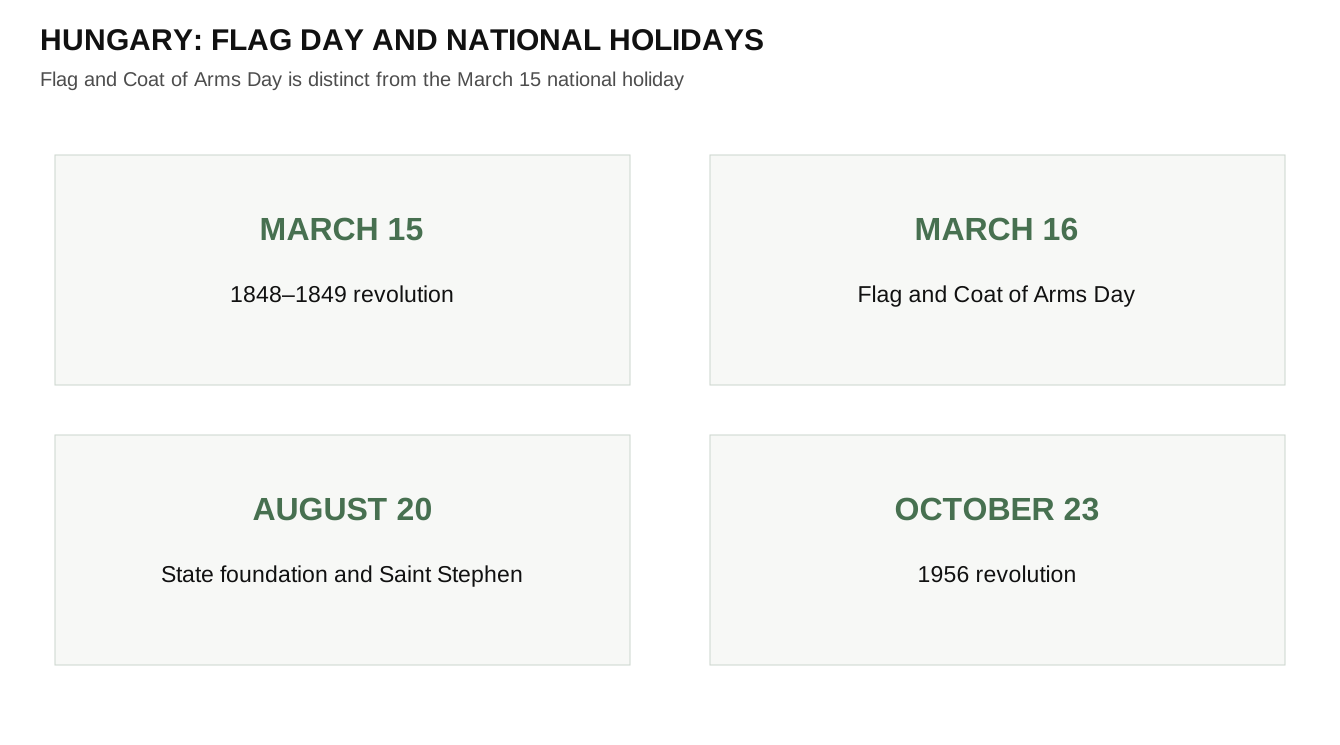
March 16 is Flag and Coat of Arms Day, designated in 2014 for observance beginning in 2015. March 15, August 20, and October 23 are the national holidays listed in the Fundamental Law. August 20 is identified there as the official state holiday.
GKBook composition, CC0; underlying flag geometry, public domain; Commons contributors.Download image
Decree 237/2001 provides recurring national mourning on October 6 and November 4. At Parliament, the national flag is raised with military honors and lowered to half-mast. For the specified public buildings, it distinguishes a mourning flag on staff displays from lowering flags on masts. This diagram does not prescribe an exact lowering distance.
GKBook composition, CC0; underlying flag geometry, public domain; Commons contributors.Download image
Hungary has horizontal red-white-green bands, Bulgaria horizontal white-green-red bands, and Italy vertical green-white-red bands from the hoist. Each complete source flag retains its own geometry and palette; matching color names do not imply identical digital shades.
GKBook comparison, CC0; Hungarian and Italian simple flag geometry, public domain; Bulgaria reference by SKopp, public domain.Download image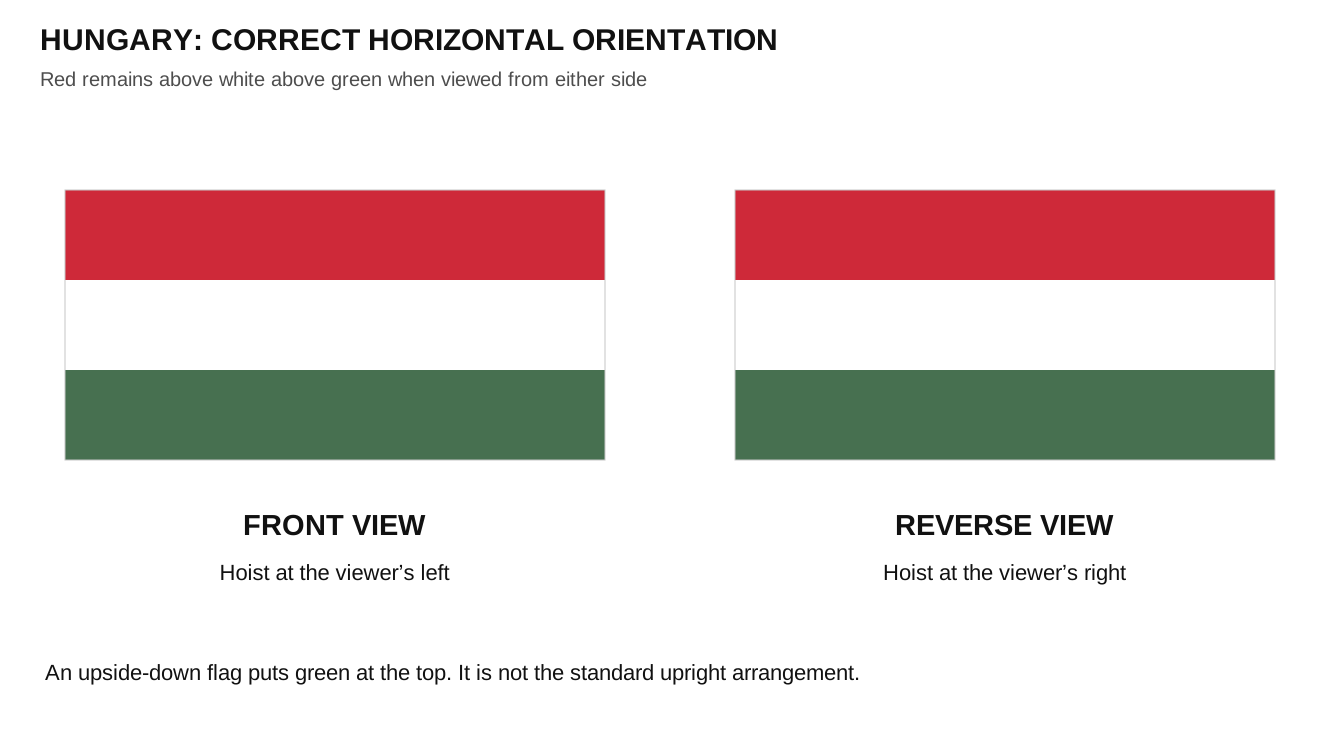
The plain horizontal tricolor has no lettering or asymmetric emblem, so the band order remains red-white-green when viewed from behind. Turning it upside down reverses the top and bottom colors. This diagram explains horizontal geometry and does not invent a universal vertical-display rule.
GKBook composition, CC0; underlying flag geometry, public domain; Commons contributors.Download image
United States soldiers salute the Hungarian flag during the Szentes Axe opening ceremony in Szentes, Hungary, on June 1, 2019. The full documentary frame shows a ceremonial setting and a folded physical flag; it is not a diagram of color specifications.
Staff Sgt. Sokha Hou / U.S. Army, 18th Military Police Brigade; public domain. The appearance of U.S. Department of War (DoW) visual information does not imply or constitute DoW endorsement.Download image
Hungarian and Polish soldiers salute as the Hungarian flag is raised during a transfer-of-authority ceremony at Camp Nothing Hill near Leposavic, Kosovo, on November 11, 2010. The photograph records this event rather than a universal flag-display arrangement.
Sgt. Jerry Boffen / U.S. Army, 130th Public Affairs Detachment; public domain. The appearance of U.S. Department of War (DoW) visual information does not imply or constitute DoW endorsement.Download image
A Hungarian flag with its central emblem cut out hangs above Corvin köz in Budapest during the October 1956 uprising. This archival black-and-white photograph records an actual irregular opening; it cannot establish the original cloth’s exact colors.
Historical image courtesy of the American Hungarian Federation; original photographer unidentified. Reused under attribution-only permission recorded on Wikimedia Commons.Download imageFrequently asked questions
What does the flag of Hungary look like?
Hungary’s national flag has three equal horizontal bands: red at the top, white in the middle, and green at the bottom. The basic design contains no coat of arms, stars, or writing. Its familiar plain tricolor should be distinguished from historical flags and authorized versions that carry the national arms.
How are the Hungarian flag’s bands arranged?
Each band occupies one-third of the flag’s height and runs across its full width. Red must be uppermost in a normal horizontal display, followed by white and green. The hoist is the attachment edge, usually drawn at the viewer’s left; the fly is the free edge opposite it.
What are the Hungarian flag’s HEX and RGB colors?
The main downloadable flag uses red #CE2939, white #FFFFFF, and green #477050. Their RGB values are 206, 41, 57; 255, 255, 255; and 71, 112, 80. These values describe this digital artwork. They are not hexadecimal codes written into Hungary’s Fundamental Law or a certificate of textile conformity.
What do Hungary’s flag colors mean?
Article I of Hungary’s Fundamental Law assigns the colors specific meanings: red represents strength, white fidelity, and green hope. These are constitutional meanings rather than merely popular explanations. Other symbolic stories may occur in general accounts, but they should not silently replace the wording of the country’s current constitutional description.
Does Hungary’s national flag need a coat of arms?
The basic constitutional flag is a plain red-white-green tricolor and does not require the coat of arms. Hungary’s symbols law also permits arms-bearing flags in specified contexts, including certain occasional uses. An illustration with the arms can therefore be a lawful variant, while remaining distinct from the ordinary plain design.
What appears in Hungary’s coat of arms?
Hungary’s coat of arms combines red-and-silver horizontal divisions with a silver double cross above a gold crown on a green triple hill. The Holy Crown rests above the shield. These elements belong to the national arms; they are not mandatory features of every Hungarian flag or symbols that should be approximated with a generic crown.
What is the Hungarian flag’s aspect ratio?
The main reference is twice as wide as it is high, written here as 2:1 width:height. That proportion matches the public-building sizes in Decree 132/2000. A 3:2 width:height proportion is separately documented for the civil ensign. Sources writing height first express the same two ratios as 1:2 and 2:3.
How can the Hungarian flag be drawn accurately?
Draw a rectangle 600 units wide and 300 units high, divide it into three horizontal bands of 100 units each, and color them red, white, and green from top to bottom. This creates the supplied 2:1 reference. Scale the complete drawing uniformly and leave the plain national flag free of extra emblems.
What sizes are listed for public-building flags?
Decree 132/2000 lists flags equivalent to 200 by 100, 300 by 150, and 400 by 200 centimeters when width is written first. Their corresponding staffs are 2.5, 3.5, and 4 meters long; their masts are 6, 9, and 12 meters high. These are public-building specifications, not every possible private flag size.
How did Hungary’s flag develop?
Hungary’s national colors grew from older heraldic and ceremonial traditions, gained formal recognition in 1848, and appeared with different state emblems during later political changes. The 1956 uprising made the flag with a hole a powerful symbol. In 1957, a constitutional amendment removed the requirement to display the arms on the national flag.
Are Hungary’s national colors older than the modern flag?
Yes. Red and silver occur in older Hungarian heraldry, and red, white, and green appeared together in ceremonial details before the modern national flag was formally recognized. Those earlier uses help explain the colors’ historical roots. They do not establish that the present plain horizontal tricolor existed unchanged throughout medieval Hungarian history.
When were Hungary’s national colors officially recognized?
Act XXI of 1848 formally prescribed Hungary’s national colors, according to the national-symbols history. This is the central nineteenth-century recognition milestone. It should be distinguished from the 1957 plain-flag amendment, the modern constitutional description, and March 16 Flag and Coat of Arms Day, which was designated much later as an annual observance.
Who designed the Hungarian flag?
The historical record examined describes a gradual development from heraldic colors and national political movements, followed by legal recognition in 1848. It does not securely identify one individual designer of the present plain tricolor. Artists who create modern vector files reproduce an established national symbol; they are not thereby its original historical designers.
What emblem appeared on Hungary’s flag from 1949 to 1956?
The historical flag associated with 1949–1956 carried the Rákosi emblem in its center. Its design includes a red star, a hammer and ear of wheat, a wheat wreath, and a ribbon. This political emblem should not be confused with Hungary’s present crowned coat of arms or simplified into an unrelated hammer-and-sickle symbol.
Why did Hungarian flags have holes in 1956?
During the 1956 uprising, revolutionaries cut the Rákosi emblem out of flags, leaving openings in the red-white-green cloth. The flag with a hole became a symbol of the uprising and rejection of that political emblem. Actual openings varied in shape; a modern schematic cannot establish one official outline for every revolutionary flag.
What changed in Hungary’s flag in 1957?
Act II of 1957 changed the constitutional flag provision to describe the national flag simply as red-white-green. Its accompanying explanation expressly removed compulsory inclusion of the coat of arms. This was a change in the relationship between flag and state emblem, not the first appearance of Hungary’s three national colors.
Which laws describe Hungary’s flag and its use?
The Fundamental Law describes the three equal bands and their meanings. Act CCII of 2011 governs national-symbol use, while Decree 132/2000 addresses specified public-building displays. Decree 237/2001 sets national-mourning arrangements, and Resolution 45/2014 establishes Flag and Coat of Arms Day. Each instrument covers a different part of the subject.
Are Pantone textile references the same as HEX colors?
No. A 2009 Hungarian Standards Institution explanatory article identifies textile color references 18-1660 for red and 18-6320 for green in MSZ 1361:2009. These are different from screen HEX values. The article also discusses measured color and fabric performance, so matching a monitor swatch alone does not demonstrate that cloth meets a standard.
Where must Hungary’s flag be displayed publicly?
Act CCII of 2011 requires display at specified state and local public institutions, with details and exceptions in the law. It also provides a ceremonial national-flag raising before Parliament on national holidays. Night illumination and removal during extreme weather have particular scopes; neither should be generalized into a rule for every private flag.
May private individuals display the Hungarian flag?
Hungary’s symbols law recognizes private use to express national belonging, subject to its restrictions and respect for the symbol. It also permits specified occasional uses and arms-bearing versions in those contexts. This does not automatically settle trademark registration, product branding, or every commercial use, which are addressed separately by the legal framework.
When is Hungary’s Flag and Coat of Arms Day?
Hungary observes Flag and Coat of Arms Day on March 16. Parliament designated the day in Resolution 45/2014, inviting institutions, organizations, and citizens to observe it beginning in 2015. The observance commemorates the national symbols and their 1848 recognition; it is separate from the March 15 national holiday.
Which Hungarian national holidays involve the flag?
The Fundamental Law lists March 15 for the 1848–1849 revolution, August 20 for state foundation and Saint Stephen, and October 23 for the 1956 revolution. It identifies August 20 as the official state holiday. Flag and Coat of Arms Day on March 16 is a separate observance established by parliamentary resolution.
When is Hungary’s flag flown at half-mast?
The national-mourning decree designates October 6 and November 4 as recurring mourning days and allows additional declarations. It provides for the national flag before Parliament to be raised with military honors and lowered to half-mast. For specified public buildings, the arrangements distinguish flags on masts from mourning flags used with staff displays.
How should Hungarian public-building flags be maintained?
Decree 132/2000 requires the covered flags to be cleaned at least every three months and replaced at least annually. Visible deterioration calls for earlier replacement. These rules concern the public-building displays within the decree’s scope. A private owner should also follow the fabric’s care instructions and avoid displaying a damaged or dirty flag.
Does the plain Hungarian flag look different from behind?
Viewed from behind, the plain Hungarian tricolor still has red above white above green; only the attachment edge changes sides relative to the viewer. Turning it upside down is different and puts green uppermost. Arms-bearing versions require additional attention to their emblem, while a vertical display should follow the applicable institutional arrangement.
What is the Hungarian civil ensign?
The documented Hungarian civil ensign is a plain horizontal red-white-green flag with a 3:2 width:height proportion. The historical merchant-shipping decree specifies equal bands and a height-to-length relationship of two to three. This shipping reference should be distinguished from the 2:1 public-building schedule and from special military colors or unit standards.
Are Hungarian military colors identical to the national flag?
No. Hungary’s historical military colors include designs with arms, decorative borders, and other features that differ from the plain horizontal national tricolor. The national-symbols gallery documents such military traditions separately. A unit color, ceremonial arms-bearing tricolor, civil ensign, and ordinary national flag should each be identified according to its actual context.
How does Hungary’s flag differ from Italy’s and Bulgaria’s?
Hungary has horizontal red-white-green bands. Bulgaria has horizontal white-green-red bands, placing white at the top. Italy has vertical green-white-red bands from the hoist. The flags share familiar color names, but their arrangements and reference shades differ. Rotating or recoloring one country’s image is not a reliable substitute for the correct flag.
What do the Hungary flag photographs document?
The photographs document the flag at a 2019 ceremony in Szentes, a 2010 flag raising in Kosovo, and a flag with its emblem cut out during the 1956 uprising in Budapest. Each caption identifies its context and credit. Photographic lighting, folds, and historical black-and-white reproduction cannot determine exact modern color specifications.
What is the Hungary flag emoji?
The Hungary flag emoji is 🇭🇺, formed from the regional indicator symbols H and U. Its Unicode sequence is U+1F1ED followed by U+1F1FA. Some systems display a flag, while others show letters. The emoji is a text symbol; its platform-specific appearance is not a precise construction drawing or textile color reference.
What mistakes should be avoided when drawing Hungary’s flag?
Avoid unequal bands, green at the top, vertical stripes, and an emblem added to a drawing labeled as the plain national flag. Keep the 2:1 and 3:2 references clearly identified. Do not call a white painted patch a genuine cutout, or substitute a generic crown for the complete coat of arms.
Which Hungary flag images are available to download?
The gallery supplies the plain 2:1 national reference, a 3:2 proportion reference, historical flags, a complete arms-bearing version, diagrams, comparisons, and documentary photographs. A large PNG accompanies the scalable SVG master. Every download is local, and each gallery caption distinguishes current designs, historical material, original explanations, and the associated image rights.
Explore all general-knowledge topics and the A-to-Z lists.

We Value Your Opinion Comments