
Guyana flag picture
Explore the construction sheet, the Independence Day observance, and the historical sequence.

| Name | The Golden ArrowheadThe constitutional text also uses the spelling “Golden Arrow Head.” |
|---|---|
| Design | Green with nested arrowheadsGold edged white; red triangle edged black; no star or coat of arms. |
| Proportions | Land 5:3 · sea 2:1Width:height; the Second Schedule writes 3:5 and 1:2 with height first. |
| Approval | January 26, 1966House of Assembly approval recorded in Parliament’s history. |
| First national use | May 26, 1966Guyana’s independence from the United Kingdom. |
| Designer | Whitney SmithThe adopted five-color design developed from his earlier proposal. |
| Flag Days initiative | May 24–26, 2025A documented government initiative; permanent annual statutory status unverified. |
| National observances | May 26 · February 23Independence Day and Republic Day commemorate different milestones. |
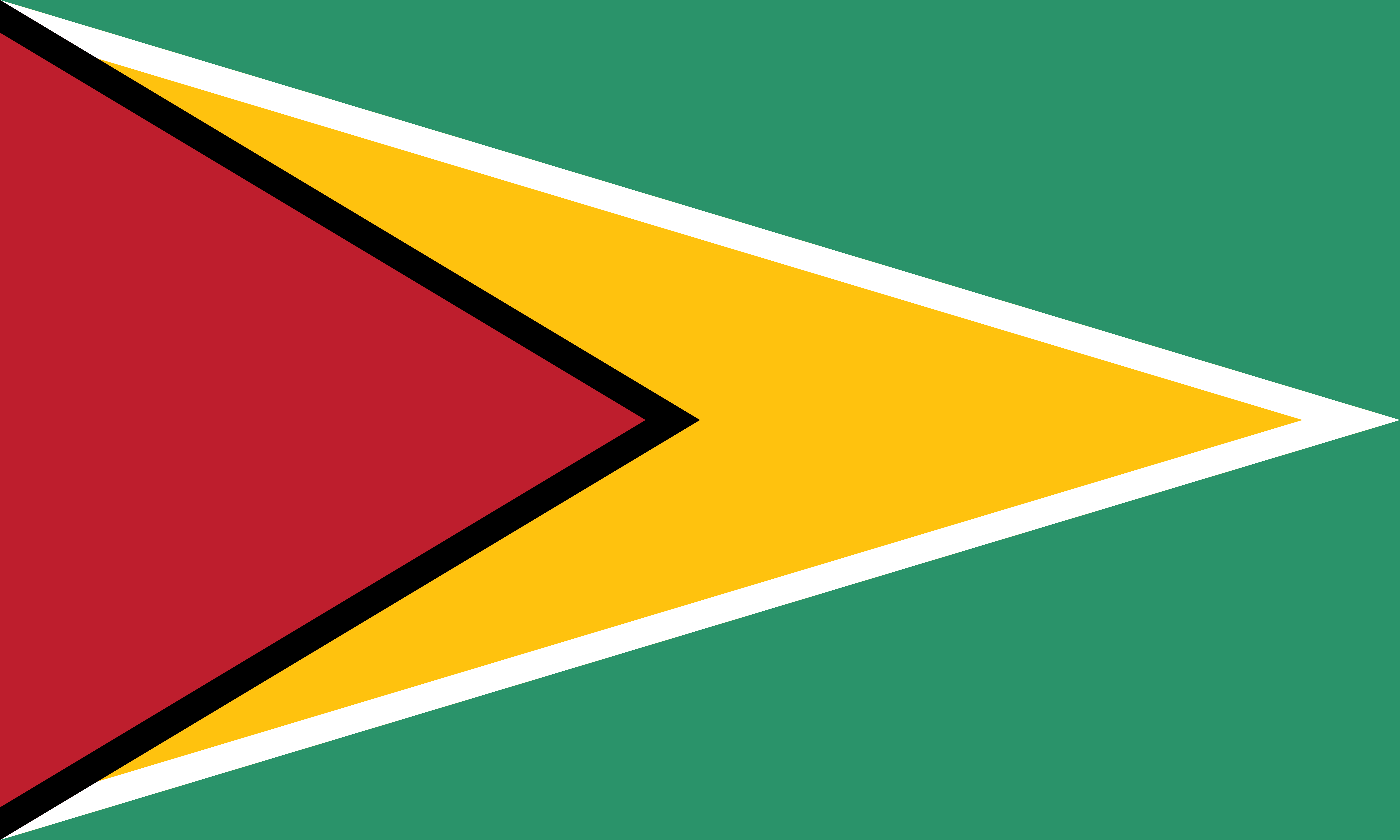
A white-edged gold arrowhead crosses the green field, with a black-edged red triangle at the hoist. Parliament’s history records approval on January 26, 1966 and national use from independence on May 26.
What is the national flag of Guyana?
Guyana’s national flag has a green field with a large gold arrowhead edged in white, overlaid by a smaller red triangle edged in black. Both triangles begin at the hoist, the attachment edge. The design is called the Golden Arrowhead and contains five colors, with no star, motto, or coat of arms.
The Golden Arrowhead identifies Guyana through a directional, five-color design. Its triangles point away from the pole, while the green field remains visible above and below the larger arrowhead.
The flag’s story includes Whitney Smith’s proposal, parliamentary approval before independence, and two proportions explicitly recorded in the Constitution. Understanding those separate details makes the design easier to identify and reproduce.
Explore the arrowhead detail, construction sheet, history, 2025 Flag Days initiative, and downloadable pictures.
How are Guyana’s flag triangles arranged?
The two triangular forms share the full hoist as their base and point toward the free edge. In the supplied reference, the large white outer triangle reaches the fly, while the smaller black outer triangle reaches the flag’s center. Gold and red fill the shapes inside their contrasting diagonal borders.
The hoist is the attachment edge; the fly is the opposite free edge. A normal flat front view places the hoist at the left. The larger white-edged form spans the full length, and the smaller black-edged form ends halfway across.
The flag is not a set of horizontal stripes. Its green areas and nested triangular shapes should remain connected exactly as shown, with no gaps or additional outlines.
What digital color values are used for Guyana’s flag?
The delivered reference uses green #2A936A, gold #FFC20E, red #BE1E2D, white #FFFFFF, and black #000000. These values document the actual SVG fills and strokes. They are not authenticated statutory color codes, and differences between digital references should not be described as official flag changes without an authoritative national specification.
| Color | HEX | RGB | Scope |
|---|---|---|---|
| Green | #2A936A | 42, 147, 106 | Reference fill |
| Gold | #FFC20E | 255, 194, 14 | Reference fill |
| Red | #BE1E2D | 190, 30, 45 | Reference fill |
| White | #FFFFFF | 255, 255, 255 | Reference border |
| Black | #000000 | 0, 0, 0 | Reference border |
The constitutional description names green, gold, red, white, and black. It does not provide HEX, RGB, CMYK, or Pantone specifications. Different digital reproductions use different shades; a file revision alone is not evidence that Guyana changed its national flag.
Gold is the established name used in national-symbols material. A flat yellow-gold screen color represents it in this reference, without implying metallic ink or a particular fabric treatment. Printed results should be checked with the intended material and color profile.
What do Guyana’s five flag colors symbolize?
The official explanation connects green with agriculture and forests, gold with mineral wealth and forward movement, white with rivers and water potential, black with strength and endurance, and red with the energetic work of nation building. These meanings are recorded in national-symbols material and the Constitution’s Second Schedule.
The Guyana Lands and Surveys Commission and Ministry of Education explain the colors in terms of the country’s land, water, resources, and people. The constitutional schedule also records the symbolic meanings.
Read these as national symbolism, not as measurements of the economy or a division of the population into five groups. The official account reviewed does not assign one color to each ethnic community.
Why is the flag called the Golden Arrowhead?
The name describes the prominent gold triangular form pointing away from the hoist. Official symbolism connects it with mineral wealth and movement into the future. The Constitution identifies the national flag by this name. The arrowhead is part of the flag’s geometry, not a separate coat of arms placed on a background.
The arrowhead’s direction gives visual form to the idea of forward movement. Its gold color connects that movement with the country’s mineral wealth. Green provides the surrounding field rather than another small emblem inside the arrow.
The name appears as both “Golden Arrowhead” and “Golden Arrow Head” in official material. Those spellings refer to the same national flag, not to separate variants.
What do the black and white borders do?
The white and black lines are contrasting borders, also called fimbriations. White edges the large gold form, and black edges the smaller red triangle. Both are part of the five-color national design. They run along the sloping sides; the reference does not add a border across the shared hoist edge.
Fimbriation is a technical word for a narrow contrasting edge. Here, white separates gold from green, and black separates red from gold. The borders also have their own symbolic meanings: waters and rivers for white, endurance for black.
A border occupies space. Consequently, the visible gold point sits slightly behind the outer white tip, and the visible red point sits behind the outer black tip. Measurements should identify which boundary they refer to.
The source drawing uses equal perpendicular border thickness along the sloping edges. Other reproductions differ, and an authoritative dimensioned national construction sheet was not authenticated. The supplied measurements are therefore explicitly reference measurements.
What are Guyana’s land and sea flag proportions?
The Constitution’s Second Schedule gives proportions of 3:5 on land and 1:2 at sea when height comes first. Written as width:height, these become 5:3 and 2:1. The sea version is relatively longer. Unlike a merely customary ratio, both relationships are explicitly stated in the published constitutional description.
This article writes width before height. A land flag measuring 1000 by 600 therefore has a ratio of 5:3. A sea flag measuring 1200 by 600 has a ratio of 2:1.
The Second Schedule writes the ratios with height first: 3:5 and 1:2. Switching the order of the numbers without explaining the convention can make two correct descriptions appear contradictory.
How are the downloadable flag’s dimensions organized?
The land SVG measures 3000 by 1800. Its large outer triangle reaches (3000, 900), and its smaller outer black triangle reaches (1500, 900), with both based along the full hoist. The PNG measures 6000 by 3600. These coordinates describe the delivered reference; exact border widths were not authenticated as legal specifications.
| Feature | Reference grid | Land SVG | Large land PNG |
|---|---|---|---|
| Full rectangle | 1000 × 600 | 3000 × 1800 | 6000 × 3600 |
| Outer white tip | (1000, 300) | (3000, 900) | (6000, 1800) |
| Outer black tip | (500, 300) | (1500, 900) | (3000, 1800) |
| Hoist endpoints | (0, 0); (0, 600) | (0, 0); (0, 1800) | (0, 0); (0, 3600) |
| Diagonal border width | 20 units | 60 units | 120 pixels |
The full outer triangle covers half the rectangle. The smaller black outer triangle has the same height but half its length, so it covers one-quarter of the rectangle. These relationships are independent of the units used.
The border measurement documents this complete source, including its clipping. It is not a constitutional cutting specification. Keep the full paths and border geometry together when scaling the artwork.
Why do some published color percentages conflict?
The Ministry of Education’s table assigns 50 percent to green, 24 to gold, 16 to red, 6 to white, and 4 to black. That makes red plus black 20 percent. A full-height triangle reaching the flag’s center occupies 25 percent, so that table and the supplied center-tip geometry do not match.
| Element | Education table | Relationship in this reference |
|---|---|---|
| Green | 50% | 50% outside the large triangle |
| Gold | 24% | Gold and visible white together: 25% |
| White | 6% | Included with gold in the 25% region |
| Red | 16% | Red and black together: 25% |
| Black | 4% | Included with red in the 25% region |
The Ministry’s revised 2021 textbook prints the five-number table clearly. Its red and black entries total 20%, while its gold and white entries total 30%. Neither combined value matches a smaller triangle whose outer point sits at the center.
Parliament’s 2012 constitutional reprint contains a separate, garbled percentage line: red is omitted, and the percentage notation is corrupted. The basic design and land/sea ratios are clear, but that line does not supply a dependable alternative construction.
The downloads preserve one documented vector reference. They do not silently redraw the flag to force agreement with conflicting percentages or claim that the discrepancy has been officially resolved.
How is Guyana’s national flag used at sea?
The sea flag keeps the Golden Arrowhead’s five-color arrangement but uses the longer 2:1 width:height rectangle specified in the Constitution. The published Shipping Act identifies Guyana’s national flag as a Guyana ship’s national colors. A maritime flag should therefore be distinguished by its proportions and legal use, not by an invented extra emblem.
Section 98 of the published Guyana Shipping Act, Chapter 49:01, identifies the national flag as a Guyana ship’s national colors. Section 99 lists circumstances for hoisting them, including port entry or departure, passing a warship, an appropriate government signal, and sunrise-to-sunset display in a Guyana port.
The same section expressly excludes vessels employed exclusively in fishing from that display provision. These are provisions in the reviewed 2012 law edition, not a universal land-display timetable or a complete account of current maritime compliance requirements.
A separate sea SVG is supplied. It preserves the sea reference’s triangle and border geometry instead of stretching the land image and changing the perpendicular thickness of its borders.
Which finished sizes preserve the two flag ratios?
For land use, examples include 100 by 60, 150 by 90, and 200 by 120 centimeters. For sea use, 100 by 50, 150 by 75, and 200 by 100 preserve the longer rectangle. These are calculated examples, not an official retail-size schedule; account separately for sleeves, hems, and fabric shrinkage.
For a 150-by-90-centimeter land flag, the outer black triangle ends 75 centimeters from the hoist at mid-height. For a 150-by-75-centimeter sea flag, that midpoint is still 75 centimeters from the hoist, but the rectangle is shorter vertically.
Allow for sleeves and hems before cutting fabric. The finished visible design is the area represented by the measurements. Uniform resizing also preserves the relationship between the borders and the colored interiors.
How did Guyana’s national flag develop?
Before independence, British Guiana used British colonial symbols, including a Blue Ensign with the Union flag in the canton and a ship-related badge. The badge changed during the colonial period. The Golden Arrowhead introduced a distinct national design at independence in 1966, with triangles and five colors replacing the colonial ensign arrangement.
Specialist records describe a circular ship badge on the British Blue Ensign.
An oval garter-style badge appeared in 1906; replacement Blue Ensigns omitted its white backing disk after 1919.
The final colonial reference uses a shield with a ship, shown on a white disk.
The early proposal used a red field and green hoist triangle without the later contrasting borders.
Parliament’s history records the House of Assembly’s approval of the flag for independent Guyana.
The Golden Arrowhead came into use at independence from the United Kingdom.
The transition to a republic followed independence; it was not the Golden Arrowhead’s first adoption.
The government promoted widespread flag display leading into Independence Day.
The colonial symbols and the Golden Arrowhead belong to different constitutional periods. The former identify British Guiana; the latter identifies independent Guyana. Changes to a colonial ship badge should not be mistaken for revisions of the five-color national flag.
The illustrated history sheet below shows the final colonial reference, the early proposal, and the adopted design. Earlier badge changes are described in the timeline without presenting an unsupported reconstruction as an original artifact.
Why do January 26 and May 26, 1966 both matter?
The Golden Arrowhead came into national use when Guyana became independent on May 26, 1966. Parliament’s history also records an earlier House of Assembly approval on January 26, 1966. These dates describe different stages: approval of the design and its use at independence. Republic status followed later, on February 23, 1970.
Parliament’s historical account records the House of Assembly approving the design on January 26, 1966. Elsewhere, the same publication states that Guyana’s own flag was put into use from independence on May 26.
May 26 is consequently the usual independence-era adoption date associated with the flag’s national use. January 26 supplies the earlier legislative approval milestone. Neither should be substituted for the later republic anniversary.
Who designed Guyana’s Golden Arrowhead?
Whitney Smith, an American flag scholar and designer, created the proposal from which Guyana’s national flag developed. Parliament’s history credits him, and the University of Texas archive holding his papers identifies him as the designer. The adopted design differs from his earlier proposal, so authorship and the subsequent changes should be explained separately.
A vexillologist studies flags; a vexillographer designs them. Whitney Smith worked in both fields. His collection at the Dolph Briscoe Center for American History provides an institutional record of his flag research and identifies the Golden Arrowhead among his designs.
The modern digital files have their own contributors. Those reproduction credits are separate from Smith’s authorship of the underlying proposal and from the officials involved in approving the national design.
What changed between the proposal and the adopted flag?
The commonly reproduced proposal has a red field, a large gold triangle, and a smaller green triangle, without the black and white borders. The adopted flag reverses red and green and includes both borders. The comparison image is a modern reconstruction of the proposal, not an original archival drawing or a former adopted national flag.
Smith’s account, reproduced by the Portland Flag Association, dates his submission to 1960. Some later summaries and the modern proposal image use 1962. The history sheet therefore labels the proposal by the broader early-1960s period instead of concealing the discrepancy.
Accounts also differ over who introduced the black and white borders. Some credit the College of Arms; a later specialist account describes changes made by a Guyanese committee before the design was sent there. The reviewed Constitution attributes the heraldic description to the Garter King of Arms but does not settle responsibility for every modification.
The final colonial vector is a legacy reproduction of the ship-badge Blue Ensign. It provides historical context and is not a photograph of an original flag or a claim that every fine detail is an archival manufacturing standard.
What does Guyana’s constitutional description establish?
Article 4 names the national flag as the Golden Arrow Head and refers to the Second Schedule. That schedule describes the design, explains its colors, and gives land and sea proportions. Article 7 establishes a duty to respect national symbols. The reviewed constitutional reprint does not provide a reliable numerical production drawing.
The Second Schedule combines an illustration, heraldic language, symbolic explanations, and land/sea proportions. Heraldic color terms include vert for green, or for gold, argent for white or silver, gules for red, and sable for black.
The reviewed parliamentary edition is labeled L.R.O. 1/2012. It is useful for the flag’s constitutional description, but its malformed color-percentage line should not be turned into precise manufacturing instructions. No numerical shade standard or definitive dimensioned border plan was authenticated.
The duty of respect in Article 7 is broader than a list of flag-handling commands. It does not by itself establish an exact folding method, a textile specification, or a penalty for every conceivable use.
How should Guyana’s flag be prepared for print or fabric?
Choose the land or sea proportions first, then preserve the complete five-color design and its contrasting borders. Use the supplied palette as a documented digital reference and assess a proof on the intended material. The SVG supports accurate scaling, but it does not certify an official textile standard or authorize a manufacturing business.
Choose the intended proportions
Use the land or sea master as appropriate. Preserve the green field, both colored triangles, and the two contrasting borders as a complete design.
Check the production proof
Do not treat a screen swatch as a certified fabric match. Review color, seams, and the finished visible dimensions on the intended material.
Simple stretching can alter the border angles and thickness. Scale uniformly from the correct master, and keep labels or measurement arrows outside the national rectangle.
The reviewed sources do not establish a special manufacturing-license process, compulsory fabric weight, stitch count, or official stock-size list. A ceremonial flag’s reported dimensions are not automatically a national production rule.
What guidance supports respectful display of Guyana’s flag?
Article 7 requires respect and proper solemnity toward Guyana’s national symbols. Ministry of Education material advises giving the flag a position of honor and keeping it off the ground. These sources support respectful display, but they should not be expanded into an invented universal timetable, salute procedure, or detailed flag-precedence code.
The Ministry’s school text recommends a position of honor. That educational advice should not be expanded into a diplomatic rule requiring Guyana’s flag to be higher than every other sovereign state’s flag in all settings.
For official ceremonies, the responsible institution should supply the actual arrangements for placement, personnel, and movements. The constitutional duty and school guidance support respect; they do not establish every operational detail.
The five-color design must remain recognizable. Place captions, institutional names, and event graphics separately from the ordinary national flag when creating an explanatory display.
What were Guyana’s Flag Days in 2025?
An official announcement established a Flag Days initiative for May 24 through May 26, 2025, leading into Independence Day. It encouraged flag displays at homes, schools, businesses, and public spaces. This verifies the named 2025 initiative; it does not by itself establish a permanent annual statutory Flag Day or an additional public holiday.
The Department of Public Information published the announcement on May 9, 2025. It described a May 24 concert at Anna Regina and encouraged widespread flag display on May 25 before Independence Day on May 26.
The initiative included homes, schools, businesses, and public spaces. It is a documented example of public participation centered on the Golden Arrowhead.
The dates here identify that announced 2025 program. The reviewed source does not establish a separate permanent annual holiday or authorize treating every later year’s program as identical.
When is Guyana’s Independence Day?
Guyana’s Independence Day is May 26, commemorating independence from the United Kingdom in 1966 and the start of national use of the Golden Arrowhead. It differs from the January 1966 approval of the design and the February 1970 transition to a republic. The dates belong to related but separate historical events.
May 26 recalls the 1966 transition from British Guiana to independent Guyana and the national flag’s entry into use. The Golden Arrowhead has consequently become a central image in independence commemorations.
The earlier January approval date concerns the design’s acceptance by the House of Assembly. It is not the date when independence began. Keep both dates when explaining the flag’s development.
Did the Golden Arrowhead begin with the republic in 1970?
No. Guyana became a republic on February 23, 1970, after the Golden Arrowhead had already entered national use at independence in 1966. Republic Day is another important occasion for flag raising. An official report describes a Joint Services parade, cultural presentations, and flag raising for the fifty-sixth republic anniversary in February 2026.
The 2026 government report documents the fifty-sixth republic anniversary on February 23. It describes a Joint Services parade and cultural performances accompanying the raising of the flag.
Republic Day and Independence Day are separate commemorations. The same national flag can be prominent at both without having been newly adopted on each occasion.
When has Guyana flown the flag at half-mast?
On May 22, 2023, an official announcement declared three days of national mourning after the Mahdia school-dormitory fire. It directed flags at public buildings to be flown at half-staff from 4 p.m. that day. This is a documented historical instruction, not a current alert or an automatic duration for every future mourning period.
The May 22, 2023 government announcement directed half-staff display at public buildings from 4 p.m. as part of three days of national mourning after the Mahdia dormitory fire.
The reported time and duration belong to that particular instruction. They do not create a universal start time or automatic three-day period for future events. A later observance requires its own authoritative notice.
The source does not specify a numerical mast position. The diagram therefore illustrates the idea without inventing a measured clearance or complete ceremonial sequence.
How should Guyana’s flag be cared for?
Keep the flag clean, dry wet fabric before storage, and protect seams and attachment points from damage. Educational guidance supports respectful treatment and keeping it off the ground. Follow the fabric maker’s care advice; the reviewed sources do not establish a mandatory folding pattern, retirement ceremony, or single disposal method for worn flags.
Inspect the attachment points and seams before outdoor display. Wind and rain can stress those areas even when the colored panels remain intact. Dry the flag before storing it, and follow the material’s actual cleaning instructions.
An original historic textile may need conservation treatment rather than routine washing or repair. Preserve reliable information about its maker, date, and use alongside the object.
These practical suggestions support respectful handling. They are not presented as a national retirement rite or a legally prescribed folding pattern.
How does Guyana’s flag appear from the reverse side?
From behind, the triangular bases appear on the viewer’s right and the arrowhead points left, because the attachment edge is now on that side. The whole flag mirrors together. The flat design is symmetrical from top to bottom, so a vertical reflection alone does not create a visually different arrangement.
A normal front-facing drawing points right; a view from behind points left. This physical reversal does not change the country represented. It changes where the observer stands relative to the cloth.
Top-to-bottom symmetry can also be confusing. Mirroring the flat artwork vertically leaves it unchanged, whereas rotating the entire rectangle 180 degrees moves the hoist to the other side. Identify the attachment edge before judging a photograph’s orientation.
Is Guyana’s coat of arms part of the flag?
No. Guyana’s ordinary national flag consists of the green field and bordered gold and red triangular forms. The coat of arms is a separate national symbol described alongside the flag in the Constitution. Adding the arms, the national motto, a star, or a presidential emblem would alter the plain Golden Arrowhead design.
The Constitution treats the flag, arms, anthem, and pledge as distinct national symbols. The ordinary Golden Arrowhead does not carry the jaguars, shield, headdress, or motto ribbon of the arms.
The national motto is “One People, One Nation, One Destiny.” The anthem is known as Green Land of Guyana. Neither its lyrics nor the motto is written across the plain flag.
How do other Guyanese flags differ from the national flag?
Special-purpose flags should be distinguished from the ordinary Golden Arrowhead. Specialist references describe presidential standards and a civil air ensign, but their histories and measurements require separate evidence. The downloads here identify the constitutionally specified land and sea versions clearly, without presenting uncertain officeholder standards or an unverified aviation construction as national masters.
The civil air ensign is described in specialist literature as light blue with a white-edged dark blue cross and a national-flag canton. The same source records uncertainty and competing proportional descriptions. It should not be used as an interchangeable national flag.
Presidential standards have a separate history of designs associated with the office and particular presidencies. A historical presidential image does not prove the current standard’s exact form. This page’s national masters are the documented land and sea versions.
How does Guyana’s flag differ from Ghana’s and Suriname’s?
Guyana uses nested arrowheads on green and has no star. Ghana has three horizontal red, yellow, and green bands with a black star. Suriname has green, white, red, white, and green horizontal bands with a yellow star. Their shared colors do not make the layouts, proportions, or national identities interchangeable.
| Country | Arrangement | Key identifying feature |
|---|---|---|
| Guyana | Green field with nested triangles | Gold arrowhead; no star |
| Ghana | Red-yellow-green horizontal bands | Black star centered on yellow |
| Suriname | Green-white-red-white-green horizontal bands | Yellow star centered on red |
The Ghana flag article explains its star-bearing design. Guyana’s arrowheads and borders remain the most useful visual clues when similar names or shared colors cause confusion.
Are Guyana, Ghana, and French Guiana the same?
No. Guyana is a sovereign country in South America; Ghana is a different sovereign country in West Africa. French Guiana is a French territory in South America. Similar names can lead to mislabeled images, but Guyana’s Golden Arrowhead should not be substituted for Ghana’s star-bearing flag or a flag associated with French Guiana.
Guyana lies on South America’s northern coast. Ghana lies in West Africa. French Guiana is an overseas department of France, also in South America. The shared sound or spelling of these names does not indicate a shared government or national flag.
For photographs, check the full caption and the design itself. A country name typed beneath the wrong flag is still a mislabeled image. The Golden Arrowhead has neither Ghana’s black star nor the layout of flags associated with French Guiana.
What is Guyana’s flag emoji and Unicode sequence?
Guyana’s flag emoji is 🇬🇾, formed from the regional-indicator letters G and Y, U+1F1EC and U+1F1FE. It is different from Ghana’s GH sequence and French Guiana’s GF sequence. Devices may show different flag artwork or a letter fallback, so use the supplied SVG or PNG when exact geometry and colors matter.
The regional indicators are G and Y: U+1F1EC U+1F1FE. The country sequence is GY, not GH or GF.
Emoji can appear shaded, waving, or simplified, depending on the platform. Some environments show letters instead. For an exact rectangular reproduction, use the downloadable SVG or PNG with its stated proportions.
What do the diplomatic photographs show?
The photographs show Guyana’s flag in two diplomatic settings: a July 6, 2023 press event in Georgetown and a July 25, 2022 meeting in Washington, D.C. Both are U.S. State Department photographs with documented captions and public-domain status. They illustrate real display conditions, while the vector reference supplies the clearest flat geometry.
Ron Przysucha’s 2023 photograph shows the flag behind Secretary Antony Blinken during the Georgetown press event. The draped cloth reveals all five colors, including the black and white borders, but folds change the apparent shape of its triangles.
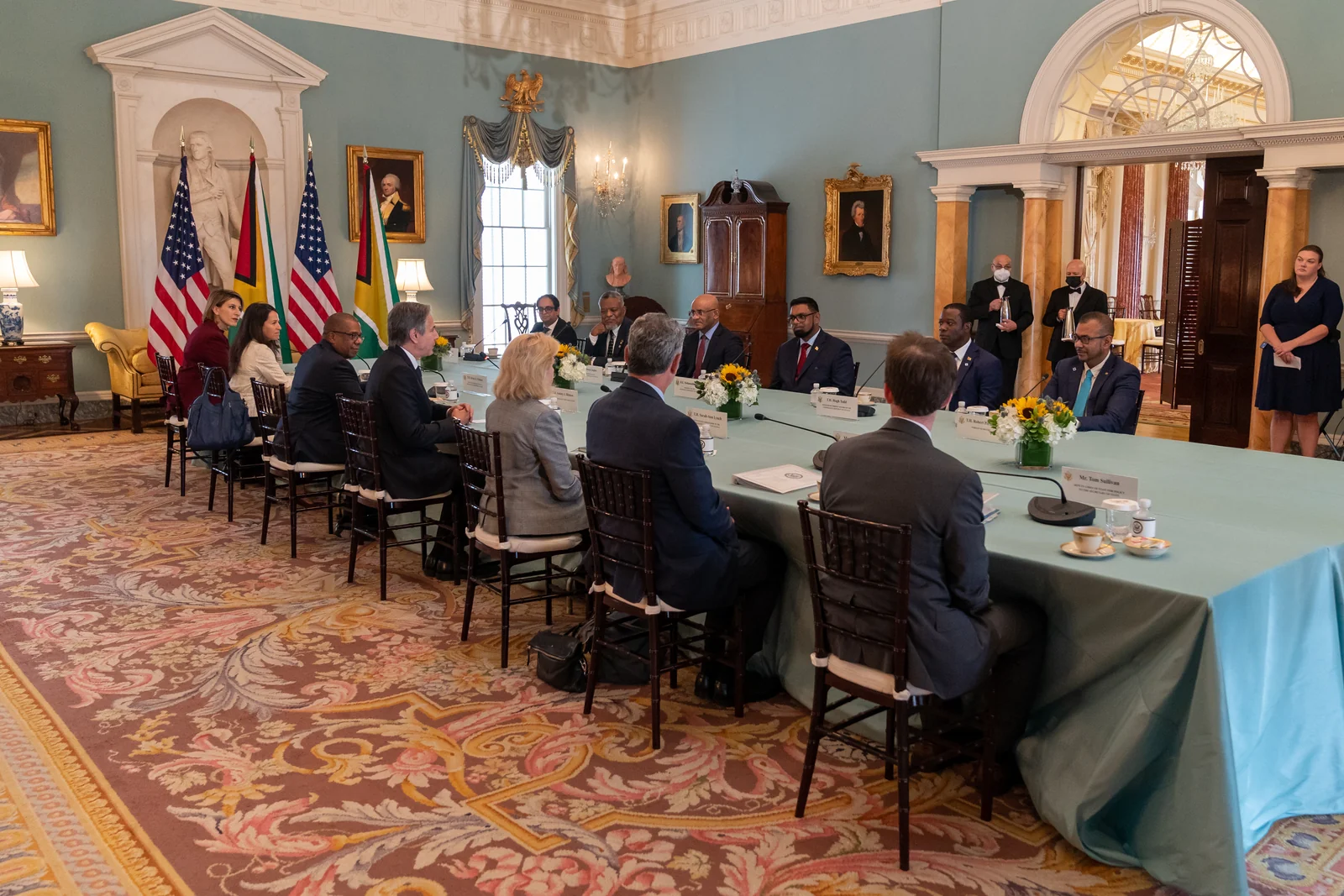
The 2022 meeting photograph shows two Guyana flags beside U.S. flags at the Department of State in Washington, D.C. Its official caption credits Freddie Everett. The caption’s photographer credit is retained rather than substituting a conflicting generic metadata field.
Both downloads preserve the full source frames, resized proportionally into WebP files. They document particular historical settings and do not imply present officeholder status or endorsement.
What should be checked in a Guyana flag drawing?
Keep the green field, gold arrowhead with white edging, and red triangle with black edging. Do not swap the borders, add a star, reverse the proposal’s colors into the national master, or stretch the land reference into an arbitrary rectangle. Distinguish the geometric outer tips from the colored interior points set back by their borders.
Keep all five colors
White belongs around gold, and black belongs around red. Omitting either border removes part of the national design and its symbolism.
The unadopted proposal and final national flag have different red-green arrangements. Label historical reconstructions clearly and use the adopted master for ordinary national display.
Preserve the correct land or sea rectangle. When adding dimensions, distinguish the outer white and black boundaries from the smaller gold and red interiors, and do not present unresolved percentage tables as exact cutting instructions.
Which Guyana flag pictures can be downloaded?
The package includes land and sea SVG masters, a large land PNG, anatomy and arrowhead details, a palette, construction and area explanations, sizes, orientation, historical and country comparisons, national dates, and a conceptual mourning illustration. Two genuine diplomatic photographs provide context. All article gallery downloads are served locally from the Guyana flag directory.
Download the land SVG, the 6000 × 3600 land PNG, or the sea SVG.
The picture gallery supplies local downloads for all diagrams, historical and country comparisons, and both photographs. Teaching labels belong to the explanatory sheets; the national masters contain only the flag design.
Download the plain-text image credits. Credits and reuse notices are supplied without external navigation.
Guyana flag pictures
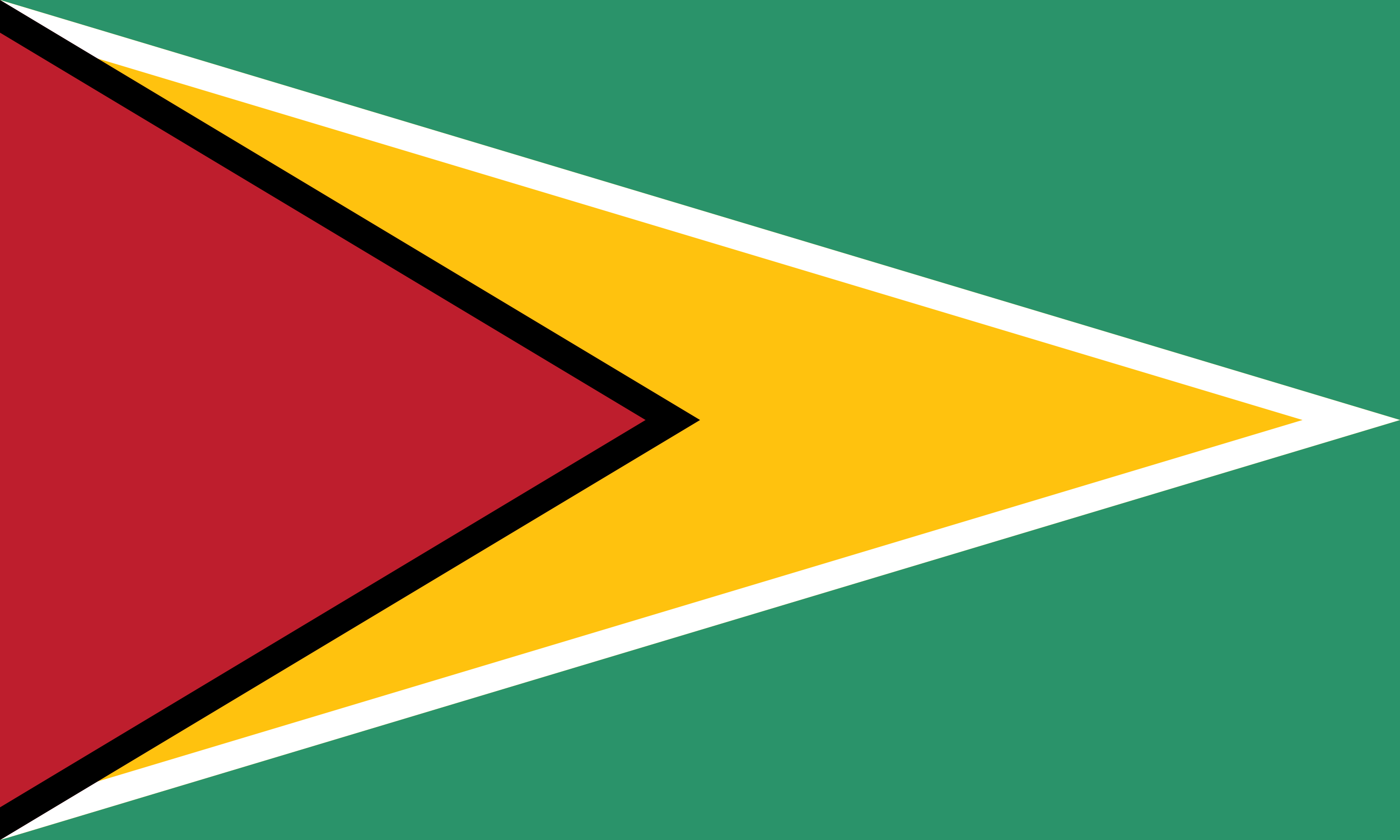
Guyana’s Golden Arrowhead has a green field, a white-edged gold arrowhead, and a black-edged red triangle at the hoist. The land ratio is 5:3 width:height. The complete source geometry is retained; numerical shades and border widths are reference choices.
GKBook composition, CC0; underlying flag geometry, public domain.Download image
The Second Schedule specifies 1:2 height:length at sea, or 2:1 width:height. This longer Golden Arrowhead retains the five-color design and the complete sea-reference geometry; it is not merely the land artwork stretched horizontally.
GKBook composition, CC0; underlying flag geometry, public domain.Download image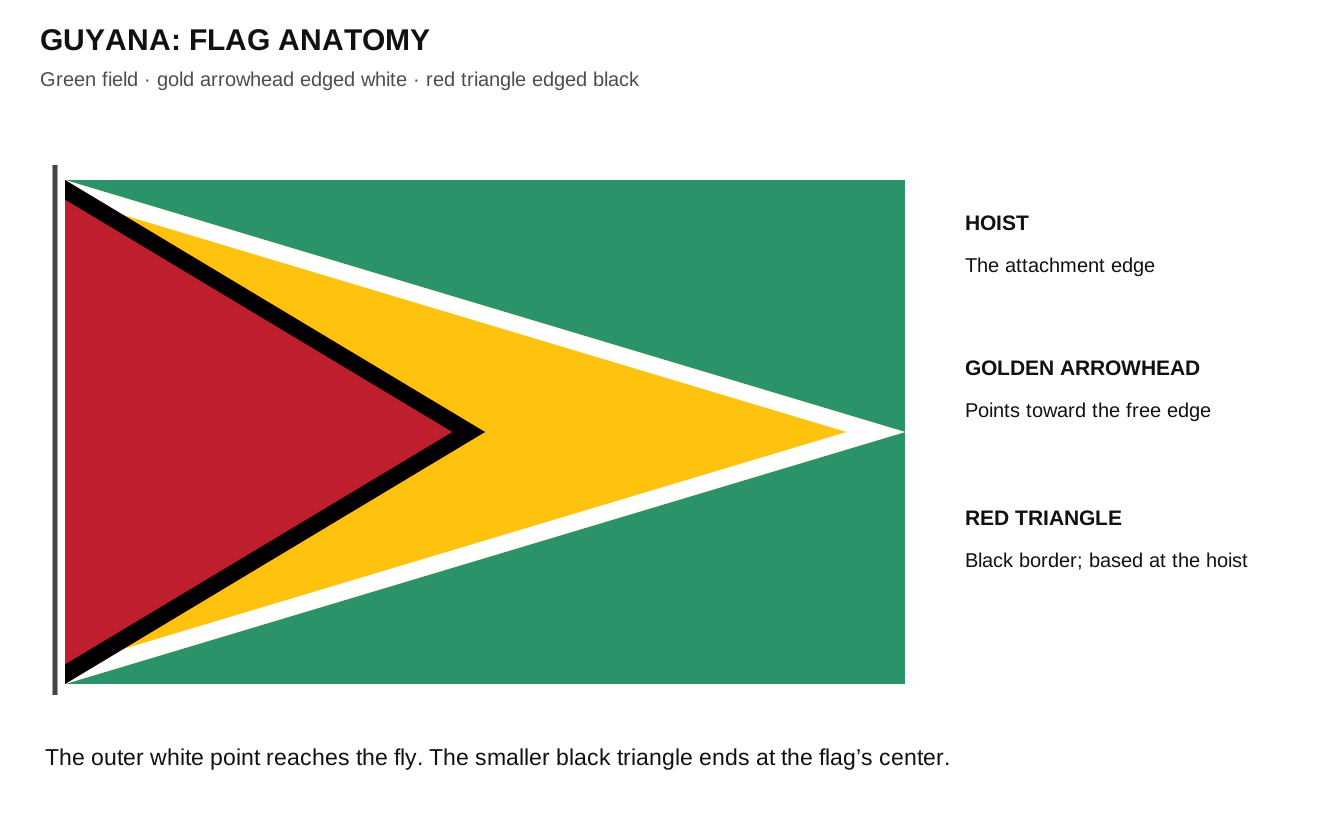
The arrowheads share the hoist as their base. The white outer point reaches the fly edge, and the smaller black-edged triangle reaches the center. Green remains above and below the larger arrowhead. Labels are outside the national design.
GKBook composition, CC0; underlying flag geometry, public domain.Download image
Gold represents mineral wealth and forward movement; white represents rivers and water potential; black represents strength and endurance. The red triangle expresses nation building. These symbolic meanings accompany a complete flag reference with both borders visible.
GKBook composition, CC0; underlying flag geometry, public domain.Download image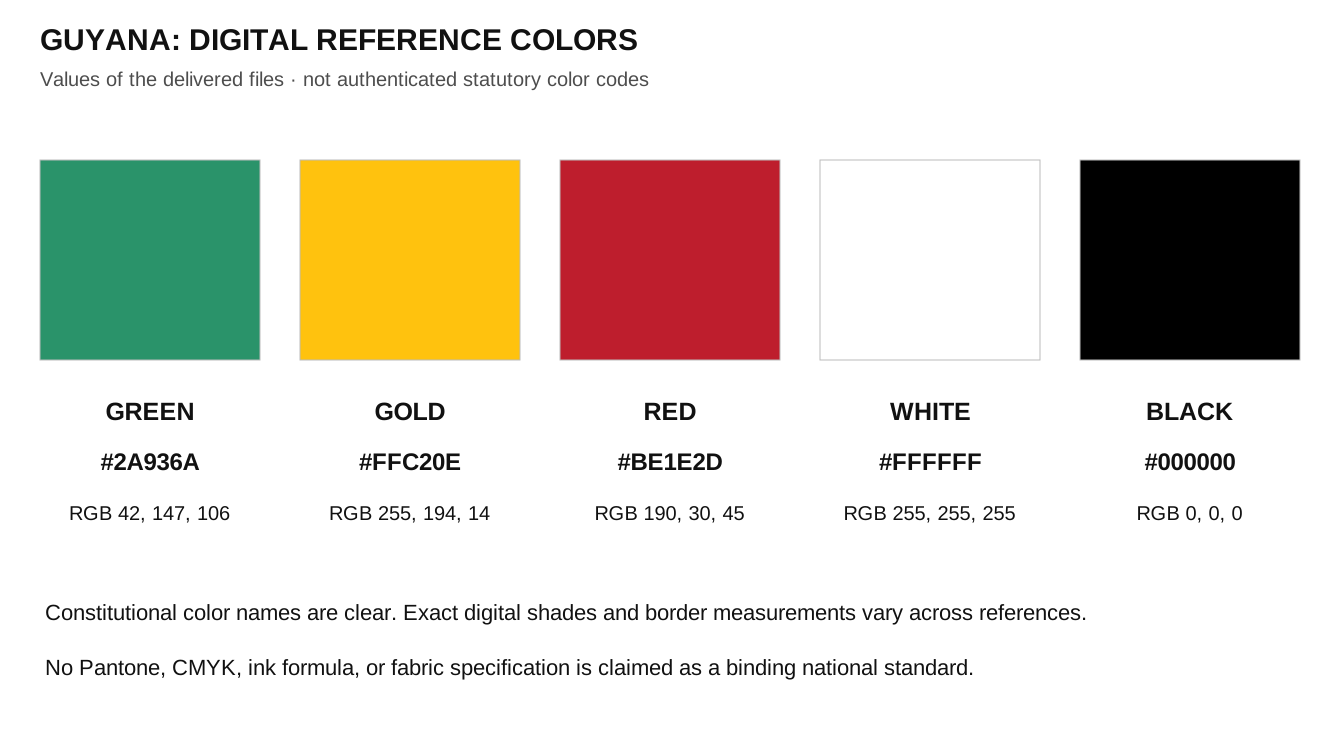
The supplied master uses green #2A936A, gold #FFC20E, red #BE1E2D, white #FFFFFF, and black #000000. These HEX and RGB values describe the downloaded reference artwork. They are not presented as a legislated palette or an official recent color change.
GKBook composition, CC0; underlying flag geometry, public domain.Download image
On a 1000-by-600 grid, the outer white triangle reaches (1000, 300), and the outer black triangle reaches (500, 300). Both share the full hoist as their base. The reference’s diagonal borders have 20-unit perpendicular thickness inside the boundary; exact legal widths were not authenticated.
GKBook composition, CC0; underlying flag geometry, public domain.Download image
In the supplied center-tip geometry, green occupies half the flag, red plus black occupies one-quarter, and visible gold plus white occupies one-quarter. The Ministry of Education’s published 50/24/16/6/4 color table differs. These are distinct records, not interchangeable construction specifications.
GKBook composition, CC0; underlying flag geometry, public domain.Download image
The land flag is 5:3 width:height, while the sea flag is 2:1. The same relationships may be written 3:5 and 1:2 when height is listed first. Complete separate references preserve the correct outline and triangle geometry in each version.
GKBook composition, CC0; underlying flag geometry, public domain.Download image
Land examples of 100 by 60, 150 by 90, and 200 by 120 centimeters retain 5:3 proportions. Sea examples of 100 by 50, 150 by 75, and 200 by 100 retain 2:1. These are calculated examples, not mandatory commercial sizes.
GKBook composition, CC0; underlying flag geometry, public domain.Download image
From behind, the shared triangle base appears on the viewer’s right because the attachment edge is there. The arrowhead points toward the viewer’s left. Horizontal symmetry means a top-to-bottom reflection alone does not alter this flat design.
GKBook composition, CC0; underlying flag geometry, public domain.Download image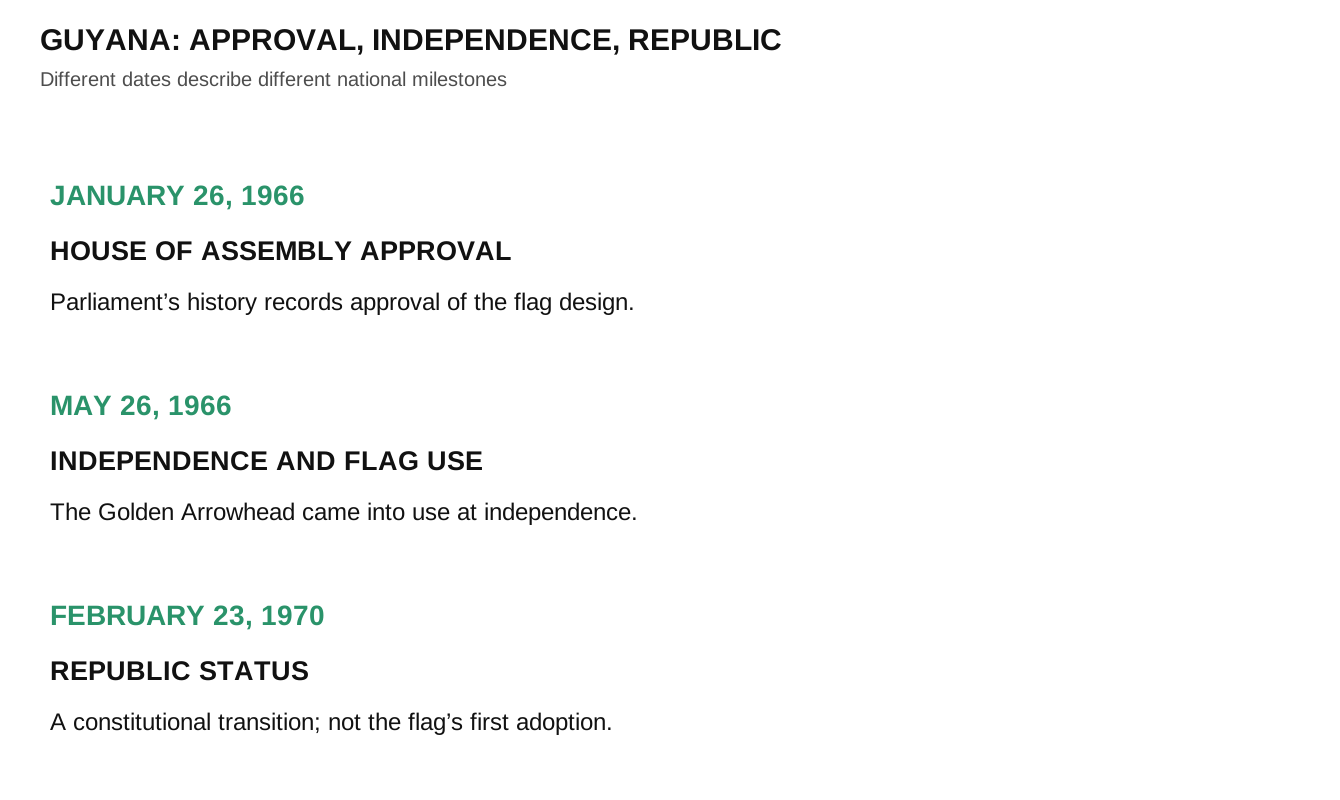
Parliament’s history records flag approval on January 26, 1966 and use from independence on May 26, 1966. Guyana became a republic on February 23, 1970. These milestones should not be merged into one flag-adoption date.
GKBook composition, CC0; underlying flag geometry, public domain.Download image
A final British Guiana Blue Ensign reference carries a Union canton and ship badge. Smith’s unadopted proposal has red and green reversed and lacks the black and white borders. The modern national flag uses all five colors. Historical drawings are reproductions, not documentary photographs.
GKBook composition, CC0; Tcfc2349 and source contributors, public-domain colonial vector; Germenfer and NorthTension, CC0 proposal reference; national flag geometry, public domain.Download image
Guyana’s nested arrowheads differ from Ghana’s three horizontal bands and black star, and from Suriname’s five horizontal bands and yellow star. The references retain their original proportions, full geometry, and individual palettes.
GKBook composition, CC0; underlying flag geometry, public domain.Download image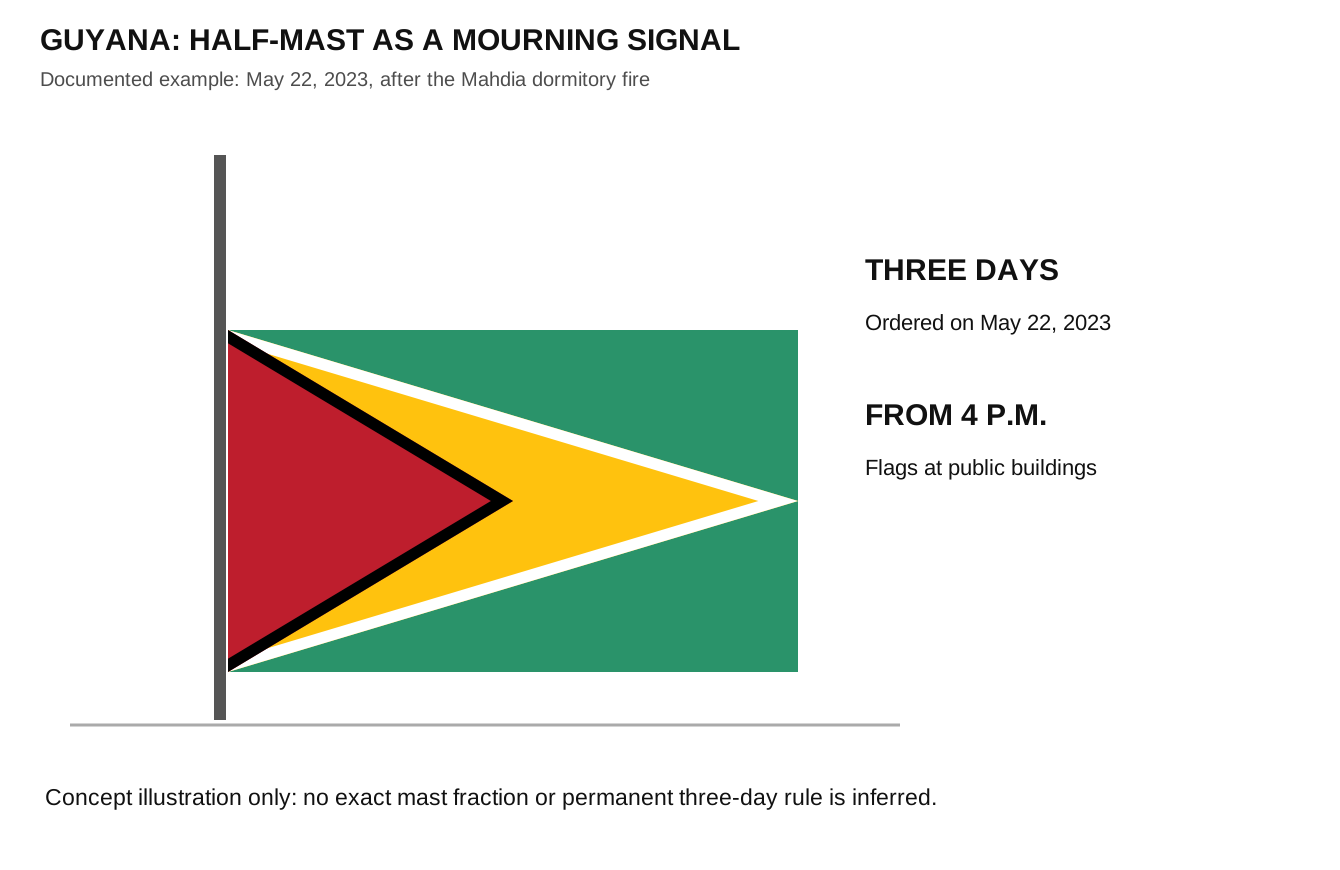
An official May 22, 2023 announcement declared three days of national mourning after the Mahdia dormitory fire and directed half-staff display at public buildings from 4 p.m. that day. The drawing illustrates a lowered flag without prescribing a numerical mast position.
GKBook composition, CC0; underlying flag geometry, public domain.Download image
Guyana’s five-color flag stands behind Secretary Antony Blinken during a joint press availability with President Irfaan Ali in Georgetown on July 6, 2023. The draped fabric shows the red triangle, black border, gold, white border, and green field.
Ron Przysucha / U.S. Department of State; public domain in the United States.Download image
Two Guyana flags appear beside U.S. flags during a meeting between Secretary Antony Blinken and President Irfaan Ali at the U.S. Department of State in Washington, D.C., on July 25, 2022. This photograph documents an indoor diplomatic display.
Freddie Everett / U.S. Department of State; public domain in the United States.Download imageFrequently asked questions
What does Guyana’s flag look like?
Guyana’s national flag has a green field with a large gold arrowhead edged in white, overlaid by a smaller red triangle edged in black. Both triangles begin at the hoist, the attachment edge. The design is called the Golden Arrowhead and contains five colors, with no star, motto, or coat of arms.
How are the triangles arranged on Guyana’s flag?
The two triangular forms share the full hoist as their base and point toward the free edge. In the supplied reference, the large white outer triangle reaches the fly, while the smaller black outer triangle reaches the flag’s center. Gold and red fill the shapes inside their contrasting diagonal borders.
What are the digital colors of Guyana’s flag?
The delivered reference uses green #2A936A, gold #FFC20E, red #BE1E2D, white #FFFFFF, and black #000000. These values document the actual SVG fills and strokes. They are not authenticated statutory color codes, and differences between digital references should not be described as official flag changes without an authoritative national specification.
What do the five colors of Guyana’s flag mean?
The official explanation connects green with agriculture and forests, gold with mineral wealth and forward movement, white with rivers and water potential, black with strength and endurance, and red with the energetic work of nation building. These meanings are recorded in national-symbols material and the Constitution’s Second Schedule.
Why is Guyana’s flag called the Golden Arrowhead?
The name describes the prominent gold triangular form pointing away from the hoist. Official symbolism connects it with mineral wealth and movement into the future. The Constitution identifies the national flag by this name. The arrowhead is part of the flag’s geometry, not a separate coat of arms placed on a background.
What are the white and black lines on Guyana’s flag?
The white and black lines are contrasting borders, also called fimbriations. White edges the large gold form, and black edges the smaller red triangle. Both are part of the five-color national design. They run along the sloping sides; the reference does not add a border across the shared hoist edge.
What is Guyana’s flag ratio on land and at sea?
The Constitution’s Second Schedule gives proportions of 3:5 on land and 1:2 at sea when height comes first. Written as width:height, these become 5:3 and 2:1. The sea version is relatively longer. Unlike a merely customary ratio, both relationships are explicitly stated in the published constitutional description.
How is the Guyana flag download constructed?
The land SVG measures 3000 by 1800. Its large outer triangle reaches (3000, 900), and its smaller outer black triangle reaches (1500, 900), with both based along the full hoist. The PNG measures 6000 by 3600. These coordinates describe the delivered reference; exact border widths were not authenticated as legal specifications.
Why do published color percentages disagree with some flag drawings?
The Ministry of Education’s table assigns 50 percent to green, 24 to gold, 16 to red, 6 to white, and 4 to black. That makes red plus black 20 percent. A full-height triangle reaching the flag’s center occupies 25 percent, so that table and the supplied center-tip geometry do not match.
Is Guyana’s sea flag a different national design?
The sea flag keeps the Golden Arrowhead’s five-color arrangement but uses the longer 2:1 width:height rectangle specified in the Constitution. The published Shipping Act identifies Guyana’s national flag as a Guyana ship’s national colors. A maritime flag should therefore be distinguished by its proportions and legal use, not by an invented extra emblem.
Which sizes preserve Guyana’s flag proportions?
For land use, examples include 100 by 60, 150 by 90, and 200 by 120 centimeters. For sea use, 100 by 50, 150 by 75, and 200 by 100 preserve the longer rectangle. These are calculated examples, not an official retail-size schedule; account separately for sleeves, hems, and fabric shrinkage.
What flag preceded Guyana’s Golden Arrowhead?
Before independence, British Guiana used British colonial symbols, including a Blue Ensign with the Union flag in the canton and a ship-related badge. The badge changed during the colonial period. The Golden Arrowhead introduced a distinct national design at independence in 1966, with triangles and five colors replacing the colonial ensign arrangement.
When was Guyana’s flag adopted?
The Golden Arrowhead came into national use when Guyana became independent on May 26, 1966. Parliament’s history also records an earlier House of Assembly approval on January 26, 1966. These dates describe different stages: approval of the design and its use at independence. Republic status followed later, on February 23, 1970.
Who designed Guyana’s national flag?
Whitney Smith, an American flag scholar and designer, created the proposal from which Guyana’s national flag developed. Parliament’s history credits him, and the University of Texas archive holding his papers identifies him as the designer. The adopted design differs from his earlier proposal, so authorship and the subsequent changes should be explained separately.
How did Whitney Smith’s proposal differ from the adopted flag?
The commonly reproduced proposal has a red field, a large gold triangle, and a smaller green triangle, without the black and white borders. The adopted flag reverses red and green and includes both borders. The comparison image is a modern reconstruction of the proposal, not an original archival drawing or a former adopted national flag.
Where is Guyana’s flag described in the Constitution?
Article 4 names the national flag as the Golden Arrow Head and refers to the Second Schedule. That schedule describes the design, explains its colors, and gives land and sea proportions. Article 7 establishes a duty to respect national symbols. The reviewed constitutional reprint does not provide a reliable numerical production drawing.
How should Guyana’s flag be prepared for printing or sewing?
Choose the land or sea proportions first, then preserve the complete five-color design and its contrasting borders. Use the supplied palette as a documented digital reference and assess a proof on the intended material. The SVG supports accurate scaling, but it does not certify an official textile standard or authorize a manufacturing business.
What official guidance addresses respect for Guyana’s flag?
Article 7 requires respect and proper solemnity toward Guyana’s national symbols. Ministry of Education material advises giving the flag a position of honor and keeping it off the ground. These sources support respectful display, but they should not be expanded into an invented universal timetable, salute procedure, or detailed flag-precedence code.
Does Guyana celebrate Flag Day?
An official announcement established a Flag Days initiative for May 24 through May 26, 2025, leading into Independence Day. It encouraged flag displays at homes, schools, businesses, and public spaces. This verifies the named 2025 initiative; it does not by itself establish a permanent annual statutory Flag Day or an additional public holiday.
When is Guyana’s Independence Day?
Guyana’s Independence Day is May 26, commemorating independence from the United Kingdom in 1966 and the start of national use of the Golden Arrowhead. It differs from the January 1966 approval of the design and the February 1970 transition to a republic. The dates belong to related but separate historical events.
Did Guyana adopt the flag when it became a republic?
No. Guyana became a republic on February 23, 1970, after the Golden Arrowhead had already entered national use at independence in 1966. Republic Day is another important occasion for flag raising. An official report describes a Joint Services parade, cultural presentations, and flag raising for the fifty-sixth republic anniversary in February 2026.
When has Guyana ordered its flag to half-mast?
On May 22, 2023, an official announcement declared three days of national mourning after the Mahdia school-dormitory fire. It directed flags at public buildings to be flown at half-staff from 4 p.m. that day. This is a documented historical instruction, not a current alert or an automatic duration for every future mourning period.
How should Guyana’s flag be handled and stored?
Keep the flag clean, dry wet fabric before storage, and protect seams and attachment points from damage. Educational guidance supports respectful treatment and keeping it off the ground. Follow the fabric maker’s care advice; the reviewed sources do not establish a mandatory folding pattern, retirement ceremony, or single disposal method for worn flags.
What does Guyana’s flag look like from behind?
From behind, the triangular bases appear on the viewer’s right and the arrowhead points left, because the attachment edge is now on that side. The whole flag mirrors together. The flat design is symmetrical from top to bottom, so a vertical reflection alone does not create a visually different arrangement.
Is Guyana’s coat of arms on the national flag?
No. Guyana’s ordinary national flag consists of the green field and bordered gold and red triangular forms. The coat of arms is a separate national symbol described alongside the flag in the Constitution. Adding the arms, the national motto, a star, or a presidential emblem would alter the plain Golden Arrowhead design.
Are presidential and civil aviation flags the same as Guyana’s national flag?
Special-purpose flags should be distinguished from the ordinary Golden Arrowhead. Specialist references describe presidential standards and a civil air ensign, but their histories and measurements require separate evidence. The downloads here identify the constitutionally specified land and sea versions clearly, without presenting uncertain officeholder standards or an unverified aviation construction as national masters.
How does Guyana’s flag differ from Ghana’s and Suriname’s?
Guyana uses nested arrowheads on green and has no star. Ghana has three horizontal red, yellow, and green bands with a black star. Suriname has green, white, red, white, and green horizontal bands with a yellow star. Their shared colors do not make the layouts, proportions, or national identities interchangeable.
Are Guyana, Ghana, and French Guiana the same place?
No. Guyana is a sovereign country in South America; Ghana is a different sovereign country in West Africa. French Guiana is a French territory in South America. Similar names can lead to mislabeled images, but Guyana’s Golden Arrowhead should not be substituted for Ghana’s star-bearing flag or a flag associated with French Guiana.
What is Guyana’s flag emoji?
Guyana’s flag emoji is 🇬🇾, formed from the regional-indicator letters G and Y, U+1F1EC and U+1F1FE. It is different from Ghana’s GH sequence and French Guiana’s GF sequence. Devices may show different flag artwork or a letter fallback, so use the supplied SVG or PNG when exact geometry and colors matter.
What do the documentary photographs show?
The photographs show Guyana’s flag in two diplomatic settings: a July 6, 2023 press event in Georgetown and a July 25, 2022 meeting in Washington, D.C. Both are U.S. State Department photographs with documented captions and public-domain status. They illustrate real display conditions, while the vector reference supplies the clearest flat geometry.
What mistakes should be avoided when drawing Guyana’s flag?
Keep the green field, gold arrowhead with white edging, and red triangle with black edging. Do not swap the borders, add a star, reverse the proposal’s colors into the national master, or stretch the land reference into an arbitrary rectangle. Distinguish the geometric outer tips from the colored interior points set back by their borders.
Which Guyana flag pictures are included for download?
The package includes land and sea SVG masters, a large land PNG, anatomy and arrowhead details, a palette, construction and area explanations, sizes, orientation, historical and country comparisons, national dates, and a conceptual mourning illustration. Two genuine diplomatic photographs provide context. All article gallery downloads are served locally from the Guyana flag directory.
Explore all general-knowledge topics and the A-to-Z lists.

We Value Your Opinion Comments