
Greece flag picture
Explore the construction sheet, the school flag observance, and the historical sequence.

| Country | Greece — Hellenic RepublicEuropean country; capital Athens. |
|---|---|
| National design | Blue and white stripes with a crossNine equal horizontal stripes: five blue and four white; cross in the upper-hoist canton. |
| Proportions | 3:2 width:heightEquivalent to 2:3 height:length; canton side equals five stripe widths. |
| Historical origin | 1822Blue and white were adopted during the War of Independence; separate land and maritime designs developed. |
| Current legal basis | Law 851/1978Published December 22, 1978; the striped design became the sole national flag. |
| Designer | No individual securely identifiedInstitutional adoption is documented; the consulted sources do not name one verified designer. |
| Cross and stripes | Christianity and the freedom mottoForeign Ministry explanations connect the nine stripes with Freedom or Death. |
| Flag observance | October 27The school observance honors the flag before the October 28 national anniversary; scheduling exceptions apply. |
Blue and white form nine equal stripes and a cross in a square canton. The striped design has roots in the 1822 naval flag; the current national settlement dates to December 22, 1978.
What is the flag of Greece?
Greece’s national flag has nine equal horizontal stripes, alternating blue and white, with blue at the top and bottom. A white cross fills a blue square in the upper corner beside the flagpole. The rectangle is one and a half times as wide as it is high.
The flag of the Hellenic Republic combines a repeated stripe pattern with a cross beside the hoist. It is recognizable at sea, on a public building, or in a small digital image because those elements have a precise relationship: nine stripes, a square canton, and a cross one stripe thick.
Two dates answer different historical questions. The blue-and-white national tradition took formal shape during the revolution in 1822. Law 851/1978 established the present striped design as the sole national flag, taking effect with publication on December 22, 1978.
Explore the construction guide, history, school flag observance, mourning rules, and downloadable pictures.
How are the stripes and canton arranged?
The canton is the square at the upper hoist, meaning the corner nearest the pole or attachment edge. On Greece’s flag it is blue and contains a white cross. Its side equals five stripe widths, while each arm of the cross has the thickness of one stripe.
The hoist is the edge attached to a pole or rope; the fly is the free edge. In a front-facing horizontal drawing, the canton is at the upper left. The blue and white stripe sequence remains fully visible along the fly.
The canton spans the height of the upper five stripes. Its lower boundary meets the next white stripe. The cross belongs inside this square, with no separate shield, outline, crown, or laurel wreath.
What color values are used in the downloadable flag?
The delivered artwork uses blue #0D5EAF, or RGB 13, 94, 175, and white #FFFFFF, or RGB 255, 255, 255. These values describe the digital reference. The law names blue and white, while a later manufacturing specification refers to an official fabric sample rather than prescribing these HEX values.
| Color | HEX | RGB | Position |
|---|---|---|---|
| Blue | #0D5EAF | 13, 94, 175 | Five stripes and the canton field |
| White | #FFFFFF | 255, 255, 255 | Four stripes and the cross |
Article 1 names blue and white. The Flag Institute’s examination of a 1979 Interior Ministry specification reports that official textile colors were to match a service sample. That is a color standard based on a physical reference, even though it is not a modern RGB or HEX table.
The Institute did not obtain the official sample and distinguishes its own suggested match from a legislated Pantone value. This page therefore neither invents an official Pantone code nor claims that Greece has no official color-production standard.
The numbers above come from the actual SVG used for these downloads. A screen, a coated print, and woven fabric can produce different appearances from a nominal color. Use the relevant official sample and procurement specification for an official textile order; do not take a shadow in a photograph as the master blue.
What do the colors, cross, and stripes mean?
The Foreign Ministry connects the nine stripes with the nine syllables of Eleftheria i Thanatos, meaning Freedom or Death. This familiar interpretation links the flag with the independence struggle. The 1978 design law specifies the stripes and cross geometrically; it does not itself set out that symbolic explanation.
The Foreign Ministry supplies these familiar explanations of the national design. The cross’s religious meaning and the stripe interpretation belong to that explanatory account; the 1978 law primarily describes the flag’s geometry, manufacture, and use.
The distinction matters when a symbol has several popular interpretations. Counting nine stripes is a verifiable design feature. Assigning them to nine geographical regions or the nine Muses would be a different claim, and neither explanation is presented here as the law’s definition.
How is the white cross drawn?
The white cross represents Christianity in the explanation published by Greece’s Foreign Ministry. Geometrically, it is an upright cross with equal-length arms extending to the edges of the blue canton. The symbol is part of the national design; it is not a separate coat of arms placed over the stripes.
On the 27-by-18 construction grid, the canton occupies x=0–10 and y=0–10. Its center is (5, 5). The vertical white bar extends from x=4 to x=6, and the horizontal white bar extends from y=4 to y=6. Each is two units thick, matching one stripe.
The four arms are equal in length from the center. This is an upright cross, not a Nordic cross shifted within the canton and not a cross with detached arms. The white bar must reach each square edge without a blue gap.
The national coat of arms also uses a cross, but its shield and surrounding laurel branches form a separate emblem. They are not additional details to insert here.
How should the nine stripes be counted?
There are nine horizontal stripes: five blue and four white. Count them along the free edge, away from the canton, where the full sequence is visible. The blue square and white cross cover the upper five stripes beside the pole; they do not change the total number of stripes.
Read downward along the free edge: blue, white, blue, white, blue, white, blue, white, blue. The canton hides part of the first five stripes at the hoist, so counting only the visible horizontal fragments beside the pole can be misleading.
The cross’s horizontal bar is not a tenth stripe. It lies within the canton and ends at the square’s right boundary, beside the third blue stripe. Equal stripe height applies to the full design regardless of the area occupied by the cross.
How is Greece’s flag constructed accurately?
Use a 27-by-18 grid. Draw nine stripes, each two units high, beginning and ending with blue. Place a blue 10-by-10 square at the upper hoist. Inside it, draw a white cross two units thick, with its center at coordinate (5, 5) and its arms reaching the square’s edges.
| Element | Grid coordinates or formula | Result |
|---|---|---|
| Outer rectangle | Width 27; height 18 | 3:2 width:height; 2:3 height:length |
| Nine stripes | Each 2 units high | Stripe thickness = H/9 |
| Blue canton | x = 0–10; y = 0–10 | Square side = 5H/9 |
| Vertical cross bar | x = 4–6; y = 0–10 | One stripe thick |
| Horizontal cross bar | x = 0–10; y = 4–6 | One stripe thick |
| Scaled width | W = 3H/2 | Preserve the complete rectangle |
The downloadable SVG is 2700 by 1800, with 200-unit stripes and a 1000-unit canton. The PNG is 5400 by 3600 pixels, with exactly 400 pixels per stripe and a 2000-pixel canton. These raster dimensions avoid fractional stripe boundaries.
Construction lines and measurements appear only on the explanatory sheet. The plain master contains the national colors and cross without a decorative border, caption, or grid. Scale the whole file uniformly instead of adjusting the canton independently.
Does the law specify standard flag sizes?
Yes. The original 1978 Gazette lists eight size classes, ranging from 648 by 432 centimeters down to 27 by 18 centimeters. It also gives stripe widths, canton sizes, and some staff dimensions. Two smaller lengths are rounded in the printed table, so distinguish the listed sizes from exact proportional calculations.
| Class | Length × height (cm) | Stripe (cm) | Canton side (cm) | Ground staff (m) | Building staff (m) |
|---|---|---|---|---|---|
| 1 | 648 × 432 | 48 | 240 | 15–18 | 9–12 |
| 2 | 405 × 270 | 30 | 150 | 10–12 | 7–8 |
| 3 | 297 × 198 | 22 | 110 | 7–9 | 5–6 |
| 4 | 189 × 126 | 14 | 70 | 5–6 | 3–4 |
| 5 | 135 × 90 | 10 | 50 | — | 2–2.6 |
| 6 | 95 × 63 | 7 | 35 | — | — |
| 7 | 68 × 45 | 5 | 25 | — | — |
| 8 | 27 × 18 | 2 | 10 | — | — |
The scan gives 405 centimeters for class 2, not 409. It gives 45 centimeters for class 7’s height. Those details matter because later transcriptions can introduce errors into an apparently simple table.
Classes 6 and 7 print lengths of 95 and 68 centimeters. Exact 3:2 calculations from their listed heights would give 94.5 and 67.5 centimeters. The table above preserves the published rounded lengths rather than silently correcting the legal document.
For a physical flag, seams, hems, sleeves, reinforcement, and shrinkage allowances belong outside the finished visible geometry. A 270-by-180-centimeter example has 20-centimeter stripes and a 100-centimeter canton; the example is a calculation, not an additional legal size class.
How has Greece’s flag developed over time?
Yes. Monarchical emblems, the relationship between land and maritime flags, and the proportions of some designs changed during successive regimes. The plain cross flag returned in 1975, before the striped national design was settled in 1978. These transitions do not mean the blue-and-white tradition began only in the twentieth century.
The First National Assembly at Epidaurus adopts the national colors during the revolution.
Different patterns serve land forces, the navy, and merchant shipping.
Merchant ships adopt the naval flag design.
Bavarian arms and later crowns distinguish particular royal and service variants.
The artwork looks back to the independence struggle and shows a Greek flag at the upper right.
The land-style cross pattern is restored before the next national settlement.
Law 851/1978 establishes the striped flag as the sole national flag.
A subsequent Interior Ministry specification refers to official fabric color samples.
Greek flag history is not a simple succession of one design after another. Land and maritime flags existed together, and royal or military additions could depend on the institution. An old flag should therefore be identified by its role as well as its date.
The present striped national design has maritime roots, while the large white cross on blue remained influential in land and service colors. The 1978 settlement made the striped design the national reference for general use.
What happened to the flag in 1822?
In January 1822, the revolutionary National Assembly adopted blue and white as national colors. The provisional administration then prescribed different designs for land forces, naval vessels, and merchant ships. These decisions belong to the War of Independence and should be distinguished from the later recognition and government of an independent Greek state.
The First National Assembly at Epidaurus provides the institutional starting point for the adopted blue-and-white colors. A subsequent March 1822 decree distinguished land, naval, and merchant designs. These decisions took place during an ongoing struggle, not after a modern state had already existed in its final form.
The national anniversary on March 25 looks back to the beginning of the struggle in 1821. It is separate from the assembly’s 1822 decisions and from the December 1978 law. Keeping those milestones distinct prevents the flag from being assigned one date that is expected to explain every stage of Greek history.
No claim is made that the modern striped flag existed unchanged throughout ancient or Byzantine history. Earlier crosses, banners, and religious imagery can be part of a broader background without proving that the current national rectangle already existed.
What does the old Greek land flag show?
The old land flag placed a white cross across a blue field, without the nine horizontal stripes. It coexisted with maritime designs for much of modern Greek history. The supplied image is a later rectangular reference of that pattern; the Presidency describes the earliest land flag as square.
The full-field cross reaches all four edges of the blue rectangle. There are no alternating horizontal stripes. That makes the land pattern easy to distinguish from today’s national flag even when both use the same broad colors.
The supplied reference preserves its own 3:2 proportions. Its broad file title must not be treated as proof that one rectangular design was used without interruption from 1822 to 1978. The earliest square form, later changes, and separate land and sea roles require their own historical context.
What was the early Greek merchant ensign?
The early merchant ensign was blue with a blue cross on a white canton, distinguishing it from the striped naval ensign. In 1828, merchant ships were brought under the naval design. The Presidency connects that change with the merchant fleet’s participation in the War of Independence.
The merchant illustration follows the written historical description rather than a disputed striped reconstruction. Its exact historical dimensions are not established here. The merchant design reverses the canton’s familiar colors: the square is white and the cross is blue. The rest of the flag is a blue field. It should not be reconstructed by taking the current striped flag and simply removing a few bands.
The 1828 change brought merchant shipping under the naval design. This helps explain why the striped flag is so closely associated with maritime use long before the current national law.
Why do historical Greek flags have royal arms?
Royal symbols reflected the monarchy rather than an extra feature of today’s national flag. Under King Otto, Bavarian arms appeared on army and naval flags. Later royal flags used a crown. Historical drawings must therefore be labeled by role and period, instead of being presented as optional additions to the current flag.
The illustrated royal naval reconstruction belongs to the period of King Otto. Its Bavarian arms identify a dynastic setting, while later royal variants used other arrangements, including a crown. These details belong to a particular historical reference, not to a generic decoration that can be added to any Greek flag.
The complete shield and surrounding heraldry are preserved in the supplied vector. The reference has its own proportions; it has not been stretched into the present national 3:2 rectangle. It is a modern reconstruction and is not presented as a photograph of an original nineteenth-century textile.
Why is December 22, 1978 the current adoption date?
The current legal settlement dates to Law 851/1978, published on December 22, 1978. The striped flag’s history is much older: a related maritime design was established in 1822. Thus 1822 describes its revolutionary origins, while 1978 identifies the modern adoption of the striped design as the sole national flag.
The original Gazette prints Law 851 in Series A, issue 233, dated December 22, 1978. The signature date is December 21, but Article 11 makes publication the effective point. Those dates should not be interchanged.
The law defines the striped design, repeals earlier flag provisions, and allows a two-year replacement transition. Its adoption date therefore does not imply that every existing physical flag was replaced on the same day.
Twentieth-century accounts also describe regime changes, variations in proportions, and the return of the plain cross flag in 1975. This article does not assign an exact late-1960s or early-1970s changeover day where the reviewed secondary chronologies differ. The original 1978 publication supplies a firmer date for the present legal settlement.
What does Vryzakis’s painting contribute to flag history?
Theodoros Vryzakis painted The Army Camp of Karaiskakis in 1855, looking back to preparations near Athens in 1827. The National Gallery identifies a Greek flag at the upper right. This is a later artistic interpretation of the independence struggle, not a photograph of the event or a technical flag specification.

The National Gallery dates The Army Camp of Karaiskakis to 1855 and relates its scene to preparations near Athens in 1827. A Greek flag is visible at the upper right, above the group on the raised ground.
The painting helps explain how the independence struggle was remembered in nineteenth-century art. It cannot establish the exact construction of every flag used in 1827. Atmospheric color, folds, perspective, and the painter’s later interpretation are different from a legal drawing.
The full composition is retained in the local reproduction. It has not been cropped to make the small painted flag appear to be an independent archival photograph.
Who designed Greece’s national flag?
The consulted official accounts document adoption by revolutionary and later state institutions but do not identify one securely verified individual designer of the national flag. A ruler, legislator, historical painter, or modern vector artist should not automatically receive that credit. The documented decisions are more reliable than an unsupported personal attribution.
The evidence identifies collective decisions by the revolutionary administration and later governments. It does not support replacing that institutional history with a confidently named individual designer.
Theodoros Vryzakis is credited for the historical painting reproduced here. The modern vector contributors prepared reference artwork. Neither role establishes authorship of the national flag. Similarly, a ruler associated with a royal variant is not automatically the designer of the stripes and cross.
The useful answer is therefore an explicit limit: no securely verified individual designer is named in the consulted official accounts. The documented adoption history remains available without an invented biography or portrait.
What matters when manufacturing a Greek flag?
The 1978 text calls for suitable fabric with lasting colors and rejects worn, faded, or printed flags for hoisting. It also provides for state procurement specifications. These requirements concern physical flags: a downloadable diagram or digital image is an educational reference, not certification that a finished textile meets official procurement rules.
Article 1 of the original 1978 text requires appropriate fabric and colors that do not fade. It expressly rejects worn, faded, or printed flags for hoisting. That provision should not be replaced with a generic statement that every printed textile is necessarily suitable for official use.
The later specification discussed by the Flag Institute uses an official service sample for the blue and white. A procurement supplier needs the applicable specification and sample, not merely an RGB screenshot. This page supplies educational artwork and construction calculations; it does not certify a finished ceremonial or outdoor flag.
Practical production still requires allowances for hems, seams, attachment fittings, and material behavior. Measure the visible design after construction, keeping nine equal stripes, a square canton, and equal cross thickness. Ensure the reverse is a proper view of the same design rather than an upside-down arrangement.
When is Greece’s Flag Day observed?
October 27 is associated with honoring Greece’s flag in schools, alongside the commemoration preceding the October 28 national holiday. Article 3 of Presidential Decree 79/2017 expressly includes the flag in those school celebrations and provides scheduling exceptions. This school observance should not be confused with a separate nationwide public holiday.
Article 3(2)(a) of Presidential Decree 79/2017 concerns kindergarten and primary-school celebrations. It expressly includes honoring the flag in the October 27 observance connected with the following day’s national anniversary.
If October 28 falls on a Sunday or Monday, the decree moves those celebrations to the preceding Friday. An annual school notice can therefore give a celebration date different from the familiar October 27 label.
The navigation uses “Flag Day” as a convenient name for this school observance. It is not a claim that October 27 is an additional nationwide public holiday, and it does not import the decree’s separate student-selection provisions as an unchanged current rule.
How do March 25 and October 28 relate to the flag?
March 25 is Greece’s Independence Day, commemorating the beginning of the independence struggle in 1821. October 28, known as Ohi Day, recalls resistance to the Italian ultimatum and invasion in 1940. Both are major national anniversaries, but neither is the publication date of the present flag law in December 1978.
The Foreign Ministry describes March 25 as the independence anniversary marking the beginning of the struggle against Ottoman rule. It also coincides with the religious feast of the Annunciation. The national commemoration does not mean that every stage of independence was completed in 1821.
October 28 recalls Greece’s resistance to the Italian ultimatum and invasion in 1940. Its school commemoration explains the neighboring October 27 flag observance. Neither anniversary should be substituted for December 22 when identifying publication of the current flag law.
For a particular year’s event, school timetable, or institutional ceremony, use the responsible authority’s actual notice. This historical account is not a complete annual holiday or event calendar.
Where is Greece’s flag displayed under the law?
The 1978 law identifies official buildings and settings including the Presidency, Parliament, ministries, diplomatic and consular authorities, educational institutions during the school term, military establishments, and ships. It also regulates ceremonial display. The applicable institution and occasion matter; one photograph cannot establish the complete rules for every Greek installation.
Article 2 names the Presidency, Parliament, ministries, diplomatic and consular authorities, specified public and local-government offices, educational institutions during the school period, military installations, and ships. Different clauses address the setting and authority responsible for the display.
Article 3 separately addresses ordered national or local celebrations, including public and private premises and homes within the relevant area. Those rules should be read together rather than turning one institutional list into a rule for every possible household use.
The original document is the basis of this account; it is not represented as a fully reviewed consolidation of every subsequent administrative change. Follow the current institution’s instructions when arranging a real ceremony.
Must the flag always be lowered at sunset?
Article 2 of the 1978 law gives an ordinary daily period from 8 a.m. until sunset for the listed official settings. Article 6 also allows flags to remain raised overnight when an ordered display lasts more than one day. The exception matters when interpreting a simple statement that flags always come down at sunset.
The ordinary 8 a.m.-to-sunset period applies to the official settings identified in Article 2. Article 6(2) provides an important exception for a flag display ordered to continue for more than one day: the flags may remain raised during the intervening nights.
Consequently, a photograph of a flag after dark does not establish a violation by itself. The occasion, duration, and relevant instruction matter. Military establishments also have provisions for their own detailed directions.
Do not add another country’s lighting exception or a universal twenty-four-hour household schedule to the Greek text. The reviewed law supplies its own framework.
Is displaying the Greek flag at home forbidden?
The reviewed law should not be reduced to a blanket statement that household flag display is forbidden. Its provisions distinguish ordinary official display, specified ceremonies, mourning, and obligations during ordered celebrations. For an actual installation, consider the relevant provisions together and follow the applicable directions rather than relying on a circulating one-sentence claim.
A circulating claim that ordinary households are categorically barred from flying the flag oversimplifies the legal text. The provisions address different circumstances: official routine display, mourning, local occasions, and ordered public celebrations.
In particular, language permitting or directing private display for an identified occasion should not automatically be read as a universal prohibition outside that occasion. Equally, the existence of private display does not cancel the law’s separate restrictions on advertising, organizational emblems, or disrespectful handling.
Consider the actual setting and applicable order. A display question about a home, a business advertisement, a school parade, and a government building can involve different provisions.
Where does the cross belong when the flag is displayed?
For a flag spread on a wall or in a display window, Article 6 places the cross to the viewer’s left. In the usual horizontal view, that means the upper-left canton. A reverse view of a free-flying flag naturally shows the canton on the opposite side and is not a manufacturing error.
For a wall or display window, Article 6(10)(a) puts the cross to the observer’s left. In the ordinary horizontal presentation, the canton therefore appears at the upper left.
A free-flying flag can be seen from either side. Viewed from behind, its attachment edge and canton appear on the right. That is the normal reverse of the cloth, not a reason to rotate the entire design or move the cross independently.
The white and blue cross arrangement does not reverse its colors on the back. Blue also remains the first and last horizontal stripe. No separate official vertical-banner construction is invented here.
How is the flag arranged with other national flags?
Article 6 requires other countries’ flags displayed with Greece’s flag in the same domestic setting to have equal dimensions and separate staffs of equal height or length. It gives the Greek flag the position of honor on the right. The organizer must apply the correct ceremonial viewpoint to the actual arrangement.
Article 6(8) describes Greek and foreign national flags displayed together within Greece: equal flag dimensions, separate staffs, and equal staff heights or lengths. It assigns the Greek flag the right-hand position of honor.
That legal wording is not a license to guess a left-to-right arrangement without identifying the ceremony’s viewpoint. A row of staffs, a moving parade, and a platform can be described from different positions. The responsible organizer should apply the appropriate viewpoint and ceremonial instructions.
The law separately places Greece’s flag on the right in a line-abreast parade arrangement and at the front center when it accompanies other banners. These are specific contexts, not one diagram that settles every installation.
Where should a flag stand beside a speaker?
The 1978 law places a flag on a staff to the speaker’s right in a lecture room. For an audience facing the speaker, that is usually the audience’s left. State the viewpoint when describing the arrangement; otherwise the phrase on the right can give two people opposite instructions.
For the lecture-room case, Article 6(10)(b) explicitly uses the speaker’s right. A person looking toward the speaker sees that side on the left. Naming both viewpoints removes a common source of contradictory placement instructions.
The diagram illustrates that single rule. It does not establish a complete state-visit order of precedence, an arrangement for every international summit, or a rule for positioning flags behind multiple speakers.
When does Greece fly the national flag at half-mast?
The law provides for half-mast display on Good Friday in its listed official settings and for national or public mourning under an Interior Ministry instruction. A particular mourning order supplies the affected premises and period. An archived announcement is evidence of that occasion, not a standing instruction to lower flags today.
Article 6(6) provides for Good Friday half-mast display in the official settings listed in Article 2(1). It also provides for national or public mourning under an Interior Ministry decision. The named setting and the specific instruction determine the scope.
For an announced mourning period, read the start, end, and affected premises. A school, public building, diplomatic mission, ship, or private installation should not assume that an unrelated historical notice answers its current situation.
The legal reference and examples below explain the practice. They do not announce an active mourning period today.
What did the January 2025 mourning order require?
A January 5, 2025 Interior Ministry decision ordered half-mast display at all public buildings following the death of former prime minister Konstantinos Simitis, continuing through January 9. It illustrates the importance of reading both the premises and dates. The order is a historical example, not a current mourning notice.
Interior Ministry decision 376, dated January 5, 2025, followed the death of former prime minister Konstantinos Simitis. It directed half-mast display at all public buildings from the day of his death through January 9, 2025.
The original decision cites Law 851/1978 and supplies an operational period and premises. That combination shows why a general explanation of mourning needs to be supplemented by the actual order for a particular event.
This is a completed historical example. It is not extended to every private household, and its dates must not be reused as a current instruction.
Does half-mast mean an exact measured position?
The reviewed provisions require half-mast display but do not provide a numerical mast-height fraction for the flag’s upper edge, center, or lower edge. The supplied diagram therefore shows lowered display conceptually. Use the responsible institution’s technical instructions for an installation rather than importing an exact measurement from another country’s protocol.
The reviewed 1978 provisions and the 2025 order do not specify whether the top, center, or bottom of the cloth must sit at an exact fraction of the staff. A diagram that placed a mathematical midpoint on the pole could therefore imply a measurement the sources do not supply.
Use the responsible institution’s technical protocol for the actual staff and ceremony. No universal black-ribbon length, foreign-flag adjustment, or full-raise-and-lower sequence is added as Greek law without a supporting instruction.
How is the cross oriented at a flag-draped funeral?
Article 6 states that when the flag covers a body, the cross is placed at the head. That orientation rule is separate from deciding who receives a flag-draped funeral or other official honors. The organizer should follow the relevant ceremonial arrangements; a general half-mast announcement does not answer every funeral question.
Article 6(10)(c) places the cross at the head when the flag covers a body. That is a concrete orientation rule. It should be distinguished from eligibility for official honors, authorization to use a ceremonial flag, and the rest of a funeral’s protocol.
A general mourning order lowers flags on specified premises; it does not automatically grant a flag-draped funeral to every person. The appropriate authority or organizer should determine the applicable honors and handling arrangements.
How should the flag be maintained and retired?
The 1978 law rejects hoisting worn or faded flags and says a flag replaced because of age should not be discarded as ordinary waste. It expresses a preference for destruction by fire. That wording should be distinguished from a claim that every owner must perform one particular folding or retirement ceremony.
Replace a flag that is worn or faded rather than continuing to hoist it. The original text also rejects ordinary disposal of an aged flag and expresses a preference for destruction by fire. “Preferably” must not be rewritten as an exclusive mandatory method or a prescribed private ritual.
For usable cloth, follow the material’s cleaning instructions, dry it fully before storage, and prevent attachments from tearing the hoist. These are practical care measures, not additional statutory rules. A historic textile may need conservation advice instead of ordinary washing or disposal.
No triangular folding requirement, universal retirement speech, or compulsory ribbon arrangement is invented. Any destruction method must be arranged safely and in accordance with the applicable local rules.
Can the flag be used for advertising or merchandise?
The 1978 law contains an express restriction on using the national flag for advertising or commercial purposes. Public-domain status of a digital drawing does not remove that separate rule. A downloadable educational image therefore does not certify that a particular logo, package, advertisement, or merchandise design is legally permitted.
Article 6(11) expressly addresses advertising and commercial use of the national flag. That national-symbol restriction is separate from copyright in a particular drawing or photograph. A public-domain flag image does not erase the display and use rules.
Trademark protection is also a distinct question. The Paris Convention’s Article 6ter framework concerns protected state emblems and related trademark uses; it is not a general copyright license or proof of government endorsement.
The files here support identification and education. They do not establish that a particular package, logo, advertisement, or product has been authorized. No current penalty amount or individualized commercial clearance is claimed.
May a school or organization alter the national design?
The law says the national flag must not carry organizational insignia or another representation and must not be adopted as an association’s own banner. The plain national design consequently contains only its stripes and cross. A school name, sponsor mark, crown, or laurel wreath should not be added to the national master.
Keep logos, sponsor marks, names, and decorative additions off the national flag itself. The law also distinguishes the national symbol from an organization’s own banner and restricts its use as ordinary balcony or window drapery without a staff.
The original parade provisions discuss an organization’s identification on a ribbon attached to the staff. That is different from printing the name across the blue and white cloth. An accessory should not be mistaken for a new feature of the national rectangle.
For a diagram, put captions and measurements outside the flag. The plain download follows that distinction.
How do Greece’s military flags differ?
The Navy’s war flag is identical to the national flag, according to the Presidency. Army and Air Force war flags instead use a white cross on blue with a central religious image: Saint George for the Army and Archangel Michael for the Air Force. These service colors are distinct from the ordinary national design.
The Presidency distinguishes the Navy’s war flag from Army and Air Force colors. The Navy uses the national design, while the other two services retain a white-cross-on-blue pattern with a central sacred image.
The Army’s Saint George and the Air Force’s Archangel Michael belong to those service colors. They are not missing details in the plain national SVG and should not be added to it. Presidential or other specialized standards are also separate categories.
This article identifies the distinction without supplying an invented religious image or claiming to be a complete operational catalog of military standards.
Is the coat of arms part of the national flag?
No. Greece’s coat of arms is a blue shield with a white cross surrounded by laurel branches, while the national flag has its cross in a blue canton and nine stripes. Shared colors and a cross connect the symbols visually, but the shield and laurel wreath are not part of the flag.
The shield and laurel branches belong to the coat of arms. The national flag’s cross sits in a square canton rather than on a shield. Related colors and symbols do not make the two designs interchangeable.
A seal, government document, military color, and ordinary national flag can therefore show different forms of national symbolism. Identify the object before deciding that an emblem has been omitted from a drawing.
How does Greece’s flag differ from similar flags?
Greece combines nine blue-and-white stripes with a white cross in a blue canton. Uruguay’s flag also has nine stripes but uses a sun in a white canton and begins with white. Finland uses a large blue Nordic cross, while Israel has two blue bands and a central six-pointed star.
| Flag | Width:height | Quick distinction |
|---|---|---|
| Greece | 3:2 | Nine stripes; blue top and bottom; white cross in blue canton |
| Uruguay | 3:2 | Nine stripes; white top and bottom; sun in white canton |
| Finland | 18:11 | Large blue Nordic cross on white; no stripe series |
| Israel | 11:8 | Two blue horizontal bands and a six-pointed central star |
Uruguay is a useful comparison because it also has nine horizontal stripes. The outer stripe color and the canton symbol distinguish it immediately. Finland and Israel share a broad blue-and-white palette but have different structures.
The sun, cross, and star remain complete in these references. They have not been replaced by font characters, and the flags have not all been stretched to one common rectangle.
What is the Greek flag emoji?
Greece’s flag emoji is 🇬🇷. It combines regional indicator G, U+1F1EC, with regional indicator R, U+1F1F7, corresponding to the country code GR. The displayed shape and shading depend on the device or application. Use the supplied SVG or PNG when exact proportions and consistent reference colors are important.
The underlying sequence is U+1F1EC U+1F1F7, representing the regional indicators G and R. It corresponds to GR. A device may display a flat flag, a waving flag, or the separate letters if the combined emoji is unsupported.
An emoji is convenient in text, but it is not a manufacturing master. Use the local vector or raster files for a layout that requires consistent color and dimensions.
What does the Athens photograph document?
The photograph records Antony Blinken meeting Greek earthquake rescue workers in Athens on February 21, 2023, with Greek officials and Greek and U.S. flags present. Chuck Kennedy made the image for the U.S. Department of State. It documents a dated diplomatic setting, rather than serving as a precise color or dimension chart.
The February 21, 2023 photograph places the Greek flag in a real diplomatic setting with earthquake rescue workers and officials in Athens. It was made by Chuck Kennedy for the U.S. Department of State and is a public-domain federal work.
The date matters: Antony Blinken’s role and the officials present belong to that event. The caption does not assert who holds office now or guess the identity of a person from appearance alone.
The full frame is retained in the local WebP versions, including the flags behind the group. Fabric folds, lighting, and perspective make this a documentary image rather than a calibrated construction or color chart.
What mistakes are most common in Greek flag drawings?
Keep nine equal stripes, blue at both outer edges, and a square canton spanning five stripes. Make the cross arms one stripe thick. Do not reverse the cross and canton colors, substitute the old full-field cross flag, add a crown, or mistake a mirrored reverse view for an incorrect design.
Check the complete pattern
Count the stripes at the free edge; check that blue is first and last; confirm a square canton; and compare the cross thickness with one stripe. A correct color palette cannot compensate for the wrong geometry.
Do not identify every plain white cross on blue as the current national flag. Label historical land, merchant, and royal references by their own roles and periods. A historical image with a crown is not a license to add a crown to the modern national master.
Separate front and reverse views from wall-display orientation. A naturally mirrored flag seen from behind is different from an upside-down flag or a wrongly recolored canton.
Which Greece flag downloads are available?
The package includes the plain national SVG and large PNG, anatomy and cross details, construction and size guides, orientation and precedence diagrams, historical land and maritime references, a history comparison, observance and mourning sheets, and look-alike comparisons. A verified diplomatic photograph and a public-domain historical painting provide additional context.
Download the plain SVG for scalable artwork, or download the 5400 × 3600 PNG for a large raster image. The picture gallery provides the individual diagrams, historical references, photograph, and painting.
The SVG contains no surrounding frame or labels. Explanatory sheets keep their measurements and context outside the flag design. Historical reconstructions, the dated photograph, and the later painting are clearly identified so their different evidential roles remain visible.
Download the plain-text image credits. Public-domain reference imagery and CC0 explanatory compositions do not remove national-symbol use restrictions or create official endorsement.
Greece flag pictures
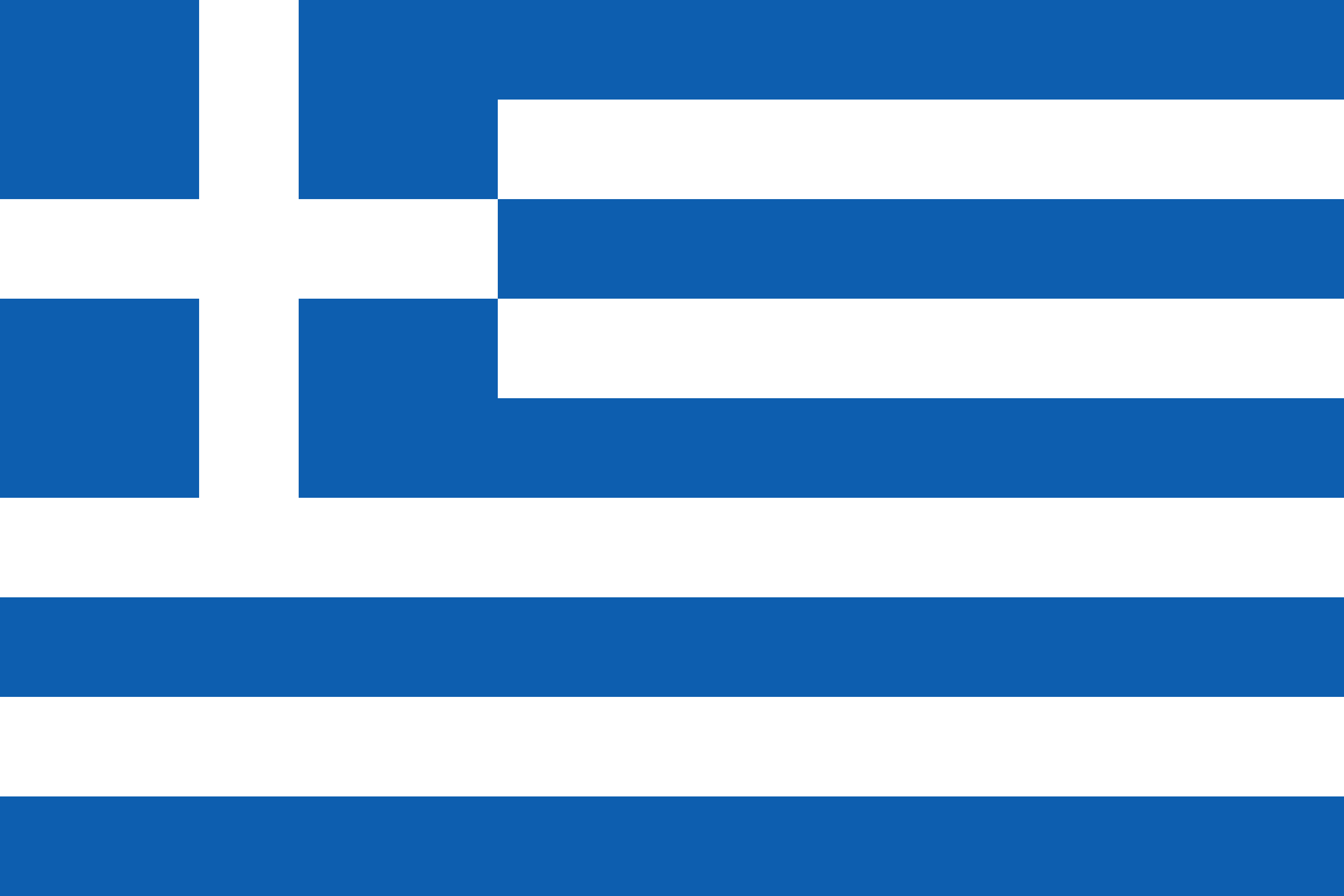
Greece’s national flag has nine equal blue-and-white horizontal stripes and a white cross in a blue canton. Blue is uppermost and lowermost; the proportions are 3:2 width:height.
GKBook composition, CC0; underlying flag geometry, public domain.Download image
The blue canton covers the upper five stripes beside the hoist. Its white cross is one stripe thick. The nine-stripe sequence is easiest to count at the free edge.
GKBook composition, CC0; underlying flag geometry, public domain.Download image
A 10-by-10 canton contains a white cross centered at (5, 5), with arms two units thick. These dimensions follow the legal relationship between the canton, cross, and stripe width.
GKBook composition, CC0; underlying flag geometry, public domain.Download image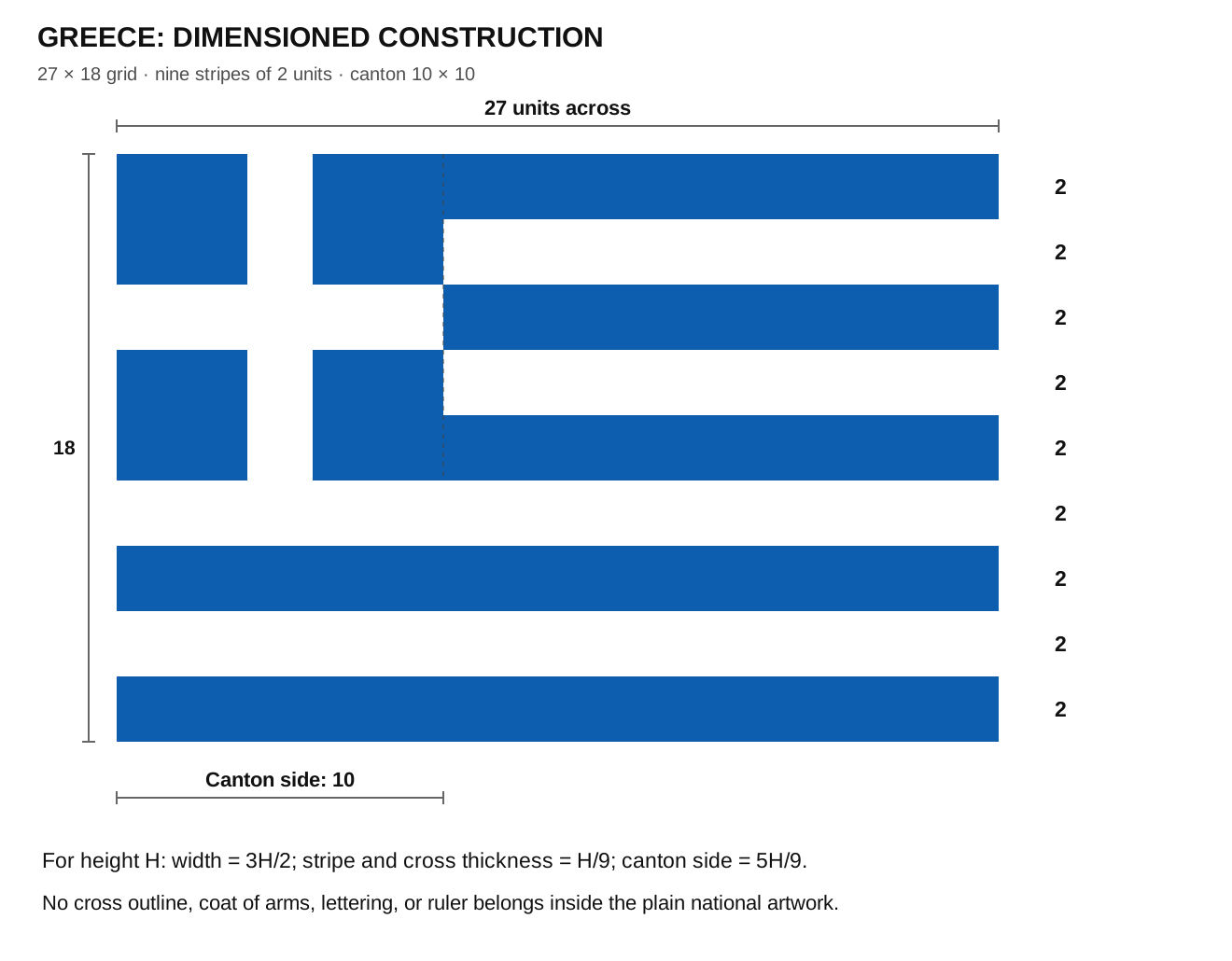
The flag fits a 27-by-18 grid. Each stripe is two units high, the canton is ten units square, and the cross arms are two units thick. The dimensions express the 1978 law’s proportions.
GKBook composition, CC0; underlying flag geometry, public domain.Download image
Exact proportional examples keep a 3:2 rectangle, equal stripes, and a square canton. The original legal size table is discussed separately, including its rounded 95- and 68-centimeter lengths.
GKBook composition, CC0; underlying flag geometry, public domain.Download image
The front shows the canton at the left attachment edge; the reverse shows it at the right attachment edge. For a wall or display window, the legal orientation places the cross to the viewer’s left.
GKBook composition, CC0; underlying flag geometry, public domain.Download image
Later rectangular reference of Greece’s blue land flag with a full white cross. The Presidency describes the earliest land flag as square; this 3:2 reconstruction does not claim to reproduce that first square flag.
GKBook composition, CC0; underlying flag geometry, public domain.Download image
Illustration of the early merchant flag’s documented blue field and blue cross on a white canton. The 3:2 canvas and detailed dimensions are illustrative, not an authenticated 1822 construction sheet. Merchant ships adopted the naval design in 1828.
GKBook independent geometric illustration, CC0; historical pattern from written descriptions.Download image
Modern reference labeled for the royal naval flag of 1833–1858, with Bavarian royal arms. Its distinct proportions and complete heraldry are retained; it is not today’s national flag or a generic version of every royal Greek flag.
GKBook composition, CC0; underlying flag geometry, public domain.Download image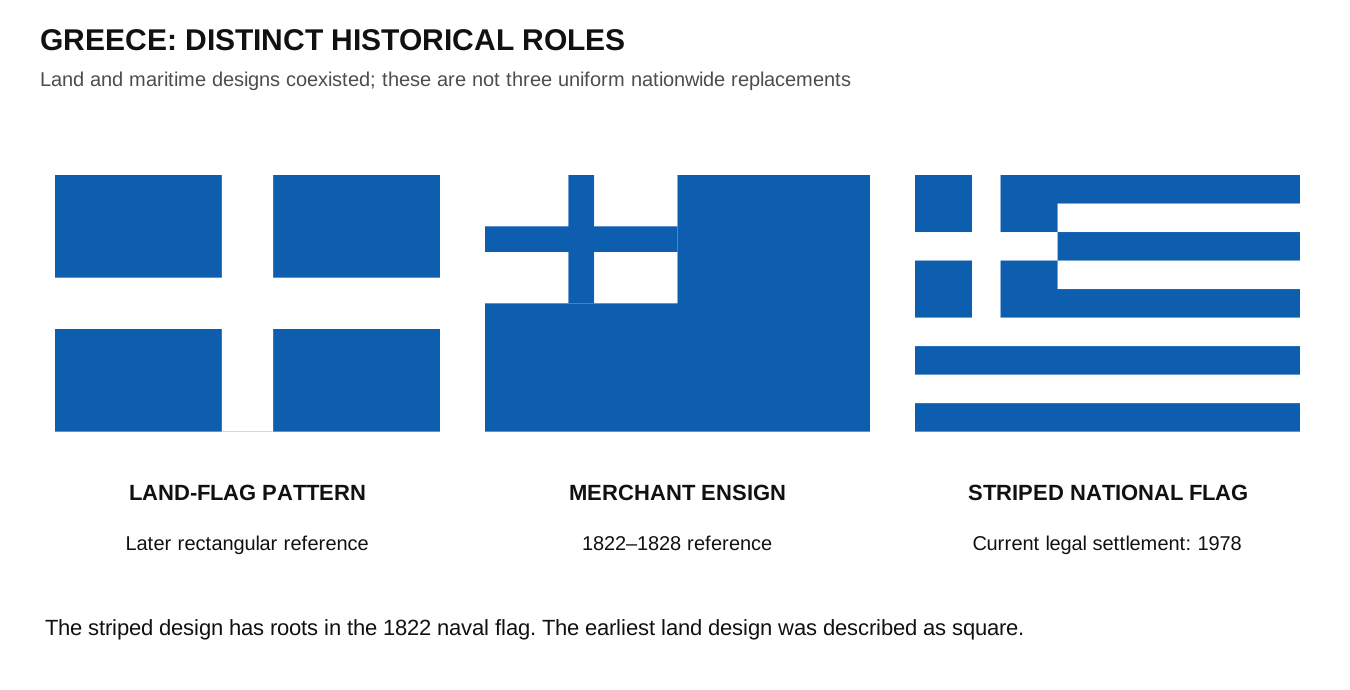
The plain-cross land pattern, illustrative early merchant reconstruction, and present striped flag had different historical roles. Their comparison is not a single uninterrupted sequence of national replacements; exact merchant dimensions are unverified.
GKBook composition, CC0; underlying flag geometry, public domain.Download image
March 25 recalls the independence struggle begun in 1821. October 27 is the school observance honoring the flag, subject to scheduling rules. October 28 recalls resistance in 1940.
GKBook composition, CC0; underlying flag geometry, public domain.Download image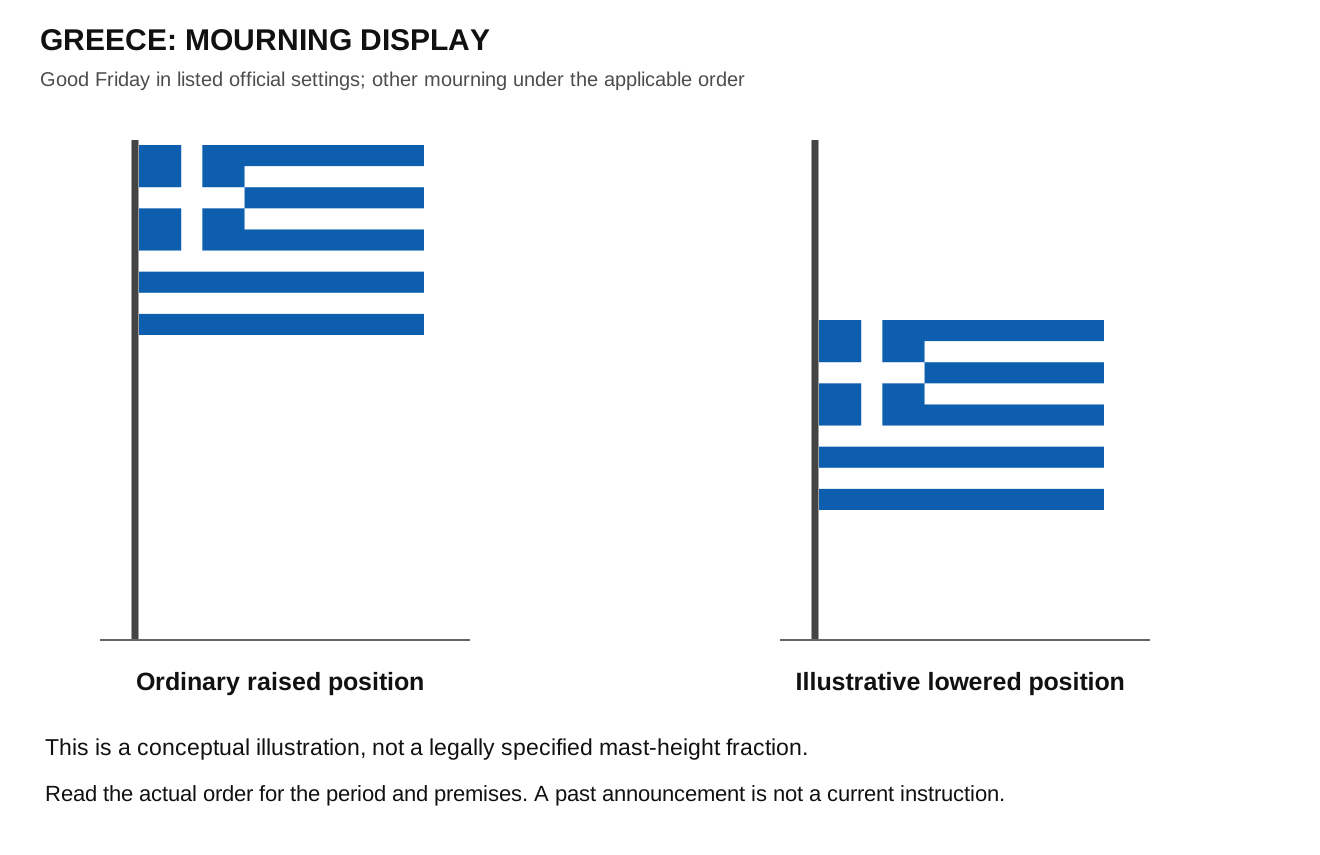
A lowered flag represents mourning. The law names Good Friday and ministerially directed national or public mourning; the illustration does not invent an exact technical lowering measurement.
GKBook composition, CC0; underlying flag geometry, public domain.Download image
In a lecture room, a flag on a staff stands at the speaker’s right, which appears on the audience’s left when they face the speaker. The diagram states the viewpoint explicitly.
GKBook composition, CC0; underlying flag geometry, public domain.Download image
Greece’s nine stripes and white cross differ from Uruguay’s sun and opposite stripe order, Finland’s Nordic cross, and Israel’s central six-pointed star. Each complete reference retains its native proportions.
GKBook composition, CC0; underlying flag geometry, public domain.Download image
Antony Blinken meets Greek earthquake rescue workers and officials in Athens on February 21, 2023. Greek and U.S. flags appear behind the group. Photograph by Chuck Kennedy, U.S. Department of State.
Chuck Kennedy / U.S. Department of State. Public domain.Download image
Theodoros Vryzakis’s 1855 painting The Army Camp of Karaiskakis depicts preparations near Athens in 1827, with a Greek flag at the upper right. It is a later artistic interpretation, not a photograph or flag construction drawing.
Theodoros Vryzakis; National Gallery, Athens; faithful public-domain reproduction. Public domain.Download imageFrequently asked questions
What does Greece’s national flag look like?
Greece’s national flag has nine equal horizontal stripes, alternating blue and white, with blue at the top and bottom. A white cross fills a blue square in the upper corner beside the flagpole. The rectangle is one and a half times as wide as it is high.
How many stripes are on the Greek flag?
There are nine horizontal stripes: five blue and four white. Count them along the free edge, away from the canton, where the full sequence is visible. The blue square and white cross cover the upper five stripes beside the pole; they do not change the total number of stripes.
What is the canton on Greece’s flag?
The canton is the square at the upper hoist, meaning the corner nearest the pole or attachment edge. On Greece’s flag it is blue and contains a white cross. Its side equals five stripe widths, while each arm of the cross has the thickness of one stripe.
What does the white cross represent?
The white cross represents Christianity in the explanation published by Greece’s Foreign Ministry. Geometrically, it is an upright cross with equal-length arms extending to the edges of the blue canton. The symbol is part of the national design; it is not a separate coat of arms placed over the stripes.
What are the Greek flag’s HEX and RGB colors?
The delivered artwork uses blue #0D5EAF, or RGB 13, 94, 175, and white #FFFFFF, or RGB 255, 255, 255. These values describe the digital reference. The law names blue and white, while a later manufacturing specification refers to an official fabric sample rather than prescribing these HEX values.
What does blue symbolize on Greece’s flag?
Greece’s Foreign Ministry associates blue with the sky and seas. That is an official explanatory account of the symbolism, rather than a numerical color standard. It does not mean that a manufacturer should sample a particular photograph of the Aegean or change the blue whenever lighting makes the sea appear different.
What does white symbolize on Greece’s flag?
The Foreign Ministry explains white as the purity of the struggle for independence. The same color forms four horizontal stripes and the cross within the canton. This symbolism concerns the flag’s historical meaning; it does not turn every white area into a separate emblem or prescribe a special fabric finish.
Why are the nine stripes linked to Freedom or Death?
The Foreign Ministry connects the nine stripes with the nine syllables of Eleftheria i Thanatos, meaning Freedom or Death. This familiar interpretation links the flag with the independence struggle. The 1978 design law specifies the stripes and cross geometrically; it does not itself set out that symbolic explanation.
What are the proportions of Greece’s flag?
The legal ratio is two units of height to three of length, commonly written 2:3 in height-to-width notation. Written as width:height, it is 3:2. Each stripe is one ninth of the total height, and the canton is a square with sides equal to five ninths of that height.
How can the Greek flag be drawn accurately?
Use a 27-by-18 grid. Draw nine stripes, each two units high, beginning and ending with blue. Place a blue 10-by-10 square at the upper hoist. Inside it, draw a white cross two units thick, with its center at coordinate (5, 5) and its arms reaching the square’s edges.
Does Greek law list standard flag sizes?
Yes. The original 1978 Gazette lists eight size classes, ranging from 648 by 432 centimeters down to 27 by 18 centimeters. It also gives stripe widths, canton sizes, and some staff dimensions. Two smaller lengths are rounded in the printed table, so distinguish the listed sizes from exact proportional calculations.
When was Greece’s present national flag adopted?
The current legal settlement dates to Law 851/1978, published on December 22, 1978. The striped flag’s history is much older: a related maritime design was established in 1822. Thus 1822 describes its revolutionary origins, while 1978 identifies the modern adoption of the striped design as the sole national flag.
Why is 1822 important in Greek flag history?
In January 1822, the revolutionary National Assembly adopted blue and white as national colors. The provisional administration then prescribed different designs for land forces, naval vessels, and merchant ships. These decisions belong to the War of Independence and should be distinguished from the later recognition and government of an independent Greek state.
What was Greece’s old land flag?
The old land flag placed a white cross across a blue field, without the nine horizontal stripes. It coexisted with maritime designs for much of modern Greek history. The supplied image is a later rectangular reference of that pattern; the Presidency describes the earliest land flag as square.
Why did Greece have a different merchant flag?
The early merchant ensign was blue with a blue cross on a white canton, distinguishing it from the striped naval ensign. In 1828, merchant ships were brought under the naval design. The Presidency connects that change with the merchant fleet’s participation in the War of Independence.
Why do some old Greek flags contain a crown or shield?
Royal symbols reflected the monarchy rather than an extra feature of today’s national flag. Under King Otto, Bavarian arms appeared on army and naval flags. Later royal flags used a crown. Historical drawings must therefore be labeled by role and period, instead of being presented as optional additions to the current flag.
Did Greece change its flag during the twentieth century?
Yes. Monarchical emblems, the relationship between land and maritime flags, and the proportions of some designs changed during successive regimes. The plain cross flag returned in 1975, before the striped national design was settled in 1978. These transitions do not mean the blue-and-white tradition began only in the twentieth century.
Who designed Greece’s national flag?
The consulted official accounts document adoption by revolutionary and later state institutions but do not identify one securely verified individual designer of the national flag. A ruler, legislator, historical painter, or modern vector artist should not automatically receive that credit. The documented decisions are more reliable than an unsupported personal attribution.
What does the historical painting show?
Theodoros Vryzakis painted The Army Camp of Karaiskakis in 1855, looking back to preparations near Athens in 1827. The National Gallery identifies a Greek flag at the upper right. This is a later artistic interpretation of the independence struggle, not a photograph of the event or a technical flag specification.
What does Greek law say about flag manufacture?
The 1978 text calls for suitable fabric with lasting colors and rejects worn, faded, or printed flags for hoisting. It also provides for state procurement specifications. These requirements concern physical flags: a downloadable diagram or digital image is an educational reference, not certification that a finished textile meets official procurement rules.
When is Greek Flag Day observed?
October 27 is associated with honoring Greece’s flag in schools, alongside the commemoration preceding the October 28 national holiday. Article 3 of Presidential Decree 79/2017 expressly includes the flag in those school celebrations and provides scheduling exceptions. This school observance should not be confused with a separate nationwide public holiday.
How do March 25 and October 28 differ?
March 25 is Greece’s Independence Day, commemorating the beginning of the independence struggle in 1821. October 28, known as Ohi Day, recalls resistance to the Italian ultimatum and invasion in 1940. Both are major national anniversaries, but neither is the publication date of the present flag law in December 1978.
Where is the Greek flag flown officially?
The 1978 law identifies official buildings and settings including the Presidency, Parliament, ministries, diplomatic and consular authorities, educational institutions during the school term, military establishments, and ships. It also regulates ceremonial display. The applicable institution and occasion matter; one photograph cannot establish the complete rules for every Greek installation.
What are Greece’s flag-flying hours?
Article 2 of the 1978 law gives an ordinary daily period from 8 a.m. until sunset for the listed official settings. Article 6 also allows flags to remain raised overnight when an ordered display lasts more than one day. The exception matters when interpreting a simple statement that flags always come down at sunset.
Is flying the Greek flag at home automatically forbidden?
The reviewed law should not be reduced to a blanket statement that household flag display is forbidden. Its provisions distinguish ordinary official display, specified ceremonies, mourning, and obligations during ordered celebrations. For an actual installation, consider the relevant provisions together and follow the applicable directions rather than relying on a circulating one-sentence claim.
Where should the cross be in a wall display?
For a flag spread on a wall or in a display window, Article 6 places the cross to the viewer’s left. In the usual horizontal view, that means the upper-left canton. A reverse view of a free-flying flag naturally shows the canton on the opposite side and is not a manufacturing error.
Where does the flag go beside a speaker?
The 1978 law places a flag on a staff to the speaker’s right in a lecture room. For an audience facing the speaker, that is usually the audience’s left. State the viewpoint when describing the arrangement; otherwise the phrase on the right can give two people opposite instructions.
How is Greece’s flag displayed with other countries’ flags?
Article 6 requires other countries’ flags displayed with Greece’s flag in the same domestic setting to have equal dimensions and separate staffs of equal height or length. It gives the Greek flag the position of honor on the right. The organizer must apply the correct ceremonial viewpoint to the actual arrangement.
When does Greece fly its flag at half-mast?
The law provides for half-mast display on Good Friday in its listed official settings and for national or public mourning under an Interior Ministry instruction. A particular mourning order supplies the affected premises and period. An archived announcement is evidence of that occasion, not a standing instruction to lower flags today.
What does a Greek mourning order actually specify?
A January 5, 2025 Interior Ministry decision ordered half-mast display at all public buildings following the death of former prime minister Konstantinos Simitis, continuing through January 9. It illustrates the importance of reading both the premises and dates. The order is a historical example, not a current mourning notice.
Does the reviewed Greek law give an exact half-mast fraction?
The reviewed provisions require half-mast display but do not provide a numerical mast-height fraction for the flag’s upper edge, center, or lower edge. The supplied diagram therefore shows lowered display conceptually. Use the responsible institution’s technical instructions for an installation rather than importing an exact measurement from another country’s protocol.
How is the Greek flag oriented over a coffin?
Article 6 states that when the flag covers a body, the cross is placed at the head. That orientation rule is separate from deciding who receives a flag-draped funeral or other official honors. The organizer should follow the relevant ceremonial arrangements; a general half-mast announcement does not answer every funeral question.
How should a worn Greek flag be treated?
The 1978 law rejects hoisting worn or faded flags and says a flag replaced because of age should not be discarded as ordinary waste. It expresses a preference for destruction by fire. That wording should be distinguished from a claim that every owner must perform one particular folding or retirement ceremony.
Can the Greek flag be used in advertising?
The 1978 law contains an express restriction on using the national flag for advertising or commercial purposes. Public-domain status of a digital drawing does not remove that separate rule. A downloadable educational image therefore does not certify that a particular logo, package, advertisement, or merchandise design is legally permitted.
May an organization add its badge to the national flag?
The law says the national flag must not carry organizational insignia or another representation and must not be adopted as an association’s own banner. The plain national design consequently contains only its stripes and cross. A school name, sponsor mark, crown, or laurel wreath should not be added to the national master.
Do Greece’s armed forces all use the same flag?
The Navy’s war flag is identical to the national flag, according to the Presidency. Army and Air Force war flags instead use a white cross on blue with a central religious image: Saint George for the Army and Archangel Michael for the Air Force. These service colors are distinct from the ordinary national design.
Is Greece’s coat of arms on its national flag?
No. Greece’s coat of arms is a blue shield with a white cross surrounded by laurel branches, while the national flag has its cross in a blue canton and nine stripes. Shared colors and a cross connect the symbols visually, but the shield and laurel wreath are not part of the flag.
How can Greece’s flag be distinguished from similar flags?
Greece combines nine blue-and-white stripes with a white cross in a blue canton. Uruguay’s flag also has nine stripes but uses a sun in a white canton and begins with white. Finland uses a large blue Nordic cross, while Israel has two blue bands and a central six-pointed star.
What is Greece’s flag emoji and country code?
Greece’s flag emoji is 🇬🇷. It combines regional indicator G, U+1F1EC, with regional indicator R, U+1F1F7, corresponding to the country code GR. The displayed shape and shading depend on the device or application. Use the supplied SVG or PNG when exact proportions and consistent reference colors are important.
What does the 2023 photograph document?
The photograph records Antony Blinken meeting Greek earthquake rescue workers in Athens on February 21, 2023, with Greek officials and Greek and U.S. flags present. Chuck Kennedy made the image for the U.S. Department of State. It documents a dated diplomatic setting, rather than serving as a precise color or dimension chart.
What common mistakes should be avoided when drawing Greece’s flag?
Keep nine equal stripes, blue at both outer edges, and a square canton spanning five stripes. Make the cross arms one stripe thick. Do not reverse the cross and canton colors, substitute the old full-field cross flag, add a crown, or mistake a mirrored reverse view for an incorrect design.
Which Greek flag images are included in the download?
The package includes the plain national SVG and large PNG, anatomy and cross details, construction and size guides, orientation and precedence diagrams, historical land and maritime references, a history comparison, observance and mourning sheets, and look-alike comparisons. A verified diplomatic photograph and a public-domain historical painting provide additional context.
Explore all general-knowledge topics and the A-to-Z lists.


We Value Your Opinion Comments