
Germany flag picture
Explore the construction sheet, the German Unity Day observance, and the historical sequence.

| Country | GermanyFederal Republic of Germany, in Central Europe; capital Berlin. |
|---|---|
| National flag | Black, red, and goldThree equal horizontal bands, with black at the top and gold at the bottom. |
| Proportions | 5:3 width:heightThe flag order states 3:5 height:length; these describe the same rectangle. |
| Federal adoption | 1949The Basic Law, promulgated on May 23, specifies black-red-gold. |
| Constitutional basis | Article 22(2) of the Basic LawThe 1996 flag order supplies the stripe layout, proportions, and banner form. |
| Designer | Historical developmentNo single modern artist is credited with inventing the national tricolor. |
| Eagle variant | Federal service flagThe Bundesdienstflagge carries the Bundesschild and has restricted official use. |
| National holiday | October 3 — German Unity DayCommemorates reunification in 1990; distinct from the May 23 Basic Law anniversary. |
Black, red, and gold form three equal horizontal bands. The plain national flag was adopted by the Federal Republic in 1949 and retained at reunification in 1990; the eagle-bearing service flag is a distinct official variant.
What is the flag of Germany?
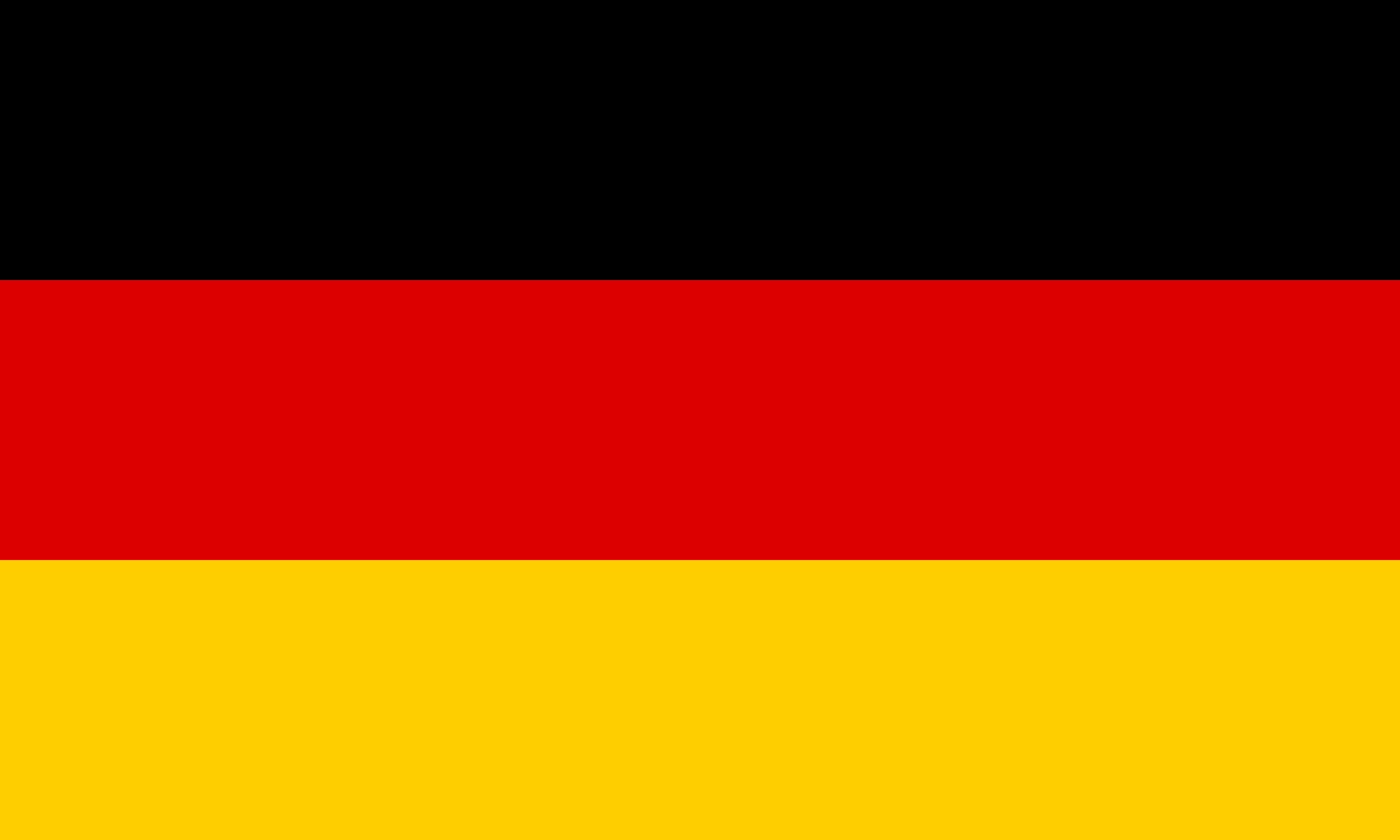
Germany’s national flag has three equal horizontal bands: black at the top, red in the middle, and gold at the bottom. Its standard width-to-height ratio is 5:3. The plain federal flag, called the Bundesflagge, contains no eagle, shield, stars, lettering, or white separating stripes.
The Federal Republic of Germany is a Central European country with its capital at Berlin. Its national tricolor is often called Schwarz-Rot-Gold, meaning black-red-gold. The German name Bundesflagge identifies the plain federal flag.
The design connects the modern republic with earlier movements for constitutional freedom and national unity. It is used by the public as well as in official settings, while certain eagle-bearing variants serve different, restricted purposes.
Explore the construction guide, historical timeline, German Unity Day, and downloadable pictures.
What is the correct stripe order?
Read the horizontal national flag from top to bottom as black, red, and gold. Each band occupies one third of the height and extends across the whole width. The same order appears on the reverse. Belgium’s vertical stripes and the former German black-white-red flag are different designs.
The bands meet directly, without outlines or white gaps. A seam, sleeve, fringe, or staff fitting is a manufacturing or display feature, not a fourth stripe.
The hoist is the edge attached to the staff; the fly is the free edge. For the ordinary horizontal flag, the color order is read from top to bottom, independently of which side carries the attachment.
The black upper stripe can disappear against a dark background. A neutral surrounding frame may help a web illustration remain visible, but that frame must remain outside the actual flag.
What are the legal colors and the download’s digital values?
The legal colors are black, red, and gold. This downloadable reference uses black #000000, red #DD0000, and gold #FFCE00. Those are the actual digital fills in the supplied artwork, not numerical codes prescribed by Article 22. Physical flag fabric, printed graphics, and screen displays require appropriate color references and proofs.
| Color | Supplied SVG HEX | RGB | Status |
|---|---|---|---|
| Black | #000000 | 0, 0, 0 | Reference artwork fill |
| Red | #DD0000 | 221, 0, 0 | Reference artwork fill |
| Gold | #FFCE00 | 255, 206, 0 | Reference artwork fill |
Article 22(2) of the Basic Law names the colors. The flag order describes their arrangement and the gold-colored lower band. Neither provision gives the three HEX codes in this table. The codes are useful for reproducing this particular digital master consistently.
A photograph is not a calibrated color swatch: shade, folds, lighting, and the camera can change its appearance. Converting RGB artwork to print also involves a color profile, ink, and substrate, so a single unsupported CMYK or Pantone formula is not presented as a legal requirement.
The Bundestag identifies RAL 1028 for the gold in its own flag installation. That institution-specific detail should not be turned into a universal numerical rule for every German flag or for every reproduction medium.
Why is a yellow-looking stripe called gold?
Gold is the legal and heraldic name of the lower stripe. In heraldic practice, yellow can represent gold without requiring metallic cloth or real gold thread. The Bundestag explains this distinction for its own flags. A yellow-looking reproduction can therefore express the prescribed gold color rather than a different national design.
The distinction is between a heraldic color name and the material used to depict it. The Bundestag explains that heraldic gold is represented by yellow, just as silver can be represented by white. Ordinary flag cloth therefore does not need a reflective metallic surface.
The legal name remains black-red-gold. A yellow-looking lower band is not an invitation to substitute white, orange, or an additional emblem. Production proofs should preserve the intended visual identity while accounting for the textile or printing process.
What do black, red, and gold mean?
The colors together symbolize Germany’s traditions of unity, freedom, and democracy. Their origins developed through nineteenth-century movements rather than a modern three-part symbolism code. The Basic Law names black, red, and gold but does not assign a separate official meaning to each stripe. Historical origin stories should be identified as such.
The uniform associations in these strips are a traditional origin explanation. The Bundestag explicitly cautions that the beginnings cannot be established with certainty. They should not be recast as a constitutional rule assigning a separate moral quality to each stripe.
The stronger historical theme concerns the combination as a whole: the pursuit of unity and freedom, later associated with democratic constitutional government. Hambach, the 1848 movement, the Weimar Republic, and the postwar Federal Republic provide distinct stages of that political history.
Stories that individually equate black with oppression, red with blood, and gold with a brighter future are not the legal specification used on this page. The Basic Law states the colors without establishing such a three-part interpretation.
How is Germany’s flag constructed?
The standard horizontal federal flag is five units wide and three units high, divided into three equal horizontal bands. A 3000-by-1800-pixel master therefore has 600-pixel bands. The legal notation of 3:5 height:length means the same thing as 5:3 width:height; reversing the notation does not create another design.
| Element | 5 × 3 frame | 3000 × 1800 SVG | 6000 × 3600 PNG |
|---|---|---|---|
| Outer rectangle | Width 5; height 3 | 3000 × 1800 | 6000 × 3600 |
| Black band | y = 0–1 | y = 0–600 | y = 0–1200 |
| Red band | y = 1–2 | y = 600–1200 | y = 1200–2400 |
| Gold band | y = 2–3 | y = 1200–1800 | y = 2400–3600 |
| All bands | Full width | 3000 wide | 6000 wide |
For any height H, the width is 5H/3 and each stripe is H/3 high. A 5:3 width:height ratio and a 3:5 height:length ratio describe the same horizontal rectangle. Always state the order of the measurements.
The standard comes from the flag order. A photograph of an unusually shaped installation is not a reason to stretch this master. The plain national download contains only the three bands; dimension lines, annotations, and surrounding panels belong exclusively to the explanatory sheets.
How can the flag be scaled for print or fabric?
Keep the width at five thirds of the height and give each stripe one third of the height. A flag measuring 150 by 90 centimeters has three 30-centimeter bands. Scale the whole design proportionally, and calculate sewing allowances, attachments, or print bleed separately from the finished visible flag.
For a 100-by-60-centimeter flag, each band is 20 centimeters high; for a 150-by-90-centimeter flag, each is 30 centimeters. A 200-by-120-centimeter flag has 40-centimeter bands. The same calculation works at classroom, desktop, and large-format scales.
The SVG is resolution independent. The supplied PNG measures 6000 by 3600 pixels and has three 1200-pixel bands. Keep the aspect ratio locked when resizing either format. Add bleed, hems, sleeves, or other attachments beyond the intended finished dimensions according to the production method.
How did the German flag develop?
Black, red, and gold became associated with nineteenth-century movements for unity and freedom, including Hambach in 1832 and the revolution of 1848. The Weimar Republic adopted the colors in 1919, and the Federal Republic chose them in 1949. Reunification in 1990 retained the plain federal flag.
The Jena student fraternity helps popularize the color combination; the exact origins remain uncertain.
Black-red-gold becomes a prominent sign of demands for political rights and German unity.
The colors are associated with efforts to create a united constitutional Germany.
The North German Confederation and later the German Empire use a different national color combination.
Black-red-gold returns as the republican national colors, alongside a compromise merchant ensign.
The democratic tricolor is displaced; in 1935 the swastika flag becomes the sole national flag.
Both initially use the plain black-red-gold tricolor; the Federal Republic records the colors in the Basic Law.
The GDR adds the hammer, compasses, and grain wreath, visibly distinguishing its flag.
The plain federal flag continues for reunified Germany.
The later flag order defines the standard horizontal flag, banner form, and specified official variants.
A political change, a change in the colors, and a later legal specification are different events. The Federal Republic’s choice in 1949 restored a historical color tradition. Reunification retained the plain tricolor, and the 1996 order did not originate black-red-gold.
Did the colors originate with volunteer uniforms?
A well-known origin tradition links the colors to black uniforms, red piping, and gold-colored buttons of the Lützow Volunteer Corps. The Bundestag cautions that the origins cannot be established with certainty. Student fraternity flags helped popularize the combination, which later acquired wider political meaning beyond any one uniform or organization.
The familiar Lützow account links black cloth, red trim, and gold-colored buttons. It offers a memorable explanation of how the colors could appear together, but the Bundestag’s historical account treats the origins as uncertain rather than identifying one proven invention.
Student fraternity flags helped carry the combination into a broader political culture. Early banners did not all have the same stripe arrangement, dimensions, or decoration. The history of the colors is therefore wider than the history of today’s precise 5:3 rectangle.
Why is Hambach important to black-red-gold?
The Hambach Festival of May 27, 1832, brought black-red-gold flags into a major movement for political rights and German unity. Johann Philipp Abresch carried a flag with equal bands in the familiar order. The surviving Hambach flag is important historical evidence, but it is not the modern legal construction specification.
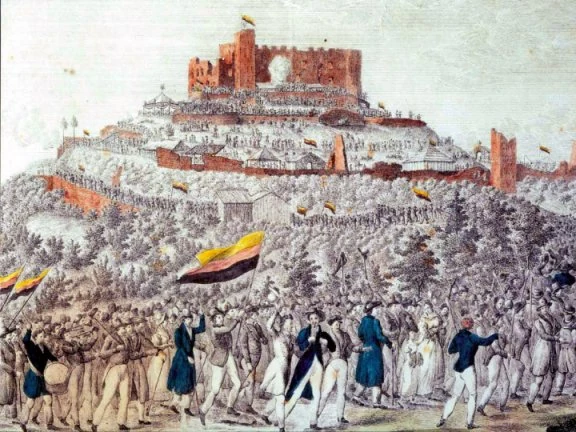
The Hambach Castle museum identifies Johann Philipp Abresch with a flag using equal black, red, and gold bands. His surviving flag is evidence of a major moment in the colors’ political history. It does not make him the sole inventor of all earlier uses or the author of the modern federal flag order.
The Brenzinger artwork reproduced here is a separate historical image. Its colored flags show gold uppermost. The reproduction is retained without recoloring, and its caption makes clear that it is not a drawing instruction for the current national flag. A surviving textile, a historical depiction, and a modern vector reconstruction are different kinds of evidence.
Why was the imperial flag black, white, and red?
The imperial color combination reflected Prussian black and white together with red associated with the Hanseatic cities. It became the flag tradition of the North German Confederation and the German Empire. This historical black-white-red design differs from today’s black-red-gold flag and should not be used as its interchangeable substitute.
The North German Confederation’s 1867 tradition continued in the German Empire from 1871. The color combination brought together Prussian black and white with red associated with the Hanseatic cities. White in the middle is the most immediate visual distinction from today’s national tricolor.
The illustrated reference is historical, not an alternative present-day federal flag. Its 3:2 rectangle is retained on its own terms; it is not stretched to match the current national master’s 5:3 proportions.
What flag did the Weimar Republic use?
The Weimar Republic adopted black, red, and gold as its national colors in 1919. The decision was contested, and the merchant ensign retained black-white-red with the national colors in the upper hoist. That compromise concerned different flag functions; it does not mean the republic’s national colors were black, white, and red.
The choice in 1919 connected the republic with the earlier unity-and-freedom tradition. The merchant ensign compromise retained black-white-red with black-red-gold in the upper hoist. Distinguishing a national flag from a merchant ensign resolves an apparent contradiction in images from the period.
The Nazi dictatorship broke with the republican tricolor. In 1935 the swastika flag became the sole national flag. That history belongs to the dictatorship; it does not make black-red-gold a Nazi flag or the swastika a feature missing from the modern German design.
When did the Federal Republic adopt the present colors?
The Federal Republic chose black, red, and gold in 1949, recording the colors in the Basic Law promulgated on May 23. The combination had earlier historical uses, including the Weimar Republic. On October 3, 1990, the same plain federal flag continued as the flag of reunified Germany.
The Basic Law was promulgated on May 23, 1949. Article 22(2), in its present numbering, states the national colors. The historical combination predates that constitution, so 1949 identifies the Federal Republic’s adoption rather than the first appearance of the colors anywhere.
The flag order of November 13, 1996, amended in 2005, gives the standard proportions and describes the banner form and official variants. The date of a later technical order should not replace 1949 in an adoption summary.
How did the East German flag differ?
Both German states initially used black, red, and gold after their establishment in 1949. In 1959, the German Democratic Republic added its emblem: a hammer and compasses surrounded by a wreath of grain ears. West Germany retained the plain tricolor, which continued after reunification in 1990.
Between 1949 and 1959, both German states initially used the same plain national color arrangement. The GDR’s addition in 1959 made the flags visibly different without changing the three background colors.
The East German reconstruction here preserves the emblem’s full paths and its 5:3 proportions. It is a historical reference, not a version needed to complete the present national flag. Reunification on October 3, 1990, retained the plain federal design; no merger of the federal eagle and the East German emblem was added.
Who designed Germany’s national flag?
Germany’s national tricolor developed through historical movements and constitutional choices, rather than a securely documented commission to one modern designer. Johann Philipp Abresch is associated with an important 1832 Hambach flag. That does not establish him as the sole inventor of the entire color tradition or the author of the 1949 constitutional decision.
The evidence supports a history of political movements and institutional adoption rather than a single modern designer credit. Abresch is associated with a particular Hambach flag; that documented role should remain attached to that historical object.
Likewise, constitutional adoption, a presidential flag order, and the production of a modern SVG are different activities. Crediting the digital reproduction does not attribute the underlying national colors to its vector artist.
How should a German national flag be made?
Reproduce three equal horizontal bands in the legal order and preserve the standard 5:3 rectangle. Sewn or printed production needs suitable color proofs, materials, and finished dimensions. The flag order specifies the design but does not prescribe a universal household fabric, stitching method, or mandatory metallic material for the gold stripe.
A sewn flag needs equal finished band heights after seams; a printed flag needs the same geometry in its artwork. Allow for shrinkage, attachment reinforcement, and the fabric’s intended conditions. These are production considerations, not invented national specifications for a single mandatory textile.
Approve a physical color sample for the actual material. A luminous screen, coated paper, and woven outdoor fabric will not behave identically. Preserve the legal color names and the overall identity instead of assuming that a nominal digital conversion guarantees a matching physical result.
Use the complete reference for complex variants. The supplied federal service flag and East German historical reconstruction preserve their internal artwork; an eagle, hammer, or grain wreath should not be replaced by a generic icon.
What is the eagle-bearing federal service flag?
The federal service flag, or Bundesdienstflagge, adds the Bundesschild to the black-red-gold bands, slightly toward the hoist. Its eagle faces the hoist. This is an official variant with restricted use, not the ordinary national flag for everyone. Other eagle-bearing souvenir designs should not automatically be treated as the authorized service flag.
The flag order specifies the Bundesschild, shifted slightly toward the hoist, with the eagle facing the staff. The shield extends into the black and gold bands by up to one fifth of each band’s height. That fraction refers to the individual band, not one fifth of the entire flag.
The plain federal flag, the service flag, the federal coat of arms, and the federal president’s standard are distinct symbols. The presidential standard is a square gold field with an eagle and a red border; it should not be confused with the horizontal service tricolor.
Section 124 of the Administrative Offenses Act protects official arms and service flags against unauthorized use, including confusingly similar versions. A souvenir flag with an eagle is not automatically an authorized official variant merely because it is sold commercially.
The Bundestag’s research review also notes that socially customary uses, including some souvenirs and sports contexts, can be permitted. The outward appearance of official use and the specific context matter; the restriction should not be simplified into a claim that every decorative eagle-bearing item is automatically unlawful.
May people fly the plain national flag?
Private individuals may generally use the plain black-red-gold national flag. It should be distinguished from the federal service flag and protected eagle or arms designs, whose unauthorized use raises separate legal issues. Ordinary private display does not turn a home, business, or sports gathering into a federal institution governed by its display timetable.
The plain tricolor is the appropriate design for ordinary national identification at a home, community event, or sports gathering. The institutional display decree does not turn these private settings into federal premises or compel participation in every official flag-flying occasion.
The Bundestag explains its own use of the plain flag through its role representing the whole people. It is an independent constitutional body with its own flag-display arrangements. Federal ministries and Parliament therefore need not use identical flag variants at every building.
When is German Unity Day?
German Unity Day is October 3, commemorating reunification in 1990. Article 2 of the Unification Treaty establishes it as the national holiday. It is also a regular federal flag-flying date. The May 23 anniversary of the Basic Law is a different observance, and neither is relabeled here as a separate statutory Flag Day.
October 3 marks reunification in 1990. Article 2(2) of the Unification Treaty establishes the date as the national holiday, and it appears in the federal decree’s regular flag-flying list.
May 23 is the anniversary of the Basic Law’s promulgation in 1949. It is also a listed federal display occasion, but it commemorates a different event. No distinct statutory national Flag Day is established by the materials used here, so this article’s observance menu points to German Unity Day.
Which occasions appear in the federal flag-flying decree?
The federal decree lists recurring occasions including January 27, May 1, May 9, May 23, June 17, July 20, October 3, the national day of mourning, and federal or European elections. Additional orders and separate institutional or state rules also matter, so this baseline list is not a complete calendar for every building.
| Date or occasion | Commemoration | 2005 decree instruction |
|---|---|---|
| January 27 | Victims of National Socialism | Half-mast |
| May 1 | Labor Day | Regular display |
| May 9 | Europe Day | Regular display |
| May 23 | Promulgation of the Basic Law | Regular display |
| June 17 | 1953 uprising | Regular display |
| July 20 | Resistance to National Socialism | Regular display |
| October 3 | German Unity Day | Regular display |
| Second Sunday before First Advent | Volkstrauertag, national day of mourning | Half-mast |
| Bundestag election day | Federal parliamentary election | Regular display |
| European election day | European Parliament election | Regular display |
The table identifies what that decree lists; it is not an exhaustive current calendar for every public building. Additional orders, the states, and independent constitutional bodies can introduce other occasions or arrangements. The highest federal authorities in Berlin and Bonn are subject to daily display under the decree.
For a concrete example of later and regional entries, Lower Saxony’s published calendar also includes March 11 for victims of terrorism, June 15 for National Veterans Day, and June 20 for victims of flight and expulsion. June 1 marks the state’s own constitutional anniversary. These examples are attributed to that calendar and do not by themselves establish a universal duty for every German institution.
Check the order applicable to the building and date. A list of commemorations is not an announcement that mourning is currently in force.
What display hours apply at federal buildings?
The federal building decree normally begins display at daybreak, but not before 7 a.m., and ends it at sunset. Flags that are illuminated may remain flying after sunset. These are rules for the decree’s institutional scope, with specific exceptions; they are not a universal private-household curfew on displaying the national flag.
The March 22, 2005 decree applies to federal departments, agencies, and the bodies within its stated scope, with exclusions and special arrangements. States and municipalities have their own responsibilities; diplomatic premises abroad also have separate instructions. Parliament’s independent rules are another reason to identify the responsible institution first.
For ordinary display under the decree, flags are raised at daybreak, no earlier than 7 a.m., and lowered at sunset. Illuminated flags may remain flying after dark. For a sequence of display days, the normal daily raising and lowering pattern still applies unless the lighting exception is used.
These are scoped institutional rules. They do not create a universal private-household nighttime ban or require every private flag owner to illuminate a flag.
How is the authorized vertical banner arranged?
Yes. The 1996 flag order expressly permits a banner form with three equal vertical stripes: black on the left, red in the middle, and gold on the right in the front view. That is a recognized arrangement, not permission to reverse the horizontal flag’s colors or stretch an eagle-bearing variant carelessly.
The flag order expressly recognizes the banner form. Its equal vertical bands run down the banner: the arrangement is not three horizontal panels stacked along an arbitrarily stretched sheet.
The order’s text does not prescribe an outer proportion for the plain banner comparable to the horizontal flag’s 3:5 height:length rule. The tall frame in this diagram is therefore illustrative, not a claimed legal banner size. The order separately describes eagle placement for a service banner; that specialized variant must not be made by rotating a horizontal shield onto its side.
What happens when the flag is viewed from behind?
No. On the horizontal flag, black stays at the top, red in the middle, and gold at the bottom when viewed from either face. The attachment edge appears on the opposite side from behind. Turning the cloth upside down changes that order; it is different from simply viewing the reverse.
A horizontal tricolor has the same top-to-bottom sequence on both faces. An upside-down flag, by contrast, has gold at the top and black at the bottom. Those are different observations and should not share an “opposite side” explanation.
The vertical banner has a specified front view. Its left-to-right appearance changes when viewed from behind, just as the sides of any piece of cloth exchange. Label the viewing direction when using a banner diagram.
How is the German flag positioned with other flags?
Under the federal building decree, European and federal flags occupy the preferred positions on the left when viewed from outside toward the building. Foreign-state and international-organization flags introduce additional ordering rules. The actual arrangement depends on the event and jurisdiction, rather than a universal instruction that Germany’s flag is always centered or always first.
| Context in the federal decree | Ordering principle |
|---|---|
| European and federal flags | Preferred positions toward the viewer’s left when facing the building |
| International or supranational organizations | Placed before foreign-state flags in the specified additional-flag sequence |
| Foreign states | German official short names determine alphabetical order |
| Federal, state, and municipal flags | Follow the relevant category order; states are alphabetical |
| Several flags together | Should have equal dimensions and suit the building |
The viewing direction matters: the decree describes the observer outside facing the building. An instruction expressed from the building’s perspective can sound reversed while identifying the same physical side.
The diagram covers a simple example, not all possible rows of flags. Additional foreign or international participants change the ordering problem. Do not apply a generic rule that the national flag must always occupy the center, or that every foreign flag automatically takes the same place at every event.
How is a German flag lowered for mourning?
The federal decree requires the flag to be raised fully before it is lowered for mourning. Official practical guidance places a horizontal hoist flag’s lower edge approximately halfway up the mast. Flags that cannot be lowered receive a mourning ribbon instead. The applicable order determines the occasion and institutional scope.
The federal decree requires the flag to be raised to full height before it is lowered. Mecklenburg-Vorpommern’s Interior Ministry gives a practical placement instruction for horizontal hoist flags: the lower edge is approximately level with the midpoint of the mast. That is not the same as placing the flag’s upper edge at half height.
The 2005 federal decree lists January 27 and Volkstrauertag as recurring half-mast occasions. The reviewed current Mecklenburg-Vorpommern guidance also includes March 11. Other mourning requires the relevant order and scope; the existence of this article does not announce an active mourning instruction.
Under the federal decree, the European flag is lowered along with the federal flag or federal service flag. Other international-organization and foreign-state flags are excluded from that automatic instruction. Their treatment requires the applicable protocol rather than an assumption that all neighboring flags must follow.
When is a mourning ribbon used instead?
A mourning ribbon is used when the flag cannot be lowered to half-mast, such as an installation with a fixed staff or a banner. It expresses mourning without changing the flag’s colors or adding a permanent national emblem. Follow the relevant institutional instructions rather than automatically combining a ribbon with a lowered flag.
A fixed staff or banner may not allow the ordinary lowering maneuver. The federal decree then permits the mourning-ribbon approach. The reviewed regional guidance distinguishes this from half-mast display: it does not prescribe adding a ribbon automatically to a flag that has already been lowered.
A ribbon is a temporary mourning addition, not a permanent change to the national design. The evidence reviewed does not supply a single universal private ribbon length or a compulsory mourning procedure for every household, so none is invented here.
Private participation in official mourning remains separate from state or military funeral arrangements. An institutional flag order does not itself establish a universal entitlement to a flag-draped coffin. The responsible ceremony organizer’s rules govern the particular event.
Why can the Flag of Unity remain fully raised?
The Flag of Unity in front of the Reichstag has a special symbolic status. The Bundestag normally exempts it from its ordinary mourning arrangements, although exceptional lowering is possible. It can therefore remain fully raised while other parliamentary flags are lowered. That difference does not by itself indicate an error or conflicting national designs.
The Bundestag identifies the large flag on the Platz der Republik in front of the Reichstag as the Flag of Unity. Its cloth measures 6 by 10 meters, consistent with the standard 3:5 height:length proportion. The photograph below records it in its parliamentary setting.
The flag has a special symbolic status in parliamentary display arrangements. It ordinarily remains fully raised during mourning, but exceptional lowering is possible. “Normally exempt” is therefore more accurate than “never lowered.” A dated example on an institutional information page should not automatically be described as the most recent exception.
Which legal rules should be distinguished?
Article 22 of the Basic Law names the national colors, and the 1996 flag order defines forms and proportions. The federal display decree governs its own institutional sphere. Section 124 of the Administrative Offenses Act separately addresses unauthorized use of official arms and service flags; criminal protection of state symbols is another legal matter.
| Instrument | What it establishes |
|---|---|
| Basic Law, Article 22(2) | National colors: black, red, and gold |
| Flag order of 1996, amended 2005 | Band layout, proportions, banner form, and specified official variants |
| Federal display decree of March 22, 2005 | Institutional display occasions, hours, precedence, and mourning within its scope |
| Administrative Offenses Act, section 124 | Unauthorized use of protected arms and official service flags, including confusingly similar versions |
| Criminal Code, section 90a | Separate criminal protection for the state and its symbols |
These rules do not make every inaccurate classroom drawing or accidental folding error the same legal offense. The type of symbol, the conduct, authorization, context, and applicable provision matter. This page does not invent a fixed fine or a general criminal penalty for any use a reader might consider disrespectful.
The Bundestag’s 2024 Research Services paper helps explain the distinction between the plain tricolor and protected official symbols. Such a research paper is analysis, not a replacement for legislation or a binding legal opinion on an individual case.
Does downloadable artwork authorize every commercial use?
Public-domain status concerns copyright in the artwork; it does not authorize use of restricted official service flags or imply government endorsement. Trademark rules are separate too. A business should distinguish the plain national tricolor from protected eagle and arms designs, and assess the actual product, branding, and presentation rather than relying solely on an image license.
Copyright status concerns the image as a creative work. Restrictions on the service flag and protected official symbols concern the use of those symbols. Trademark protection, including the state-symbol framework associated with Article 6ter of the Paris Convention, is another question.
The supplied service-flag image is an educational reference. Its availability does not grant a business official status or authorize misleading government endorsement. The plain national tricolor, a product label, a registered mark, and an eagle-bearing official sign require different assessments.
How should the flag be maintained and replaced?
Keep the flag clean, dry, securely attached, and recognizable, following care instructions for its material. Repair or replace worn cloth while preserving its proportions and colors. The reviewed federal materials do not establish one compulsory private folding pattern, burning ceremony, or deadline requiring ordinary sports flags to be discarded after a tournament.
Inspect the hoist fittings, seams, and fly edge for wear. Keep the fabric from rubbing against a wall, and use cleaning instructions appropriate to the material and print or sewing process. Dry the cloth before storage to reduce avoidable damage.
The Bundestag describes washing and repair as part of its own flag management. That practical example supports maintaining usable cloth rather than assuming every used flag must immediately be discarded. Historically significant textiles need conservation care suited to the object.
No universal private triangular fold or compulsory burning ceremony is established in the reviewed federal material. If an institution has its own retirement or storage procedure, follow that applicable procedure.
What does the Reichstag photograph show?
The photograph shows German flags at the Reichstag building in Berlin on April 7, 2020, including the large Flag of Unity in the foreground. Jürgen Federau released it under CC0. It documents parliamentary display in 2020, not the first raising at reunification or a historical adoption ceremony.
The photograph includes the Reichstag building, its flag display, and the large Flag of Unity in the foreground. Its full frame is retained in the responsive WebP files, with no invented people or substituted flag designs.
The date is April 7, 2020. The image is not presented as the first raising at reunification in 1990, a current live view, or a calibrated color sample. Jürgen Federau’s CC0 dedication permits this reproduction with the plain-text credit shown beside it.
How does Germany’s flag differ from similar flags?
Germany uses three equal horizontal bands of black, red, and gold, without an emblem. Belgium uses vertical black, yellow, and red bands. Uganda repeats black, yellow, and red in six horizontal bands and adds a crested crane in a white disk. Stripe direction, order, and emblem identify them more reliably than colors alone.
| Flag | Stripe arrangement | Additional identifying feature |
|---|---|---|
| Germany | Horizontal black, red, gold | No emblem on the plain national flag; 5:3 reference |
| Belgium | Vertical black, yellow, red | 15:13 national reference shown |
| Uganda | Six horizontal black, yellow, red bands | White disk with a crested crane; 3:2 reference |
| Historical German imperial flag | Horizontal black, white, red | Historical 3:2 reference, not the current tricolor |
Germany and Belgium share a similar palette but differ in direction and sequence. Uganda repeats its three colors and adds a central emblem. The imperial German reference substitutes white for the middle color and places red at the bottom.
The comparison preserves complete reference artwork. It does not standardize all rectangles to one ratio or replace the crane with an approximate bird.
What is Germany’s flag emoji?
Germany’s flag emoji is 🇩🇪. It combines regional indicator D, U+1F1E9, with regional indicator E, U+1F1EA, corresponding to the country code DE. Appearance varies with the device and application, and some systems show letters. Use the supplied SVG or PNG when consistent, printable geometry is more important than a text symbol.
The country sequence is DE, represented by regional indicator D followed by regional indicator E. Font and platform support determine whether a reader sees a flat flag, a shaded flag, or the letters.
Use the exact vector or raster master for reproducible construction and print work. An emoji is a text display convenience, not a color standard or a guarantee that all platforms draw the same rectangle.
Which German flag errors are common?
Keep black at the top and gold at the bottom, with all three bands equally high. Do not substitute Belgium’s vertical pattern, the imperial black-white-red flag, or the East German emblem-bearing flag. The eagle is not required on the ordinary national flag, and its official service variant has separate use restrictions.
Check these details before using an image
- Read horizontal colors from the top: black, red, gold.
- Give each band one third of the height, without separator stripes.
- Use 5:3 width:height for the standard national master.
- Keep the plain national flag distinct from the restricted service flag.
- Label historical imperial and East German images with their periods.
- Do not treat the Hambach illustration as today’s stripe-order guide.
- Distinguish October 3 from the May 23 Basic Law anniversary.
- Apply mourning and precedence instructions within the correct institutional scope.
What are the key facts at a glance?
Remember three equal horizontal bands, black-red-gold from top to bottom, and a standard 5:3 width-to-height ratio. The Federal Republic adopted the colors in 1949 and retained the plain flag at reunification in 1990. October 3 is German Unity Day; an eagle identifies a different variant, not a missing feature of the national flag.
| Topic | Key point |
|---|---|
| Country | Federal Republic of Germany; capital Berlin |
| Design | Three equal horizontal black-red-gold bands |
| Ratio | 5:3 width:height; 3:5 height:length |
| Federal adoption | 1949; Basic Law promulgated May 23 |
| Reunification | October 3, 1990; plain flag retained |
| National holiday | October 3 — German Unity Day |
| Official eagle variant | Bundesdienstflagge; restricted use |
| Emoji | 🇩🇪 — DE |
Which flag images and files are available?
The package includes the plain national SVG and large PNG, construction and size sheets, vertical and reverse views, historical reconstructions, an official-variant reference, mourning and display diagrams, and comparison images. It also includes a Reichstag photograph and historical Hambach artwork. Each gallery item identifies its purpose and has a local download.
The unannotated national flag is available as a scalable SVG and a 6000 × 3600 PNG. The annotated sheets explain layout, dimensions, sizes, orientation, anniversaries, comparisons, and display.
The gallery distinguishes historical reconstructions from the official-variant reference, historical artwork, and documentary photograph. Responsive versions of one image do not count as extra subjects. Every subject has a caption, plain-text credit, and local download.
The media credits identify the permitted artwork and the limits of an image license. The picture gallery follows.
Germany flag pictures
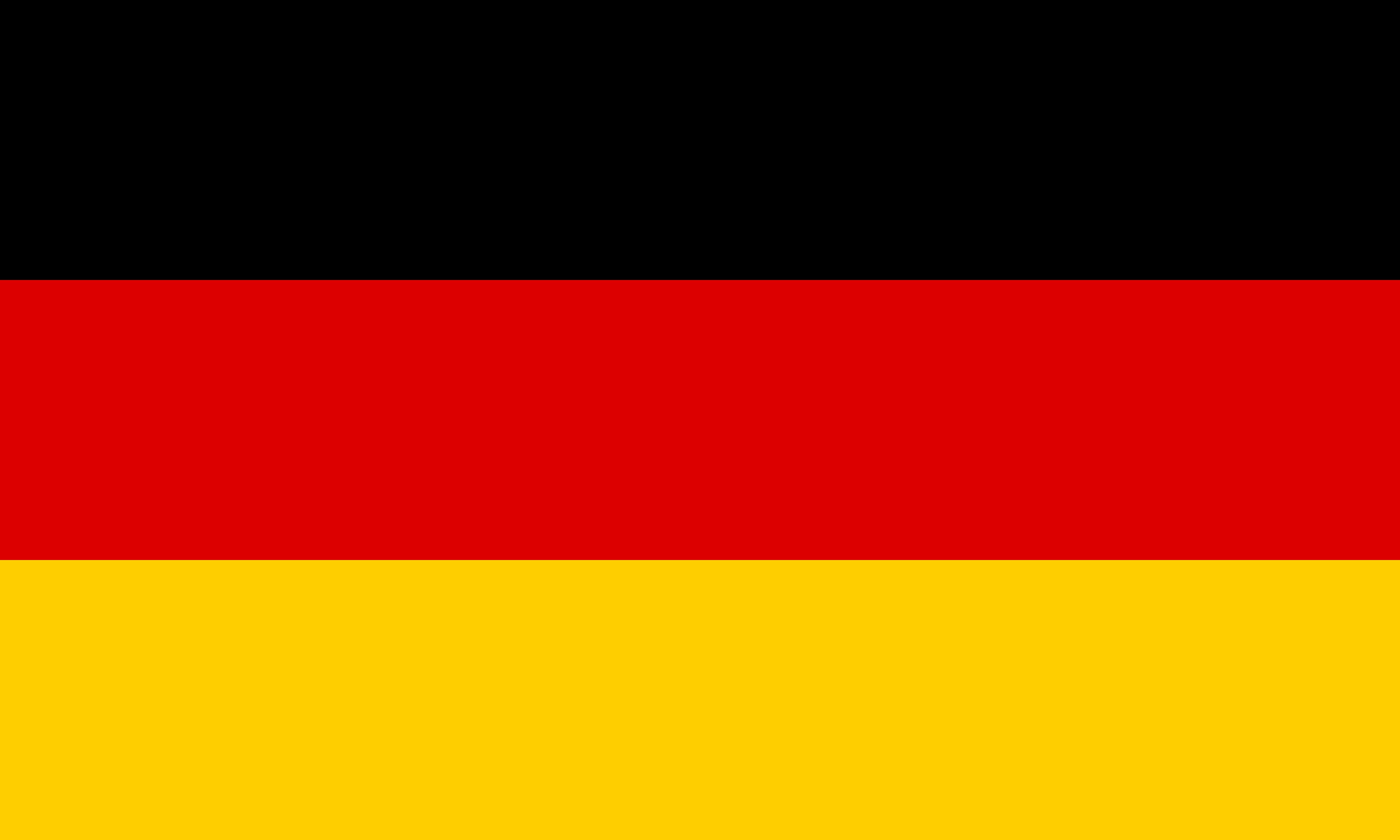
Germany’s plain national flag has three equal horizontal bands: black at the top, red in the middle, and gold at the bottom. Its width-to-height ratio is 5:3.
GKBook composition, CC0; underlying flag geometry, public domain.Download image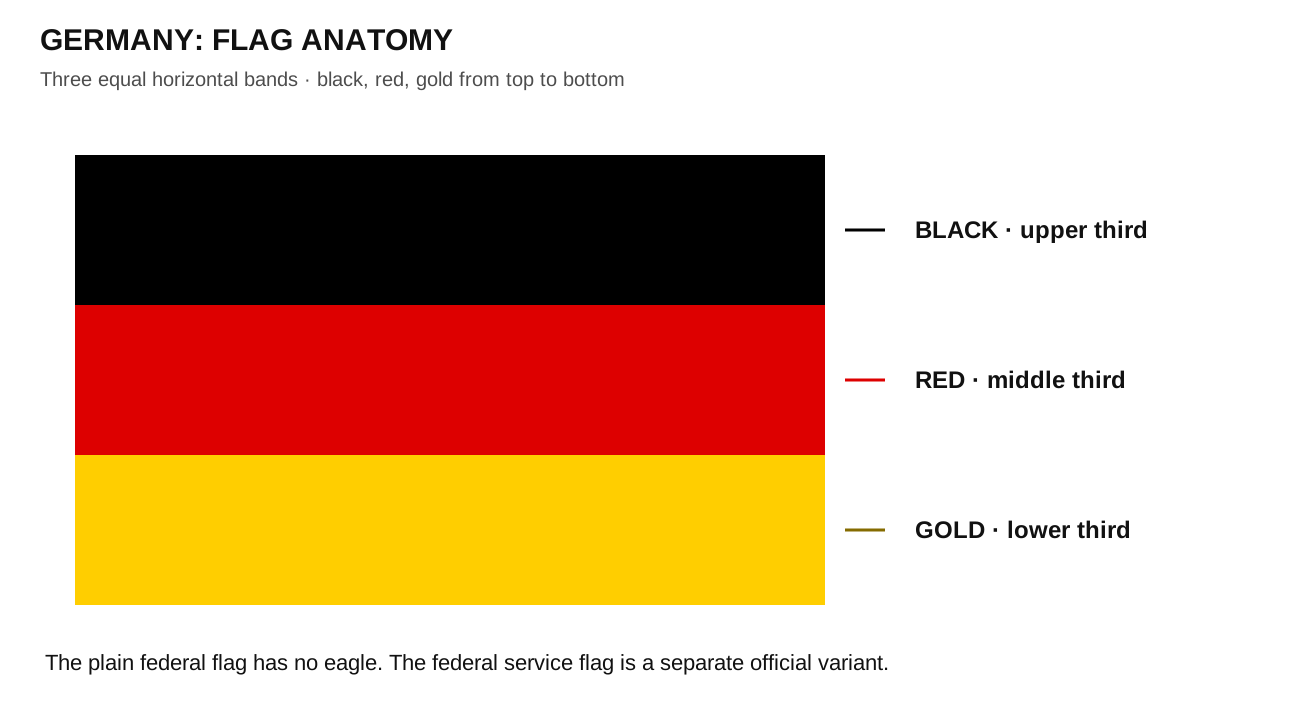
The three bands are equally high and run from hoist to fly. The plain national flag has no eagle, shield, stars, lettering, or separating stripes.
GKBook composition, CC0; underlying flag geometry, public domain.Download image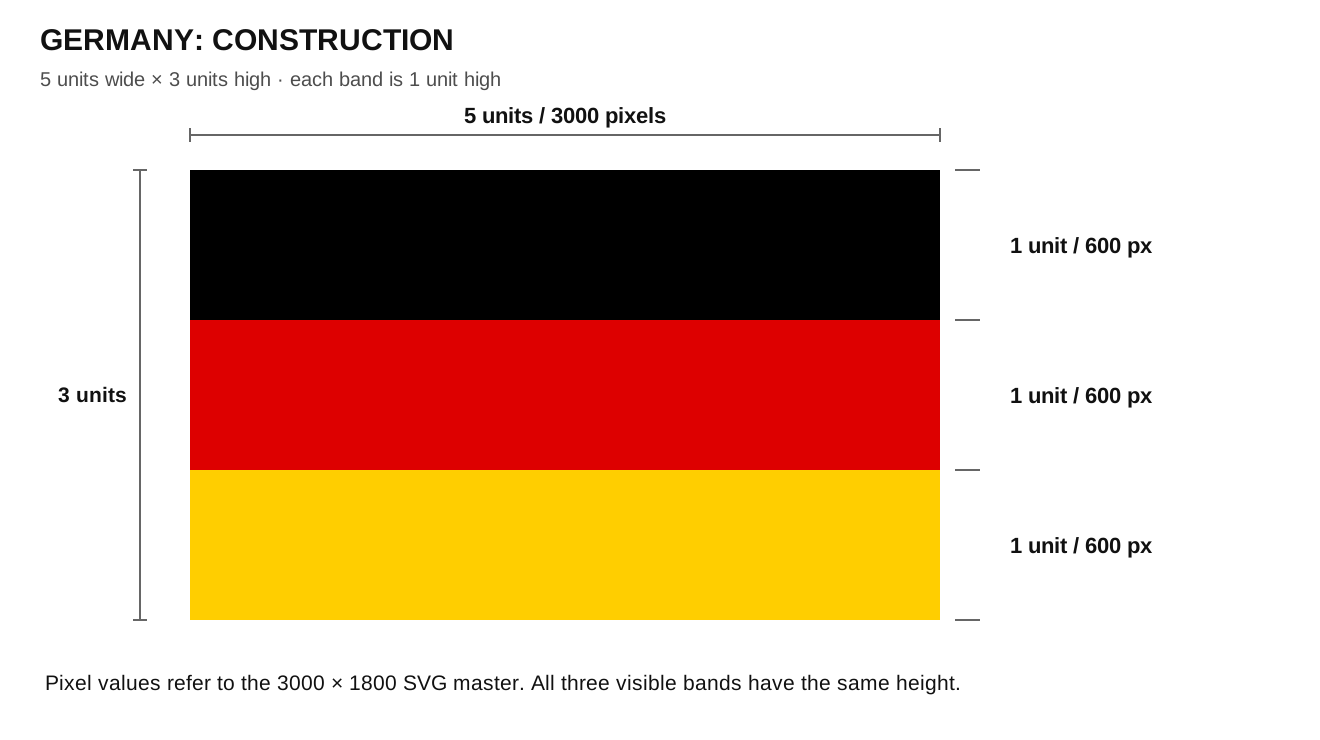
The standard horizontal flag uses a 5-by-3 frame divided into three equal one-unit bands. In the 3000-by-1800 master, each band is 600 pixels high.
GKBook composition, CC0; underlying flag geometry, public domain.Download image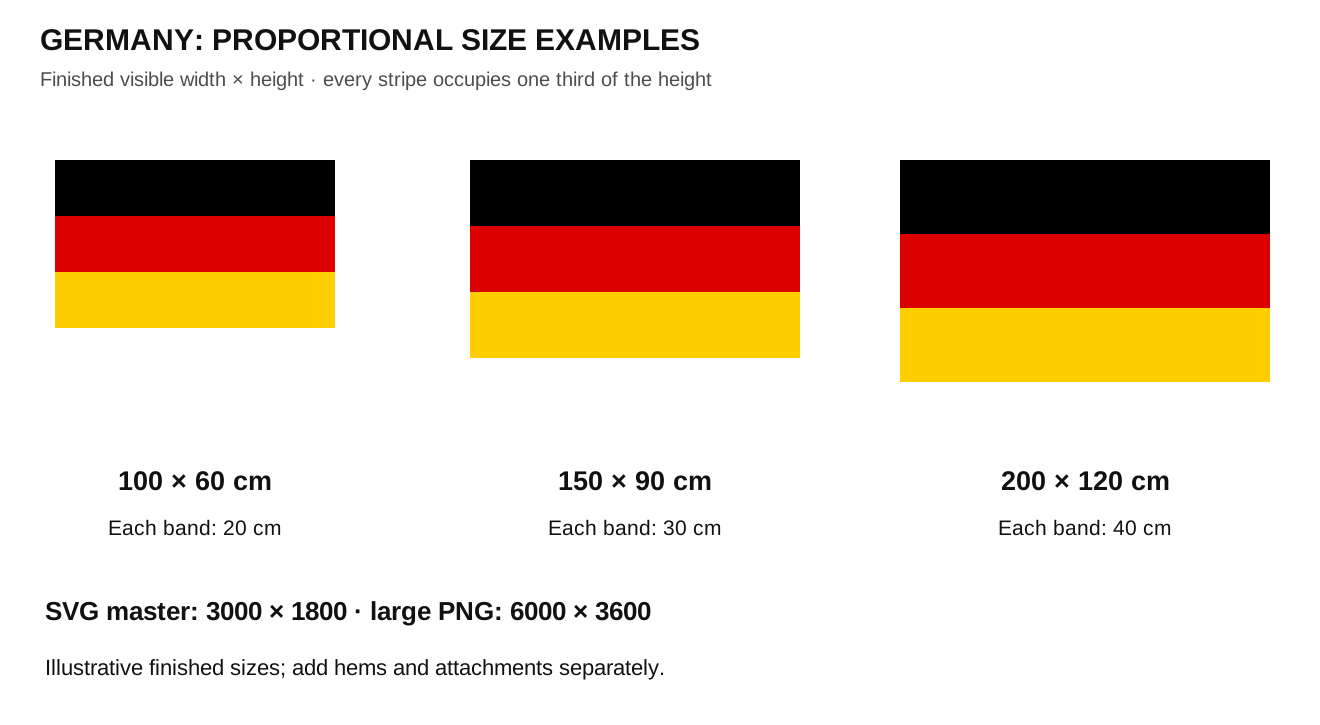
Flags measuring 100 by 60, 150 by 90, and 200 by 120 centimeters preserve the standard 5:3 rectangle. Their bands are respectively 20, 30, and 40 centimeters high.
GKBook composition, CC0; underlying flag geometry, public domain.Download image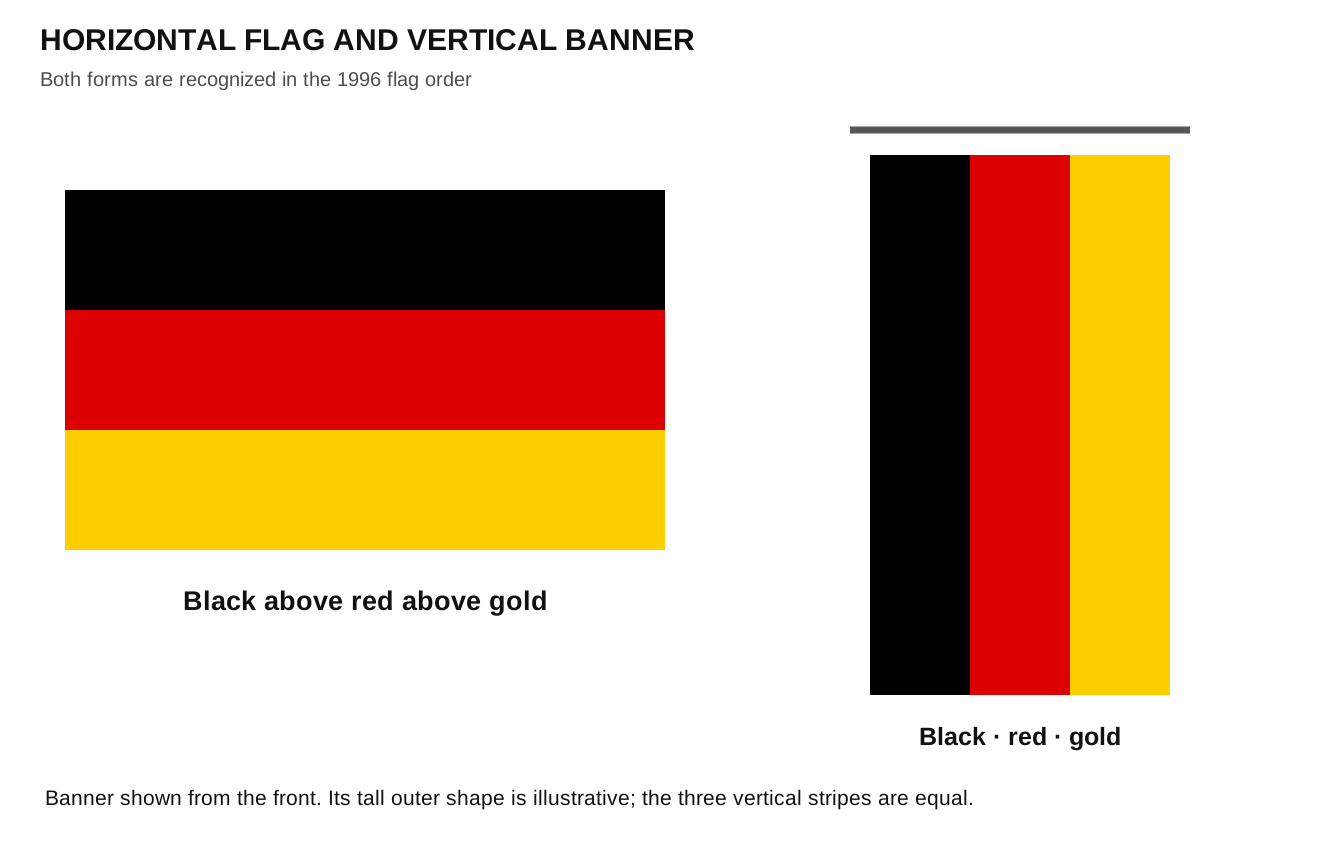
The horizontal flag has black, red, and gold from top to bottom. The vertical banner has black, red, and gold from left to right in the front view. The banner’s tall aspect ratio is illustrative, not a prescribed national measurement.
GKBook composition, CC0; underlying flag geometry, public domain.Download image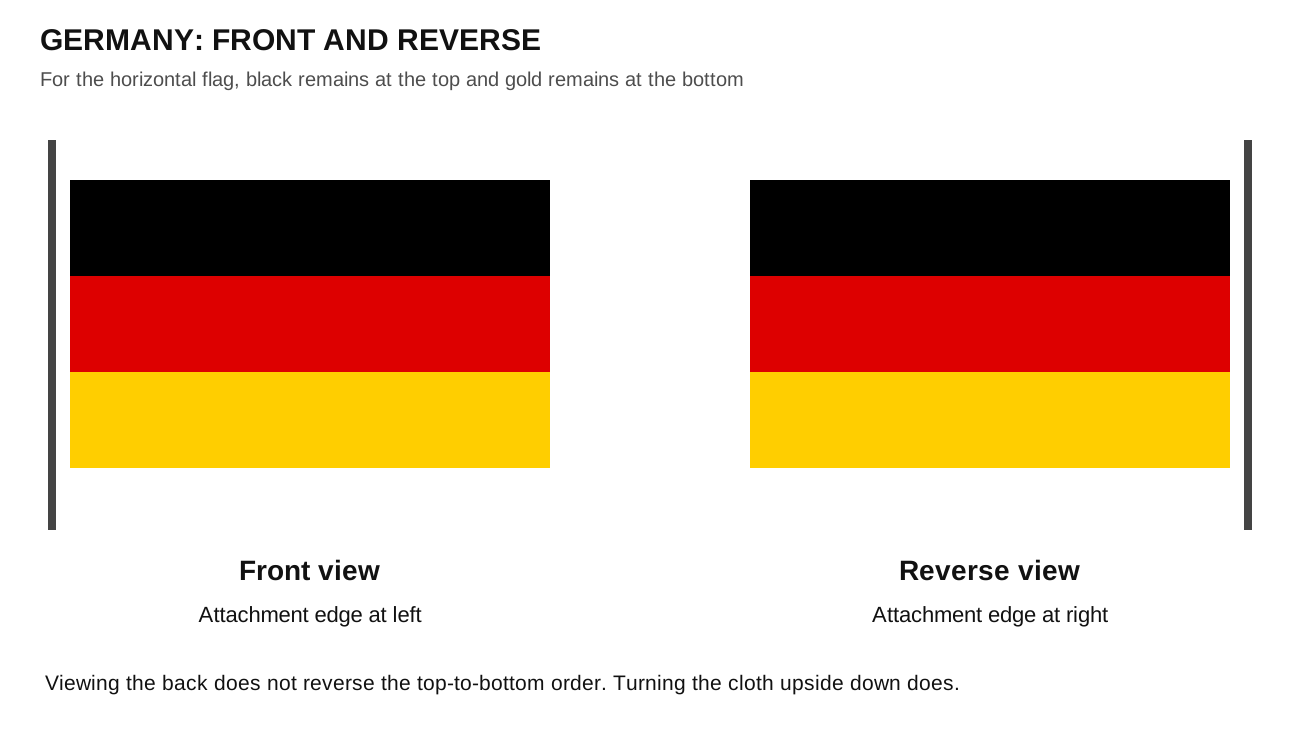
The plain horizontal flag reads black, red, gold on both faces. The hoist appears on the opposite side when viewed from behind; gold does not become the upper stripe.
GKBook composition, CC0; underlying flag geometry, public domain.Download image
Educational reference for the Bundesdienstflagge: black, red, and gold with the Bundesschild shifted toward the hoist. This official variant has restricted use and is distinct from the plain national flag.
Underlying official flag artwork, public domain; GKBook preparation, CC0.Download image
Modern reconstruction of the black-white-red flag associated with the North German Confederation and the German Empire. The reference is shown at 3:2 and is not today’s black-red-gold federal flag.
Underlying historical flag geometry, public domain; GKBook preparation, CC0.Download image
Modern reconstruction of the East German flag with a hammer and compasses inside a wreath of grain ears on black, red, and gold. The complete emblem is retained; it is not part of the present national flag.
Underlying former official flag artwork, public domain; GKBook preparation, CC0.Download image
The imperial black-white-red flag, the later East German flag, and the present plain federal flag are compared at their own reference proportions. The article’s timeline explains the intervening periods; this picture is not an exhaustive sequence.
GKBook composition, CC0; underlying flag geometry, public domain.Download image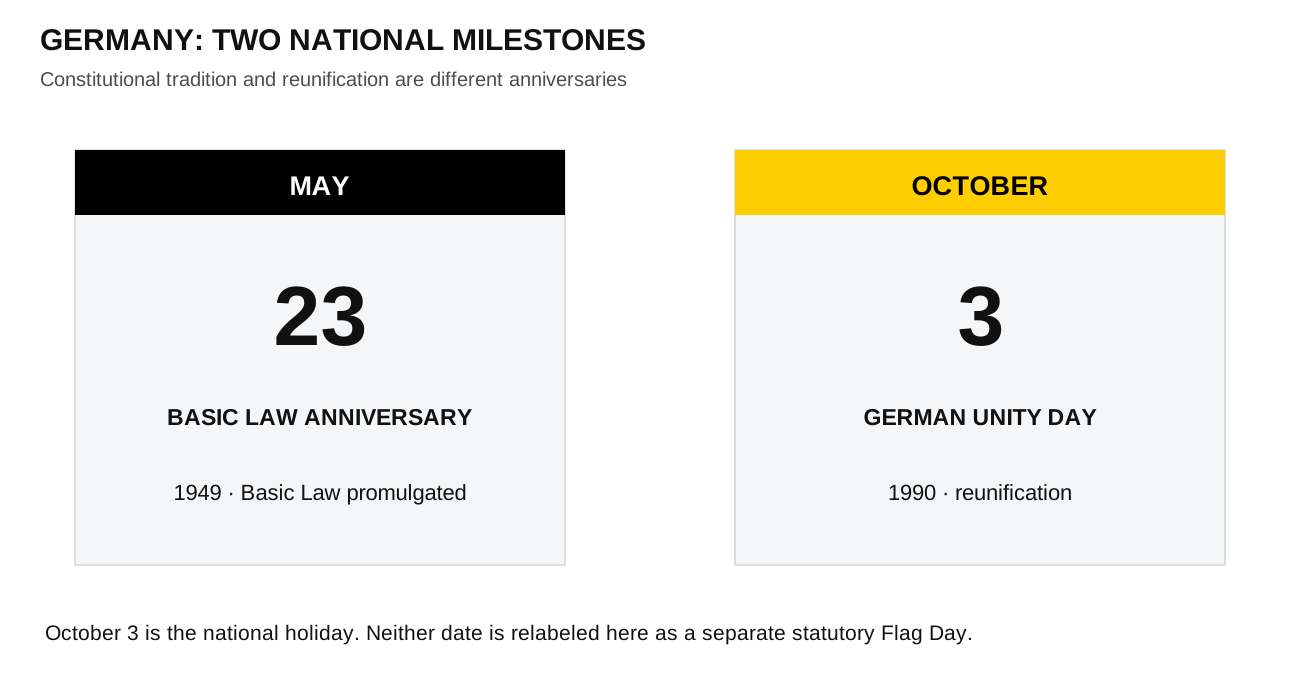
May 23 recalls the 1949 promulgation of the Basic Law. October 3 is German Unity Day, commemorating reunification in 1990. These are distinct national milestones.
GKBook composition, CC0; underlying flag geometry, public domain.Download image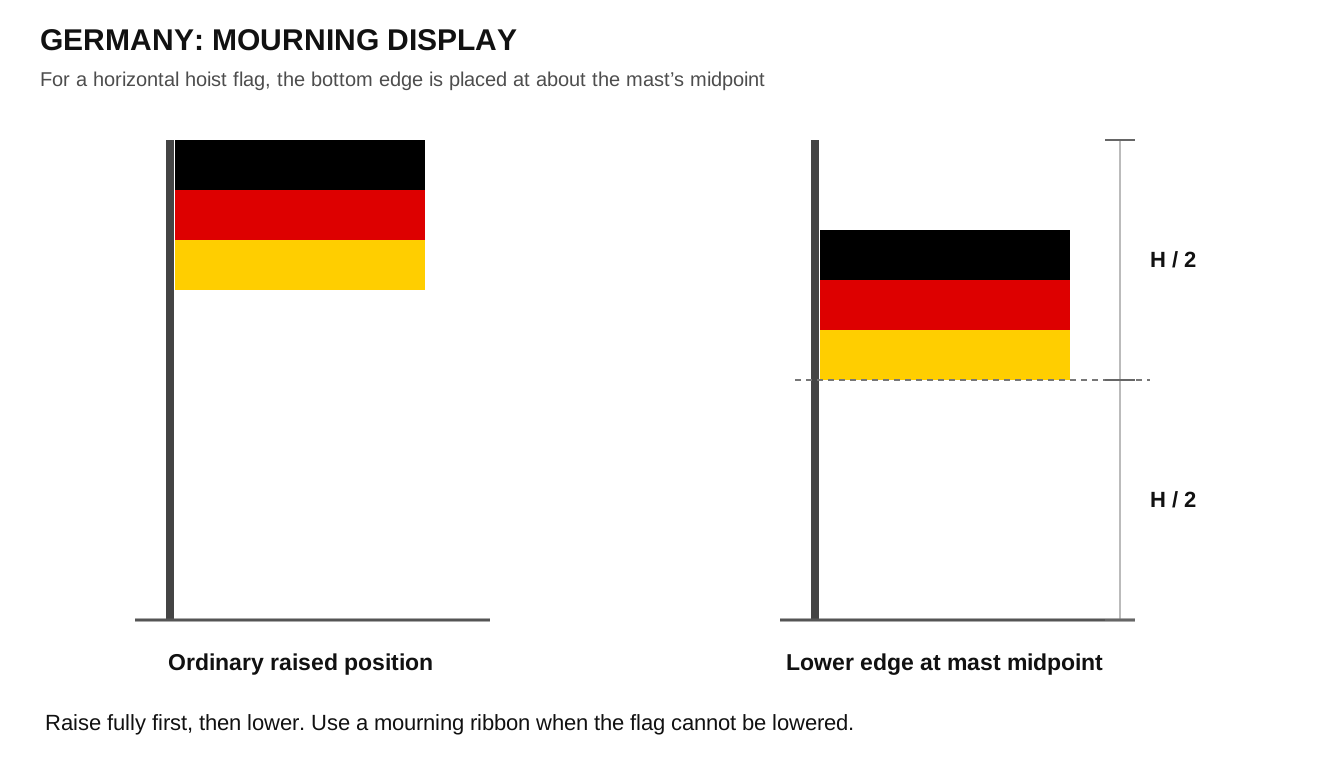
The diagram follows official guidance placing the lower edge of a horizontal hoist flag approximately halfway up the mast. The federal decree requires a full raising before lowering. A ribbon is used for flags that cannot be lowered.
GKBook composition, CC0; underlying flag geometry, public domain.Download image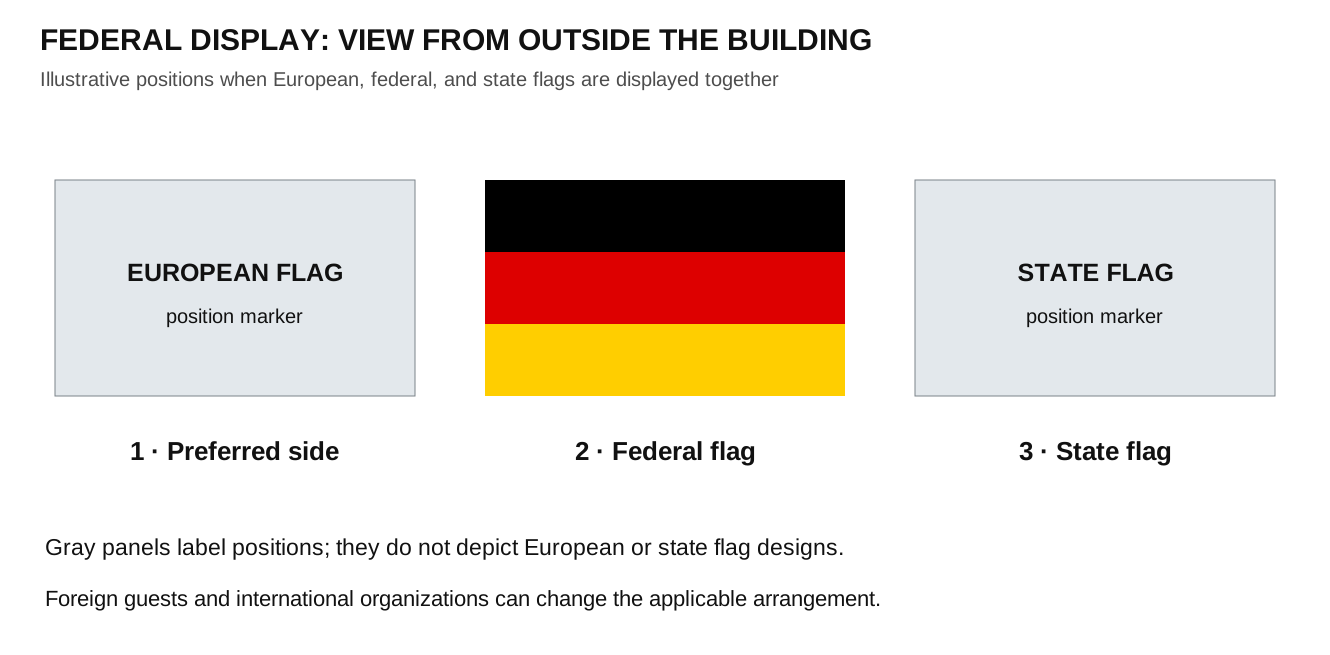
Viewed from outside toward the building, the European and federal flags occupy the preferred left-side positions before a state flag. Gray panels label positions only. Additional international flags require the applicable event-specific order.
GKBook composition, CC0; underlying flag geometry, public domain.Download image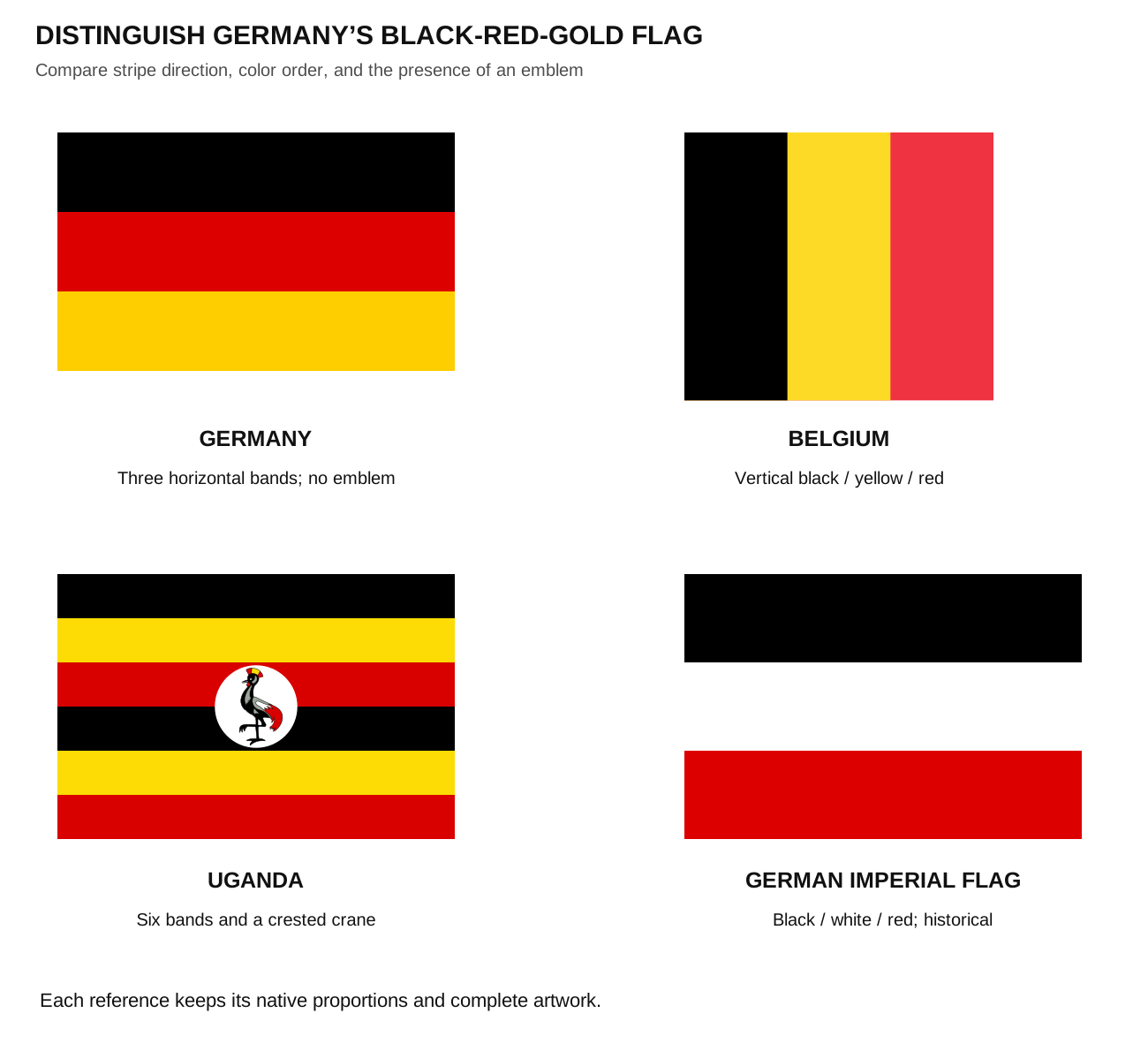
Germany’s plain horizontal black-red-gold flag differs from Belgium’s vertical stripes, Uganda’s six bands and crane emblem, and the historical German black-white-red flag. Each complete reference retains its own proportions.
GKBook composition, CC0; underlying flag geometry, public domain.Download image
German flags fly at the Reichstag building in Berlin on April 7, 2020, including the large Flag of Unity in the foreground. The photograph shows parliamentary display, not the 1990 reunification ceremony.
Jürgen Federau. CC0.Download image
Erhard Joseph Brenzinger’s 1832 depiction of the procession to Hambach Castle. The colored reproduction shows flags with gold uppermost; it is historical artwork, not a guide to the current black-red-gold stripe order.
Erhard Joseph Brenzinger. Public domain.Download imageFrequently asked questions
What does Germany’s national flag look like?
Germany’s national flag has three equal horizontal bands: black at the top, red in the middle, and gold at the bottom. Its standard width-to-height ratio is 5:3. The plain federal flag, called the Bundesflagge, contains no eagle, shield, stars, lettering, or white separating stripes.
What is the correct order of Germany’s flag colors?
Read the horizontal national flag from top to bottom as black, red, and gold. Each band occupies one third of the height and extends across the whole width. The same order appears on the reverse. Belgium’s vertical stripes and the former German black-white-red flag are different designs.
What are Germany’s flag colors and HEX values?
The legal colors are black, red, and gold. This downloadable reference uses black #000000, red #DD0000, and gold #FFCE00. Those are the actual digital fills in the supplied artwork, not numerical codes prescribed by Article 22. Physical flag fabric, printed graphics, and screen displays require appropriate color references and proofs.
Why is the bottom stripe called gold when it looks yellow?
Gold is the legal and heraldic name of the lower stripe. In heraldic practice, yellow can represent gold without requiring metallic cloth or real gold thread. The Bundestag explains this distinction for its own flags. A yellow-looking reproduction can therefore express the prescribed gold color rather than a different national design.
What do black, red, and gold symbolize?
The colors together symbolize Germany’s traditions of unity, freedom, and democracy. Their origins developed through nineteenth-century movements rather than a modern three-part symbolism code. The Basic Law names black, red, and gold but does not assign a separate official meaning to each stripe. Historical origin stories should be identified as such.
What are the correct dimensions of Germany’s flag?
The standard horizontal federal flag is five units wide and three units high, divided into three equal horizontal bands. A 3000-by-1800-pixel master therefore has 600-pixel bands. The legal notation of 3:5 height:length means the same thing as 5:3 width:height; reversing the notation does not create another design.
How can a German flag be scaled for printing?
Keep the width at five thirds of the height and give each stripe one third of the height. A flag measuring 150 by 90 centimeters has three 30-centimeter bands. Scale the whole design proportionally, and calculate sewing allowances, attachments, or print bleed separately from the finished visible flag.
Can Germany’s flag be displayed as a vertical banner?
Yes. The 1996 flag order expressly permits a banner form with three equal vertical stripes: black on the left, red in the middle, and gold on the right in the front view. That is a recognized arrangement, not permission to reverse the horizontal flag’s colors or stretch an eagle-bearing variant carelessly.
How did Germany’s black-red-gold flag develop?
Black, red, and gold became associated with nineteenth-century movements for unity and freedom, including Hambach in 1832 and the revolution of 1848. The Weimar Republic adopted the colors in 1919, and the Federal Republic chose them in 1949. Reunification in 1990 retained the plain federal flag.
Did the colors come from the Lützow Volunteer Corps?
A well-known origin tradition links the colors to black uniforms, red piping, and gold-colored buttons of the Lützow Volunteer Corps. The Bundestag cautions that the origins cannot be established with certainty. Student fraternity flags helped popularize the combination, which later acquired wider political meaning beyond any one uniform or organization.
Why is the Hambach Festival important to the German flag?
The Hambach Festival of May 27, 1832, brought black-red-gold flags into a major movement for political rights and German unity. Johann Philipp Abresch carried a flag with equal bands in the familiar order. The surviving Hambach flag is important historical evidence, but it is not the modern legal construction specification.
Why did the German Empire use black, white, and red?
The imperial color combination reflected Prussian black and white together with red associated with the Hanseatic cities. It became the flag tradition of the North German Confederation and the German Empire. This historical black-white-red design differs from today’s black-red-gold flag and should not be used as its interchangeable substitute.
What flag did the Weimar Republic use?
The Weimar Republic adopted black, red, and gold as its national colors in 1919. The decision was contested, and the merchant ensign retained black-white-red with the national colors in the upper hoist. That compromise concerned different flag functions; it does not mean the republic’s national colors were black, white, and red.
Was black-red-gold the flag of Nazi Germany?
No. The Nazi regime displaced the democratic black-red-gold tradition. In 1935, it made the swastika flag the sole national flag. That emblem belongs to the history of the dictatorship, not to the present Federal Republic’s flag. The postwar choice of black-red-gold recalled the earlier movement for unity and freedom.
When was Germany’s present federal flag adopted?
The Federal Republic chose black, red, and gold in 1949, recording the colors in the Basic Law promulgated on May 23. The combination had earlier historical uses, including the Weimar Republic. On October 3, 1990, the same plain federal flag continued as the flag of reunified Germany.
How did East Germany’s flag differ from West Germany’s?
Both German states initially used black, red, and gold after their establishment in 1949. In 1959, the German Democratic Republic added its emblem: a hammer and compasses surrounded by a wreath of grain ears. West Germany retained the plain tricolor, which continued after reunification in 1990.
Did Germany adopt a new flag at reunification?
Reunification on October 3, 1990, did not introduce a new national stripe pattern. The Federal Republic’s plain black-red-gold flag continued for the reunified country. The East German emblem no longer formed part of the national flag. German Unity Day commemorates reunification, while the modern federal color decision dates to 1949.
Who designed Germany’s national flag?
Germany’s national tricolor developed through historical movements and constitutional choices, rather than a securely documented commission to one modern designer. Johann Philipp Abresch is associated with an important 1832 Hambach flag. That does not establish him as the sole inventor of the entire color tradition or the author of the 1949 constitutional decision.
How should a physical German national flag be made?
Reproduce three equal horizontal bands in the legal order and preserve the standard 5:3 rectangle. Sewn or printed production needs suitable color proofs, materials, and finished dimensions. The flag order specifies the design but does not prescribe a universal household fabric, stitching method, or mandatory metallic material for the gold stripe.
What is the German flag with an eagle?
The federal service flag, or Bundesdienstflagge, adds the Bundesschild to the black-red-gold bands, slightly toward the hoist. Its eagle faces the hoist. This is an official variant with restricted use, not the ordinary national flag for everyone. Other eagle-bearing souvenir designs should not automatically be treated as the authorized service flag.
May private individuals fly Germany’s plain national flag?
Private individuals may generally use the plain black-red-gold national flag. It should be distinguished from the federal service flag and protected eagle or arms designs, whose unauthorized use raises separate legal issues. Ordinary private display does not turn a home, business, or sports gathering into a federal institution governed by its display timetable.
Why does the Bundestag use a flag without an eagle?
The Bundestag explains that it uses the plain black-red-gold flag because it represents the whole people. As an independent constitutional body, it regulates its own flag display. The federal government’s service-flag rules are therefore not a reason to assume that Parliament must add an eagle to every flag it flies.
When is German Unity Day?
German Unity Day is October 3, commemorating reunification in 1990. Article 2 of the Unification Treaty establishes it as the national holiday. It is also a regular federal flag-flying date. The May 23 anniversary of the Basic Law is a different observance, and neither is relabeled here as a separate statutory Flag Day.
On which days are flags flown at federal buildings?
The federal decree lists recurring occasions including January 27, May 1, May 9, May 23, June 17, July 20, October 3, the national day of mourning, and federal or European elections. Additional orders and separate institutional or state rules also matter, so this baseline list is not a complete calendar for every building.
Can German flags remain flying at night?
The federal building decree normally begins display at daybreak, but not before 7 a.m., and ends it at sunset. Flags that are illuminated may remain flying after sunset. These are rules for the decree’s institutional scope, with specific exceptions; they are not a universal private-household curfew on displaying the national flag.
Does the back of Germany’s flag reverse the stripe order?
No. On the horizontal flag, black stays at the top, red in the middle, and gold at the bottom when viewed from either face. The attachment edge appears on the opposite side from behind. Turning the cloth upside down changes that order; it is different from simply viewing the reverse.
Where does Germany’s flag stand beside other flags?
Under the federal building decree, European and federal flags occupy the preferred positions on the left when viewed from outside toward the building. Foreign-state and international-organization flags introduce additional ordering rules. The actual arrangement depends on the event and jurisdiction, rather than a universal instruction that Germany’s flag is always centered or always first.
How is Germany’s flag flown at half-mast?
The federal decree requires the flag to be raised fully before it is lowered for mourning. Official practical guidance places a horizontal hoist flag’s lower edge approximately halfway up the mast. Flags that cannot be lowered receive a mourning ribbon instead. The applicable order determines the occasion and institutional scope.
When is a black mourning ribbon used?
A mourning ribbon is used when the flag cannot be lowered to half-mast, such as an installation with a fixed staff or a banner. It expresses mourning without changing the flag’s colors or adding a permanent national emblem. Follow the relevant institutional instructions rather than automatically combining a ribbon with a lowered flag.
Are all neighboring flags lowered during German mourning?
The federal decree says that when the federal flag or federal service flag is lowered for mourning, the European flag is lowered too. Other international-organization and foreign-state flags are excluded from that automatic instruction. Their treatment depends on the relevant protocol and circumstances; one national mourning order does not control every foreign flag.
Why does the large Flag of Unity sometimes remain fully raised?
The Flag of Unity in front of the Reichstag has a special symbolic status. The Bundestag normally exempts it from its ordinary mourning arrangements, although exceptional lowering is possible. It can therefore remain fully raised while other parliamentary flags are lowered. That difference does not by itself indicate an error or conflicting national designs.
Which laws govern Germany’s flag and its protected variants?
Article 22 of the Basic Law names the national colors, and the 1996 flag order defines forms and proportions. The federal display decree governs its own institutional sphere. Section 124 of the Administrative Offenses Act separately addresses unauthorized use of official arms and service flags; criminal protection of state symbols is another legal matter.
Does public-domain flag artwork permit every commercial use?
Public-domain status concerns copyright in the artwork; it does not authorize use of restricted official service flags or imply government endorsement. Trademark rules are separate too. A business should distinguish the plain national tricolor from protected eagle and arms designs, and assess the actual product, branding, and presentation rather than relying solely on an image license.
How should a German flag be cared for or retired?
Keep the flag clean, dry, securely attached, and recognizable, following care instructions for its material. Repair or replace worn cloth while preserving its proportions and colors. The reviewed federal materials do not establish one compulsory private folding pattern, burning ceremony, or deadline requiring ordinary sports flags to be discarded after a tournament.
Does a mourning flag order require private funeral use?
No. An institutional mourning order concerns the buildings and bodies within its scope; it does not automatically require private homes to fly flags or establish a universal right to drape every coffin. State and military ceremonies have their own arrangements. For a particular funeral, follow the responsible organizer’s applicable protocol.
How is Germany’s flag different from Belgium’s and Uganda’s?
Germany uses three equal horizontal bands of black, red, and gold, without an emblem. Belgium uses vertical black, yellow, and red bands. Uganda repeats black, yellow, and red in six horizontal bands and adds a crested crane in a white disk. Stripe direction, order, and emblem identify them more reliably than colors alone.
What is Germany’s flag emoji?
Germany’s flag emoji is 🇩🇪. It combines regional indicator D, U+1F1E9, with regional indicator E, U+1F1EA, corresponding to the country code DE. Appearance varies with the device and application, and some systems show letters. Use the supplied SVG or PNG when consistent, printable geometry is more important than a text symbol.
What does the Reichstag photograph show?
The photograph shows German flags at the Reichstag building in Berlin on April 7, 2020, including the large Flag of Unity in the foreground. Jürgen Federau released it under CC0. It documents parliamentary display in 2020, not the first raising at reunification or a historical adoption ceremony.
Why do flags in the Hambach artwork look different?
The colored reproduction of Erhard Joseph Brenzinger’s 1832 Hambach scene shows flags with gold uppermost. It is a historical illustration, not the current legal construction drawing. Preserve that distinction rather than recoloring an archival image to fit today’s specification or copying its painted stripe order into the plain national download.
What common German flag mistakes should be avoided?
Keep black at the top and gold at the bottom, with all three bands equally high. Do not substitute Belgium’s vertical pattern, the imperial black-white-red flag, or the East German emblem-bearing flag. The eagle is not required on the ordinary national flag, and its official service variant has separate use restrictions.
Which Germany flag files can I download?
The package includes the plain national SVG and large PNG, construction and size sheets, vertical and reverse views, historical reconstructions, an official-variant reference, mourning and display diagrams, and comparison images. It also includes a Reichstag photograph and historical Hambach artwork. Each gallery item identifies its purpose and has a local download.
What are the key Germany flag facts to remember?
Remember three equal horizontal bands, black-red-gold from top to bottom, and a standard 5:3 width-to-height ratio. The Federal Republic adopted the colors in 1949 and retained the plain flag at reunification in 1990. October 3 is German Unity Day; an eagle identifies a different variant, not a missing feature of the national flag.
Explore all general-knowledge topics and the A-to-Z lists.

We Value Your Opinion Comments