
The Gambia flag picture
Explore the construction sheet, the Independence Day observance, and the historical sequence.
| Country | The GambiaRepublic of The Gambia, in West Africa; capital Banjul. |
|---|---|
| Design | Red, white, blue, white, greenFive horizontal stripes; the blue band is narrower than the red and green. |
| Proportions | 3:2 width:heightSchedule 1 specifies 27 units across and 18 down; also written 2:3 height:length. |
| Stripe heights | 6:1:4:1:6From top to bottom; the blue stripe and two white separators together fill the middle third. |
| National flag introduced | February 18, 1965The independence flag had been selected and announced in 1964. |
| Designer | Louis Lucien ThomasiAn accountant who won the design competition; often identified simply as Louis Thomasi. |
| National colors | Red, white, blue, and greenReference HEX values: #CE1126, #FFFFFF, #0C1C8C, and #3A7728; not statutory screen-color codes. |
| Independence Day | February 18Annual national observance; no separate official annual Flag Day was established in the reviewed sources. |
The national flag entered use at independence on February 18, 1965. Blue and its two white separators together fill the middle third of the flag.
What is the flag of The Gambia?
The Gambia’s flag has horizontal red, blue, and green bands, with a narrow white stripe on each side of the blue. Read from top to bottom, the sequence is red, white, blue, white, green. It has no coat of arms, star, lettering, or other central emblem.
The flag identifies the Republic of The Gambia, a West African country extending inland along the River Gambia from the Atlantic coast. Senegal surrounds the country on its landward sides. The capital is Banjul, known as Bathurst when independence arrived in 1965.
The blue stripe connects the design directly with that river setting. Red and green frame it, while the two white stripes create clear separation. A correctly drawn flag needs all five stripes even though its three broad colored areas receive most of the attention.
Explore the construction guide, history, Independence Day, and downloadable pictures.
What identifies The Gambia flag’s design?
The correct order is red, white, blue, white, and green from top to bottom. Red and green have equal heights, while blue is narrower. Each white stripe is one quarter of the blue stripe’s height. The same order remains visible when the correctly oriented flag is viewed from behind.
Every stripe extends from the hoist, where the flag is attached, to the fly, its free edge. The red and green areas are equally deep. The blue is shallower, and neither white stripe should disappear into a seam or be mistaken for an outline around the flag.
A flag’s staff, finial, fringe, and fastening are physical fittings. They are separate from the plain rectangle shown in the downloadable SVG. The national design does not require a decorative frame.
Because this flag has no central emblem to enlarge, the feature card presents the whole design at its correct proportions.
What colors and digital values are used?
The flag uses red, white, blue, and green. The downloadable reference uses red #CE1126, white #FFFFFF, blue #0C1C8C, and green #3A7728. These are the actual values in this artwork, not numerical color codes prescribed by the Constitution. Physical production still requires suitable color references, materials, and proofs.
| Color | HEX in this artwork | RGB | Position |
|---|---|---|---|
| Red | #CE1126 | 206, 17, 38 | Top; six units |
| White | #FFFFFF | 255, 255, 255 | Two one-unit separators |
| Blue | #0C1C8C | 12, 28, 140 | Center; four units |
| Green | #3A7728 | 58, 119, 40 | Bottom; six units |
The constitutional description names colors and dimensions without supplying HEX, RGB, Pantone, or CMYK codes. This table reports the fills actually used in the provided artwork. A screen color is not automatically a textile specification.
For printing, use the intended paper or fabric, the production color system, and a color-managed proof. For sewn cloth, compare physical swatches. Hems and attachments must not reduce the visible white separators below their intended size.
Lighting, fabric texture, folds, and camera processing affect apparent color in photographs. Those variations do not by themselves show that the national design changed.
What do the flag’s colors represent?
The independence-era government explanation associates red with the sun, blue with the River Gambia, green with agricultural resources, and white with unity and peace. Later descriptions also associate red with the savanna and green with forests. These interpretations explain the colors; they do not change the prescribed stripe arrangement.
The Government Printer’s independence leaflet, dated February 15, 1965, explains the colors through the sun, the River Gambia, agricultural resources, unity, and peace. A reproduction survives in Jos Poels’s archival study of the flag’s design. The Flag Institute’s later explanation adds savanna and forest associations.
The blue stripe’s geographic connection is especially direct: the river gives the country its name and runs through its territory. Nevertheless, the flag is a symbol, not a diagram of the river’s actual bends or the relative areas of farmland, woodland, and water.
Keep the original explanation distinct from later expanded descriptions. The sources establish the meanings but do not prove that the designer personally wrote every explanatory phrase. None of these interpretations adds an emblem or changes the stripes.
How is The Gambia’s flag constructed?
The Constitution gives an outer rectangle twenty-seven units across and eighteen units down, equivalent to 3:2 width to height. The standard stripe construction is 6:1:4:1:6 from top to bottom. This is also described as a 2:3 flag when the convention lists height before length, rather than width before height.
| Measurement | Fraction or formula | 2700 × 1800 master |
|---|---|---|
| Overall width | W = 3H / 2 | 2700 pixels |
| Overall height | H | 1800 pixels |
| Red stripe | H / 3 | 600 pixels; y = 0–600 |
| First white stripe | H / 18 | 100 pixels; y = 600–700 |
| Blue stripe | 2H / 9 | 400 pixels; y = 700–1100 |
| Second white stripe | H / 18 | 100 pixels; y = 1100–1200 |
| Green stripe | H / 3 | 600 pixels; y = 1200–1800 |
All ratios on this page are width to height unless stated otherwise. Thus 3:2 width:height and 2:3 height:length describe the same rectangle. They do not represent two competing current designs.
The published constitutional schedule includes repeated “one third” wording beside the main colors. Read with its specified eighteen-unit height, the established construction is 6:1:4:1:6, as used by the reviewed reference vector and explained in the archival flag study. Adding an extra one-third unit to each main band would instead produce nineteen units and conflict with that height.
For a raster drawing, choose a height divisible by eighteen so every separator occupies a whole number of pixel rows. The vector scales without rounding its geometric boundaries.
Why is the blue band narrower than the red and green?
No. Red and green each occupy one third of the height, but blue occupies only two ninths. The middle third comprises the blue band together with both white separators: one plus four plus one units. Making red, blue, and green equally wide and then adding white would produce the wrong construction.
One useful way to check a drawing is to divide its height into three equal zones. The first is entirely red. The second contains white, blue, and white in a 1:4:1 relationship. The third is entirely green.
The red and green are each one and a half times as tall as blue. Each white separator is one quarter as tall as blue. These relationships are calculations from the standard construction, not separate symbolic claims.
How can the design be scaled for printing or display?
Start with a rectangle twenty-seven units wide and eighteen high. Divide its height into six red units, one white, four blue, one white, and six green. A 2700-by-1800-pixel version therefore uses stripe heights of 600, 100, 400, 100, and 600 pixels. Each stripe extends across the full width.
The supplied SVG is 2700 by 1800 in its intrinsic coordinate frame. The large PNG is 5400 by 3600 pixels, giving stripe heights of 1200, 200, 800, 200, and 1200 pixels. Neither plain file contains a border, caption, or watermark.
A fabric example 108 centimeters wide and 72 centimeters high has stripes 24, 4, 16, 4, and 24 centimeters high. Calculate hems and joins separately so the finished visible flag retains those measurements.
The size chart supplies examples rather than official purchasing classes. Select a physical size and attachment system appropriate to the installation and wind exposure.
How did the national flag develop?
The present national flag was selected during preparations for independence and introduced on February 18, 1965. It replaced colonial symbolism with a plain arrangement associated with the country’s sun, river, agriculture, unity, and peace. The design continued after The Gambia became a republic in 1970 and during the Senegambia Confederation.
A distinct Gambia badge appears in the late colonial flag record; the 1889 Admiralty flag book documents the elephant, palm, and G device.
A public competition leads to selection of Louis Lucien Thomasi’s design during preparations for independence.
The new national symbols are presented in Bathurst before independence.
The national flag is raised as British rule ends. This date is the flag’s adoption and independence anniversary.
The Gambia becomes a republic and keeps the national flag.
The Gambia and Senegal retain their distinct national flags during the confederation.
Section 3 refers to Schedule 1, including a rectangle twenty-seven units across and eighteen down.
The timeline separates selecting a design, presenting it, introducing it at independence, and later recording its dimensions in a Constitution. Those events did not all happen on the same day.
The present arrangement also differs from the older colonial ensign in purpose and appearance. It removes the British canton and colonial badge and expresses the independent country through a plain sequence of national colors.
What did the colonial flag look like?
A late colonial Blue Ensign combined a dark blue field, a Union Flag in the upper hoist, and a circular colonial badge showing an elephant, palm, and red G. The historical illustration supplied here is a modern reconstruction of that ensign, not an original textile or the current national flag.
The Union Flag occupies the canton, the upper area nearest the hoist. The round badge sits toward the fly and includes an elephant, a palm, and a red G. These features belong to the colonial design and are absent from today’s national flag.
The illustration preserves the reviewed historical vector’s complete geometry at a 2:1 width-to-height ratio. Its colors are reconstruction colors. It should not be used to infer the precise dyes, stitching, wear, or manufacture of a surviving nineteenth-century flag.
When did the independence flag enter national use?
February 18, 1965, the date of independence from the United Kingdom, is the national flag’s adoption date. Selection and public presentation of the design had taken place during 1964. Distinguishing those stages explains why earlier drawings or announcements exist without making the national independence anniversary a different date.
At the midnight transition from February 17 to 18, 1965, the independence ceremony in Bathurst marked the replacement of British authority by the new nation. The Union Flag was lowered and the Gambian national flag raised.
The earlier 1964 competition and public presentation explain the design’s preparation. Independence Day identifies its national introduction. The existence of a pre-independence drawing is not evidence of a different independence date.
Why do early documents show a different outer shape?
Archival artwork and the government’s independence leaflet show a 2:1 width-to-height rectangle. The current constitutional format is 3:2, which looks less elongated. The comparison on this page illustrates those documented shapes using the same modern palette. It does not establish an exact changeover date or reproduce an original historical textile.
The 1964 College of Arms artwork and the government’s independence leaflet show the longer 2:1 width-to-height format. Early published material was not completely uniform: other references used the less elongated rectangle familiar today.
The current constitutional measurement is unambiguous about the outside rectangle: twenty-seven units across and eighteen down. This article does not assign a precise year to the transition from every early illustration to that format.
What is the constitutional basis for the flag?
Section 3 of the 1997 Constitution identifies the national flag by reference to Schedule 1. That schedule specifies a rectangle twenty-seven units across and eighteen down and lists the horizontal colors. The failed 2024 constitutional replacement proposal did not enact a new Constitution; the 1997 framework remained in force.
The relevant provisions are Section 3 and Schedule 1 of the 1997 Constitution. Section 3 refers the flag design to the schedule and treats the national anthem separately. The schedule names the horizontal colors and specifies the outside dimensions.
On July 7, 2025, the proposed 2024 constitutional replacement failed to secure the required National Assembly majority at its second reading. A draft’s proposed provisions should therefore not be presented as an enacted replacement flag law. The existing flag description remains the basis used here.
The Constitution’s separate provision on the public seal does not make a seal an element of the flag. It also should not be casually rewritten into a blanket private-use ban on the national colors.
Who designed The Gambia’s national flag?
Louis Lucien Thomasi, an accountant, designed The Gambia’s national flag through the independence preparations’ public competition. Shorter accounts often call him Louis Thomasi. Archival research by Jos Poels identifies his fuller name. The designer, the committee selecting the entry, and the authorities approving national use had different roles in the process.
The fuller name matters because popular summaries often shorten it. The attribution here follows Jos Poels’s research, which examines archival records and information from the designer’s family, together with the Flag Institute’s account identifying Louis Thomasi as an accountant.
The competition attracted 504 proposals from 238 people. Selection, official approval, and presentation were stages in adopting the design; they do not turn every official involved into its artist. The article does not invent a surviving original drawing for every competition entry.
How is a physical Gambia flag made?
A maker can sew separate colored panels or print the complete design onto suitable fabric. The finished visible stripes must preserve the red–white–blue–white–green order and the 6:1:4:1:6 heights. Hems, seams, reinforcement, and attachments need separate allowances. The reviewed national description does not mandate one textile, stitch, or printing process.
In a sewn flag, join the panels so their visible areas retain the intended heights after the seams are finished. Narrow white panels require particular care: allowing a seam to consume too much of a separator changes the flag’s appearance.
A printed flag starts from the complete vector design. Check the final rectangle, color proof, reverse-side appearance, and attachment edge before a production run. The supplier should state the substrate, print process, finishing, and expected exposure conditions.
Fringe and staff fittings may suit a particular ceremonial object. They should be ordered separately from the national artwork and should not be mistaken for compulsory elements of every Gambian flag.
How does the flag relate to other national symbols?
No. The plain national flag consists of its five horizontal stripes and has no coat of arms or inscription. The anthem, For The Gambia Our Homeland, is a separate national symbol. Displaying a flag beside arms, an official seal, or a musical performance does not add those elements to its design.
The title For The Gambia Our Homeland identifies the national anthem. Its music and words belong to a different form of national expression from the flag’s geometric design.
An official seal, coat of arms, military color, or institutional standard can appear in the same setting as the national flag. Such objects have their own identities. No unverified service badge or presidential emblem is added to the plain downloadable design.
When is The Gambia’s Independence Day?
The Gambia celebrates Independence Day on February 18, marking independence in 1965 and the introduction of the national flag. Government information identifies this annual observance, and a presidential declaration made February 18, 2025, a public holiday for the sixtieth anniversary. A particular ceremony’s location and timetable depend on its announced program.
| Date | Meaning | What is established |
|---|---|---|
| February 18 | Independence Day | Annual observance; independence and national flag introduction in 1965 |
| February 18, 2025 | Sixtieth independence anniversary | Specific presidential public-holiday declaration |
| April 24 | Republic anniversary | Historical transition in 1970; the flag was retained |
Independence celebrations bring the flag into public focus, but annual programs can change. A current event notice is needed for ceremony times, venues, security arrangements, and institutional participation.
February 18 is the appropriate verified national observance for this article’s navigation. The reviewed sources did not establish a separate official annual Flag Day. April 24 is shown as a republic anniversary without asserting a current nationwide public-holiday declaration.
Was the flag retained through later political changes?
The Gambia retained its national flag during the Senegambia Confederation with Senegal, which lasted from 1982 to 1989. Senegal’s flag remained a distinct design with vertical green, yellow, and red bands and a central green star. Political association between the countries did not turn their two national flags into interchangeable symbols.
The change from a constitutional monarchy to a republic on April 24, 1970, left the national design in place. During the later Senegambia Confederation, The Gambia likewise retained its own flag alongside Senegal’s separate national symbol.
These examples distinguish a change in political arrangements from a change in flag design. Neither automatically requires new colors, a new emblem, or a replacement rectangle. A claimed alteration needs its own evidence.
How should the national flag be displayed?
For an ordinary horizontal display, keep red at the top and green at the bottom, with both white separators visible. Use a clean, securely attached flag whose proportions are correct. Additional arrangements for a government building, school, diplomatic event, or military ceremony should follow that institution’s applicable instructions and event plan.
Practical display checks
- Keep red above blue and green, with both white separators visible.
- Use the 3:2 rectangle and correct stripe heights.
- Check the attachment points and allow safe clearance.
- Follow the event organizer’s ceremony and mourning instructions.
- Distinguish the flag from adjacent signs and decorations.
Errors to avoid
- Do not make all three broad colored bands equally high.
- Do not add a coat of arms or a star to the plain national flag.
- Do not reverse the top and bottom when viewing the back.
- Do not infer a household display duty from an official ceremony.
- Do not borrow another country’s flag code as Gambian law.
These are practical design and installation checks. Any additional institutional duty must come from an applicable instruction, rather than from an illustration of the flag.
How do the front, reverse, and vertical displays differ?
The reverse retains the same top-to-bottom colors because the design has only full-width horizontal stripes. The attachment edge appears on the opposite side when viewed from behind. A flag with green at the top is upside down, not simply reversed. Vertical banners require a separately considered mounting arrangement and orientation.
The national design is horizontally symmetrical within each stripe. Looking at its back therefore does not alter the red–white–blue–white–green sequence. Turning the whole flag upside down does alter it.
A vertical decorative banner creates a separate layout question. Rotating a horizontal rectangle makes the stripes vertical; it does not establish a universal Gambian rule about the resulting left-to-right sequence. Use the specified banner artwork and mounting plan for that setting.
How should the flag appear with other countries’ flags?
Use the host institution’s protocol and the event’s agreed arrangement. A diplomatic meeting, international sports ceremony, and military formation can follow different plans. The national flag’s design does not establish a universal viewer-left or viewer-right position. Pole heights, sight lines, mounting security, and unobstructed display are useful practical checks.
Begin with the host’s protocol, the purpose of the event, and a clearly stated viewpoint. A stage, a row of poles, and a procession present different problems. A photograph of one arrangement does not create a rule for every other setting.
As practical preparation, check comparable visibility, mounting security, and room for the cloth to move. No diagram here assigns The Gambia permanently to every viewer’s left or right without an applicable institutional instruction.
Is there one national timetable for raising and lowering flags?
The reviewed sources do not establish one mandatory raising or lowering hour for every Gambian household and institution. A national anniversary gives a date, while an event program supplies ceremony times. Follow the relevant organizer’s directions for the actual setting instead of treating a foreign country’s flag code as Gambian law.
A ceremony combines distinct elements: the national flag, participants’ actions, and sometimes the anthem. Military formations may have service-specific procedures, while visitors and civilian participants follow the organizer’s directions.
This article does not prescribe a fixed household salute, compulsory sunset removal, universal lighting rule, or one daily raising hour. Independence Day’s date and a particular ceremony’s schedule answer different questions.
How is mourning shown with The Gambia’s flag?
Official mourning instructions can require flags to be lowered. After Sir Dawda Kairaba Jawara’s death, a seven-day national mourning period ran from August 27 through September 2, 2019, with flags at all state institutions lowered to half-mast. That documented instruction does not establish a permanent mast-height formula or a current mourning order.
| Point | Documented 2019 instruction | For another occasion |
|---|---|---|
| Reason | Death of Sir Dawda Kairaba Jawara | Use the actual new announcement |
| Period | August 27–September 2, 2019 | Confirm both the start and end |
| Scope | Flags at all state institutions | Check the institutions and locations covered |
| Display | Flags lowered to half-mast | Follow the applicable mounting and handling instruction |
| Technical detail | No numerical mast fraction given | Do not substitute a foreign height formula |
The State House newsletter records the seven-day mourning period and the instruction to all state institutions. That scope is more precise than assuming that every private household received the same mandatory direction.
The source does not establish a fixed distance below the finial, an exact cloth-edge coordinate, a universal black-ribbon substitute, or a required preliminary raising sequence. A fixed fitting that cannot lower needs guidance from the responsible institution.
This is a historical example, not an announcement of an active mourning order. The flag’s stripe geometry remains unchanged when its position on a pole changes.
How do funeral honors differ from lowered flags on buildings?
A direction to lower flags at state institutions does not by itself settle who is entitled to a flag-draped coffin or how a funeral flag should be handled. Those are separate ceremonial questions. The responsible institution and funeral organizer should establish eligibility, placement, handling, and the flag’s disposition for the particular service.
A lowered building flag expresses an institutional or national mourning observance. Placing a flag on a coffin concerns an individual service and can involve different responsibilities and permissions.
Confirm the arrangements with the responsible institution and funeral organizer. A general explanation of half-mast display cannot settle ceremonial eligibility, the direction of a coffin drape, presentation rights, or later treatment of a particular cloth.
What legal claims can be made from the flag description?
Section 3 and Schedule 1 define the national flag; those provisions do not themselves supply a fixed criminal penalty for every misuse. Any claim about an offense needs the applicable law and context. This article does not import another country’s Flag Act, invent a Gambian fine, or decide liability in an individual case.
The Constitution establishes the design through Section 3 and Schedule 1. That design rule should be distinguished from criminal offenses, rules concerning an official seal, trademark protection, and an institution’s ceremony instructions.
The reviewed evidence does not support quoting a universal Gambian flag-insult fine or declaring that every private display requires permission. The absence of such a claim here is not a conclusion that no other law could ever apply to particular conduct.
A similarly named Flag Act from another country is not evidence of Gambian law. This page explains the verified national design without deciding an individual legal dispute.
What should be considered before commercial use?
Public-domain artwork addresses copyright in the supplied drawing. It does not establish government endorsement or settle every trademark application. WIPO distinguishes state-symbol protection under Article 6ter from copyright in artwork. Commercial use should be assessed in its actual context, especially when a product or brand might imply official approval or affiliation.
WIPO explains that Article 6ter protects state flags and certain other emblems against unauthorized registration or use as trademarks without creating an intellectual-property right in the symbol itself. Copyright and trademark therefore require separate consideration.
The supplied national geometry is public domain, and the original explanatory compositions are released under CC0. Those artwork permissions do not certify a product, confer official status, or imply endorsement by The Gambia or GKBook.
How should a flag be cared for and retired?
Use the maker’s care instructions, inspect seams and attachments, and replace cloth that no longer presents the design clearly. Dry a flag before storage and protect historically important textiles from unsuitable cleaning. The reviewed sources do not establish a compulsory household folding pattern, burning ceremony, or fixed cutting method for retirement.
Inspect the fly edge, seams, and attachment points. Follow the actual maker’s instructions for cleaning the fabric and print process. Dry the cloth before folding or enclosing it, and avoid storage conditions likely to cause mildew, staining, or fading.
An old ceremonial flag or historically important textile may need conservation advice before laundering or restitching. Keep a record of its provenance and condition rather than treating it as an ordinary replaceable outdoor flag.
No compulsory burning ritual, triangular fold, or prescribed number of cuts is established by the reviewed sources. Use an appropriate, respectful method consistent with the material and applicable local arrangements.
How can The Gambia be distinguished from other flags?
The Gambia has a narrower blue band between two white separators, with red above and green below. Sierra Leone has three equal green, white, and blue bands. Hungary has red, white, and green without blue. Senegal uses vertical bands and a star. Checking stripe order and separators is more reliable than recalling colors alone.
| Country | Fast identification cue | Difference from The Gambia |
|---|---|---|
| The Gambia | Red / white / blue / white / green | Two narrow white stripes around a narrower blue band |
| Senegal | Vertical green / yellow / red; green star | Different direction, yellow center, and an emblem |
| Sierra Leone | Equal green / white / blue bands | No red; one broad white middle band |
| Hungary | Red / white / green bands | No blue; one broad white middle band |
At a small size, the white separators can disappear or merge with the background. Preserve enough resolution to show them. On folded fabric, wait for an unobstructed view before identifying the flag from a partial color patch.
The Gambia and Senegal’s close geographic relationship does not make their flags similar in construction. Their association in the former confederation is historical context, not a reason to substitute one national image for the other.
What do the historical illustrations establish?
No. The colonial ensign is a modern vector reconstruction, and the early-proportions comparison is an explanatory drawing using documented shapes. Neither is an original cloth, archival photograph, or historical color master. The gallery labels these distinctions so a clear educational illustration is not mistaken for a documentary record.
The colonial illustration preserves a reviewed CC0 vector, including its complete canton and badge. The early-proportions illustration compares a documented longer rectangle with the constitutional format using the same modern colors, so shape can be compared clearly.
The ordinary flag, construction sheet, sizes, orientation views, and mourning diagram are purpose-built reference graphics. The mourning position is schematic, and the size examples are not official procurement classes.
The gallery contains no documentary photographs or video. Its drawings are labeled as references, reconstructions, or explanatory diagrams; none is presented as a photographed independence ceremony, museum textile, or current official event.
What are The Gambia’s emoji and country-letter sequence?
The flag emoji is 🇬🇲. Its underlying sequence combines regional indicator G, U+1F1EC, with regional indicator M, U+1F1F2, corresponding to GM. Appearance depends on the device, font, and application. Some systems show the letters instead of a flag; for consistent printable artwork, use the supplied SVG or PNG.
The underlying regional indicators encode GM. Whether they appear as a colored flag or separate letters depends on the platform’s font and emoji support.
For a large reproduction or consistent website illustration, use the local vector or PNG. An enlarged emoji screenshot is not a reliable construction sheet, and its platform-specific drawing need not match the exact dimensions of the supplied master.
Which common Gambia flag mistakes should be avoided?
Keep both white separators and make blue narrower than red and green. Do not add a star, arms, or lettering to the national flag. Preserve the 3:2 outer rectangle and the 6:1:4:1:6 stripe heights. Finally, distinguish the current design from a colonial ensign, an early elongated illustration, or a decorative banner.
Keep the distinctions clear
- Five stripes, four colors: white appears twice.
- Unequal broad bands: blue is narrower than red and green.
- Middle third: white plus blue plus white equals six units.
- Current rectangle: 3:2 width:height is the same shape as 2:3 height:length.
- Artwork values: digital HEX codes are not constitutional textile codes.
- History: a colonial badge and early elongated format are not today’s complete reference.
- Designer: Louis Lucien Thomasi is distinct from the officials who selected and approved the design.
- Observance: February 18 is Independence Day; a separate annual Flag Day was not verified.
- Mourning: the documented 2019 instruction covered state institutions and is not a current order.
- Images: the historical drawings are reconstructions and comparisons, not archival photographs.
Which Gambia flag pictures can be downloaded?
The gallery supplies the plain national SVG, construction and layout guides, a colonial reconstruction, historical comparisons, size examples, orientation views, an anniversary calendar, a mourning diagram, and comparisons with other flags. A large national PNG is also available. Each download is hosted on this website and identified by its purpose.
| File | Purpose | Download |
|---|---|---|
| Plain national SVG | 2700 × 1800 scalable reference | Download SVG |
| Plain national PNG | 5400 × 3600 pixels | Download PNG |
| Construction sheet | 27 × 18 grid; 6:1:4:1:6 stripes | Download construction |
| Colonial ensign | Modern historical reconstruction | Download historical SVG |
| Early proportions | 2:1 and 3:2 shape comparison | Download comparison |
| National anniversaries | February 18 and April 24 explained | Download calendar |
| Mourning diagram | Schematic lowered flag | Download diagram |
The gallery also supplies the labeled layout, middle-third explanation, colonial-to-national comparison, size examples, front and reverse views, and comparisons with Senegal, Sierra Leone, and Hungary. Each has a caption, plain-text credit, and local download.
The unannotated SVG and PNG show the national design alone. Guides add explanatory material around the flag; historical images state their purpose. Repeated use of an illustration within the article does not increase the count of distinct gallery subjects.
The Gambia flag pictures

The Gambia’s national flag has red, blue, and green horizontal bands separated by two narrow white stripes. The width-to-height ratio is 3:2 and stripe heights are 6:1:4:1:6.
GKBook composition, CC0; underlying flag geometry, public domain.Download image
Labels identify the red, white, blue, white, and green sequence. The red and green bands are each six units high, the blue band four, and each white separator one.
GKBook composition, CC0; underlying flag geometry, public domain.Download image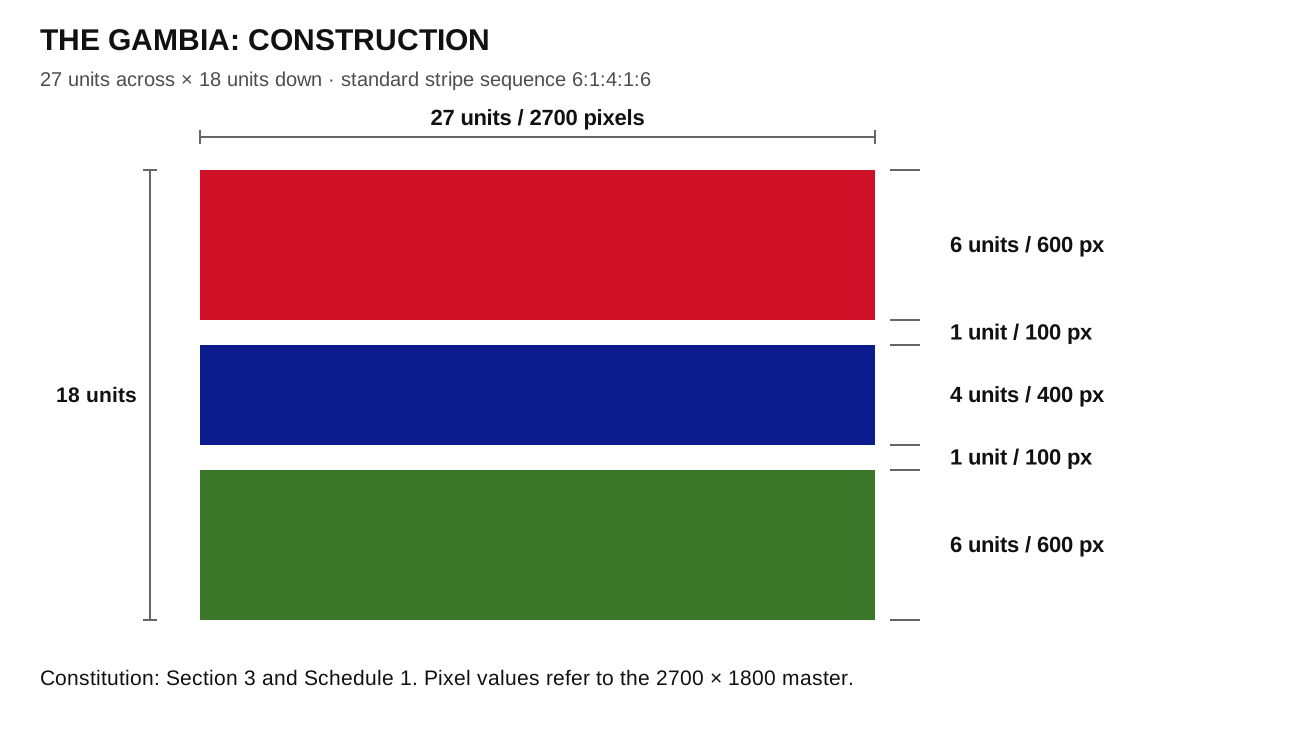
A 27-by-18 grid gives the constitutional outer rectangle. The standard stripe heights total eighteen units: six red, one white, four blue, one white, and six green.
GKBook composition, CC0; underlying flag geometry, public domain.Download image
The flag divides into three equal six-unit zones only when the middle zone includes white, blue, and white together. Blue alone is four eighteenth parts of the height, or two ninths.
GKBook composition, CC0; underlying flag geometry, public domain.Download image
Modern reconstruction of the late colonial Blue Ensign, with a Union Flag canton and a circular badge showing an elephant, palm, and red G. This is historical artwork, not the present national flag or an original textile.
Historical vector by Thommy, CC0; GKBook preparation, CC0.Download image
A colonial Blue Ensign is compared with the present plain national flag. The national colors entered use at independence in 1965; the current view uses the constitutional 3:2 width-to-height format.
GKBook composition, CC0; underlying flag geometry, public domain.Download image
Archival design artwork and the independence leaflet show a longer 2:1 flag. The present Constitution specifies 3:2. These diagrams compare the documented shapes using one modern palette; they are not archival reproductions.
GKBook composition, CC0; underlying flag geometry, public domain.Download image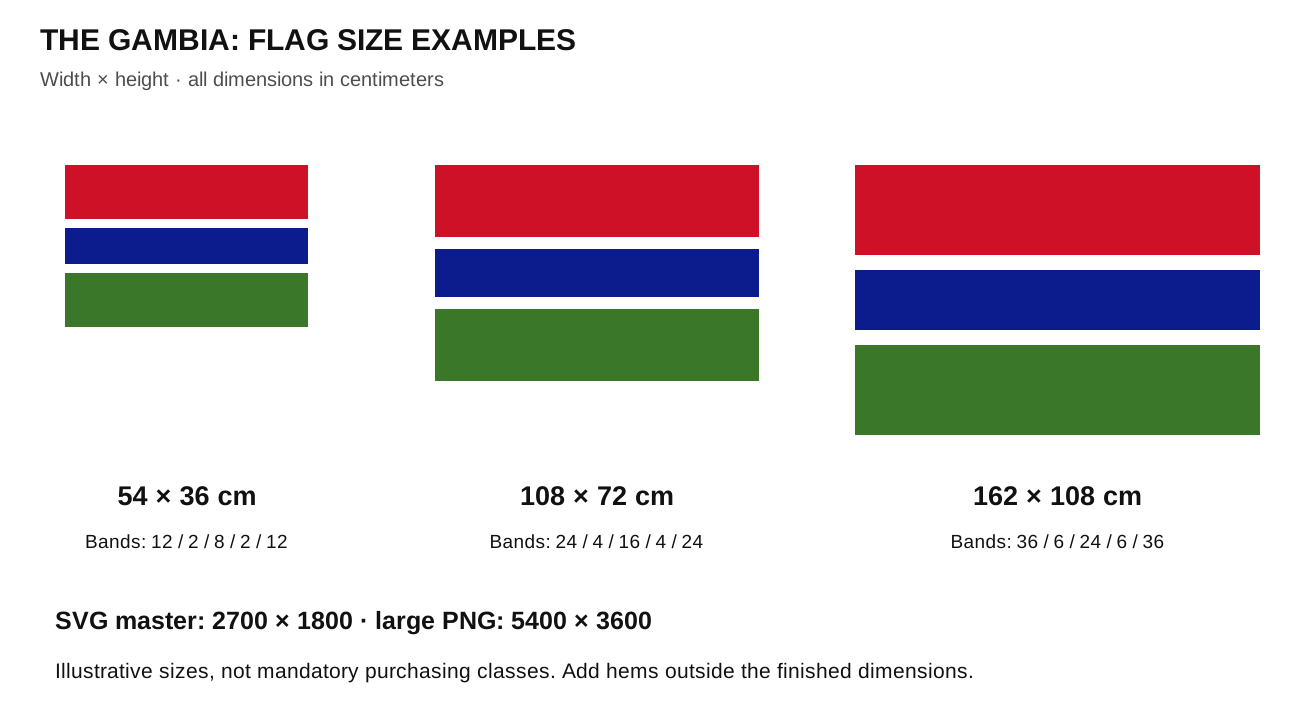
Flags of 54 by 36, 108 by 72, and 162 by 108 centimeters preserve the 3:2 rectangle and 6:1:4:1:6 stripe heights. These are scaling examples, not mandatory national size classes.
GKBook composition, CC0; underlying flag geometry, public domain.Download image
The front and reverse share the red–white–blue–white–green order. The attachment edge appears on the opposite side when viewed from behind; green does not move to the top.
GKBook composition, CC0; underlying flag geometry, public domain.Download image
February 18 commemorates independence in 1965 and the national flag’s introduction. April 24 marks the republic established in 1970, when the flag was retained. The second date is not presented as a current public-holiday declaration.
GKBook composition, CC0; underlying flag geometry, public domain.Download image
Ordinary and lowered positions illustrate mourning display without fixing a mast fraction. After Sir Dawda Kairaba Jawara’s death, flags at all state institutions were lowered for August 27–September 2, 2019.
GKBook composition, CC0; underlying flag geometry, public domain.Download image
The Gambia differs from neighboring Senegal’s vertical bands and star, Sierra Leone’s equal green–white–blue bands, and Hungary’s red–white–green design without blue. Each flag is shown at its own reference proportions.
GKBook composition, CC0; underlying flag geometry, public domain.Download imageFrequently asked questions
What does The Gambia’s national flag look like?
The Gambia’s flag has horizontal red, blue, and green bands, with a narrow white stripe on each side of the blue. Read from top to bottom, the sequence is red, white, blue, white, green. It has no coat of arms, star, lettering, or other central emblem.
What is the correct stripe order on The Gambia’s flag?
The correct order is red, white, blue, white, and green from top to bottom. Red and green have equal heights, while blue is narrower. Each white stripe is one quarter of the blue stripe’s height. The same order remains visible when the correctly oriented flag is viewed from behind.
What are The Gambia flag’s colors and HEX codes?
The flag uses red, white, blue, and green. The downloadable reference uses red #CE1126, white #FFFFFF, blue #0C1C8C, and green #3A7728. These are the actual values in this artwork, not numerical color codes prescribed by the Constitution. Physical production still requires suitable color references, materials, and proofs.
What do the colors of The Gambia’s flag mean?
The independence-era government explanation associates red with the sun, blue with the River Gambia, green with agricultural resources, and white with unity and peace. Later descriptions also associate red with the savanna and green with forests. These interpretations explain the colors; they do not change the prescribed stripe arrangement.
What does red represent on The Gambia’s flag?
Red forms the upper six units of the flag’s eighteen-unit height. The government’s independence-era explanation connects it with the sun, while later accounts also mention the savanna. Red is therefore a geographic and environmental symbol in these explanations, rather than an officially documented reference to bloodshed in the flag’s original description.
Why is blue in the middle of The Gambia’s flag?
Blue represents the River Gambia, the waterway around which the country extends. It occupies four of the flag’s eighteen vertical units and is separated from red and green by white stripes. The position is symbolic: the blue band does not trace the river’s actual bends, width, or course on a map.
What does the green stripe represent?
The green lower band represents agricultural resources in the government’s independence-era account. Later descriptions also connect green with the country’s forests. It has the same height as the red upper band: six units out of eighteen. The stripe symbolizes national resources without measuring cultivated land or forest cover as a percentage.
What do the two white stripes represent?
The white stripes represent unity and peace. One separates red from blue, and the other separates blue from green. Each is one unit high in the standard eighteen-unit construction. They are intentional parts of the national design, so they should remain visible in small illustrations, stitched flags, and printed reproductions.
What are the proportions of The Gambia’s flag?
The Constitution gives an outer rectangle twenty-seven units across and eighteen units down, equivalent to 3:2 width to height. The standard stripe construction is 6:1:4:1:6 from top to bottom. This is also described as a 2:3 flag when the convention lists height before length, rather than width before height.
Are the three main colored bands equal?
No. Red and green each occupy one third of the height, but blue occupies only two ninths. The middle third comprises the blue band together with both white separators: one plus four plus one units. Making red, blue, and green equally wide and then adding white would produce the wrong construction.
How can I draw a correctly proportioned Gambia flag?
Start with a rectangle twenty-seven units wide and eighteen high. Divide its height into six red units, one white, four blue, one white, and six green. A 2700-by-1800-pixel version therefore uses stripe heights of 600, 100, 400, 100, and 600 pixels. Each stripe extends across the full width.
How did The Gambia’s national flag develop?
The present national flag was selected during preparations for independence and introduced on February 18, 1965. It replaced colonial symbolism with a plain arrangement associated with the country’s sun, river, agriculture, unity, and peace. The design continued after The Gambia became a republic in 1970 and during the Senegambia Confederation.
What flag was used in colonial Gambia?
A late colonial Blue Ensign combined a dark blue field, a Union Flag in the upper hoist, and a circular colonial badge showing an elephant, palm, and red G. The historical illustration supplied here is a modern reconstruction of that ensign, not an original textile or the current national flag.
When was The Gambia’s national flag adopted?
February 18, 1965, the date of independence from the United Kingdom, is the national flag’s adoption date. Selection and public presentation of the design had taken place during 1964. Distinguishing those stages explains why earlier drawings or announcements exist without making the national independence anniversary a different date.
Why do some early Gambia flag illustrations look longer?
Archival artwork and the government’s independence leaflet show a 2:1 width-to-height rectangle. The current constitutional format is 3:2, which looks less elongated. The comparison on this page illustrates those documented shapes using the same modern palette. It does not establish an exact changeover date or reproduce an original historical textile.
What does the Constitution say about The Gambia’s flag?
Section 3 of the 1997 Constitution identifies the national flag by reference to Schedule 1. That schedule specifies a rectangle twenty-seven units across and eighteen down and lists the horizontal colors. The failed 2024 constitutional replacement proposal did not enact a new Constitution; the 1997 framework remained in force.
Who designed The Gambia’s flag?
Louis Lucien Thomasi, an accountant, designed The Gambia’s national flag through the independence preparations’ public competition. Shorter accounts often call him Louis Thomasi. Archival research by Jos Poels identifies his fuller name. The designer, the committee selecting the entry, and the authorities approving national use had different roles in the process.
How is The Gambia’s flag made?
A maker can sew separate colored panels or print the complete design onto suitable fabric. The finished visible stripes must preserve the red–white–blue–white–green order and the 6:1:4:1:6 heights. Hems, seams, reinforcement, and attachments need separate allowances. The reviewed national description does not mandate one textile, stitch, or printing process.
When is The Gambia’s Independence Day?
The Gambia celebrates Independence Day on February 18, marking independence in 1965 and the introduction of the national flag. Government information identifies this annual observance, and a presidential declaration made February 18, 2025, a public holiday for the sixtieth anniversary. A particular ceremony’s location and timetable depend on its announced program.
Does The Gambia have a separate official Flag Day?
The reviewed official sources establish February 18 as Independence Day, associated with the national flag’s introduction in 1965. They did not establish a separate annual national Flag Day. This page therefore uses Independence Day in its navigation and distinguishes a verified observance from an unsupported date borrowed from another country.
Did the flag change when The Gambia became a republic?
The Gambia became a republic on April 24, 1970, and retained its national flag. The independence date remains February 18, 1965. These anniversaries concern different constitutional milestones. Showing April 24 in a historical timeline does not, by itself, establish a currently declared public holiday or a separate official Flag Day.
Was the flag replaced during the Senegambia Confederation?
The Gambia retained its national flag during the Senegambia Confederation with Senegal, which lasted from 1982 to 1989. Senegal’s flag remained a distinct design with vertical green, yellow, and red bands and a central green star. Political association between the countries did not turn their two national flags into interchangeable symbols.
Are the national anthem and coat of arms part of the flag?
No. The plain national flag consists of its five horizontal stripes and has no coat of arms or inscription. The anthem, For The Gambia Our Homeland, is a separate national symbol. Displaying a flag beside arms, an official seal, or a musical performance does not add those elements to its design.
How should The Gambia’s flag be displayed?
For an ordinary horizontal display, keep red at the top and green at the bottom, with both white separators visible. Use a clean, securely attached flag whose proportions are correct. Additional arrangements for a government building, school, diplomatic event, or military ceremony should follow that institution’s applicable instructions and event plan.
Does the reverse of The Gambia’s flag look different?
The reverse retains the same top-to-bottom colors because the design has only full-width horizontal stripes. The attachment edge appears on the opposite side when viewed from behind. A flag with green at the top is upside down, not simply reversed. Vertical banners require a separately considered mounting arrangement and orientation.
How should The Gambia’s flag be arranged with other flags?
Use the host institution’s protocol and the event’s agreed arrangement. A diplomatic meeting, international sports ceremony, and military formation can follow different plans. The national flag’s design does not establish a universal viewer-left or viewer-right position. Pole heights, sight lines, mounting security, and unobstructed display are useful practical checks.
Is there one mandatory daily flag-raising time?
The reviewed sources do not establish one mandatory raising or lowering hour for every Gambian household and institution. A national anniversary gives a date, while an event program supplies ceremony times. Follow the relevant organizer’s directions for the actual setting instead of treating a foreign country’s flag code as Gambian law.
When is The Gambia’s flag flown at half-mast?
Official mourning instructions can require flags to be lowered. After Sir Dawda Kairaba Jawara’s death, a seven-day national mourning period ran from August 27 through September 2, 2019, with flags at all state institutions lowered to half-mast. That documented instruction does not establish a permanent mast-height formula or a current mourning order.
Does a half-mast order automatically authorize a flag-draped coffin?
A direction to lower flags at state institutions does not by itself settle who is entitled to a flag-draped coffin or how a funeral flag should be handled. Those are separate ceremonial questions. The responsible institution and funeral organizer should establish eligibility, placement, handling, and the flag’s disposition for the particular service.
Does the constitutional flag description set criminal penalties?
Section 3 and Schedule 1 define the national flag; those provisions do not themselves supply a fixed criminal penalty for every misuse. Any claim about an offense needs the applicable law and context. This article does not import another country’s Flag Act, invent a Gambian fine, or decide liability in an individual case.
Does public-domain flag artwork guarantee unrestricted commercial use?
Public-domain artwork addresses copyright in the supplied drawing. It does not establish government endorsement or settle every trademark application. WIPO distinguishes state-symbol protection under Article 6ter from copyright in artwork. Commercial use should be assessed in its actual context, especially when a product or brand might imply official approval or affiliation.
How should a damaged Gambia flag be cared for or retired?
Use the maker’s care instructions, inspect seams and attachments, and replace cloth that no longer presents the design clearly. Dry a flag before storage and protect historically important textiles from unsuitable cleaning. The reviewed sources do not establish a compulsory household folding pattern, burning ceremony, or fixed cutting method for retirement.
How is The Gambia’s flag different from similar flags?
The Gambia has a narrower blue band between two white separators, with red above and green below. Sierra Leone has three equal green, white, and blue bands. Hungary has red, white, and green without blue. Senegal uses vertical bands and a star. Checking stripe order and separators is more reliable than recalling colors alone.
What is the flag emoji for The Gambia?
The flag emoji is 🇬🇲. Its underlying sequence combines regional indicator G, U+1F1EC, with regional indicator M, U+1F1F2, corresponding to GM. Appearance depends on the device, font, and application. Some systems show the letters instead of a flag; for consistent printable artwork, use the supplied SVG or PNG.
Which Gambia flag images can I download?
The gallery supplies the plain national SVG, construction and layout guides, a colonial reconstruction, historical comparisons, size examples, orientation views, an anniversary calendar, a mourning diagram, and comparisons with other flags. A large national PNG is also available. Each download is hosted on this website and identified by its purpose.
Are the historical flag images original photographs?
No. The colonial ensign is a modern vector reconstruction, and the early-proportions comparison is an explanatory drawing using documented shapes. Neither is an original cloth, archival photograph, or historical color master. The gallery labels these distinctions so a clear educational illustration is not mistaken for a documentary record.
What mistakes should be avoided when drawing The Gambia’s flag?
Keep both white separators and make blue narrower than red and green. Do not add a star, arms, or lettering to the national flag. Preserve the 3:2 outer rectangle and the 6:1:4:1:6 stripe heights. Finally, distinguish the current design from a colonial ensign, an early elongated illustration, or a decorative banner.
Why is the country called The Gambia in the article?
The country’s official usage includes the definite article, so this page uses The Gambia for the national name and Gambian as the adjective. Its flag belongs to the West African republic whose capital is Banjul. The River Gambia is both a central geographic feature and the meaning associated with the blue stripe.
Explore all general-knowledge topics and the A-to-Z lists.


We Value Your Opinion Comments