An Octopus Keeps a Second Set of Teeth Just for Drilling
When an octopus cannot pull a shell open, a muscular salivary papilla studded with minute teeth — separate from the radula, its primary toothed ribbon — can drill through it. Secretions from the posterior salivary glands then help relax the muscle holding the shell closed.
The Mimic Octopus Impersonates the Animals Predators Avoid
The mimic octopus, first seen off Sulawesi in 1998 and named Thaumoctopus mimicus, flattens, contorts and recolors itself into imitations of flatfish, lionfish and banded sea snakes. Reports credit it with impersonating a dozen or more marine animals, nearly all of them venomous or unpalatable.
White Shark Teeth Saw — Mako Teeth Spear
Two close cousins carry opposite toolkits: the great white's broad triangular teeth are serrated like steak knives for shearing blubber, while the shortfin mako's are smooth, narrow spikes for pinning slippery fish. Read the tooth and you read the menu. In sharks, cutlery is destiny.
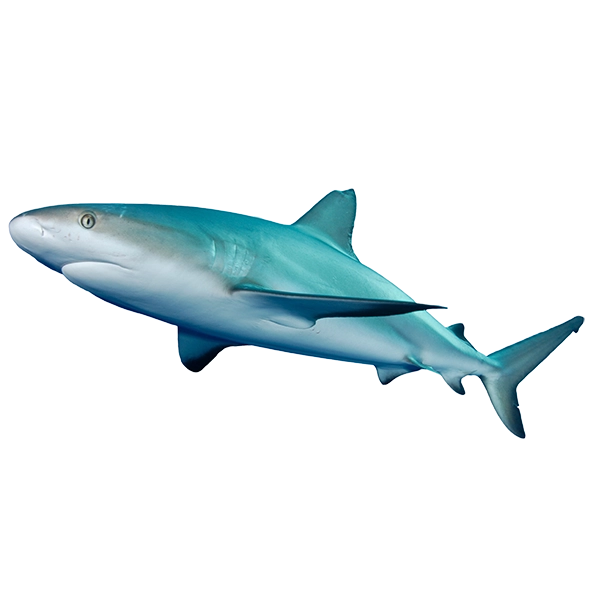
Silky Sharks Wear the Smoothest Skin in the Family
The silky shark's denticles are so small and densely packed that its skin feels sleek rather than sandpapery — the trait that named it. The finish trims drag for a life spent chasing tuna in open water. Even among sharks, there is a best-dressed.
Some Octopuses Can Open Childproof Containers
Captive octopuses routinely learn to open screw-top containers for food. At the Seattle Aquarium, some also worked out childproof pill-bottle caps. In a baby-bottle test, one octopus bypassed the screw top entirely by tearing off the nipple.
Thresher Sharks Kill With Their Tails
The thresher's scythe-like upper tail can equal the length of its body, and high-speed video published in 2013 shows the shark whipping it overhead to stun whole groups of sardines before circling back to swallow the dazed. It is the only shark that hunts with a bullwhip.
The Pocket Shark's Pockets Are Built to Squirt Light
By 2020, pocket sharks were known from exactly two specimens: a 40 cm (16 in) female trawled near the Nazca Ridge off Chile in 1979, and a 14 cm (5.5 in) male netted in the Gulf of Mexico in 2010 and named the American pocket shark in 2019. Each carries a slit-like pocket above the base of each pectoral fin, and a 2020 study of the Gulf specimen's pocket glands found the cellular machinery for secreting a luminous fluid. A shark barely longer than a smartphone is built with glowing pockets.
The Whale Shark's Mouth Holds 300 Rows of Useless-Looking Teeth
A whale shark's cavernous mouth carries about 300 rows of tiny vestigial teeth — thousands in all — that play no role in feeding, leftovers from toothier ancestors; the animal filter-feeds instead through gill rakers. Evolution rarely cleans out the attic.
A Deep-Sea Octopus Guarded Her Eggs for 53 Months Without Feeding
From 2007 to 2011, researchers from the Monterey Bay Aquarium Research Institute returned 18 times to the same site in Monterey Canyon and found the same scarred Graneledone boreopacifica female guarding about 160 eggs. She was never observed feeding and grew progressively thinner. Her 53-month brood remains the longest recorded for any animal.
Sharks Use Earth's Magnetic Field Like a Map
In a 2021 experiment, 20 wild-caught bonnethead sharks held in a tank were exposed to magnetic fields mimicking spots hundreds of kilometers (hundreds of miles) from where they were caught — and turned to swim “home,” orienting on magnetic cues alone, the first solid evidence that sharks read Earth's magnetic field as a true map. Some of the longest migrations in the sea may run on planetary GPS.
Great Whites Keep Their Eyes and Brain Warm
Great white sharks, shortfin makos and their mackerel-shark kin run heat exchangers of tightly packed blood vessels that keep swimming muscles, eyes and brain well above sea temperature — regional warm-bloodedness in a fish. A warm retina sees fast prey in cold water. The great white hunts pre-heated.
Basking Sharks Filter a Swimming Pool Every Hour
The basking shark, the second-largest fish, cruises open-mouthed and passively strains plankton from roughly 1,800 metric tons of seawater per hour — on the order of an Olympic pool's worth. All that machinery runs on animals barely visible to the eye.
A Day on Venus Is Longer Than Its Year
Venus turns so slowly that a single rotation takes 243 Earth days, while its whole trip around the Sun takes only 225. On Venus, the day outlasts the year.
Blue-Ringed Octopuses Flash Their Rings as a Warning
A blue-ringed octopus is small and usually drab, but vivid iridescent blue rings appear when it feels threatened. The display serves as a warning; the animal generally tries to escape, and nearly every recorded bite has come after someone picked it up.
Some Sharks Vomit by Ejecting Their Entire Stomach
To purge something indigestible, a shark can perform gastric eversion — pushing its whole stomach out through its mouth, rinsing it inside-out in seawater, then swallowing it back into place. Scientists have filmed the maneuver taking only seconds. It is the ocean's most extreme reset button.
A Frilled Shark Pregnancy May Last 3.5 Years
The eel-like frilled shark, a deep-water relic with 300 needle teeth arranged in frills, is estimated to carry its young for around 3.5 years — among the longest gestations proposed for any vertebrate. In the cold deep, even birth runs in slow motion.
English Called Sharks “Sea Dogs” and “Dogfish” Until the 1500s
The English had sea dog, dogfish and hound-fish — names for the small sharks of home waters — but no name at all for the big tropical animal Captain John Hawkins's men brought to London in 1569. A handbill advertising the specimen said exactly that: there was no proper name for it, “but that certayne men of Captayne Haukinses doth call it a sharke.” Within thirty years “shark” also meant a swindler, and etymologists still argue which sense came first.
The Shortfin Mako Is the Fastest Shark in the World
The shortfin mako is the fastest shark in the world — a torpedo-shaped, crescent-tailed hunter that runs down tuna and swordfish in the open ocean.
Every Octopus Has a Favorite Arm
Given eight seemingly interchangeable arms, an octopus still plays favorites: in a 2006 experiment, every animal tested reached into a maze with the same preferred arm again and again, and individuals favor one eye as well. Unlike human handedness, though, the species has no side — roughly half the animals lean left and half lean right, so the preference is personal rather than built into the octopus.
"Cephalopod" Means Head-Foot, and the Anatomy Explains Why
The Greek roots behind Cephalopoda translate as head and foot, describing a body plan in which the two are fused. The eight arms are modifications of the same muscular foot that a snail crawls on, rearranged into a ring around the head. The mouth and beak sit underneath, at the center of that ring. An octopus is a mollusk that walks on a reinvented snail foot.
Lantern Sharks Wear Light as Camouflage
Small deep-sea lantern sharks grow light-producing organs called photophores along their undersides, matching the dim glow filtering from above so predators looking up see nothing. Some also flash light along spines and fins. In the deep, the best hiding place is brightness.
Goblin Sharks Fire Their Jaws Like a Slingshot
The deep-sea goblin shark's jaws shoot forward at prey in what researchers measured as the fastest jaw protrusion known in fishes, snapping out from under its blade-like snout before retracting. Video analysis published in 2016 called the mechanism "slingshot feeding." Its face is a loaded weapon.
Octopuses Can See Polarized Light That Humans Cannot
Octopus photoreceptors are arranged in two channels that detect the orientation of polarized light. Behavioral tests show they can distinguish differences in polarization angle of only a few degrees. This can make transparent prey visible even when brightness and color provide little contrast.
Georges Cuvier Mistook an Argonaut's Mating Arm for a Parasitic Worm
Male argonauts detach a specialized mating arm inside the female, where it can continue moving on its own. In 1829, Georges Cuvier mistook these arms for parasitic worms and named them Hectocotylus octopodis. The term hectocotylus is still used for a cephalopod's specialized mating arm.
The Greenland Shark's Eye Parasite Is Less Blinding Than Legend Says
Around Greenland, the sharks' eyes are frequently parasitized by Ommatokoita elongata, a pale copepod about 3 cm (1.2 in) long that anchors itself to the cornea — for decades, reason enough to assume the hosts were all but blind. A 2026 study of Greenland shark eyes found a pristine, purely rod-based retina tuned to deep-water blue, with no sign of degeneration even in a specimen more than 130 years old, and a cornea that still passes most light despite the parasite. Video shows the sharks turning their eyes toward light. The longest-lived vertebrate is not blind; it just lives where there is little to see.
Pound for Pound, the Bull Shark Bites Hardest
Researchers measuring shark bites found the bull shark delivering nearly 6,000 newtons (about 1,300 pounds of force) at the back teeth — the strongest bite for body size of any shark tested, published in 2012. The stout jaw is built like a bolt cutter for turtles and big fish. Size sets the headline; the bull shark sets the ratio.
Basking Sharks Cannot Suck — They Can Only Cruise
Unlike whale sharks, which gulp and suction-feed, the basking shark is a pure ram filter feeder: its colossal gape works only when the animal swims forward, forcing water through its gill rakers. Stop the shark and the filter stops with it. For a basking shark, motion is the meal.
The Argonaut Octopus Builds Its Own Submarine Ballast Tank
The argonaut is a small octopus that lives in open water, and the female builds herself a thin white shell using two of her arms. She swims to the surface, traps a gulp of air inside the shell, then dives — and deep down the squeezed air balances her weight exactly, so she floats in midwater without swimming.
Whale Sharks Are Identified With a Hubble Star Algorithm
Every whale shark wears a unique constellation of pale spots, so scientists adapted a 1986 star-mapping algorithm built for the Hubble Space Telescope era to match shark flanks the way astronomers match star fields. The method anchors a global photo-ID library with tens of thousands of encounters. Fittingly, the whale shark's name in Madagascar — marokintana — means "many stars."
Sharks Have Survived Five Mass Extinctions
The shark lineage has endured for more than 400 million years, swimming through all five of Earth's great mass extinctions — including the one that ended the dinosaurs. They watched the rise and fall of nearly everything else in the ocean.
An Octopus Has Eight Arms and Zero Tentacles
In cephalopod anatomy, arms carry suckers along their whole length while tentacles are longer, retractable and suckered mainly at the tip. Squid and cuttlefish have both — eight arms plus two tentacles. Octopuses have eight arms and nothing else. The word "tentacle" is almost universally applied to them and is almost universally wrong.
Octopuses Sleep About 10 Hours a Day
In round-the-clock observations at 22 °C (72 °F), nocturnal octopuses averaged about 12 quiet-sleep bouts of 50 minutes each plus roughly 10 brief active-sleep bouts. Together, these amounted to about 10 hours of sleep per day. Warmer water shortened the interval between active bouts.
A Great White's Camouflage Works in Both Directions
The white shark's two-tone paint job is engineering: slate-gray above blends into deep water for eyes looking down, while the pale belly dissolves into surface glare for eyes looking up. The scheme, countershading, hides a two-ton predator in open water. The most famous silhouette in the sea is built to have none.
A Wild Octopus Collected Rocks to Block Its Den Entrance
Researcher Jennifer Mather observed a wild octopus leave its den, collect three rocks, set them aside, carry them back and stack them across the entrance before resting. The sequence has been discussed as possible planning, although that interpretation remains debated.
The Whale Shark Is the Largest Fish in the Sea
The whale shark is the largest fish alive, and the biggest reliably measured individual reached 18.8 m (61 ft 8 in). It feeds almost entirely on plankton, straining tiny drifting life through a mouth up to 1.5 m (5 ft) wide. The ocean's biggest shark eats some of its smallest creatures.
Your Odds of Dying by Shark Are About One in 4 Million
The International Shark Attack File puts a U.S. beachgoer's lifetime-scale risk of a fatal shark bite near one in 4.3 million — far below the risks of lightning, bees or the drive to the beach. In a typical year sharks bite about 70 people worldwide, unprovoked, and about six of those bites are fatal.
Shark Liver Oil Lit Lamps and Paved Industries
Before petroleum, oil rendered from shark livers lit lamps, tanned leather and greased machinery; entire fisheries — from Achill Island's basking sharks to the World War II hunt for vitamin A-rich soupfin sharks — rose and crashed on shark oil. Sharks powered human nights before electricity did.
The Greenland Shark Is the Longest-Lived Vertebrate Known
Radiocarbon dating of proteins in their eye lenses shows Greenland sharks live at least 272 years — longer than any other animal with a backbone. The oldest of the 28 sharks measured in the landmark 2016 study, a female just over 5 m (16 ft) long, was estimated at roughly 392 years old. Females don't even reach maturity until around 150, and a big one cruising the Arctic today has been swimming for some three centuries.
Megalodon's Bite Was Several Times a T. rex's
Biomechanical modeling published in 2008 estimated the bite force of megalodon, the largest shark that ever lived, at roughly 108,000 to 182,000 newtons — up to about 41,000 pounds of force, the strongest bite calculated for any animal at the time. That is several times the estimated bite of Tyrannosaurus rex. The figure often circulates mislabeled as “psi”; it is total force, and it needed no exaggerating.
Researchers Have Measured Stable Personality Differences in Octopuses
Repeated behavioral tests have found consistent individual differences in octopus activity, reactivity and avoidance. Later work in another species found similar temperament differences early in life, showing that individuals of the same species can behave predictably differently.
Sharks Hear the Thrash of Prey From Far Away
Sharks are tuned to low-frequency pulses — the irregular vibrations of a struggling fish — which they detect with inner ears and a lateral-line system running the length of the body. Long before a shark sees you, it has heard and felt you.
Whale Sharks Cross Oceans for a Buffet
Satellite-tagged whale sharks travel thousands of kilometers to arrive precisely when food blooms — coral spawn off Australia, fish eggs off Yucatán — forming seasonal gatherings of hundreds, the largest known assemblies of giant fish. Somehow, the world's biggest fish keeps a calendar.
Roughly 90% of an Octopus Is Muscle
With no internal or external skeleton, an octopus is roughly 90% muscle. Its arms act as muscular hydrostats, stiffening, bending and extending by contracting muscles against one another rather than pulling on bones. This structure gives the animal both strength and extreme flexibility.
Some Sharks Take a Decade or More to Have Their First Pup
Many large sharks mature astonishingly late — white sharks at roughly 26–33 years by vertebral studies, Greenland sharks near 150 — and then produce few young after long pregnancies. That slow arithmetic is why overfishing empties shark seas so fast and refills them so slowly.
Veined Octopuses Carry Coconut Shells for Future Shelter
During more than 500 diver hours off Indonesia, researchers watched veined octopuses dig up coconut-shell halves, stack them and carry them as far as 20 meters (66 feet) before assembling them into shelters. Because the shells provide no protection while being transported and are saved for later use, the behavior was classified as tool use.
The Larger Pacific Striped Octopus Mates Face to Face and Spawns Repeatedly
Pairs of larger Pacific striped octopuses mate face to face with their suckers aligned, share food and may occupy the same den for days. Females produce multiple clutches over months instead of a single terminal brood.
Warm Springs Shorten Deep-Sea Octopus Brooding to About 1.8 Years
At the Octopus Garden, a nursery near the base of Davidson Seamount off California, surrounding seawater is about 1.6 °C (35 °F), while water seeping from cracks reaches nearly 11 °C (51 °F). Pearl octopus (Muusoctopus robustus) mothers cement their eggs to the rock and brood in the warmer crevices, where higher temperatures raise metabolic rates and shorten incubation from an expected five or more years to roughly 1.8 years.
Megalodon Was Not the Great White Shark's Ancestor
Megalodon, the extinct giant that grew several times the size of any shark alive, left teeth so like a great white shark's that the family tree looks obvious — but fossil evidence places the two on separate lineages, the white shark's ancestry tracking closer to ancient mako-like sharks. Megalodon's line ended; it left no descendants. The great white is the giant's rival's grandchild, not the giant's.
The Octopus Siphon Powers Jetting, Inking and Debris Throwing
The siphon is a muscular funnel that forcefully expels water from the body. An octopus uses it for jet propulsion, to eject ink, and to aim water beneath the arm web strongly enough to throw silt, shells and other debris.
A Swimming Shark Generates Its Own Lift Like an Aircraft
With pectoral fins shaped like wings and a tail delivering forward thrust, many sharks fly through water more than they float in it — negatively buoyant bodies held aloft by hydrodynamics, sinking whenever they glide too slowly. A great white shark is, structurally, a heavier-than-water aircraft.
A Shark's Intestine Works Like a Corkscrew Valve
CT scans published in 2021 revealed that the spiral intestine of sharks functions like a Tesla valve, easing food one way while resisting backflow — a design engineers patented a century after sharks evolved it. Digestion, in a shark, is plumbing genius.
Only Three Shark Species Grew Giant on Plankton
Of 500-plus shark species, exactly three became filter-feeding giants — the whale shark, the basking shark and the megamouth — each evolving the strategy separately. Gigantism in sharks arrived not with bigger prey but with smaller. The three largest mouths in the family eat things you can barely see.
Megalodon Nurseries Filled Ancient Shallow Seas
Fossil sites in Panama, Spain and the southeastern U.S. preserve concentrations of small juvenile teeth of megalodon, the extinct giant shark that hunted the oceans until about 3.6 million years ago — evidence the giants birthed and raised young in warm, food-rich shallows; 2025 growth analyses indicate newborns already stretched about 3.6–3.9 m (12–13 ft). The deadliest daycare in history had ocean views.
An Octopus's Brain Is a Ring With Its Throat Running Through It
The central brain is not a lump above the mouth. It is a donut of fused lobes encircling the esophagus, split into a supraesophageal mass handling learning and memory and a subesophageal mass handling movement. Food passes through the middle of the brain on its way to the gut. Whatever an octopus swallows, it swallows through its own head.
Whale Sharks May Live More Than a Century
Radiocarbon from Cold War bomb tests, lodged in the growth bands of two dead whale sharks' vertebrae, proved in 2020 that each band marks one year — and put one shark, a 10 m (33 ft) female stranded in Pakistan, at 50 years old, the oldest ever verified. Earlier modelling built on those yearly bands suggests the largest may live a century. The biggest fish in the sea is also one of its slow-burning elders.
Basking Sharks Were Once Mistaken for Sea Serpents
When basking shark carcasses decay, the gill apparatus and lower jaw fall away first, leaving a small-headed, long-necked hulk — the source of several famous "sea serpent" and "plesiosaur" strandings, including the 1977 Zuiyo-maru carcass hauled up off New Zealand. Many monsters, examined closely, turn out to be sharks twice over.
The Salmon Shark Swims Warm in Arctic-Cold Seas
The salmon shark of the North Pacific maintains body temperatures around 21–26 °C (70–79 °F) even in near-freezing water — among the warmest bodies of any fish — letting it chase salmon where most predators stiffen. It is a shark wearing its own wetsuit of blood.
Science Missed a One-Ton Shark Until 1976
The megamouth shark — a blubbery, 16-foot (5 m) filter feeder with a cavernous, glow-lipped mouth — was entirely unknown until one tangled in a U.S. Navy vessel's gear off Hawaii in 1976. Only a few hundred sightings have ever been logged since. The 20th century's biggest zoological surprise swam in from the deep.
Octopuses Can Tell Two Keepers Apart in Identical Uniforms
At the Seattle Aquarium, eight giant Pacific octopuses met two unfamiliar people dressed the same way for two weeks: one always fed them, the other always touched them with a bristly stick. By the end, the animals showed measurably different body patterns, arm movements and funnel orientation toward each person, and the larger ones changed their breathing rate. The uniform trick was the point. They were not reading the clothes.
Killer Whales Eat Great White Livers Like Surgeons
Off South Africa, a pair of orcas has repeatedly killed great white sharks and removed their energy-rich livers with almost surgical precision, leaving the rest. Tagging studies show white sharks fleeing the region for months after such attacks. The ocean's most feared fish has a boss.
Octopus Skin Carries a Chemical That Says "Do Not Grab This"
Hundreds of suckers per arm will stick to almost anything they meet, which raises an obvious problem for an animal with eight boneless arms. Israeli researchers found that amputated octopus arms grabbed petri dishes readily but would not grab octopus skin, and gripped dishes smeared with skin extract about ten times more weakly. The signal works in the arm itself, with no help from the brain. The octopus solved knots with chemistry.
The Blacktip Reef Shark Is the Ocean's Great Homebody
While cousins cross oceans, tracked blacktip reef sharks often spend years inside a home range of well under a square kilometer of reef. The fin cutting the lagoon today is likely the same individual as last season's. Not every shark is a wanderer; some are neighbors.
The Swell Shark Inflates Like a Balloon and Glows Green
Cornered, the swell shark gulps water to double its girth and wedge itself into rock crevices; under blue light its skin also fluoresces brilliant green, visible to other swell sharks' eyes. It is both a pufferfish impersonator and a secret neon sign.
Baby Bamboo Sharks Sense Danger From Inside the Egg
Bamboo shark embryos, still sealed in their egg cases, freeze — stopping gill movement — when they detect the electric field of a predator outside, resuming only when the threat passes. The survival course begins before hatching.
A Special Heart Protein Keeps Salmon Sharks Alive in Icy Water
The salmon shark's heart is loaded with SERCA2, a calcium-pump protein expressed at levels closer to a mammal's heart than a fish's, keeping cardiac muscle contracting in water that would stop most fish hearts. The finding, published in Science in 2005, helped explain how a warm-bodied shark patrols sub-Arctic seas. Its cold tolerance is written in molecules.
A Shark's Jaw Is Not Attached to Its Skull
Shark jaws hang in slings of muscle and ligament, letting the whole apparatus thrust forward and gape wide independent of the head — the mechanism behind slow-motion footage of white sharks seeming to launch their mouths at prey. The skull aims; the jaw travels.
The Oceanic Whitetip May Be History's Deadliest Shark to Castaways
Jacques Cousteau called the oceanic whitetip "the most dangerous of all sharks" — not for beaches, but for the open sea, where it reaches shipwrecks and air crashes first. It is widely implicated in deaths among the roughly 900 sailors set adrift by the USS Indianapolis sinking in 1945, though exposure and thirst killed many. The shark you have never heard of owns the ocean's worst disasters.
Sharks Can Sense Five Billionths of a Volt
Jelly-filled pores on a shark's snout — the ampullae of Lorenzini — detect the faint electric fields of living bodies: in Kalmijn's 1982 experiments, sharks and rays responded to voltage gradients of just 5 nanovolts per centimeter, five billionths of a volt. A flounder hiding under sand still broadcasts its heartbeat. To a shark, every animal in the sea is a battery that cannot be switched off.
Sevengill Sharks Hunt Seals in Packs
The broadnose sevengill — a stout, spotted cow shark with seven gill slits instead of the usual five, up to about 3 m (10 ft) long — is one of the few sharks that regularly prey on seals, and it does not always do it alone. Off South Africa and California, observers have watched sevengills hunting in loose packs, a strategy David Ebert described in 1991 as social facilitation, alongside stealth, ambush and sudden bursts of speed. Adults have only two known predators of their own: orcas and great whites. A shark shaped like a Jurassic leftover runs the coast like a wolf pack.
Hawaiians Honored Sharks as Family Guardians
In Hawaiian tradition, certain sharks were ʻaumākua — ancestral guardian spirits of specific families — fed, respected and never hunted by those they protected. The man-eater of one culture's nightmares was another culture's grandmother.
Fossil Shark Teeth Were Once Called Tongue Stones
For centuries Europeans prized glossopetrae — "tongue stones" — as magical charms against poison, believing they fell from the sky or grew from serpents' tongues. In 1666 the Danish anatomist Nicolas Steno dissected a great white shark's head and showed they were shark teeth, a founding moment for paleontology. A superstition dissolved in one dissection.
The Smallest Shark Fits in Your Hand
The dwarf lanternshark of the deep Caribbean matures at around 6 to 8 inches (15–20 cm) — smaller than many goldfish — and carries light-producing organs along its belly. The ocean's most feared family includes a member you could hide in a coat pocket.
Blue Sharks Commute Across Entire Oceans
Tagged blue sharks ride ocean gyres on migrations spanning thousands of miles — Atlantic individuals recaptured across the ocean from where they were marked — following temperature bands and prey like long-haul truckers of the open sea. Their round trips can circle an entire ocean basin.
Most Octopus Species Live About a Year or Less
Most octopus species live for roughly a year or less. The giant Pacific octopus is unusually long-lived at about three to five years, while the deep-sea Graneledone boreopacifica has been recorded brooding its eggs for 53 months.
Male and juvenile blanket octopuses tear stinging tentacles from Portuguese men-of-war and hold them in their arms, apparently as weapons or deterrents. Skin chemistry is thought to keep the stinging cells from firing against them.
One Shark Is a Confirmed Omnivore — It Digests Seagrass
Feeding trials published in 2018 showed bonnethead sharks digesting and absorbing nutrients from seagrass, not merely swallowing it while hunting crabs — the first shark shown to be a true omnivore. More than half its diet can be plants. Somewhere in the hammerhead family, a shark went partly vegetarian.
Great Whites Breach Like Missiles
Hunting seals at Seal Island, South Africa, great whites rocket upward from deep water and launch fully clear of the surface, striking from below at speeds researchers estimate near 40 km/h (25 mph) at breach. A two-ton fish becomes briefly airborne. The ambush comes from the third dimension.
Deep-Sea Octopus Nurseries Depend on Manganese Nodules Targeted for Mining
The pale deep-sea octopod nicknamed Casper was filmed near Hawaii in 2016 at more than 4,000 meters (13,100 feet) — the deepest record was 4,290 meters (14,100 feet) — a record depth for its group. Related octopods were then found attaching their eggs to the stalks of dead sponges, and those sponges grow only on manganese nodules — potato-shaped metal lumps that take millions of years to form and are prime targets for seabed mining. Remove the nodules and the sponges go, and with them the nursery.
Nurse Sharks Are the Ocean's Vacuum Cleaners
Nurse sharks generate suction among the strongest measured in any fish, inhaling prey from crevices with a sound like a slurp — one possible origin of their name. They can pump water over their gills while lying still, so they spend daylight dozing in piles on the seafloor.
Most Shark Bites Are a Case of Mistaken Identity
Vision-model research simulating a white shark's eye found that surfers paddling overhead closely match the silhouette and motion of seals — supporting the long-held mistaken-identity explanation for many bites, which are frequently single strikes without feeding. To a young white shark looking up, a surfboard is a seal-shaped question.
There Is a Shark Named for Looking Like a Pig
The pigeye shark — a stocky, snub-snouted, small-eyed cousin of the bull shark — patrols murky Indo-Pacific shallows and is so often mistaken for the bull that scientists struggle to count it. Its name is not a nickname; it is the official common name. Somewhere a shark answers, formally, to "pigeye."
Zebra Sharks Trade Their Stripes for Spots
Juvenile zebra sharks wear bold dark-and-pale bands; as they mature the bars dissolve into a field of leopard-like spots, and divers routinely misname the adults. One species manages to impersonate two big cats in one lifetime. The zebra grows up to be a leopard.
The Eiffel Tower Grows in Summer
Heat swells the tower's 7,300 metric tons of iron, lifting it as much as 15 centimeters (6 inches) taller in high summer than in deep winter, by engineers' estimates. And because the sun warms one face faster than the rest, over a clear day the summit traces a little circle about 15 centimeters wide — always leaning gently away from the sun.
Sharks Once Had a Buzz-Saw Cousin
Helicoprion, a 270-million-year-old shark relative, grew a spiral whorl of teeth like a circular saw blade set in its lower jaw — a structure so bizarre that scientists argued for a century about where on the body it belonged until CT scans settled it in 2013. Evolution once shipped a power tool with fins.
A Giant Pacific Octopus Can Guard Up to 100,000 Eggs Without Eating
A female giant Pacific octopus hangs her eggs from the roof of her den in hundreds of strands of roughly 250 eggs each, commonly totaling 18,000 to 74,000 and occasionally reaching 100,000. For six or seven months she fans them, cleans them and blows water over them, and does not eat. As the eggs hatch, she blows the young free of the den with her last strength, then dies. Each hatchling emerges the size of a rice grain, weighing about 22 milligrams, and of the tens of thousands, a handful will reach adulthood.
Shark Skin Copied Onto an Airfoil Boosted Lift-to-Drag by 323%
A shark's skin is armored with tooth-like denticles whose ridges shed drag, and engineers have been copying them. In 2014 a Harvard team 3D-printed an artificial shark skin and showed it improved swimming performance on a flapping foil; in 2018 the same lab, with the University of South Carolina, molded shortfin mako denticles onto an airfoil and found arrangements that cut drag and added lift at once, improving the lift-to-drag ratio by up to 323% at low angles of attack. Denticle-patterned surfaces are studied for aircraft, drones and wind turbines. Four hundred million years of prototyping ended up in engineering journals.
Inky the Octopus Escaped a New Zealand Aquarium Down a Drainpipe
In 2016 staff at the National Aquarium of New Zealand in Napier found Inky's tank empty and a trail of water across the floor. He had exploited a lid left ajar after maintenance, crossed roughly 2.5 meters (8 feet) of floor and squeezed into a drainpipe about 50 meters (160 feet) long that emptied into Hawke's Bay. He was never seen again. His tankmate, Blotchy, stayed put.
Epaulette Sharks Survive an Hour With No Oxygen at All
On Great Barrier Reef platforms cut off at night by spring low tides, the epaulette shark tolerates hours of severe hypoxia — oxygen near 5% of normal — and at least an hour of total anoxia, with no drop in its brain's energy stores and no neurons lost afterward. It manages this by throttling demand rather than boosting supply: an adenosine-driven slowdown leaves the shark in a coma-like torpor until oxygen returns, when it snaps back to alertness within moments. Researchers at Griffith University and the University of Auckland study its brain mitochondria for clues to limiting stroke and heart-attack damage, where the harm comes as oxygen floods back. A reef shark's hour without oxygen is a lesson medicine wants.
Hammerheads Sweep Their Heads Like Metal Detectors
The underside of a hammerhead's wide head is studded with electroreceptors, and the shark swings it across the seafloor to scan for the faint fields of stingrays buried in sand — the width of the hammer widens the search area with every pass, an advantage Kajiura and Holland measured in 2002. Great hammerheads then use the hammer itself to pin a ray to the bottom while they bite. The strange head is both the search coil and the weapon.
Mako Means Shark in Māori
The shortfin mako carries its Māori name into science and sport worldwide; in New Zealand tradition mako teeth were treasured ear pendants of high status. One of the ocean's fastest animals is one of the few whose everyday English name is borrowed from a Polynesian language.
Dumbo Octopuses Swim by Flapping, Not Jetting
Cirrate octopuses, the deep-sea group nicknamed dumbo for the ear-like fins above their eyes, propel themselves by slowly beating those fins rather than by jetting water. A web of skin joins the arms into an umbrella. The deepest octopus ever filmed was one of them, foraging almost 7 kilometers down.
Shark Fossils Are Mostly Smiles
Because cartilage rarely fossilizes, the shark fossil record is overwhelmingly teeth — shed continuously for 400 million years — plus occasional vertebrae and rare body impressions. Some fossil beds hold thousands of teeth per square meter. Sharks wrote their autobiography almost entirely in bite.
The Largest Known Octopus Gathering on Earth Sits on a Dead Volcano
At the base of Davidson Seamount off California, about 3,200 meters (10,500 feet) down, roughly 6,000 nesting pearl octopuses were counted in a 2.5-hectare patch, and researchers estimate the full site holds more than 20,000 nests. Named the Octopus Garden, it is the largest octopus aggregation known anywhere. The animals migrate there to mate, nest and die.
Aristotle Called the Octopus 'Stupid' More Than 2,000 Years Ago
In History of Animals, Aristotle called the octopus a stupid creature because it would approach a person's lowered hand. Yet he also accurately described its specialized mating arm, a feature European naturalists later had to rediscover.
Wild Octopuses Throw Things, Sometimes at Each Other
Cameras trained on gloomy octopuses in Jervis Bay, Australia, caught 102 throws in 24 hours of footage from a group of about ten animals. Each throw involves gathering silt, shells or algae in the arms and repositioning the siphon under the arm web to blast the material several body lengths. Throws in social contexts were more forceful, more often silt than shells, and more often made by dark-colored individuals — and they frequently connected. Targeted throwing had previously been seen only in some social mammals.
Sleeping Octopuses Flash Through Colors Roughly Once an Hour
A resting octopus lies pale and still, then erupts for about a minute into twitching arms, darting eyes, quickened breathing and racing skin patterns before going quiet again. The phase has a raised arousal threshold, is regulated by prior sleep, and produces neural activity resembling wakefulness, making it broadly comparable to mammalian REM sleep.
Baby Bull Sharks Grow Up in Rivers
Female bull sharks deliver pups in estuaries and river mouths, and the young may spend years in low-salinity nurseries where big marine predators cannot follow. Fresh water is not a stunt for the species; it is a life stage. Some of the ocean's most formidable sharks learned to swim in rivers.
Humanity Kills About 80 Million Sharks a Year
The most rigorous global estimate, published in Science in 2024, found fishing kills roughly 80 million sharks annually — about 25 million of them from threatened species — and the toll rose even as anti-finning laws increased tenfold. Sharks, by comparison, kill about six people worldwide in a typical year. For every human lost to a shark, humans take more than 10 million sharks.
Lemon Sharks Have Friends
Juvenile lemon sharks in Bimini prefer specific companions and learn tasks faster after watching experienced sharks — evidence of social personality and social learning in a fish long assumed solitary and simple. Shark school is not just a pun.
In Mixed-Species Hunts, Fish Scout and the Octopus Chooses the Route
Three-dimensional tracking of octopus-fish hunting groups showed goatfish scouting ahead and signaling discoveries, while the octopus largely determined whether the group moved toward them. Group composition also changed how much each species contributed and how successful the hunt was.
That is every fact on the shelf — all 199 of them.
We Value Your Opinion Comments