
France flag picture
Explore the construction sheet, the naval distinction, and the historical sequence.

| Country | FranceFrench Republic; the national emblem represents France, including its overseas territories. |
|---|---|
| Design | Three equal vertical bandsBlue at the hoist, white in the center, red at the fly; no central emblem. |
| Proportions | Commonly 3:2 width:heightThe Constitution names the colors; Article 2 does not prescribe this outer ratio. |
| Adopted order | February 15, 1794The Revolutionary decision established blue–white–red; use was later interrupted. |
| Design attribution | Revolutionary developmentJacques-Louis David is traditionally associated with the order; a sole designer is not securely established. |
| National colors | Blue, white, and redDigital reference here: #002654, #FFFFFF, #CE1126; screen values are not universal textile specifications. |
| National Day | July 14Annual national holiday since the law of July 6, 1880; distinct from the 1794 flag decision. |
| Naval distinction | 30% blue · 33% white · 37% redThe naval ensign has unequal bands; the ordinary national reference uses equal thirds. |
The familiar color order dates to 1794. July 14 is National Day; naval proportions and historical Cross of Lorraine flags are distinct topics.
What is the flag of France?
France’s national flag is a tricolor with three equal vertical bands: blue at the hoist, white in the center, and red at the fly. The usual rectangular reference is three units wide and two units high. The plain national design has no arms, lettering, stars, or central badge.
The tricolor is the national emblem of the French Republic. It represents France as a whole, including its overseas territories. The design is simple enough to recognize at a distance, but its history brings together revolution, monarchy, republican government, military service, and national remembrance.
The standard picture on this page shows equal bands in a common 3:2 rectangle. A flag with a red Cross of Lorraine, embroidered unit name, or unequal stripe widths needs a more specific explanation. Explore the construction guide, naval distinction, and historical timeline.
In French, le drapeau tricolore means the three-colored flag. The phrase bleu, blanc, rouge names its colors in their familiar order.
What identifies the French flag’s design?
Blue belongs at the hoist, the edge attached to the pole or halyard. In the standard front-view illustration, blue appears on the left, white in the middle, and red on the right. Looking at the reverse of the same cloth naturally reverses that visible left-to-right order.
Each band reaches from the top edge to the bottom edge. The white band separates the blue and red and has the same width as either neighbor. No outline divides the bands on the actual flag.
The hoist is the attachment side, and the fly is the free outer side. These terms remain useful when wind, folds, or a reverse view make a photograph harder to read.
Marianne, the Gallic rooster, official seals, and military inscriptions belong to other national or institutional imagery. None is required on the plain tricolor.
A thin outline around an explanatory picture merely keeps the white area visible against the page. The unannotated national SVG and PNG contain the flag colors without that explanatory frame.
What colors and numerical values are used?
France’s national colors are blue, white, and red. The supplied dark-blue illustration uses #002654, #FFFFFF, and #CE1126 respectively. These are the actual digital fills in this reference, not a universal textile specification enacted by Article 2. Printed and woven flags require an appropriate physical color reference and proof.
| Band | HEX in this reference | RGB | Position |
|---|---|---|---|
| Blue | #002654 | 0, 38, 84 | Hoist third |
| White | #FFFFFF | 255, 255, 255 | Middle third |
| Red | #CE1126 | 206, 17, 38 | Fly third |
Article 2 identifies the colors by name. It does not supply a HEX, RGB, CMYK, or Pantone table. The codes above document the selected digital artwork and make the page’s own assets reproducible; they should not be promoted into a nationwide statutory textile specification.
A national emblem and a government communications brand are related but different design contexts. Do not automatically substitute a website’s brand palette for a physical flag procurement specification.
Color appearance depends on lighting, material, camera processing, display settings, ink, and printing profile. For a commissioned flag, obtain the relevant physical reference and approve a proof. There is no useful universal CMYK conversion independent of the intended printing process.
Why are both dark and lighter blue versions encountered?
French flags have appeared in both darker navy and lighter blue versions. A presidential decision made in 2020 returned selected official displays to a darker blue, and the change was widely reported in 2021. It did not introduce a new tricolor or require every existing flag to be replaced.
The lighter blue is associated with official use beginning in the 1970s. INA’s account places the change under President Valéry Giscard d’Estaing. Accounts and image labels differ over its precise starting year, so a filename is not treated here as definitive evidence of a nationwide change on one date.
The later return to navy blue at the presidency was decided on July 13, 2020 and publicly confirmed in November 2021. INA also notes darker blue in some presidential speech backdrops before that decision. These are distinct stages in presentation, rather than three separate adoptions of the national flag.
The report did not describe an obligation to replace every flag already in use. A lighter example is therefore not automatically a foreign flag or a newly invented design. For an official order, follow the specification relevant to that installation.
What do the three colors represent?
The official historical explanation connects blue and red with Paris and white with the monarchy. Their combination emerged during the French Revolution, first in cockades and then in flags. The tricolor consequently represents the nation and Republic, while its individual colors retain those historical associations rather than separate legally assigned virtues.
The Élysée’s historical explanation presents the combination as a Revolutionary meeting of Parisian colors and royal white. It helps explain why white appears between blue and red, while also placing the symbol in a political history more complicated than a modern list of three abstract virtues.
Those associations do not imply that modern France is a monarchy. Symbols can outlast the institutions with which a component was originally associated. The tricolor became an enduring national and republican emblem through later history.
Other stories connect individual colors with saints, military banners, or older French traditions. Such accounts require their own historical evidence; they should not be merged into a single supposedly official meaning for every stripe.
How does the flag relate to liberty, equality, and fraternity?
Liberty, equality, and fraternity are the French Republic’s motto, but assigning one word to each stripe is not the official historical account of the colors. Article 2 identifies both the tricolor and the motto without establishing a stripe-by-stripe correspondence. Treat that popular matching exercise as interpretation, not a prescribed origin.
The motto is Liberté, Égalité, Fraternité. The Constitution places it alongside the tricolor and the national anthem as an expression of the Republic. That association is collective: the flag can evoke the Republic’s values without assigning liberty exclusively to blue, equality exclusively to white, and fraternity exclusively to red.
A classroom interpretation, poster, or speech may use that three-part correspondence as a teaching device. Historical explanation should identify it as an interpretation instead of presenting it as the reason the colors were first combined in 1789.
How is the French national flag constructed?
The ordinary French flag has three equal vertical bands, commonly arranged in a rectangle with a width-to-height ratio of 3:2. On that drawing, each band is one unit wide and two units high. Article 2 of the present Constitution specifies the colors but does not state the outer ratio.
| Measurement | Formula | 1800 × 1200 example |
|---|---|---|
| Overall width | W | 1800 pixels |
| Overall height for this format | 2W / 3 | 1200 pixels |
| Each band width | W / 3 | 600 pixels |
| Blue interval | 0 to W / 3 | 0–600 |
| White interval | W / 3 to 2W / 3 | 600–1200 |
| Red interval | 2W / 3 to W | 1200–1800 |
The government’s 2002 Senate answer traces equal widths to the 1794 decision and notes the explicit equality of the bands in the 1946 Constitution. It explains that the shorter wording of Article 2 in the 1958 Constitution did not abolish the established equal-band arrangement.
The width-to-height format and the widths of the bands are separate measurements. A 3:2 rectangle can contain either equal national bands or the naval allocation; the outside shape alone does not settle which construction is shown.
For a sharp small raster image, choosing a width divisible by three avoids rounding unequal columns. Vector artwork retains the proportions at any scale.
How can the design be scaled for different uses?
The common 3:2 format scales to many sizes, including 90 by 60 centimeters and 150 by 100 centimeters. Each national band remains one-third of the width. These are calculated examples rather than compulsory retail sizes; the mounting system, wind exposure, and material determine practical choices for a particular installation.
Calculate the band widths before adding hems or manufacturing allowances. A finished 150-by-100-centimeter flag has three 50-centimeter-wide bands. The fabric needed for seams can be wider before assembly, but the visible finished design should retain equal thirds.
The downloadable PNG is 3600 by 2400 pixels, with each band 1200 pixels wide. The SVG remains preferable when a print system can accept vectors. Increasing a low-resolution photograph is not a substitute for the supplied geometric master.
Choose a pole, bracket, and flag size together, considering wind load and safe mounting. These are installation decisions, not an invented national rule tying every flag to one fixed fraction of pole height.
How did the tricolor become France’s enduring emblem?
The French tricolor grew out of Revolutionary cockades and maritime flags. Blue, white, and red were placed in the familiar order in 1794. White returned during the Bourbon Restoration, and the tricolor returned in 1830. Later political and constitutional changes retained the design while adding new historical associations.
Tricolor cockades
Revolutionary Paris combines blue, white, and red in a wearable national symbol.
Early maritime arrangements
The colors enter Revolutionary maritime flag arrangements before the familiar order is settled.
The familiar order
The Convention establishes blue at the hoist, white in the middle, and red at the fly.
White returns
Royal white interrupts the tricolor’s history; this is not a claim of continuous national use since 1794.
The tricolor returns
The July Revolution is followed by renewed use under Louis-Philippe.
The tricolor is retained
Lamartine defends it against proposals for a red flag.
National Day established
The law makes July 14 an annual national holiday.
Free France symbolism
The Cross of Lorraine is adopted in the Free French naval setting.
Constitutional descriptions
The 1946 text states equal bands; Article 2 of the current Constitution names the tricolor.
A presidential shade decision
The return to darker blue is decided in 2020 and publicly reported in 2021.
A political transition does not necessarily create a new flag. The same colors served different regimes, while royal restoration temporarily displaced them. A complete chronology must therefore distinguish adoption, interruption, restoration, and the addition of a symbol to a particular historical variant.
What happened before the rectangular tricolor was settled?
Blue and red cockades appeared in Revolutionary Paris in 1789, and white was combined with them in the emerging national symbol. The story that Lafayette personally created the combination for Louis XVI is traditionally repeated, but official accounts acknowledge uncertainty. A cockade is a wearable rosette, distinct from a rectangular flag.
A cockade is worn on clothing or a hat; it is not itself a national flag. During 1789, the colors acquired political significance through such badges. The story of Louis XVI accepting a tricolor cockade in Paris on July 17 belongs to that development.
Official historical accounts qualify the familiar claim that Lafayette combined the three colors. The existence of the traditional story is well documented; exclusive personal authorship is less secure. Giving a legend an exact inventor label would conceal that distinction.
The colors appeared in maritime arrangements in 1790 before the blue–white–red order of 1794. Early naval arrangements involved more than simply swapping the bands of today’s rectangle. This page does not invent a definitive 1790 reconstruction from a short narrative description.
What exactly does the February 15, 1794 date mean?
February 15, 1794 is the key adoption date for the familiar blue–white–red order, with blue at the hoist. In the Revolutionary calendar, this was 27 Pluviôse, Year II. The decision predates today’s Constitution and National Day law; later restorations of the tricolor do not erase that earlier milestone.
The date identifies the National Convention’s decision about the tricolor arrangement. The blue band was to touch the staff or hoist, with white next and red at the outer edge. That is why the date appears in the infobox and the main flag illustration’s metadata.
It does not mean that the current Fifth Republic existed in 1794, that every later French regime used the tricolor continuously, or that an identical shade was imposed on every textile for the next two centuries.
The Revolutionary-calendar equivalent, 27 Pluviôse, Year II, refers to the same day. July 14 belongs to a different historical and commemorative question, while 1830 marks the tricolor’s return after royal restoration.
How did royal restoration and the July Revolution affect the flag?
White was associated with the Bourbon monarchy and returned during the Restoration after Napoleon’s first fall. The tricolor’s history therefore includes interruptions rather than uninterrupted use from 1794 onward. Following the July Revolution of 1830, the blue–white–red flag returned under Louis-Philippe and remained a central national symbol.
Royal white and the Revolutionary tricolor carried different political associations. The return of the Bourbons after Napoleon’s first fall brought white back into official use. This does not justify presenting a simplified date range as if every episode of the Restoration era had identical flag practice.
The July Revolution took place over July 27, 28, and 29, 1830, remembered as the Three Glorious Days. Louis-Philippe accepted the tricolor, linking the new settlement to a symbol already familiar from the Revolution and Napoleonic period.
Historical royal flags could contain other elements according to context. No generic blank white rectangle is labeled here as an exact reconstruction of every royal military or maritime standard.
Why does Lamartine appear in the flag’s history?
During the February Revolution of 1848, some revolutionaries favored a red flag. Alphonse de Lamartine defended retaining the tricolor, which remained the national emblem. The episode helps explain how a flag that had served earlier regimes continued into the new republic instead of being replaced simply because the government changed.
Lamartine’s defense of the tricolor on February 25, 1848 is a prominent episode in the official narrative. It shows that retention was debated: the red flag had its own revolutionary supporters, and keeping the tricolor was a political choice.
The page summarizes that dispute without manufacturing a quotation or reducing every red flag in French history to the same movement. The retained design continued to carry meanings accumulated under earlier governments even as a republic replaced the July Monarchy.
What is the historical flag with the Cross of Lorraine?
A tricolor bearing the Cross of Lorraine is associated with Free France and resistance during the Second World War. The symbol was adopted in the Free French naval setting in 1940 and appeared in several forms. It is a historical addition, not part of today’s plain three-band national flag.
The Cross of Lorraine has two horizontal arms. The Order of the Liberation’s museum material connects its adoption with Admiral Émile Muselier and the Free French naval forces in July 1940. It provided a distinguishing symbol for the movement associated with Charles de Gaulle.
Free French flags were not confined to one rectangular tricolor with a cross. The museum documents an early naval bow flag, among other objects. The gallery’s red-cross tricolor is therefore identified as an associated historical form, not as the sole authorized wartime design for every service.
The cross is absent from today’s ordinary national flag. It should not be added to a present-day national download unless the intended subject is explicitly that historical movement or another documented use.
Who can accurately be credited with the flag’s design?
The French flag developed through Revolutionary political decisions and earlier tricolor symbols, rather than through a securely documented single inventor. Jacques-Louis David is traditionally linked to the arrangement adopted in 1794, but the Élysée describes that attribution as a legend. Lafayette’s cockade association is also different from designing the finished flag.
Several kinds of authorship are often compressed into a single name: creating a cockade, proposing a flag arrangement, passing the official decision, sewing an early textile, and drawing a modern digital file. They are different contributions.
The Élysée attributes the familiar story about Jacques-Louis David choosing the order to legend. That wording supports a qualified historical association, rather than a firm claim that he alone invented the entire national flag. Lafayette’s role in cockade traditions should be qualified in the same way.
The adopted arrangement is a result of Revolutionary institutional action and an evolving symbol. Modern vector contributors are credited for the file preparation, and no unsupported first textile manufacturer is named.
How should the tricolor be produced accurately?
Begin with three equal vertical bands and keep blue at the attachment edge. Preserve the chosen outer proportions and keep the plain national design free of added emblems. For physical production, confirm the required color reference, fabric, seams, and fittings with the supplier; a monitor image alone cannot certify textile colors.
Preserve the national design
- Use equal visible widths for the ordinary national flag.
- Put blue at the finished attachment edge.
- Keep the colors solid and the divisions vertical.
- Scale the rectangle uniformly.
- Check the physical sample against the intended specification.
Avoid common production errors
- Do not use naval widths for an equal-band national order.
- Do not add Marianne, a rooster, a crest, or advertising to a plain reference.
- Do not convert the bands to horizontal stripes.
- Do not infer color accuracy from a folded or sunlit photograph.
- Do not count sewing allowances as visible band width.
Woven, sewn, and printed flags can all reproduce the design. The appropriate material depends on indoor or outdoor use, wind, durability, weight, and the attachment hardware. The sources reviewed do not establish one compulsory fabric for every private and public flag.
A double-sided printed product also needs an agreed viewing arrangement. A normal single cloth can show the reverse of the front design; it should not be judged solely by whether a photograph reads left to right.
How do national flags, naval ensigns, and military colors differ?
The ordinary French national flag is the plain blue–white–red tricolor. Military unit colors, historical Free France flags, naval ensigns, and other institutional standards can have particular markings or proportions. Those distinct objects should not be presented as optional decorations on a general national flag or as one interchangeable coat-of-arms version.
| Object | Distinguishing feature | Do not confuse it with |
|---|---|---|
| Plain national flag | Equal vertical blue, white, and red bands | A military unit’s embroidered color |
| Naval ensign | 30:33:37 band widths | Equal national thirds |
| Commissioning pennant | Long maritime object; 20:20:60 color allocation | A rectangular ensign |
| Military unit color or standard | Unit-specific inscriptions and ceremonial details | A universal coat-of-arms national flag |
| Free France-associated flag | Historical Cross of Lorraine addition | Today’s plain tricolor |
The National Day history records the presentation of military colors at Longchamp in 1880, with inscriptions and unit identities. Such objects have their own ceremonial history and should be described individually when their embroidery or honors matter.
The terms drapeau and pavillon occur in French sources, with pavillon especially familiar for a maritime ensign. A translation should preserve the relevant object and use, rather than assuming every mention refers to the same plain classroom image.
What rules govern public and private display?
Official instructions govern flag display on public buildings for national ceremonies, visits by foreign heads of state, and mourning. These directions are transmitted through the state’s administrative chain. Schools also have specific statutory requirements. Outside such obligations, local authorities can initiate displays, while private buildings may be decorated voluntarily.
The government distinguishes official instructions from discretionary local display. Instructions for national ceremonies, visiting foreign heads of state, and official mourning pass through the Prime Minister’s administrative chain, the Interior Ministry, and prefects to the relevant local authorities.
Within those instructions, the public-building display is obligatory. Outside applicable obligations, a mayor may also initiate a display or mourning arrangement. Private buildings may display the flag voluntarily; the existence of a national ceremony does not by itself establish a duty for every household.
Schools are an important statutory case and have their own requirements. Broad statements such as “all buildings must always fly the flag” lose these distinctions. The school section and mourning section explain the relevant contexts.
Why is July 14 France’s National Day?
France’s National Day is July 14, established as an annual national holiday by the law of July 6, 1880. Its historical explanation embraces both the storming of the Bastille in 1789 and the Festival of the Federation in 1790. It is distinct from the flag-order decision of February 15, 1794.
The holiday connects two anniversaries: the storming of the Bastille on July 14, 1789 and the Festival of the Federation on July 14, 1790. The latter celebrated national unity. The 1880 law names the date without attaching a single historical year to it.
Benjamin Raspail introduced the proposal in May 1880; parliamentary approval preceded the law of July 6. The first celebration under that law included the presentation of military flags at Longchamp. Modern observances can include parades, local ceremonies, public decoration, and celebrations.
In English, “Bastille Day” is familiar, but “National Day” leaves room for both historical references. July 14 is not France’s independence day. Nor does it mark the February 1794 decision about the flag’s color order.
No separately verified recurring national Flag Day is substituted for this holiday. The menu therefore identifies this section as National Day, and the adoption anniversary remains clearly labeled in the history.
What other occasions belong to the commemorative calendar?
French flag displays accompany National Day and a wider calendar of commemorations, including May 8 and November 11. The defense ministry’s recurring commemorative calendar contains eleven national occasions, with an additional customary tribute to Jean Moulin. Instructions for each occasion determine public-building display; this is not a universal private-household schedule.
| Recurring date | Occasion |
|---|---|
| March 19 | Remembrance for civilian and military victims of the Algerian War and fighting in Tunisia and Morocco |
| Last Sunday in April | Remembrance of the victims and heroes of deportation |
| May 8 | Victory in 1945 |
| Second Sunday in May | Joan of Arc and patriotism |
| May 27 | National Resistance Day |
| June 8 | Tribute to those who died for France in Indochina |
| June 18 | Commemoration of de Gaulle’s appeal of June 18, 1940 |
| July 16 if Sunday; otherwise the following Sunday | Remembrance of victims of racist and antisemitic crimes of the French State, and tribute to the Righteous of France |
| September 25 | Tribute to harkis and other former auxiliary personnel |
| November 11 | Victory and Peace; tribute to all who died for France |
| December 5 | Tribute concerning the Algerian War and fighting in Morocco and Tunisia, including the groups identified by the national observance |
The customary tribute to Jean Moulin takes place at the Panthéon in Paris on June 17. The ministry distinguishes that usage from the eleven occasions established by legislation or regulation. July 14 National Day has its own ceremonies and should not be forced into that separate eleven-entry classification.
May 9, Europe Day, has a European-flag requirement in the government’s public-building guidance. Other national, local, and exceptional commemorations also exist. A calendar category is not a complete statement of every event France may commemorate.
For a particular year or exceptional event, the applicable instructions settle timing and any mourning arrangements. A remembrance day does not automatically mean that every flag is lowered: ceremonial display and mourning display are different directions.
How are flags displayed at French schools?
French education law requires the national and European flags, together with the Republic’s motto, on the facades of public schools and secondary schools and their contracted private counterparts. A separate provision covers classroom displays, including both flags, the motto, and the national anthem’s words. These are specific educational requirements.
Article L111-1-1 of the Education Code addresses the facades of public schools and secondary schools and private schools under contract. It brings together the tricolor, the European flag, and the Republic’s motto. That specific obligation should not be generalized to every kind of privately owned building.
Article L111-1-2 separately provides for classroom display of the two flags, the motto, and the words of the national anthem. A classroom reproduction and an exterior fabric flag can therefore serve related educational purposes through different physical forms.
The plain French flag remains the same three-band emblem. The European flag is displayed as a separate symbol, not inserted into a corner of the French national design.
How should French and other flags be positioned together?
The defense ministry’s public-building guide places the French flag in the position of honor, to the viewer’s right when facing the building, with the European flag on the viewer’s left. That viewpoint matters: heraldic and observer descriptions can differ. More complicated groups of flags need the applicable event arrangement.
The defense ministry’s guide explains the French and European pair using a front view: the French flag appears on the viewer’s right. A statement about an emblem’s own right can mean the opposite side from the observer’s right, so those words should never be left ambiguous.
The same guide describes temporarily honoring a foreign visitor with the visitor’s flag to the viewer’s left of the French flag in a simple pairing. For several foreign flags, it calls for an alphabetical arrangement using the country names in the respective national languages. A conference or institution can have a more specific protocol plan.
Use the relevant plan for a curved line, central position, multiple rows, or an indoor diplomatic backdrop. A photograph of one press event is evidence of that event, not proof of a universal arrangement for every public building.
What changes when the flag is viewed from behind or hung differently?
For the ordinary horizontal flag, keep blue at the hoist and red at the free outer edge. The standard front-view drawing reads blue, white, red from left to right. A reverse view is naturally mirrored. For a vertical hanging installation, confirm the intended attachment and viewing arrangement before preparing the textile.
The national illustration fixes the hoist at the left so that different readers can compare the same view. A real flag is a two-sided object, and the pole can appear on either side of a photograph. Before calling a photographed flag reversed, identify its attachment edge.
Vertical banners, ceiling suspensions, and draped textiles introduce different mounting choices. This article does not invent one nationwide rotation formula for every installation. Confirm the intended viewing side and institutional plan, and preserve the blue–white–red sequence relative to the agreed hoist.
How do ceremonial handling and ordinary display differ?
Flag raising can form part of a ceremony with commands, music, and respectful attention from those present. The precise sequence depends on the institution and occasion. The national-service ceremony guide describes careful handling and coordinated raising, but a particular youth or military sequence should not be imposed on every civilian display.
A ceremony can coordinate flag movement with spoken commands, the anthem, a salute, and a designated audience position. Organizers should agree on that sequence before the event so that handlers and participants respond together.
The education ministry’s national-service ceremony guide describes handling the cloth carefully and a folding tradition in which blue remains visible. That is evidence for the ceremony described in the guide; it does not establish an American-style triangular fold or a universal legal pattern for every French household.
Keep the flag clean and intact, check the halyard and attachment, and rehearse where necessary. The appropriate posture or salute depends on whether the participants are civilians, uniformed personnel, or part of a specifically regulated ceremony.
Are there national everyday flag-raising hours?
There is no single everyday clock schedule established here for every French private flag. Public-building instructions specify the relevant occasion, and government guidance recommends installing commemorative displays the previous evening and removing them the following day. Military colors and organized ceremonies follow their own schedules, which should not be generalized nationwide.
The government’s 2022 Senate answer recommends preparing commemorative public-building displays on the evening before the occasion and taking them down the following day. It does not establish a universal eight-in-the-morning rule for every flag.
A military establishment’s daily colors, a school ceremony’s timetable, and a public-building commemorative display are different situations. Permanent displays also differ from flags installed for a single ceremony. Follow the instruction for the actual site and occasion.
Lighting and a secure installation may be relevant to a flag displayed after dark. Those practical considerations should not be presented as a borrowed foreign statute requiring a specific lamp or sunset ceremony throughout France.
How is mourning shown on French public buildings?
French civil guidance describes lowering the flag to about the middle of its mast for mourning. If lowering is technically impossible, a black ribbon is tied at the top of the mast. Official instructions determine the occasion and duration; local authorities can also initiate mourning displays within their responsibilities.
| Situation | Civil guidance | Important distinction |
|---|---|---|
| Flag can move on a mast | Lower it to about the mast’s mid-height | Follow the instruction for the occasion and duration |
| Flag cannot be lowered | Tie a black ribbon at the top of the mast | A technical alternative for a fixed fitting |
| National official mourning | Instructions pass through the state and prefectural chain | Do not infer a current mourning order from this article |
| Local mourning initiative | A mayor can initiate an appropriate local display | Different from announcing a nationwide order |
The French expression mise en berne refers to mourning display. The civil guide describes mid-height without prescribing which particular edge of the fabric must intersect a numerical pole coordinate. The drawing therefore communicates the position approximately.
Specialized military ceremonial instructions can be more detailed. Their technical halyard measurements should not be mixed with a civilian public-building diagram or with another country’s lower-edge rule.
This article explains the general practice and does not announce an active period of national mourning. For an actual occasion, use the issued instruction rather than guessing a duration from an earlier event.
How does a funeral honor differ from a building’s mourning display?
Half-mast display concerns the flag on a mast, while a flag-covered coffin is a separate funeral honor. Eligibility and arrangements depend on the relevant funeral or institutional rules. A building’s mourning instruction should not be treated as automatic authorization for every ceremonial use of the tricolor at a funeral.
A lowered outdoor flag communicates mourning at the building or institution. A flag placed on a coffin is part of a funeral arrangement and can involve separate eligibility, handling, and ceremonial responsibilities. One does not automatically establish entitlement to the other.
For a particular funeral, the family, funeral organizer, and relevant institution should confirm which honor applies and who handles the flag. The national-service folding example does not settle coffin orientation, presentation to relatives, or the procedure at burial.
An old regimental color, commemorative banner, or family flag may also have preservation needs. Avoid altering or laundering a historically important textile merely to fit a generic display routine.
What legal protection applies to the tricolor?
French criminal law protects the national flag in specified circumstances. One provision covers public outrage at events organized or regulated by public authorities; another covers certain intentional degrading acts liable to disturb public order. The legal conditions matter, so it is inaccurate to describe every criticism or misuse as the same automatic offense.
Article 433-5-1 of the Penal Code concerns public outrage against the flag or anthem during an event organized or regulated by public authorities. The text provides a fine of €7,500 and, when the act is committed collectively, up to six months of imprisonment together with that fine.
Article R645-15 addresses a separate, conditional offense outside that provision. It requires an intention to insult the flag in circumstances liable to disturb public order, and covers specified degrading treatment in public, as well as the described recording or distribution of images of such private acts by their perpetrator.
Those conditions are material. The article does not turn every unfavorable opinion, accidental stain, artistic reference, or damaged textile into the same automatic criminal offense. Nor does the public-domain status of a vector drawing remove national-symbol rules.
What should be distinguished in commercial use?
Reproducing a simple flag image and registering a flag-based trademark are different questions. The Paris Convention protects state flags against unauthorized use or registration as trademarks, while other national-symbol and advertising rules may apply. Public-domain artwork does not establish official endorsement or guarantee that a particular commercial mark is acceptable.
A simple geometric image can be free of copyright while the national symbol remains subject to other rules. Copyright answers who controls the artwork; trademark protection, advertising accuracy, and official endorsement address different questions.
WIPO’s explanation of Article 6ter of the Paris Convention concerns unauthorized registration or use of state flags as trademarks. It does not create copyright in every flag reproduction or turn each educational picture into an official government product.
For merchandise, packaging, or a brand application, assess the actual design and use. Avoid implying that the French state certifies or sponsors a product simply because its flag is displayed. The downloadable artwork is a reference asset, not an approval for a proposed commercial mark.
How should the flag be maintained and retired?
Keep the flag clean, intact, and securely attached, replacing a badly faded or damaged example when appropriate. Follow the manufacturer’s washing and drying instructions and store the cloth dry. A historically significant flag may require conservation advice. Practical care should not be confused with an invented universal French folding or disposal ritual.
Inspect the fly edge, seams, attachment points, and color fading. Use cleaning instructions suitable for the actual fabric and print process, and allow the flag to dry before folding or storage. A secure, clean display follows the government guide’s general expectation of respectful condition.
Replace a badly worn flag where it can no longer serve that purpose. This page does not prescribe compulsory burning, a fixed number of cuts, or a borrowed retirement ceremony as French law. Disposal should suit the material and applicable local arrangements.
For an archival textile, conservation takes priority over making it look new. Record its condition and history before attempting cleaning, restitching, or other irreversible work.
How can similar European tricolors be distinguished?
France uses vertical blue, white, and red bands. Italy also has vertical bands but uses green at the hoist instead of blue. The Netherlands has horizontal bands, with red above white above blue. Compare both color and direction; rotating the French flag does not produce an accurate Dutch reference.
Begin with stripe direction. France and Italy have upright bands; the Netherlands has horizontal bands. Then compare the first color at the hoist or top. This separates a blue-hoist French tricolor from Italy’s green-hoist flag and the Netherlands’ red-top arrangement.
Small icons, shadows, and folds can obscure those differences. Use an unobstructed view where possible, and do not rely on a single isolated blue, white, or red patch to identify a flag.
What do the two documentary photographs establish?
The historical photograph shows a French tricolor at the Arc de Triomphe in Paris on August 26, 1944, after liberation. The contemporary image shows French and European flags at a Paris press appearance on April 2, 2024. Both document real use, while fabric folds and lighting limit geometric or color comparisons.

Jack Downey’s Office of War Information photograph records crowds on the Champs-Élysées and a large tricolor inside the Arc de Triomphe. Its source date is August 26, 1944. That is the photograph’s date; it should not be copied from an imprecise caption as the date the city itself was liberated.
The selected Commons file is a restoration of a historical color image held by the Library of Congress. Its file history records scratch and dust removal, tonal adjustments, and repair of a light leak. The page preserves the complete selected frame and adds no new retouching or colorization.
Chuck Kennedy’s U.S. Department of State image records the joint Paris press appearance of Antony Blinken and Stéphane Séjourné on April 2, 2024. The source metadata establishes those names, roles at that event, and the date; they are not claims about current officeholders.
The contemporary photograph is also retained in full. Both images show genuine use but contain folds, lighting differences, and perspective. Construction and digital color values therefore come from the separately supplied vector reference.
What are the France emoji and country-letter sequence?
The France flag emoji is 🇫🇷, formed from the regional indicator letters F and R: U+1F1EB and U+1F1F7. Its appearance depends on the platform, application, and font. Some systems show the letters instead of a flag; use the supplied SVG or PNG when accurate geometry and colors are required.
The two regional indicators encode FR. A supporting platform can display the pair as a flag, while another may display the letters. That difference is a rendering choice and does not change the underlying country sequence.
An emoji is convenient inside text, but its proportions, border, shading, or cloth effect can vary. Use the plain SVG for scalable graphics and the large PNG when the destination requires a raster image.
Which French flag mistakes should be avoided?
Common mistakes include putting red at the hoist, using horizontal bands, treating the naval proportions as the ordinary national design, and assigning a constitutional virtue to each stripe. Other errors confuse July 14 with the 1794 adoption decision or describe the recent darker presidential blue as an entirely new national flag.
Keep these distinctions clear
- Color order: blue belongs at the hoist, even when a reverse view changes the apparent order.
- Band widths: equal national thirds differ from naval 30:33:37.
- Constitution and pixels: Article 2 names colors, not HEX values.
- Symbolism and motto: a three-word motto does not establish three original stripe meanings.
- Adoption and holiday: February 15, 1794 and July 14 answer different questions.
- Attribution: David and Lafayette traditions need qualification.
- Shade and adoption: a darker presidential blue did not create a new national flag in 2021.
- Historical emblem: the Cross of Lorraine is not required on today’s plain flag.
- Public and private: a public-building instruction is not automatically a household duty.
- Copyright and use: a reusable drawing is not an official endorsement.
Which France flag pictures can be downloaded?
The page provides a scalable national SVG, a 3600-by-2400 PNG, construction and comparison sheets, a naval ensign drawing, a Free France historical reconstruction, and display diagrams. It also includes two documented photographs. Each gallery subject has a caption, plain-text credit, and a download hosted within the same website.
| File | Purpose | Download |
|---|---|---|
| Plain national SVG | Scalable three-band reference | Download SVG |
| Plain national PNG | 3600 × 2400 pixels | Download PNG |
| Construction sheet | Common 3:2 rectangle and equal thirds | Download construction |
| Naval ensign | Original 30:33:37 geometric drawing | Download naval SVG |
| Band-width comparison | National and naval distinction | Download comparison |
| Mourning diagram | Movable mast and fixed-fitting alternative | Download diagram |
The gallery adds the historical reconstruction, timeline, orientation and positioning guides, size examples, comparison flags, and both documentary photographs. Every subject has a plain-text credit and a download on the same website.
The national SVG and PNG are unannotated. Explanatory sheets add text and guides outside the flag drawing, while the Free France image is clearly historical. Responsive photo sizes and repeated placements do not count as additional gallery subjects.
France flag pictures

France’s national flag has three equal vertical bands: blue at the hoist, white in the center, and red at the fly. This plain reference uses the common 3:2 width-to-height format and has no coat of arms.
GKBook composition, CC0; underlying flag references, public domain.Download image
Blue occupies the hoist third, white the middle third, and red the fly third. All bands extend the full height. The standard front view has the hoist at the left; the reverse view naturally reverses the visible order.
GKBook composition, CC0; underlying flag references, public domain.Download image
The supplied national flag uses a 3-unit width and 2-unit height. Each vertical band is 1 unit wide. Equal bands are confirmed by the government’s historical and constitutional explanation; the common 3:2 outer format is not specified in Article 2 of the current Constitution.
GKBook composition, CC0; underlying flag references, public domain.Download image
An educational drawing of the French naval ensign with blue, white, and red occupying 30%, 33%, and 37% of its width. The outer rectangle here is 3:2. This unequal-band maritime convention must not replace equal thirds in the ordinary national reference.
GKBook original geometric drawing, CC0; proportions from the French government’s Senate answer.Download image
The ordinary French flag has three equal bands. The naval ensign uses 30% blue, 33% white, and 37% red, a distinction confirmed by the government in a 2002 Senate answer referring to an 1836 measurement table. Both examples retain blue at the hoist.
GKBook composition, CC0; underlying flag references, public domain.Download image
A modern vector reconstruction of a tricolor associated with Free France, with a red Cross of Lorraine on the white band. It illustrates a historical symbol connected with the movement from 1940, not an optional emblem on today’s plain national flag or an original wartime textile.
Heptagon and Commons contributors, public domain; GKBook preparation, CC0.Download image
Four sample sizes preserve the common 3:2 rectangle and equal vertical thirds. Physical dimensions and pixel dimensions are calculated examples, not a French legal catalog of mandatory flag sizes. The large national PNG supplied here measures 3600 by 2400 pixels.
GKBook composition, CC0; underlying flag references, public domain.Download image
The timeline separates Revolutionary color origins, the 1794 order, the 1830 return, retention in 1848, Free France symbolism, the 1958 Constitution, and the presidential shade change made in 2020 and reported in 2021. It does not present a new blue shade as a new national adoption.
GKBook composition, CC0; underlying flag references, public domain.Download image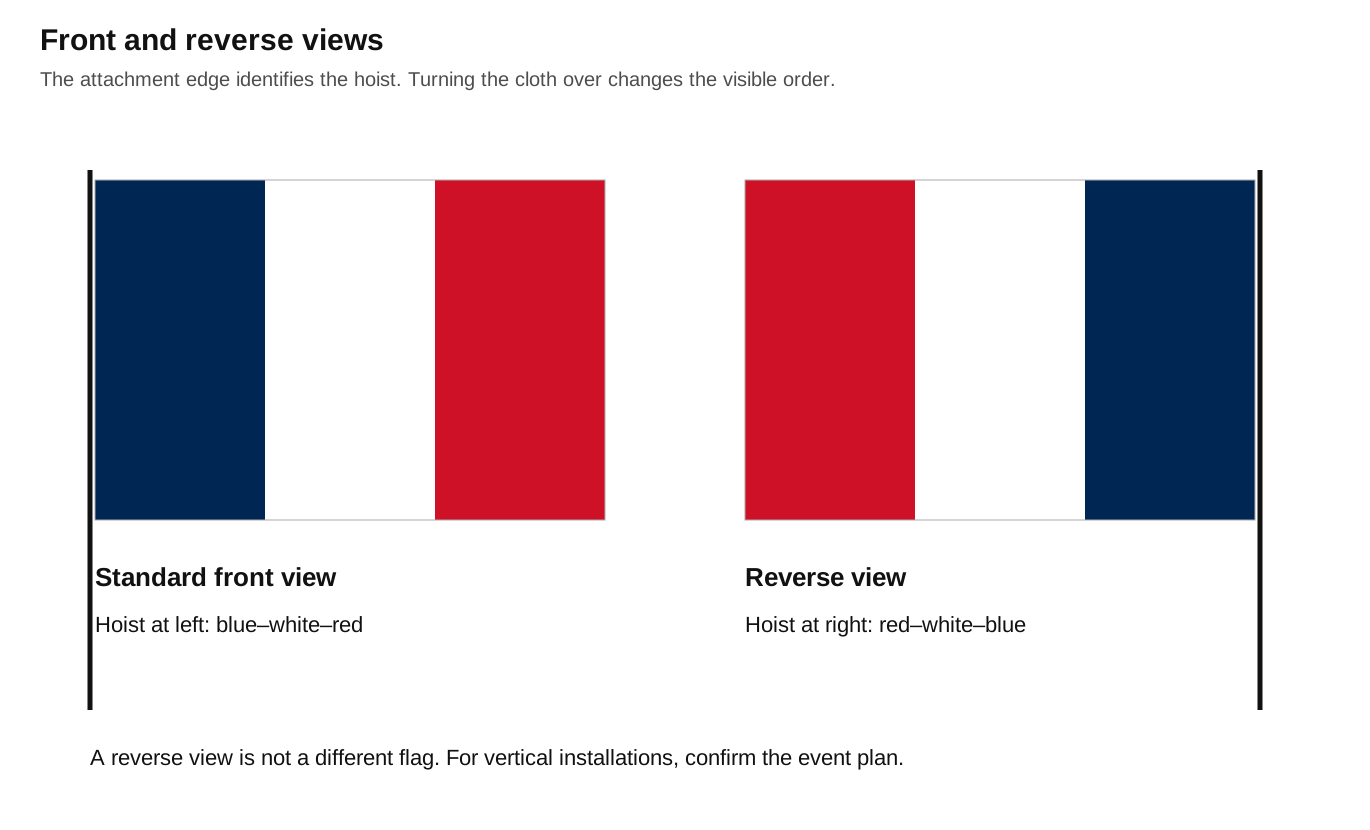
Seen from its standard front, the French flag reads blue, white, red from left to right, with blue attached to the pole. Seen from behind, the order appears reversed while blue remains beside the same pole. This is a view of the cloth, not a new flag design.
GKBook composition, CC0; underlying flag references, public domain.Download image
In the Ministry of the Armed Forces’ public-building guidance, the French flag is to the viewer’s right and the European flag to the viewer’s left. The gray labeled panel is only a position marker. It is not a substitute flag or a drawing of the European emblem.
GKBook composition, CC0; underlying flag references, public domain.Download image
French civil guidance calls for lowering the flag to about the middle of its mast for mourning. If the fitting cannot be lowered, it specifies a black ribbon at the top of the mast. The position is schematic; specialized military ceremonies can have more detailed instructions.
GKBook composition, CC0; underlying flag references, public domain.Download image
France uses vertical blue, white, and red. Italy substitutes green for the blue hoist band. The Netherlands uses horizontal red, white, and blue, with red above white above blue. The actual reference proportions are preserved instead of rotating or recoloring one flag to stand for another.
GKBook composition, CC0; underlying flag references, public domain.Download image
French and European flags at a joint press appearance by Antony Blinken and Stéphane Séjourné in Paris on April 2, 2024. The French flag is partly folded. This photograph documents diplomatic use; it is not a flat construction drawing or a calibrated color sample.
Photograph: Chuck Kennedy / U.S. Department of State, public domain. Full selected frame retained; resized and converted to WebP.Download image
Crowds on the Champs-Élysées in Paris on August 26, 1944, after the city’s liberation, with a large French tricolor hanging inside the Arc de Triomphe. This is a digitized historical color photograph in a restored Commons version, not a newly generated scene.
Photograph: Jack Downey / U.S. Office of War Information; Library of Congress, public domain. Commons restoration contributors; Full selected frame retained; resized and converted to WebP.Download imageFrequently asked questions
What does France’s national flag look like?
France’s national flag is a tricolor with three equal vertical bands: blue at the hoist, white in the center, and red at the fly. The usual rectangular reference is three units wide and two units high. The plain national design has no arms, lettering, stars, or central badge.
Which side of the French flag is blue?
Blue belongs at the hoist, the edge attached to the pole or halyard. In the standard front-view illustration, blue appears on the left, white in the middle, and red on the right. Looking at the reverse of the same cloth naturally reverses that visible left-to-right order.
What colors and HEX codes does the French flag use?
France’s national colors are blue, white, and red. The supplied dark-blue illustration uses #002654, #FFFFFF, and #CE1126 respectively. These are the actual digital fills in this reference, not a universal textile specification enacted by Article 2. Printed and woven flags require an appropriate physical color reference and proof.
Why do French flags sometimes have different shades of blue?
French flags have appeared in both darker navy and lighter blue versions. A presidential decision made in 2020 returned selected official displays to a darker blue, and the change was widely reported in 2021. It did not introduce a new tricolor or require every existing flag to be replaced.
What do the French flag’s colors symbolize?
The official historical explanation connects blue and red with Paris and white with the monarchy. Their combination emerged during the French Revolution, first in cockades and then in flags. The tricolor consequently represents the nation and Republic, while its individual colors retain those historical associations rather than separate legally assigned virtues.
Do blue, white, and red mean liberty, equality, and fraternity?
Liberty, equality, and fraternity are the French Republic’s motto, but assigning one word to each stripe is not the official historical account of the colors. Article 2 identifies both the tricolor and the motto without establishing a stripe-by-stripe correspondence. Treat that popular matching exercise as interpretation, not a prescribed origin.
What are the proportions of the French flag?
The ordinary French flag has three equal vertical bands, commonly arranged in a rectangle with a width-to-height ratio of 3:2. On that drawing, each band is one unit wide and two units high. Article 2 of the present Constitution specifies the colors but does not state the outer ratio.
Why does the French naval ensign have unequal bands?
France’s naval ensign follows a maritime convention in which blue, white, and red occupy 30%, 33%, and 37% of the width. A government answer in the Senate confirms this exception and refers to an 1836 measurement table. It must be distinguished from the ordinary national flag’s three equal bands.
What sizes can a French flag have?
The common 3:2 format scales to many sizes, including 90 by 60 centimeters and 150 by 100 centimeters. Each national band remains one-third of the width. These are calculated examples rather than compulsory retail sizes; the mounting system, wind exposure, and material determine practical choices for a particular installation.
How did the French tricolor develop?
The French tricolor grew out of Revolutionary cockades and maritime flags. Blue, white, and red were placed in the familiar order in 1794. White returned during the Bourbon Restoration, and the tricolor returned in 1830. Later political and constitutional changes retained the design while adding new historical associations.
How did the tricolor cockade become associated with France?
Blue and red cockades appeared in Revolutionary Paris in 1789, and white was combined with them in the emerging national symbol. The story that Lafayette personally created the combination for Louis XVI is traditionally repeated, but official accounts acknowledge uncertainty. A cockade is a wearable rosette, distinct from a rectangular flag.
When was the French flag adopted?
February 15, 1794 is the key adoption date for the familiar blue–white–red order, with blue at the hoist. In the Revolutionary calendar, this was 27 Pluviôse, Year II. The decision predates today’s Constitution and National Day law; later restorations of the tricolor do not erase that earlier milestone.
Why did France use a white flag before returning to the tricolor?
White was associated with the Bourbon monarchy and returned during the Restoration after Napoleon’s first fall. The tricolor’s history therefore includes interruptions rather than uninterrupted use from 1794 onward. Following the July Revolution of 1830, the blue–white–red flag returned under Louis-Philippe and remained a central national symbol.
Why was the tricolor retained in 1848?
During the February Revolution of 1848, some revolutionaries favored a red flag. Alphonse de Lamartine defended retaining the tricolor, which remained the national emblem. The episode helps explain how a flag that had served earlier regimes continued into the new republic instead of being replaced simply because the government changed.
What does the Cross of Lorraine on a French flag mean?
A tricolor bearing the Cross of Lorraine is associated with Free France and resistance during the Second World War. The symbol was adopted in the Free French naval setting in 1940 and appeared in several forms. It is a historical addition, not part of today’s plain three-band national flag.
Who designed the French flag?
The French flag developed through Revolutionary political decisions and earlier tricolor symbols, rather than through a securely documented single inventor. Jacques-Louis David is traditionally linked to the arrangement adopted in 1794, but the Élysée describes that attribution as a legend. Lafayette’s cockade association is also different from designing the finished flag.
How should a French national flag be made or printed?
Begin with three equal vertical bands and keep blue at the attachment edge. Preserve the chosen outer proportions and keep the plain national design free of added emblems. For physical production, confirm the required color reference, fabric, seams, and fittings with the supplier; a monitor image alone cannot certify textile colors.
Does France have a separate national flag with a coat of arms?
The ordinary French national flag is the plain blue–white–red tricolor. Military unit colors, historical Free France flags, naval ensigns, and other institutional standards can have particular markings or proportions. Those distinct objects should not be presented as optional decorations on a general national flag or as one interchangeable coat-of-arms version.
When must French public buildings display the flag?
Official instructions govern flag display on public buildings for national ceremonies, visits by foreign heads of state, and mourning. These directions are transmitted through the state’s administrative chain. Schools also have specific statutory requirements. Outside such obligations, local authorities can initiate displays, while private buildings may be decorated voluntarily.
When is France’s National Day?
France’s National Day is July 14, established as an annual national holiday by the law of July 6, 1880. Its historical explanation embraces both the storming of the Bastille in 1789 and the Festival of the Federation in 1790. It is distinct from the flag-order decision of February 15, 1794.
Which commemorative days involve the French flag?
French flag displays accompany National Day and a wider calendar of commemorations, including May 8 and November 11. The defense ministry’s recurring commemorative calendar contains eleven national occasions, with an additional customary tribute to Jean Moulin. Instructions for each occasion determine public-building display; this is not a universal private-household schedule.
Are French and European flags required at schools?
French education law requires the national and European flags, together with the Republic’s motto, on the facades of public schools and secondary schools and their contracted private counterparts. A separate provision covers classroom displays, including both flags, the motto, and the national anthem’s words. These are specific educational requirements.
Where does the French flag go beside the European flag?
The defense ministry’s public-building guide places the French flag in the position of honor, to the viewer’s right when facing the building, with the European flag on the viewer’s left. That viewpoint matters: heraldic and observer descriptions can differ. More complicated groups of flags need the applicable event arrangement.
How should the French flag be oriented?
For the ordinary horizontal flag, keep blue at the hoist and red at the free outer edge. The standard front-view drawing reads blue, white, red from left to right. A reverse view is naturally mirrored. For a vertical hanging installation, confirm the intended attachment and viewing arrangement before preparing the textile.
What happens when the French flag is raised ceremonially?
Flag raising can form part of a ceremony with commands, music, and respectful attention from those present. The precise sequence depends on the institution and occasion. The national-service ceremony guide describes careful handling and coordinated raising, but a particular youth or military sequence should not be imposed on every civilian display.
What time should the French flag be raised and lowered?
There is no single everyday clock schedule established here for every French private flag. Public-building instructions specify the relevant occasion, and government guidance recommends installing commemorative displays the previous evening and removing them the following day. Military colors and organized ceremonies follow their own schedules, which should not be generalized nationwide.
How is the French flag displayed for mourning?
French civil guidance describes lowering the flag to about the middle of its mast for mourning. If lowering is technically impossible, a black ribbon is tied at the top of the mast. Official instructions determine the occasion and duration; local authorities can also initiate mourning displays within their responsibilities.
Is half-mast display the same as covering a coffin with the flag?
Half-mast display concerns the flag on a mast, while a flag-covered coffin is a separate funeral honor. Eligibility and arrangements depend on the relevant funeral or institutional rules. A building’s mourning instruction should not be treated as automatic authorization for every ceremonial use of the tricolor at a funeral.
Does French law protect the national flag?
French criminal law protects the national flag in specified circumstances. One provision covers public outrage at events organized or regulated by public authorities; another covers certain intentional degrading acts liable to disturb public order. The legal conditions matter, so it is inaccurate to describe every criticism or misuse as the same automatic offense.
Can the French flag be used in a logo or on merchandise?
Reproducing a simple flag image and registering a flag-based trademark are different questions. The Paris Convention protects state flags against unauthorized use or registration as trademarks, while other national-symbol and advertising rules may apply. Public-domain artwork does not establish official endorsement or guarantee that a particular commercial mark is acceptable.
How should a French flag be cared for?
Keep the flag clean, intact, and securely attached, replacing a badly faded or damaged example when appropriate. Follow the manufacturer’s washing and drying instructions and store the cloth dry. A historically significant flag may require conservation advice. Practical care should not be confused with an invented universal French folding or disposal ritual.
How is France’s flag different from Italy’s and the Netherlands’ flags?
France uses vertical blue, white, and red bands. Italy also has vertical bands but uses green at the hoist instead of blue. The Netherlands has horizontal bands, with red above white above blue. Compare both color and direction; rotating the French flag does not produce an accurate Dutch reference.
What do the historical and diplomatic flag photographs show?
The historical photograph shows a French tricolor at the Arc de Triomphe in Paris on August 26, 1944, after liberation. The contemporary image shows French and European flags at a Paris press appearance on April 2, 2024. Both document real use, while fabric folds and lighting limit geometric or color comparisons.
What is the France flag emoji?
The France flag emoji is 🇫🇷, formed from the regional indicator letters F and R: U+1F1EB and U+1F1F7. Its appearance depends on the platform, application, and font. Some systems show the letters instead of a flag; use the supplied SVG or PNG when accurate geometry and colors are required.
What are common mistakes about the French flag?
Common mistakes include putting red at the hoist, using horizontal bands, treating the naval proportions as the ordinary national design, and assigning a constitutional virtue to each stripe. Other errors confuse July 14 with the 1794 adoption decision or describe the recent darker presidential blue as an entirely new national flag.
Which French flag files are available to download?
The page provides a scalable national SVG, a 3600-by-2400 PNG, construction and comparison sheets, a naval ensign drawing, a Free France historical reconstruction, and display diagrams. It also includes two documented photographs. Each gallery subject has a caption, plain-text credit, and a download hosted within the same website.
What is the French flag called?
The French flag is commonly called the tricolor, or le drapeau tricolore in French, referring to its three colors. The expression bleu, blanc, rouge names their order. These descriptive terms identify the national emblem; they do not mean that every three-colored flag elsewhere is a version of France’s flag.
Does the French national flag contain Marianne or a rooster?
The plain French national flag contains only its three vertical color bands. Marianne, the Gallic rooster, the republican emblem, and military inscriptions belong to other symbols or particular uses. Adding any of them changes the plain reference and should not be presented as a required part of the ordinary national flag.
Does the French naval pennant use the same widths as the ensign?
No. The government’s explanation distinguishes the naval ensign from the commissioning pennant. It gives the ensign as 30% blue, 33% white, and 37% red, but the pennant’s color lengths as 20%, 20%, and 60%. Those allocations concern different maritime objects and should not be mixed into the national flag’s equal thirds.
Is February 15 France’s National Day or a separate Flag Day?
February 15 marks the 1794 decision establishing the familiar flag order. France’s National Day is July 14, under the 1880 law. The official sources reviewed here do not establish February 15 as a separate recurring national Flag Day, so the adoption anniversary should not be labeled as one.
Was the Paris liberation photograph taken on the flag’s adoption date?
No. The Paris photograph dates to August 26, 1944, long after the tricolor’s 1794 adoption milestone. It records celebrations after the city’s liberation and shows the flag in historical use. The image date, the liberation event, and the original flag decision are separate facts that should not be combined.
Why is blue placed next to the pole?
The Revolutionary decision of February 15, 1794 fixed the order with blue at the hoist, white in the middle, and red at the fly. That documented arrangement explains today’s identification rule. Claims that the position was chosen for one specific psychological effect or modern political slogan require separate evidence.
Does the European flag replace the French flag?
No. The French tricolor remains the national emblem. The European flag can accompany it, and French schools have specific requirements for displaying both. Government protocol also addresses Europe Day on May 9. Joint display represents separate national and European symbols, rather than a replacement or a fourth color added to France’s flag.
Explore all general-knowledge topics and the A-to-Z lists.


We Value Your Opinion Comments