
Finland flag picture
Explore the construction sheet, the official variants, and the historical sequence.

| Country | FinlandRepublic of Finland, in Northern Europe. |
|---|---|
| Design | Blue Nordic cross on whiteThe upright bar sits nearer the hoist; the national flag has no arms. |
| Proportions | 18:11 width:heightHorizontal units 5:3:10; vertical units 4:3:4. |
| Adopted | May 29, 1918Parliament approved the blue-cross design on May 28. |
| Designers | Eero Snellman and Bruno TuukkanenThe artists prepared the adopted blue-cross design. |
| National colors | Blue and whitePantone 294 C is a legally recognized approximation for the blue. |
| Flag Day | Midsummer DaySaturday between June 20 and 26; distinct from December 6. |
| State forms | Arms added at the cross intersectionRectangular state, swallow-tailed military, and presidential forms. |
The national flag dates to 1918. Arms distinguish state forms, while Midsummer Flag Day and December 6 Independence Day are separate observances.
What is the flag of Finland?
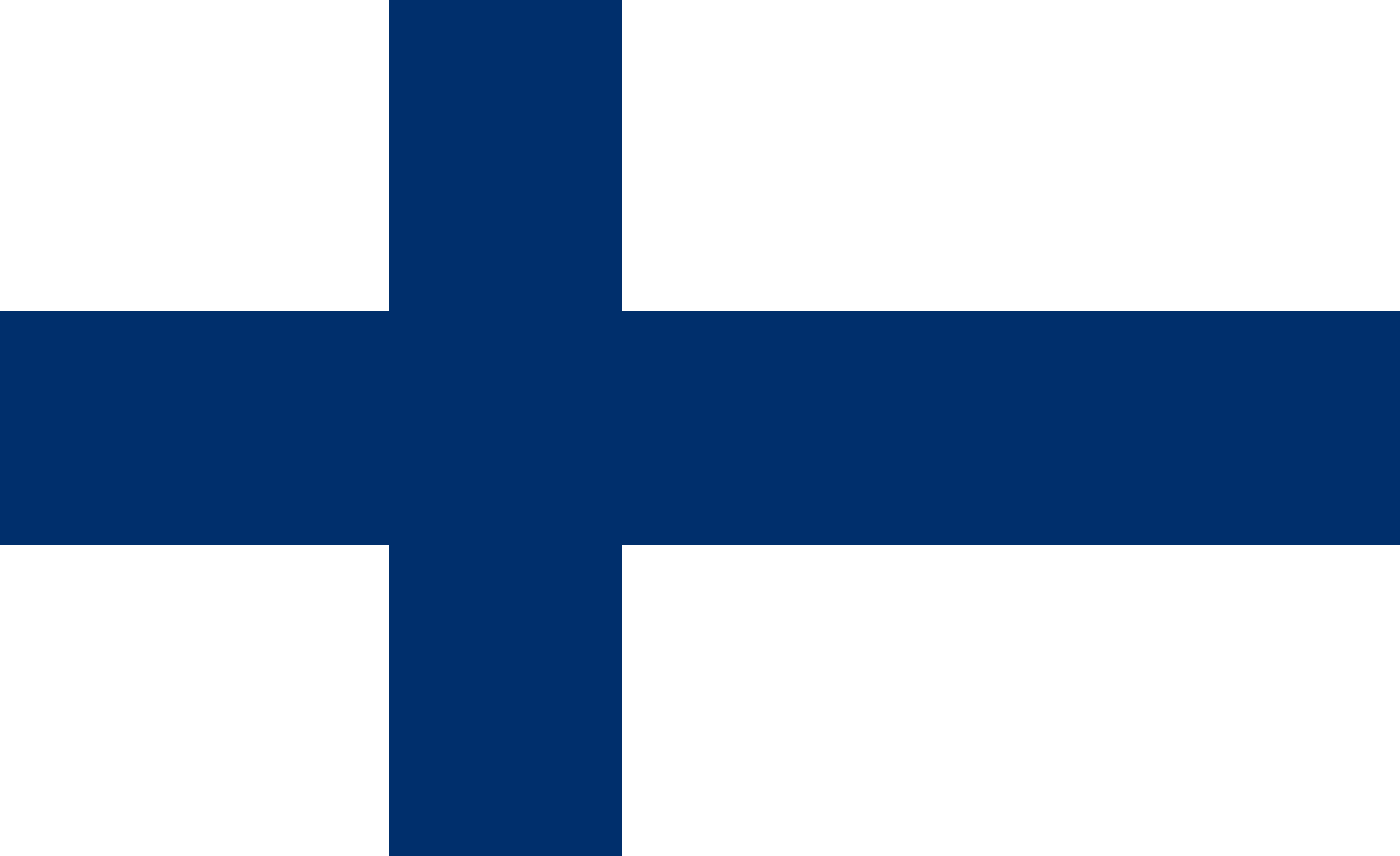
Finland’s national flag is a white rectangle bearing a blue Nordic cross. The upright crossbar is closer to the hoist, leaving longer white panels toward the fly. Its width-to-height ratio is 18:11. The ordinary national flag contains no coat of arms, lettering, stars, or separate corner emblem.
The Republic of Finland is a Northern European country. Its national flag is recognizable through a restrained combination of two colors and a cross shifted toward the pole. The current design belongs to the period immediately after independence, rather than to the later date of the present Flag Act.
The blue cross on white is the flag available for general national use. A lion-bearing Finnish flag is usually a state variant or a historical illustration. Explore the measured construction, official forms, and downloadable pictures.
What are the flag’s identifying features?
The Finnish flag uses a blue cross whose two bars have equal thickness. Its upright bar is offset toward the hoist instead of standing at the rectangle’s center. The white fly-side panels are twice as wide as the hoist-side panels, producing the recognizable Nordic cross arrangement.
Both blue bars are the same thickness. The horizontal bar lies midway between the top and bottom edges, but the upright bar sits toward the hoist. That distinction is the key to drawing the design accurately.
The hoist is the attachment side; the fly is the free outer side. In the standard front-view drawing, the hoist is at the left. The fly-side white panels are twice the width of the hoist-side panels, while all four have the same height.
Do not move the cross intersection to the center of the whole rectangle. Its center is 6.5 units from the hoist, compared with the flag’s overall midpoint at 9 units.
What colors and numerical specifications apply?
Finland’s national flag is blue and white. The legal color decision specifies measured color values and recognizes Pantone 294 C and NCS 4060-R90B as blue approximations. The supplied digital national flag uses #002F6C and #FFFFFF; these screen values are not themselves the statutory textile color measurements.
| Use | Color | Recognized Pantone approximation | Recognized NCS approximation |
|---|---|---|---|
| National and state flags | Blue | 294 C | 4060-R90B |
| Arms on state variants | Red | 186 C | 1090-Y90R |
| Arms on state variants | Yellow / gold | 123 C | 0080-Y20R |
| Color | L* | a* | b* |
|---|---|---|---|
| Blue | 29.06 | 7.24 | −36.98 |
| Red | 39.4 | 59.0 | 29.6 |
| Yellow | 73.4 | 14.8 | 79.0 |
The decision also gives chromaticity and luminance values and a maximum color difference of four CIE 1976 ΔE*ab units. These are production measurements under specified conditions. A designer should not treat a monitor screenshot as a physical color standard.
| Delivered illustration | Color | HEX | RGB |
|---|---|---|---|
| National flag | Blue | #002F6C | 0, 47, 108 |
| National flag | White | #FFFFFF | 255, 255, 255 |
| Current state references | Red | #D21034 | 210, 16, 52 |
| Current state references | Yellow / gold | #FFC726 | 255, 199, 38 |
The screen palette and the statutory specification answer different questions. These HEX values document the actual files; they are not additional legal color standards. Historical reconstructions are also not proof of the exact appearance of an old fabric.
CMYK values depend on the printing profile, ink, and material. Use a physical proof for textile or print production rather than inventing one universal four-number conversion.
What do the colors and cross represent?
The familiar explanation connects the Finnish flag’s blue with lakes and its white with winter snow. Finland’s official country-information service relates that interpretation to the nineteenth-century writer Zacharias Topelius. These associations explain the two national colors; they do not assign a separate meaning to each white rectangle.
The lakes-and-snow explanation is supported by Finland’s official country-information service. It connects the colors with Topelius’s nineteenth-century writing and the natural landscape. This association predates adoption of the independent republic’s flag.
The cross identifies a design family shared across the Nordic region. A geometric description and a symbolic interpretation should remain distinct: the Flag Act prescribes the cross’s shape and placement, while the familiar landscape interpretation explains the choice of colors.
No separate meaning is assigned here to four white panels, a particular compass direction, or an invented list of four national virtues.
How does the Nordic cross relate to neighboring flags?
Finland’s flag belongs to the Nordic cross family, whose upright crossbar is shifted toward the hoist. This layout connects its appearance with neighboring Nordic flags while blue on white makes the Finnish design distinct. The shared cross form does not mean that the countries use identical dimensions or colors.
The shared arrangement is an upright and horizontal cross whose intersection lies toward the hoist. Finland, Sweden, and Iceland can therefore look structurally related even though their fields, cross colors, and proportions differ.
Recognition depends on the complete combination. Finland’s white ground and single blue cross differ from Sweden’s blue ground and yellow cross, and from Iceland’s red cross outlined in white on blue. The comparison diagram preserves those differences.
How is the Finnish flag constructed?
Finland’s national flag measures 18 units wide and 11 units high. From hoist to fly, the divisions are 5, 3, and 10 units; from top to bottom, they are 4, 3, and 4. Both crossbars are 3 units thick, and every measurement scales by the same factor.
| Measurement | Units | At 1800 × 1100 pixels |
|---|---|---|
| Overall width | 18 | 1800 |
| Overall height | 11 | 1100 |
| Hoist white-panel width | 5 | 500 |
| Crossbar thickness | 3 | 300 |
| Fly white-panel width | 10 | 1000 |
| Upper and lower white-panel height | 4 each | 400 each |
| Cross-intersection center | x = 6.5; y = 5.5 | x = 650; y = 550 |
The vertical bar runs from x = 5 to x = 8 units, and the horizontal bar from y = 4 to y = 7. Their overlap is a 3-by-3 square. The outer ratio alone is insufficient: a centered cross or narrower crossbars would still produce the wrong design.
Scale every coordinate uniformly. At half the illustrated width, all distances halve, producing a 900-by-550 image. The explanatory guide marks are not part of the flag.
What sizes and pole proportions are suitable?
The Ministry of the Interior recommends a flag height of about one-sixth of the pole height. Its width then follows the national 18:11 ratio. For a six-meter pole, that suggests roughly one meter high and 1.64 meters wide. This is guidance, not a compulsory national size class.
A flag 110 centimeters high is 180 centimeters wide. A flag 55 centimeters high is 90 centimeters wide. These convenient examples follow directly from the ratio and do not establish required retail sizes.
For a pole, begin with the recommended height relationship, then calculate the width. A six-meter pole suggests a flag about one meter high; 18 divided by 11 gives a width of approximately 1.64 meters. Mounting strength, wind exposure, and material remain practical installation choices.
How did Finland’s flag develop?
Finland’s flag history includes the older lion arms, nineteenth-century debate over national colors, a red lion flag during early independence, and the blue-cross design adopted in May 1918. Later changes concerned state-flag details and legislation. They should not be mistaken for the first adoption of the national blue cross.
An early surviving arms display
Finland’s lion arms appear on Gustav Vasa’s tomb monument in Uppsala.
Student celebration in Helsinki
A white student flag with the arms appears at the Toukola festival.
Blue and white in national debate
Topelius associates the colors with Finland’s landscape.
Independence and the red lion flag
The red lion flag appears at the Government Palace.
Blue-cross design adopted
Parliament approves the design on May 28; the law follows May 29.
State-flag details revised
The early state-flag arms arrangement is changed.
A later Flag Act
Act 380/1978 replaces the 1918 law; the blue-cross identity continues.
Color decision and commencement
Decision 827/1993 takes effect on January 1, 1995.
Updated display provisions
The amended decree expressly includes county elections.
The timeline distinguishes the history of the arms, debate about national colors, adoption of the national flag, and later legislation. A country’s emblem can be older than the flag carrying it, and a new law can preserve a much older design.
What preceded the blue-cross national flag?
A red flag bearing Finland’s lion arms appeared at the Government Palace when independence was declared on December 6, 1917. It served as a semi-official state symbol during the first months of independence. The blue-cross national flag followed in May 1918, after debate over the new country’s colors.
Before 1809, the territory of present-day Finland was part of Sweden. It then became an autonomous grand duchy in the Russian Empire. Finland had its own lion arms, while an independent national flag remained a later development.
The 1848 student celebration at Toukola in Helsinki is an early milestone: the university student union used a white flag bearing the arms. Blue and white gained attention in later nineteenth-century debate and appeared in private and yachting contexts.
At independence in December 1917, red and gold from the arms remained plausible national colors. The red lion flag served during the first months, but the Civil War made color choices politically charged. The eventual blue-white solution was part of the effort to settle a national design.
The supplied red lion image is a reconstructed historical reference. Its file metadata contains inconsistent dates; the chronology here follows the Finnish government’s history, not an erroneous image-page replacement date.
When did the blue-cross design become Finland’s flag?
Parliament approved the blue-cross design on May 28, 1918, and the flag law was issued on May 29. May 29, 1918, is therefore the adoption date used here. Finland’s independence date, December 6, 1917, and the later Flag Act of 1978 are separate historical and legal milestones.
The 1918 decision came after independence and the Civil War. The parliamentary approval date and the date of the law are consecutive events, not competing answers to the same question. The adopted design is associated with May 29 because that is the date of the flag law.
The government’s centennial account places approval on May 28 and Senate confirmation the following day. The later Flag Act also identifies the repealed predecessor as the law of May 29, 1918. Those mutually supporting records determine the date used in the infobox.
The red lion flag had represented early independence; the blue cross became the lasting national design. A historical illustration of a state form should not be substituted for the plain national flag adopted in that period.
What changed after the 1918 adoption?
The Flag Act of 1978 established the later legal framework and replaced the 1918 Act. It did not make 1978 the first appearance of Finland’s blue-cross national flag. State-flag artwork and legal provisions changed over time, while the national flag’s basic blue-on-white identity continued from the 1918 adoption.
State-flag details were revised in 1920. The earlier reconstruction includes an additional crown above the shield, whereas the current state flag places the arms in a gold-bordered square at the cross intersection. The lion inside Finland’s present arms remains crowned.
The 1978 Act replaced the original law and set out the national, state, military, and presidential forms. The color decision made in 1993 took effect in 1995. Neither date should displace 1918 as the national flag’s adoption year.
Later amendments also update institutional names and display rules. The version of the flag-flying decree effective January 1, 2026, expressly includes county elections in its election provision; this is a legal update, not a newly designed flag.
Who designed Finland’s adopted flag?
The adopted blue-cross design is credited to artists Eero Snellman and Bruno Tuukkanen. They worked within the wartime drawing-office setting associated with Akseli Gallen-Kallela. Zacharias Topelius helped popularize blue and white decades earlier, but promoting the colors and preparing the adopted 1918 flag design are different contributions.
Snellman and Tuukkanen prepared the blue-cross design in the drawing-office environment led by Akseli Gallen-Kallela. The official centennial account describes Snellman completing the proposal with Tuukkanen while Gallen-Kallela was away. It supports joint credit for the adopted flag, rather than naming only the best-known artist connected with the office.
Topelius’s earlier role concerned the national colors and their landscape associations. J. V. Snellman, honored on a customary flag day, is also a different person from the flag artist Eero Snellman.
Historical design credit is separate from modern vector authorship and from sewing a particular ceremonial textile. The evidence used here does not identify a verified maker of the first national flag cloth.
How should a Finnish flag be made or printed?
Reproduce Finland’s national flag by keeping the 18:11 rectangle, equal three-unit crossbars, and the correct five-unit hoist and ten-unit fly panels. Use a suitable blue color proof for the material. Preserve the plain white field and distinguish the national design from state flags that carry the arms.
Keep the statutory design
- Use the 18:11 rectangle and the 5:3:10 / 4:3:4 grid.
- Keep both crossbars equally thick.
- Check the blue against an appropriate physical color reference.
- Keep the national flag free of the state arms and added lettering.
- Confirm the finished cloth’s orientation and attachment edge.
Avoid misleading substitutions
- Do not center the upright crossbar.
- Do not stretch one dimension independently.
- Do not choose a state or presidential form for ordinary private display.
- Do not treat a photograph as a calibrated color standard.
- Do not call an altered logo-bearing design an unchanged Finnish flag.
The Ministry explains that flag status is not confined to one material: a correctly proportioned, correctly colored representation can be a flag even on a sticker. The legislation does not prescribe one universal fiber or sewing method.
For outdoor cloth, seams, reinforcement, fastening, and durability need to suit the installation. These practical choices are separate from the exact proportions and color requirements.
What national and state flag forms does Finland use?
Finland distinguishes the plain national flag, the rectangular state flag with arms, the swallow-tailed state flag used by the Defense Forces, and the President’s flag. The President’s form adds the Cross of Freedom to the upper hoist. These are different official uses, not interchangeable decorative versions of the national flag.
| Form | Shape | Identifying addition | Use |
|---|---|---|---|
| National flag | 18:11 rectangle | No arms | Everyone may fly it; civilian national ensign |
| Rectangular state flag | 18:11 rectangle | Arms at cross intersection | State users specified by law |
| Swallow-tailed state flag | 19:11 bounding rectangle | Arms and three pointed tails | Defense Forces and their ships |
| President’s flag | 19:11 bounding rectangle | Arms, tails, and Cross of Freedom | President of the Republic |
Special yacht-club ensigns can be authorized separately. They should not be treated as ordinary state flags or reproduced by adding an arbitrary club badge to the national flag. The Flag Act distinguishes those approved special cases from unauthorized alterations.
Who uses the rectangular flag with the arms?
The rectangular state flag is for the state bodies and vessels specified in Finnish law. It adds the national arms at the blue cross intersection while retaining the 18:11 rectangle. The Ministry states that private individuals cannot be granted permission to fly this state form; everyone may fly the national flag.
The legal list includes Parliament, ministries and other specified state institutions, diplomatic missions, certain public bodies, and state vessels. Institutional names have been updated by amendments, so an old translated list should not be assumed to reproduce the current Act word for word.
The arms occupy the square where the two blue bars meet. A gold border encloses that square, with a thickness equal to one-fortieth of the crossbar width. On a 1800-by-1100 drawing, the crossbar is 300 pixels thick and the gold border is 7.5 pixels.
The presence of the arms does not make this a more ceremonial version freely available to every user. Private national display uses the plain blue-cross flag.
How is the swallow-tailed state flag constructed?
The three-pointed form is Finland’s swallow-tailed state flag, used by the Defense Forces and their ships. Its bounding dimensions are 19 units wide and 11 high, one unit longer than the rectangular flag. It carries the arms at the cross intersection and is distinct from the plain national flag.
The flag retains the 11-unit height but extends to a 19-unit overall width. Its white fly panels run six units beyond the upright crossbar before the tail construction; the tails extend five units. The central point is an isosceles triangle whose base equals the three-unit cross thickness.
The top and bottom outer edges remain straight. The two white outer points and the central blue point create a three-pointed fly. The downloadable reference preserves the detailed state arms and the legally described overall shape.
The Defense Forces’ Flag Day is June 4, the birthday of Marshal Mannerheim. It is distinct from the Day of the Finnish Flag at Midsummer.
How can the President’s flag be recognized?
The President’s flag uses the swallow-tailed state design and adds a blue-and-yellow Cross of Freedom in the upper-hoist white panel. The national arms remain at the main cross intersection. This legally specified identifying emblem distinguishes the presidential form from both the ordinary national flag and the military state flag.
Look first for the swallow-tailed state shape and arms at the cross intersection, then for the additional blue-and-yellow Cross of Freedom in the upper-hoist white panel. That extra emblem identifies the presidential form.
The Flag Act reserves this design for the President. The illustrated standard describes the office’s flag, without implying that any named current officeholder designed it. An educational illustration of the standard is also different from authorization to fly it as one’s own flag.
What details appear in the state flag’s arms?
Finland’s state-flag arms show a crowned gold lion on red, with an armored right foreleg holding a raised straight sword. The lion’s hind legs stand over a curved saber, and nine silver rosettes surround it. A gold border encloses the square placed at the blue cross intersection.
| Element | Identification |
|---|---|
| Lion | Crowned, gold, and upright on the hind legs |
| Right foreleg | An armored arm holding a raised straight sword |
| Under the hind legs | A curved saber |
| Field | Red with nine silver rosettes |
| Metal colors | Gold lion and selected fittings; silver blades and armor |
| Flag placement | Gold-bordered square at the blue cross intersection |
The Ministry traces an early surviving arms display to Gustav Vasa’s tomb monument in Uppsala, made in the 1580s. The exact origins of the emblem are less certain than its modern legal description.
The nine rosettes are part of that description. This article does not assign one to each of nine provinces without supporting evidence. The lion’s own crown is still present; it must not be confused with the additional crown above the shield in the early state-flag reconstruction.
Who may fly the national flag and on which occasions?
Everyone has the right to fly Finland’s national flag. Individuals may use it for celebrations and other suitable occasions, including days outside the official calendar. The legal flag-flying duty on official days concerns specified public buildings; it does not create a blanket requirement for every private household to display a flag.
The right to use the national flag belongs to everyone. It may mark birthdays, weddings, anniversaries, civic celebrations, and other appropriate occasions beyond the calendar’s named observances. The flag is not restricted to Finnish citizens alone.
Official flag days establish a duty for the premises specified in the decree, including buildings of state agencies and institutions and public buildings in Åland. Voluntary private display remains a different matter.
Use the ordinary national form unless an authorized role calls for another. Before a formal event, settle the pole layout, timing, and any applicable mourning direction.
When is Finland’s national Flag Day?
The Day of the Finnish Flag is Midsummer Day, the Saturday falling between June 20 and June 26. Its display period begins at 6 p.m. on Midsummer Eve and continues overnight until 9 p.m. on Midsummer Day. Independence Day is a different observance, held on December 6.
Midsummer Day is the Saturday between June 20 and 26. The special display period spans Midsummer Eve and the following day, so the flag remains raised through the short northern summer night.
The Day of the Finnish Flag is not the same as the Defense Forces’ Flag Day on June 4 or Independence Day on December 6. Each has a distinct reason and place in the official calendar.
The May 29 anniversary of the 1918 flag law is historically significant, but it is not substituted here for the recurring statutory Flag Day at Midsummer.
Which occasions are statutory flag-flying days?
Official flag-flying days include Kalevala Day, May Day, Mother’s Day, the Defense Forces’ Flag Day, Midsummer, Father’s Day, and Independence Day. The decree also covers specified elections, nationwide referendums, and the President’s inauguration. These statutory occasions should be distinguished from customary flag days and additional recommendations for particular events.
| Date or rule | Occasion |
|---|---|
| February 28 | Kalevala Day / Finnish Culture Day |
| May 1 | May Day / Finnish Labor Day |
| Second Sunday in May | Mother’s Day |
| June 4 | Defense Forces’ Flag Day; Mannerheim’s birthday |
| Saturday, June 20–26 | Midsummer Day / Day of the Finnish Flag |
| Second Sunday in November | Father’s Day |
| December 6 | Independence Day |
| Covered voting days | Parliamentary, presidential, county, municipal, and European Parliament elections; nationwide referendums |
| Inauguration day | The day the President takes office |
The voting provision expressly includes county elections in the current decree. The relevant election or referendum determines the applicable day; this table does not invent future election dates or extend the rule to every informal public vote.
Official flag-flying status and public-holiday status are separate categories. A date’s appearance in this table does not by itself determine shop hours, leave entitlement, or whether every workplace is closed.
Which customary flag days are recognized?
Customary flag days are established observances recognized in Finland’s flag calendar, but they belong to a different category from the official days listed in the flag-flying decree. They honor cultural figures, public causes, and remembrance. People may also fly the national flag on personal occasions without waiting for either category.
| Date or rule | Observance |
|---|---|
| February 5 | J. L. Runeberg Day |
| March 19 | Minna Canth Day / Equality Day |
| April 9 | Mikael Agricola Day / Finnish Language Day; also Elias Lönnrot’s birthday |
| April 27 | National War Veterans’ Day |
| May 9 | Europe Day |
| May 12 | J. V. Snellman Day / Finnish Identity Day |
| Third Sunday in May | Remembrance Day |
| July 6 | Eino Leino Day / Poetry and Summer Day |
| Last Saturday in August | Finnish Nature Day |
| October 1 | Miina Sillanpää Day / Civic Participation Day |
| October 10 | Aleksis Kivi Day / Finnish Literature Day |
| October 24 | United Nations Day |
| November 6 | Finnish Swedish Heritage Day |
| November 20 | Children’s Rights Day |
| December 8 | Jean Sibelius Day / Finnish Music Day |
The Ministry may also recommend flag-flying for state visits, notable events, or particular commemorations. A recommendation for one occasion does not automatically add a permanent official day to the decree.
The table distinguishes established customary observances from year-specific recommendations. It also keeps J. V. Snellman’s observance separate from Eero Snellman’s role in designing the flag.
What daily and seasonal flag-flying times apply?
Ordinary flag-flying begins at 8 a.m. and ends at sunset, no later than 9 p.m. Midsummer has continuous overnight display, and Independence Day ends at 8 p.m. Covered election days have an evening exception when voting closes after sunset. During polar night, the Ministry recommends 8 a.m. to 4 p.m.
| Situation | Raise | Lower |
|---|---|---|
| Ordinary flag-flying day | 8 a.m. | Sunset, no later than 9 p.m. |
| Midsummer | 6 p.m. on Midsummer Eve | 9 p.m. on Midsummer Day |
| Independence Day | 8 a.m. | 8 p.m. |
| Covered election day when polls close after sunset | 8 a.m. | 8 p.m. |
| Polar night recommendation | 8 a.m. | 4 p.m. |
Ordinary lowering follows sunset, subject to the 9 p.m. limit. It is not a blanket sunrise-to-sunset rule, because raising is specified at 8 a.m. The polar-night recommendation addresses the period when the sun does not rise.
State offices can have permitted practical variations, and vessels follow applicable maritime practice. A ceremony organizer should apply the relevant category instead of assuming every occasion follows one identical schedule.
How should Finland’s flag be arranged with other flags?
At a Finnish host event, Finland’s flag takes the place of honor, usually the viewer’s left in a simple front-facing arrangement. Foreign countries normally follow French alphabetical order. National flags should use equal pole and hoist heights; special Nordic arrangements and the event’s layout can require a more specific plan.
The usual place of honor is the heraldic right, meaning the viewer’s left when facing a simple line of flags. This does not justify raising Finland above visiting national flags: equal pole height and equal hoist height preserve equal presentation.
After the host flag, foreign countries normally follow French alphabetical order. Nordic events can use Scandinavian ordering; the Nordic Council has a specified order that also accommodates autonomous territories and the Council’s flag.
The Ministry’s broader precedence guidance distinguishes independent states, autonomous territories, international organizations, regional bodies, the Sámi flag, regional flags, associations, and companies. A semicircle, paired entrance, or central place of honor needs an arrangement suited to the actual site.
How should the flag’s front, reverse, and hanging position be handled?
For the usual horizontal front view, the shorter white panels belong beside the pole and the longer panels extend toward the fly. This places the upright blue bar nearer the hoist. The national flag has no lettering or arms to orient, but an incorrectly mirrored front-view illustration still reverses the layout.
When the flag is viewed from behind, the shorter panels naturally appear on the opposite side of the image. That physical reverse view differs from accidentally mirroring a front-view reference intended to show the hoist at the left.
For a vertical installation, determine how the attachment edge and the viewing side will be presented before production. The sources used here do not supply one universal special vertical redesign. Preserve the complete national geometry rather than moving the cross to make a convenient banner.
State flags also require the arms to be handled correctly. Their orientation should come from a suitable official master and the installation plan.
How is the Finnish flag lowered for mourning?
Raise the Finnish flag fully, then lower it until its lower edge reaches the midpoint of the pole. Before taking it down, raise it to the top again. This Ministry guidance uses the flag’s lower edge as the reference, not the center of the cloth or a guessed percentage of pole height.
The Ministry advises lowering the flag as soon as news of a death is received. If the news arrives late in the day, mourning display can be postponed until the following day. General national mourning may also be recommended after a major disaster or the death of a prominent person.
The measurement concerns the lower edge of the cloth. Setting the flag’s center at the midpoint, or using a generic two-thirds-height rule from another country, would not reproduce the stated Finnish guidance.
A house of mourning may use half-mast even on a customary or official flag day. This explanation describes the practice; it does not announce a current period of national mourning.
What happens to the flag after a funeral or at a memorial service?
On the funeral day, the flag remains at half-mast until the funeral service and burial have taken place. It is then raised fully for the rest of the flag-flying period. A memorial service uses full-mast display. The house of mourning may fly half-mast even on an official or customary flag day.
After the funeral service and burial, the flag is raised fully for the remaining display period. The Ministry explains this as a mark of honor. A memorial service is marked at full mast rather than by continuing the funeral-day half-mast position automatically.
Half-mast timing is separate from placing a flag on a coffin, folding a ceremonial textile, or presenting it to a family. This page does not invent a nationally required folding sequence or universal coffin orientation from the sources reviewed.
What does Finnish flag legislation require?
The main instruments are the Flag Act 380/1978, the flag-flying decree 383/1978, and the color decision 827/1993. They address design, authorized flag forms, display occasions, timing, and colors. The decree was amended with effect from January 1, 2026, including express coverage of county elections among the relevant voting occasions.
| Instrument | Main subject | Relevant distinction |
|---|---|---|
| Flag Act 380/1978 | Design, official forms, use, and offenses | Everyone may fly the national flag; state forms are reserved |
| Flag-flying decree 383/1978 | Official days, times, and precedence | Current text includes the amendment effective January 1, 2026 |
| Color decision 827/1993 | Measured colors and recognized approximations | Made in 1993; effective January 1, 1995 |
| Coat of Arms Act 381/1978 | The national arms | Separate heraldic definition used by state variants |
The Flag Act prohibits unauthorized additions and provides fines for specified conduct, including public disrespect, unauthorized use of reserved forms, and selling substantially incorrect designs as Finnish flags. It does not support an invented fixed euro penalty for every mistake.
The national flag’s civilian maritime role and approved special yacht-club ensigns are covered separately from military use. Permission to reproduce a public-domain drawing is also a different question from entitlement to fly a reserved official form.
The 2026 display amendment updates election wording and administrative provisions. The current consolidation of the Flag Act also updates state institutions. Neither change creates a new national design.
Can the flag or arms be used in business and design?
Commercial use of Finland’s flag is not generally forbidden. However, incorporating the flag or coat of arms into a registered trademark or protected design requires the Ministry’s permission under the relevant rules. A reusable public-domain image does not remove those national-symbol requirements or turn a product into an officially endorsed item.
The Ministry distinguishes ordinary commercial use from incorporating the flag or arms into a registered trademark or protected design. The latter requires permission. It would be inaccurate to turn that specific requirement into a claim that every advertisement or brochure always needs the same application.
The Ministry also identifies restrictions on selling a substantially altered emblem as Finland’s national arms. Official seals and reserved official flag forms have their own rules.
The downloadable educational files carry their own copyright and provenance information. Public-domain or CC0 status addresses reuse of that artwork; it does not declare an intended product officially approved or waive Finnish national-symbol rules.
How should a flag be maintained and retired?
Keep the flag clean, intact, and dry before storage, and follow the textile maker’s cleaning instructions. Check the free edge and hoist attachments for damage. These are practical care measures, separate from the legal design rules. A historically significant flag may need conservation advice before repair or disposal is considered.
Inspect blue fabric for fading and white areas for stains, and check the fly edge, seams, and fastening points. Follow the manufacturer’s washing and drying directions, especially when different materials are joined. Store the flag fully dry to reduce damage.
A badly damaged flag should be replaced for display. This article does not prescribe a universal burning ceremony, fixed number of cuts, or borrowed folding ritual as Finnish law. Disposal should be respectful and suitable for the material and local waste arrangements.
An old flag with documentary or family significance may deserve preservation. Photograph its condition and seek appropriate conservation advice before making irreversible repairs.
How can Finland’s flag be distinguished from similar Nordic flags?
Finland has a blue cross on white, Sweden a yellow cross on blue, and Iceland a red cross edged in white on blue. All use the Nordic cross arrangement, but their rectangle proportions differ. Color order, the presence of a border around the cross, and proportions provide useful identification clues.
At a distance, begin with the background: Finland is the white-field flag in this comparison. Then look for the plain blue cross. Iceland’s cross has a white edging around red, while Sweden’s is yellow against blue.
The references also have different ratios: Finland 18:11, Sweden 8:5, and Iceland 25:18. A shared cross layout does not justify copying a neighboring country’s drawing grid.
How do Åland and Sámi flags relate to the national flag?
Finland’s national flag, Åland’s flag, and the Sámi flag represent different identities and uses. Åland has its own flag and flag days under its autonomous arrangements. The Sámi have a distinct people’s flag and calendar. Neither should be described as merely an alternate color version of Finland’s national blue cross.
Åland’s autonomous arrangements include a distinct flag and calendar. The national flag article should acknowledge that identity without treating the regional flag as the Finnish national design with an optional addition.
The Sámi flag represents an Indigenous people across national borders. Its use and observances are a different subject from the rectangular and swallow-tailed Finnish state forms.
For joint displays, the relevant precedence guidance and event arrangement determine how different categories are presented. The existence of several recognized identities does not change the blue-cross national construction described above.
What does the accession photograph document?
The photograph records Finnish, NATO, and U.S. flags during Finland’s accession proceedings in Brussels on April 4, 2023. Finland became NATO’s thirty-first ally that day. The Finnish cloth is partly hidden and folded, so the image documents ceremonial use rather than supplying exact flag dimensions or calibrated colors.
The Finnish flag stands to the left in the image, partly behind a participant. NATO’s flag occupies the middle position in the photographed room, and a U.S. flag stands to the right. This event-specific indoor arrangement is not a universal Finnish outdoor precedence template.
Chuck Kennedy made the photograph for the U.S. Department of State. The complete frame is retained in both supplied sizes. Finland became NATO’s thirty-first ally on April 4, 2023; that historical description is not a claim about the alliance’s present total membership.
The image source’s prose contains a year typo. Its metadata and NATO’s dated accession report agree on 2023, which is the year used in the caption.
What is the Finland flag emoji and country sequence?
The Finland flag emoji is 🇫🇮, formed from the regional-indicator letters F and I. Its Unicode sequence is U+1F1EB followed by U+1F1EE. Supported platforms display the combined flag glyph; other environments may show letter symbols. Emoji artwork is convenient for text but is not a production drawing master.
The two regional indicators encode the country sequence FI. Their combination can display as a flag, but rendering depends on the operating system, application, and font. If a platform shows letters instead, the underlying sequence has not necessarily changed.
Use the supplied SVG or PNG when the exact cross placement, blue value, and proportions matter. A tiny emoji is a text symbol and can simplify or stylize the design.
Which common Finnish flag mistakes should be avoided?
Common mistakes include centering the upright crossbar, adding the arms to every Finnish flag, treating 1978 as the original adoption year, and confusing Midsummer’s Flag Day with Independence Day. Another error is placing the flag’s center at mid-pole for mourning when the Ministry’s guidance refers to its lower edge.
Keep the distinctions clear
- Offset cross: the upright bar is nearer the hoist, not centered.
- National versus state: the plain national flag has no lion arms.
- 1918 versus 1978: adoption predates the later Flag Act.
- May 28 versus May 29: parliamentary approval and the law are successive events.
- Three separate dates: June 4, Midsummer, and December 6 mark different observances.
- Measured color versus pixels: a HEX code is not a statutory textile measurement.
- Two kinds of crown: the lion remains crowned in today’s arms.
- Mourning position: the lower edge, not the center, reaches the pole midpoint.
- Different Snellmans: Eero designed the flag; J. V. has a customary flag day.
- Public-domain art: copyright status does not confer official-state use rights.
Which Finland flag images are available for download?
The page offers the plain national flag as SVG and PNG, along with explanatory diagrams and illustrations of official and historical variants. SVG suits scalable artwork; the PNG works in ordinary image software. Captioned teaching sheets include labels outside the flag and should be distinguished from the unannotated national design.
| File | Use | Download |
|---|---|---|
| Plain national SVG | Scalable national design, 18:11 | Download SVG |
| Plain national PNG | 3600 × 2200 pixels | Download PNG |
| Construction sheet | The legal unit grid | Download construction |
| Variant comparison | National, state, military, and presidential forms | Download comparison |
| Mourning diagram | The Ministry’s lower-edge position | Download diagram |
The gallery includes individual state variants, historical reconstructions, practical diagrams, and the documentary photograph. Each subject has a caption and plain-text credit. Repeated placements and responsive photo sizes do not inflate the gallery’s subject count.
The national PNG and SVG are plain flag designs. Teaching sheets add explanatory labels outside the design; historical reconstructions remain identified as such. A downloadable state variant is for study and does not grant permission to fly a reserved form.
Finland flag pictures

Finland’s national flag is a blue Nordic cross on white. The upright crossbar is nearer the hoist. The rectangle has a width-to-height ratio of 18:11 and carries no coat of arms.
GKBook composition, CC0; underlying flag references, public domain.Download image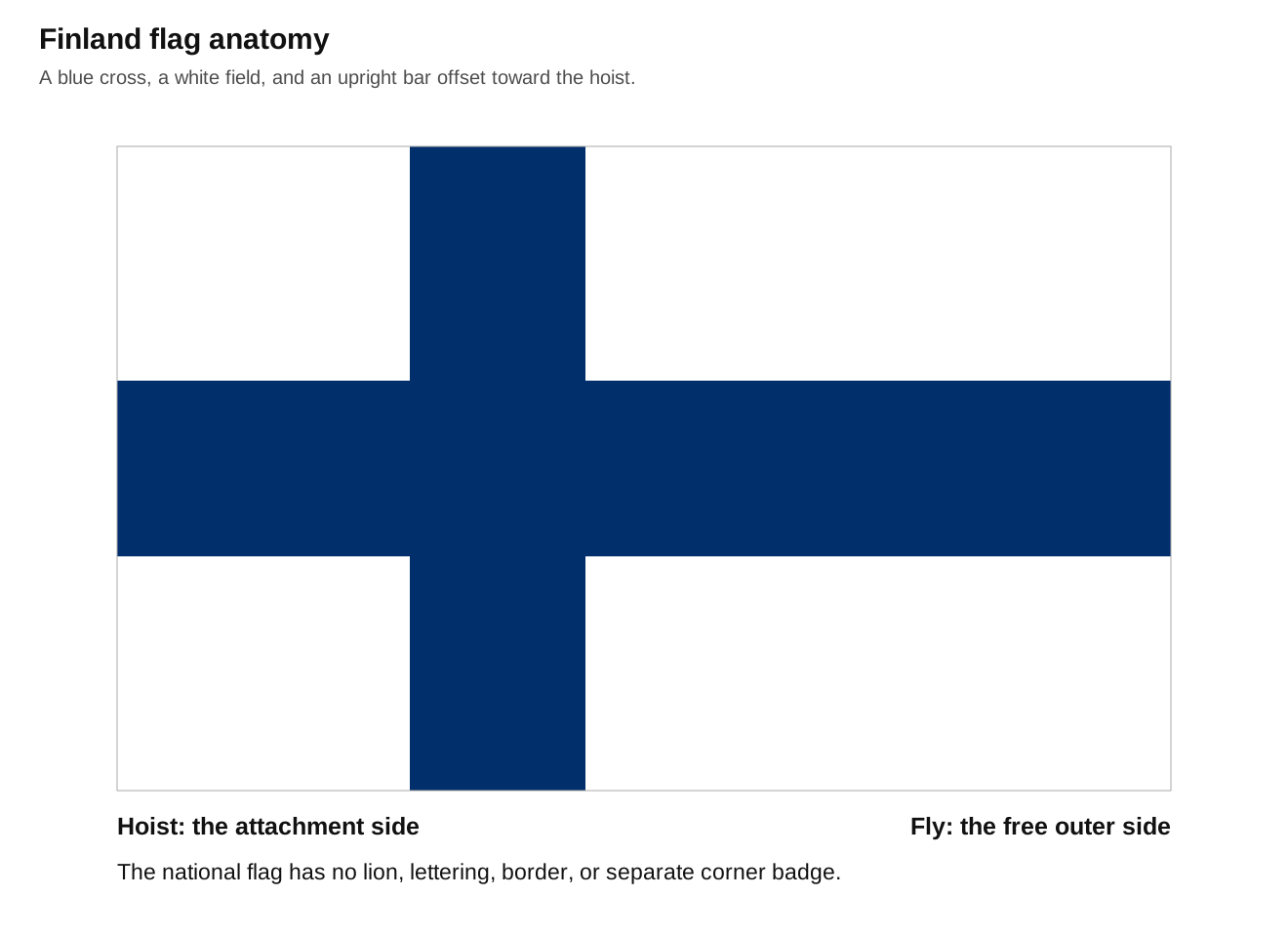
The blue horizontal bar meets an upright bar nearer the hoist. White rectangles on the fly side are twice as wide as those beside the hoist. The ordinary national flag contains no heraldic shield.
GKBook composition, CC0; underlying flag references, public domain.Download image
The Flag Act sets width 18 and height 11. Horizontal divisions are 5, 3, and 10 units; vertical divisions are 4, 3, and 4. Both crossbars are 3 units wide. Measurements sit outside the flag artwork.
GKBook composition, CC0; underlying flag references, public domain.Download image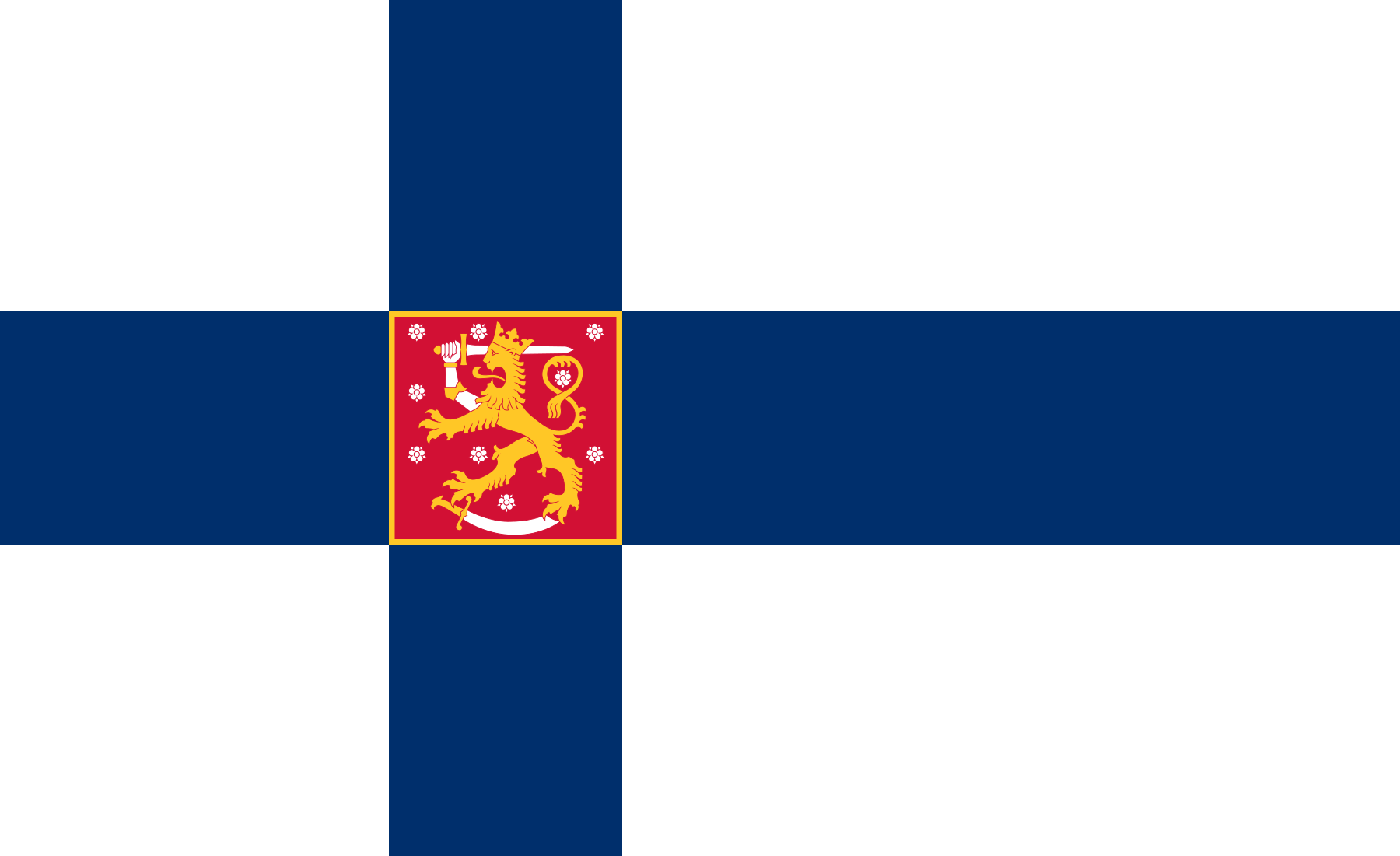
The rectangular state flag adds Finland’s arms in a gold-bordered square at the blue cross intersection. Its 18:11 form is reserved for the state users specified by law.
Vzb83 and Commons contributors, public domain; GKBook preparation, CC0.Download image
The swallow-tailed state flag has three points and a 19:11 bounding rectangle. The Finnish Defense Forces use this form, including on their ships. The arms remain at the cross intersection.
Denelson83 and Commons contributors, public domain; GKBook preparation, CC0.Download image
The President’s flag is the swallow-tailed state form with a blue-and-yellow Cross of Freedom in the upper hoist. It identifies the President’s flag and is not the ordinary national flag.
Hapo and Commons contributors, public domain; GKBook preparation, CC0.Download image
A modern reconstruction of the red lion flag associated with the first months of independence in 1917–1918. It is a historical illustration, not an archival textile photograph or the current national flag.
Ningyou and Commons contributors, public domain; GKBook preparation, CC0.Download image
A modern reconstruction of the 1918–1920 state flag with the earlier crowned arms arrangement. Historical colors and details are illustrative; this is not a calibrated photograph of an original textile.
Oraivio, Zscout370, Vzb83, and Commons contributors, public domain; GKBook preparation, CC0.Download image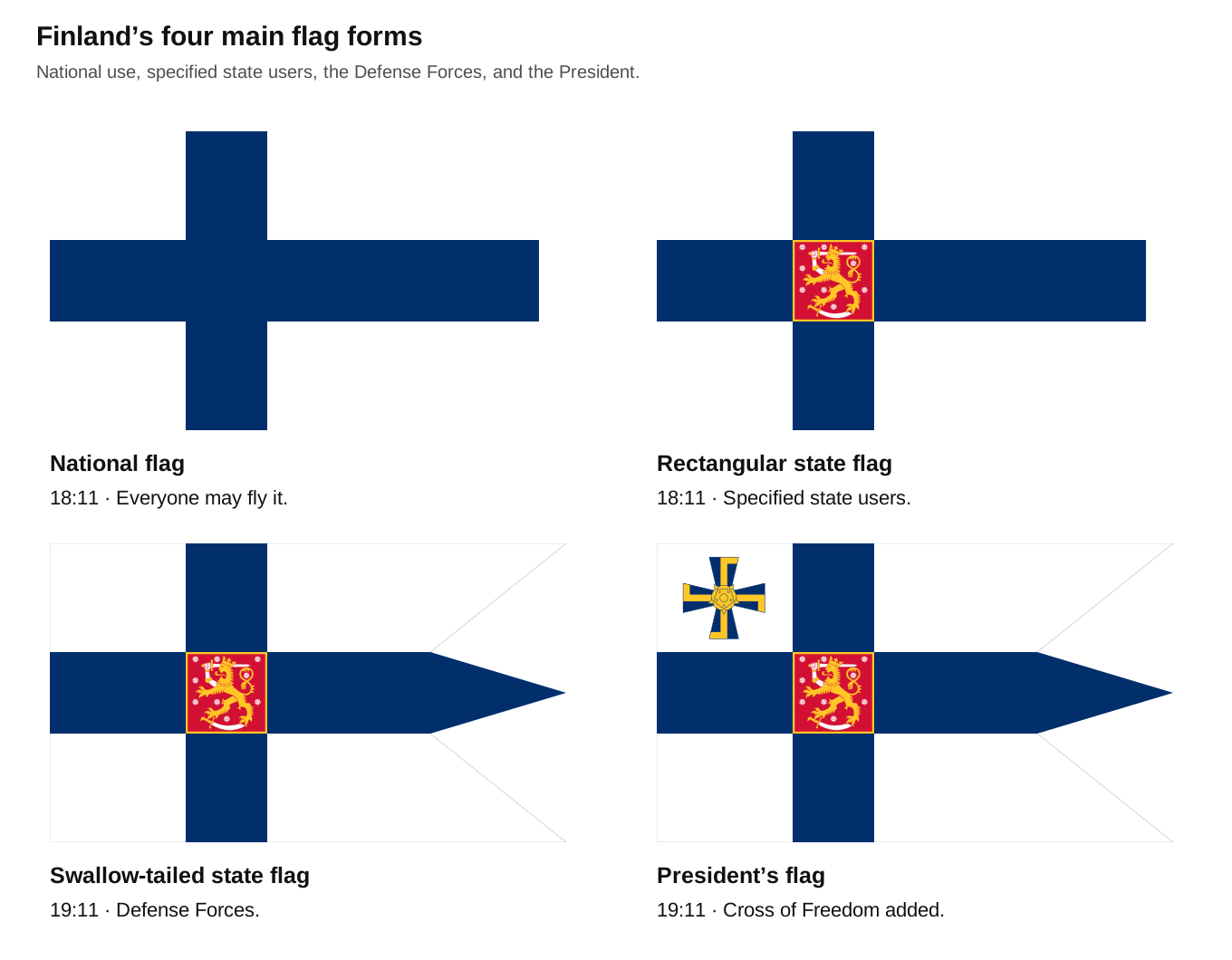
Finland’s plain national flag differs from the rectangular state flag with arms. The military form is swallow-tailed, and the President’s form adds the Cross of Freedom. The rectangular forms are 18:11; the swallow-tailed forms have 19:11 bounding dimensions.
GKBook composition, CC0; underlying flag references, public domain.Download image
The state flag’s arms show a crowned gold lion on red, an armored right foreleg holding a straight sword, a curved saber under the hind legs, and nine silver rosettes. A gold border surrounds the square at the cross intersection.
GKBook composition, CC0; underlying flag references, public domain.Download image
A reconstructed red lion flag and a reconstructed 1918–1920 state flag are compared with the current rectangular state reference. The blue-cross national flag was adopted in May 1918. Later state-flag revisions do not make 1978 the national flag’s original adoption year.
GKBook composition, CC0; underlying flag references, public domain.Download image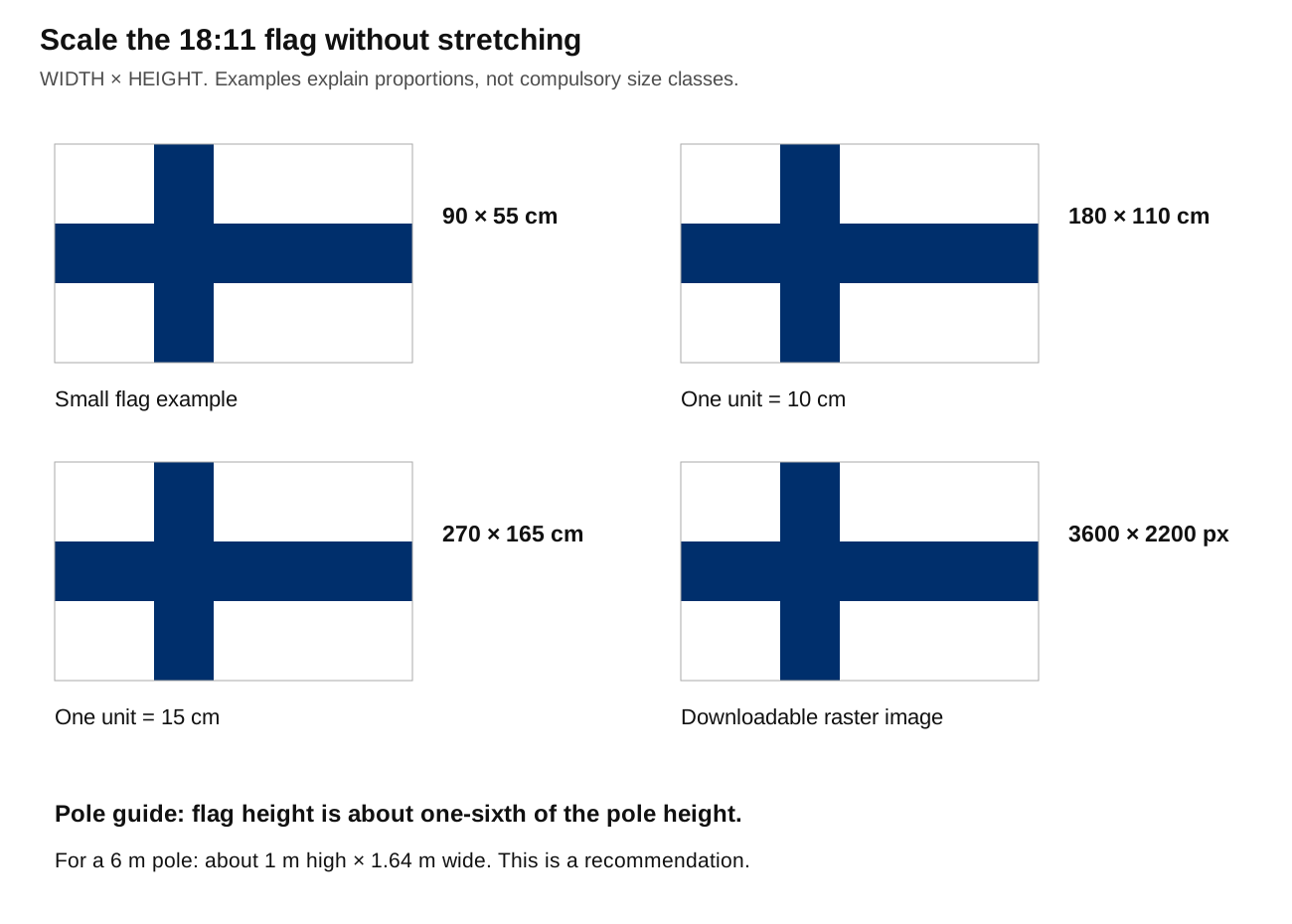
Example flags preserve 18:11 proportions. The Ministry recommends a flag height of about one-sixth of the pole height. For a 6-meter pole, that suggests about 1 meter high and 1.64 meters wide; it is a practical recommendation, not a mandatory size class.
GKBook composition, CC0; underlying flag references, public domain.Download image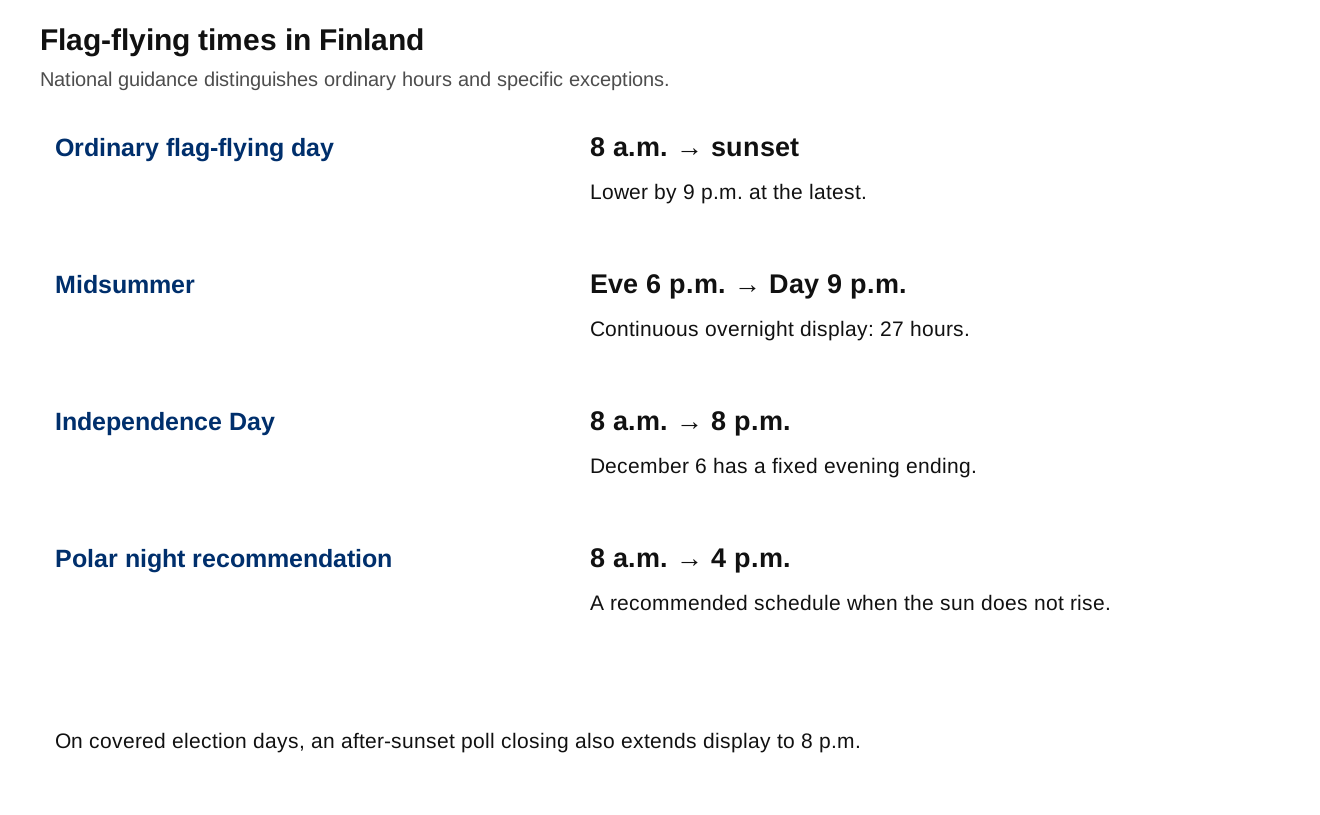
Ordinary display begins at 8 a.m. and ends at sunset, no later than 9 p.m. Midsummer runs from 6 p.m. on the eve to 9 p.m. the next day. Independence Day ends at 8 p.m. Polar-night guidance recommends 8 a.m. to 4 p.m.; covered election days have an evening exception.
GKBook composition, CC0; underlying flag references, public domain.Download image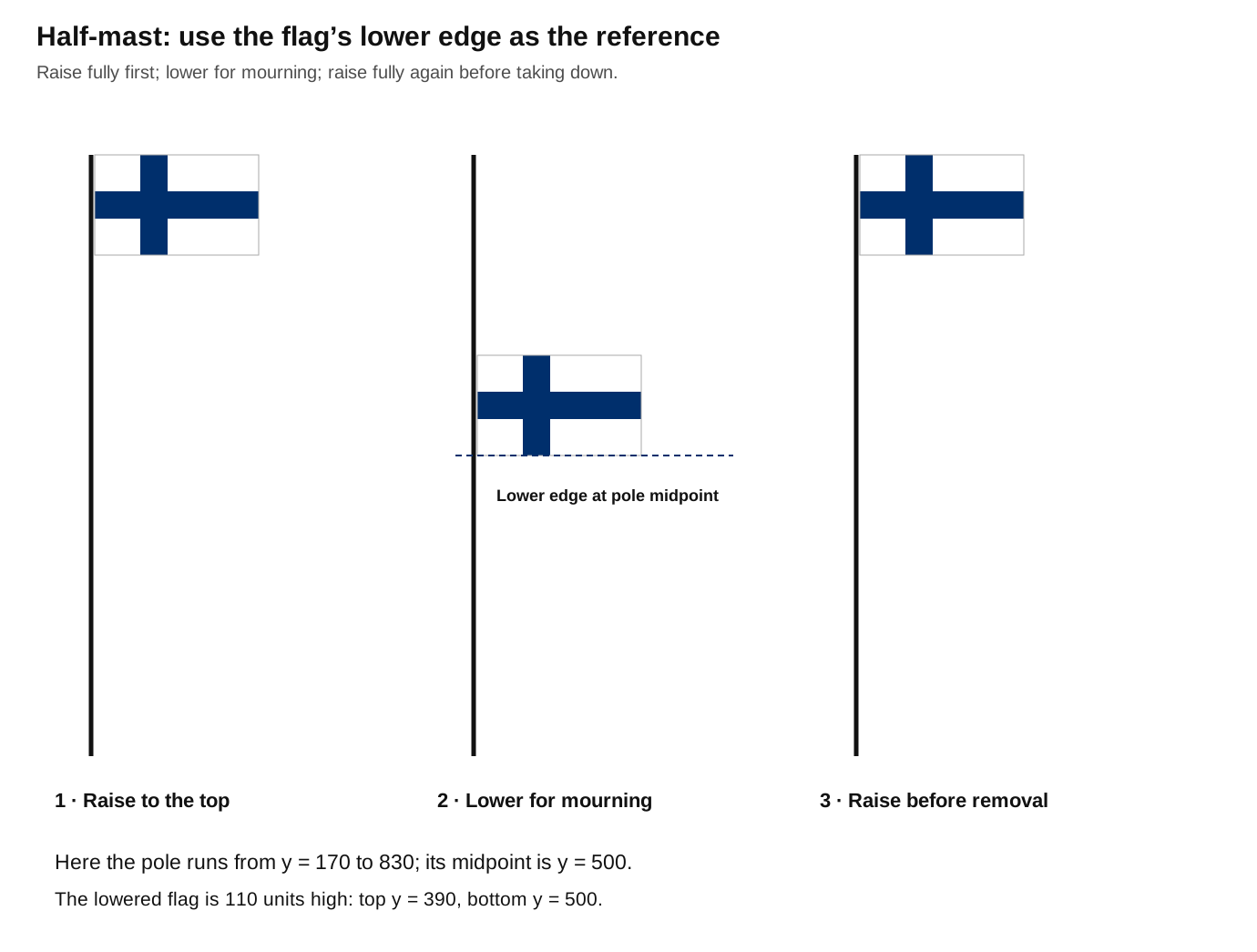
For Finnish mourning display, raise the flag to the top, then lower it until its lower edge is at the midpoint of the pole. Raise it fully again before taking it down. The diagram follows the Ministry’s lower-edge reference, not a guessed position for the flag’s center.
GKBook composition, CC0; underlying flag references, public domain.Download image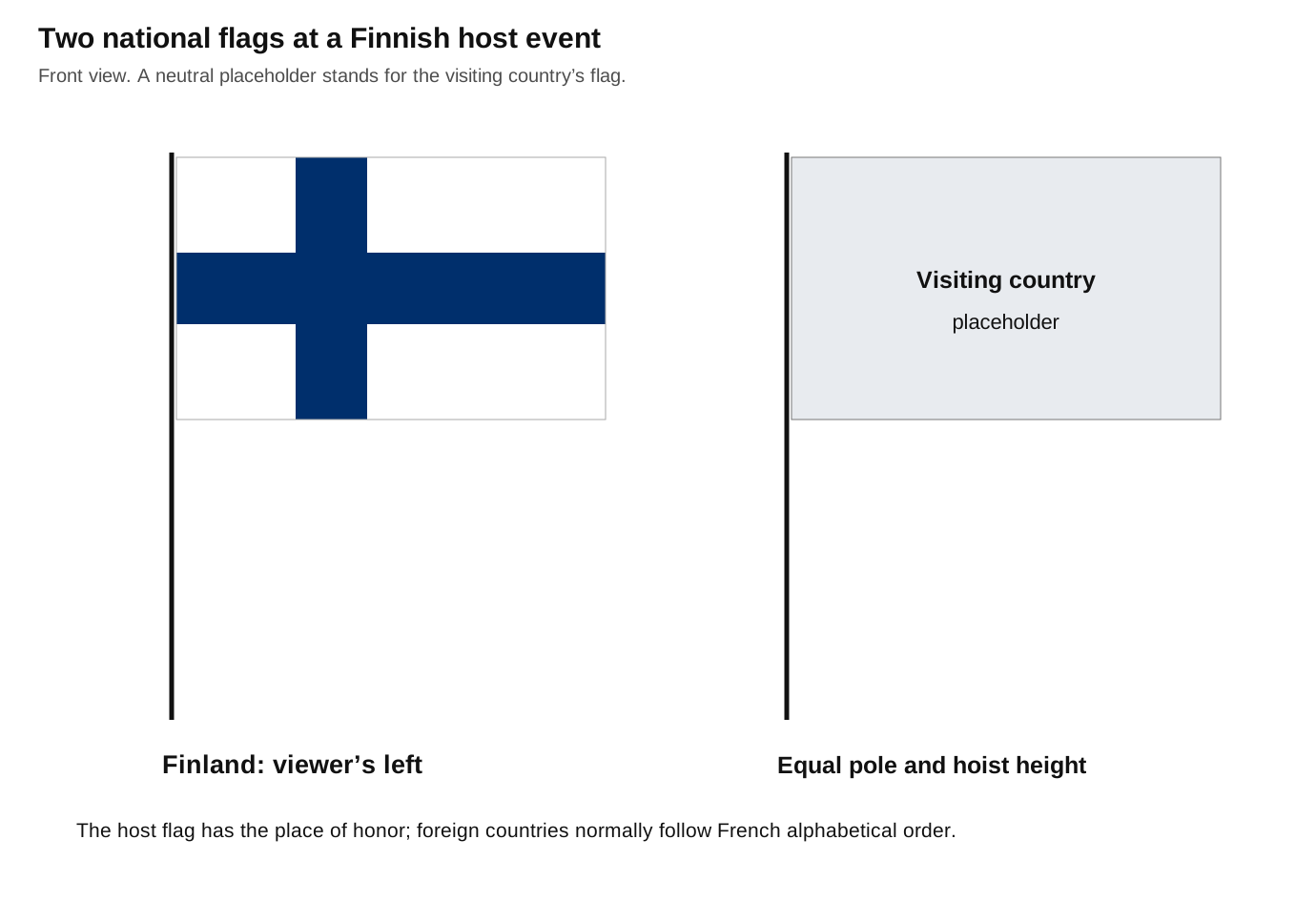
In this simple two-pole front view, Finland occupies the usual place of honor at the viewer’s left. Both poles and hoist positions are equal in height. The gray visiting-country rectangle is a labeled teaching placeholder, not a real national flag.
GKBook composition, CC0; underlying flag references, public domain.Download image
Finland has a blue cross on white, Sweden a yellow cross on blue, and Iceland a red cross bordered in white on blue. Each Nordic cross is offset toward the hoist, but the countries use different rectangle proportions.
GKBook composition, CC0; underlying flag references, public domain.Download image
Finnish, NATO, and U.S. flags during Finland’s accession proceedings at NATO Headquarters in Brussels on April 4, 2023. The Finnish flag is partly obscured by a participant and by fabric folds. This is documentary evidence of use, not a flat design or color reference.
Photograph: Chuck Kennedy / U.S. Department of State, public domain. Full frame retained; resized and converted to WebP.Download imageFrequently asked questions
What does Finland’s national flag look like?
Finland’s national flag is a white rectangle bearing a blue Nordic cross. The upright crossbar is closer to the hoist, leaving longer white panels toward the fly. Its width-to-height ratio is 18:11. The ordinary national flag contains no coat of arms, lettering, stars, or separate corner emblem.
What makes the Finnish flag’s cross distinctive?
The Finnish flag uses a blue cross whose two bars have equal thickness. Its upright bar is offset toward the hoist instead of standing at the rectangle’s center. The white fly-side panels are twice as wide as the hoist-side panels, producing the recognizable Nordic cross arrangement.
What are the official colors of Finland’s flag?
Finland’s national flag is blue and white. The legal color decision specifies measured color values and recognizes Pantone 294 C and NCS 4060-R90B as blue approximations. The supplied digital national flag uses #002F6C and #FFFFFF; these screen values are not themselves the statutory textile color measurements.
What do the blue and white colors mean?
The familiar explanation connects the Finnish flag’s blue with lakes and its white with winter snow. Finland’s official country-information service relates that interpretation to the nineteenth-century writer Zacharias Topelius. These associations explain the two national colors; they do not assign a separate meaning to each white rectangle.
Why does Finland use a Nordic cross?
Finland’s flag belongs to the Nordic cross family, whose upright crossbar is shifted toward the hoist. This layout connects its appearance with neighboring Nordic flags while blue on white makes the Finnish design distinct. The shared cross form does not mean that the countries use identical dimensions or colors.
What are the exact proportions of Finland’s flag?
Finland’s national flag measures 18 units wide and 11 units high. From hoist to fly, the divisions are 5, 3, and 10 units; from top to bottom, they are 4, 3, and 4. Both crossbars are 3 units thick, and every measurement scales by the same factor.
How large should a Finnish flag be for its pole?
The Ministry of the Interior recommends a flag height of about one-sixth of the pole height. Its width then follows the national 18:11 ratio. For a six-meter pole, that suggests roughly one meter high and 1.64 meters wide. This is guidance, not a compulsory national size class.
What are the main stages in Finland’s flag history?
Finland’s flag history includes the older lion arms, nineteenth-century debate over national colors, a red lion flag during early independence, and the blue-cross design adopted in May 1918. Later changes concerned state-flag details and legislation. They should not be mistaken for the first adoption of the national blue cross.
What flag did Finland use immediately after independence?
A red flag bearing Finland’s lion arms appeared at the Government Palace when independence was declared on December 6, 1917. It served as a semi-official state symbol during the first months of independence. The blue-cross national flag followed in May 1918, after debate over the new country’s colors.
When was Finland’s blue-cross flag adopted?
Parliament approved the blue-cross design on May 28, 1918, and the flag law was issued on May 29. May 29, 1918, is therefore the adoption date used here. Finland’s independence date, December 6, 1917, and the later Flag Act of 1978 are separate historical and legal milestones.
Did Finland adopt an entirely new national flag in 1978?
The Flag Act of 1978 established the later legal framework and replaced the 1918 Act. It did not make 1978 the first appearance of Finland’s blue-cross national flag. State-flag artwork and legal provisions changed over time, while the national flag’s basic blue-on-white identity continued from the 1918 adoption.
Who designed Finland’s blue-cross flag?
The adopted blue-cross design is credited to artists Eero Snellman and Bruno Tuukkanen. They worked within the wartime drawing-office setting associated with Akseli Gallen-Kallela. Zacharias Topelius helped popularize blue and white decades earlier, but promoting the colors and preparing the adopted 1918 flag design are different contributions.
How can Finland’s flag be reproduced accurately?
Reproduce Finland’s national flag by keeping the 18:11 rectangle, equal three-unit crossbars, and the correct five-unit hoist and ten-unit fly panels. Use a suitable blue color proof for the material. Preserve the plain white field and distinguish the national design from state flags that carry the arms.
What are Finland’s main official flag variants?
Finland distinguishes the plain national flag, the rectangular state flag with arms, the swallow-tailed state flag used by the Defense Forces, and the President’s flag. The President’s form adds the Cross of Freedom to the upper hoist. These are different official uses, not interchangeable decorative versions of the national flag.
Who may fly Finland’s rectangular state flag?
The rectangular state flag is for the state bodies and vessels specified in Finnish law. It adds the national arms at the blue cross intersection while retaining the 18:11 rectangle. The Ministry states that private individuals cannot be granted permission to fly this state form; everyone may fly the national flag.
Why does one Finnish flag have three pointed tails?
The three-pointed form is Finland’s swallow-tailed state flag, used by the Defense Forces and their ships. Its bounding dimensions are 19 units wide and 11 high, one unit longer than the rectangular flag. It carries the arms at the cross intersection and is distinct from the plain national flag.
How is the President of Finland’s flag different?
The President’s flag uses the swallow-tailed state design and adds a blue-and-yellow Cross of Freedom in the upper-hoist white panel. The national arms remain at the main cross intersection. This legally specified identifying emblem distinguishes the presidential form from both the ordinary national flag and the military state flag.
What appears in the arms on Finland’s state flag?
Finland’s state-flag arms show a crowned gold lion on red, with an armored right foreleg holding a raised straight sword. The lion’s hind legs stand over a curved saber, and nine silver rosettes surround it. A gold border encloses the square placed at the blue cross intersection.
Can anyone fly Finland’s national flag?
Everyone has the right to fly Finland’s national flag. Individuals may use it for celebrations and other suitable occasions, including days outside the official calendar. The legal flag-flying duty on official days concerns specified public buildings; it does not create a blanket requirement for every private household to display a flag.
When is the Day of the Finnish Flag?
The Day of the Finnish Flag is Midsummer Day, the Saturday falling between June 20 and June 26. Its display period begins at 6 p.m. on Midsummer Eve and continues overnight until 9 p.m. on Midsummer Day. Independence Day is a different observance, held on December 6.
Which days are official flag-flying days in Finland?
Official flag-flying days include Kalevala Day, May Day, Mother’s Day, the Defense Forces’ Flag Day, Midsummer, Father’s Day, and Independence Day. The decree also covers specified elections, nationwide referendums, and the President’s inauguration. These statutory occasions should be distinguished from customary flag days and additional recommendations for particular events.
How do customary flag days differ from official ones?
Customary flag days are established observances recognized in Finland’s flag calendar, but they belong to a different category from the official days listed in the flag-flying decree. They honor cultural figures, public causes, and remembrance. People may also fly the national flag on personal occasions without waiting for either category.
What time should Finland’s flag be raised and lowered?
Ordinary flag-flying begins at 8 a.m. and ends at sunset, no later than 9 p.m. Midsummer has continuous overnight display, and Independence Day ends at 8 p.m. Covered election days have an evening exception when voting closes after sunset. During polar night, the Ministry recommends 8 a.m. to 4 p.m.
Where is Finland’s flag placed beside other national flags?
At a Finnish host event, Finland’s flag takes the place of honor, usually the viewer’s left in a simple front-facing arrangement. Foreign countries normally follow French alphabetical order. National flags should use equal pole and hoist heights; special Nordic arrangements and the event’s layout can require a more specific plan.
Which side of Finland’s flag should be next to the pole?
For the usual horizontal front view, the shorter white panels belong beside the pole and the longer panels extend toward the fly. This places the upright blue bar nearer the hoist. The national flag has no lettering or arms to orient, but an incorrectly mirrored front-view illustration still reverses the layout.
How is Finland’s flag flown at half-mast?
Raise the Finnish flag fully, then lower it until its lower edge reaches the midpoint of the pole. Before taking it down, raise it to the top again. This Ministry guidance uses the flag’s lower edge as the reference, not the center of the cloth or a guessed percentage of pole height.
How long does a Finnish flag remain at half-mast on a funeral day?
On the funeral day, the flag remains at half-mast until the funeral service and burial have taken place. It is then raised fully for the rest of the flag-flying period. A memorial service uses full-mast display. The house of mourning may fly half-mast even on an official or customary flag day.
What laws govern Finland’s flag?
The main instruments are the Flag Act 380/1978, the flag-flying decree 383/1978, and the color decision 827/1993. They address design, authorized flag forms, display occasions, timing, and colors. The decree was amended with effect from January 1, 2026, including express coverage of county elections among the relevant voting occasions.
Can Finland’s flag be used commercially?
Commercial use of Finland’s flag is not generally forbidden. However, incorporating the flag or coat of arms into a registered trademark or protected design requires the Ministry’s permission under the relevant rules. A reusable public-domain image does not remove those national-symbol requirements or turn a product into an officially endorsed item.
How should a Finnish flag be cared for?
Keep the flag clean, intact, and dry before storage, and follow the textile maker’s cleaning instructions. Check the free edge and hoist attachments for damage. These are practical care measures, separate from the legal design rules. A historically significant flag may need conservation advice before repair or disposal is considered.
How does Finland’s flag differ from Sweden’s and Iceland’s?
Finland has a blue cross on white, Sweden a yellow cross on blue, and Iceland a red cross edged in white on blue. All use the Nordic cross arrangement, but their rectangle proportions differ. Color order, the presence of a border around the cross, and proportions provide useful identification clues.
Does Finland’s national flag replace the Åland or Sámi flags?
Finland’s national flag, Åland’s flag, and the Sámi flag represent different identities and uses. Åland has its own flag and flag days under its autonomous arrangements. The Sámi have a distinct people’s flag and calendar. Neither should be described as merely an alternate color version of Finland’s national blue cross.
What does the Finland flag photograph show?
The photograph records Finnish, NATO, and U.S. flags during Finland’s accession proceedings in Brussels on April 4, 2023. Finland became NATO’s thirty-first ally that day. The Finnish cloth is partly hidden and folded, so the image documents ceremonial use rather than supplying exact flag dimensions or calibrated colors.
What is the Finland flag emoji?
The Finland flag emoji is 🇫🇮, formed from the regional-indicator letters F and I. Its Unicode sequence is U+1F1EB followed by U+1F1EE. Supported platforms display the combined flag glyph; other environments may show letter symbols. Emoji artwork is convenient for text but is not a production drawing master.
What are common mistakes when identifying Finland’s flag?
Common mistakes include centering the upright crossbar, adding the arms to every Finnish flag, treating 1978 as the original adoption year, and confusing Midsummer’s Flag Day with Independence Day. Another error is placing the flag’s center at mid-pole for mourning when the Ministry’s guidance refers to its lower edge.
Which Finland flag files can I download?
The page offers the plain national flag as SVG and PNG, along with explanatory diagrams and illustrations of official and historical variants. SVG suits scalable artwork; the PNG works in ordinary image software. Captioned teaching sheets include labels outside the flag and should be distinguished from the unannotated national design.
Is the background of Finland’s national flag white or light blue?
The background is white. Blue belongs to the cross, not the surrounding field. Shadows, reflected sky, aging cloth, and screen settings can change how white appears in a photograph. For an unambiguous digital illustration, use the supplied plain reference and preserve the white rectangles on both sides of the cross.
Is a red flag with a gold lion Finland’s current national flag?
No. A red lion flag belongs to Finland’s early-independence flag history, whereas the current national flag is the blue cross on white adopted in May 1918. Red and gold still appear within the arms on state variants, but the ordinary national flag does not carry that heraldic square.
Was the lion’s crown removed from Finland’s present arms?
The lion in Finland’s present arms remains crowned. Historical state-flag changes must not be described as removing every crown from the current emblem. The early state-flag reconstruction shows an additional crown above the shield, while the current reference keeps the lion’s own crown within the red square.
Why does Finland’s flag stay up overnight at Midsummer?
Midsummer has an explicit exception to the ordinary daily lowering schedule. The prescribed period runs from 6 p.m. on Midsummer Eve to 9 p.m. on Midsummer Day, a continuous twenty-seven hours. This exception belongs to the Day of the Finnish Flag and should not be generalized to every summer night.
Must Finnish households fly the flag on every official flag day?
The official-day duty in the flag-flying decree applies to specified state premises and public buildings in Åland. It does not impose a universal duty on every private home. Individuals are welcome to display the national flag on official, customary, and personal occasions, following the relevant timing and respectful handling guidance.
Can Finland’s national flag be flown by Finnish civilian ships?
Finnish civilian ships use the national flag as their national ensign under the Flag Act. Approved yacht-club special ensigns are a separate authorized category. The swallow-tailed state flag serves the Defense Forces, including their ships, so it should not be substituted simply because an ordinary vessel is sailing at sea.
Does Finland’s flag law include penalties?
The Flag Act provides fines for specified offenses, including public disrespect toward the flag, unauthorized use of reserved flag forms, and selling substantially incorrect designs as Finnish flags. These provisions should be read in their actual legal context. The article does not invent a fixed euro fine or a universal prison sentence.
Is #002F6C the legally prescribed Finnish blue?
The delivered SVG uses #002F6C as its digital blue. Finnish color rules instead specify measured color values and recognize particular Pantone and NCS approximations, including Pantone 294 C. A HEX triplet describes screen channels; it is not a substitute for the prescribed measurement conditions or a physical textile color proof.
Explore all general-knowledge topics and the A-to-Z lists.

We Value Your Opinion Comments