
Fiji flag picture
Explore the construction sheet, the shield’s details, and the historical sequence.
| Country | FijiRepublic of Fiji, in the South Pacific. |
|---|---|
| Design | Light blue with canton and shieldUnion Flag at upper hoist; national shield on the fly. |
| Proportions | 2:1 width:heightAlso written 1:2 when height is stated first. |
| Adopted | October 10, 1970First flown on independence from Britain. |
| Designers | Tessa Mackenzie and Robi WilcockJoint winners of the national flag competition. |
| Principal colors | Light blue, dark blue, red, whiteGold, green, brown, and black also appear in the shield. |
| National Day | October 10 — Fiji DayThe independence anniversary, shared with the flag’s first raising. |
| Shield origins | Coat of arms granted in 1908Lion with cocoa pod; sugarcane, palm, dove, and bananas. |
The 1908 arms grant and 1970 flag adoption are distinct milestones. Fiji retained the design after becoming a republic in 1987 and after the later redesign debate.
What is the flag of Fiji?
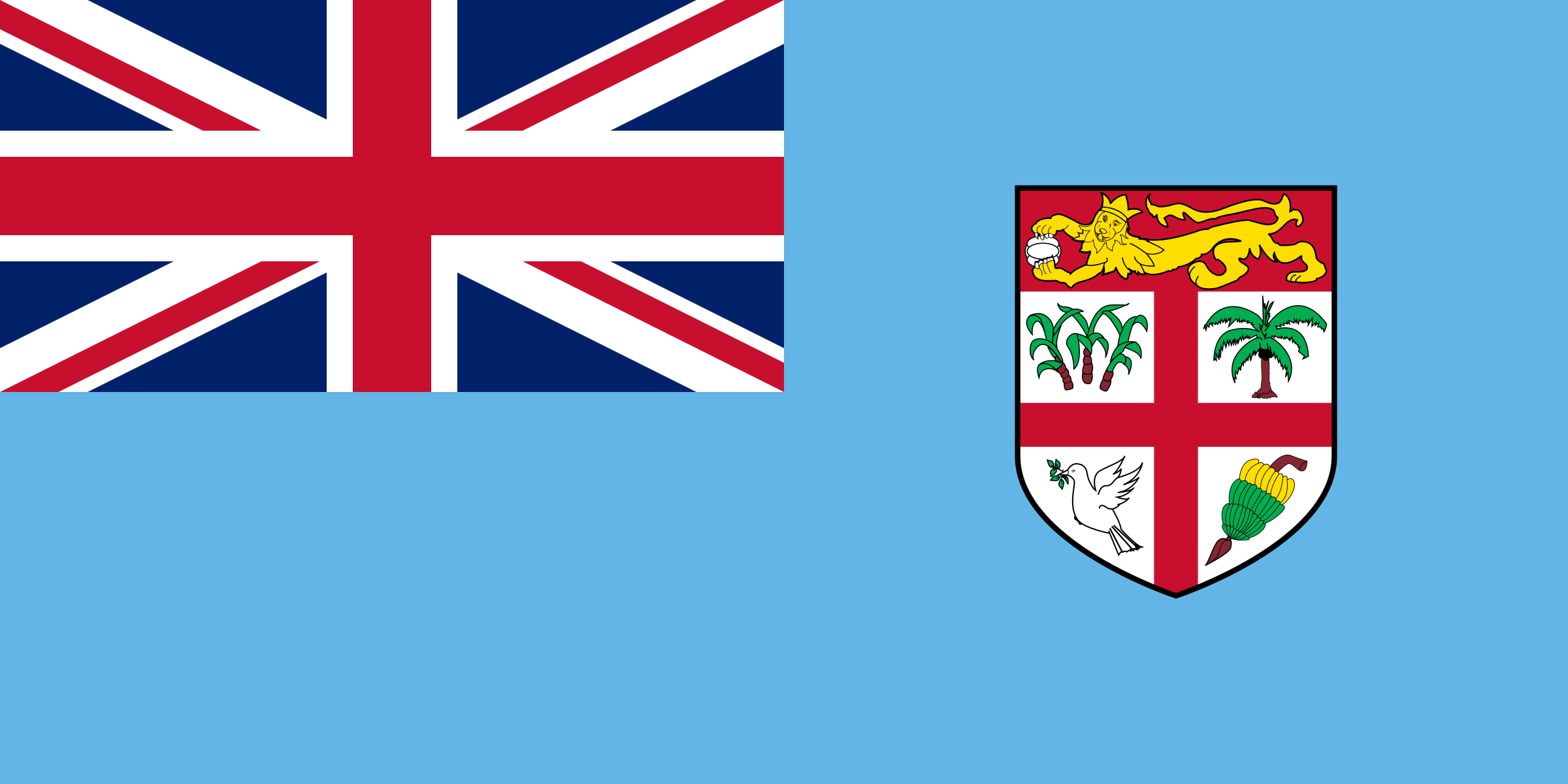
Fiji’s flag has a light blue field with the Union Flag in the upper corner beside the hoist. A shield from Fiji’s coat of arms appears in the outer half. The shield contains a gold lion, a red cross, agricultural emblems, and a white dove carrying an olive branch.
The Republic of Fiji is a South Pacific island country. Its national flag combines a broad expanse of light blue with a British-style canton and a detailed Fijian shield. The long rectangle, pale field, and shield together distinguish it from other national flags that contain the Union Jack.
The current design dates to independence in 1970. The shield is older, deriving from the coat of arms granted in 1908. Explore the shield’s symbols, the historical timeline, and the downloadable pictures.
What are the flag’s identifying features?
Fiji’s national flag is twice as wide as it is high: 2:1 in width-to-height terms, or 1:2 with height first. A 120-by-60-centimeter flag has this shape. In the supplied artwork, the Union canton occupies the upper quarter, while the shield is centered within the outer half.
Start with the rectangle: its horizontal width is twice its vertical height. The Union Flag occupies the upper quarter beside the pole. The shield sits opposite it in the fly half, where its white ground and red divisions stand out against the blue.
The shield has a gold lion across its red top and four smaller compartments below. Even at a distance, those red-and-white divisions give Fiji’s flag a different visual identity from flags whose fly carries stars.
“Hoist” means the side attached to the pole; “fly” means the free outer side. A canton is the upper corner by the hoist. These terms describe positions, not additional symbols or separate flag parts to omit when producing the complete design.
What are the flag’s colors and digital values?
The supplied SVG uses light blue #62B5E5, dark blue #012169, red #C8102E, and white #FFFFFF, with additional shield colors. These identify this digital reference, not a universally enacted numerical palette. Published references differ in shade specifications, so print production should use an agreed color proof rather than assume screen values are statutory.
| Color | SVG HEX | RGB | Where it appears |
|---|---|---|---|
| Light blue | #62B5E5 | 98, 181, 229 | Main field |
| Dark blue | #012169 | 1, 33, 105 | Union canton |
| Red | #C8102E | 200, 16, 46 | Union crosses, shield cross, and chief |
| White | #FFFFFF | 255, 255, 255 | Union details, shield ground, and dove |
| Gold / yellow | #FEDD00 | 254, 221, 0 | Lion and agricultural details |
| Green | #00AD50 | 0, 173, 80 | Plant details |
| Brown / maroon | #862633 | 134, 38, 51 | Botanical details |
| Black | #000000 | 0, 0, 0 | Outlines and fine details |
Official descriptions identify a light or sky-blue field but do not supply the comprehensive numerical production palette reproduced in this table. Specialist references report different shades in naval, Olympic, and commercial specifications. An event’s approved color sheet can be appropriate for that event without establishing a universal law for every Fiji flag.
These HEX and RGB values make the delivered files reproducible. They are not official Pantone declarations, and a CMYK conversion depends on the printing process and profile. For fabric or print work, compare a physical color proof and check that the lion, plants, and dove retain readable detail.
What do the flag’s colors and symbols mean?
The light blue field represents the Pacific Ocean, and the Union Flag recalls Fiji’s historical links with Britain. The shield combines a British heraldic lion with agricultural emblems and a dove of peace. Its details connect the country’s colonial heraldry, island economy, and a symbol used before cession.
The field’s ocean association is stated in Fiji’s diplomatic description, which connects the Pacific with island life, fishing, and tourism. The Union canton and gold lion preserve historical links with Britain. The shield also carries crops familiar to Fiji’s agricultural history and a dove associated with peace.
These meanings should be attached to the relevant objects. The reviewed official explanations do not assign a separate national virtue to every red stripe, white opening, dark outline, or shade of green. Heraldic colors help describe the design even where no independent symbolic meaning is specified.
What appears on the shield of Fiji’s flag?
A gold lion holding a cocoa pod occupies the red upper section. Below it, a red cross divides a white shield into four quarters. Viewed from the front, sugarcane is upper left, a coconut palm upper right, a dove lower left, and a bunch of bananas lower right.
| Part | Identification | Reading the design |
|---|---|---|
| Red chief | Gold lion holding a cocoa pod | The chief is the top compartment, above the quartered area |
| Upper left | Sugarcane | Three cane stalks in the reference |
| Upper right | Coconut palm | A tree, not the pod held by the lion |
| Lower left | White dove with an olive branch | Peace and a link to the pre-cession Cakobau emblem |
| Lower right | Bananas | A bunch of fruit |
| Red upright cross | Cross of Saint George | Divides the white area into quarters |
The lion is shown walking, with its head turned toward the viewer, a heraldic posture described as passant guardant. The object held between its forepaws is a cocoa pod. Some older descriptions misidentify it as a coconut; the current Fijian diplomatic accounts distinguish it from the coconut palm below.
The dove matters because the shield is not solely a set of imported British symbols. Fiji’s embassy connects the dove with the Cakobau government’s flag before cession. That historical connection does not mean every nineteenth-century Fijian flag had the same layout as today’s national flag.
Does the flag carry the complete coat of arms?
No. The flag displays the shield from the coat of arms. The complete arms also have two Fijian warrior supporters, a canoe crest, and a motto scroll. Those surrounding elements do not appear on the ordinary national flag, even though they remain part of the fuller heraldic achievement.
The complete coat of arms surrounds the shield with two Fijian warriors and places a canoe above it as a crest. A scroll below carries Rerevaka na Kalou ka Doka na Tui. Fiji’s Wellington diplomatic history translates the motto as “Fear God and honor the King.”
The ordinary national flag leaves out the warriors, canoe, and motto scroll. Its fly contains the shield alone. Adding the full achievement would change the familiar national design, even though the added elements belong to Fiji’s heraldic identity.
The royal wording of the historic motto and the Union canton should be understood in their historical settings. Fiji’s later status as a republic did not automatically erase inherited symbols or require a new national flag.
Why does Fiji’s flag retain the Union Jack?
The Union Jack, also called the Union Flag, recalls Fiji’s historical connection with the United Kingdom. Fiji became independent in 1970 and retained this canton in its new national design. The flag also remained unchanged when Fiji became a republic in 1987, so the canton does not indicate current British rule.
The Union Flag combines the upright red Cross of Saint George with diagonal crosses associated with Scotland and Ireland. On Fiji’s flag it occupies the upper-hoist quarter, with the correct diagonal offsets retained. Drawing generic centered red diagonals produces a different canton.
Fiji’s official description calls the national design a defaced sky-blue ensign. In vexillology, “defaced” means that a badge has been added to a base flag. It is a technical term and does not mean that the flag has been vandalized.
The light blue national flag also differs from Fiji’s dark blue government ensign. Both can contain the same canton and shield while serving different purposes.
Who designed the national flag?
Fiji’s official embassy account credits the winning design jointly to Robi Wilcock and Tessa Mackenzie, who is named there as Mrs. Murray MacKenzie. Mackenzie’s later account describes separate entries with the same essential idea. Their historical design credit is distinct from the work of artists who later prepared digital flag files.
The embassy’s older form of Mackenzie’s name refers to the same person commonly identified as Tessa Mackenzie. Crediting only one entrant would omit the joint result recorded by the official account.
In a later interview, Mackenzie recalled that she and Wilcock submitted their designs independently. Both arrived at the same essential combination: a blue field, the Union Flag, and the shield from Fiji’s arms. The account links her choice of blue with the surrounding sea.
Historical design credit is different from digital illustration credit. The files here preserve the detailed artwork of the credited reference contributors. Neither that vector authorship nor the competition account establishes a verified name for the maker of the first ceremonial textile.
How can the flag be reproduced faithfully?
Keep the 2:1 rectangle, the correctly oriented Union canton, and the complete shield in the fly half. Scale the design uniformly so its small emblems remain recognizable. Use the supplied vector for sharp output and approve the chosen fabric, printing method, and physical colors for the intended display.
Preserve the complete design
- Maintain twice as much width as height.
- Keep the canton at the upper hoist and preserve its diagonal offsets.
- Retain the shield in the fly half, with every crop and the dove recognizable.
- Keep the lion’s cocoa pod and the coconut palm distinct.
- Check a physical proof for the intended material and viewing distance.
Avoid substitutions
- Do not place the shield at the center of the whole flag.
- Do not replace the shield with the complete coat of arms.
- Do not use a dark blue, red, or white ensign as the ordinary national flag.
- Do not mirror the front-view reference or distort its proportions.
- Do not add a slogan or logo and describe the result as the unchanged national design.
At small sizes, the shield is the demanding part of production. Printing, embroidery, and appliqué have different limits for fine outlines. Scale a complete master and inspect the result rather than substituting generic fruit, a different lion, or a simplified unidentified bird.
Choose fabric, seams, attachments, and reinforcement for the actual setting. These are practical production choices; the sources reviewed here do not establish one universal required fiber, thread count, or stitching method.
How are the flag’s proportions and shield placement arranged?
The shield is centered within the outer half of the flag, opposite the hoist. In the supplied 1200-by-600-pixel reference, its center is near coordinate 900, 300. These measurements describe the reference artwork; they are not presented as a complete statutory construction grid for every shield line and curve.
| Element | Relationship | 1200 × 600 reference |
|---|---|---|
| Overall rectangle | Width = 2H; height = H | 1200 × 600 pixels |
| Union canton | Width = H; height = H/2 | 600 × 300 pixels |
| Fly half | Outer half of the whole rectangle | x = 600 to 1200 |
| Shield center | Near the center of the fly half | Approximately x = 900, y = 300 |
| Shield detail | Preserve the source artwork | Do not replace fine curves with a guessed construction |
The shield’s top is near y = 144 and its point near y = 456 in the source coordinate system. Its outer width is about 242 pixels. These are measurements of the digital reference, not a claim that a national regulation prescribes every one of those decimal coordinates.
When resizing the flag, multiply all dimensions by the same factor. For example, a reduction to 600 × 300 pixels halves the canton dimensions and shield coordinates together. Stretching only the width changes the design’s proportions.
What sizes are suitable for a Fiji flag?
A Fiji national flag can be scaled while preserving its 2:1 width-to-height ratio. Examples include 60 by 30, 90 by 45, and 150 by 75 centimeters. These are practical examples rather than verified mandatory national size classes; the intended pole, venue, material, and viewing distance determine a suitable size.
The examples show a ratio, not a set of official use classes. A desktop display, parade flag, wall graphic, and outdoor flag can need different materials and mounting arrangements even when their rectangle proportions match.
For a two-meter-wide flag, the corresponding height is one meter. For a 2400-pixel-wide image, the height is 1200 pixels. The downloadable PNG uses that latter size, while the SVG can scale without a fixed pixel ceiling.
When is Fiji Day and the flag’s anniversary?
Fiji Day is October 10, marking independence from Britain in 1970. The national flag first flew on that same date, so its anniversary coincides with the independence observance. October 10 also recalls cession in 1874. This article does not identify a separate officially established annual Flag Day.
October 10, 1970 marks independence and the first raising of the light blue national flag. October 10, 1874 is the earlier date of cession to Britain. The shared day and month join two distinct historical events; they should not be collapsed into a single adoption date.
Fiji Day is the appropriate national observance for this page’s navigation. The reviewed official descriptions do not establish a separate recurring national Flag Day under that name. A particular year’s ceremonies, venue, and public-holiday arrangements should be checked from that year’s announcements.
Displaying the flag at an independence celebration connects the current national symbol with its first public appearance. It does not imply that every household is subject to a verified universal display duty.
How has Fiji’s flag developed over time?
Fiji’s flag history includes pre-cession symbols, British colonial ensigns, the coat of arms granted in 1908, and the light blue independence flag introduced in 1970. The national design continued after the republic was declared in 1987. Later redesign proposals did not replace the flag that Fiji uses today.
Pre-cession symbols
Fijian governments used their own flags. The present dove is linked to the Cakobau government’s peace emblem.
Cession to Britain
The colonial period begins, bringing Fiji into the British ensign tradition.
Coat of arms granted
The heraldic shield later used on the independence flag is established within the full coat of arms.
Independence flag raised
The light blue national flag first flies as Fiji becomes independent.
Republic, same national flag
The 1970 design remains despite the constitutional change.
Replacement proposed
A public proposal begins a later effort to replace the national design.
National design competition
Twenty-three finalist designs are considered; none becomes the adopted replacement.
Existing flag retained
The government announces that the established flag will remain, citing public attachment and recovery priorities.
Nineteenth-century flag references describe several different Fijian governments and designs. Some details are disputed or based on later reconstructions. The sequence above therefore identifies the well-supported connection of the dove and the principal national milestones without pretending to show a complete, uniform pre-cession flag series.
How did colonial ensigns differ from the independence flag?
The independence flag introduced a light blue field while retaining a Union canton and using the shield alone on the fly. The colonial ensign tradition used dark blue and fuller representations of Fiji’s arms. The shield’s survival provides continuity, but the 1970 national design should not be labeled a colonial-era flag.
The colonial Blue Ensign tradition combined the Union canton with a badge identifying the territory. Fiji’s fuller arms included the two warrior supporters, canoe crest, and motto. The independence flag’s lighter field and shield-only device created a distinct national composition while preserving recognizable historical elements.
Historical illustrations vary in badge treatment, and dates attached to reconstructed drawings should be assessed separately. The dark blue government ensign shown in this article is a current-function reference with the shield; it should not be relabeled as an exact reproduction of every colonial flag used between 1874 and 1970.
When and where did the current flag first fly?
Fiji’s current national flag was adopted on October 10, 1970, the day the country became independent from Britain. Its first ceremonial raising is associated with Albert Park in Suva. The shield has older origins in the 1908 coat of arms, so the flag’s adoption and the heraldic grant are different milestones.
The official emblem description gives October 10, 1970, as the first day the national flag flew. Mackenzie’s account places the independence raising at Albert Park, Suva. She recalled seeing the ceremony from the roof of Government Buildings.
The 1908 grant belongs to the shield’s history; the 1970 date belongs to the national flag that uses it. The design competition, the manufacture of particular textiles, and the first ceremonial raising are related but separate events.
Did the flag change when Fiji became a republic?
Fiji retained its 1970 flag after becoming a republic in 1987. The continued Union canton reflects the design’s history rather than a requirement that the country remain a monarchy. Discussions about replacing colonial symbols occurred later, but they should not be mistaken for an adopted replacement national flag.
Fiji’s diplomatic description explicitly notes continuity after the republic was declared in 1987. A surviving historical symbol is not a reliable shorthand for a country’s present constitutional status: the same flag can continue through major political changes.
Later proposals discussed removing or changing inherited colonial imagery. Those discussions form part of the flag’s history, but an announced proposal, a competition entry, and an adopted national flag are different categories.
What happened to the proposed replacement flag?
In August 2016, the government announced that the existing flag would remain. The explanation included public attachment displayed during Fiji’s Olympic rugby sevens success and priorities for recovery after Tropical Cyclone Winston. A national competition had considered alternatives in 2015, but none of those designs became the replacement national flag.
The proposal was publicly announced in 2013, followed by a national design competition in 2015. Twenty-three finalist designs were selected. The debate concerned a more distinctly indigenous expression of Fiji’s identity and the place of colonial symbols in the national flag.
The government’s August 2016 decision retained the familiar design. Its explanation referred both to the public’s attachment to the flag during the Olympic rugby sevens victory and to directing resources toward recovery from Tropical Cyclone Winston. Describing the decision as caused by rugby alone would omit the stated practical priority.
The 2015 entries remain proposals. Neither their selection as finalists nor passage of the 2015 flag-protection legislation means that a new national design was actually raised as a replacement.
Which maritime ensigns does Fiji use?
Fiji has distinct maritime ensigns as well as its light blue national flag. The civil ensign has a red field, the government ensign a dark blue field, and the naval ensign a white field. The illustrated references retain the Union canton and national shield while changing the main field color.
| Flag | Main field | Reference function |
|---|---|---|
| National flag | Light blue | Ordinary national identity |
| Civil ensign | Red | Civil / merchant maritime use |
| Government ensign | Dark blue | Government ships |
| Naval ensign | White | Navy ships |
The published 2015 Act’s maritime amendment also distinguishes white, dark blue, and red ensigns by naval, government, and other Fijian ship use. Its commencement question, explained below, remains separate from identifying the established visual references.
For an actual vessel, use the current instructions of the responsible maritime authority. The downloadable illustrations explain identification and do not certify a vessel’s registration, entitlement, or compliance.
Where and how is the national flag displayed?
Fiji’s national flag appears at government and diplomatic settings, national celebrations, sporting events, and other public displays. Formal arrangements should follow the instructions for the particular venue or ceremony. The practical guidance here preserves the design and respectful handling without claiming an independently verified universal daily schedule or household display duty.
The diplomatic photograph shows the flag in a formal bilateral meeting. Fiji Day observances and national sporting celebrations provide other familiar settings. In each case, the design remains recognizable even when a physical flag is draped, moving in the wind, or partly obscured by folds.
For a formal ceremony, confirm the pole arrangement, raising and lowering times, order of participating flags, and any mourning instruction with the organizer. Keep the flag clear of damage and maintain a dignified presentation.
No universal Fijian sunrise-to-sunset rule, exact precedence chart for every combination of flags, or mandatory private-household display schedule is established by the sources used for this article. General event planning advice should not be described as a quoted national regulation.
How should orientation and the reverse side be handled?
For a standard front-facing horizontal illustration, place the Union canton at the upper left beside the hoist and keep the shield upright in the fly half. Do not mirror that artwork as a shortcut. Vertical installations and two-sided production should follow the relevant event instructions and an approved display master.
The canton’s diagonal offsets make mirroring noticeable. For a standard front view, use the supplied complete flag rather than rebuilding the canton from generic crosses. The shield’s crop positions also reverse if the whole artwork is mirrored.
A reverse view through a single fabric layer naturally shows the design from the other side. That physical circumstance differs from accidentally publishing a mirrored front-view illustration. A double-sided flag, wall hanging, or vertical banner needs a clear production and viewing plan.
An event-specific instruction to rotate a flag does not establish a universal rule for every Fijian display. Obtain the appropriate master for the installation instead of guessing a special vertical composition.
When is Fiji’s flag lowered for mourning?
Fiji’s government directs half-mast display for particular mourning occasions. An official notice dated April 1, 2026, recorded Cabinet approval following the death of former President Ratu Epeli Nailatikau. That is a historical example, not a claim that mourning continues indefinitely; the applicable announcement supplies the dates and instructions.
The April 1, 2026, Ministry of Foreign Affairs notice stated that Cabinet had approved half-mast display in honor of the late former President Ratu Epeli Nailatikau. Its initial wording continued the direction until further notice. Quoting that historical announcement does not establish that the instruction remains active at a later date.
The published 2015 Act includes a half-mast provision for the President, Prime Minister, and others approved by the Minister. The commencement limitation discussed in the law section applies to that text as well. The dated Cabinet announcement supplies independent evidence of actual mourning practice.
For a current ceremony, follow the operative announcement’s dates and handling directions. The sources here do not establish one mathematical pole fraction or a standard black-ribbon size to add to every mourning display.
How should a flag be used at a funeral?
A funeral’s responsible authority should specify whether a national flag is used and how it is handled. The sources reviewed for this page do not establish a universal Fijian coffin-fold sequence or automatic entitlement for every funeral. Avoid importing another country’s folding ceremony and presenting it as Fiji’s prescribed custom.
A state funeral, military funeral, community ceremony, and private family observance can involve different responsibilities. The organizer should obtain the relevant directions before assigning flag bearers or preparing a coffin covering.
Handle any ceremonial textile carefully and protect it from damage. No triangular fold, fixed number of folds, automatic family presentation, or universal coffin orientation is asserted here as a verified Fijian national rule.
What does the published 2015 flag law cover?
The published National Flag Protection Act 2015 sets out a framework for a new flag, its use, protection, commercial permissions, and related matters. Its commencement depends on a ministerial Gazette notice. The sources reviewed here did not establish that notice and the associated flag declaration, so the text is described with that limitation.
| Part of the published Act | Subject covered | How to read it here |
|---|---|---|
| Section 1 | Commencement by Gazette notice | Passage and commencement are different steps |
| Sections 3–4 | New-flag objective and ministerial declaration | The Act’s text does not itself prove a replacement was adopted |
| Sections 5–9 | Respect, display, and prohibited conduct | Report the framework without assuming every clause is operative |
| Sections 10–11 | Commercial approval and merchandise | Copyright clearance is a separate issue |
| Section 12 | Half-mast occasions | Current event directions still need to be checked |
| Sections 14–18 | Amendment procedure, penalties, regulations, and transition | Detailed provisions belong to the published framework |
| Section 19 | Changes to ship-registration terminology | Distinguishes the maritime ensign colors |
Parliament passed the Act on August 26, 2015, and presidential assent followed on August 31. The title alone should not be treated as evidence that the 1970 flag was replaced. Section 1 requires a commencement date appointed by notice, and the text defines the flag through a declaration under Section 4.
The Act contains substantive restrictions and penalties, as well as regulation-making powers. This article does not present their enforcement against a particular use as settled, because the reviewed evidence did not establish the necessary commencement and declaration instruments. That is an evidence limitation, not a conclusion that the Act was repealed or can never apply.
For a legal or commercial decision, obtain the current authoritative position and applicable instruments. The historical description of the flag and its 1970 adoption should remain separate from assumptions about the legal operation of later legislation.
Can reusable flag artwork be used commercially without conditions?
Reusable flag artwork does not by itself authorize every commercial use of a national symbol. The published 2015 Act contains written-approval provisions concerning logos, advertising, and merchandise, but its commencement and declaration require separate verification. For a commercial project, confirm the applicable requirements with the responsible Fijian authority before relying on copyright status alone.
The downloadable educational artwork uses public-domain references and original CC0 compositions. Those copyright descriptions permit reuse of the files on their stated terms; they are not an official license to use a national symbol for any business purpose.
The published Act addresses use as a trademark or logo, commercial advertising, production, and sale of flag-bearing merchandise. Its written-approval provisions need to be read with the commencement and declaration issues already explained. A public-domain image and government approval are different questions.
Do not imply that a flag in a product layout endorses the product or that this package certifies an intended campaign. Keep the unaltered national reference distinct from a business logo or proposed decorative adaptation.
How should a flag be maintained and retired?
Follow the textile maker’s care instructions, inspect the fly edge and attachments, and allow the flag to dry before storing it. Replace an unsuitable display flag when damage or fading obscures the design. Treat any historically important textile as a potential conservation object rather than automatically disposing of it as ordinary worn material.
Check the free edge for fraying, the hoist for worn attachments, and the shield for fading or print loss. Store a dry flag in clean conditions and follow the textile maker’s instructions for cleaning. A heavily damaged flag is a poor identification reference even if its broad blue field remains visible.
The published 2015 Act contains language about dignified private burning of damaged flags within its production-and-sale provision. Given the legal applicability limitation already described, this is not presented as a universal instruction for every owner to burn a flag.
Retirement should be respectful and appropriate to the material and setting. A flag associated with a significant historic event may merit conservation or museum advice before disposal is considered.
How does Fiji’s flag differ from other Pacific flags?
Both Fiji and Tuvalu use light blue fields with Union cantons, but the fly symbols differ. Fiji displays its heraldic shield, while Tuvalu displays nine yellow stars. Look for the shield’s red cross and gold lion when identifying Fiji; the common canton and broad blue background alone are not enough.
Tuvalu’s nine yellow stars occupy the fly of a blue flag. Fiji instead has a single shield containing several small objects. When the image is tiny, look for the shield’s red-and-white block rather than trying to identify every crop.
Australia’s dark blue flag carries white stars, including the large Commonwealth Star below the canton and the Southern Cross toward the fly. Fiji’s pale blue field and shield supply the quickest distinction. Shared British ensign ancestry does not make these national flags interchangeable.
What are the most common misunderstandings about Fiji’s flag?
The gold lion holds a cocoa pod between its forepaws. Fiji’s official descriptions identify the object as cocoa, not a coconut. A coconut palm appears separately in the shield’s upper-right quarter. Keeping those two details distinct helps explain both the lion’s heraldic setting and the agricultural imagery below it.
Keep these distinctions clear
- Cocoa, not coconut: the lion holds a cocoa pod; the coconut appears as a palm below.
- Shield, not complete arms: the warriors, canoe, and motto are absent from the national flag.
- 1970, not 1908: flag adoption and the grant of the coat of arms are different events.
- Joint design credit: the official competition account names both Mackenzie and Wilcock.
- Republican continuity: the flag remained after the 1987 constitutional change.
- Proposals, not replacements: the 2015 finalists did not become the national flag.
- Different ensigns: red, dark blue, and white fields identify separate maritime references.
- Reference colors: the SVG palette is not claimed as a universally enacted numerical specification.
What does the diplomatic flag photograph show?
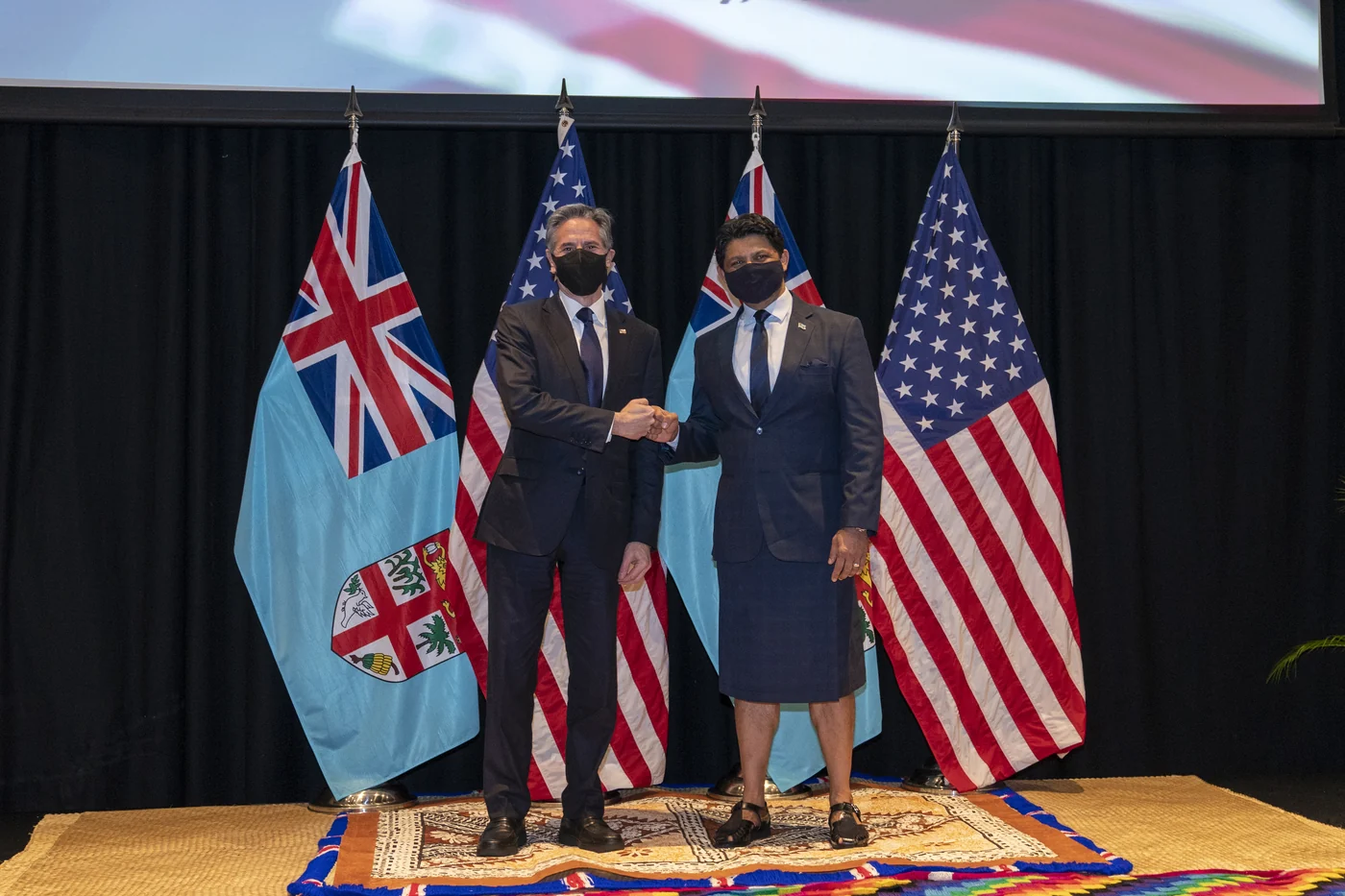
The photograph shows Fijian and U.S. flags at a meeting in Nadi on February 12, 2022, between Acting Prime Minister Aiyaz Sayed-Khaiyum and Secretary of State Antony J. Blinken. It records an actual ceremonial setting. Fabric folds, lighting, and perspective mean it should not be used as a precise color or geometry master.
Fiji’s flags stand alongside U.S. flags during the February 2022 meeting. Their cloth folds demonstrate how a real display differs from a flat diagram. The shield remains visible on the nearer Fijian flag, with the Union canton above it along the hanging fabric.
Ron Przysucha made the photograph for the U.S. Department of State. The delivered versions preserve the complete frame and are resized for responsive display. The participants’ titles describe their roles at that event, rather than asserting that they still hold those offices.
What is the Fiji flag emoji?
The Fiji flag emoji is 🇫🇯. It is formed from the regional-indicator letters F and J, corresponding to the country code FJ. Its appearance depends on the platform and font. Because a small emoji cannot reliably display the shield’s fine detail, use the supplied flag artwork for accurate study or printing.
The sequence consists of U+1F1EB followed by U+1F1EF. Supported platforms combine the two regional-indicator characters into a flag glyph; other environments can display the letter symbols instead.
An emoji is useful in running text but is not a detailed drawing master. The lion, cocoa pod, dove, and crop outlines need more space than a small glyph usually provides.
Which Fiji flag files are available to download?
Download the complete national flag SVG for scalable artwork, or the PNG for straightforward use in documents and image software. The gallery also provides labeled teaching diagrams, maritime ensign references, and a documentary photograph. Choose the light blue national flag when the task calls specifically for Fiji’s ordinary national symbol.
| File | Best use | Download |
|---|---|---|
| National flag SVG | Scalable illustration and careful resizing | Download SVG |
| National flag PNG | 2400 × 1200 pixels for documents and image software | Download PNG |
| Shield detail | Teaching the lion, cocoa pod, crops, cross, and dove | Download detail |
| Construction diagram | Understanding the 2:1 rectangle and placement | Download diagram |
| Ensign comparison | Distinguishing national, civil, government, and naval flags | Download comparison |
The gallery below includes the remaining diagrams and individual maritime ensign references. Captioned teaching sheets contain labels and guide marks outside the national design. Choose the plain national flag when you need an unannotated light blue Fiji flag.
Credits appear with the gallery images. The documentary photograph is a historical record; it is not a substitute for the vector’s geometry or a fabric color proof.
Fiji flag pictures
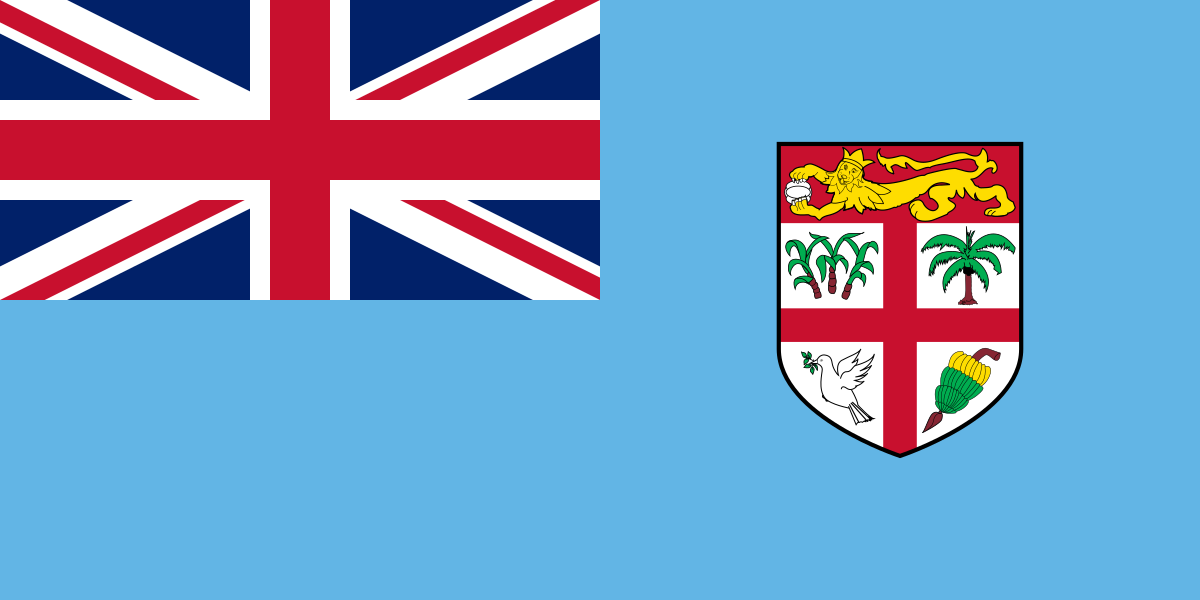
Fiji’s national flag has a light blue field, the Union Flag in the upper hoist, and the shield from the national coat of arms on the fly. Its width is twice its height.
GKBook composition, CC0; underlying flag references, public domain.Download image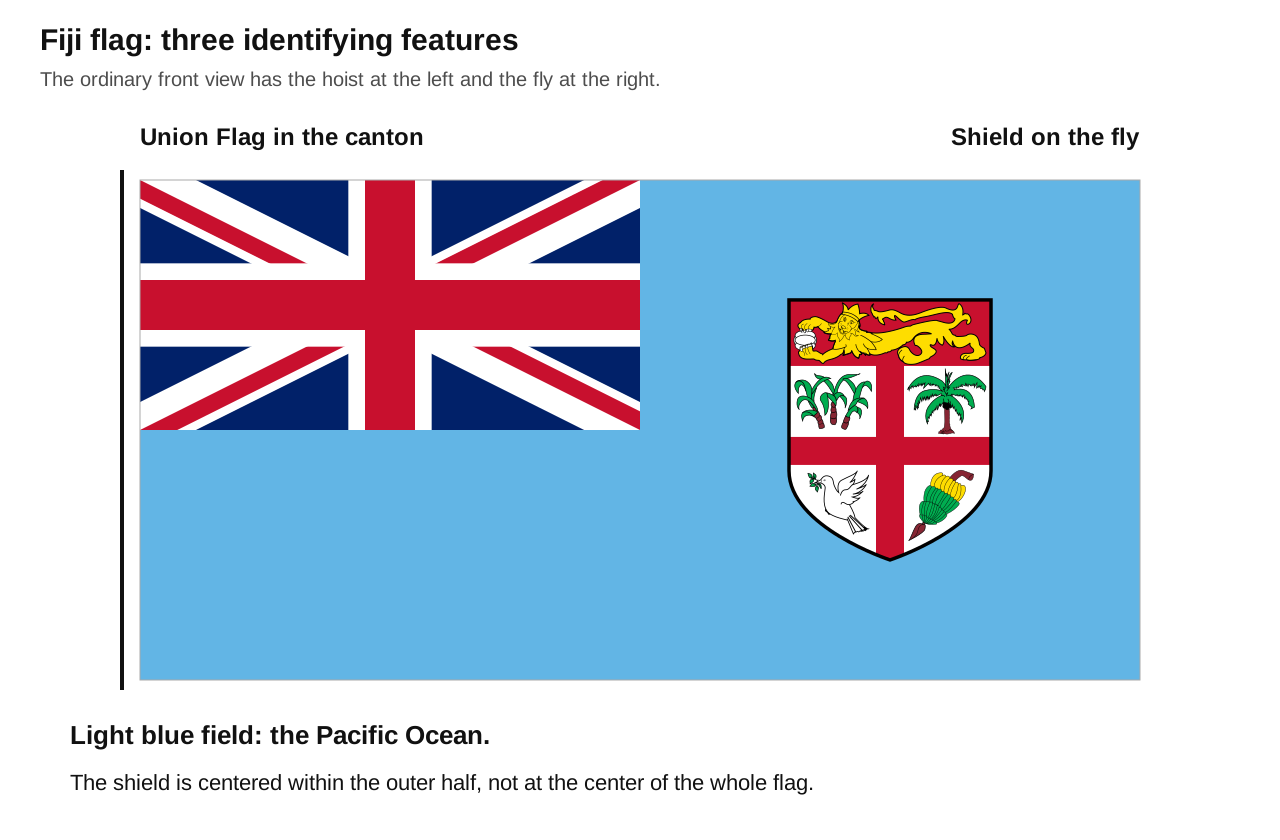
The Union Flag fills the upper quarter next to the hoist. The national shield stands in the outer half of the light blue field. The full coat of arms, with supporters, crest, and motto, is not placed on this flag.
GKBook composition, CC0; underlying flag references, public domain.Download image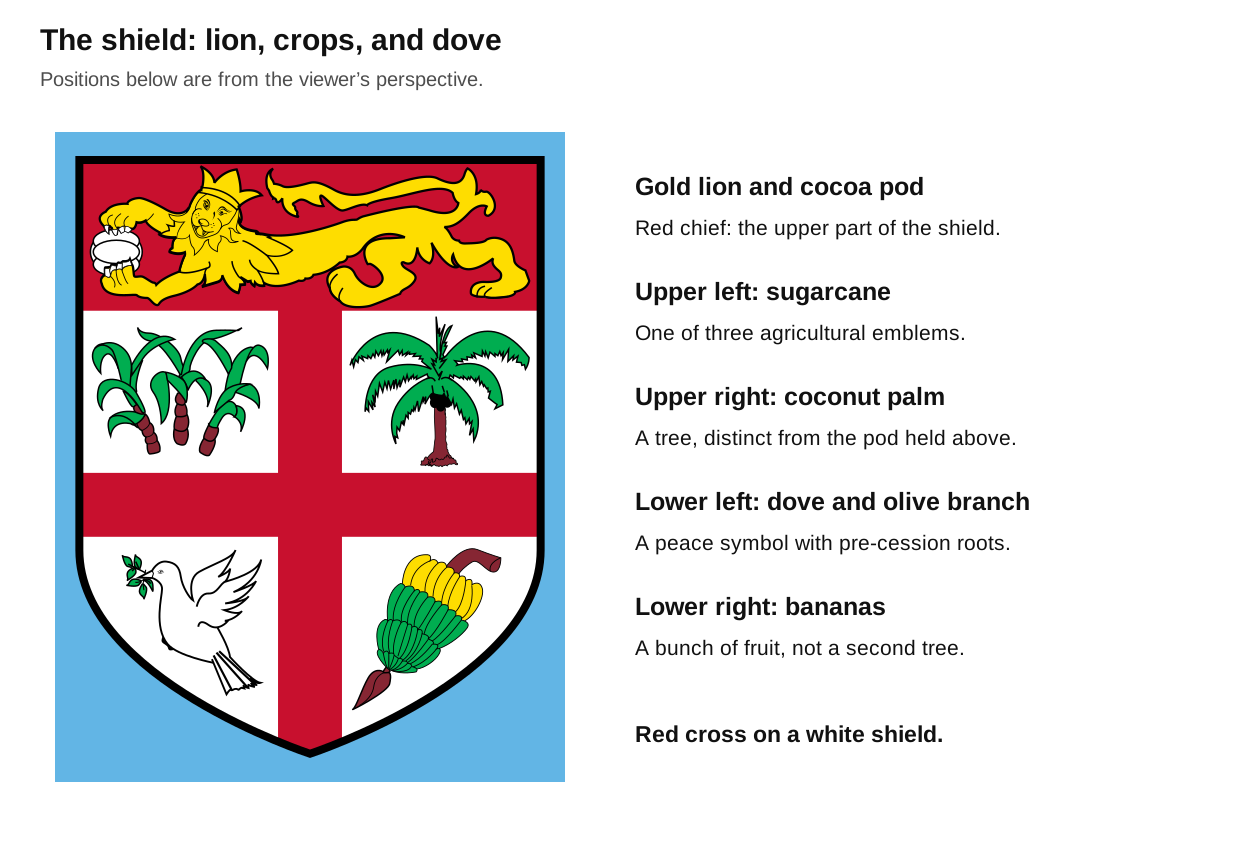
A gold lion holds a cocoa pod in the red chief. Below, a red cross divides the white shield: sugarcane at upper left, a coconut palm at upper right, a dove with an olive branch at lower left, and bananas at lower right. Positions are described as seen by the viewer.
GKBook composition, CC0; underlying flag references, public domain.Download image
The Union Flag combines upright and diagonal crosses in red, white, and dark blue. Its diagonal red stripes are offset within the white stripes. This is a detail crop for study, not a separate Fiji national flag.
GKBook composition, CC0; underlying flag references, public domain.Download image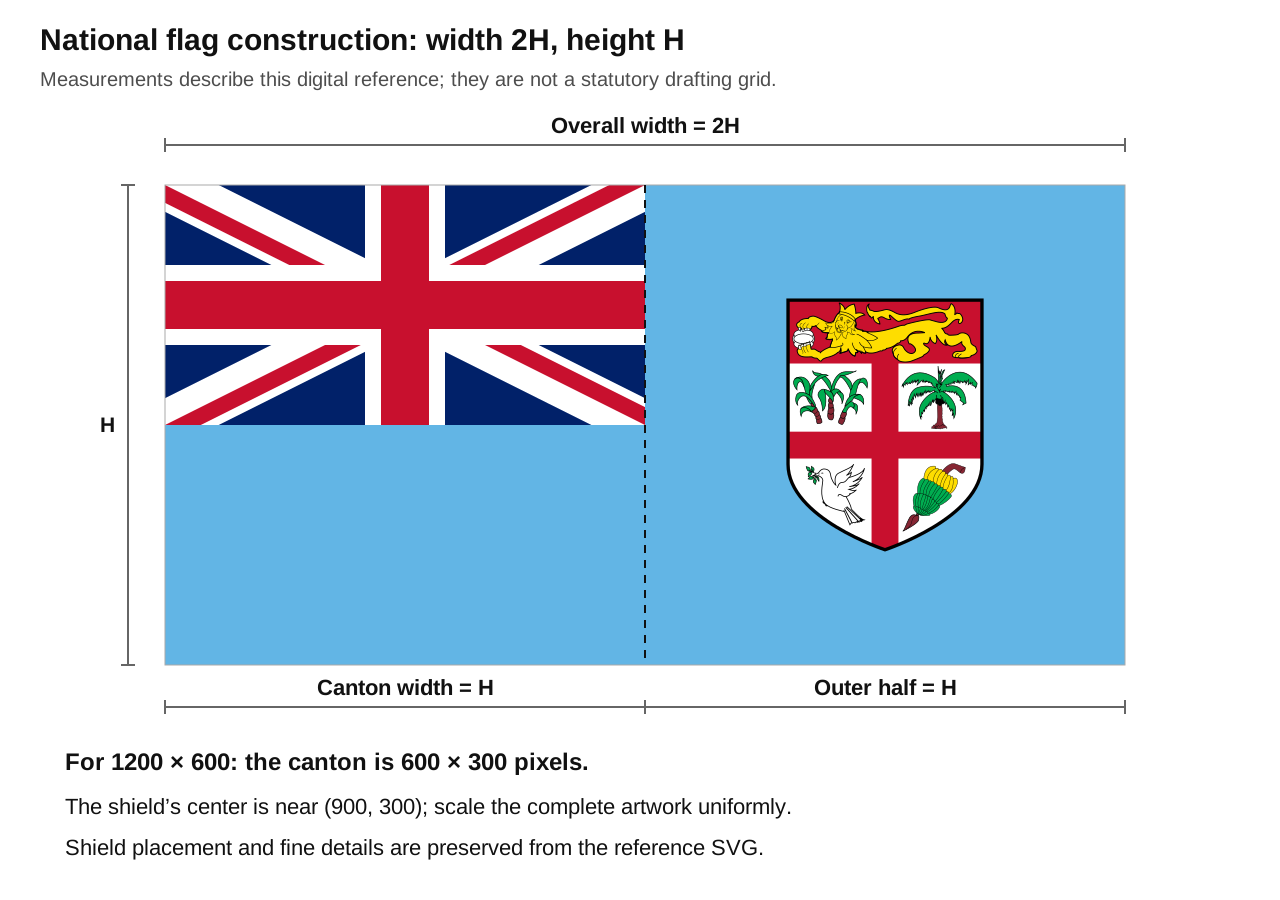
Fiji’s national flag is 2:1 in width-to-height terms. In the supplied 1200-by-600 reference, the Union canton occupies 600 by 300 pixels. The shield is centered in the fly half. These measurements explain the artwork rather than claiming a legally prescribed shield construction grid.
GKBook composition, CC0; underlying flag references, public domain.Download image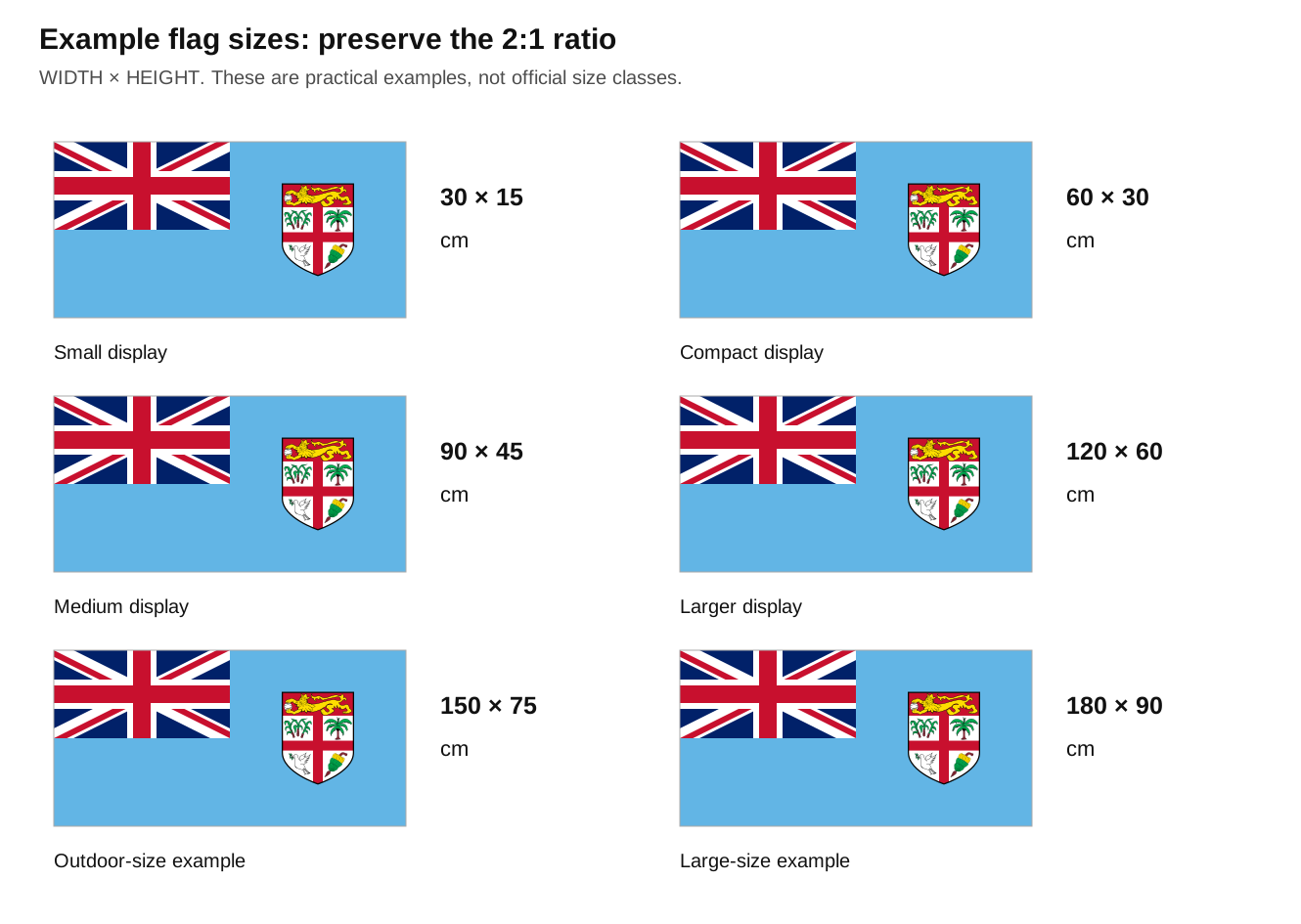
Examples of width by height in centimeters are 30 by 15, 60 by 30, 90 by 45, 120 by 60, 150 by 75, and 180 by 90. They all preserve 2:1 proportions and are not presented as government-mandated sizes. Illustrations are normalized for legibility.
GKBook composition, CC0; underlying flag references, public domain.Download image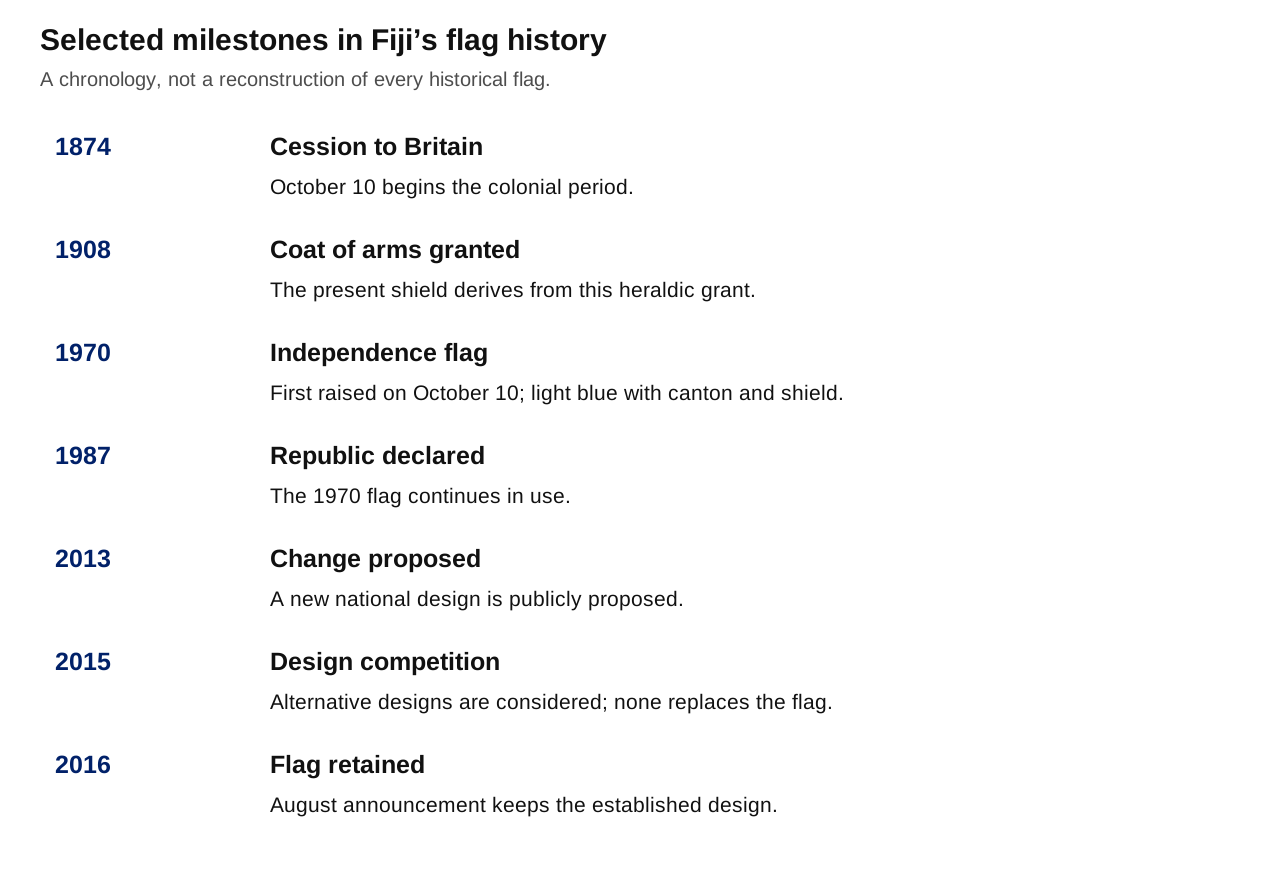
The timeline separates cession in 1874, the 1908 coat of arms, the independence flag of October 10, 1970, continuity after the republic in 1987, the 2013 proposal and 2015 competition, and the August 2016 decision to retain the flag.
GKBook composition, CC0; underlying flag references, public domain.Download image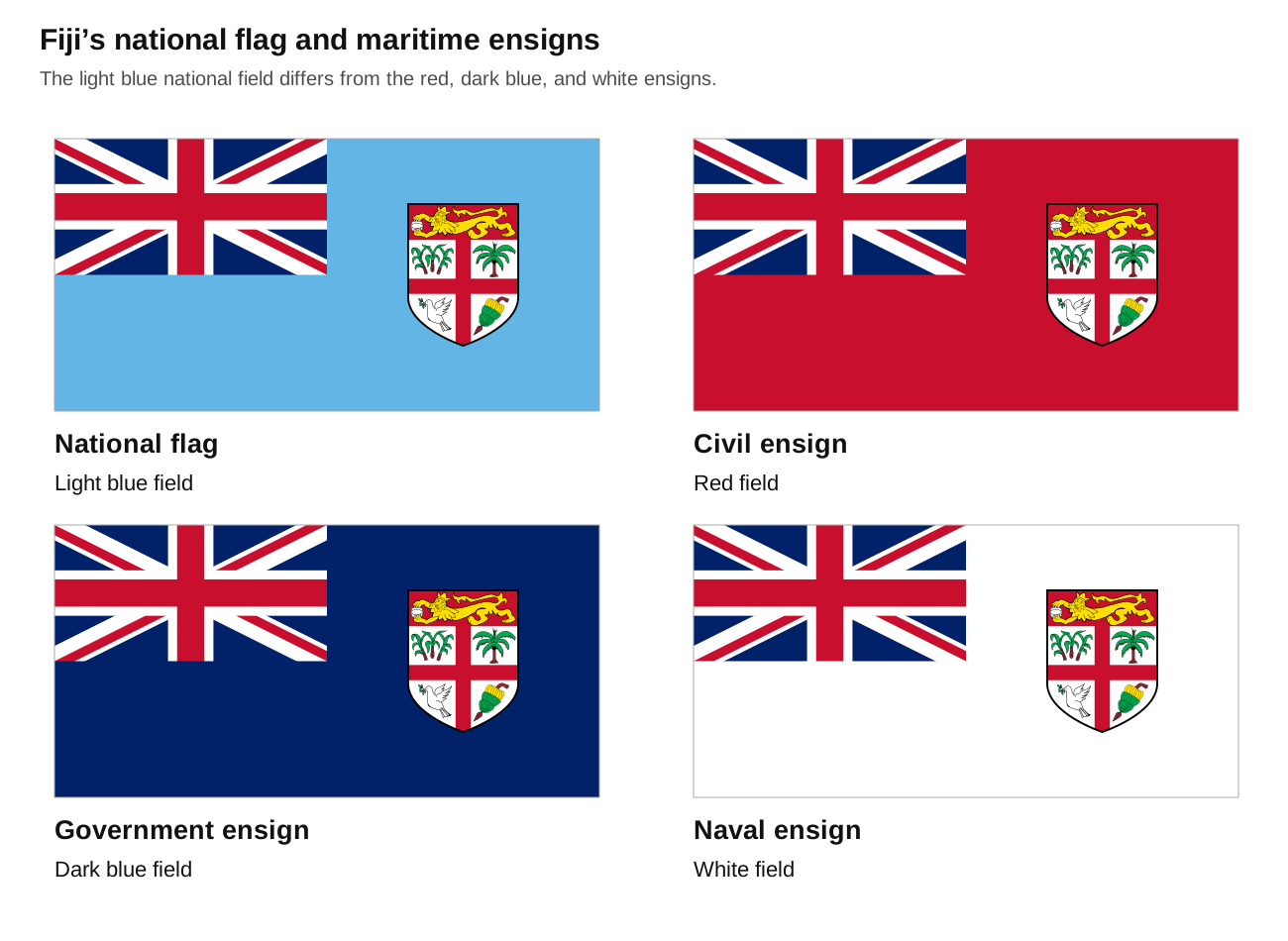
The national flag has a light blue field. The civil ensign is red, the government ensign dark blue, and the naval ensign white. Each illustrated ensign retains the Union canton and shield. Their distinct functions should not be confused with alternative national flag designs.
GKBook composition, CC0; underlying flag references, public domain.Download image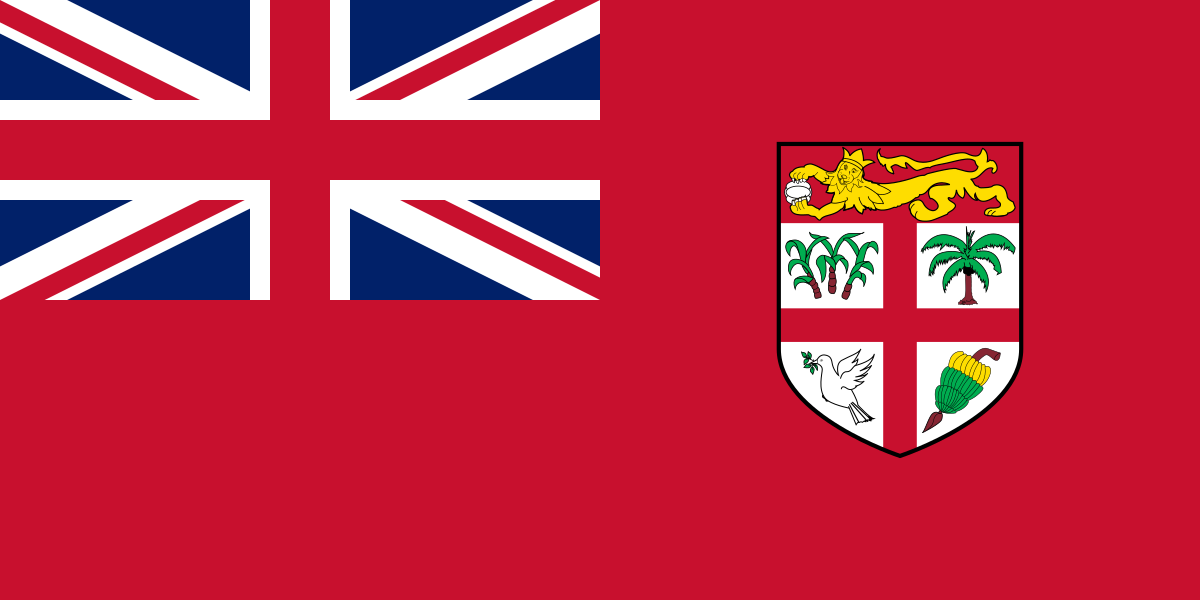
Fiji’s red civil ensign carries the Union Flag in the upper hoist and the national shield on the fly. It is distinct from the light blue national flag.
Greentubing and subsequent Commons contributors, public domain; GKBook preparation, CC0.Download image
Fiji’s government ensign has a dark blue field, Union canton, and national shield. Its dark blue field distinguishes it from the light blue national flag.
Greentubing and subsequent Commons contributors, public domain; GKBook preparation, CC0.Download image
Fiji’s naval ensign uses a white field with the Union Flag in the upper hoist and the national shield on the fly. It is a maritime service flag, not the ordinary national flag.
Greentubing and subsequent Commons contributors, public domain; GKBook preparation, CC0.Download image
An ordinary raised flag is compared with a lowered mourning display. Fiji’s government issues half-mast announcements for particular occasions. The positions are schematic and do not prescribe a fixed fraction of the pole or indicate that a past announcement remains in effect.
GKBook composition, CC0; underlying flag references, public domain.Download image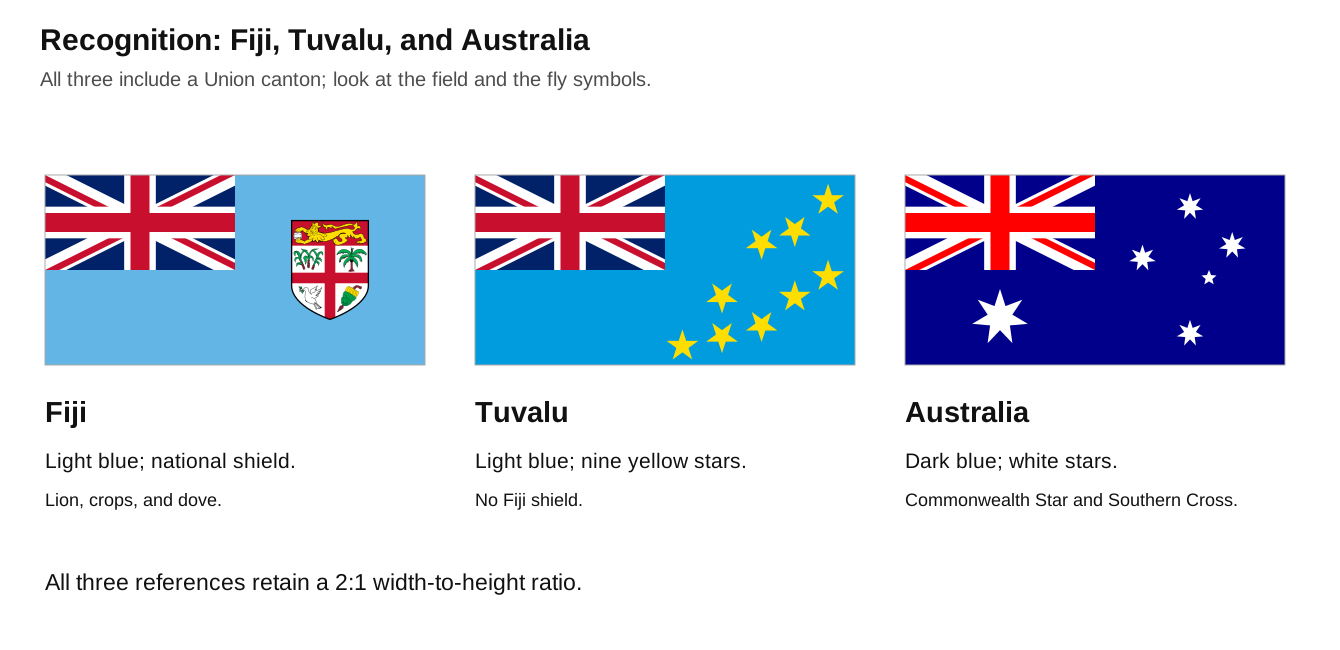
Fiji combines a light blue field with a shield. Tuvalu has a light blue field with nine yellow stars. Australia has a dark blue field with white stars. The common Union canton alone does not identify the country; each reference here is 2:1.
GKBook composition, CC0; underlying flag references, public domain.Download image
Fijian and U.S. flags at a meeting between Fiji’s Acting Prime Minister Aiyaz Sayed-Khaiyum and U.S. Secretary of State Antony J. Blinken in Nadi, Fiji, on February 12, 2022. The photograph documents ceremonial display rather than calibrated flag colors.
Photograph: Ron Przysucha / U.S. Department of State, public domain. Full frame retained; resized and converted to WebP.Download imageFrequently asked questions
What does Fiji’s flag look like?
Fiji’s flag has a light blue field with the Union Flag in the upper corner beside the hoist. A shield from Fiji’s coat of arms appears in the outer half. The shield contains a gold lion, a red cross, agricultural emblems, and a white dove carrying an olive branch.
What are the proportions of Fiji’s flag?
Fiji’s national flag is twice as wide as it is high: 2:1 in width-to-height terms, or 1:2 with height first. A 120-by-60-centimeter flag has this shape. In the supplied artwork, the Union canton occupies the upper quarter, while the shield is centered within the outer half.
What are Fiji’s flag color codes?
The supplied SVG uses light blue #62B5E5, dark blue #012169, red #C8102E, and white #FFFFFF, with additional shield colors. These identify this digital reference, not a universally enacted numerical palette. Published references differ in shade specifications, so print production should use an agreed color proof rather than assume screen values are statutory.
What does the Fiji flag mean?
The light blue field represents the Pacific Ocean, and the Union Flag recalls Fiji’s historical links with Britain. The shield combines a British heraldic lion with agricultural emblems and a dove of peace. Its details connect the country’s colonial heraldry, island economy, and a symbol used before cession.
Why is Fiji’s flag light blue?
Fiji’s official diplomatic description connects the light blue field with the Pacific Ocean. The color suits the country’s island setting and the importance of the sea. It also distinguishes the national flag from the dark blue government ensign and the dark blue fields of several other Pacific flags.
Why does Fiji’s flag contain the Union Jack?
The Union Jack, also called the Union Flag, recalls Fiji’s historical connection with the United Kingdom. Fiji became independent in 1970 and retained this canton in its new national design. The flag also remained unchanged when Fiji became a republic in 1987, so the canton does not indicate current British rule.
What is on the shield of Fiji’s flag?
A gold lion holding a cocoa pod occupies the red upper section. Below it, a red cross divides a white shield into four quarters. Viewed from the front, sugarcane is upper left, a coconut palm upper right, a dove lower left, and a bunch of bananas lower right.
What is the lion holding on Fiji’s flag?
The gold lion holds a cocoa pod between its forepaws. Fiji’s official descriptions identify the object as cocoa, not a coconut. A coconut palm appears separately in the shield’s upper-right quarter. Keeping those two details distinct helps explain both the lion’s heraldic setting and the agricultural imagery below it.
Which crops appear on Fiji’s flag?
The shield shows sugarcane, a coconut palm, and a bunch of bananas in three of its quarters. A cocoa pod is held by the lion above them. These agricultural details are separate objects: the palm is a tree, the bananas are a bunch of fruit, and the cocoa belongs to the chief.
What does the dove on Fiji’s flag represent?
The white dove with an olive branch is a peace symbol. Fiji’s embassy also connects it with the main emblem on the Cakobau government’s flag before cession to Britain. On the current shield, the dove occupies the lower-left quarter as the viewer looks at the front of the flag.
What is the red cross on Fiji’s shield?
The red upright cross divides the white shield into four quarters containing the crops and dove. It is identified as the Cross of Saint George in Fiji’s official history. It belongs to the shield’s heraldic design and should not be confused with the larger crossed elements inside the Union canton.
Does the flag show Fiji’s complete coat of arms?
No. The flag displays the shield from the coat of arms. The complete arms also have two Fijian warrior supporters, a canoe crest, and a motto scroll. Those surrounding elements do not appear on the ordinary national flag, even though they remain part of the fuller heraldic achievement.
Who designed Fiji’s flag?
Fiji’s official embassy account credits the winning design jointly to Robi Wilcock and Tessa Mackenzie, who is named there as Mrs. Murray MacKenzie. Mackenzie’s later account describes separate entries with the same essential idea. Their historical design credit is distinct from the work of artists who later prepared digital flag files.
How should Fiji’s flag be reproduced?
Keep the 2:1 rectangle, the correctly oriented Union canton, and the complete shield in the fly half. Scale the design uniformly so its small emblems remain recognizable. Use the supplied vector for sharp output and approve the chosen fabric, printing method, and physical colors for the intended display.
Where is the shield positioned on Fiji’s flag?
The shield is centered within the outer half of the flag, opposite the hoist. In the supplied 1200-by-600-pixel reference, its center is near coordinate 900, 300. These measurements describe the reference artwork; they are not presented as a complete statutory construction grid for every shield line and curve.
What sizes can a Fiji flag have?
A Fiji national flag can be scaled while preserving its 2:1 width-to-height ratio. Examples include 60 by 30, 90 by 45, and 150 by 75 centimeters. These are practical examples rather than verified mandatory national size classes; the intended pole, venue, material, and viewing distance determine a suitable size.
When is Fiji’s National Day?
Fiji Day is October 10, marking independence from Britain in 1970. The national flag first flew on that same date, so its anniversary coincides with the independence observance. October 10 also recalls cession in 1874. This article does not identify a separate officially established annual Flag Day.
What are the main stages in Fiji’s flag history?
Fiji’s flag history includes pre-cession symbols, British colonial ensigns, the coat of arms granted in 1908, and the light blue independence flag introduced in 1970. The national design continued after the republic was declared in 1987. Later redesign proposals did not replace the flag that Fiji uses today.
When was Fiji’s current flag adopted?
Fiji’s current national flag was adopted on October 10, 1970, the day the country became independent from Britain. Its first ceremonial raising is associated with Albert Park in Suva. The shield has older origins in the 1908 coat of arms, so the flag’s adoption and the heraldic grant are different milestones.
How did the independence flag differ from the colonial flag?
The independence flag introduced a light blue field while retaining a Union canton and using the shield alone on the fly. The colonial ensign tradition used dark blue and fuller representations of Fiji’s arms. The shield’s survival provides continuity, but the 1970 national design should not be labeled a colonial-era flag.
Did Fiji change its flag when it became a republic?
Fiji retained its 1970 flag after becoming a republic in 1987. The continued Union canton reflects the design’s history rather than a requirement that the country remain a monarchy. Discussions about replacing colonial symbols occurred later, but they should not be mistaken for an adopted replacement national flag.
Why did Fiji keep its flag after the redesign proposals?
In August 2016, the government announced that the existing flag would remain. The explanation included public attachment displayed during Fiji’s Olympic rugby sevens success and priorities for recovery after Tropical Cyclone Winston. A national competition had considered alternatives in 2015, but none of those designs became the replacement national flag.
Does Fiji have different flags for ships?
Fiji has distinct maritime ensigns as well as its light blue national flag. The civil ensign has a red field, the government ensign a dark blue field, and the naval ensign a white field. The illustrated references retain the Union canton and national shield while changing the main field color.
Is a red Fiji flag the national flag?
A red field with Fiji’s Union canton and shield identifies the civil ensign in the references used here. The ordinary national flag has a light blue field. A change in background color therefore may identify a different function, rather than an alternative shade of the same national flag.
Where is Fiji’s flag displayed?
Fiji’s national flag appears at government and diplomatic settings, national celebrations, sporting events, and other public displays. Formal arrangements should follow the instructions for the particular venue or ceremony. The practical guidance here preserves the design and respectful handling without claiming an independently verified universal daily schedule or household display duty.
How should Fiji’s flag be oriented?
For a standard front-facing horizontal illustration, place the Union canton at the upper left beside the hoist and keep the shield upright in the fly half. Do not mirror that artwork as a shortcut. Vertical installations and two-sided production should follow the relevant event instructions and an approved display master.
When is Fiji’s flag flown at half-mast?
Fiji’s government directs half-mast display for particular mourning occasions. An official notice dated April 1, 2026, recorded Cabinet approval following the death of former President Ratu Epeli Nailatikau. That is a historical example, not a claim that mourning continues indefinitely; the applicable announcement supplies the dates and instructions.
Are there special rules for flag use at a funeral?
A funeral’s responsible authority should specify whether a national flag is used and how it is handled. The sources reviewed for this page do not establish a universal Fijian coffin-fold sequence or automatic entitlement for every funeral. Avoid importing another country’s folding ceremony and presenting it as Fiji’s prescribed custom.
What is Fiji’s National Flag Protection Act 2015?
The published National Flag Protection Act 2015 sets out a framework for a new flag, its use, protection, commercial permissions, and related matters. Its commencement depends on a ministerial Gazette notice. The sources reviewed here did not establish that notice and the associated flag declaration, so the text is described with that limitation.
Can Fiji’s flag be used in a logo or advertisement?
Reusable flag artwork does not by itself authorize every commercial use of a national symbol. The published 2015 Act contains written-approval provisions concerning logos, advertising, and merchandise, but its commencement and declaration require separate verification. For a commercial project, confirm the applicable requirements with the responsible Fijian authority before relying on copyright status alone.
How should a Fiji flag be cared for?
Follow the textile maker’s care instructions, inspect the fly edge and attachments, and allow the flag to dry before storing it. Replace an unsuitable display flag when damage or fading obscures the design. Treat any historically important textile as a potential conservation object rather than automatically disposing of it as ordinary worn material.
How can Fiji’s flag be distinguished from Tuvalu’s?
Both Fiji and Tuvalu use light blue fields with Union cantons, but the fly symbols differ. Fiji displays its heraldic shield, while Tuvalu displays nine yellow stars. Look for the shield’s red cross and gold lion when identifying Fiji; the common canton and broad blue background alone are not enough.
How does Fiji’s flag differ from Australia’s?
Fiji has a light blue field and a heraldic shield on the fly. Australia has a dark blue field with white stars, including the Commonwealth Star and Southern Cross. Both contain a Union canton and use 2:1 proportions, but their background colors and main identifying symbols are visibly different.
What does the diplomatic photograph show?
The photograph shows Fijian and U.S. flags at a meeting in Nadi on February 12, 2022, between Acting Prime Minister Aiyaz Sayed-Khaiyum and Secretary of State Antony J. Blinken. It records an actual ceremonial setting. Fabric folds, lighting, and perspective mean it should not be used as a precise color or geometry master.
What is the Fiji flag emoji?
The Fiji flag emoji is 🇫🇯. It is formed from the regional-indicator letters F and J, corresponding to the country code FJ. Its appearance depends on the platform and font. Because a small emoji cannot reliably display the shield’s fine detail, use the supplied flag artwork for accurate study or printing.
Which Fiji flag image should I download?
Download the complete national flag SVG for scalable artwork, or the PNG for straightforward use in documents and image software. The gallery also provides labeled teaching diagrams, maritime ensign references, and a documentary photograph. Choose the light blue national flag when the task calls specifically for Fiji’s ordinary national symbol.
Is there writing on Fiji’s national flag?
Fiji’s ordinary national flag has no motto text. Its shield omits the scroll that belongs to the full coat of arms. That scroll carries the Fijian motto Rerevaka na Kalou ka Doka na Tui, translated in Fiji’s official diplomatic history as an injunction to fear God and honor the King.
What does “defaced ensign” mean for Fiji’s flag?
In flag terminology, a defaced ensign is an ensign bearing an added badge or device; the word does not mean damaged or dishonored. Fiji’s official description uses the term for its sky-blue design with the shield on the fly. The light blue field remains an important part of its identity.
Explore all general-knowledge topics and the A-to-Z lists.

We Value Your Opinion Comments