
Ethiopia flag picture
Explore the construction sheet, the star and rays, and the historical sequence.

| Country | EthiopiaFederal Democratic Republic of Ethiopia; in the Horn of Africa. |
|---|---|
| Design | Tricolor with a blue diskGreen, yellow, and red equal bands; yellow pentagram and five rays. |
| Proportions | 2:1 width:heightOrdinary national flag; the specified official vehicle flag is 4:3. |
| Federal emblem | February 6, 1996Proclamation 16/1996; circle placement amended October 31, 1996. |
| Current flag law | August 28, 2009Proclamation 654/2009, amended by Proclamation 863/2014. |
| Colors | Green, yellow, red, blueThe star and rays use yellow; the blue disk represents peace. |
| Flag Day | First Monday of TikimtEthiopian calendar month; normally falls in Gregorian October. |
| Designer attribution | Abebe AlamboCredited in reference catalogs; the reviewed proclamations name no individual designer. |
The older tricolor tradition, the federal emblem’s February 1996 enactment, the October 1996 amendment, and the replacement 2009 law are distinct milestones. Flag Day follows the Ethiopian calendar.
What is the flag of Ethiopia?
Ethiopia’s flag has three equal horizontal bands: green at the top, yellow in the middle, and red at the bottom. A blue disk at the center carries an interlaced yellow pentagram and five yellow rays. The ordinary national flag is twice as wide as it is high.
The flag belongs to the Federal Democratic Republic of Ethiopia, in the Horn of Africa. Its long green-yellow-red rectangle combines an old national color tradition with the federal emblem introduced in 1996. The emblem gives the current design a different identity from earlier imperial and plain tricolor flags.
The complete flag SVG provides a scalable reference. The construction section explains the disk geometry, and the Flag Day section distinguishes the Ethiopian calendar rule from a fixed Gregorian date.
What are the flag’s identifying features?
Read the horizontal bands from top to bottom as green, yellow, and red. Each band occupies one third of the flag’s height. The blue disk overlaps all three bands, while the star and rays are yellow. Reversing the outer bands or omitting the emblem changes the current national design.
The pentagram is formed from linked yellow line segments, with a point facing upward. Five separate rays extend outward around it. The gaps at the line crossings help give the star its interlaced appearance; a generic solid star is a different drawing.
The blue circle sits on the center of the entire rectangle. It is wider than the yellow band is high, so it necessarily enters the green and red areas. Its placement is symmetrical above and below the horizontal middle line.
The design uses four principal colors, even though its background is a tricolor. Yellow appears both as a field band and within the emblem. A white gap, outline, extra seal, inscription, or substituted lion is not part of the supplied current national reference.
What are the flag’s colors and digital values?
The supplied digital reference uses green #078930, yellow #FCDD09, red #DA121A, and blue #0F47AF. These are the actual SVG colors, not numerical codes enacted in the flag proclamation. The law names the colors without prescribing HEX, RGB, CMYK, or Pantone values; printed fabric therefore requires a separate color proof.
| Color | SVG HEX | RGB | Position |
|---|---|---|---|
| Green | #078930 | 7, 137, 48 | Top band |
| Yellow | #FCDD09 | 252, 221, 9 | Middle band, pentagram, and rays |
| Red | #DA121A | 218, 18, 26 | Bottom band |
| Blue | #0F47AF | 15, 71, 175 | Circular emblem background |
Article 6 calls for bright basic colors, but it does not supply an international color chart, ink recipe, or numerical screen palette. Published images can therefore differ in saturation and in the blue disk’s shade. A photograph also changes with lighting, exposure, cloth translucency, and the viewing device.
A light-blue rendering is often cataloged as an earlier federal version. The reviewed 2009 English text says blue; it does not enact the HEX value #0F47AF or explicitly describe a change from one numerical blue to another. The downloadable reference should be understood as a documented digital rendering, not a claim that a particular screen code is written into the law.
For printing, request a proof on the actual material and settle the approved color targets with the commissioning authority. An automatically calculated CMYK approximation is not the same thing as an official national manufacturing standard.
What do the colors, star, and rays mean?
The star represents unity founded on the common will of Ethiopia’s peoples. Its straight, equal lines signify equality among Nations, Nationalities, Peoples, and religions. The proclamation does not assign each of the five points to a particular ethnic group, region, or religion, so such one-to-one mappings should not be invented.
Articles 7 and 8 assign meanings separately to the field colors and the national emblem. Green combines productive work with fertility and development. Yellow joins hope with justice and equality. Red recalls sacrifice and heroism in securing freedom and equality.
Within the emblem, peace is represented by blue, equality by the star’s equal lines, voluntary unity by the star, and a bright future by the rays. These meanings explain why simply removing the disk or replacing the pentagram with a solid star changes more than an ornamental detail.
Older, religious, and popular interpretations of the colors belong to their own historical contexts. They should not displace the meanings in the current proclamation. In particular, the five points are not a statutory list of five regions, five ethnic groups, or five religions.
How are the flag and central disk proportioned?
The disk’s diameter is two thirds of the flag’s height. This follows from the legal requirement that its outer edge reach the midpoint of both the green and red bands. On the supplied 1200-by-600 reference, the disk measures 400 pixels across and is centered at coordinates 600, 300.
Let the ordinary flag’s height be H. Its width is 2H, and each horizontal band is H/3 high. The disk’s center is at half the width and half the height. Its top is at H/6 and its bottom at 5H/6, measured down from the upper edge.
At 1200 × 600 pixels, each stripe is 200 pixels high, the disk’s diameter is 400 pixels, and its radius is 200 pixels. Scaling to 120 × 60 centimeters gives 20-centimeter bands and a 40-centimeter disk. The same proportional calculation works for any ordinary 2:1 size.
The proclamation establishes the emblem’s form, but the reviewed text does not supply a complete numerical drafting schedule for every star segment and stroke. Those details are therefore retained coherently from one reference master instead of being assembled from incompatible drawings. The special vehicle rectangle needs separate attention.
Which laws define the Ethiopian flag?
Flag Proclamation 654/2009 sets out the design, official meanings, sizes, display procedures, mourning rules, and prohibited uses. Proclamation 863/2014 later amended Flag Day and mourning authority during parliamentary recess. The Ministry of Justice lists these laws as in force, while the two 1996 flag enactments were replaced.
| Instrument | Effective date or constitutional provision | Role |
|---|---|---|
| Constitution | Article 3 | Three equal bands, central emblem, equality and unity; regional symbols permitted |
| Proclamation 16/1996 | February 6, 1996 | Earlier federal flag and emblem law; later repealed |
| Proclamation 48/1996 | October 31, 1996 | Amended circle placement and illustration; later repealed |
| Proclamation 654/2009 | August 28, 2009 | Replacement flag law: design, meanings, sizes, display, restrictions |
| Proclamation 863/2014 | August 11, 2014 | Amends Flag Day and mourning authority during parliamentary recess |
Article 3 of the Constitution establishes the central principles, while the proclamation supplies operational detail. Article 27 of the 2009 law repeals the two 1996 enactments. That repeal changes which text governs current practice; it does not erase the earlier laws’ importance to the design’s history.
The 2014 amendment changes two subjects rather than replacing the entire design. It moves the statutory Flag Day rule to Tikimt and gives the House Speaker authority in the specified recess situation. References to Article 22 must also account for the renumbering of its later paragraphs.
The flag law’s scope includes Ethiopia, specified Ethiopian diplomatic premises and vessels, and Ethiopian citizens abroad. This article summarizes the reviewed law and its recorded amendment; an institution applying it should also follow the relevant regulations, directives, and current official instructions for its setting.
How did Ethiopia’s flag develop?
The rectangular tricolor is associated with Menelik II and 1897, following earlier uses of the national colors. Its central devices changed through imperial, socialist, transitional, and federal periods. The age of the color tradition should therefore be distinguished from the adoption of the present blue disk and yellow star.
Rectangular tricolor tradition
The modern rectangular green-yellow-red tradition is associated with Menelik II; earlier pennants and color usages form part of its background.
Crowned Lion of Judah
State flags carried a lion with a cross-topped staff. Historical artwork and usage varied, so one modern SVG does not represent every surviving imperial flag.
Italian occupation
The occupation interrupted imperial rule. Liberation and Haile Selassie’s return are commemorated in the May 5 observance.
Monarchy overthrown
The imperial political setting ended. A transitional uncrowned-lion treatment was followed by other state emblems and plain tricolor use.
People’s Democratic Republic
A socialist-era national emblem appeared on the state flag; civil and state usage should not be collapsed into one identical illustration.
Transitional period
Plain tricolor use and changing state emblems preceded the federal blue-disk flag. A plain historical flag is not the current prescribed design.
Constitution adopted
Article 3 specifies equal green, yellow, and red bands with a central national emblem reflecting equality and unity.
Federal emblem legislated
Proclamation 16/1996 establishes the flag and emblem framework.
Circle placement amended
Proclamation 48/1996 specifies the circle reaching the midpoint of both outer bands and replaces the illustration.
New flag proclamation
Proclamation 654/2009 replaces the earlier flag enactments and supplies extensive display rules.
Flag Day and mourning amended
Proclamation 863/2014 replaces the Meskerem observance with the first Monday of Tikimt and addresses parliamentary recess.
Why does the historical imperial flag show a lion?
The crowned Lion of Judah belongs to Ethiopia’s imperial flag tradition. Historical state flags showed the lion carrying a cross-topped staff, although artwork varied. The current federal national flag uses a yellow pentagram on a blue disk instead. A lion-bearing historical reference is therefore not the present national design.
The Lion of Judah connected the imperial state flag with the monarchy and its religious and dynastic symbolism. The familiar crowned lion carries a staff topped by a cross and bearing a small banner. It is a historical national device, not another drawing of the federal pentagram.
The label “1897–1974” used in some image catalogs is a broad period label. Specialist histories record differing lion treatments, civil flags, and other variants within that span. The supplied imperial reference SVG is a modern illustration of a recognizable historical form, not a verified image of the first 1897 cloth.
After the monarchy’s overthrow in 1974, a short-lived treatment removed the lion’s crown and altered the staff device. Later socialist state emblems followed. The historical comparison does not imply that Ethiopia moved directly from this exact crowned-lion drawing to the present star without intervening designs.
Is a flag without the blue disk the current national flag?
A plain green-yellow-red tricolor has historical and cultural significance, but the 2009 proclamation requires the national flag to include the emblem. It expressly prohibits using the national flag without it. Historical illustrations and accounts of earlier civil flags should not be presented as authorization for an emblem-free current national flag.
The plain tricolor has appeared in historical civil use and continues to carry meaning in cultural and political settings. Describing that history is different from describing the national flag mandated by the 2009 proclamation.
Article 16 requires the national emblem on the flag, and Article 23 makes omission a specific prohibited use. A picture from an earlier period, a diaspora event, or a cultural gathering should therefore be captioned according to what it actually shows. It should not automatically replace the current national reference in an encyclopedia, classroom chart, or official display.
Why are both 1996 and 2009 associated with the flag?
The blue-disk federal emblem was established by Proclamation 16/1996, effective February 6, 1996. Its circle placement was amended on October 31 that year. The present flag proclamation took effect on August 28, 2009. These are distinct milestones, while the green-yellow-red tricolor tradition is considerably older than the federal emblem.
February 6, 1996 belongs to the original federal flag-and-emblem proclamation. October 31, 1996 belongs to its amendment, including the circle’s reach into the outer bands. August 28, 2009 belongs to the replacement flag proclamation.
The mid-band circle requirement is therefore not a wholly new invention of the 2009 law. Equally, the law’s use of the word blue does not establish a legally prescribed HEX-code change on that date. Distinguishing enactment, amendment, and digital rendering avoids a misleading one-date explanation.
Who is credited with the modern emblem’s design?
Reference catalogs credit Abebe Alambo with the federal emblem. The proclamations reviewed establish the design and its meaning but do not name an individual designer. That attribution should therefore be identified as a catalog credit, while modern vector illustrators should be credited separately for the particular artwork being reproduced.
Abebe Alambo is named in published reference metadata for the federal emblem. The primary proclamations reviewed describe what the emblem is and what it represents, but they do not provide a designer biography, a competition record, or an account of the first textile’s manufacture.
The delivered current flag artwork is based on the public-domain vector credited to SKopp and subsequent Commons contributors. That is a credit for the digital reference, distinct from the historical design attribution. The evidence does not support inventing a named seamstress, first factory, or undocumented commissioning ceremony.
How can the flag be reproduced faithfully?
Use a complete master with equal green, yellow, and red bands, a centered circular blue disk, and the full interlaced yellow star and rays. Preserve the appropriate proportions and prescribed size for the intended setting. Proof the actual fabric and inks rather than treating a monitor preview as manufacturing approval.
Preserve the complete design
- Use equal horizontal bands in the correct order.
- Center the blue disk and retain its circular shape.
- Keep the interlaced pentagram, its gaps, and all five rays.
- Select the size and proportions appropriate to the specified use.
- Approve a physical proof where color and fine detail matter.
Avoid changes to the national symbol
- Do not remove the emblem or substitute a solid star.
- Do not add slogans, a logo, or another badge.
- Do not stretch the circle into an oval.
- Do not use a historical lion flag as the current federal design.
- Do not describe screen colors as statutory Pantone specifications.
At small sizes, check whether the method can retain the star’s narrow openings and the five separate rays. A simplified, filled-in shape may be easier to print but would change the reference. For sewn or printed cloth, agree on hoist reinforcement, attachments, exposure, and the intended appearance from the reverse.
These production recommendations complement the legal design and size rules. They do not establish one mandatory fabric, stitching method, thread count, or commercial product certification.
Which official sizes are prescribed?
The proclamation lists six ordinary sizes. Expressed as width by height in centimeters, they are 420 by 210, 300 by 150, 270 by 135, 210 by 105, 180 by 90, and 42 by 21. Different sizes serve squares, buildings, ships, processions, street displays, and specified official desks.
| Size number | Width × height, cm | Specified uses |
|---|---|---|
| 1 | 420 × 210 | Major squares |
| 2 | 300 × 150 | Medium squares |
| 3 | 270 × 135 | Squares of offices, higher education institutions, and organizations; major government buildings |
| 4 | 210 × 105 | Specified organizations and businesses on major buildings’ ground floors; major ships; guard-of-honor processions |
| 5 | 180 × 90 | Street displays for foreign guests and public holidays; medium ships |
| 6 | 42 × 21 | Desks of the President, Prime Minister, and ambassadors |
The English law’s table states the shorter measurement before the longer one, calling them width and length. This page consistently states horizontal width × vertical height. Thus the law’s 210 × 420 becomes 420 × 210 here; the rectangle itself has not changed.
Size numbers identify use classes. A large square, a government building, a ship, and an official desk are not interchangeable settings. Article 13 separately describes a semicircular finial; the repealed 1996 law’s spear-shaped description should not be copied as the current rule.
What is special about the official vehicle flag?
Article 11 provides a special flag for designated official vehicles: 40 centimeters wide and 30 centimeters high. That is 4:3 in width-to-height terms, unlike the ordinary 2:1 flag. The exception concerns specified official use; it does not make every privately displayed car flag an authorized official vehicle flag.
The English text gives the special width-to-length ratio as 3:4 because it names the short dimension first. In this article’s horizontal-width-first convention, the same rectangle is 40 cm × 30 cm, or 4:3. It is visibly less elongated than an ordinary 2:1 flag.
Article 21 addresses flags on the vehicles of designated senior officials, including the President, Prime Minister, ambassadors, parliamentary presiding officers, federal ministers, and other listed officeholders. It also describes the Ethiopian and visiting official’s flags on a government vehicle receiving a foreign official.
Use the responsible office’s approved fittings and master. Merely resizing a finished ordinary flag nonproportionally would distort its disk and star, and the presence of a flag on a private vehicle does not confer the official status described by the law.
When is Ethiopia’s Flag Day celebrated?
Ethiopia’s Flag Day falls on the first Monday of Tikimt, an Ethiopian calendar month, under the 2014 amendment. It normally occurs in Gregorian October, but it is not defined as the first Monday of that Gregorian month. For example, the National Bank marked the 2025 observance on October 13.
The 2014 amendment replaces Article 4’s earlier second-Monday-of-Meskerem rule with the first Monday of Tikimt, also transliterated Tikimit. The month belongs to the Ethiopian calendar. It should not be silently converted into “the first Monday of October” in the Gregorian calendar.
The National Bank of Ethiopia recorded its eighteenth national observance on Monday, October 13, 2025. That dated event provides a concrete example of the observance, while the amendment supplies the recurring legal rule. A report’s Gregorian shorthand should not override the actual calendar wording in the law.
Flag Day concerns the flag as a national symbol. Its identification here does not imply a universal private-household display duty, a particular year’s event timetable, or a complete statement of public-holiday working arrangements.
How do Adwa and Patriots’ Victory Day differ from Flag Day?
Ethiopia’s national history does not fit a simple colonial-independence anniversary. Adwa Victory Day, observed on March 2, recalls the 1896 victory over an invading Italian army. Patriots’ Victory Day on May 5 recalls liberation from the later Italian occupation. These historical commemorations are separate from the annual Flag Day.
| Observance | Calendar reference | Historical focus |
|---|---|---|
| Flag Day | First Monday of Tikimt | National flag, unity, and sovereignty |
| Adwa Victory Day | March 2 | Victory at Adwa in 1896 |
| Patriots’ Victory Day | May 5 | Liberation from Italian occupation in 1941 |
The victory at Adwa became a powerful symbol of resistance to colonial conquest. The later Italian occupation from 1936 to 1941 is a separate episode; it should not disappear behind an oversimplified claim that Ethiopia never experienced foreign occupation.
The May 5 commemoration recalls the struggle of Ethiopian patriots and the end of that occupation. Neither anniversary is the legal adoption date of the 1996 blue-disk emblem, and neither replaces the Tikimt rule for Flag Day. This is a comparison of the three observances, not a full national holiday calendar.
Where and on what occasions is the flag displayed?
The proclamation identifies daily display at specified public institutions, schools, military and police establishments, border facilities, diplomatic premises, and Ethiopian merchant ships and boats, subject to its exceptions. It also addresses other government offices on public holidays and election locations. These provisions should not be rewritten as a universal daily household obligation.
Article 12 lists institutions and settings, including the House of Peoples’ Representatives, the Council of Ministers, regional organs of government, ministries, executive bodies, courts, schools, military and police establishments, border facilities, diplomatic buildings, ambassadors’ residences, and merchant ships and boats. It includes a force-majeure qualification.
The article also covers other government offices on public holidays, specified senior offices and residences, and election registration and polling locations. Where the national flag accompanies certain institutional or organizational emblems, the law gives it a central, higher position in the arrangement.
Article 14 places an institutional flagstaff, where possible, centrally in front of the institution. These placement and institutional-use provisions are more specific than general advice to display a flag respectfully. They should be applied to the actual location described.
When should the flag be raised and lowered?
For ordinary displays covered by Article 15, the stated hours are 6 a.m. to 6 p.m. Schools raise the flag before classes and lower it at 6 p.m. Holiday display covers the eve, the holiday, and the following day within the daily hours; a military emergency-area exception also exists.
The ordinary schedule in Article 15 is 6 a.m. to 6 p.m. for the institutions and vessels covered by that provision. Schools raise the flag before classes begin, then lower it at 6 p.m. Military units in areas under a state of emergency have a stated exception.
For national public holidays, the flag is displayed on the eve, the day itself, and the following day, within the stated daily hours. The phrase “three days” should not be interpreted as permission to leave the flag aloft continuously through the intervening nights.
These times come from the proclamation’s English text. A ceremony’s operational instructions should make the local clock convention and schedule clear to participants, especially where different ways of expressing time are in use.
How is the national flag arranged with other flags?
In a paired display, the proclamation places Ethiopia’s national flag on the right as understood from the flag party’s viewpoint, facing the observers. This is the viewer’s left. Multi-flag arrangements have additional rules, and the provisions for regional flags differ from those governing foreign flags and international organizations.
| Arrangement | National flag position | Ordering rule |
|---|---|---|
| One regional flag | National flag on its own right | Paired arrangement |
| Two regional flags | National flag centered and higher | Regional flags in Amharic alphabetical order |
| More than two regional flags | National flag at its own right end | Regional flags follow in Amharic alphabetical order |
| One foreign flag | National flag on its own right | Paired arrangement |
| Two foreign flags | National flag centered | Other flags in English alphabetical order |
| Larger international group | As provided in Article 19 | English alphabetical order; separate host-not-participating provision |
Article 19 extends the foreign-flag provisions, with necessary adjustments, to the United Nations, African Union, and other international organizations. Its wording differs from the regional arrangement. In particular, the rule raising the national flag above two regional flags should not be transferred indiscriminately to a display of sovereign foreign flags.
For a formal multi-country ceremony, work from the complete applicable instructions and the participant list. The paired diagram is an explanation of viewpoint, not a substitute for the full arrangement rules or a claim about every diplomatic photograph.
How is the flag carried in a guard-of-honor procession?
Article 20 places the flag five meters ahead of the first guard-of-honor row. It describes holding the lower staff with the right hand and the upper portion with the left, centered before the body, with accompaniment. This specific procession rule should not be treated as a universal spacing rule for every parade.
The law’s five-meter spacing concerns the flag carried before a guard of honor. Its handling description places the staff centrally in front of the bearer, with the right hand lower and the left hand higher. Accompaniment is required, but the reviewed passage does not prescribe a number of escorts to be invented by an illustrator.
The statutory size assigned to this use is Size 4: 210 centimeters wide by 105 centimeters high. A school parade, public march, or sports entrance may have its own instructions; the guard-of-honor rule should retain its named context.
How should orientation and the reverse side be handled?
The national design is defined in its ordinary horizontal arrangement, with green above yellow above red and a centered emblem. The reviewed proclamation does not provide a separate universal vertical-display construction. Follow the responsible organizer’s applicable instructions, preserve the complete design, and avoid importing another country’s rotation rule without evidence.
For an ordinary horizontal illustration, keep green above yellow above red and the pentagram upright. The disk stays circular. A hanging physical flag will fold, and its reverse can be seen through the cloth; neither circumstance changes the underlying national design.
Before producing a two-sided flag or a vertical installation, confirm the intended viewing arrangement with the responsible authority. The diagrams here retain the verified horizontal reference. They do not invent a universal vertical rule or prescribe a different reverse emblem unsupported by the reviewed text.
When is the Ethiopian flag lowered for mourning?
Article 22 provides for half-masting during declared national mourning following the death of specified senior leaders, including former officeholders, and other persons designated by the House of Peoples’ Representatives. The 2014 amendment allows the Speaker to act during recess. The particular declaration determines the occasion; the article does not announce ongoing mourning.
The named senior offices are President, Prime Minister, and Deputy Prime Minister, whether the person died in office or after retirement. For other persons, Article 22 gives the House of Peoples’ Representatives a decision-making role. The 2014 amendment adds the Speaker’s authority while the House is in recess.
The article concerns declared national mourning. It does not automatically supply a calendar date, a duration for every death, or an instruction that mourning is currently in effect. The applicable declaration provides the concrete occasion and arrangements.
Official-holiday exception
When national mourning coincides with an official holiday, the law says the flag is not flown at half-mast. This was originally Article 22(3) and became Article 22(4) after the 2014 addition. The reviewed provisions do not specify a mathematical lowering fraction or a standard black-ribbon size.
How is a flag handled on a coffin?
Article 22 directs that a flag covering a coffin be folded before the coffin is lowered into the grave, so that the flag does not touch the ground. This handling rule is separate from the declaration of national mourning. It does not establish one mandatory ceremonial fold pattern in the reviewed text.
The relevant handling clause was renumbered Article 22(5) by the 2014 amendment. It calls for folding the flag before the coffin is lowered, protecting it from contact with the ground.
The reviewed clause does not give a detailed fold sequence, prescribe a triangular bundle, or establish identical funeral entitlements for everyone. Those matters should not be supplied by copying the funeral customs of another country. Follow the instructions for the actual ceremony and the authority responsible for it.
Which uses of the flag are prohibited?
Article 23 prohibits several uses, including omitting the emblem, defacing the flag, displaying a damaged or faded flag, incorrect design or timing, certain covering uses, commercial advertising, and failure to honor raising or lowering. Its categories are specific; they should be read alongside the law’s scope rather than reduced to one vague etiquette rule.
| Article 23 item | Prohibited category, summarized |
|---|---|
| 1 | Using the national flag without its emblem |
| 2 | Defacing the flag with writing, symbols, or pictures |
| 3 | Displaying an old, faded, or torn flag |
| 4 | Putting advertisements, notices, other flags, or emblems on the national flagstaff |
| 5 | Publicly disrespecting the flag through words, writing, or action |
| 6 | Using incorrect color order, size, or emblem |
| 7 | Displaying the flag outside the permitted times |
| 8 | Using the flag to cover tables or other materials at meetings |
| 9 | Using it as a building cover |
| 10 | Using it for commercial advertising |
| 11 | Failing to honor the flag when it is raised or lowered |
The distinction between a complete flag and an emblem-free tricolor is explicit in the statute. Respectful treatment also includes the condition of the cloth and the way it is displayed, not merely whether the colors can still be recognized.
The table summarizes the categories; it is not a determination that a particular photograph, historical exhibit, educational illustration, or commercial proposal falls within a specific offense. Context, the law’s scope, and applicable official instructions remain relevant.
Does reusable artwork permit commercial flag advertising?
The 2009 proclamation expressly lists commercial advertising among prohibited flag uses. Public-domain status for a drawing does not remove that separate restriction on the national symbol. A downloadable image may be useful for education and identification, but its copyright status should not be mistaken for government approval of a commercial campaign.
The media supplied here use public-domain source artwork or original CC0 explanatory compositions. That makes their copyright status suitable for this educational package and its plain-text credits. It does not override Ethiopia’s separate rules governing the national symbol.
Article 23 specifically addresses commercial advertising and certain uses as coverings. Adding a logo or promotional wording can also alter the flag itself. A reusable drawing should therefore never be presented as an official endorsement, authorization, or exemption for a proposed product campaign.
What penalties are written into the flag proclamation?
Yes. Article 24 sets maximum fines and imprisonment terms for prohibited acts, with a higher maximum for using the flag without its emblem. It also provides a separate fine rule for legal persons. These are statutory provisions in the text reviewed, not predictions about how a particular case will be handled.
| Provision | Maximum or rule stated in Article 24 |
|---|---|
| Acts listed in Article 23(2)–(11) | Fine up to 3,000 birr or rigorous imprisonment up to one year |
| Using the national flag without its emblem, Article 23(1) | Fine up to 5,000 birr or rigorous imprisonment up to one year and six months |
| Legal persons committing the Article 24(2) offense | A fine of at least twice the fine specified for the emblem-omission offense |
The penalty distinction shows that the emblem is treated as a substantive element of the national flag. The figures above report the reviewed statute; they do not establish what a court would impose in any particular circumstances or describe every possible later directive.
How should flags be cared for and retired?
The proclamation prohibits displaying old, faded, or torn flags and directs respectful burning when a flag has become unusable. It separately calls for flags associated with historical events to be kept in museums. Routine care should follow the fabric maker’s instructions, while a potentially historic textile needs preservation assessment before disposal.
For a serviceable flag, follow the manufacturer’s washing and drying instructions. Inspect the fly edge, seams, hoist attachments, and printed emblem. Dry the fabric before storage and keep it away from conditions that cause mildew, staining, or abrasion. These are practical care measures rather than additional statutory textile specifications.
Article 17 distinguishes flags connected with historical events, which should be preserved in museums, from flags that have become unusable, which it directs to be respectfully burned. Article 23 separately prohibits displaying old, faded, or torn flags.
A potentially significant historic textile should be assessed for preservation before it is treated as worn-out display material. The legal reference to burning does not supply a detailed public ceremony or authorize unsafe disposal at an unsuitable location.
How did Ethiopia’s colors influence other African flags?
Ethiopia’s longstanding tricolor and its importance as a symbol of African sovereignty helped make green, yellow, and red influential Pan-African colors. Later national flags adopted related palettes in their own arrangements. That shared visual tradition does not mean their symbols, proportions, histories, or officially assigned color meanings are identical.
Ethiopia’s resistance to colonial conquest, particularly the memory of Adwa, gave its national colors international resonance. Green, yellow, and red became one of the major palettes associated with Pan-African identity and later national independence movements.
The influence is a history of shared symbolism, not a single drafting standard. Other countries changed stripe direction, band order, proportions, and central devices. Their own laws and histories determine their flags’ meanings. The current Ethiopian blue disk is also a later federal symbol, distinct from the older tricolor’s international influence.
How does Ethiopia’s flag differ from Ghana’s and Mali’s?
Ethiopia uses green, yellow, and red horizontal bands with a blue disk containing a yellow pentagram and rays. Ghana uses red, yellow, and green horizontal bands with a solid black star. The supplied Ethiopian reference is 2:1, while Ghana’s is 3:2, giving the rectangles visibly different shapes.
For Ghana, look first for the red top band and solid black star. Ethiopia instead has green at the top, with an interlaced yellow star inside a blue disk. Ghana’s central star stands directly on yellow; there is no blue roundel.
Mali provides a different distinction: its bands run vertically, green at the hoist followed by yellow and red, and there is no emblem. The shared colors alone are insufficient for identification. Stripe direction, color order, central symbol, and rectangle proportions should be considered together.
What are the most common misunderstandings about the flag?
The blue-disk federal emblem was established by Proclamation 16/1996, effective February 6, 1996. Its circle placement was amended on October 31 that year. The present flag proclamation took effect on August 28, 2009. These are distinct milestones, while the green-yellow-red tricolor tradition is considerably older than the federal emblem.
Keep these distinctions clear
- Old colors, newer emblem: the tricolor tradition predates the 1996 federal emblem.
- Several legal dates: February 1996, October 1996, August 2009, and August 2014 concern different enactments.
- Circle placement: the mid-band rule is already present in the October 1996 amendment.
- Four principal colors: the tricolor field also carries blue in the emblem.
- Five points: the law does not allocate one point to each of five named groups.
- Calendar precision: Tikimt is not simply another name for Gregorian October.
- A special rectangle: the designated vehicle flag is 4:3, while the ordinary flag is 2:1.
- Historical pictures: an imperial lion or plain tricolor is not the current prescribed federal design.
What does the diplomatic flag photograph show?
The photograph records a meeting between Ethiopian Prime Minister Abiy Ahmed and U.S. Secretary of State Antony J. Blinken in Washington, D.C., on December 13, 2022. Ethiopia’s flag appears in the diplomatic setting. The caption identifies historical roles and an event date; it does not describe today’s officeholders or a color-calibration reference.
The Ethiopian flag stands behind the Ethiopian delegation during the December 2022 meeting. Its folds change the apparent geometry, and the room’s illumination affects the visible colors. The image provides a real setting for the symbol without functioning as a construction drawing.
Freddie Everett made the photograph for the U.S. Department of State. The delivered versions retain the full source frame, resized and converted to WebP. The image is presented as a historical event record, with the participants’ roles identified at that time.
What is the Ethiopia flag emoji?
Ethiopia’s flag emoji is 🇪🇹, formed from the regional-indicator letters ET. Platforms may show a small flag or display the letters instead. The tiny emblem can vary with the operating system and font, so an emoji should not replace a detailed flag drawing when accuracy of shape and color matters.
The regional-indicator pair ET identifies Ethiopia in the emoji sequence. Its appearance depends on the platform, and a monochrome environment may show letter symbols instead of a colored flag. For a lesson, print layout, or detailed identification exercise, use the full reference image so the pentagram and rays remain legible.
Which Ethiopia flag picture should be downloaded?
Choose the complete national-flag SVG for a scalable illustration of the current design. The emblem close-up, construction sheets, historical references, comparisons, timeline, and display diagrams serve different educational purposes. Keep their labels and captions with them, and obtain the required production master before treating an explanatory picture as an official manufacturing specification.
| Purpose | Choose |
|---|---|
| Current national design | Complete 2:1 flag SVG |
| Recognizing the parts | Anatomy and enlarged emblem sheets |
| Dimensions | Ordinary construction, six sizes, and vehicle exception diagrams |
| Historical study | Imperial reference, imperial–federal comparison, and timeline |
| Display guidance | Paired viewpoint, daily times, and mourning schematics |
| Comparing national designs | Ethiopia, Ghana, and Mali sheet |
| A real diplomatic setting | December 2022 photograph with its caption and credit |
The picture gallery labels each downloadable subject separately. Historical references, detail crops, neutral size outlines, and explanatory diagrams should keep those descriptions when reused. None should be relabeled as a photograph of an original historic flag or a complete official production specification.
Ethiopia flag pictures

Three equal horizontal bands of green, yellow, and red carry a central blue disk with an interlaced yellow pentagram and five yellow rays. The ordinary national flag is 2:1 in width-to-height terms.
GKBook composition, CC0; underlying flag references, public domain.Download image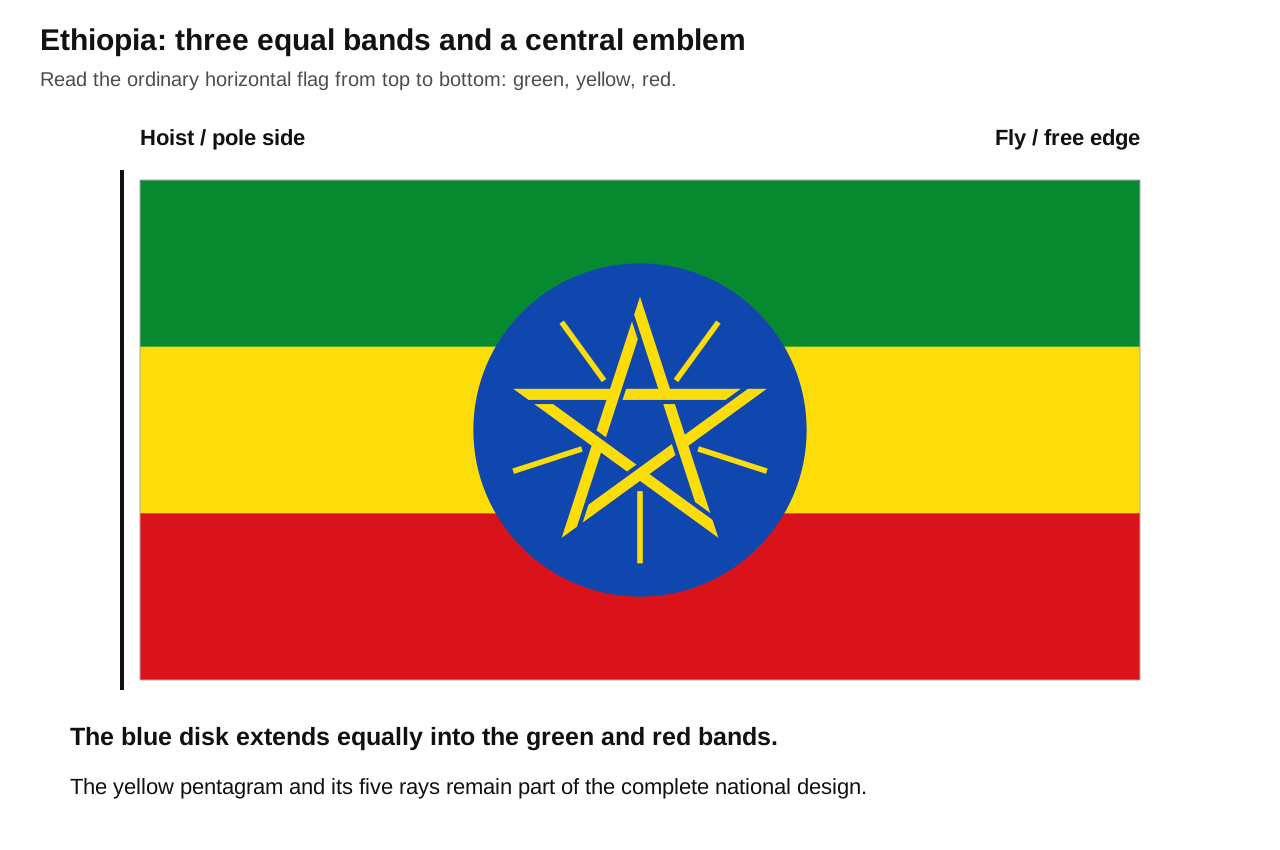
The green top, yellow middle, and red bottom each occupy one third of the height. A blue disk is centered on the field. Its yellow star and five rays must not be omitted from a representation of the current national flag.
GKBook composition, CC0; underlying flag references, public domain.Download image
The blue background represents peace. The star’s equal lines express equality, the star represents voluntary unity, and the yellow rays express a bright future. The five points are not assigned to five named ethnic groups by the proclamation.
GKBook composition, CC0; underlying flag references, public domain.Download image
Article 6 places the blue circle’s outer edge at the midpoint of each outer band. With three equal bands, that gives a diameter of two thirds of the flag’s height. This geometric calculation applies to the ordinary 2:1 reference.
GKBook composition, CC0; underlying flag references, public domain.Download image
The six ordinary sizes, stated here as width by height, are 420 by 210, 300 by 150, 270 by 135, 210 by 105, 180 by 90, and 42 by 21 centimeters. The proclamation assigns them to different locations and official uses.
GKBook composition, CC0; underlying flag references, public domain.Download image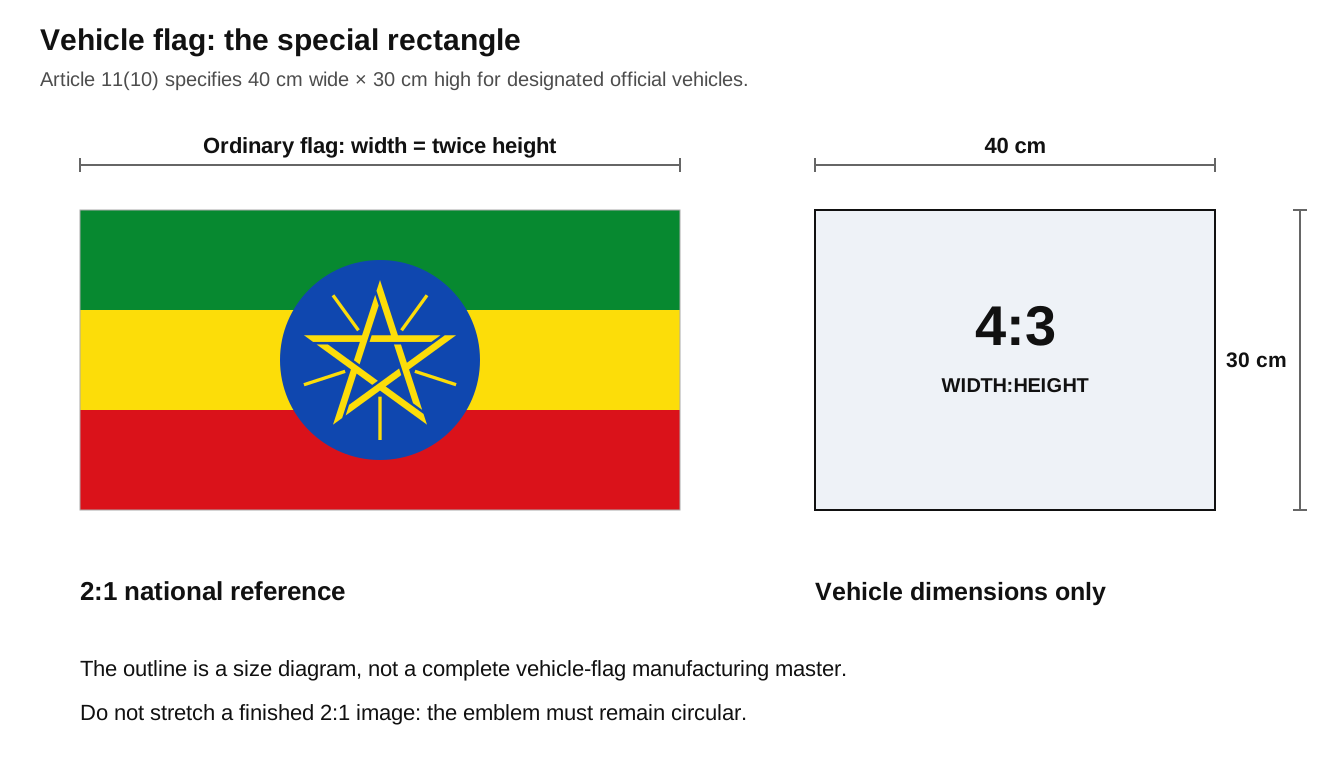
The proclamation’s designated vehicle flag measures 40 centimeters wide and 30 centimeters high, a 4:3 width-to-height ratio. The neutral outline shows that special size without pretending to supply an independently verified vehicle artwork master.
GKBook composition, CC0; underlying flag references, public domain.Download image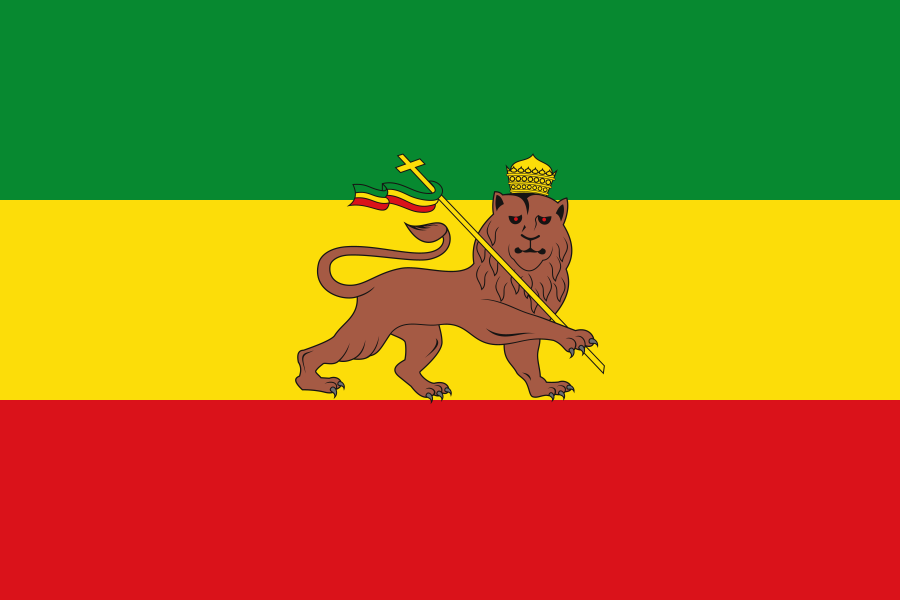
An imperial-era reference shows a crowned Lion of Judah carrying a cross-topped staff on a green-yellow-red tricolor. This modern vector preserves a 3:2 historical rendering; it is not the current national flag or a photograph of an original textile.
Oren neu dag / Wikimedia Commons, public domain; GKBook preparation, CC0.Download image
A crowned Lion of Judah distinguishes the illustrated imperial-era flag. The current federal reference instead uses a blue disk, interlaced yellow star, and five rays. The two references retain their different 3:2 and 2:1 proportions.
GKBook composition, CC0; underlying flag references, public domain.Download image
Selected milestones distinguish the nineteenth-century tricolor, imperial lion, socialist-era state flag, federal emblem introduced in February 1996, October 1996 circle amendment, replacement 2009 law, and 2014 Flag Day amendment.
GKBook composition, CC0; underlying flag references, public domain.Download image
In a paired display, the proclamation’s right-hand position is the flag party’s right, which is the observer’s left. The second rectangle is a neutral placeholder. Regional and foreign multi-flag arrangements are governed by separate articles.
GKBook composition, CC0; underlying flag references, public domain.Download image
Ordinary displays covered by Article 15 run from 6 a.m. to 6 p.m.; schools raise the flag before classes. Holiday display covers the eve, the holiday, and the next day, with the daily hours still applying. The military emergency-area exception is distinct.
GKBook composition, CC0; underlying flag references, public domain.Download image
The flag is lowered during declared national mourning under Article 22. The 2014 amendment adds authority for the House Speaker during recess. The law also contains an official-holiday exception. This drawing does not set an exact mast fraction or announce a current mourning period.
GKBook composition, CC0; underlying flag references, public domain.Download image
Ethiopia has a blue disk and yellow star on green-yellow-red horizontal bands. Ghana reverses the outer-band order and has a black star. Mali arranges green, yellow, and red vertically without an emblem. Ethiopia’s 2:1 reference is longer than the other two 3:2 references.
GKBook composition, CC0; underlying flag references, public domain.Download image
Ethiopian and U.S. flags at a meeting between Ethiopian Prime Minister Abiy Ahmed and U.S. Secretary of State Antony J. Blinken in Washington, D.C., on December 13, 2022. This historical photograph shows ceremonial use, not calibrated flag colors.
Photograph: Freddie Everett / U.S. Department of State, public domain. Full frame retained; resized and converted to WebP.Download imageFrequently asked questions
What does Ethiopia’s flag look like?
Ethiopia’s flag has three equal horizontal bands: green at the top, yellow in the middle, and red at the bottom. A blue disk at the center carries an interlaced yellow pentagram and five yellow rays. The ordinary national flag is twice as wide as it is high.
What is the correct order of Ethiopia’s flag colors?
Read the horizontal bands from top to bottom as green, yellow, and red. Each band occupies one third of the flag’s height. The blue disk overlaps all three bands, while the star and rays are yellow. Reversing the outer bands or omitting the emblem changes the current national design.
What are Ethiopia’s flag proportions?
The ordinary flag has a width-to-height ratio of 2:1, also written as 1:2 when height comes first. A 120-by-60-centimeter rectangle has this shape. The proclamation separately specifies a 40-by-30-centimeter flag for designated official vehicles, so the ordinary ratio should not be applied to that exception.
What are Ethiopia’s flag color codes?
The supplied digital reference uses green #078930, yellow #FCDD09, red #DA121A, and blue #0F47AF. These are the actual SVG colors, not numerical codes enacted in the flag proclamation. The law names the colors without prescribing HEX, RGB, CMYK, or Pantone values; printed fabric therefore requires a separate color proof.
What does the green band mean?
The 2009 proclamation associates green with labor, fertility, and development. This official explanation is more specific than simply calling green a landscape color. Other popular accounts may emphasize vegetation or hope, but those interpretations should be distinguished from the meanings expressly assigned by the current flag law.
What does the yellow band mean?
The yellow band represents hope, justice, and equality under the 2009 proclamation. Yellow also appears in the central star and rays, where the emblem’s separate explanation applies. Sharing a color does not mean that the background band, star lines, and radiating strokes all have one identical legal meaning.
What does the red band mean?
The proclamation connects red with sacrifice and heroism in the pursuit of freedom and equality. Descriptions referring to blood shed for Ethiopia summarize part of that association, but the law’s wording is broader. It places the color within the country’s collective struggle and the values represented by the flag.
What does the blue circle represent?
The blue circular background of Ethiopia’s national emblem represents peace. It is centered on the flag and reaches halfway into the green and red bands. The circle is an integral part of the national design, rather than a decorative backdrop that can be removed while retaining the current official flag.
What does the yellow star represent?
The star represents unity founded on the common will of Ethiopia’s peoples. Its straight, equal lines signify equality among Nations, Nationalities, Peoples, and religions. The proclamation does not assign each of the five points to a particular ethnic group, region, or religion, so such one-to-one mappings should not be invented.
How many rays are around the star?
The familiar national emblem has five yellow rays around its interlaced five-pointed star. The flag law associates the rays with a bright future for Ethiopia’s peoples. These strokes are separate from the pentagram’s lines; replacing the whole emblem with a solid yellow star loses both its construction and its meaning.
How large is the blue disk?
The disk’s diameter is two thirds of the flag’s height. This follows from the legal requirement that its outer edge reach the midpoint of both the green and red bands. On the supplied 1200-by-600 reference, the disk measures 400 pixels across and is centered at coordinates 600, 300.
When was the modern Ethiopian flag adopted?
The blue-disk federal emblem was established by Proclamation 16/1996, effective February 6, 1996. Its circle placement was amended on October 31 that year. The present flag proclamation took effect on August 28, 2009. These are distinct milestones, while the green-yellow-red tricolor tradition is considerably older than the federal emblem.
What changed in October 1996?
Proclamation 48/1996 amended the earlier law so that the blue emblem’s circumference reached the midpoint of the green and red bands. It also replaced the pictorial representation. The amendment took effect on October 31, 1996, establishing the placement rule later repeated in the replacement flag law of 2009.
Which law governs Ethiopia’s flag?
Flag Proclamation 654/2009 sets out the design, official meanings, sizes, display procedures, mourning rules, and prohibited uses. Proclamation 863/2014 later amended Flag Day and mourning authority during parliamentary recess. The Ministry of Justice lists these laws as in force, while the two 1996 flag enactments were replaced.
What does Ethiopia’s Constitution say about the flag?
Article 3 describes green, yellow, and red horizontal bands of equal size with a national emblem at the center. It connects the emblem with equality and unity among Ethiopia’s peoples and religious communities. It also permits member states of the federation to have flags and emblems determined by their legislatures.
How old is Ethiopia’s green-yellow-red flag tradition?
The rectangular tricolor is associated with Menelik II and 1897, following earlier uses of the national colors. Its central devices changed through imperial, socialist, transitional, and federal periods. The age of the color tradition should therefore be distinguished from the adoption of the present blue disk and yellow star.
Why do some Ethiopian flags show a lion?
The crowned Lion of Judah belongs to Ethiopia’s imperial flag tradition. Historical state flags showed the lion carrying a cross-topped staff, although artwork varied. The current federal national flag uses a yellow pentagram on a blue disk instead. A lion-bearing historical reference is therefore not the present national design.
Is the Ethiopian flag without the blue emblem official?
A plain green-yellow-red tricolor has historical and cultural significance, but the 2009 proclamation requires the national flag to include the emblem. It expressly prohibits using the national flag without it. Historical illustrations and accounts of earlier civil flags should not be presented as authorization for an emblem-free current national flag.
Who designed Ethiopia’s modern national emblem?
Reference catalogs credit Abebe Alambo with the federal emblem. The proclamations reviewed establish the design and its meaning but do not name an individual designer. That attribution should therefore be identified as a catalog credit, while modern vector illustrators should be credited separately for the particular artwork being reproduced.
How should Ethiopia’s flag be reproduced accurately?
Use a complete master with equal green, yellow, and red bands, a centered circular blue disk, and the full interlaced yellow star and rays. Preserve the appropriate proportions and prescribed size for the intended setting. Proof the actual fabric and inks rather than treating a monitor preview as manufacturing approval.
What official flag sizes does Ethiopia specify?
The proclamation lists six ordinary sizes. Expressed as width by height in centimeters, they are 420 by 210, 300 by 150, 270 by 135, 210 by 105, 180 by 90, and 42 by 21. Different sizes serve squares, buildings, ships, processions, street displays, and specified official desks.
Why is the official vehicle flag a different shape?
Article 11 provides a special flag for designated official vehicles: 40 centimeters wide and 30 centimeters high. That is 4:3 in width-to-height terms, unlike the ordinary 2:1 flag. The exception concerns specified official use; it does not make every privately displayed car flag an authorized official vehicle flag.
When is Ethiopia’s Flag Day?
Ethiopia’s Flag Day falls on the first Monday of Tikimt, an Ethiopian calendar month, under the 2014 amendment. It normally occurs in Gregorian October, but it is not defined as the first Monday of that Gregorian month. For example, the National Bank marked the 2025 observance on October 13.
Did Ethiopia’s Flag Day date change?
Yes. The original 2009 proclamation specified the second Monday of Meskerem. The 2014 amendment replaced that provision with the first Monday of Tikimt. Both are Ethiopian calendar months. An account using the older Meskerem rule without identifying it as superseded gives the wrong current statutory basis for the observance.
Does Ethiopia have a colonial Independence Day?
Ethiopia’s national history does not fit a simple colonial-independence anniversary. Adwa Victory Day, observed on March 2, recalls the 1896 victory over an invading Italian army. Patriots’ Victory Day on May 5 recalls liberation from the later Italian occupation. These historical commemorations are separate from the annual Flag Day.
Where must the Ethiopian flag be displayed?
The proclamation identifies daily display at specified public institutions, schools, military and police establishments, border facilities, diplomatic premises, and Ethiopian merchant ships and boats, subject to its exceptions. It also addresses other government offices on public holidays and election locations. These provisions should not be rewritten as a universal daily household obligation.
At what times is the Ethiopian flag raised and lowered?
For ordinary displays covered by Article 15, the stated hours are 6 a.m. to 6 p.m. Schools raise the flag before classes and lower it at 6 p.m. Holiday display covers the eve, the holiday, and the following day within the daily hours; a military emergency-area exception also exists.
Which side should Ethiopia’s flag occupy in a pair?
In a paired display, the proclamation places Ethiopia’s national flag on the right as understood from the flag party’s viewpoint, facing the observers. This is the viewer’s left. Multi-flag arrangements have additional rules, and the provisions for regional flags differ from those governing foreign flags and international organizations.
How is the flag carried in a guard-of-honor procession?
Article 20 places the flag five meters ahead of the first guard-of-honor row. It describes holding the lower staff with the right hand and the upper portion with the left, centered before the body, with accompaniment. This specific procession rule should not be treated as a universal spacing rule for every parade.
Can the Ethiopian flag be displayed vertically?
The national design is defined in its ordinary horizontal arrangement, with green above yellow above red and a centered emblem. The reviewed proclamation does not provide a separate universal vertical-display construction. Follow the responsible organizer’s applicable instructions, preserve the complete design, and avoid importing another country’s rotation rule without evidence.
When is Ethiopia’s flag flown at half-mast?
Article 22 provides for half-masting during declared national mourning following the death of specified senior leaders, including former officeholders, and other persons designated by the House of Peoples’ Representatives. The 2014 amendment allows the Speaker to act during recess. The particular declaration determines the occasion; the article does not announce ongoing mourning.
What if national mourning coincides with an official holiday?
The proclamation expressly states that the flag is not flown at half-mast when national mourning coincides with an official holiday. This is an Ethiopian statutory exception, not a general rule for every country. The relevant declaration and the amended numbering of Article 22 should be checked when applying the provision.
What does the law say about a flag used on a coffin?
Article 22 directs that a flag covering a coffin be folded before the coffin is lowered into the grave, so that the flag does not touch the ground. This handling rule is separate from the declaration of national mourning. It does not establish one mandatory ceremonial fold pattern in the reviewed text.
What flag uses does the proclamation prohibit?
Article 23 prohibits several uses, including omitting the emblem, defacing the flag, displaying a damaged or faded flag, incorrect design or timing, certain covering uses, commercial advertising, and failure to honor raising or lowering. Its categories are specific; they should be read alongside the law’s scope rather than reduced to one vague etiquette rule.
Can the Ethiopian national flag be used in commercial advertising?
The 2009 proclamation expressly lists commercial advertising among prohibited flag uses. Public-domain status for a drawing does not remove that separate restriction on the national symbol. A downloadable image may be useful for education and identification, but its copyright status should not be mistaken for government approval of a commercial campaign.
Does the flag law include penalties?
Yes. Article 24 sets maximum fines and imprisonment terms for prohibited acts, with a higher maximum for using the flag without its emblem. It also provides a separate fine rule for legal persons. These are statutory provisions in the text reviewed, not predictions about how a particular case will be handled.
How should an old or damaged Ethiopian flag be handled?
The proclamation prohibits displaying old, faded, or torn flags and directs respectful burning when a flag has become unusable. It separately calls for flags associated with historical events to be kept in museums. Routine care should follow the fabric maker’s instructions, while a potentially historic textile needs preservation assessment before disposal.
Why do many African flags use green, yellow, and red?
Ethiopia’s longstanding tricolor and its importance as a symbol of African sovereignty helped make green, yellow, and red influential Pan-African colors. Later national flags adopted related palettes in their own arrangements. That shared visual tradition does not mean their symbols, proportions, histories, or officially assigned color meanings are identical.
How is Ethiopia’s flag different from Ghana’s?
Ethiopia uses green, yellow, and red horizontal bands with a blue disk containing a yellow pentagram and rays. Ghana uses red, yellow, and green horizontal bands with a solid black star. The supplied Ethiopian reference is 2:1, while Ghana’s is 3:2, giving the rectangles visibly different shapes.
How is Ethiopia’s flag different from Mali’s?
Mali arranges green, yellow, and red in three vertical bands, with green at the hoist and no central emblem. Ethiopia uses the same color sequence horizontally and adds its blue disk and yellow star. The supplied references also differ in proportions: Ethiopia is 2:1, while Mali is 3:2.
What does the diplomatic photograph show?
The photograph records a meeting between Ethiopian Prime Minister Abiy Ahmed and U.S. Secretary of State Antony J. Blinken in Washington, D.C., on December 13, 2022. Ethiopia’s flag appears in the diplomatic setting. The caption identifies historical roles and an event date; it does not describe today’s officeholders or a color-calibration reference.
Which Ethiopia flag image should I download?
Choose the complete national-flag SVG for a scalable illustration of the current design. The emblem close-up, construction sheets, historical references, comparisons, timeline, and display diagrams serve different educational purposes. Keep their labels and captions with them, and obtain the required production master before treating an explanatory picture as an official manufacturing specification.
What is Ethiopia’s flag emoji?
Ethiopia’s flag emoji is 🇪🇹, formed from the regional-indicator letters ET. Platforms may show a small flag or display the letters instead. The tiny emblem can vary with the operating system and font, so an emoji should not replace a detailed flag drawing when accuracy of shape and color matters.
Explore all general-knowledge topics and the A-to-Z lists.

We Value Your Opinion Comments