
Eswatini flag picture
Explore the construction sheet, the shield and spears, and the historical sequence.
| Country | EswatiniKingdom of Eswatini; formerly known as Swaziland. |
|---|---|
| Design | Five bands and a shieldBlue, yellow, red, yellow, blue; a horizontal shield, two spears, and a staff. |
| Proportions | 3:2 width:heightAlso written 2:3 height:width; conventional bands follow 3:1:8:1:3. |
| Origins | King Sobhuza II / 1941The design derives from a flag given to the Swazi Pioneer Corps. |
| First national raising | April 25, 1967Distinct from independence, adoption, and the later Flag Act. |
| Adoption | October 6, 1968Date stated in the government identity manual; the Act commenced November 29. |
| Flag Day | April 25Commemorates the 1967 raising of the national flag. |
| Independence Day | September 6Commemorates independence in 1968; the country then used the name Swaziland. |
The 1941 military precursor, the 1967 national raising, independence in September 1968, and the October adoption date are distinct milestones. Blue, red, and yellow form the field; black and white shape the shield.
What is the flag of Eswatini?
Eswatini’s flag has five horizontal bands: blue, yellow, red, yellow, and blue. The broad red center carries a horizontal black-and-white shield, two spears, and a staff decorated with feather tassels. The complete rectangle is three units wide for every two units high.
The flag belongs to the Kingdom of Eswatini, a country in southern Africa formerly known as Swaziland. Its main identifying features are the broad red center and the elongated shield lying across the cloth. The narrow yellow stripes are separate bands, even though the emblem attracts more attention.
The flag connects a military precursor with the later independent state. Its story includes a 1941 banner, a national raising in 1967, independence and adoption milestones in 1968, and the 2018 change of country name. Those events explain why a single date cannot answer every question about its origin.
The conventional flag SVG preserves the familiar detailed emblem. The rendering comparison explains other published treatments, while the Flag Day section separates the annual flag commemoration from Independence Day.
What are the shield, spears, and feather decorations?
The main object is a horizontal Nguni-style oxhide shield associated with Swazi military tradition. Its black-and-white pattern is linked with peaceful coexistence. Two spears and a staff accompany it, while feather tassels add royal associations. The shield-and-weapons emblem is not the country’s complete coat of arms.
The shield is associated with the Emasotja regiment; the spelling Emasotsha also appears in flag descriptions. It is shown horizontally, consistent with the traditional carrying position described in specialist accounts. Its light and dark patches represent an oxhide pattern, not lettering.
Two assegais, or spears, lie above the staff. Three feather tassels decorate the composition. Their royal associations help distinguish the emblem from a generic collection of weapons.
The long staff is a separate object. Counting every parallel shaft as a spear would give the wrong total. Likewise, the small white and black marks within the shield belong to its traditional pattern; they should not be replaced with typed characters or removed when reducing the artwork.
Which colors and digital values appear on the flag?
Published renderings use different blues. The supplied conventional SVG uses #3E5EB9, while the 2024 government manual prints Pantone 542 C and C51 M16 Y0 K0. Screen values, printed specifications, and photographed fabric should be kept distinct. A commissioned official flag needs an approved artwork and color proof.
| Part | Conventional SVG HEX | RGB | Role |
|---|---|---|---|
| Blue | #3E5EB9 | 62, 94, 185 | Upper and lower bands |
| Yellow | #FFD900 | 255, 217, 0 | Narrow bands and parts of the emblem |
| Red | #B10C0C | 177, 12, 12 | Broad central band |
| Black | #000000 | 0, 0, 0 | Shield pattern and outlines |
| White | #FFFFFF | 255, 255, 255 | Shield pattern and spearheads |
These values describe the principal colors in this downloadable file. Fine feather details additionally use blue #3D5DA7 and red #A70000. The palette is not presented as the only official digital standard. Small differences between a file’s actual fills and color tables reproduced elsewhere are another reason to inspect the artwork rather than assume that a familiar HEX code is a statutory specification.
The 2024 manual’s printed color guidance
| Color label | Pantone label printed in manual | CMYK printed in manual |
|---|---|---|
| Blue | 542 C | C51 M16 Y0 K0 |
| Yellow | 803 C | C0 M9 Y100 K0 |
| Red | 157 C | C0 M88 Y85 K0 |
| Black | Black | C0 M0 Y0 K100 |
The red Pantone label appears inconsistent with the pictured red and its process recipe. This page does not silently substitute a different Pantone number. The manual’s printed labels, its CMYK mixes, and an RGB illustration should be treated as distinct references until the commissioning authority approves a physical proof.
For comparison, the supplied lighter-color reference uses blue #7BAFD4, yellow #FFE900, and red #FF1E26. The natural-tassel reference uses blue #78A3CD, yellow #F5E03D, and red #C20002, with additional feather tones. Neither a shaded photograph nor an emoji can settle a color specification.
What do the colors and emblem symbolize?
The government identity manual associates blue with peace and stability, red with past battles, and yellow with the country’s resources. The shield’s black and white express peaceful coexistence between black and white people. These meanings explain the symbolism without turning every tiny decorative shade into a separate national message.
The symbolism combines peace with the memory of conflict. Red recalls past battles, while blue points toward peace and stability. The narrow yellow stripes represent resources rather than an additional weapon or border ornament.
The black-and-white shield connects a traditional defensive object with the ideal of coexistence. It should not be interpreted as two rival countries, nor should either half be removed to simplify the message. The shield and weapons also convey protection, while the feather ornaments carry a connection to royal authority.
The widowbird and lourie associations concern the feather tradition. A blue stylized tassel on a flat drawing does not claim that every real feather had precisely that screen color. This distinction matters when comparing symbolic explanations with the varied artwork used in print and online.
What are the flag’s proportions and band dimensions?
The traditional band-height sequence is 3:1:8:1:3. Each blue band occupies three-sixteenths of the height, each yellow band one-sixteenth, and red one-half. This is the construction used by the supplied conventional SVG. The numerical drawing in the 2024 identity manual differs and is discussed separately.
For the conventional master, let the total height be H. The width is 3H/2. From top to bottom, the band heights are 3H/16, H/16, H/2, H/16, and 3H/16. The two yellow bands together occupy one-eighth of the height, while the two blue bands together occupy three-eighths.
A discrepancy in the government manual
The manual’s prose gives width:height as 3:2, but its numerical drawing labels the rectangle 120 mm × 78.6 mm. Its band heights are 14, 5.6, 39.4, 5.6, and 14 mm. Those values total 78.6 mm and do not reproduce the conventional grid exactly. At a width of 120 mm, an exact 3:2 rectangle would be 80 mm high.
The same diagram labels the shield’s height as 34 mm and the staff span as 96 mm. These are details of that particular drawing, not measurements that can be mixed indiscriminately with a differently scaled master. For production, resolve the required drawing as a whole instead of combining measurements from competing illustrations.
When did Eswatini’s flag begin?
The design is traced to a flag King Sobhuza II gave the Swazi Pioneer Corps in 1941. Its military origin preceded the national raising of April 25, 1967 and independence in 1968. A precursor’s date, a public raising, and later legal recognition describe different stages of the flag’s history.
A military precursor
King Sobhuza II gives a flag to the Swazi Pioneer Corps, the origin associated with the later national design.
First national raising
The government manual records the flag’s first raising; Flag Day commemorates this event.
College of Arms registration
Registration follows refinement; the manual also describes an official hoisting on this date.
Independence
The country becomes independent under the name Swaziland.
Adoption date
The government identity manual identifies this as the national flag’s adoption date.
Royal assent to the Act
The Flags and Coat of Arms Act receives assent.
The Act commences
The national flag, royal standard, and arms receive separate statutory treatment.
Tassel change reported
The later government manual reports black tassels from 2011, although its own artwork shows blue tassels.
Name changes to Eswatini
The national symbol continues under the country’s new name.
Government identity manual launched
A government branding program publishes flag artwork, history, and production guidance, including the inconsistencies discussed here.
How did the military banner influence the national flag?
King Sobhuza II is associated with the flag’s origin through the banner he gave the Swazi Pioneer Corps in 1941. Later refinement preceded national use. The evidence reviewed does not securely identify one named textile maker or establish that the King personally drew every line of the modern digital emblem.
The military connection explains the shield, spears, fighting staff, and feather decorations. The emblem expresses a specific local tradition instead of borrowing a generic European heraldic shield. Descriptions connect the hide shield with the Emasotja regiment and explain its horizontal orientation.
The 1941 date belongs to the precursor given to the Swazi Pioneer Corps. It is not the date of independent statehood. Nor does the existence of that precursor establish that a surviving modern vector is a line-for-line copy of the original cloth. Refinement, registration, and national use followed later.
Why are 1967 and several 1968 dates associated with the flag?
The government identity manual gives October 6, 1968 as the adoption date. The flag had already been raised in April 1967, and independence came on September 6, 1968. The Flags and Coat of Arms Act then commenced on November 29, 1968, providing a further, separate legal milestone.
| Date | Milestone | What it does not mean |
|---|---|---|
| April 25, 1967 | First national raising | Not the date of independence |
| October 30, 1967 | College of Arms registration | Not the beginning of the 1941 precursor |
| September 6, 1968 | Independence | Not the specific Flag Day observance |
| October 6, 1968 | Adoption date in the manual | Not the commencement date of the Act |
| November 29, 1968 | Act commences | Not the first public appearance of the design |
Flag histories often become confusing when every milestone is labeled “adoption.” Keeping the event beside the date preserves the distinction. April 25 commemorates an act of raising the flag; September 6 commemorates independence; the October and November dates concern adoption and legislation in different senses.
What does the Flags and Coat of Arms Act establish?
The Swaziland Flags and Coat of Arms Act, 1968 defines the national flag, royal standard, and coat of arms in separate parts of its schedule. It commenced on November 29, 1968. The accessible consolidated text reviewed for this article is dated December 1, 1998; that date is not a new flag adoption.
| Provision | Subject |
|---|---|
| Section 3 / Schedule Part I | Royal standard |
| Section 4 / Schedule Part III | National flag |
| Section 5 / Schedule Part II | Coat of arms |
| Section 6 | Power to amend the schedule by Gazette notice; special royal concurrence for Part I |
| Section 7 | Power to make regulations about use, locations, times, condition, and related matters |
The three national symbols are related but legally distinguished. A description of the royal standard cannot simply be substituted for the national flag, and the complete coat of arms is not the same object as the shield-and-weapons emblem on the flag.
Section 7 is an enabling provision: it allows more detailed regulations to be made. It does not, by itself, prove a particular daily raising hour, a rule for every private home, or a universally permitted commercial use. The reviewed consolidated text is dated December 1, 1998; later applicable regulations or amendments need to be checked for a specific official use.
Did the change from Swaziland to Eswatini create a new flag?
Eswatini is the country formerly called Swaziland. The name change took effect on April 19, 2018, while the recognizable national flag design continued. Older laws, archive descriptions, and historical captions therefore use Swaziland or Swazi without necessarily referring to a different national flag.
The United Nations records the change of name as effective April 19, 2018. Its later communication record explains why international material gradually began using Eswatini. The older name remains appropriate when accurately naming the 1968 statute or describing an event that occurred before the change.
Swaziland flag and Eswatini flag therefore commonly refer to the same recognizable national design in historical and modern contexts. Differences in blue, red, spear shafts, or feather rendering require their own explanation; the country’s new name is not sufficient evidence of a new geometric flag specification.
The flag emoji is 🇸🇿, represented by the regional-indicator letters SZ. Depending on the platform, it may appear as a small flag or as letters. Its tiny, platform-dependent emblem is unsuitable as an authoritative drawing.
Is an original Swazi flag preserved in the archives?
The National Archives lists an original Swazi flag among its holdings. That brief catalog description does not identify a verified textile date, dimensions, maker, or current display arrangement. It supports the existence of a preserved historical object, while leaving those more specific questions open until an authoritative object record is available.
The government’s National Archives description lists an original Swazi flag among its holdings. This is evidence about a collection, not a detailed conservation catalog. It does not establish that the item is currently on public display or identify it conclusively as the 1941 precursor or the cloth raised in 1967.
The illustrations on this page are consequently labeled as modern flag renderings, diagrams, or a chronology. They do not simulate aged fabric or pretend to reproduce an inspected historic textile. A more exact account of the surviving object would require its accession record, documented provenance, and an authorized image.
Who is credited with the flag’s design?
King Sobhuza II is associated with the flag’s origin through the banner he gave the Swazi Pioneer Corps in 1941. Later refinement preceded national use. The evidence reviewed does not securely identify one named textile maker or establish that the King personally drew every line of the modern digital emblem.
The strongest documented association is with King Sobhuza II and the 1941 military banner. The later national design went through refinement before its 1967 registration. These are different kinds of contribution: initiating a symbol, developing artwork, sewing a cloth, and drafting a present-day vector file.
A modern file’s uploader or illustrator should not be presented as the historical designer. Equally, a royal association does not prove the identity of the person who stitched the first textile. The page retains the documented origin while avoiding an unsupported story about a named seamstress, factory, competition, or single surviving drawing.
How can the design be reproduced faithfully?
Start with an approved master and preserve the complete rectangle, band order, and emblem proportions. Keep the shield markings, paired spears, staff, and tassels legible. Select fabric and construction suited to the intended display, then proof the actual materials and colors rather than treating a screen preview as final manufacturing approval.
The emblem makes accurate reproduction more demanding than a plain striped flag. Start with one coherent master. Scale the shield, hide pattern, spearheads, shafts, staff, and tassels together. At small sizes, choose a production method that keeps the details distinguishable rather than replacing the emblem with a rough silhouette.
For sewn work, the band boundaries and the applied or printed emblem need to align with the chosen master. For printed fabric, inspect a proof on the actual material: translucency, ink behavior, and the view from the reverse can affect the result. These are practical production considerations, not a claim that one fabric or technique is legally required.
Agree on the hoist attachment, reinforcement, intended exposure, and viewing distance with the maker. A 90-by-60-centimeter example has blue bands 11.25 centimeters high, yellow bands 3.75 centimeters high, and a 30-centimeter red center. Official commissions should settle the manual’s artwork and color inconsistencies before production.
Why do published flag illustrations look different?
The 2024 government manual says the tassels changed to black in 2011, yet its illustrated flag still shows blue tassels. Other published artwork uses natural dark feathers. That inconsistency supports distinguishing rendering variants; it does not justify inventing a fully documented legal replacement of the entire national flag.
The conventional reference uses deep blue, dark red, yellow shafts, and blue tassels. A lighter rendering based on the 2024 manual uses a much paler blue and brighter red. Another published version uses dark natural-looking feathers and pale spear shafts. These differences are visible even when the core shield and band design remains recognizable.
The manual’s statement about a 2011 change to black tassels conflicts with its own blue-tassel image. Its written 3:2 proportion also conflicts with the numerical dimensions on its construction drawing. Those discrepancies should remain visible in a careful account. They cannot support a confident narrative in which every illustration is assigned a clean, legally verified start and end date.
Separate downloads retain the labels lighter-color rendering and natural-tassel rendering. The primary conventional image is an educational illustration, not a certification of the only master permitted for official manufacture.
How does the royal standard differ?
The national flag centers a shield and weapons. The later Mswati III royal standard centers a gold lion and includes smaller royal devices. This differs from the earlier design described in the 1968 Act, which added a gold lion to the upper blue band of the national flag.
The Act’s schedule describes a gold standing lion in the center of the national flag’s upper blue band. Specialist historical accounts associate that earlier royal design with Sobhuza II. It should not be confused with the more elaborate Mswati III reference illustrated here.
The later royal standard, reported from 1986, moves the prominent lion to the center and distributes smaller shields, weapons, a headdress, and a royal cipher across the blue bands. A royal standard serves a different official purpose from the national flag. This comparison explains the distinction without claiming an exhaustive legal history of every royal banner.
Is the central flag emblem the complete coat of arms?
No. The flag’s central shield and weapons are not the complete national coat of arms. The Act describes the arms separately, including a shield, crest, lion and elephant supporters, and the motto SIYINQABA. Adding the entire coat of arms to an ordinary national flag would change its familiar design.
The Act treats the national arms as a separate symbol. Its description includes a shield with spears, a crest, a lion and an elephant as supporters, and the motto SIYINQABA. The full heraldic composition has a different arrangement and purpose from the emblem placed across the flag’s red band.
The shared use of traditional defensive imagery explains the resemblance. It does not make the two designs identical. For a national-flag illustration, retain the prescribed flag emblem instead of pasting a government seal or complete coat of arms onto the center.
When is Flag Day celebrated in Eswatini?
Eswatini observes Flag Day on April 25, commemorating the national flag’s first raising in 1967. A government report records the country marking its fifty-fourth anniversary in 2021. The observance is separate from Independence Day on September 6; a flag commemoration should not be confused with the full public-holiday calendar.
The first raising took place on April 25, 1967. A government review for April 2021 explicitly records the country celebrating fifty-four years since that event, confirming the observance in official reporting.
Flag Day focuses on the national symbol and its public introduction. Independence Day focuses on the achievement of independence. Both can involve the flag, but their historical subjects are different. The identification of Flag Day here does not substitute for an annually updated statutory public-holiday calendar.
How is Independence Day different from Flag Day?
Independence Day is September 6, commemorating independence in 1968, when the country was known as Swaziland. It differs from Flag Day on April 25 and the October 6 adoption date recorded in the identity manual. A national anniversary and the flag’s institutional history therefore answer different calendar questions.
The country became independent on September 6, 1968. The national flag had already been raised the previous year, so the independence anniversary cannot be used as the flag’s first-ever appearance. The government manual’s October 6 adoption date is another separate milestone.
| Occasion | Date | Commemorates |
|---|---|---|
| Flag Day | April 25 | First national raising in 1967 |
| Independence Day | September 6 | Independence in 1968 |
Historical photographs and anniversary graphics may still use Swaziland when describing 1968. That wording identifies the country’s name at the time. Modern captions can explain the connection directly rather than replacing every historical name or implying that two different countries are involved.
What should be considered when displaying the flag?
Use the complete design respectfully and follow any official instructions applying to the location or occasion. The 1968 Act authorizes regulations concerning places, times, condition, and use of national symbols. Its enabling provisions should not be misquoted as a verified nationwide daily raising schedule or a universal obligation for every household.
Preserve a clear national symbol
- Use a complete flag with its five bands and full emblem.
- Check the hoist, fly, shield orientation, and spear direction against the selected master.
- Keep the cloth and fittings in a condition suitable for the setting.
- Follow the organizer’s instructions for ceremonial position and timing.
Avoid unsupported substitutions
- Do not replace the shield with the complete coat of arms.
- Do not substitute a royal standard for the ordinary national flag.
- Do not treat a diagram’s size as a universal legal minimum.
- Do not import another country’s raising hours or precedence rules.
A classroom picture, a privately displayed flag, a government installation, and a diplomatic ceremony do not necessarily have identical requirements. The Act’s power to regulate objects, places, and times explains why the applicable notice or regulation matters. This article does not invent a fixed daily schedule or a standing duty for every household.
How should orientation and the reverse side be handled?
A vertical installation needs a clear orientation instruction from the responsible organizer or authority. The reviewed national sources do not establish a universal vertical-display rule for every setting. Keep the flag’s complete design and proportions, and avoid borrowing another country’s rotation rule or independently reversing the shield and spear arrangement.
In the supplied obverse reference, the pole edge is on the left, the shield’s black portion lies toward that edge, and the spearheads point right toward the free edge. The entire design should remain internally consistent. Mirroring one component while leaving the others unchanged produces a hybrid drawing.
A flag seen through fabric from the reverse can naturally appear mirrored. That observation should not be confused with an instruction to reverse the artwork for a front-facing graphic. For a physical two-sided flag, agree on the intended production and viewing treatment with the maker and commissioning authority.
Event-specific vertical-display guidance should remain tied to its event. A rotation adopted for an international sporting venue is not automatically a universally applicable national rule. The downloadable images therefore retain the ordinary horizontal reference rather than inventing a national vertical construction sheet.
When and how is the flag displayed for mourning?
Half-mast display is associated with officially directed mourning. A contemporary report documented lowered flags in September 2018 following the death of former Prime Minister Sibusiso Barnabas Dlamini. That historical example is not a current order or an annual rule; the relevant notice should determine the buildings, duration, and arrangements.
The September 2018 report concerned the death of former Prime Minister Sibusiso Barnabas Dlamini. It demonstrates a historical use of half-mast display. It does not create an annual date, identify a current mourning period, or specify that all private flags must follow the same schedule.
For an actual observance, use the instruction naming the occasion, locations, start and end times, and handling. The reviewed sources do not establish a national numerical lowering fraction or a standard black-ribbon measurement for a fixed staff. The diagram should not be measured as though it were such a regulation.
Can public-domain flag artwork be used in any context?
Copyright status and the regulation of national symbols are separate matters. Public-domain artwork can be reused without a copyright license fee, but the Flag Act authorizes rules about national flags, arms, royal standards, and imitations. An official or commercial application should therefore be checked for any applicable symbol-use requirements.
The downloadable reference artwork has been selected with documented public-domain or CC0 status. That addresses copyright in the artwork. Rules protecting a national flag or reserving an official standard can still apply independently of copyright.
The Act permits regulations concerning flags, arms, royal standards, and imitations. A proposed commercial mark, official-looking seal, or representation of government endorsement therefore requires attention to its specific context and any applicable rules. The existence of a reusable SVG alone does not establish official approval of a product or organization.
How should the flag be cleaned, stored, and replaced?
Follow the fabric maker’s cleaning instructions, dry the flag before storage, and inspect seams, attachments, and printed details. Replace an everyday flag when fading or damage makes the design unclear. These are practical care recommendations; a historically significant textile should receive conservation advice instead of routine washing or casual disposal.
Use the maker’s instructions for washing, drying, and ironing because fabric and printing methods differ. Check the fly edge, hoist reinforcement, seams, and attachments for wear. Let the cloth dry fully before packing it away, and store it where moisture and abrasion will not damage the design.
A badly faded or torn everyday flag can no longer present the intended colors and emblem clearly. Replace it appropriately for its use. The reviewed material does not establish one mandatory national disposal ceremony, so this page does not prescribe burning or another ritual as a universal rule.
A historic textile is different from a replaceable display flag. Keep its provenance with it and seek conservation advice before cleaning, repairing, or disposing of it. An archive’s original object should not be treated as ordinary household fabric.
How does Eswatini’s flag differ from similar African flags?
Both flags show shields and spears, but their layouts differ clearly. Eswatini has a horizontal black-and-white shield and blue-yellow-red-yellow-blue bands. Kenya has an upright shield and crossed spears over black, red, and green bands separated by narrow white stripes. The similar military imagery does not make their designs interchangeable.
Kenya’s upright shield and crossed spears create a more vertical central composition. Eswatini’s elongated shield lies across the broad red center, with its spears extending toward the fly. The contrasting stripe colors provide another immediate distinction.
Lesotho offers a different comparison: its black central symbol is a mokorotlo hat, not a shield. Its blue-white-green background has three bands and no narrow yellow stripes. A shared regional setting or rectangular proportion should not obscure these clear national differences.
Does the flag have only three colors or three spears?
The background contains five bands made from three colors: blue, yellow, and red. The emblem adds black and white, along with two spears and a separate staff. Counting only the background colors or treating the staff as a third spear misses important details of the complete design.
Common points of confusion
- Five background bands: blue and yellow each appear twice around the red center.
- Two spears and one staff: three long shafts do not mean three spears.
- A horizontal shield: the complete coat of arms is a separate symbol.
- Different dates: 1941 origins, the 1967 raising, and 1968 state milestones describe different events.
- A new country name: Eswatini replaced Swaziland in 2018 without making every earlier flag image obsolete.
- Published variants: color and tassel differences require explanation rather than an invented sequence of replacement flags.
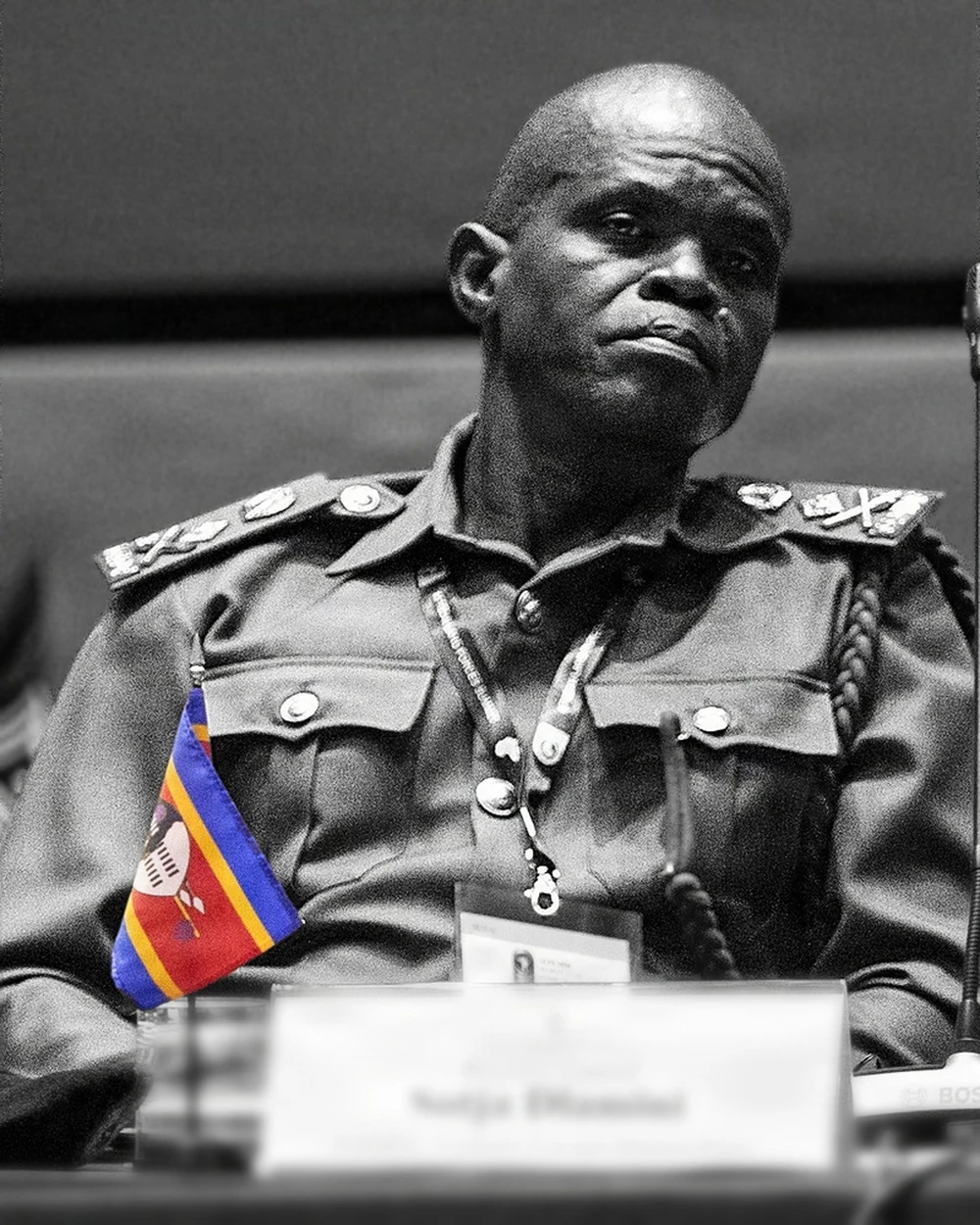
What does the summit photo illustration show?
No. It is a U.S. Army photo illustration published in August 2026, based on a March 23 photograph of Brig. Gen. Sotja Dlamini at a summit in Rome. Its creator isolated the flag in color and altered surrounding tones and focus. It provides context, not a calibrated flag-color reference.
The underlying scene comes from the African Land Forces Summit in Rome on March 23, 2026. The U.S. Army later produced an illustration for an Independence Day message. Its August production and publication dates are separate from the March date of the photographed event.
The colored desk flag remains visible within an intentionally altered surrounding image. That treatment makes the flag easy to identify, but it also means this is a photo illustration rather than an unedited record of the scene’s original colors. The provided full frame is retained in the downloadable WebP versions.
Which Eswatini flag picture should be downloaded?
Choose the unannotated conventional SVG for a clear, scalable flag illustration, or select the separately labeled lighter-color and natural-tassel references for comparison. Construction sheets, the emblem crop, royal comparison, timeline, and mourning schematic are explanatory images. For official manufacture, confirm the required master rather than assuming every downloadable rendering is interchangeable.
| Purpose | Image to choose |
|---|---|
| General illustration | Complete conventional flag SVG |
| Published artwork comparison | Lighter-color and natural-tassel SVGs |
| Design details | Anatomy and emblem-detail sheets |
| Proportions and scaling | Construction and size diagrams |
| Historical sequence | Selected-milestone timeline |
| Royal distinction | National flag and royal-standard comparison |
| Regional recognition | Eswatini, Kenya, and Lesotho comparison |
| Mourning explanation | Clearly labeled schematic |
| Documentary context | Summit photo illustration with its caption and credit |
The picture gallery gives each image its own label, caption, and download. Keep those labels with explanatory diagrams so that a royal standard, cropped emblem, timeline, or schematic is not mistaken for the complete ordinary national flag.
Eswatini flag pictures
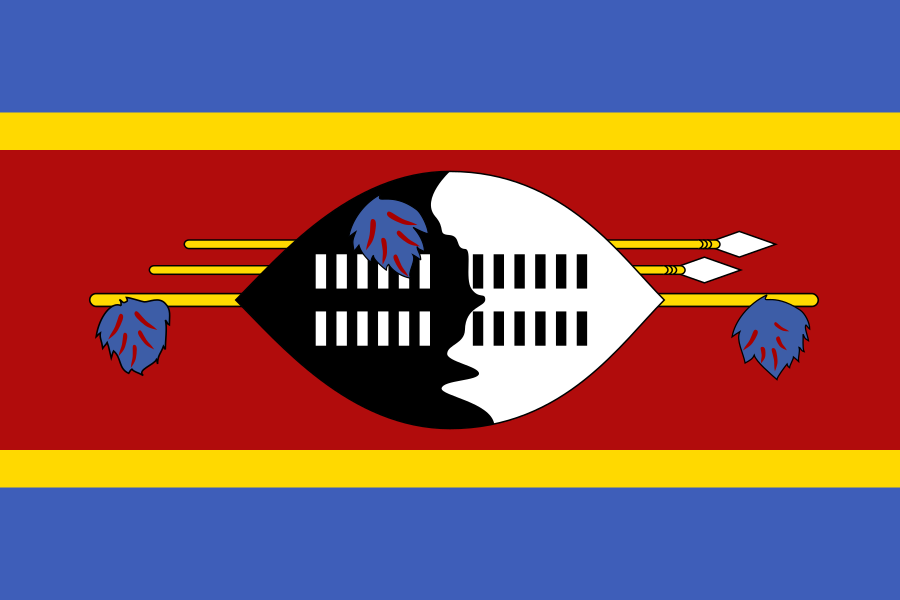
Five horizontal bands in blue, yellow, red, yellow, and blue surround a horizontal black-and-white shield, two spears, and a staff with feather tassels. Width:height is 3:2. This conventional digital rendering is distinguished from other published color and tassel treatments.
GKBook composition, CC0; underlying flag references, public domain.Download image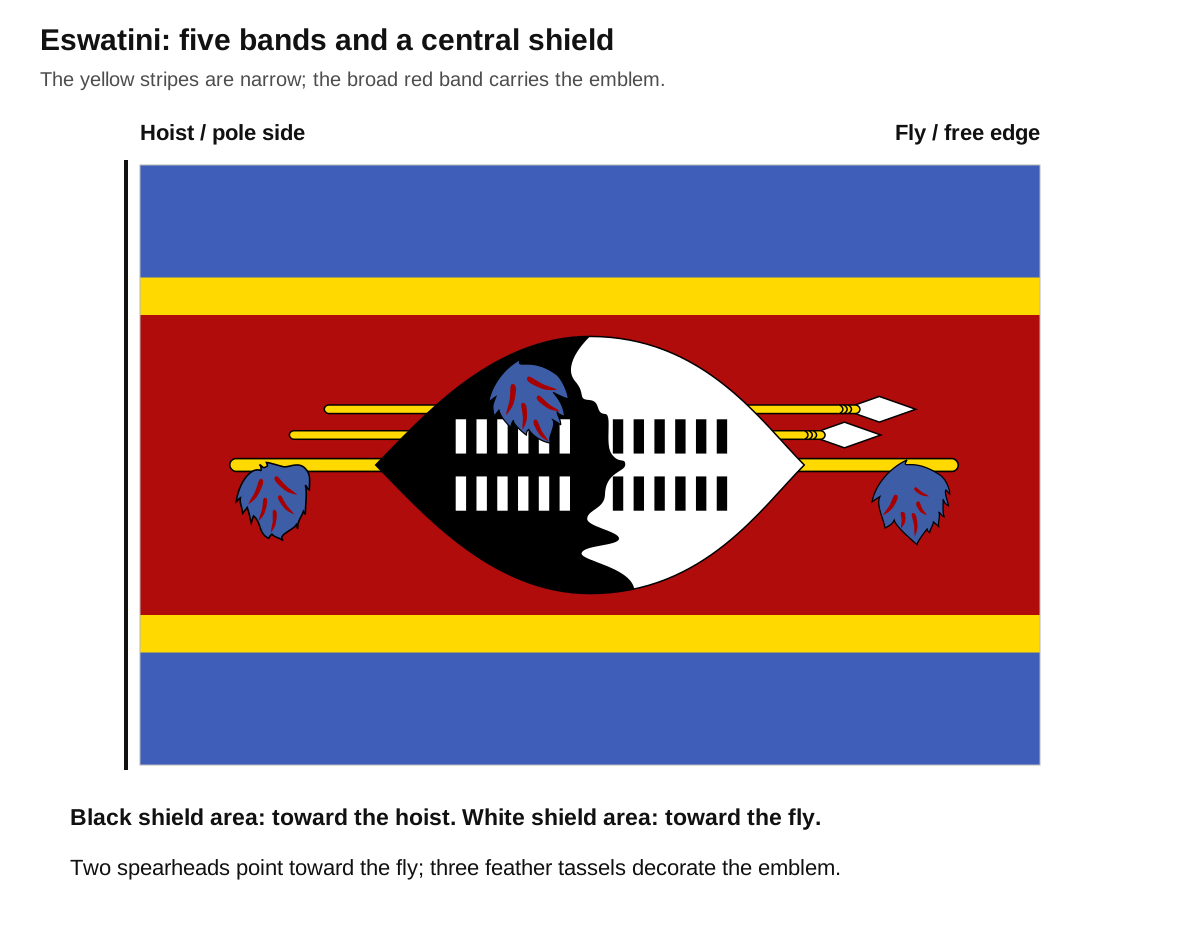
In the standard obverse view, the shield’s black area is toward the hoist and its white area toward the fly. Two spears point toward the fly. Five horizontal bands run blue, yellow, red, yellow, and blue from top to bottom.
GKBook composition, CC0; underlying flag references, public domain.Download image
Enlarged emblem detail preserves the reference’s shield outline, hide markings, paired spears, staff, and three feather tassels. The red field remains behind the design. This is a crop for explanation rather than a standalone national flag.
GKBook composition, CC0; underlying flag references, public domain.Download image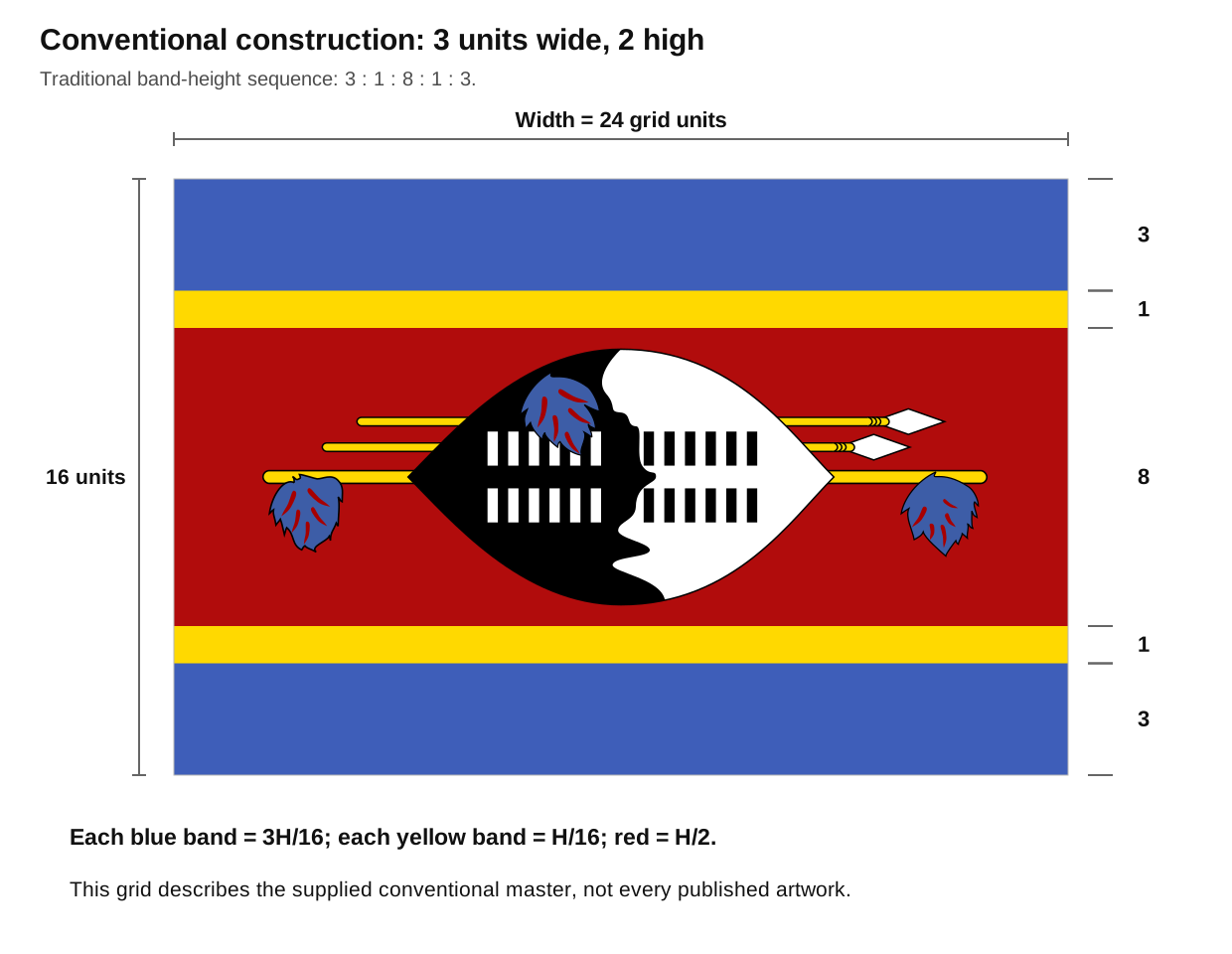
A 24-by-16 grid gives a 3:2 rectangle. Band heights are 3, 1, 8, 1, and 3 units. The supplied 900-by-600 SVG therefore has blue bands 112.5 pixels high, yellow bands 37.5 pixels high, and a red band 300 pixels high.
GKBook composition, CC0; underlying flag references, public domain.Download image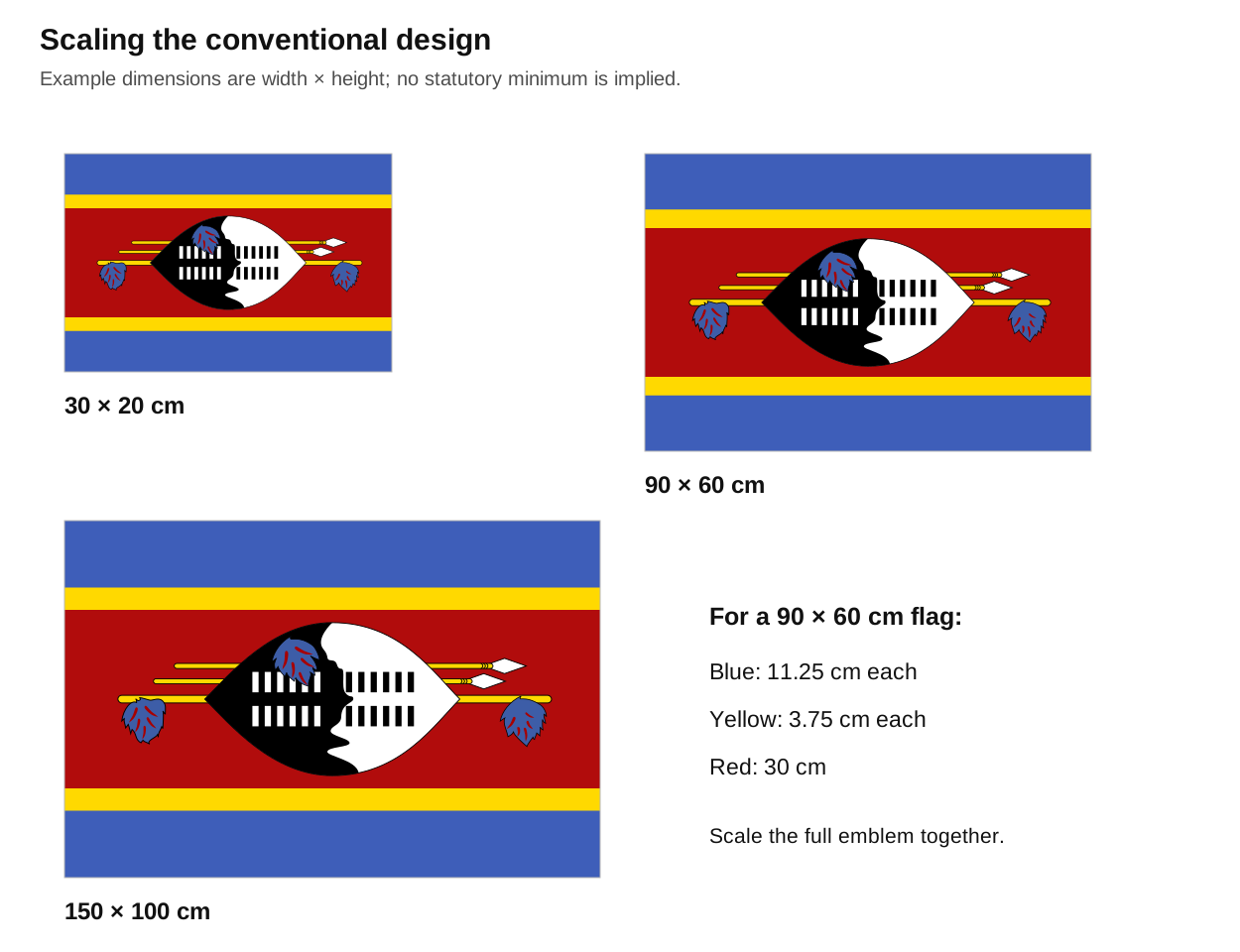
Three illustrative sizes preserve width:height 3:2. At 90 by 60 centimeters, the conventional bands measure 11.25, 3.75, 30, 3.75, and 11.25 centimeters from top to bottom. These examples are scaling calculations, not legally prescribed product sizes.
GKBook composition, CC0; underlying flag references, public domain.Download image
A published lighter-color rendering based on the 2024 government identity manual uses pale blue, bright red and yellow, and blue tassels. It illustrates a documented artwork treatment; it should not be read as proof that every earlier rendering ceased to be valid.
GKBook composition, CC0; underlying flag references, public domain.Download image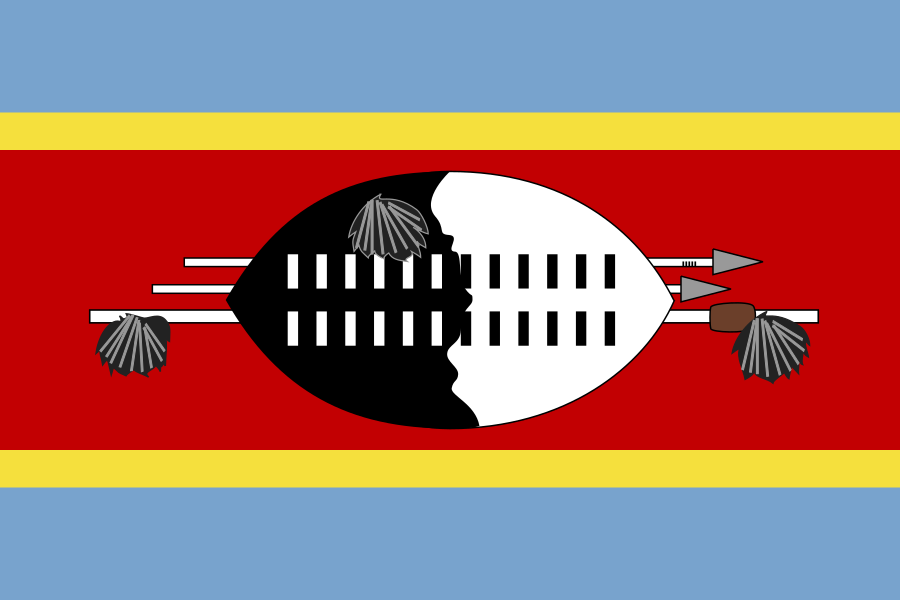
This published rendering uses pale blue, natural dark feather tassels, and pale spear shafts. Differences in rendering need to be distinguished from the continued identity of the national flag: five bands, a horizontal shield, paired spears, and a staff.
GKBook composition, CC0; underlying flag references, public domain.Download image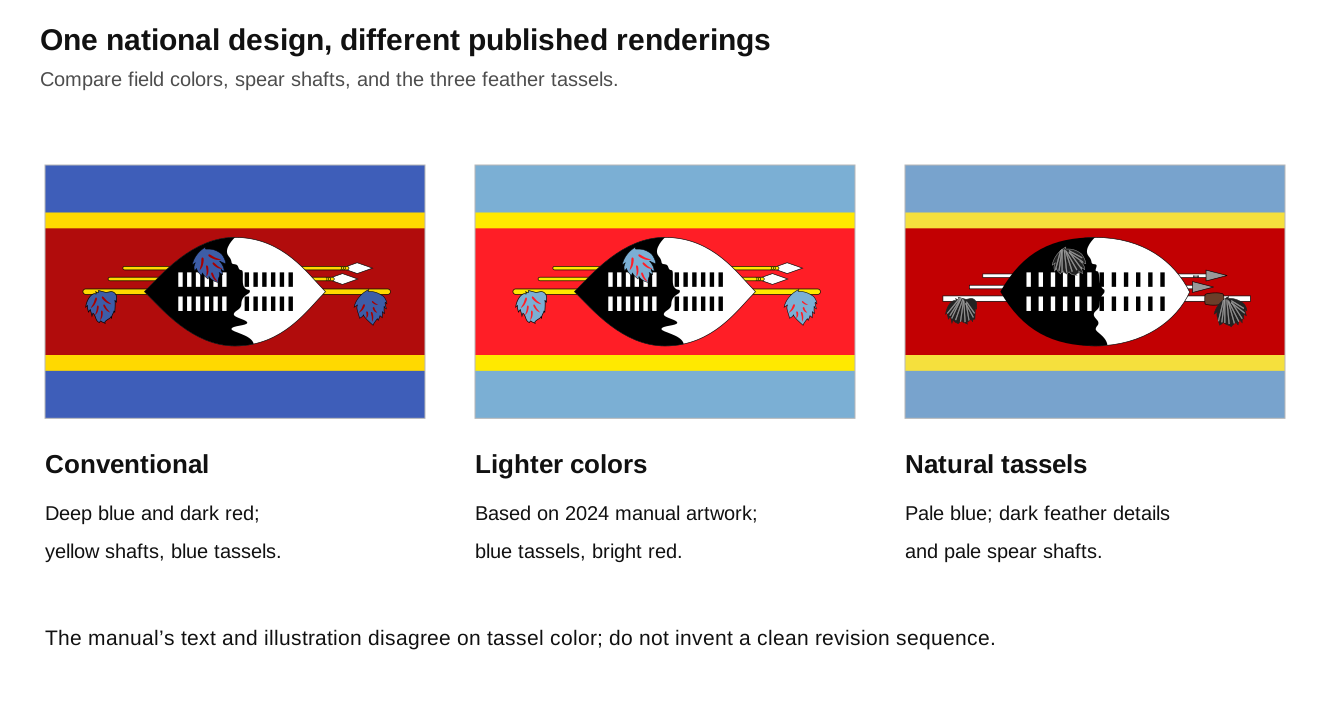
The conventional, lighter-color, and natural-tassel illustrations retain the same national design. The 2024 manual says tassels changed to black in 2011, while its own pictured flag still has blue tassels. These are documented differences in published artwork, not three separate national flags.
GKBook composition, CC0; underlying flag references, public domain.Download image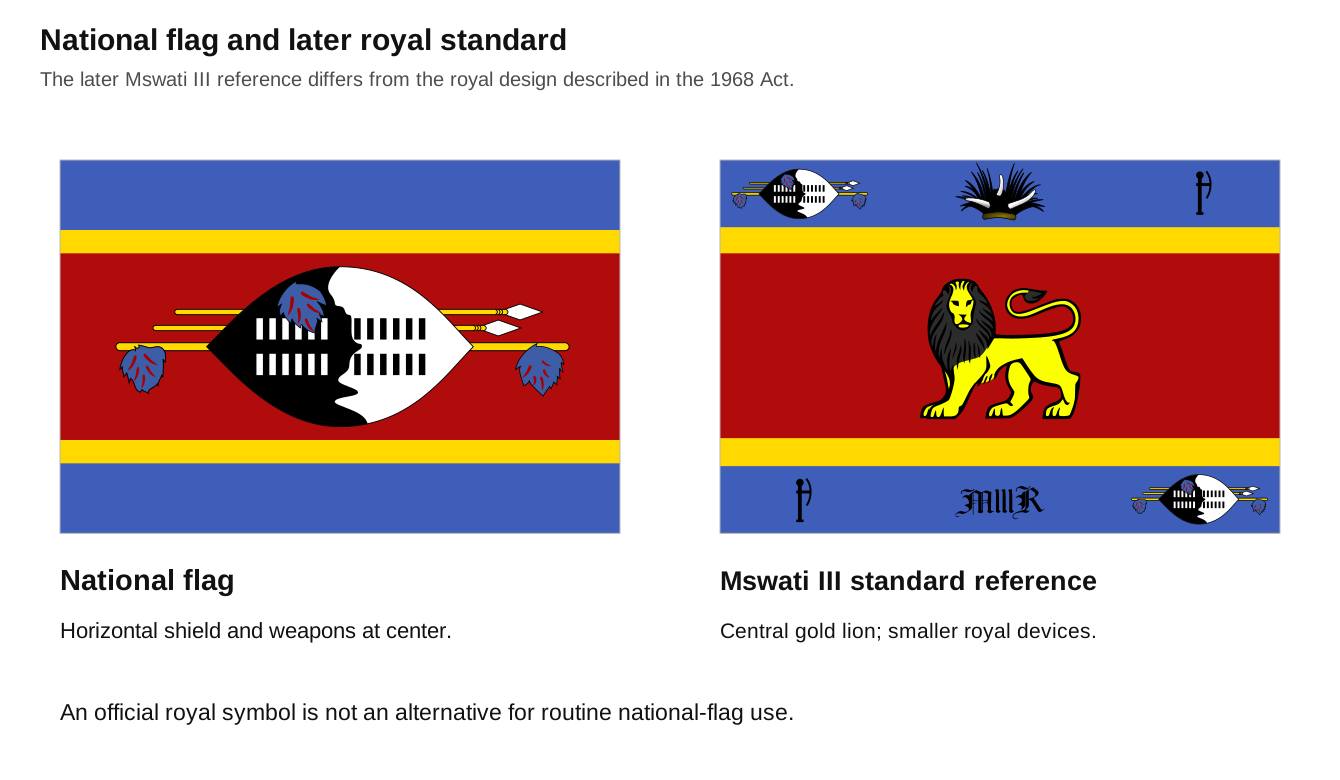
The national flag centers a horizontal shield and weapons. The later Mswati III royal-standard reference centers a gold lion and places smaller royal devices on the blue bands. It is different from the earlier royal design described in the 1968 Act, which added a lion to the national flag’s upper blue band.
GKBook comparison, CC0; national flag reference, CC0; royal artwork by Rannpháirtí anaithnid / Tóraí and contributors, public domain.Download image
Eswatini uses a horizontal shield on blue-yellow-red-yellow-blue bands. Kenya has an upright shield and crossed spears on black-red-green bands separated by narrow white stripes. Lesotho has a black mokorotlo hat on blue-white-green bands. All three references retain 3:2 proportions.
GKBook composition, CC0; underlying flag references, public domain.Download image
A 1941 military precursor was followed by the national raising on April 25, 1967, independence on September 6, 1968, the October 6 adoption date, and commencement of the Flag Act on November 29. The country changed its name to Eswatini in 2018.
GKBook composition, CC0; underlying flag references, public domain.Download image
The flag can be lowered on a mast during officially directed mourning. This drawing contrasts an ordinary raised position with a lowered position; it does not establish an exact national lowering fraction, annual mourning date, or standing order for every building.
GKBook explanatory composition, CC0; underlying national flag reference, CC0. Mast positions are schematic.Download image
U.S. Army photo illustration published in August 2026, based on a photograph of Brig. Gen. Sotja Dlamini at the African Land Forces Summit in Rome, Italy, on March 23, 2026. The creator isolated the desk flag in color and altered the surrounding tones and focus.
Photo: Staff Sgt. Catessa Palone, U.S. Army. Photo illustration: Brian Andries; public domain. The appearance of U.S. Department of War (DoW) visual information does not imply or constitute DoW endorsement.Download imageFrequently asked questions
What does Eswatini’s flag look like?
Eswatini’s flag has five horizontal bands: blue, yellow, red, yellow, and blue. The broad red center carries a horizontal black-and-white shield, two spears, and a staff decorated with feather tassels. The complete rectangle is three units wide for every two units high.
Is the Eswatini flag the same as the Swaziland flag?
Eswatini is the country formerly called Swaziland. The name change took effect on April 19, 2018, while the recognizable national flag design continued. Older laws, archive descriptions, and historical captions therefore use Swaziland or Swazi without necessarily referring to a different national flag.
Does the flag have three stripes or five?
The flag has five horizontal bands, although only three colors form those background bands. Read them from top to bottom as blue, yellow, red, yellow, and blue. Black and white appear in the central shield, so counting the background colors alone does not describe the complete flag.
What is the ratio of Eswatini’s flag?
The flag is 3:2 in width-to-height terms, equivalent to 2:3 when height is stated first. A 90-by-60-centimeter rectangle has that shape. The entire design, including the shield and weapons, should scale proportionately; stretching the field while leaving the emblem unchanged distorts the composition.
What are the conventional band proportions?
The traditional band-height sequence is 3:1:8:1:3. Each blue band occupies three-sixteenths of the height, each yellow band one-sixteenth, and red one-half. This is the construction used by the supplied conventional SVG. The numerical drawing in the 2024 identity manual differs and is discussed separately.
What do the flag’s colors mean?
The government identity manual associates blue with peace and stability, red with past battles, and yellow with the country’s resources. The shield’s black and white express peaceful coexistence between black and white people. These meanings explain the symbolism without turning every tiny decorative shade into a separate national message.
What shade of blue should be used?
Published renderings use different blues. The supplied conventional SVG uses #3E5EB9, while the 2024 government manual prints Pantone 542 C and C51 M16 Y0 K0. Screen values, printed specifications, and photographed fabric should be kept distinct. A commissioned official flag needs an approved artwork and color proof.
Why does the flag contain a large red band?
Red is associated with past battles in the government’s explanation. It forms the broad central field, making space for the horizontal shield and weapons. In the conventional 3:1:8:1:3 construction, that red band is half the flag’s total height, substantially wider than either blue band or either yellow stripe.
What do the yellow stripes represent?
The yellow stripes are associated with Eswatini’s resources. They separate the large red center from the blue upper and lower bands. Each yellow stripe is narrow in the conventional construction, measuring one-sixteenth of the flag’s height. Yellow also appears in parts of the emblem in familiar published illustrations.
What is the object in the center of the flag?
The main object is a horizontal Nguni-style oxhide shield associated with Swazi military tradition. Its black-and-white pattern is linked with peaceful coexistence. Two spears and a staff accompany it, while feather tassels add royal associations. The shield-and-weapons emblem is not the country’s complete coat of arms.
Which way should the shield and spears face?
In the conventional obverse view, the black portion of the shield lies toward the hoist, or pole side, and the white portion toward the fly. The two spearheads point toward the fly. Preserve the reference artwork as a whole instead of mirroring only the shield or one weapon.
How many spears are on the flag?
There are two spears, positioned with the horizontal shield and a separate staff or fighting stick. The long staff should not be counted as a third spear. Keeping these objects distinct helps explain why the emblem has several parallel shafts but only two recognizable spearheads in its familiar rendering.
What are the feather decorations called?
The feather decorations are described as injobo, with three tassels shown on the emblem. Accounts connect them with widowbird and lourie feathers and with royal use. Published drawings treat their colors differently, so blue graphic tassels should not be mistaken for a literal natural-history illustration of every individual feather.
Did Eswatini change its flag in 2011?
The 2024 government manual says the tassels changed to black in 2011, yet its illustrated flag still shows blue tassels. Other published artwork uses natural dark feathers. That inconsistency supports distinguishing rendering variants; it does not justify inventing a fully documented legal replacement of the entire national flag.
Why do the manual’s dimensions need care?
The 2024 manual describes the flag as 3:2, but its diagram labels a 120-by-78.6-millimeter rectangle. Those numbers are not exactly 3:2. Its band measurements also differ from the traditional 3:1:8:1:3 grid. The discrepancy should be disclosed rather than silently presented as one perfectly consistent construction standard.
Which law defines Eswatini’s national flag?
The Swaziland Flags and Coat of Arms Act, 1968 defines the national flag, royal standard, and coat of arms in separate parts of its schedule. It commenced on November 29, 1968. The accessible consolidated text reviewed for this article is dated December 1, 1998; that date is not a new flag adoption.
When did Eswatini’s flag originate?
The design is traced to a flag King Sobhuza II gave the Swazi Pioneer Corps in 1941. Its military origin preceded the national raising of April 25, 1967 and independence in 1968. A precursor’s date, a public raising, and later legal recognition describe different stages of the flag’s history.
Who designed the flag of Eswatini?
King Sobhuza II is associated with the flag’s origin through the banner he gave the Swazi Pioneer Corps in 1941. Later refinement preceded national use. The evidence reviewed does not securely identify one named textile maker or establish that the King personally drew every line of the modern digital emblem.
When was the national flag first raised?
The government identity manual identifies April 25, 1967 as the first raising of the national flag, during the period before independence. April 25 is consequently commemorated as Flag Day. This event should be separated from the October 1967 registration, September 1968 independence, and October 1968 adoption date.
What happened on October 30, 1967?
The government identity manual records registration of the flag by the College of Arms on October 30, 1967, following refinement of the design. That milestone came after the April national raising and before independence. Registration should not be substituted for every other date when describing the flag’s adoption history.
When was Eswatini’s flag adopted?
The government identity manual gives October 6, 1968 as the adoption date. The flag had already been raised in April 1967, and independence came on September 6, 1968. The Flags and Coat of Arms Act then commenced on November 29, 1968, providing a further, separate legal milestone.
When is Eswatini’s Independence Day?
Independence Day is September 6, commemorating independence in 1968, when the country was known as Swaziland. It differs from Flag Day on April 25 and the October 6 adoption date recorded in the identity manual. A national anniversary and the flag’s institutional history therefore answer different calendar questions.
When is Eswatini’s Flag Day?
Eswatini observes Flag Day on April 25, commemorating the national flag’s first raising in 1967. A government report records the country marking its fifty-fourth anniversary in 2021. The observance is separate from Independence Day on September 6; a flag commemoration should not be confused with the full public-holiday calendar.
Is an original Swazi flag preserved?
The National Archives lists an original Swazi flag among its holdings. That brief catalog description does not identify a verified textile date, dimensions, maker, or current display arrangement. It supports the existence of a preserved historical object, while leaving those more specific questions open until an authoritative object record is available.
How is the royal standard different from the national flag?
The national flag centers a shield and weapons. The later Mswati III royal standard centers a gold lion and includes smaller royal devices. This differs from the earlier design described in the 1968 Act, which added a gold lion to the upper blue band of the national flag.
Is the flag’s shield the national coat of arms?
No. The flag’s central shield and weapons are not the complete national coat of arms. The Act describes the arms separately, including a shield, crest, lion and elephant supporters, and the motto SIYINQABA. Adding the entire coat of arms to an ordinary national flag would change its familiar design.
How should a faithful flag reproduction be made?
Start with an approved master and preserve the complete rectangle, band order, and emblem proportions. Keep the shield markings, paired spears, staff, and tassels legible. Select fabric and construction suited to the intended display, then proof the actual materials and colors rather than treating a screen preview as final manufacturing approval.
Is there a single required size for every Eswatini flag?
The sources reviewed do not establish one mandatory physical size for every private, desk, building, or ceremonial flag. The size examples on this page simply preserve 3:2 proportions and the conventional band grid. For an official installation, obtain the responsible authority’s requirements for the artwork, cloth dimensions, fittings, and placement.
What display rules should be followed?
Use the complete design respectfully and follow any official instructions applying to the location or occasion. The 1968 Act authorizes regulations concerning places, times, condition, and use of national symbols. Its enabling provisions should not be misquoted as a verified nationwide daily raising schedule or a universal obligation for every household.
Can the flag be displayed vertically?
A vertical installation needs a clear orientation instruction from the responsible organizer or authority. The reviewed national sources do not establish a universal vertical-display rule for every setting. Keep the flag’s complete design and proportions, and avoid borrowing another country’s rotation rule or independently reversing the shield and spear arrangement.
When is Eswatini’s flag flown at half-mast?
Half-mast display is associated with officially directed mourning. A contemporary report documented lowered flags in September 2018 following the death of former Prime Minister Sibusiso Barnabas Dlamini. That historical example is not a current order or an annual rule; the relevant notice should determine the buildings, duration, and arrangements.
Is the mourning position always exactly halfway down?
This article does not establish a fixed national lowering fraction. The illustration is schematic and simply distinguishes a raised flag from a lowered mourning display. Follow the official instruction for the event and mast concerned, rather than measuring a decorative drawing or importing a numerical rule from another country’s flag code.
How should an Eswatini flag be cared for?
Follow the fabric maker’s cleaning instructions, dry the flag before storage, and inspect seams, attachments, and printed details. Replace an everyday flag when fading or damage makes the design unclear. These are practical care recommendations; a historically significant textile should receive conservation advice instead of routine washing or casual disposal.
Does public-domain artwork mean every use is unrestricted?
Copyright status and the regulation of national symbols are separate matters. Public-domain artwork can be reused without a copyright license fee, but the Flag Act authorizes rules about national flags, arms, royal standards, and imitations. An official or commercial application should therefore be checked for any applicable symbol-use requirements.
How is Eswatini’s flag different from Kenya’s?
Both flags show shields and spears, but their layouts differ clearly. Eswatini has a horizontal black-and-white shield and blue-yellow-red-yellow-blue bands. Kenya has an upright shield and crossed spears over black, red, and green bands separated by narrow white stripes. The similar military imagery does not make their designs interchangeable.
How is Eswatini’s flag different from Lesotho’s?
Lesotho’s flag has blue, white, and green horizontal bands with a black mokorotlo hat in the center. Eswatini uses five blue-yellow-red-yellow-blue bands and a horizontal shield with weapons. Their references share a 3:2 rectangular shape, but the central symbol and background colors provide immediate ways to distinguish them.
Is the summit image an unedited documentary photograph?
No. It is a U.S. Army photo illustration published in August 2026, based on a March 23 photograph of Brig. Gen. Sotja Dlamini at a summit in Rome. Its creator isolated the flag in color and altered surrounding tones and focus. It provides context, not a calibrated flag-color reference.
Which Eswatini flag file should I download?
Choose the unannotated conventional SVG for a clear, scalable flag illustration, or select the separately labeled lighter-color and natural-tassel references for comparison. Construction sheets, the emblem crop, royal comparison, timeline, and mourning schematic are explanatory images. For official manufacture, confirm the required master rather than assuming every downloadable rendering is interchangeable.
What is Eswatini’s flag emoji?
Eswatini’s flag emoji is 🇸🇿. Its underlying regional-indicator letters are SZ, reflecting the country code associated historically with Swaziland. Platforms may render the small emblem differently or show letters instead of a flag. An emoji is a display convenience and cannot serve as a detailed manufacturing or construction reference.
Are the printed Pantone labels exact RGB equivalents?
No. The manual’s Pantone labels, its CMYK recipes, and the colors embedded in a digital SVG are different kinds of specifications. The manual also contains an apparent red-label inconsistency. They should be reported accurately as published, with a production proof used to resolve the intended physical appearance before official manufacture.
Explore all general-knowledge topics and the A-to-Z lists.

We Value Your Opinion Comments