
Estonia flag picture
Explore the construction sheet, the three-band design, and the historical sequence.

| Country | EstoniaRepublic of Estonia, one of the three Baltic states. |
|---|---|
| Design | Blue, black, and whiteThree equal horizontal bands; the ordinary flag has no emblem. |
| Proportions | 11:7 width:heightThe Flag Act expresses the same shape as 7:11 hoist:fly. |
| Historic beginning | June 4, 1884The first student flag was consecrated at Otepää; colors selected in 1881. |
| State adoption | November 21, 1918The Provisional Government approved the national colors as the state flag. |
| Flag Day | June 4A distinct observance commemorating the first flag’s consecration. |
| Independence anniversaries | February 24 / August 201918 declaration / 1991 restoration of independence. |
| Blue specification | Pantone 285 CThe current Flag Act’s annex also gives C91 M43 Y0 black0. |
Blue is above black above white, with equal band heights and no central emblem. The first student flag of 1884, state adoption in 1918, and later restoration of public use are distinct milestones. Color meanings below are traditional interpretations.
What is the flag of Estonia?
Estonia’s national flag consists of three equal horizontal bands: blue at the top, black in the middle, and white at the bottom. It is eleven units wide for every seven units of height. The ordinary national flag carries no shield, cross, star, inscription, or other central emblem.
The design is immediately recognizable because of its dark middle band and white lower edge. It belongs to the Republic of Estonia, one of the three Baltic states, and serves both as a national symbol and as the state flag. Its simplicity does not mean that its proportions or order can be changed freely.
The flag’s story begins before the republic. Students in Tartu selected the colors in 1881, the first cloth was consecrated in 1884, and state adoption followed in 1918. The tricolor later endured prohibition during occupation and returned publicly as independence was restored. Those stages explain why several different years appear in accounts of the same flag.
Use the complete flag SVG for the ordinary design. The construction diagram explains its geometry, while the flag-day table and mourning guidance cover important distinctions in its use.
Does Estonia’s flag have an emblem?
The ordinary national flag has no coat of arms. Estonia’s presidential flag and naval ensign are separate official designs that add national arms, and the naval ensign also has a different outline. Those variants should not be used to add a shield to an ordinary blue-black-white national flag.
The name sinimustvalge means blue-black-white. Read the ordinary flag from top to bottom in that order. Each band runs across the complete width, and every band has the same height.
The hoist is the edge attached to the pole; the fly is the free edge. The white stripe remains part of the flag even when it blends into a white page. A surrounding border in a diagram merely makes that edge visible.
Which colors and blue specification should be used?
The Flag Act’s annex specifies Pantone 285 C for blue and gives printing components of 91 percent cyan, 43 percent magenta, zero yellow, and zero black. The downloadable SVG uses #0072CE, or RGB 0, 114, 206. The file’s screen values should be distinguished from the Act’s physical color reference.
| Color | Digital reference | RGB | Official specification or role |
|---|---|---|---|
| Blue | #0072CE | 0, 114, 206 | Pantone 285 C; upper band |
| Black | #000000 | 0, 0, 0 | Middle band |
| White | #FFFFFF | 255, 255, 255 | Lower band |
The annex’s four printing components are conventionally written C91 M43 Y0 K0; its English table labels the black component B. They describe the blue field, not a mixture to use for the separate black stripe. No additional Pantone codes for black and white are invented here.
Pantone, process printing, and an RGB screen file describe color through different systems. Preserve the statutory blue reference for physical specifications and agree on a production proof. Do not sample a shaded fold in a photograph and treat that pixel as a replacement national standard.
What do blue, black, and white mean?
Traditional interpretations connect blue with the sky, truth, and the future; black with the soil, the past, and attachment to the homeland; and white with snow, spiritual light, and hope. The Government Office notes that no definitive original explanation was recorded, so these meanings should not be treated as statutory definitions.
The meanings are best understood as a family of cultural associations. Sky and snow provide a connection to the landscape; truth, hope, and memory supply a moral or historical reading. Different accounts emphasize different elements, and the Flag Act itself defines the arrangement rather than assigning each stripe one compulsory interpretation.
A familiar winter scene with blue sky above dark trees and snow can help someone remember the sequence. It does not prove that the flag was designed from that particular scene. The documented act was the students’ choice of colors, made to express identity while distinguishing their organization from other student corporations.
What are the exact proportions and band dimensions?
Estonia’s flag is 11:7 when stated as width to height. The Flag Act gives the same shape as 7:11 hoist to fly, with the shorter dimension first. For example, a flag 165 centimeters wide and 105 centimeters high follows the prescribed proportions without stretching the three bands.
Let the height be H. The width is 11H/7 and each band is H/3. Equivalently, start with width W, calculate the height as 7W/11, and place the boundaries at one-third and two-thirds of that height. Because no emblem overlaps the bands, their visible areas are also equal.
A 165-by-105-centimeter flag therefore divides into three bands each 165 centimeters long and 35 centimeters high. The order of the dimensions matters: 11:7 width:height and 7:11 hoist:fly describe the same flag. A generic 3:2 or 2:1 rectangle would have a different outline.
When did the Estonian flag begin?
Estonian students selected blue, black, and white as their colors in Tartu in 1881. The first cloth flag was made in 1884 and consecrated at Otepää on June 4 that year. It began as a student society’s flag before becoming a wider national symbol and eventually the state flag.
Colors chosen in Tartu
On September 29, Estonian students selected blue, black, and white as their identifying colors.
First flag consecrated
The first cloth flag was consecrated at Otepää, the event commemorated by Flag Day.
From national symbol to state flag
Independence was proclaimed in February; the government approved the state flag on November 21, and it rose on Tall Hermann on December 12.
Parliament adopts a flag law
The Riigikogu established the state flag’s legal status through the State Flag Act.
Historic cloth placed in the museum
The first flag was deposited in the Estonian National Museum.
Occupation and concealment
The national symbol was prohibited under Soviet occupation; the original cloth was replaced with a duplicate and protected.
Brief return to Tall Hermann
The national tricolor flew there again during September 20–22 before renewed Soviet occupation.
Tricolor restored to the tower
The blue-black-white flag returned to Tall Hermann before the restoration of full national independence.
Historic state symbols restored by law
The Supreme Council adopted a law restoring the state flag and coat of arms used before August 1940.
Independence restored; original recovered
Independence was restored on August 20. The hidden original flag was brought out on December 26.
Present Flag Act
The Act was passed on March 23, 2005 and generally took effect on January 1, 2006; its school-display provision began earlier.
Flag-day list expanded
The current consolidated text includes Estonian Literature Day and specified national song and dance festival days.
How did a student flag become the state flag?
The Provisional Government approved the blue-black-white national flag as the state flag on November 21, 1918. It had already been used around the declaration of independence earlier that year. Parliament adopted a State Flag Act on June 27, 1922, a later legal milestone rather than the flag’s original student beginning.
The student colors spread with the people and organizations involved in Estonia’s cultural awakening. The Government Office describes their use at song festivals, agricultural exhibitions, choir events, and sporting occasions. The tricolor acquired a wider national meaning before Estonia possessed an independent state apparatus.
This development was gradual. The 1881 color choice, the 1884 consecration, the 1918 state decision, and the 1922 law are not competing answers to one identical question. They mark the selection of colors, creation of a ceremonial object, adoption by a government, and subsequent legislation.
What happened to the flag during occupation and restoration?
Soviet occupation authorities prohibited the blue-black-white national symbol, while its meaning endured among Estonians. The flag’s history includes suppression, concealment, and later public return. A brief reappearance on Tall Hermann in September 1944 and its restoration there in February 1989 are distinct events, rather than one uninterrupted period of ordinary public display.
The original cloth’s concealment and the prohibition of a national symbol were related but distinct stories. The first concerns a particular object; the second concerns public expression of Estonian identity. A newly made tricolor could communicate that identity even while the historic original remained hidden.
The February 24, 1989 raising on Tall Hermann was consequently a major public milestone. The Supreme Council’s law of August 7, 1990 then restored the state flag and coat of arms used before August 1940. Both events came before the August 20, 1991 restoration of independence. The same basic color sequence connected the earlier republic with the restoration period; it was not an entirely new post-1991 invention.
Does the original 1884 flag survive?
Yes. The first blue-black-white flag survives and belongs to the Estonian Students’ Society. The Estonian National Museum displays it in its permanent exhibition. It was protected during occupation and later recovered from hiding; its survival concerns the original historic cloth, not merely a modern copy of the familiar tricolor.
The Government Office’s account names Karl Aun in the protection of the historic flag. It describes a substitution in 1940 and preservation on his father’s farm, followed by the flag’s recovery on December 26, 1991. This explains how an exceptionally early national object survived a period when its public use was forbidden.
The Estonian National Museum’s June 2026 Flag Day notice identifies the original in its permanent exhibition and confirms that it belongs to the Estonian Students’ Society. A contemporary SVG cannot reproduce the object’s fabric, seams, age, or conservation history. The downloadable master is therefore labeled as the current national design, not as a facsimile of the 1884 textile.
What does the current Flag Act regulate?
The Estonian Flag Act, passed on March 23, 2005 and generally effective from January 1, 2006, describes the design and regulates its use. The consolidated text reviewed here is in force from December 30, 2022. The Act covers display, flag days, mourning, special variants, and respectful use.
The law separates several subjects that a simple flag picture cannot explain: the right to display the flag, duties attached to particular buildings and days, permanent display, correct orientation, precedence, mourning, special official flags, and the retirement of unusable cloth. The annex also supplies the blue color reference.
This article uses the consolidated text marked in force from December 30, 2022, with its English translation published on January 30, 2023, together with current Government Office guidance. The Estonian text is legally authoritative. A translation is a useful reading aid; the guidance explains practices that should not all be misrepresented as separate statutory commands.
The Act’s general commencement was January 1, 2006. The school-display provision took effect on September 1, 2005. Neither date is the original adoption of the blue-black-white design, whose student and state history is much older.
Who chose the colors and made the first flag?
The color choice came from the Estonian student organization in Tartu rather than a verified sole modern designer. The Estonian National Museum credits Paula Hermann, Miina Hermann, later known as Miina Härma, and Emilie Beermann with sewing the first flag in 1884. Choosing the colors and making the cloth are distinct contributions.
The three sewing credits identify work on the first textile, while the student organization’s meeting explains the choice of colors. Rudolf Kallas is associated with the consecration at Otepää. Those roles are different and should not be collapsed into a single unsupported claim that one person invented, sewed, blessed, and legally adopted the flag.
Likewise, a modern vector contributor reproduces an established symbol. The public-domain reference and the newly prepared teaching diagrams provide usable artwork, but their file authors are not presented as the original designers of Estonia’s national colors.
What dimensions should a manufactured flag use?
The Act specifies a minimum of 105 centimeters in height and 165 centimeters in length for flags on a wall-mounted flagstaff or roof flagpole. It also relates a freestanding pole’s length approximately to six times the flag’s hoist dimension. These installation rules do not define the size of every desk flag.
| Finished width × height | Band height | Application note |
|---|---|---|
| 33 × 21 cm | 7 cm | Scaling example, not the building-display minimum |
| 165 × 105 cm | 35 cm | Minimum for wall-mounted or roof flag installations |
| 220 × 140 cm | 46⅔ cm | Larger proportional example |
Prepare the three bands with equal finished heights, keep their joins straight, and verify the finished rectangle after hemming. Extra material for seams, sleeves, or attachment tabs must not be counted as an additional colored band. The white lower stripe must remain fully visible after trimming or mounting.
For printing, retain the vector master and use an approved blue reference and proof. For cloth, agree on the material and attachment appropriate to the location. The Flag Act gives the aspect ratio and installation-related requirements; it does not mandate one universal fabric for every desk flag, outdoor flag, and historical ceremonial textile.
How do the presidential and naval flags differ?
The presidential flag adds the greater national coat of arms to the blue-black-white rectangle. The naval ensign instead has the lesser arms and a three-tailed fly. Both are distinct official designs with particular uses; the ordinary national flag remains a plain tricolor without a central badge.
| Design | Identifying detail | Distinct purpose |
|---|---|---|
| Ordinary national flag | Three plain bands; 11:7 rectangle | National and state flag |
| Presidential flag | Greater national coat of arms in the center | President’s residence, vehicle, and specified ceremonial use |
| Naval ensign | Lesser arms and three-tailed fly; 13:7 reference | Estonian Navy |
| Authorized special-emblem flags | Specified badge under a separate regulation | Entitled offices and services, not unrestricted decoration |
Sections 17 and 19 require the lions to face the flagstaff on both sides of the relevant official flags. That is a meaningful reverse-side production detail; simply printing the same front-view artwork unchanged on both faces may produce the wrong orientation.
Section 18 provides for designated special-emblem flags, and the Government Office also identifies the defense minister’s flag as a related official design. A legal authorization for categories of institutions does not establish that every possible departmental variant is currently in use. These illustrations focus on the ordinary national, presidential, and naval designs.
When is Estonia’s Flag Day?
Estonia’s Flag Day is June 4. It commemorates the consecration of the first blue-black-white student flag at Otepää on June 4, 1884. The date is listed in the Flag Act and is distinct from Independence Day on February 24 and the restoration anniversary on August 20.
The day looks back to a student ceremony rather than to a modern government competition. Public commemorations have included raising the flag at Tall Hermann, events in Otepää, and museum activities connected with the historic original. Specific event times and visitor access can vary from year to year.
Flag Day is one entry in a much broader statutory calendar. Its presence does not make every flag day a public holiday or impose identical duties on private homes and public institutions. The next two sections distinguish the national anniversaries and the full list of regular occasions.
How do Estonia’s two independence anniversaries differ?
Estonia celebrates Independence Day on February 24, recalling the proclamation of the republic in 1918. August 20 separately marks the restoration of independence in 1991. Both are flag days, but June 4 is the specific Flag Day associated with the first student flag’s consecration in 1884.
February 24 commemorates the republic proclaimed in 1918. The Government Office describes traditions including raising flags, wreath laying, services, a military parade, and presidential ceremonies. The anniversary belongs to the founding of the state.
August 20 commemorates the 1991 decision restoring national independence. It is connected with the recovery of statehood after occupation, not the initial creation of the student colors. Both dates carry a national flag-display requirement for residential, commercial, and office buildings under section 4; June 23, Victory Day, is the third such date.
Which other dates are official flag days?
Yes. The Flag Act lists commemorative, cultural, family, and national occasions, including Estonian Literature Day, Mother Tongue Day, Veterans’ Day, Europe Day, and the Day of Mourning. It also covers specified song and dance festival days, elections, and referendums. Some observances follow weekday rules rather than a fixed calendar date.
| Date or rule | Occasion |
|---|---|
| January 3 | Commemoration of combatants of the War of Independence |
| January 30 | Estonian Literature Day |
| February 2 | Anniversary of the Tartu Peace Treaty |
| February 24 | Independence Day |
| March 14 | Mother Tongue Day |
| April 23 | Veterans’ Day |
| May 9 | Europe Day |
| Second Sunday in May | Mothers’ Day |
| June 1 | Day for the Protection of Children |
| June 4 | Flag Day |
| June 14 | Day of Mourning |
| June 23 | Victory Day |
| June 24 | Midsummer Day |
| Dates of the specified festivals | National Song and Dance Festival; Youth Song and Dance Festival |
| August 20 | Restoration of Independence Day |
| September 1 | Day of Knowledge |
| Second Sunday in September | Grandparents’ Day |
| Third Saturday in October | Finno-Ugric Day |
| Second Sunday in November | Fathers’ Day |
| Applicable voting days | Riigikogu, local council, and European Parliament elections; referendums |
Government and local authority agencies and public-law legal persons raise the flag on flag days. Polling-station buildings are additionally covered on the listed voting days. Schools have a separate school-day display requirement, while certain public buildings retain permanent flags.
The government can designate an additional occasion. The Act also calls for Lithuania’s flag on February 16 and Latvia’s on November 18 alongside Estonia’s at the buildings of Parliament, the President, and the Government. Those specific diplomatic displays should not be mistaken for an extra universal requirement on every private home.
When should the flag be raised and lowered?
The general rule is to raise the flag at sunrise, no later than 8 a.m., and lower it at sunset, no later than 10 p.m. Permanently displayed flags, Tall Hermann’s special schedule, Midsummer Night, and any government decision for a particular occasion must be considered separately.
Sunrise and sunset change with season and location. The clock limits make the general rule practical during Estonia’s long summer days and short winter days. A flag need not be lowered at 10 p.m. if sunset requires an earlier lowering under the ordinary rule.
Permanent display requires nighttime illumination. The flag stays up on Midsummer Night, between June 23 and 24. For an exceptional government-designated occasion, follow that occasion’s directions rather than assuming the normal daily schedule applies unchanged.
Why is the flag on Tall Hermann important?
The blue-black-white flag was raised again on Tall Hermann tower in Tallinn on February 24, 1989. It had first been raised there as Estonia’s state symbol on December 12, 1918. The 1989 ceremony preceded the restoration of national independence on August 20, 1991, so those dates mark different milestones.
Tall Hermann, also known by its Estonian name Pikk Hermann, stands at Toompea in Tallinn. Parliament identifies it as a central symbol of national independence. The same location helps connect the first raising in 1918 with the public return of the tricolor in 1989.
Its daily schedule is specific: sunrise, but no earlier than 7 a.m., followed by lowering at sunset. Raising uses music associated with the national anthem; lowering uses a musical signature based on Gustav Ernesaks’s Mu isamaa on minu arm, with lyrics by Lydia Koidula. These are separate musical functions, and no lyrics are reproduced here.
Parliament’s account explains that flags removed from service at the tower are numbered and archived. The symbolic setting and documented care of those flags are distinct from the practical replacement of an ordinary worn household flag.
How is the flag displayed vertically?
When the Estonian flag is displayed vertically, its blue band belongs on the observer’s left, followed by black and then white. This requirement is stated in the Flag Act. Rotate the complete rectangle and preserve the band proportions instead of reversing the colors or treating the display as a different flag design.
Do not confuse this rule with rotating a screen image in whichever direction happens to fit a layout. The result must have the specified observer-facing order. Scaling remains uniform: the same rectangle becomes tall and narrow, and the three full-height vertical regions retain equal widths.
Government Office guidance also places a flag beside a speaker’s lectern on the audience’s left and keeps the cloth off the floor. The reference point matters whenever directions such as left and right appear in ceremonial instructions.
Where does Estonia’s flag go in a group?
The Estonian flag occupies a prominent position, with the precise place of honor depending on the number of flags, layout, and viewing direction. Flags are raised separately at the same height on equal-length poles and with equal hoist dimensions. The Act and Government Office guidance also distinguish national, international-organization, and local flags.
The Government Office describes the place of honor as the viewer’s left for a simple two-pole row and the center for ordinary rows of three, five, or seven. Other formations and a nearby focal point, such as an entrance or speaker, can change the arrangement. The diagram is not a universal plan for every courtyard or ceremony.
For other national flags, the Act uses the alphabetical order of country names in French. When displaying European Union member-state flags, it specifies their names in their own languages. All flags have equal hoist dimensions and fly at the same height on separate equal-length poles. Equal heights do not require stretching every country’s flag into the same aspect ratio.
The photograph illustrates a real diplomatic setting and the national tricolor in use. The two officials are identified in the context of the March 2022 event, without implying that those are their current offices.
How is Estonia’s flag displayed for mourning?
The flag is displayed for mourning on national mourning days, including June 14, the annual Day of Mourning. The Flag Act allows a black ribbon at the upper end of a fixed staff or a half-mast display. Government Office guidance explains the handling of each arrangement in more detail.
| Installation or occasion | Treatment | Important distinction |
|---|---|---|
| Land-based mast | Lower edge at the mast midpoint | Raise fully before lowering and before taking down |
| Fixed staff | Black ribbon attached at the upper end | Guidance: 50 mm wide; length about twice the flag’s length |
| June 14 | Annual Day of Mourning | A recurring observance, separate from exceptional mourning orders |
| National mourning announcement | Follow its date and scope | A past announcement does not set today’s flag position |
| Shipboard mourning | Separate maritime guidance | Do not transfer a ship’s lowering fraction to a land mast |
For a standard 165-centimeter-long flag, twice the length gives about 330 centimeters of ribbon. A lowered mast flag generally does not also receive that ribbon. Government Office custom does not leave a mourning flag flying into darkness, even if illuminated; this should be kept separate from the ordinary permanent-display rule.
The guidance also describes covering a coffin in specified military or state funeral contexts, with blue over the deceased person’s heart. The flag must not touch the ground and is removed before burial or cremation. That treatment is a funeral use of the flag, not a new national design.
Can a pennant or color decoration replace the national flag?
No. The Flag Act allows everyone to use a streamer in the national color sequence but explicitly says that it does not substitute for the Estonian flag. A long decorative pennant can therefore express the national colors without satisfying a requirement to raise the complete rectangular flag on a flag day.
Use the flag and colors respectfully
- Use a complete, correctly proportioned flag when a flag display is required.
- Keep the cloth clean, undamaged, and clear of the ground and nearby obstacles.
- Distinguish a national-color decoration from the flag itself.
Avoid misleading substitutions
- Do not substitute a streamer for the required rectangular flag.
- Do not add official arms to invent an ordinary national variant.
- Do not use a flag-containing sign as a trademark or service mark contrary to section 15.
The Act permits use of the flag and its color sequence in accordance with good practice. It also restricts confusingly similar private flags, with a specific exception for the Estonian Students’ Society. Public-domain status of the artwork and rules governing the national symbol are different questions.
Government Office advertising guidance emphasizes that a use must not misleadingly suggest a state recommendation or guarantee. A decorative blue-black-white design therefore still needs to be considered in its actual context.
Is the naval ensign the same as an ordinary ship’s national flag?
No. Estonia’s naval ensign, with the lesser coat of arms and a three-tailed fly, serves the navy. An ordinary vessel’s right to fly Estonia’s national flag is a separate matter governed by ship-flag legislation and maritime customs. The naval design is therefore not a general replacement for every ship’s national flag.
The naval ensign identifies a military use. Ordinary ship nationality and the right to fly the Estonian flag are governed by separate ship-flag legislation, which section 14 of the Flag Act expressly recognizes, together with international maritime customs. A recreational or merchant vessel should not select a naval ensign merely because it is operating at sea.
Government Office guidance distinguishes the national flag at the stern from a bow jack, signal flags, club pennants, and a courtesy flag used in another country’s waters. It also describes maritime mourning differently from a land-based mast. These separate functions explain why several flags can appear on one vessel without all being alternatives to its national ensign.
How should the flag be maintained and retired?
Keep the flag clean and undamaged, as required by the Act. Government Office guidance recommends drying it before storage, following the maker’s washing instructions, repairing tears with matching thread, and storing it in a dry place. A fragile historic flag requires conservation care rather than routine treatment intended for replaceable modern cloth.
Follow the maker’s material-specific washing instructions, dry the flag before packing it away, and inspect seams and attachments. Keep it from striking the wall, roof, trees, or nearby objects. Guidance advises against raising flags in a severe storm, when wind loading can damage the cloth or fittings.
Section 16 requires dignified destruction when a flag is no longer usable. Government Office guidance describes separating the bands and disposing of the pieces discreetly in a closed package, or nonpublic burning where appropriate. Burning is not presented as the only method. Historically important textiles should instead be assessed for conservation and preservation.
How does Estonia’s flag differ from the other Baltic flags?
Estonia has equal blue-black-white bands. Latvia has carmine-white-carmine bands with a narrower white stripe, in a 2:1:2 ratio. Lithuania has equal yellow-green-red bands. The flags also have different rectangular proportions, so their shared Baltic setting should not lead to exchanging their colors, band widths, or national identities.
Estonia and Lithuania both have three equal horizontal bands, but their colors are entirely different. Latvia’s narrow white center band is an additional structural clue: its two carmine bands are each twice the white band’s height.
The aspect ratios provide a second check. Estonia is 11:7, Latvia 2:1, and Lithuania 5:3 in the supplied references. When placing them together in a ceremonial row, preserve those shapes while matching the required hoist height. The teaching plate uses equal display widths solely for side-by-side recognition.
Did a snowy landscape create the flag design?
A winter landscape can resemble the flag’s blue sky, dark trees, and white snow, making it a memorable visual comparison. The documented origin, however, is the selection of colors by Estonian students in Tartu in 1881. A matching photograph does not prove that one particular landscape or image inspired the design.
Other distinctions to remember
- Three bands, no central badge: arms belong to separate official-use designs.
- 11:7 is not 3:2: use Estonia’s actual rectangle.
- June 4 is Flag Day: February 24 and August 20 mark different independence anniversaries.
- 1884 is not state adoption: the first student flag preceded the 1918 government decision.
- The tower has its own schedule: “not before 7 a.m.” is different from the general “no later than 8 a.m.” rule.
- A flag day is not automatically a public holiday: the statutory calendar covers several kinds of observance.
Which Estonia flag image should be downloaded?
Use the unannotated Estonia flag SVG for the complete ordinary national design. The construction sheets, vertical-display example, mourning diagrams, and historical timeline are explanatory plates. The presidential and naval designs have separate official purposes and should not replace the plain blue-black-white rectangle in an ordinary national-flag download.
| Purpose | Image |
|---|---|
| Complete ordinary national flag | Unannotated Estonia flag SVG |
| Geometry and scaling | Construction and size sheets |
| Display guidance | Vertical, day-cycle, placement, and mourning diagrams |
| Historical understanding | Milestone timeline |
| Official-use distinction | National, presidential, and naval comparison |
| Baltic recognition | Estonia, Latvia, and Lithuania comparison |
| Documentary context | March 8, 2022 diplomatic photograph |
The gallery below contains the current flag and each explanatory subject. Captions and labels remain with teaching plates so that an official-use variant, a schematic mourning arrangement, or a timeline is not mistaken for the plain national flag.
Estonia flag pictures

Estonia’s national flag has three equal horizontal bands: blue at the top, black in the middle, and white at the bottom. Its width-to-height ratio is 11:7. The ordinary national flag has no coat of arms.
GKBook composition, CC0; underlying flag references, public domain.Download image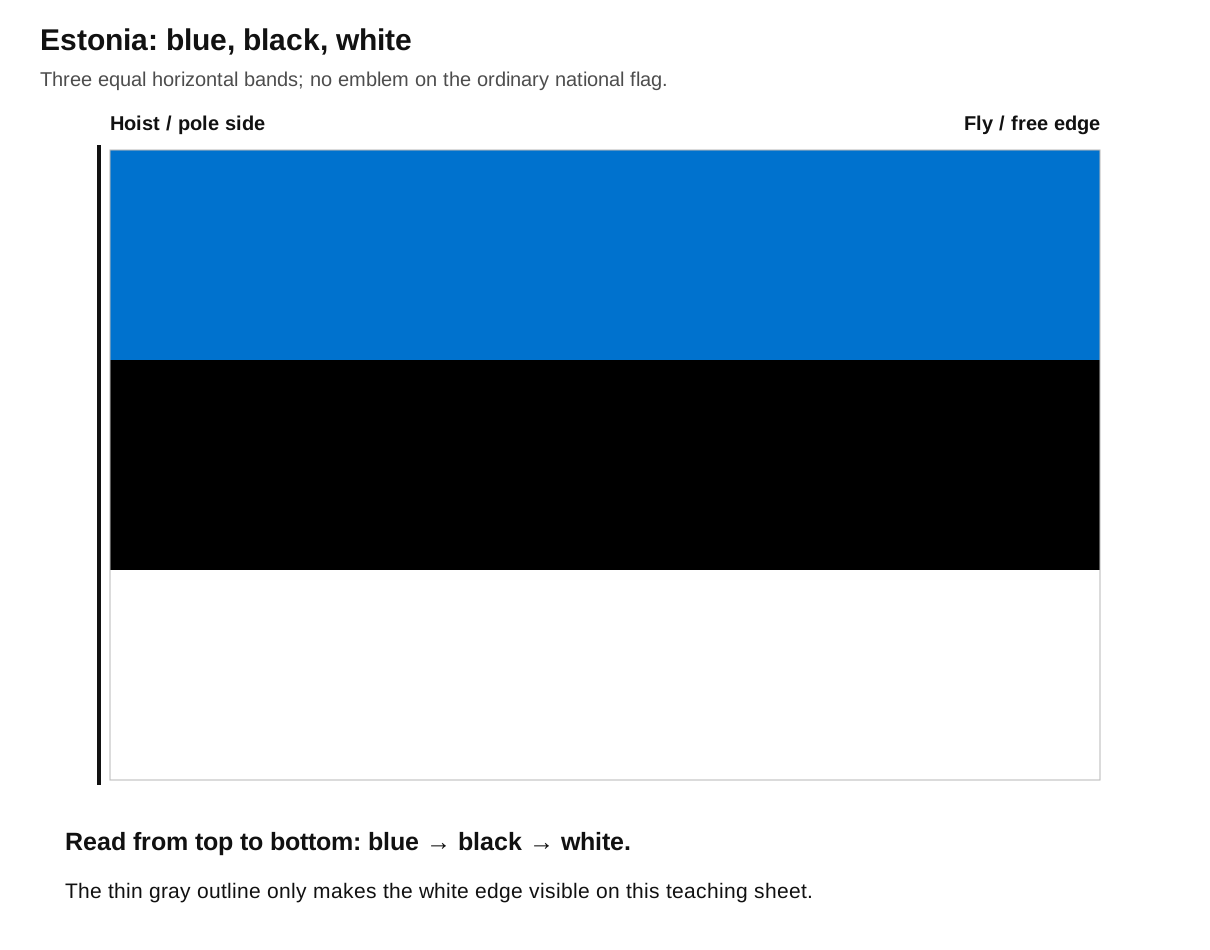
Blue, black, and white form equal full-width bands. The hoist is the pole edge and the fly is the free edge. A thin teaching outline separates the white band from the page background; it is not part of the flag.
GKBook composition, CC0; underlying flag references, public domain.Download image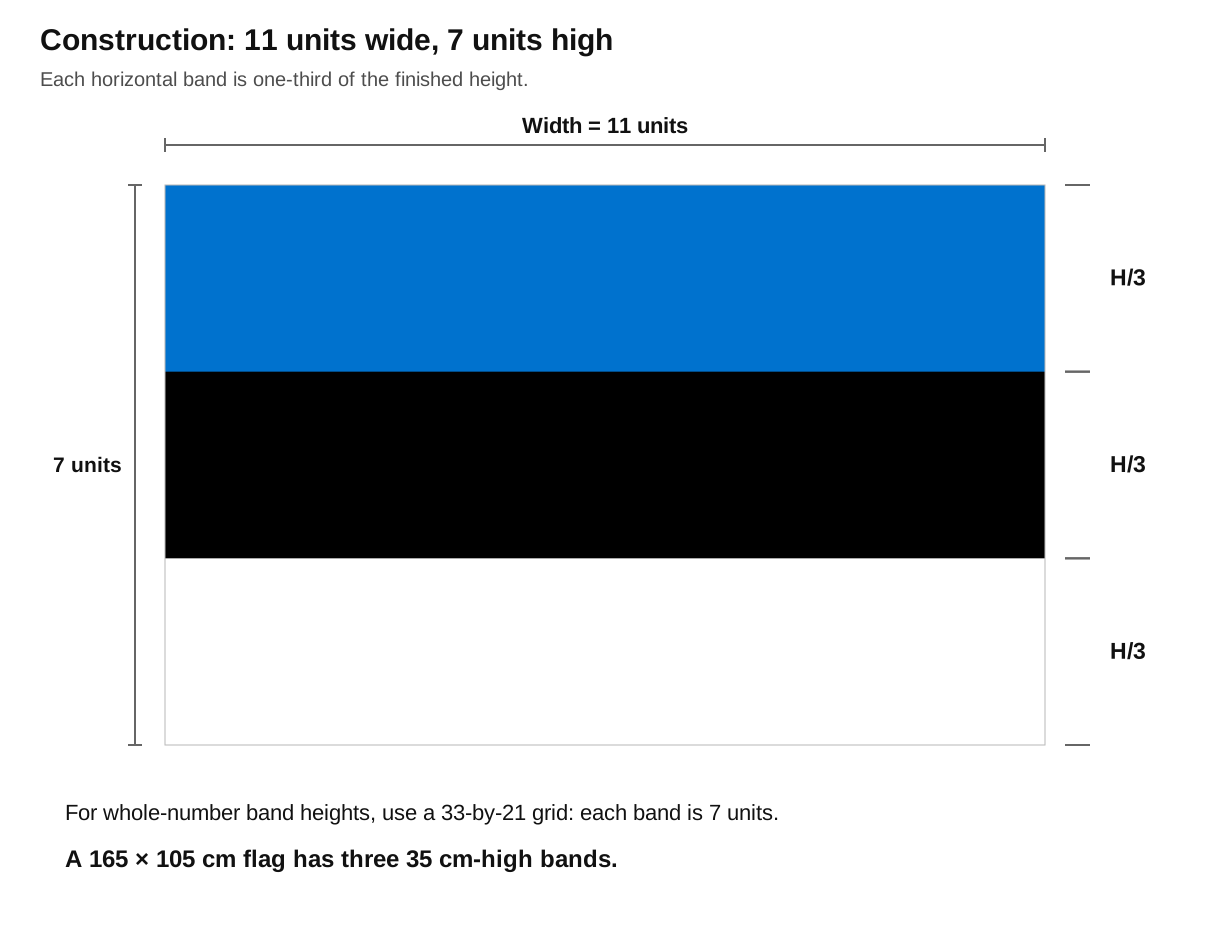
The rectangle measures eleven units wide by seven high. Each band is H/3. An equivalent 33-by-21 grid gives each band seven units of height. A 165-by-105-centimeter example has three 35-centimeter bands.
GKBook composition, CC0; underlying flag references, public domain.Download image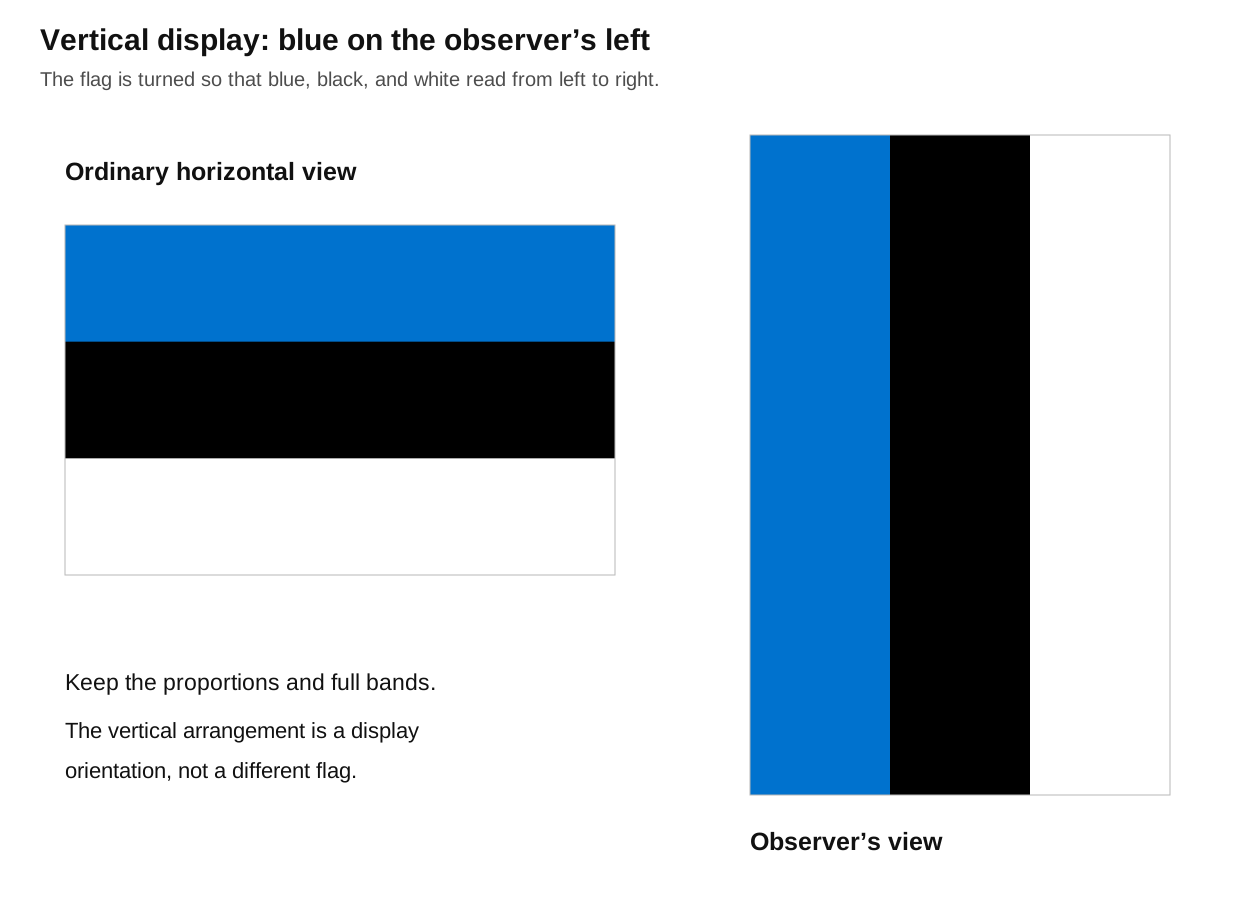
When the Estonian flag is displayed vertically, blue is on the observer’s left, black in the middle, and white on the right. The ordinary horizontal design is shown alongside the rotated flag, with its proportions preserved.
GKBook composition, CC0; underlying flag references, public domain.Download image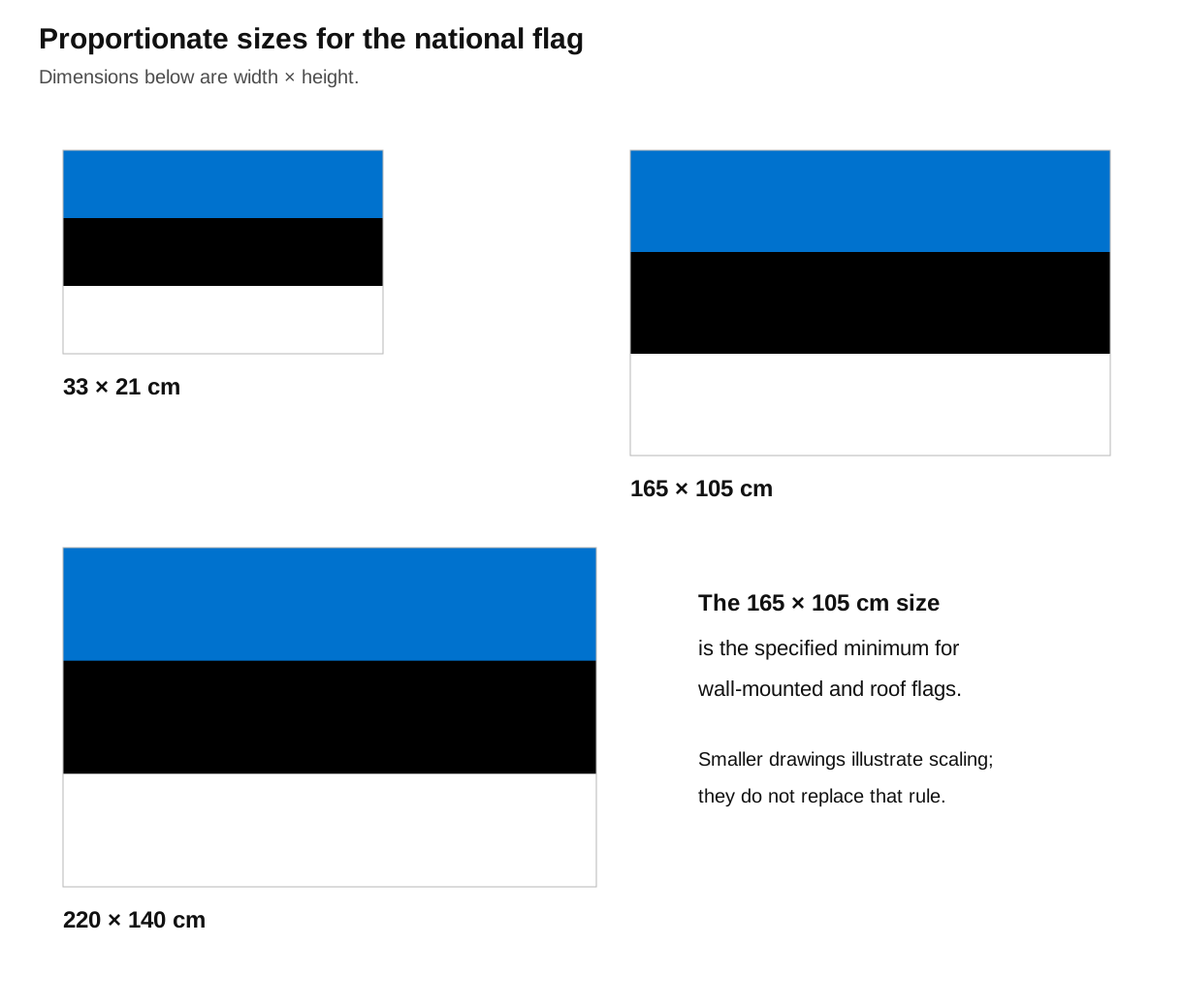
Each illustrated size preserves 11:7 width:height. The Flag Act specifies a minimum of 105 centimeters in height and 165 centimeters in length for a wall-mounted flagstaff or roof flagpole. Smaller examples explain scaling and are not compliance examples for those installations.
GKBook composition, CC0; underlying flag references, public domain.Download image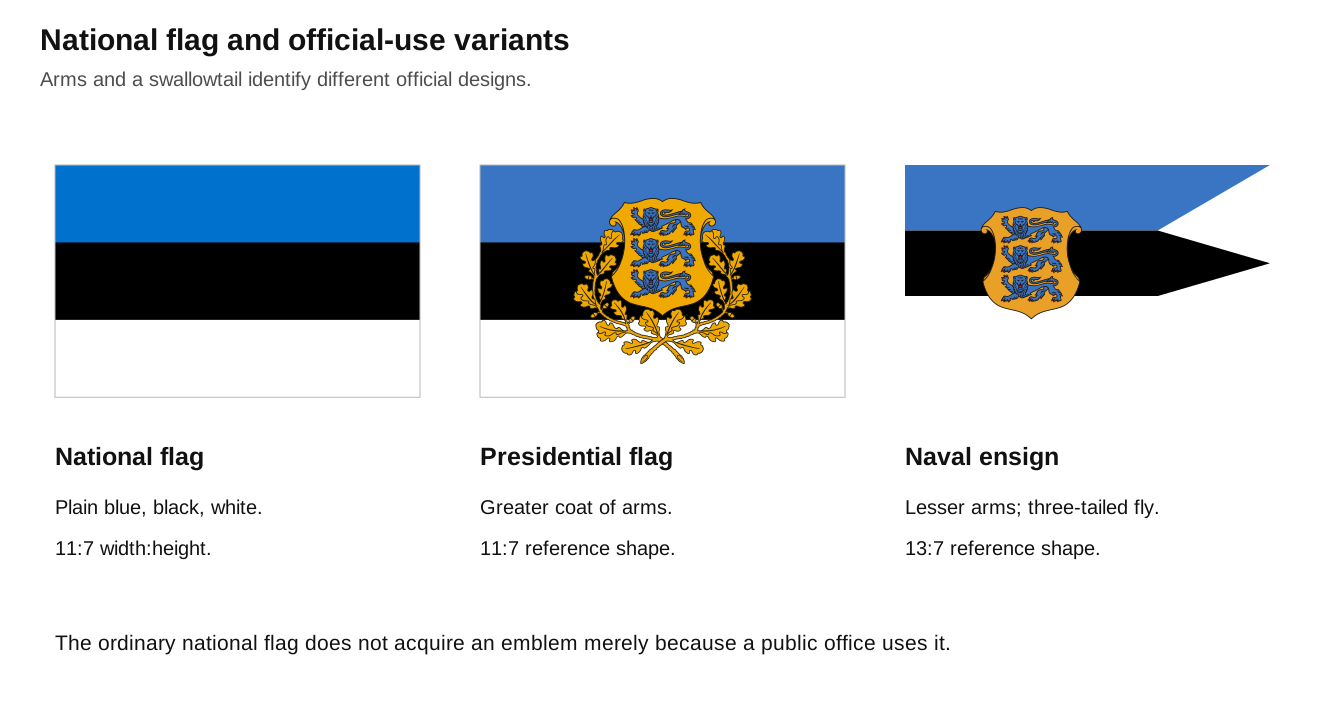
The ordinary national flag is a plain tricolor. The presidential flag adds the greater national coat of arms. The naval ensign has a three-tailed fly and the lesser arms. The comparison preserves the source shapes and heraldic paths.
GKBook comparison, CC0; national, presidential, and naval reference artwork, public domain; Commons contributors including Denelson83 and Quibik.Download image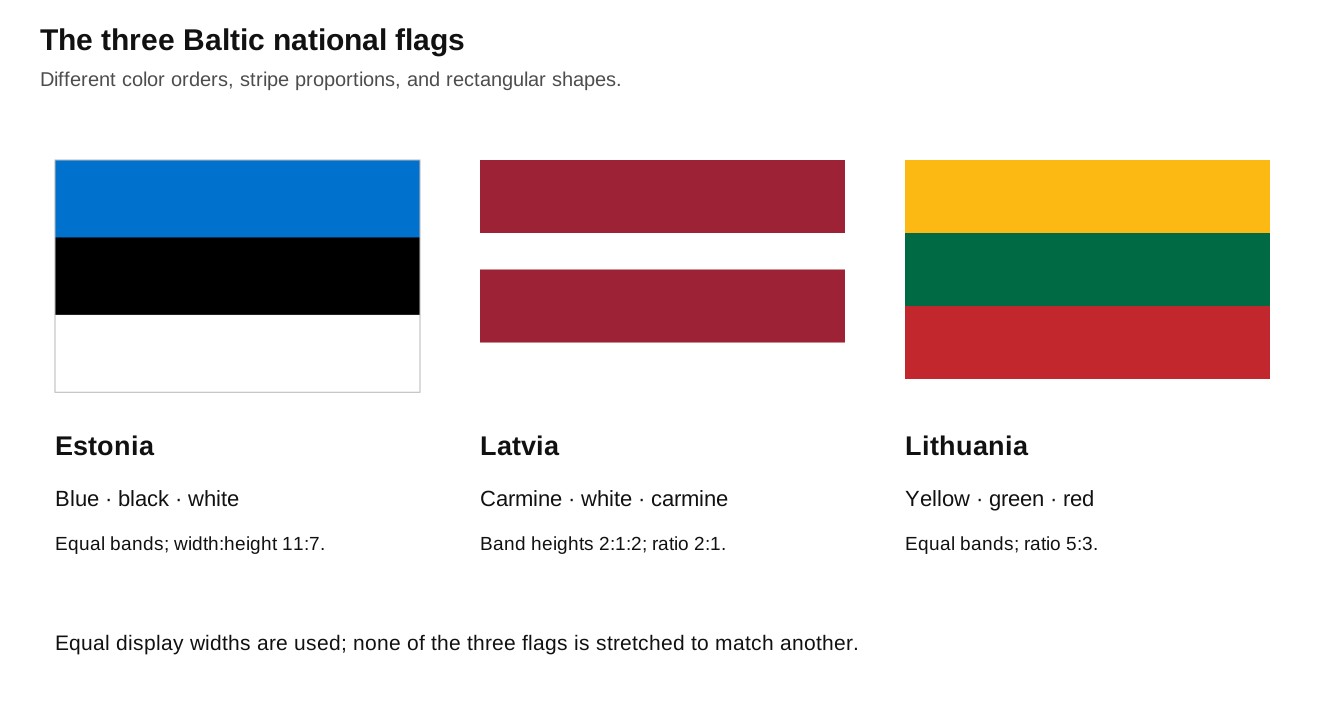
Estonia uses equal blue-black-white bands. Latvia uses carmine-white-carmine with a narrower white stripe, in a 2:1:2 band ratio. Lithuania uses equal yellow-green-red bands. The displayed national flags retain their own 11:7, 2:1, and 5:3 width-to-height proportions.
GKBook composition, CC0; underlying flag references, public domain.Download image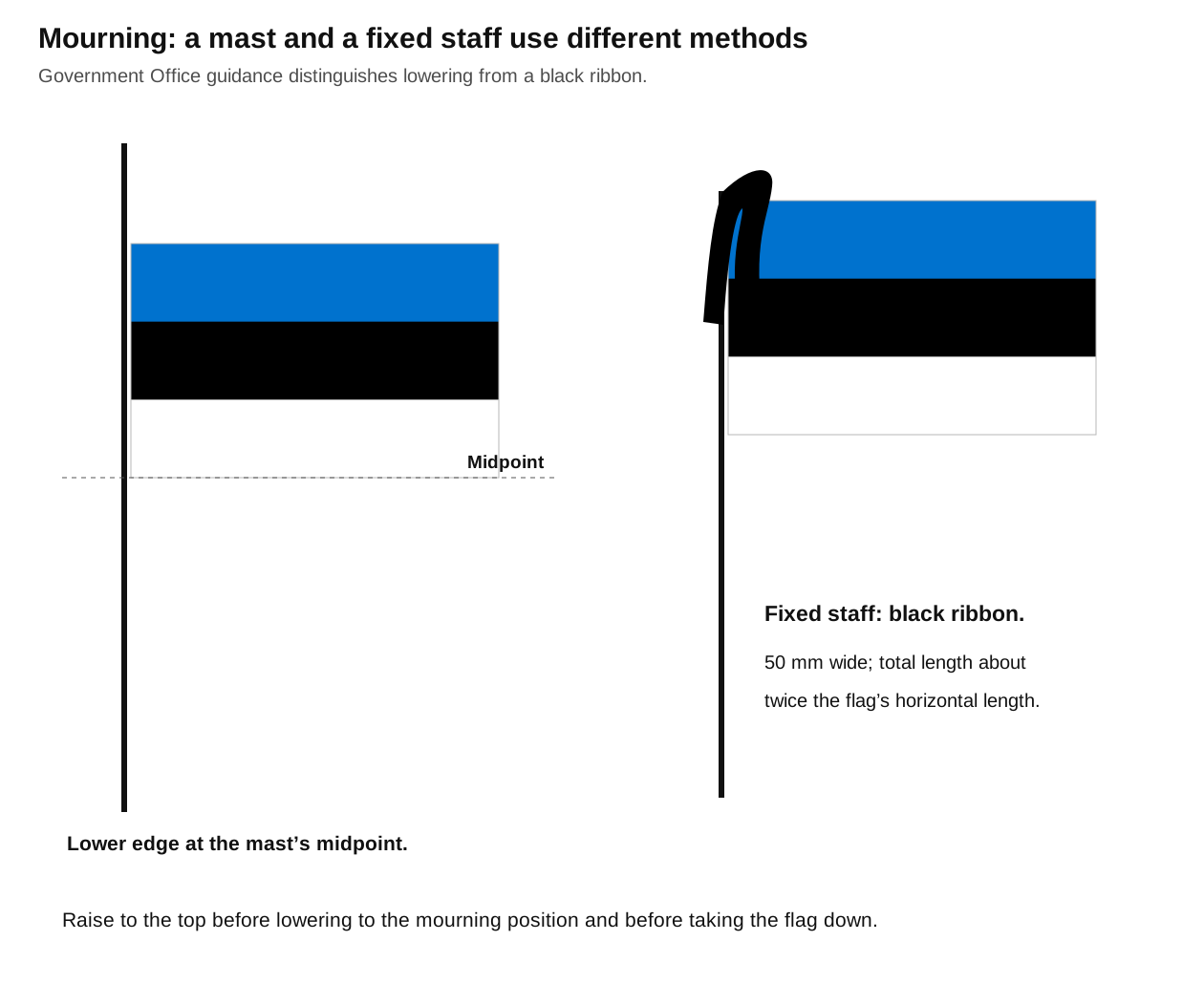
For land-based mast display, Government Office guidance places the flag’s lower edge at the mast midpoint, raising it to the top before lowering and again before taking it down. A fixed staff instead carries a black ribbon. The ribbon drawing is schematic, not a cutting pattern.
GKBook composition, CC0; underlying flag references, public domain.Download image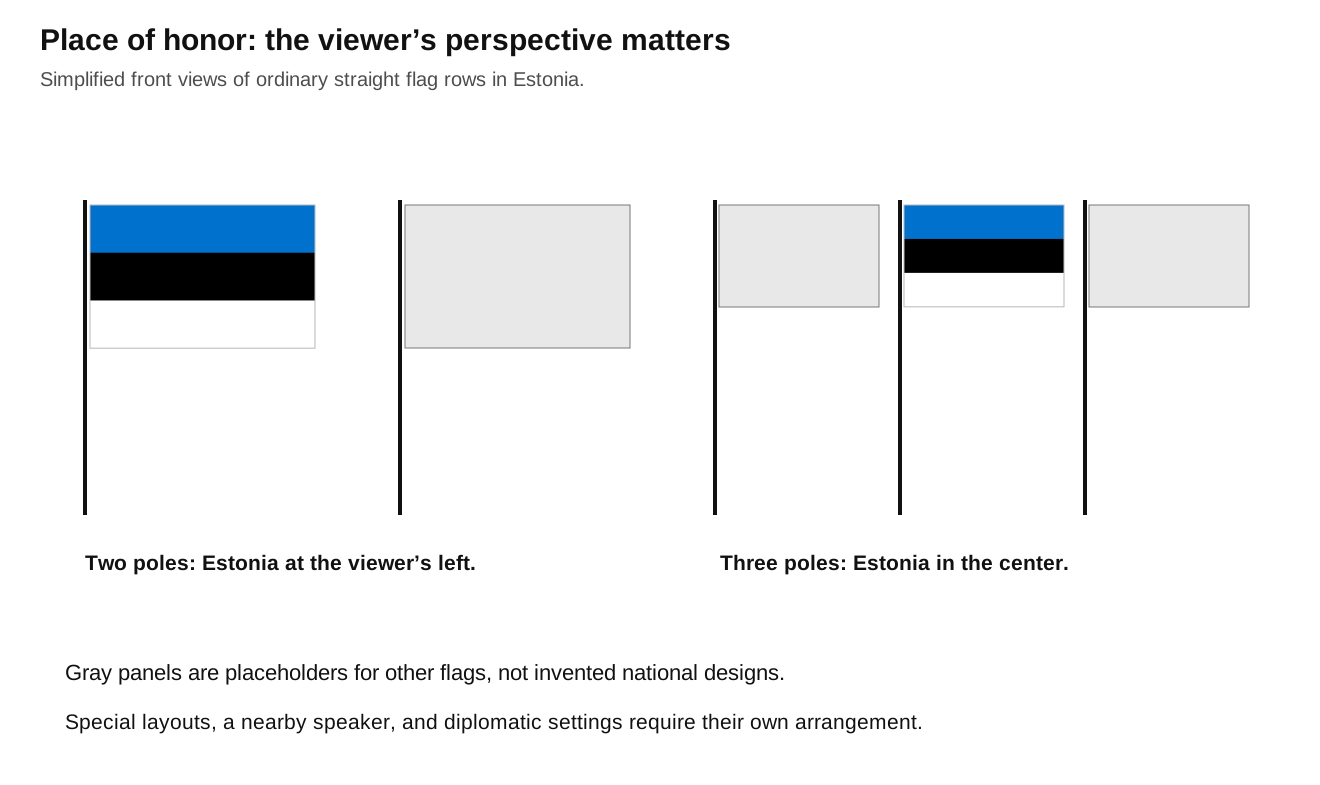
In these simplified front-view examples, the Estonian flag occupies the viewer’s left in a two-pole row and the center in a three-pole row. Gray panels indicate other flags without depicting a particular country. The guidance depends on the viewing direction, layout, and focal point.
GKBook composition, CC0; underlying flag references, public domain.Download image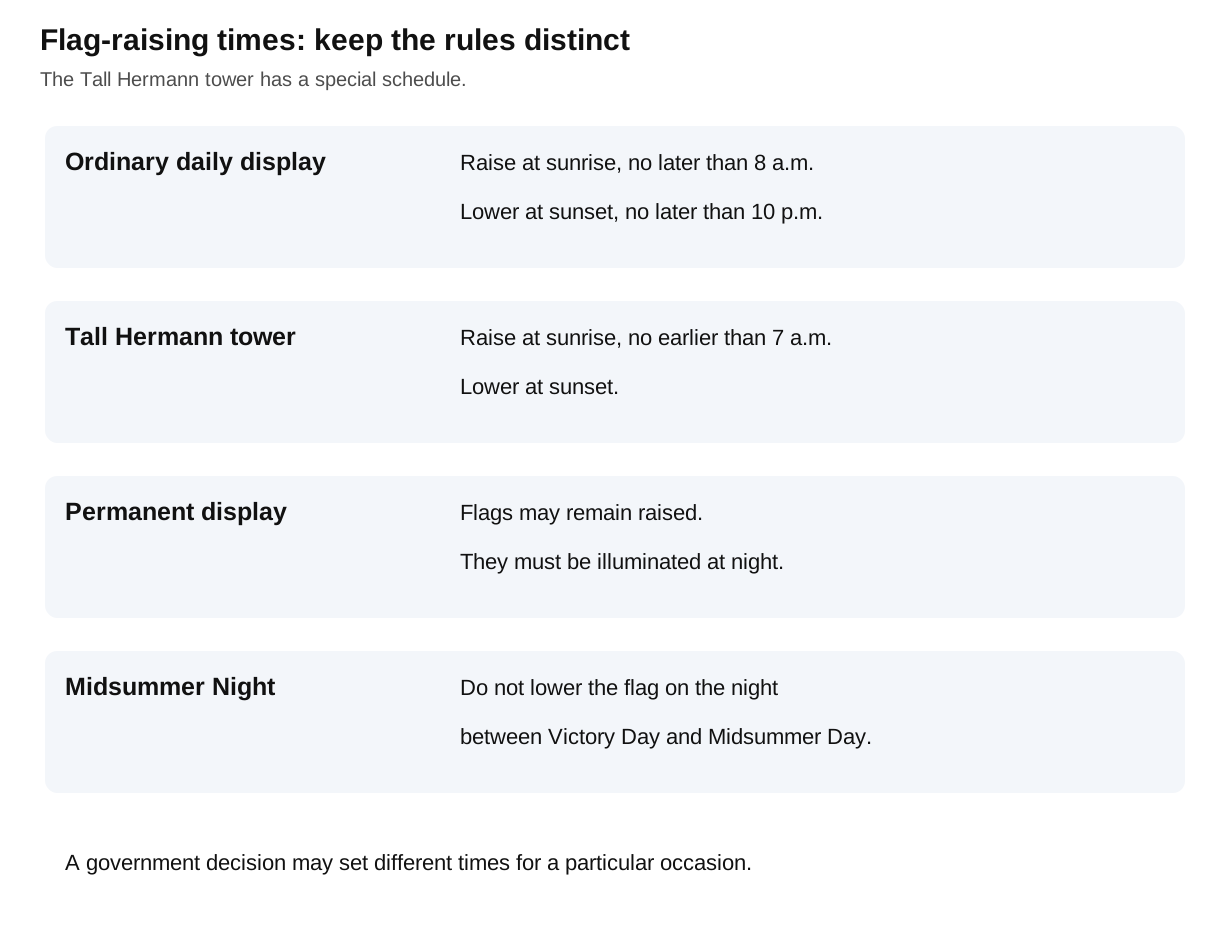
Ordinary daily display uses sunrise with an 8 a.m. latest raising time and sunset with a 10 p.m. latest lowering time. Tall Hermann instead uses sunrise but not before 7 a.m. Permanently raised flags need nighttime lighting. Midsummer Night is a separate exception to lowering.
GKBook composition, CC0; underlying flag references, public domain.Download image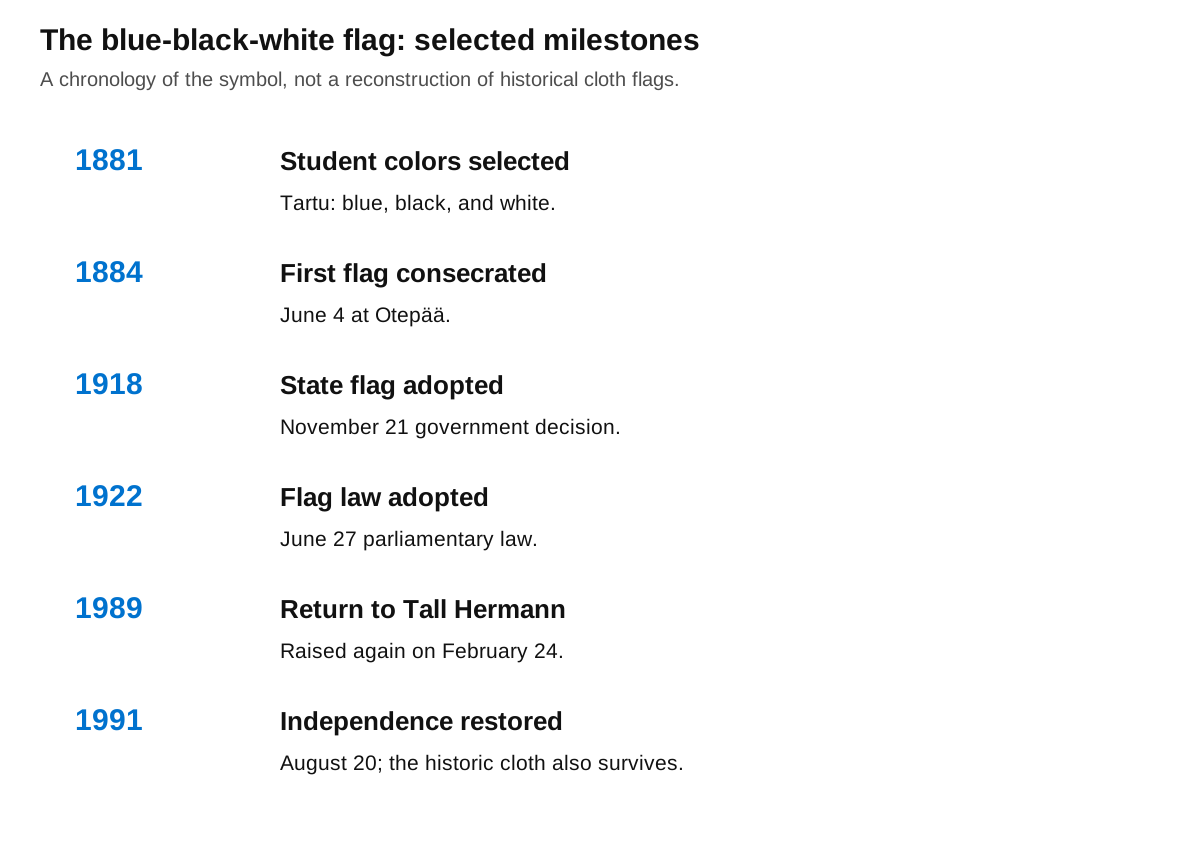
Estonian students chose the colors in 1881; the first flag was consecrated in 1884. State adoption followed in 1918 and a flag law in 1922. The tricolor returned to Tall Hermann in 1989, before independence was restored in 1991.
GKBook composition, CC0; underlying flag references, public domain.Download image
Antony Blinken signs a book beside Kaja Kallas during their meeting in Tallinn, Estonia, on March 8, 2022. Estonia’s blue-black-white flag stands behind Kallas beside the U.S. flag.
Photo: Ron Przysucha, U.S. Department of State; public domain. Full-frame resizing and WebP conversion.Download imageFrequently asked questions
What does Estonia’s flag look like?
Estonia’s national flag consists of three equal horizontal bands: blue at the top, black in the middle, and white at the bottom. It is eleven units wide for every seven units of height. The ordinary national flag carries no shield, cross, star, inscription, or other central emblem.
What does sinimustvalge mean?
Sinimustvalge is the Estonian name formed from the flag’s three colors: blue, black, and white. It describes their familiar sequence and is closely associated with Estonian national identity. The name refers to the tricolor as a whole, rather than to a special military version or a separate flag emblem.
Does Estonia’s national flag have a coat of arms?
The ordinary national flag has no coat of arms. Estonia’s presidential flag and naval ensign are separate official designs that add national arms, and the naval ensign also has a different outline. Those variants should not be used to add a shield to an ordinary blue-black-white national flag.
What do the Estonian flag’s colors symbolize?
Traditional interpretations connect blue with the sky, truth, and the future; black with the soil, the past, and attachment to the homeland; and white with snow, spiritual light, and hope. The Government Office notes that no definitive original explanation was recorded, so these meanings should not be treated as statutory definitions.
Was the flag copied from a snowy forest landscape?
A winter landscape can resemble the flag’s blue sky, dark trees, and white snow, making it a memorable visual comparison. The documented origin, however, is the selection of colors by Estonian students in Tartu in 1881. A matching photograph does not prove that one particular landscape or image inspired the design.
What are the proportions of Estonia’s flag?
Estonia’s flag is 11:7 when stated as width to height. The Flag Act gives the same shape as 7:11 hoist to fly, with the shorter dimension first. For example, a flag 165 centimeters wide and 105 centimeters high follows the prescribed proportions without stretching the three bands.
How wide are the three bands?
Each horizontal band occupies one-third of the flag’s total height and extends across its full length. On a 165-by-105-centimeter flag, each band is 35 centimeters high. On a construction grid, a 33-by-21 rectangle is convenient because every band then measures exactly seven grid units in height.
Which blue is specified for Estonia’s flag?
The Flag Act’s annex specifies Pantone 285 C for blue and gives printing components of 91 percent cyan, 43 percent magenta, zero yellow, and zero black. The downloadable SVG uses #0072CE, or RGB 0, 114, 206. The file’s screen values should be distinguished from the Act’s physical color reference.
Which law describes the Estonian flag?
The Estonian Flag Act, passed on March 23, 2005 and generally effective from January 1, 2006, describes the design and regulates its use. The consolidated text reviewed here is in force from December 30, 2022. The Act covers display, flag days, mourning, special variants, and respectful use.
When did the blue-black-white flag originate?
Estonian students selected blue, black, and white as their colors in Tartu in 1881. The first cloth flag was made in 1884 and consecrated at Otepää on June 4 that year. It began as a student society’s flag before becoming a wider national symbol and eventually the state flag.
When was Estonia’s flag adopted as a state flag?
The Provisional Government approved the blue-black-white national flag as the state flag on November 21, 1918. It had already been used around the declaration of independence earlier that year. Parliament adopted a State Flag Act on June 27, 1922, a later legal milestone rather than the flag’s original student beginning.
When was the historic state flag formally restored?
On August 7, 1990, the Supreme Council adopted a law restoring the state flag and coat of arms used before August 1940. This legal milestone followed the tricolor’s return to Tall Hermann in February 1989 and preceded the restoration of national independence on August 20, 1991.
Who designed or made the first Estonian flag?
The color choice came from the Estonian student organization in Tartu rather than a verified sole modern designer. The Estonian National Museum credits Paula Hermann, Miina Hermann, later known as Miina Härma, and Emilie Beermann with sewing the first flag in 1884. Choosing the colors and making the cloth are distinct contributions.
Does the original 1884 flag still exist?
Yes. The first blue-black-white flag survives and belongs to the Estonian Students’ Society. The Estonian National Museum displays it in its permanent exhibition. It was protected during occupation and later recovered from hiding; its survival concerns the original historic cloth, not merely a modern copy of the familiar tricolor.
How was the first flag preserved during occupation?
The Government Office’s history describes Karl Aun replacing the original flag with a museum duplicate in 1940 and safeguarding the original on his father’s farm. The hidden flag was brought out on December 26, 1991. That preservation story belongs to the historic object and should not be confused with later flag-raising ceremonies.
Was Estonia’s flag prohibited during Soviet occupation?
Soviet occupation authorities prohibited the blue-black-white national symbol, while its meaning endured among Estonians. The flag’s history includes suppression, concealment, and later public return. A brief reappearance on Tall Hermann in September 1944 and its restoration there in February 1989 are distinct events, rather than one uninterrupted period of ordinary public display.
When did the flag return to Tall Hermann?
The blue-black-white flag was raised again on Tall Hermann tower in Tallinn on February 24, 1989. It had first been raised there as Estonia’s state symbol on December 12, 1918. The 1989 ceremony preceded the restoration of national independence on August 20, 1991, so those dates mark different milestones.
When is Estonia’s Independence Day?
Estonia celebrates Independence Day on February 24, recalling the proclamation of the republic in 1918. August 20 separately marks the restoration of independence in 1991. Both are flag days, but June 4 is the specific Flag Day associated with the first student flag’s consecration in 1884.
When is Estonia’s Flag Day?
Estonia’s Flag Day is June 4. It commemorates the consecration of the first blue-black-white student flag at Otepää on June 4, 1884. The date is listed in the Flag Act and is distinct from Independence Day on February 24 and the restoration anniversary on August 20.
Are there other official flag days?
Yes. The Flag Act lists commemorative, cultural, family, and national occasions, including Estonian Literature Day, Mother Tongue Day, Veterans’ Day, Europe Day, and the Day of Mourning. It also covers specified song and dance festival days, elections, and referendums. Some observances follow weekday rules rather than a fixed calendar date.
When must residential buildings display the flag?
Section 4 of the Flag Act calls for the flag on residential, commercial, and office buildings on Independence Day, Victory Day, and the restoration of independence anniversary: February 24, June 23, and August 20. Other flag-day obligations apply to public bodies, and everyone may also display the flag respectfully on additional occasions.
What time should the Estonian flag be raised and lowered?
The general rule is to raise the flag at sunrise, no later than 8 a.m., and lower it at sunset, no later than 10 p.m. Permanently displayed flags, Tall Hermann’s special schedule, Midsummer Night, and any government decision for a particular occasion must be considered separately.
Does Tall Hermann follow the same raising time?
Tall Hermann has its own rule: the flag rises at sunrise, but not before 7 a.m., and is lowered at sunset. This is different from the general latest raising time of 8 a.m. The tower’s ceremony also uses musical signatures associated with raising and lowering the flag.
May Estonia’s flag remain raised overnight?
A permanently hoisted Estonian flag must be illuminated at night. The Act also says the flag is not lowered on Midsummer Night, between Victory Day and Midsummer Day. These provisions should be distinguished from ordinary daily lowering and from the additional customs governing flags displayed specifically for mourning.
How should Estonia’s flag be hung vertically?
When the Estonian flag is displayed vertically, its blue band belongs on the observer’s left, followed by black and then white. This requirement is stated in the Flag Act. Rotate the complete rectangle and preserve the band proportions instead of reversing the colors or treating the display as a different flag design.
Is there a minimum flag size for a building?
The Act specifies a minimum of 105 centimeters in height and 165 centimeters in length for flags on a wall-mounted flagstaff or roof flagpole. It also relates a freestanding pole’s length approximately to six times the flag’s hoist dimension. These installation rules do not define the size of every desk flag.
How is Estonia’s flag arranged with other flags?
The Estonian flag occupies a prominent position, with the precise place of honor depending on the number of flags, layout, and viewing direction. Flags are raised separately at the same height on equal-length poles and with equal hoist dimensions. The Act and Government Office guidance also distinguish national, international-organization, and local flags.
When is Estonia’s flag flown for mourning?
The flag is displayed for mourning on national mourning days, including June 14, the annual Day of Mourning. The Flag Act allows a black ribbon at the upper end of a fixed staff or a half-mast display. Government Office guidance explains the handling of each arrangement in more detail.
Where should the flag sit at half-mast?
For a land-based mast, Government Office guidance places the flag’s lower edge at the mast’s midpoint. Raise it to the top before lowering it to that position, and again before taking it down. Maritime mourning uses separate guidance, so a shipboard lowering fraction should not be applied automatically to a building’s mast.
How is a mourning ribbon used on a fixed staff?
Government Office guidance describes a black ribbon attached to the upper end of a fixed flagstaff. It specifies a width of 50 millimeters and a total length approximately twice the flag’s horizontal length, about 3,300 millimeters for a standard 165-centimeter flag. A mast lowered for mourning generally does not also need that ribbon.
How should the flag be cleaned and stored?
Keep the flag clean and undamaged, as required by the Act. Government Office guidance recommends drying it before storage, following the maker’s washing instructions, repairing tears with matching thread, and storing it in a dry place. A fragile historic flag requires conservation care rather than routine treatment intended for replaceable modern cloth.
How should an unusable Estonian flag be retired?
The Act requires dignified destruction of a flag that has become unusable. Government Office guidance describes separating its colored bands and then disposing of the pieces discreetly, including in a closed package. Its guidance also mentions nonpublic burning; that is not the only described method and does not override local safety rules.
How does the presidential flag differ?
The presidential flag places Estonia’s greater national coat of arms in the center of the blue-black-white field on both sides. The Act specifies that the lions face the flagstaff on each side. This is a flag for the President’s official use, not the standard emblem-free national design.
How does Estonia’s naval ensign differ?
The naval ensign uses the national color sequence and the lesser national coat of arms, with a distinctive three-tailed fly. The reference illustrated here has a 13:7 width-to-height ratio. The Act requires the lions to face the flagstaff on both sides; the ordinary rectangular national flag remains a separate design.
Can a blue-black-white pennant replace the national flag?
No. The Flag Act allows everyone to use a streamer in the national color sequence but explicitly says that it does not substitute for the Estonian flag. A long decorative pennant can therefore express the national colors without satisfying a requirement to raise the complete rectangular flag on a flag day.
Can the flag image be used as a trademark?
Section 15 of the Flag Act prohibits using a sign containing the Estonian flag image as a trademark or service mark. Use of the flag and its color sequence must follow good practice. These rules are separate from copyright status, so public-domain artwork does not remove restrictions on how national symbols are used.
How does Estonia’s flag differ from Latvia’s and Lithuania’s?
Estonia has equal blue-black-white bands. Latvia has carmine-white-carmine bands with a narrower white stripe, in a 2:1:2 ratio. Lithuania has equal yellow-green-red bands. The flags also have different rectangular proportions, so their shared Baltic setting should not lead to exchanging their colors, band widths, or national identities.
What does the diplomatic photograph show?
The photograph records Antony Blinken’s meeting with Kaja Kallas in Tallinn on March 8, 2022, while they served as U.S. Secretary of State and Estonian Prime Minister. Estonia’s flag stands behind Kallas beside the U.S. flag. Ron Przysucha made the photograph for the U.S. Department of State.
Which image is the complete current national flag?
Use the unannotated Estonia flag SVG for the complete ordinary national design. The construction sheets, vertical-display example, mourning diagrams, and historical timeline are explanatory plates. The presidential and naval designs have separate official purposes and should not replace the plain blue-black-white rectangle in an ordinary national-flag download.
Explore all general-knowledge topics and the A-to-Z lists.

We Value Your Opinion Comments