
Ecuador flag picture
Explore the construction sheet, the coat of arms, and the historical sequence.

| Country | EcuadorThe Republic of Ecuador in northwestern South America. |
|---|---|
| Design | Yellow, blue, and red tricolorHorizontal bands, with the coat of arms on the institutional form shown here. |
| Band heights | 2:1:1Yellow occupies one-half; blue and red each occupy one-quarter. |
| Proportions | 3:2 width:heightThe 2009 presidential guide states this ratio; also written 2:3 height:width. |
| Tricolor restored | September 26, 1860Gabriel García Moreno restored the yellow-blue-red design; confirmed in 1861. |
| Legal definition | 1900 decreeAdopted October 31, signed November 7, and published December 5, 1900. |
| Design heritage | Francisco de Miranda’s tricolorThe modern national design developed through later Ecuadorian decisions. |
| Flag Day | September 26A national observance associated with flag honors and school oath ceremonies. |
Yellow occupies as much height as blue and red together. The arms combine an Andean condor, Chimborazo, a river and steamship, the sun, branches, flags, and republican symbols. The 1860 restoration of the tricolor and the 1900 flag-and-arms decree are separate milestones.
What is the flag of Ecuador?
Ecuador’s flag is a horizontal yellow, blue, and red tricolor. Yellow occupies the upper half, while blue and red each occupy one-quarter. The familiar institutional version carries the national coat of arms in the center. Its modern form combines a nineteenth-century tricolor tradition with later Ecuadorian legal and graphic specifications.
The three colors connect Ecuador with the independence-era history also shared by Colombia and Venezuela. The condor-topped coat of arms makes the familiar Ecuadorian flag readily identifiable: within a small central image are a mountain, a river, a steamship, the sun, and other national symbols.
Three different questions help make sense of its history. The tricolor was restored on September 26, 1860. A 1900 decree defined the arms and distinguished several uses of the flag. The presidential Instructivo de uso de los Símbolos Patrios, issued in November 2009, provides the 3:2 width-to-height format used by the illustration here.
“Ecuador flag” commonly means the emblem-bearing design shown above. A plain tricolor also has a documented place in the legal history, so an image without arms needs context before it is called incorrect.
The bands and the central coat of arms
Read the bands from top to bottom: yellow, blue, red. Each extends from the hoist, where the flag attaches to its staff, to the free end, or fly. The arms lie over the colored field; they do not divide it into separate panels.
The middle of the flag’s total height is also the boundary between yellow and blue. This explains the seemingly unusual placement: an emblem centered on the whole rectangle naturally crosses that boundary instead of sitting wholly inside the yellow band.
The national design is a rectangle, not a swallowtail. Its central feature is a full coat of arms, not a simple bird silhouette or an isolated mountain. Gold fringe, staff ornaments, carrying belts, and embroidery belong to particular physical flags and ceremonial equipment; they are separate from the basic three-band field.
Reading the coat of arms
The arms provide a compact picture of national identity. The 1900 decree describes an oval containing the sun, zodiac signs, Chimborazo, a river, and a steamship with a caduceus mast. Outside the oval are national flags, palm and laurel branches, consular fasces, and a condor with its wings spread.
| Element | Identification | Meaning or role |
|---|---|---|
| Condor | Andean condor above the oval | Official explanations associate it with energy and effort. |
| Sun and zodiac | Aries, Taurus, Gemini, Cancer | Historical months: March, April, May, and June. |
| Snowy mountain | Chimborazo | A prominent national landscape symbol. |
| River and vegetation | A symbolic Guayas landscape | Waterways and fertile land within the emblem. |
| Steamship and caduceus | The vessel conventionally called Guayas | Navigation and commerce. |
| Laurel and palm | Branches flanking the composition | Glory and peace, respectively, in official explanations. |
| Four national flags | Two on each side of the oval | The national tricolor repeated within the arms. |
| Consular fasces | Bound rods and an axe beneath the oval | Republican dignity and authority. |
The four zodiac signs refer to historical months, not to a horoscope for the country. The caduceus combines a winged staff with intertwined serpents and has a commercial meaning in this particular emblem. Calling it a medical symbol without that context misses the decree’s explicit connection with navigation and trade.
The landscape is heraldic. It joins mountain, river, vegetation, and vessel into one national scene rather than reproducing a surveyed view. The river should therefore not be read as an exact map of the Guayas basin. Similarly, the ship’s place in the arms does not mean that every Ecuadorian flag is a naval ensign.
Government publications differ on whether the historic steamship should be dated to 1840 or 1841. Its identity and commercial symbolism are clear enough to explain the flag without treating either construction-year claim, or a claim of regional priority, as settled here.
Flag colors and digital values
The field has three colors. The detailed coat of arms adds white, black, greens, browns, grays, gold tones, and shaded artwork. Saying that Ecuador has a tricolor does not mean that every pixel in an emblem-bearing digital file must use only three paint values.
| Field color | HEX in this SVG | RGB | Band height |
|---|---|---|---|
| Yellow | #FFDD00 | 255, 221, 0 | 1/2 of the flag |
| Blue | #034EA2 | 3, 78, 162 | 1/4 of the flag |
| Red | #ED1C24 | 237, 28, 36 | 1/4 of the flag |
The decree names yellow, blue, and red but does not provide hexadecimal numbers. The 2009 illustrated guide is useful evidence for the arrangement and proportions. Neither source justifies presenting a convenient internet Pantone or CMYK table as a binding national color law.
The downloadable SVG retains its documented reference fills. An embroidered flag, a printed banner, and a screen image may differ because of the material, production process, lighting, and display settings. The documentary photographs below illustrate actual objects, but their photographed colors are not a substitute for a manufacturing color sample.
For a physical commission, match the responsible institution’s approved artwork and color sample, then proof the finished material. Do not change the blue simply to make it look different from Colombia’s in an image editor; identification depends on the complete design and intended use.
What do Ecuador’s flag colors mean?
Official explanations connect yellow with the abundance and fertility of Ecuador’s land, blue with the sky and sea, and red with the blood and sacrifice of independence heroes. The coat of arms adds symbols of national landscape, history, commerce, peace, glory, and republican dignity to the three-color field.
The Ministry of Foreign Affairs’ country information explains the three colors in these terms. Parliamentary commemorations also emphasize the productive and mineral wealth represented by yellow. These are civic explanations of the national symbol, while the decree separately specifies how the colors are arranged.
Keep meaning and measurement distinct. Yellow’s association with abundance does not supply a mathematical proof of its larger area; its double-height band is a design rule. Nor should the red band be assigned to a present-day political movement simply because that movement also uses red.
The arms bring several ideas together rather than giving the entire emblem one simplistic meaning. The condor, landscape, vessel, branches, and fasces can be understood individually, while their combination presents a national identity shaped by geography, independence, work, and public institutions.
Proportions and an accurate construction grid
The presidential guide states 3:2 width:height. Divide the height into four equal units: yellow takes two, blue takes one, and red takes one. A convenient drawing grid is 12 units wide by 8 units high, with the band boundaries at 4 and 6 units below the top.
| Element | Relative measurement | Example: 120 × 80 cm |
|---|---|---|
| Whole flag | W:H = 3:2 | 120 cm wide, 80 cm high |
| Yellow band | H/2 | 40 cm high |
| Blue band | H/4 | 20 cm high |
| Red band | H/4 | 20 cm high |
| Horizontal center | W/2 from the hoist | 60 cm from the hoist |
| Reference emblem height | H/2 | Approximately 40 cm |
The guide’s physical example is 2.20 meters long by 1.47 meters high. Those rounded figures give a ratio very slightly different from 1.5. The document also states the exact 3:2 relationship, so the scalable drawing follows that explicit ratio instead of turning centimeter rounding into a new national shape.
The source vector uses a 1440 × 960 coordinate system. Its bands end at y = 480 and y = 720. The complete emblem occupies approximately half the flag’s height, from y = 240 to y = 720, centered around x = 720. Preserve the emblem as a unit: redrawing only the oval while leaving out the flags or fasces changes its total footprint.
The half-height emblem is visible in the 2009 construction illustration. Its precise curves, feather shapes, and gradients belong to the chosen reference artwork. This educational download is not a claim that every historical rendering or every textile workshop used identical microscopic line work.
History of Ecuador’s national flag
The present flag belongs to a long regional and national sequence. Its three colors were not invented in 1900, and the republic founded in 1830 did not use the same blue-and-white flag throughout the nineteenth century. The important transitions are the tricolor inheritance, the Marcist period, the restoration, and later legal and graphic definition.
The shared tricolor heritage
Francisco de Miranda’s yellow-blue-red flag provided an important source for the later tricolor tradition inherited through Gran Colombia.
Guayaquil and the independence period
Blue-and-white flags accompanied Guayaquil’s independence. The broader independence settlement also brought the Gran Colombian tricolor to the territory of modern Ecuador.
The Republic of Ecuador
The new republic retained the tricolor inheritance after separation from Gran Colombia. Later changes to national arms and their rendering should not be collapsed into one uniform nineteenth-century image.
The Marcist interruption
The March Revolution introduced a white-blue-white flag with three stars. A later version in the same year used seven stars for the provinces then forming the republic.
The tricolor returns
García Moreno restored yellow, blue, and red on September 26, 1860. The National Convention confirmed the decision in 1861.
The flag and arms defined
Congress adopted the decree on October 31, Alfaro signed it on November 7, and publication followed on December 5 in Registro Oficial No. 1272.
An educational emblem reference
The artistic treatment attributed to Pedro Pablo Traversari was approved for educational use, according to Quito’s official historical account.
Flag Day established
The national observance of September 26 was established to commemorate the restoration of the tricolor.
Illustrated construction guidance
The presidential national-symbols guide set out a 3:2 rectangle, emblem placement, and distinctions between ordinary flags and ceremonial standards.
This sequence separates changes to the national design from the adoption of an observance or the publication of a drawing guide. An anniversary in 1955 did not introduce a new set of colors, while the 2009 guide should not be described as the first appearance of the condor, mountain, and ship.
Independence-era flags before the republic
Official commemorative histories recall a red flag with a white saltire in connection with Quito’s 1809 independence movement. Guayaquil’s independence on October 9, 1820, is associated with a different design: five alternating blue and white horizontal bands, with three white stars in the central blue band.
A June 2, 1822 description gave the Free Province of Guayaquil a white flag with a blue upper-hoist canton and a central white star. These local independence-era flags belong to the history leading toward Ecuador, but they should not be presented as flags of a republic that had already existed under its later constitutional form.
The meaning assigned to the three 1820 stars varies between historical accounts. The diagram identifies their number and placement without turning one contested mapping of cities or districts into a certain fact. Its light blue and 3:2 rectangles are illustrative reconstruction choices.
The broader Gran Colombian settlement explains why the yellow-blue-red tradition then became so influential. A shared origin does not erase the separate histories or present identities of the countries that later used these colors.
The white-and-blue Marcist flags, 1845–1860
The Revolución Marcista takes its name from March 1845. The new provisional government displaced the tricolor with vertical white, light-blue, and white bands. Three white stars appeared in the central blue band; the later seven-star version reflected the seven provinces of the period.
The Convention at Cuenca changed the star count later in 1845. Both versions belong to the same broad blue-and-white period, which ended with the restoration of the tricolor in 1860. The seven stars therefore should not be counted as provinces of present-day Ecuador.
The change was more substantial than moving an emblem on the modern flag. It changed both the palette and the direction of the bands. White outer panels and a blue vertical center make these historical flags easy to distinguish from today’s horizontal yellow, blue, and red arrangement.
Historical illustrations help compare the designs, but they cannot establish the dimensions, age, or authenticity of a particular surviving cloth. A museum object would need its own provenance. The images here are modern explanatory reconstructions, with that status retained in their captions and downloads.
The 1900 decree and later guidance
The decree’s own closing text resolves the dates often compressed into a single “1900 adoption.” Congress acted on October 31. Eloy Alfaro signed the execution order on November 7. The publication note identifies December 5 and Registro Oficial No. 1272. A later Assembly account confirms the same sequence.
| Provision | Subject | Why it matters |
|---|---|---|
| Article 1 | Description of the coat of arms | Identifies the condor, oval, landscape, ship, branches, flags, and fasces. |
| Article 2 | The horizontal tricolor | Specifies yellow, blue, and red, with yellow twice the height of either other band. |
| Article 3 | Emblem-bearing official flags | Places the national arms centrally over yellow and blue. |
| Articles 4–6 | Municipal, army, merchant, and private uses | Explains why the historical legal framework includes more than one flag form. |
Article 2 of the Constitution recognizes the flag, coat of arms, and anthem established by law as national symbols. It is a statement of their constitutional status, not a replacement construction sheet containing every color value and embroidery detail.
The November 2009 presidential guide supplies practical illustrated distinctions. The Ministry of Foreign Affairs’ 2024 manual addresses official event arrangements, while Executive Decree 439 of 2022 provides the public ceremonial framework. These documents answer different questions; a display manual, a constitutional recognition, and a historical design decree should not be treated as interchangeable sources.
Official, plain, and municipal forms
The best-known Ecuadorian flag carries the arms, but the 1900 law makes important distinctions. Article 3 describes the arms on flags for national buildings, warships, fortresses, and diplomatic or consular use abroad. Article 5 applies that form to the army, with additional unit identification addressed separately.
Article 6 assigns merchant ships and private individuals the tricolor described in Article 2, without adding the arms. Article 4 instead describes municipal-building flags with a circle of white stars in the blue band, equal in number to the provinces. That municipal provision is distinct from a city’s own local flag.
The 2009 guide illustrates the emblem-bearing national flag for public, private, civil, military, and police institutions. This later institutional treatment is one reason a simple “government has arms; everyone else never does” slogan is inadequate when explaining actual flag use.
A useful identification records three things: the flag’s design, the context in which it is used, and the date of the evidence. The plain form can closely resemble Colombia’s national tricolor. An emblem-bearing cloth at a school, a diplomatic display, and a historical municipal specification therefore deserve their own descriptions.
Design heritage and artistic authorship
Francisco de Miranda is the key name in the shared tricolor heritage. Ecuador’s Foreign Ministry connects the national flag with the yellow-blue-red flag he raised in 1806 and with the subsequent Gran Colombian tradition. That is an account of ancestry, not evidence that he drew every feature of Ecuador’s modern arms.
Gabriel García Moreno restored the tricolor in 1860. Eloy Alfaro signed the 1900 decree. Their roles concern national adoption and legal definition; neither should automatically be labeled the sole graphic designer of the entire emblem-bearing flag.
The artistic treatment of the coat of arms is commonly attributed to Pedro Pablo Traversari. Quito’s official account of an educational history event states that the design was approved in 1916 for use in education. This is a later artistic-reference milestone, separate from the decree’s 1900 description of the emblem.
The modern SVG also has its own production history. The delivered reference credits the Presidency of Ecuador and named vector contributors. Those digital contributors are not substitutes for the historical figures, and a 2009 file date is not the date when Ecuador first adopted yellow, blue, and red.
Manufacture, sizes, and two-sided artwork
The 2009 guide distinguishes the ordinary cloth national flag from a velvet ceremonial standard with an embroidered coat of arms on both faces. It describes the latter as kept in a place of honor and carried with an escort on designated ceremonial occasions. A standard is therefore more than an outdoor flag made from a heavier fabric.
For an ordinary flag, begin with the finished rectangle and calculate band heights before allowing for seams, hems, a pole sleeve, or reinforcement. Those allowances are outside the visible design. Keep the national arms proportional; compressing them horizontally to fit an available embroidery area alters the condor and oval.
The guide calls for the arms on both faces. Printed fabric can show through, while embroidery may require a separate treatment on each side. A photograph alone will not establish which manufacturing method was used. The responsible institution’s approved artwork and commission requirements should govern the actual object.
Inspect small details at the finished size: the caduceus, zodiac signs, fasces, branches, and all four flags can disappear when an emblem is reduced too far. The downloadable vector preserves these elements. For very small displays, a clear, correctly proportioned image is more useful than a distorted attempt to enlarge only one part of the arms.
Official display and the place of honor
The Ministry of Foreign Affairs’ 2024 protocol manual illustrates Ecuador’s position of honor at official events hosted by Ecuador. With an odd number of flags, Ecuador takes the center. In a two-flag arrangement, its illustrated position is on the audience’s left, corresponding to the ceremonial right.
The manual separately treats international organizations, whose flags are arranged alphabetically under the relevant event rules. Its arrangements for diplomatic premises and Ecuador-hosted meetings should not be converted into a claim that Ecuador’s flag must occupy the same position at every international venue.
Practical care
- Use a clean, serviceable flag with secure attachments.
- Keep the complete design visible and correctly oriented.
- Check the host’s ceremony plan and the intended audience viewpoint.
- Use consistent display sizes suited to the setting.
Avoid identification errors
- Do not replace the condor with an eagle.
- Do not make all three bands equal.
- Do not use a ceremonial photograph as a universal construction rule.
- Do not infer a nationwide instruction from one building’s display.
The care points are practical guidance, not a newly invented list of Ecuadorian offenses. Formal events also have their own attendance, escort, anthem, and movement requirements. A visitor should follow the announced ceremony rather than copy a military salute from a photograph without regard to their role.

When is Ecuador’s Flag Day?
Ecuador’s Flag Day is September 26, commemorating the restoration of the yellow-blue-red tricolor in 1860. The national observance was established in 1955. Schools and public institutions mark it with civic honors, flag ceremonies, and the Juramento a la Bandera, although individual events may follow a nearby school-day schedule.
The date connects today’s national symbol with the decision to replace the Marcist blue-and-white flag. It is separate from the October 31 observance for the coat of arms and from other independence commemorations. The fact that the arms appear on the flag does not merge their two commemorative dates.
Official accounts document the flag being honored by public-service institutions as well as schools. A Portoviejo fire-service report, for example, records flag-raising observances across its companies on September 26, 2017. Such a report demonstrates a particular event; it does not establish one mandatory program for every institution.
When discussing Flag Day, distinguish the anniversary from the working calendar of an event. A ceremony held on an adjacent weekday can commemorate September 26 without changing the national date. The relevant institution’s published program supplies the time and local arrangements.
The school oath and student flag-bearers
The Juramento a la Bandera is a civic oath associated with respect for the national flag and the responsibilities of citizenship. School ceremonies also recognize flag-bearers, standard-bearers, and escorts. These roles give a visible place to student achievement within the institutional observance.
Quito Informa’s report dated September 25, 2026, describes ceremonies held during that week and concluding that day. It records participation by 2,170 regular final-year secondary students and 1,034 adults in the municipal return-to-education program. The example shows that the ceremony can include adults completing their schooling, not just one age group.
The same report explains that students carry the national flag, Quito’s standard, and their institutions’ symbols in distinct roles. Seeing several flags at a school therefore does not mean that each is a national variant. The name, emblem, and assignment of each standard matter.
The oath ceremony is a civic event, while a military color guard follows a different institutional procedure. The national symbol connects them, but the number of escorts, movements, uniforms, and wording should come from the applicable program. This article does not turn one photographed ceremony into a universal script.
Half-staff display and official mourning
A lowered flag expresses mourning, but the duration and locations depend on the applicable rule or official order. Executive Decree 439, issued in 2022, replaced the earlier public ceremonial regulation of 2002. Its provisions distinguish between deaths of Ecuadorian authorities and foreign dignitaries, rather than prescribing one duration for every loss.
| Provision in Decree 439 | Specified occasion | Scope described |
|---|---|---|
| Article 58 | Death of the serving constitutional president | Eight days of national mourning; half-staff at the listed public, military, and police premises. |
| Article 69 | Specified other serving or former Ecuadorian authorities | The Foreign Ministry prepares a special ceremonial arrangement for the particular case. |
| Article 71 | Death of a foreign head of state, government, or reigning house from a diplomatically represented country | Three days at the National Palace and the Foreign Ministry. |
| Article 73 | Death of a foreign minister from a diplomatically represented country | Three days at the Foreign Ministry. |
A rule limited to the National Palace and Foreign Ministry is not an instruction for every private home. Likewise, an institutional gesture and a formal national mourning declaration do not automatically have the same scope. Read the authority, dates, places, and duration stated in the actual order.
The drawing intentionally avoids a timed raising sequence or a numbered folding routine. The reviewed public ceremonial provisions establish particular mourning circumstances and locations; they are not a complete operating manual for every kind of flagstaff or every military unit.
Storage, ceremonial use, and retirement
Ordinary care starts with dry, clean storage and gentle handling of the cloth and attachments. Fold or roll the flag in a way suited to its material, keeping heavy fittings from damaging the embroidery. These are practical preservation measures; they are not presented as a legally prescribed Ecuadorian folding pattern.
The 2009 guide describes a place of honor for a ceremonial standard when it is not being carried. Such a standard should be treated as an institutional object with its own custody arrangements, particularly when it bears embroidered insignia or a documented association with an important event.
The Ecuadorian Air Force’s report published October 4, 2024, documents solemn flag-incineration ceremonies held in connection with Flag Day. It describes the collection, custody, and transfer of ashes after the ceremony. The publication date should not be silently substituted for an exact event date that the report does not supply.
That documented military practice does not establish a household disposal requirement. An institution with an unserviceable flag should follow its responsible authority’s retirement procedure. A historically significant cloth should be assessed before an irreversible disposal decision; the significance of the object is separate from whether it is suitable for continued outdoor display.
Ecuador, Colombia, and Venezuela compared
The resemblance among these flags comes from their shared tricolor heritage. Looking only for yellow, blue, and red is therefore insufficient. Check the band heights first, then the emblem or stars, and finally the context in which the particular form is being used.
| Flag shown | Band heights | Main identification cue |
|---|---|---|
| Ecuador, coat-of-arms form | 2:1:1 | The condor-topped arms in the center. |
| Colombia, national tricolor | 2:1:1 | A plain yellow-blue-red field. |
| Venezuela, eight-star form | 1:1:1 | An upward arch of eight white stars on blue. |
Colombia’s Law 12 of 1984 confirms the half-height yellow band and quarter-height blue and red bands. Venezuela’s Foreign Ministry describes equal-height bands with eight stars in an arch. These structural differences are more dependable than trying to identify a country from a slightly lighter blue in a photograph.
The difficult case is Ecuador’s historically specified plain civil or merchant form. With no arms visible, its layout can closely resemble Colombia’s. A reliable caption may need the vessel, institution, location, or source history; certainty should not be invented from the colors alone.
Common mistakes and useful distinctions
| Misconception | What to check instead |
|---|---|
| The three bands are equal. | Yellow is twice the height of blue or red. |
| Every flag without arms is necessarily incorrect. | The 1900 decree includes a plain private and merchant form. |
| The bird is an eagle. | It is an Andean condor. |
| The mountain is Cotopaxi. | The legal description names Chimborazo. |
| The ship makes it exclusively a naval flag. | The ship belongs to the national coat of arms. |
| All historical stars represent today’s provinces. | The seven-star Marcist design reflects its own historical period. |
| October 31, November 7, and December 5 were separate redesigns. | They are legislative, execution, and publication stages of the 1900 decree. |
| A color code found online must be official law. | Identify the actual source and distinguish digital artwork from textile standards. |
A further distinction concerns the word pabellón. It can refer to a national flag or a ceremonial form depending on the document. The 2009 guide defines particular flag and standard categories, so translate the term with attention to that context rather than giving every occurrence one rigid English equivalent.
Photographs introduce their own complications. Folds can hide the bottom band or part of the condor; perspective can make a rectangle look square; reflected light can shift the apparent colors. Use a flat reference drawing for geometry and a photograph for the real setting it documents.
Ecuador flag at a glance
Remember the sequence yellow, blue, red, the band-height relationship 2:1:1, and the overall 3:2 width-to-height rectangle. On the emblem-bearing form, the condor-topped arms cross the yellow-blue boundary.
| Quick reference | Answer |
|---|---|
| Tricolor restored | September 26, 1860; confirmed in 1861 |
| Flag-and-arms decree | 1900: Congress October 31, execution November 7, publication December 5 |
| Flag Day | September 26 |
| Coat of Arms Day | October 31 |
| Bird and mountain | Andean condor and Chimborazo |
| Related flags | Colombia and Venezuela share the tricolor heritage |
| Downloads | Flag SVG, labeled diagrams, and documentary photographs in the gallery below |
The gallery separates the present reference flag, explanatory diagrams, historical reconstructions, and documentary photographs. Their captions identify what each image can establish, making the set useful for recognition, study, and accurate illustration.
Ecuador flag pictures
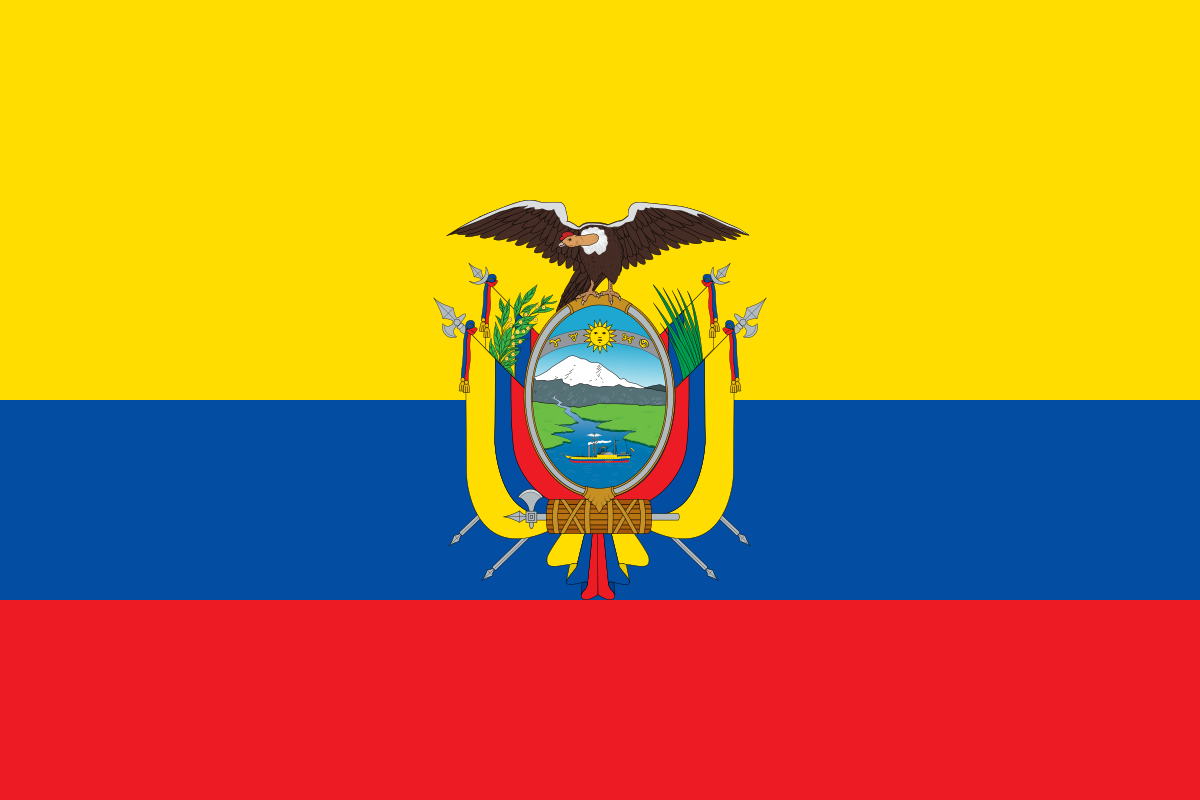
The flag of Ecuador in a 3:2 width-to-height format: a half-height yellow band above quarter-height blue and red bands, with the national coat of arms centered over yellow and blue.
GKBook composition, CC0; underlying Ecuador reference artwork, public domain / CC0.Download image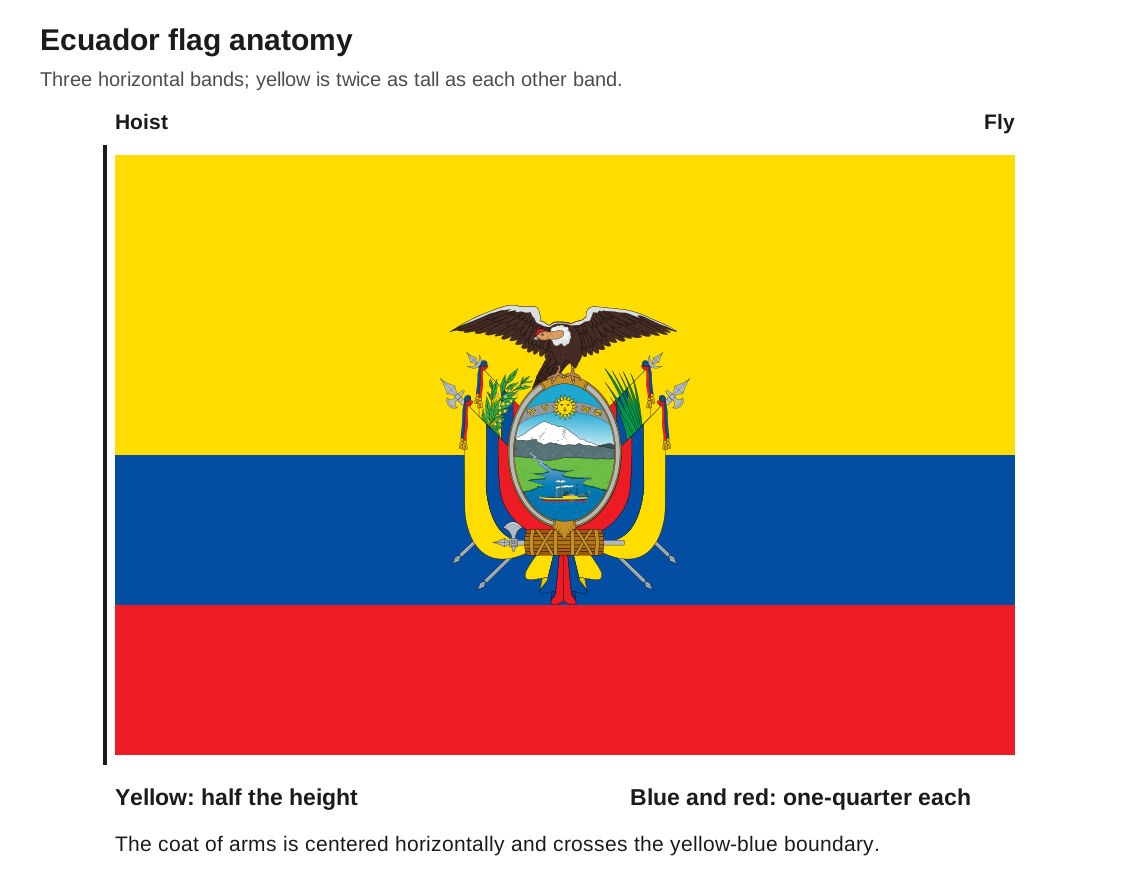
A labeled front view identifies the hoist and fly. Yellow occupies the upper half; blue and red each occupy one-quarter of the height. The coat of arms spans the yellow and blue bands.
GKBook composition, CC0; underlying Ecuador reference artwork, public domain / CC0.Download image
A 12-by-8 grid gives bands of 4, 2, and 2 units. The dashed box indicates the supplied emblem’s half-height placement. At 120 by 80 centimeters, the bands are 40, 20, and 20 centimeters high.
GKBook composition, CC0; underlying Ecuador reference artwork, public domain / CC0.Download image
The enlarged coat of arms shows the Andean condor, sun and four zodiac signs, Chimborazo, a river and steamship, a caduceus, laurel and palm branches, four national flags, and consular fasces.
GKBook composition, CC0; underlying Ecuador reference artwork, public domain / CC0.Download image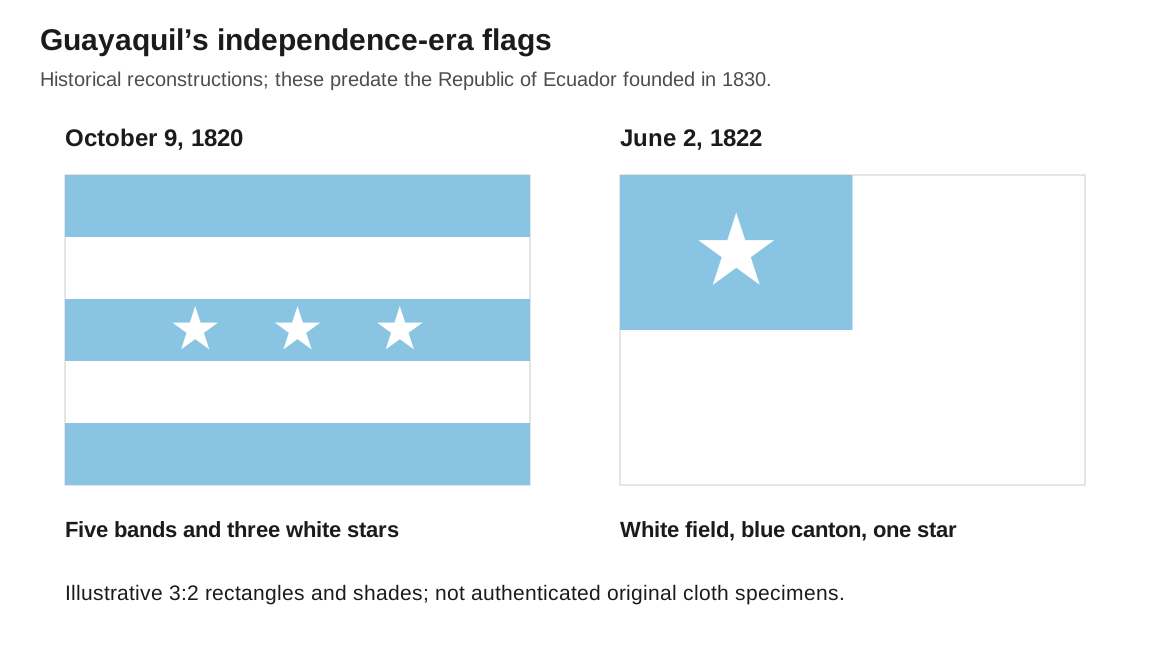
Two reconstructions show Guayaquil’s blue-and-white independence-era flags: five horizontal bands with three stars in 1820, and a white field with a blue upper-hoist canton and one star in 1822. Proportions and shades are illustrative.
GKBook historical reconstruction, CC0.Download image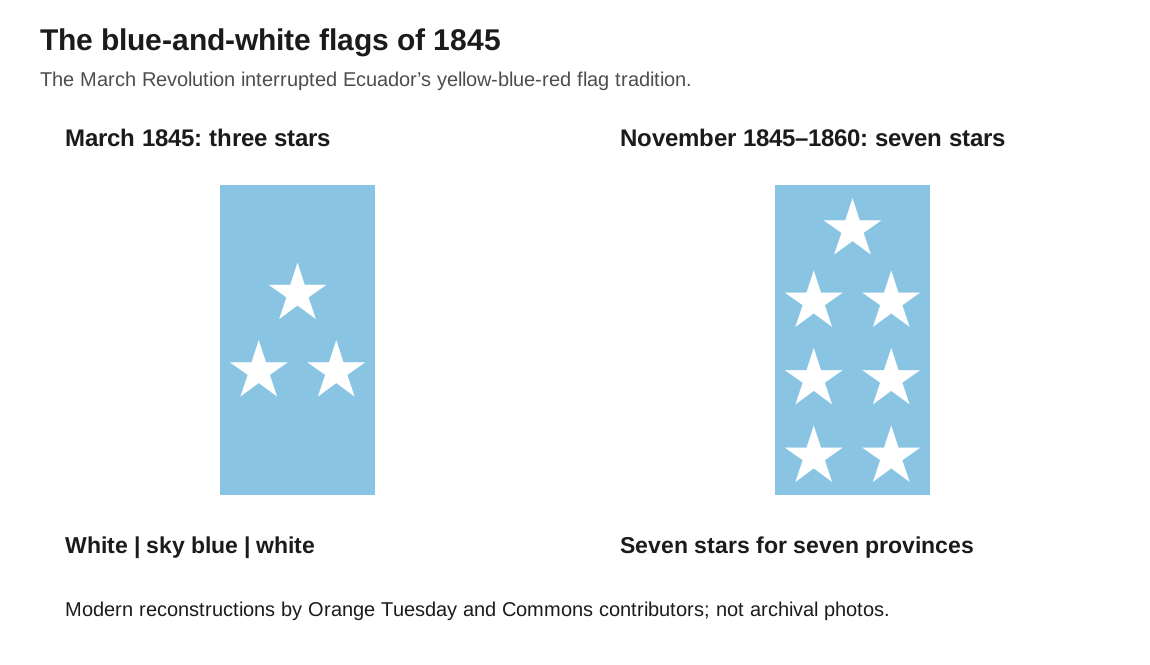
The early 1845 flag has three white stars on the central blue band. The later 1845–1860 version has seven stars, representing the seven provinces of that period. Both are modern historical reconstructions.
GKBook layout, CC0; reconstructions by Orange Tuesday and Commons contributors, public domain.Download image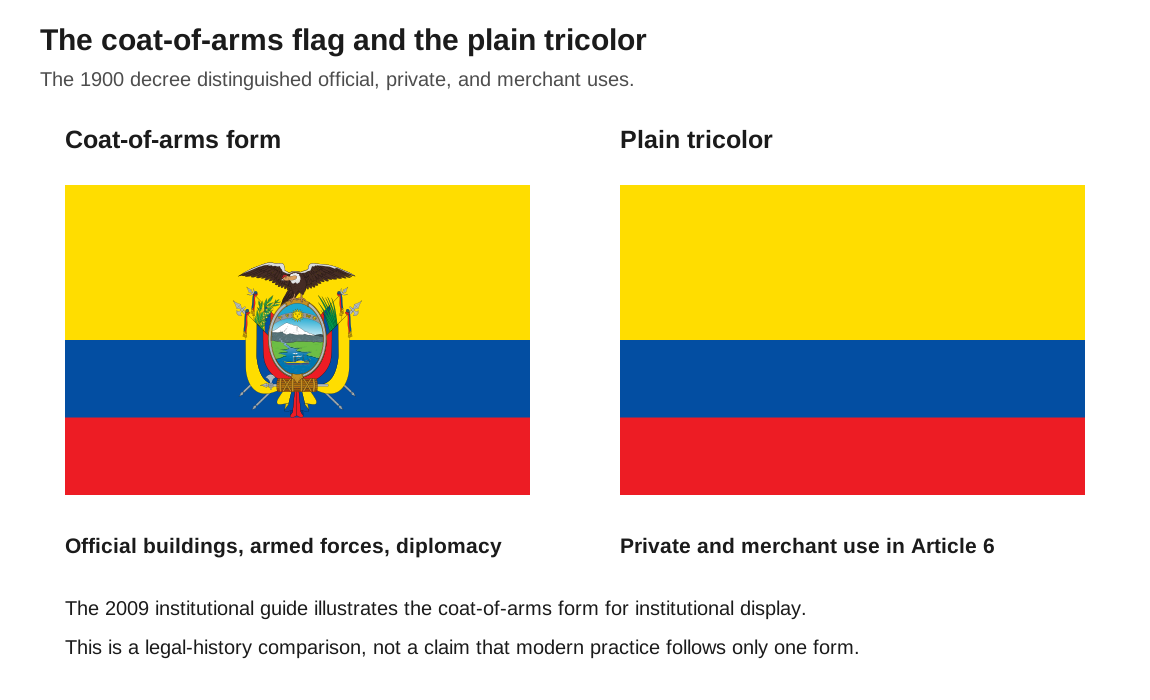
The coat-of-arms form is compared with the plain yellow-blue-red tricolor described for merchant ships and private people in Article 6 of the 1900 decree. Modern institutional guidance illustrates the emblem-bearing flag.
GKBook composition, CC0; underlying Ecuador reference artwork, public domain / CC0.Download image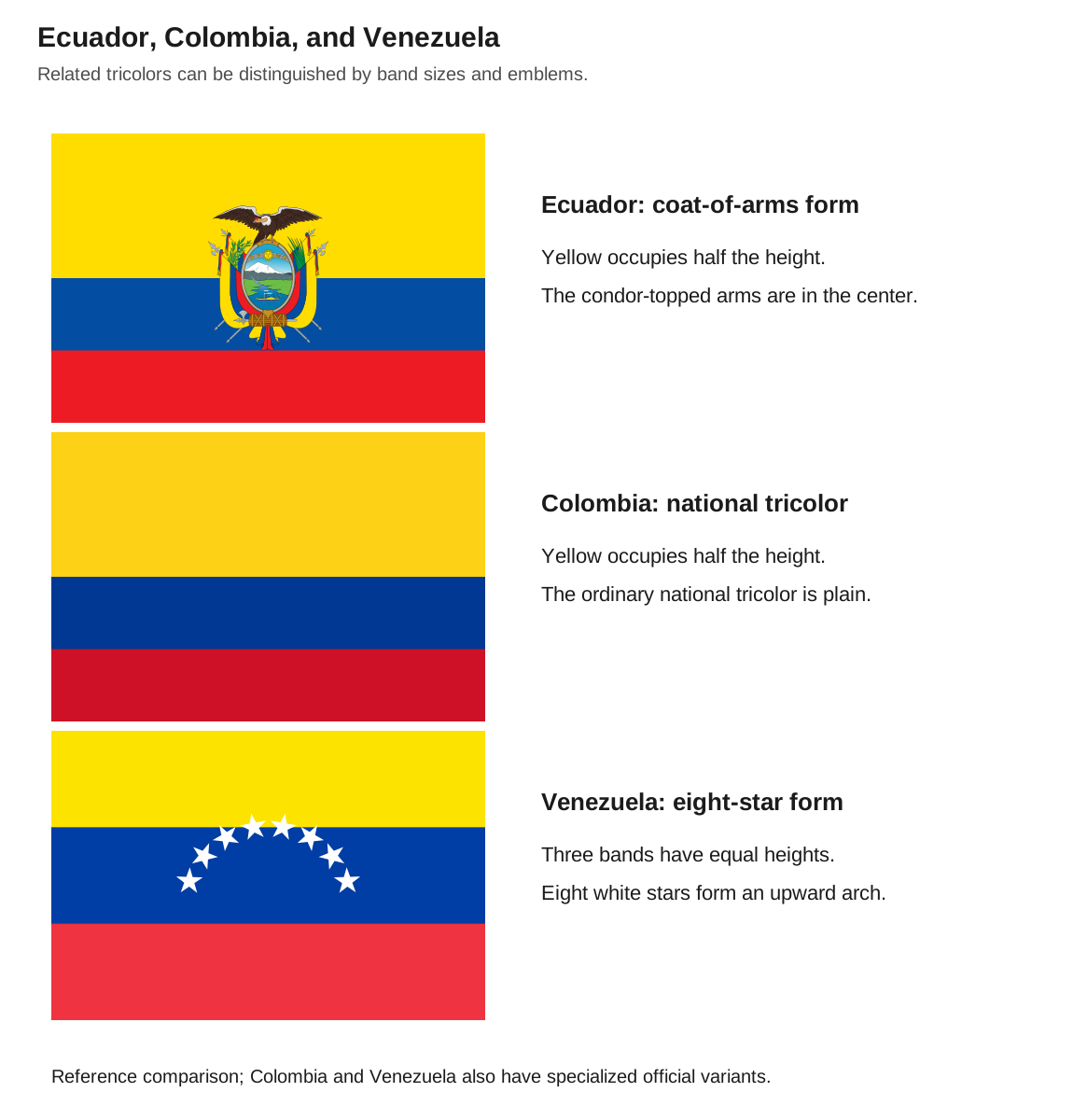
Ecuador’s coat-of-arms form and Colombia’s plain national flag both have a half-height yellow band. Venezuela’s eight-star form has three equal bands. Specialized official variants require their own identification.
GKBook composition, CC0; underlying Ecuador reference artwork, public domain / CC0.Download image
For an Ecuador-hosted official display, the 2024 manual puts Ecuador at the audience’s left in a pair and in the center of a three-flag arrangement. Gray rectangles stand for other flags.
GKBook composition, CC0; underlying Ecuador reference artwork, public domain / CC0.Download image
A schematic half-staff display illustrates mourning. The applicable official order defines its duration and scope; the drawing does not establish a current national observance or a precise halyard measurement.
GKBook composition, CC0; underlying Ecuador reference artwork, public domain / CC0.Download image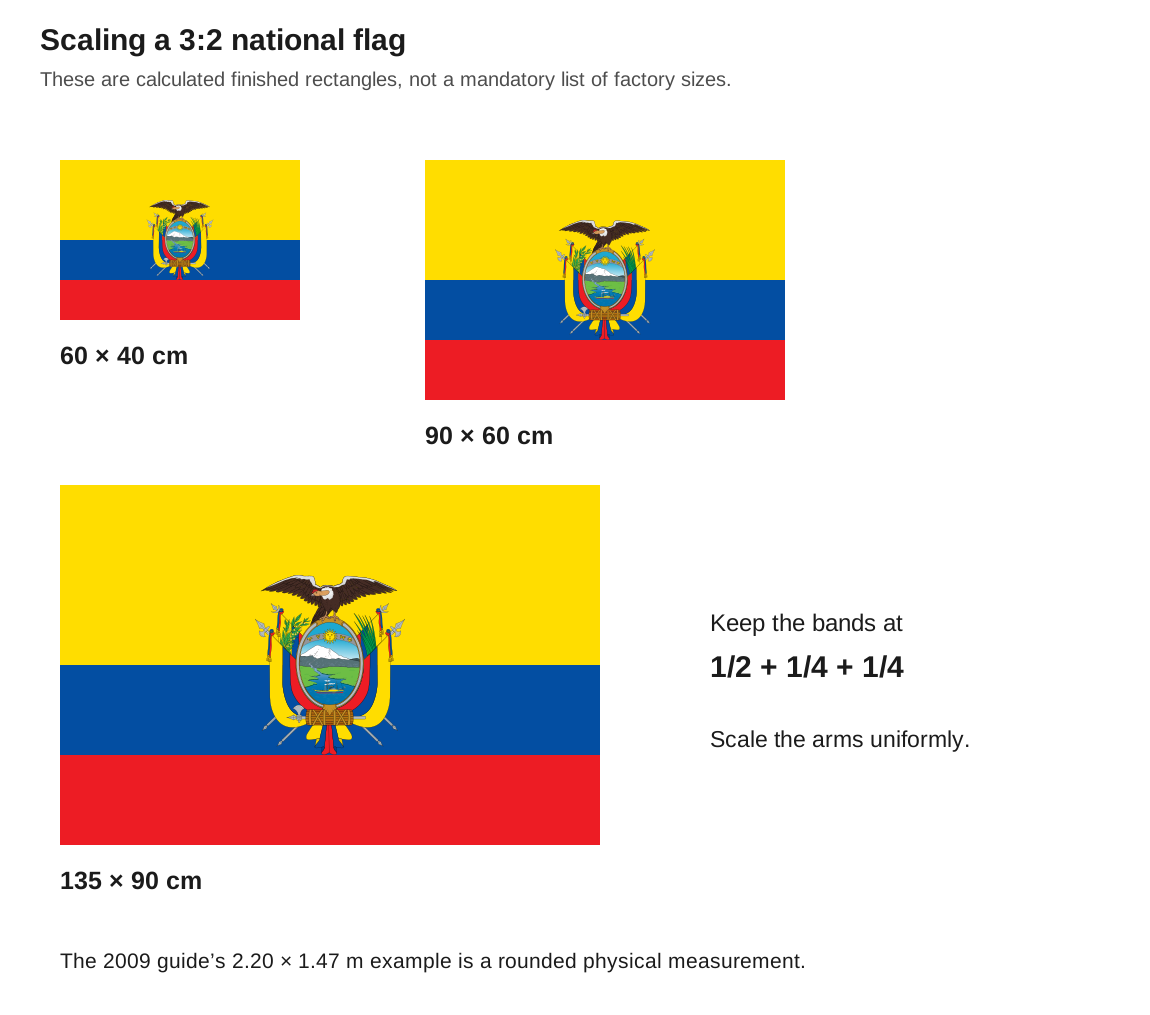
Three calculated 3:2 sizes—60 by 40, 90 by 60, and 135 by 90 centimeters—illustrate uniform scaling. They are examples, not a national schedule of compulsory manufacturing sizes.
GKBook composition, CC0; underlying Ecuador reference artwork, public domain / CC0.Download image
Ecuador’s flag beside the Inter-American Defense College flag at Fort Lesley J. McNair, Washington, D.C., on May 22, 2026.
U.S. Air Force photo by Tech. Sgt. Mozer O. Da Cunha; public domain. Full-frame WebP conversion and resizing.Download image
A U.S. Army color guard carries Ecuador’s flag at Arlington National Cemetery in Virginia on December 19, 2022, during President Guillermo Lasso’s visit.
U.S. Army photo by Elizabeth Fraser, Arlington National Cemetery; public domain. Full-frame WebP conversion and resizing.Download imageThe appearance of U.S. Department of War (DoW) visual information does not imply or constitute DoW endorsement.
Frequently asked questions
What does the Ecuador flag look like?
Ecuador’s flag has three horizontal bands: yellow at the top, blue in the middle, and red at the bottom. Yellow occupies half the height, while blue and red each occupy one-quarter. The familiar institutional form carries the national coat of arms in the center, across yellow and blue.
What are the proportions of Ecuador’s flag?
The 2009 presidential guide specifies a rectangle with a 3:2 width-to-height ratio, also written 2:3 when height is listed first. It gives a physical example of 2.20 by 1.47 meters. Those rounded measurements should not replace the guide’s separately stated exact ratio when drawing a scalable flag.
Why is the yellow band larger?
The legal description gives yellow twice the height of each other band. It therefore fills half the flag, with blue and red dividing the remainder equally. Official explanations connect yellow with the country’s abundance and fertile land, but that symbolism does not establish a separate numerical formula for its size.
What does yellow represent on the flag?
Government explanations associate yellow with the abundance and fertility of Ecuador’s land. Some official descriptions also emphasize mineral wealth. Yellow is the uppermost and largest band. Its meaning belongs to the national symbolism; it should not be reduced to an unsupported claim about one crop or one particular mineral deposit.
What does the blue band mean?
Blue represents Ecuador’s sky and sea in the government’s explanation of the tricolor. It forms the middle band, taking one-quarter of the total flag height. The coat of arms extends over part of it, while the underlying blue band continues across the full width of the national design.
What does red symbolize?
Red recalls the blood and sacrifice of the heroes of independence. It forms the bottom quarter of the flag. This established civic interpretation should be distinguished from an attempt to assign the color to a modern political party, a current administration, or a numerical count of historical casualties.
What bird is on Ecuador’s flag?
The bird above the shield is an Andean condor, shown with spread wings. It forms part of Ecuador’s national coat of arms. Official explanations associate the condor with energy and effort, while the legal description establishes its place above the oval. It should not be identified as an eagle.
What mountain appears in the coat of arms?
The snowy mountain is Chimborazo. The emblem combines it with a river landscape and a steamship to bring together national geographic and economic symbols. This is a heraldic composition, so the picture should not be treated as a literal topographic map or a precise diagram of the Guayas river system.
What does the ship on the flag represent?
The steamship is conventionally identified as the Guayas. Its mast takes the form of a caduceus, which the legal description connects with navigation and commerce. The vessel belongs inside the coat of arms; it is not a separate naval badge placed elsewhere on the yellow, blue, and red field.
Why are zodiac signs included in the shield?
Aries, Taurus, Gemini, and Cancer appear beside the sun. They refer to the months of March, April, May, and June associated with important events in Ecuador’s history. Their presence is historical symbolism, not a claim that the flag predicts events or assigns an astrological identity to Ecuadorian citizens.
What do the branches and fasces mean?
Official explanations connect laurel with national glory and palm with peace. The consular fasces beneath the oval express republican dignity and authority. These are parts of the coat of arms, together with the condor, flags, landscape, and ship; each should be read within the historical emblem rather than in isolation.
Where should the coat of arms be placed?
The arms are centered horizontally and extend over the yellow and blue bands. The 2009 guide shows them on both sides of the flag and illustrates a half-height emblem. Preserve the complete drawing when scaling it; moving the shield into the red band or stretching it changes the composition.
What are the flag’s HEX color codes?
The supplied reference SVG uses yellow #FFDD00, blue #034EA2, and red #ED1C24 for its three bands. The coat of arms contains additional colors and gradients. These codes describe this digital artwork; they are not presented as a legally mandated national Pantone, ink, or fabric-dye specification.
When was Ecuador’s present tricolor adopted?
Gabriel García Moreno restored the yellow-blue-red tricolor on September 26, 1860, replacing the blue-and-white Marcist flag. The National Convention confirmed the change in 1861. The detailed 1900 decree and the later construction guide belong to subsequent legal and graphic development, rather than a single undifferentiated adoption date.
Why do sources give several dates in 1900?
The decree was adopted by Congress on October 31, 1900, signed for execution by Eloy Alfaro on November 7, and published on December 5. These dates refer to different stages of the same legal measure. They should not be presented as three unrelated redesigns of the national flag.
Who designed Ecuador’s flag?
Its yellow-blue-red heritage is associated with Francisco de Miranda’s early nineteenth-century tricolor. Ecuador’s present national flag developed through later political and legal decisions, including the restoration under García Moreno and the 1900 decree under Alfaro. Crediting Miranda’s influence does not make him the illustrator of every detail of today’s coat of arms.
Did Ecuador once use a blue-and-white flag?
Yes. The March Revolution of 1845 brought a white-blue-white vertical design with three white stars. Later that year, seven stars represented the seven provinces of the period. This Marcist flag remained in use until the tricolor was restored in 1860; modern drawings are reconstructions of those historical designs.
Is an Ecuador flag without the coat of arms always wrong?
No. Article 6 of the 1900 decree assigned the plain tricolor to merchant ships and private people, while other articles specified emblem-bearing official flags. The 2009 institutional guide illustrates the coat-of-arms form. Identifying an actual flag therefore requires attention to its date, setting, and intended use.
What is the municipal flag with white stars?
Article 4 of the 1900 decree described a municipal-use tricolor with a circle of white stars on blue, one for each province, instead of the coat of arms. This historical provision should not be confused with an individual city’s own flag or assumed to describe every modern municipal display.
How is Ecuador’s flag different from Colombia’s?
Both use yellow, blue, and red horizontal bands in a 2:1:1 height arrangement. Ecuador’s familiar institutional flag has its distinctive condor-topped coat of arms in the center, while Colombia’s ordinary national tricolor is plain. Ecuador’s historically specified plain civil form makes context essential when no emblem is visible.
How is Ecuador’s flag different from Venezuela’s?
Venezuela’s eight-star form has three equally high yellow, blue, and red bands and an arch of eight white stars in the blue band. Ecuador gives yellow half the height and commonly displays its coat of arms. The related colors reflect shared history, while band proportions and symbols distinguish the designs.
When is Ecuador’s Flag Day?
Ecuador observes Flag Day on September 26, recalling the restoration of the tricolor in 1860. The national observance was established in 1955. Flag honors and school oath ceremonies are closely associated with it, although the scheduled ceremony at a particular institution may take place on a nearby school day.
What is the Juramento a la Bandera?
It is a civic oath ceremony in which students affirm respect for the national flag and their responsibilities as citizens. It is associated with Flag Day and the recognition of flag-bearers and escorts. Quito’s municipal reporting documents participation by both regular final-year secondary students and adults completing their education.
Where does Ecuador’s flag go beside another flag?
The Foreign Ministry’s 2024 manual places Ecuador’s flag in the position of honor at Ecuador-hosted official events. In a pair, its illustrated arrangement puts Ecuador on the audience’s left; with three flags, Ecuador occupies the center. International organizations use the alphabetical arrangements described for their own settings.
When is the Ecuador flag flown at half-staff?
Half-staff display expresses mourning, with its scope and duration set by the relevant official rules or order. The public ceremonial regulation includes distinct provisions for different deaths and locations. A lowered flag at one institution is therefore not enough to establish that every building in Ecuador must observe national mourning.
What should happen to a worn flag?
Ecuador’s armed forces document solemn flag-retirement ceremonies that include incineration and the respectful collection and custody of ashes. That institutional practice should not be turned into a do-it-yourself disposal instruction for every household. A damaged flag should be removed from display and handled through an appropriate institutional procedure.
Are ceremonial standards the same as ordinary outdoor flags?
The 2009 presidential guide distinguishes the ordinary cloth flag from a velvet ceremonial standard with an embroidered coat of arms on both faces. It describes the latter as kept in a place of honor and carried with an escort for designated ceremonies. Those requirements should not be transferred to every outdoor flag.
Does gold fringe form part of the basic national design?
Gold fringe can appear on ceremonial flags, as documentary photographs show, but it is not one of the three horizontal bands defined in the flag decree. A flat national-flag illustration need not add fringe. Distinguish the flag’s design from the finishing and equipment used for a particular ceremonial object.
Should the coat of arms appear on both sides?
The 2009 presidential guide specifies the national arms on both faces. A cloth photograph can show folds, transparency, or the reverse view, so the apparent orientation alone is insufficient to assess manufacture. For a ceremonial commission, agree the two-sided artwork and embroidery treatment with the responsible institution.
How can I draw the Ecuador flag accurately?
Begin with a 3:2 rectangle, divide its height into four equal units, and assign two units to yellow, one to blue, and one to red. Then place the complete coat of arms centrally across yellow and blue. Scale the supplied SVG uniformly to preserve the emblem’s intricate details.
Explore all general-knowledge topics and the A-to-Z lists.

We Value Your Opinion Comments