
Djibouti flag picture
Explore the construction sheet, the triangle and star, and the historical sequence.

| Country | Republic of DjiboutiA sovereign country in the Horn of Africa. |
|---|---|
| Design | Blue, green, white, and redTwo horizontal bands, a white hoist triangle, and a red star. |
| National adoption | June 27, 1977The date of independence from France. |
| Common proportions | 3:2 width:heightEquivalent to 2:3 height:width; longer formats also occur in references. |
| Distinctive emblem | Five-pointed red starOne point is upright in the ordinary horizontal display. |
| Constitutional basis | Article 2Identifies the flag’s colors and five-pointed red star. |
| Principal observance | June 27 — Independence DayA major occasion for national-flag display. |
| National motto | Unity · Equality · PeaceA separate constitutional motto; it is not printed on the flag. |
The white triangle joins the blue upper band and green lower band at the hoist, with the red star set inside it. The flag became the republic’s national symbol at independence. Its four colors and single star form a recognizable design on cloth and in small illustrations.
What is the flag of Djibouti?
The flag of Djibouti has equal horizontal bands of light blue and green, a white triangle at the hoist, and a red five-pointed star inside the triangle. It became the national flag at independence on June 27, 1977. Its familiar composition connects peace, national unity, and the country’s independence struggle.
Djibouti is the country’s name as well as the name of its capital. The flag shown here represents the republic. Its two bands run horizontally, with blue above green. The triangle is part of the flag’s field, and the star is the only added emblem.
The republic’s constitutional description in Article 2 names the colors and the red five-pointed star. A visual reference is also published by the Djiboutian embassy in Kuwait. Neither a national motto nor the separate coat of arms belongs inside the ordinary flag.
The triangle, star, and horizontal bands
The flag can be understood in two layers. A blue-and-green rectangle forms the background. A white triangle overlays its left side in the normal front view, and the red star lies entirely inside that triangle. The horizontal boundary between blue and green meets the triangle’s point.
The triangle reaches both corners beside the pole. Its white area is not a narrow border, a separate pennant, or a wedge floating within the rectangle. The star has five outer points and a solid fill, without a circular background or an outline.
| Term | Meaning in this flag |
|---|---|
| Hoist | The edge attached to the pole or staff; the triangle’s base lies here. |
| Fly | The free end, where the blue and green bands reach the outer edge. |
| Field | The colored surface of the flag, including the white triangle. |
| Charge | An emblem placed on a field; here, the red star. |
The star’s upright orientation helps identify a correctly prepared horizontal illustration. In a photograph, wind can twist the fabric and tilt the star; that does not by itself indicate a different official design. Inspect the cloth’s attachment and folds before judging its orientation.
Flag colors and digital values
The flag has four colors: light blue, green, white, and red. The values below match the downloadable artwork in this article. They are taken from the actual 900 × 600 SVG reference on Wikimedia Commons, rather than from a color sample in a photograph.
| Color | HEX | RGB | Location |
|---|---|---|---|
| Light blue | #6AB2E7 | 106, 178, 231 | Upper band |
| Green | #12AD2B | 18, 173, 43 | Lower band |
| White | #FFFFFF | 255, 255, 255 | Hoist triangle |
| Red | #D7141A | 215, 20, 26 | Five-pointed star |
A hex value describes a digital color. A fabric dye, spot-color ink, and a four-color printed image are different production systems, so a numerical conversion does not guarantee an identical physical result. For a manufactured flag, use the specification or approved sample provided for that order.
Article 2 does not publish RGB, hex, CMYK, or Pantone numbers. Published flag references give differing color approximations, so this article does not combine several tables into a purported universal standard. Consistency within a particular illustration is a useful goal; it is not proof of a legal color tolerance.
What do Djibouti’s flag colors and star symbolize?
Common explanations associate light blue with sea and sky, green with the earth, white with peace, and the red star with unity and the independence struggle. Blue and green also have historical associations with the Issa Somali and Afar communities. These interpretations describe a shared national symbol rather than separate community flags.
The U.S. Air Force Culture and Language Center’s Djibouti guide records this combination of landscape, community, peace, and independence meanings. The legal description and an explanation of symbolism serve different purposes: one identifies the emblem, while the other helps explain its associations.
The red star has five points, but the Constitution does not assign a province or an individual value to each point. Counting administrative divisions and then imposing that number on the flag would require additional historical evidence. The star can be recognized and understood without inventing five separate labels.
Construction and measurements of this rendering
The supplied SVG is 900 units wide and 600 high. Each horizontal band occupies half the height. Its equilateral white triangle has vertices at (0, 0), (0, 600), and approximately (519.615, 300). Coordinates start at the top-left corner, with x increasing rightward and y increasing downward.
For a finished height H, the width is 1.5H, each band is H/2 high, and the triangle reaches approximately 0.866025H into the field. At H = 600, the rectangle’s center is x = 450, but the triangle’s point is near x = 519.615. Moving it to x = 450 would change this construction.
| Flag height | Flag width | Each band’s height | Triangle depth |
|---|---|---|---|
| 20 cm | 30 cm | 10 cm | About 17.321 cm |
| 60 cm | 90 cm | 30 cm | About 51.962 cm |
| 100 cm | 150 cm | 50 cm | About 86.603 cm |
The star’s visible top is at y = 225 and its lowest points at y = 375, giving a height of 150 units, or one-quarter of the flag height. Its vertical axis is at x = 198.86. Those coordinates reproduce this reference; they do not establish a universal rule that the star must be placed at the geometric centroid of every published triangle.
Scale the entire artwork uniformly. Enlarging only the star or stretching the rectangle horizontally changes its relationship to the triangle. Hems, sleeves, stitching, and attachment hardware require separate allowance beyond the visible finished design.
Why do different Djibouti flag proportions appear?
The common flag is listed as 2:3 height:width, equivalent to 3:2 width:height, but longer proportions also appear in specialist references. The Constitution does not settle the numerical ratio. This article uses one clearly identified 3:2 rendering throughout and shows the longer 21:38 height:width convention separately for comparison.
Flags of the World records both ratios and disagreements about triangle geometry. One contributor cites a French naval-authority sketch dated July 22, 1977 for 2:3. That reported evidence supports the common rendering, but the original letter was not independently inspected here.
A catalog’s ratio, a ceremonial cloth seen in a photograph, and a constitution’s brief description need not provide the same kind of information. State the convention being used, preserve it consistently, and obtain the required master drawing when preparing a formal production order.
History: independence and constitutional recognition
The flag’s national adoption belongs to the end of French rule in 1977. The independence referendum, the French law enabling independence, the actual transfer of sovereignty, and admission to the United Nations are related events with different dates. Keeping them separate avoids turning every constitutional milestone into a new flag.
French administration
The territory was known as French Somaliland and later as the French Territory of the Afars and the Issas. This is the colonial background to independence, not an earlier adoption of the republic’s national flag.
Independence referendum
A referendum preceded the creation of the independent republic. Keep this voting date separate from June 27, the date of independence and national-flag adoption.
French independence law
Law No. 77-625 provided that the territory would cease to be part of the French Republic and become independent on June 27.
The national flag at independence
The blue, green, white, and red-star flag became the flag of the Republic of Djibouti. June 27 remains the central independence anniversary.
United Nations membership
Djibouti joined the United Nations. Admission to the organization is a separate milestone from independence and does not supply a new flag-adoption date.
Constitutional recognition
Article 2 of the Constitution identifies the flag by its colors and five-pointed red star. This later constitutional statement did not originate the 1977 national flag.
A law defining the republic’s seal
Law No. 91/AN/00/4ème L defined the separate seal. Its date should not be mistaken for a redesign or readoption of the national flag.
Article 1 of French Law No. 77-625 directly establishes June 27, 1977 as the effective independence date. The United Nations membership list separately records September 20, 1977 as Djibouti’s admission date.
Accounts of the flag’s earlier movement origins are less uniform than the independence date. This article does not reconstruct an unverified party banner, reuse an imagined medieval flag, or treat a modern national illustration as a photograph of the first raising. A dated documentary image and a modern explanatory drawing answer different historical questions.
Who designed the Djibouti flag?
The design is attributed to Mahamoud Harbi in a specialist flag reference, but a primary design commission or signed master drawing was not verified here. That attribution should be presented with its qualification. The flag’s designer, the political figures associated with independence, and the person who raised it are distinct historical roles.
The attribution appears in a Flags of the World contribution citing an older Djiboutian website. Article 2 itself does not name a designer. A secure adoption date can therefore coexist with a more cautiously documented authorship account.
The national flag and the republic’s seal
Djibouti’s seal is a separate symbol: a laurel wreath surrounds a shield and spear topped by a five-pointed star, with a hand holding a traditional dagger on either side. None of that surrounding composition is added to the ordinary national flag.
The presidency’s published text of Law No. 91/AN/00/4ème L, dated July 10, 2000, defines the seal and explains its elements. The laurel refers to peace following independence; the shield, spear, and star concern defense of sovereignty and territory; the daggers refer to cultural traditions and solidarity.
The law also reserves use of the seal to specified institutions, with provision for presidential authorization of diplomatic use. Those seal provisions should not be transferred automatically to a household national flag. The symbols share a star and a national identity, but their graphic forms and legal treatment are not interchangeable.
Making and reproducing the flag
A clear reproduction preserves the four colors, the equal-height bands, the full-hoist triangle, and the upright red star. A printed flag and a flag assembled from separate pieces can depict the same design. The finished appearance is the reference point, while the production method determines cutting, printing, and seam allowances.
| Production stage | Practical check |
|---|---|
| Artwork | Use one complete reference; avoid mixing a star from one diagram with a triangle from another. |
| Scaling | Keep width, height, triangle, and star in the same scale relationship. |
| Color proof | Compare the intended ink or cloth against the approved sample for the order. |
| Assembly | Allow for seams and attachments without consuming the visible star or triangle. |
| Final inspection | Lay the flag flat to check proportions before judging it while folded or flying. |
This article does not establish a required fabric, fabric weight, factory, stitch count, or national size catalog. Those details belong in the relevant procurement or maker’s instructions. A small classroom print and an outdoor flag also have different practical needs, even when their drawing is identical.
Check the reverse as well as the front. A single layer naturally shows a reversed arrangement when seen through the cloth; an additional printed layer must be aligned deliberately. Keep attribution and licensing information with any reused photograph rather than treating all media in a flag article as interchangeable artwork.
Displaying the flag respectfully
For a formal occasion, start with the host institution’s instructions: the approved flag, its position, the time of raising and lowering, and any ceremonial directions. The short constitutional description is not a complete display manual. The practical points below support careful handling without claiming a universal Djiboutian flag code.
Useful checks
- Identify the hoist before attaching the flag.
- Keep the cloth clear of the ground and obstructions.
- Check that the star, triangle, and bands remain recognizable.
- Use sound attachments and follow the venue’s arrangements.
Details to confirm with the host
- Order and spacing in a display with other flags.
- Indoor, outdoor, or nighttime arrangements.
- Vertical hanging and any approved special artwork.
- Mourning instructions and the period they cover.
These handling recommendations do not create a legal ban on a particular hour, a mandatory pole height, or an obligation for every private building to fly a flag. Such claims need the actual applicable instrument. A flag on a vessel or at a military ceremony may also be subject to instructions specific to that setting.
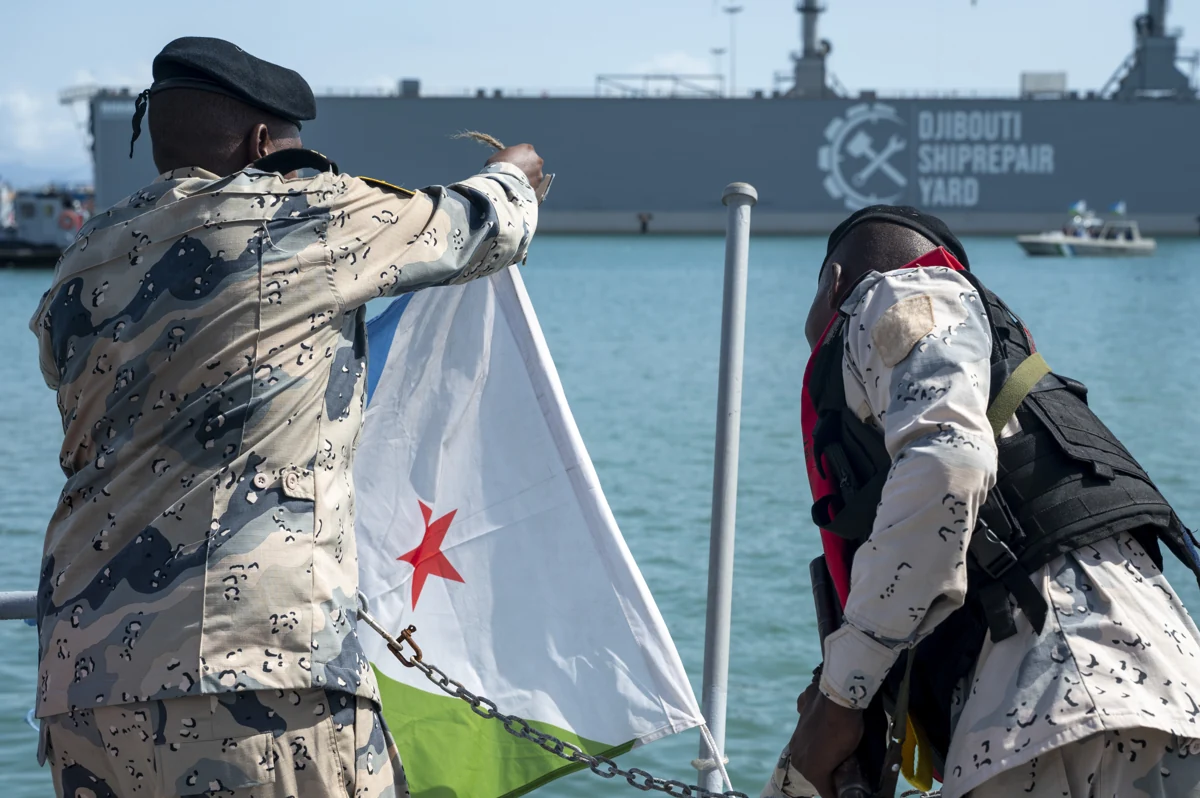
The photograph records a particular flag-handling scene during Exercise Bull Shark. It is evidence of use in that setting, not a measured demonstration of a countrywide hoisting sequence. Folds and motion can obscure the design, which is why the flat illustration remains useful alongside the photograph.
Front, reverse, and vertical presentation
In the front view used throughout this page, the pole is at the left, the white triangle lies along that edge, and blue is above green. From the opposite side of the same flag, the pole and triangle appear on the right. The star remains upright because a horizontal reflection does not turn its upper point downward.
Vertical display needs a separate orientation decision. Rotating the entire ordinary flag clockwise rotates the star as well, while keeping the star upright would require altered artwork. Obtain the layout approved for the particular event; do not describe either operation as a national legal rule on the strength of a general flag illustration.
For digital use, preserve the full rectangle and its aspect ratio. A circular avatar, narrow banner crop, or waving effect can hide the triangle or remove a star point. Such decorative treatments should not replace a complete flag illustration where exact identification matters.
When is Djibouti’s Flag Day?
June 27, Independence Day, is the main national occasion discussed here for flying Djibouti’s flag. It commemorates independence in 1977 and is marked by official and public celebration. A separate nationwide statutory holiday formally called Flag Day was not verified, so the observance is identified by its established Independence Day name.
In its June 27, 2024 account of the national address, the presidency connected the flag with shared national belonging. The June 27, 2026 national-day message again treated the anniversary as an occasion for unity and recognition of contributions to the country.
A school display can connect the flag with a simple chronological explanation: a referendum in May, independence on June 27, and United Nations admission in September. This keeps a flag celebration attached to its historical context without inventing a second adoption date.
When does Djibouti fly its flag at half-staff?
Djibouti has lowered its national flag under official mourning orders. A decree dated June 11, 2000 ordered half-staff display after the death of Syrian President Hafez El-Assad. For a present occasion, follow the relevant order’s dates, scope, and instructions rather than treating one historical mourning period as a permanent rule.
Decree No. 2000-0154/PRE specified a period from June 11 through June 14, 2000, ending at midnight. It provides a concrete example of flag-lowering ordered as an expression of mourning and solidarity.
“Half-staff” and “half-mast” are both used in English for a lowered mourning display. In this article they describe the same general idea. The exact arrangement at a particular building, vessel, or ceremony should come from the responsible organizer rather than a measurement guessed from a photograph.
The flag in Djiboutian public life
The flag’s colors appear beyond formal flagpoles. In its June 29, 2026 report on the independence celebrations, La Nation described decorated streets, homes, shops, public buildings, and vehicles. It also reported demand for clothing and accessories using national colors.
These uses can express participation in a common celebration. A full flag, a string of bunting, and clothing inspired by blue, green, white, and red remain different objects. Identifying them accurately helps preserve the distinction between the national design and a decorative arrangement based on its palette.
The flag also has an international identifying role. Beside a delegation, in a sporting display, or among national flags at a meeting, its color arrangement distinguishes Djibouti. A star alone is less specific because stars appear on many flags; the surrounding triangle and two bands make this design recognizable.
How is Djibouti’s flag different from Somalia’s?
Djibouti’s flag has blue and green horizontal bands, a white triangle at the hoist, and a red star inside that triangle. Somalia’s flag has a plain light-blue field with a white star in the center. The star color, triangle, and green band provide clearer distinctions than comparing blue shades alone.
Somalia’s presidency describes its flag as a light-blue rectangle with a central white five-pointed star. The shared star shape does not make the two flags interchangeable, nor does it mean their national histories or adoption dates are the same.
When identifying a small image, look for the white triangle first. In Djibouti’s flag it provides a large bright shape beside the pole, with the red star set inside it. If the image contains only a white star on an uninterrupted blue field, it matches Somalia’s basic design instead.
Care, storage, and historical flags
For an ordinary modern flag, follow the maker’s cleaning directions and check the fly edge, seams, and attachments for wear. Store it clean and dry, with no unnecessary strain on damaged fabric. These are general care recommendations; they are not presented as a national legal washing or retirement procedure.
A flag with documented historical use may deserve preservation even when it is no longer suitable for flying. Keep information about its date, owner, event, materials, and repairs with the object. Seek textile-conservation advice before cleaning fragile cloth, removing attachments, or making repairs that could destroy evidence of its history.
No required disposal ceremony is established here. Treat an ordinary worn flag according to the material and local arrangements, and distinguish it from a historically significant object. A modern reproduction should likewise retain its own identity rather than acquiring an unsupported claim that it was used at independence.
Flag pictures and downloadable artwork
The gallery below contains the actual flag illustration, construction and comparison diagrams, and two documentary photographs used in this article. Each image has its own caption, dimensions, source information, and download link. The SVG diagrams can be scaled without turning their lines and edges into a low-resolution bitmap.
The sea-side photograph was made on May 4, 2017. The flag-handling photograph records a scene from May 5, 2024. They are contemporary documentary views, not images of the 1977 adoption ceremony. The full frames are retained in the downloadable WebP versions, with smaller copies supplied for responsive display.
The new explanatory diagram work carries a CC0 dedication. The sea-side photograph remains under CC BY-SA 4.0, with its creator credited; the U.S. National Guard image is identified as public domain in the United States. Keep the indicated credit, source, license, and change notice with any reuse that requires them.
Djibouti flag pictures

Light blue above green, with a white hoist triangle and a red five-pointed star. This illustration uses width:height 3:2.
GKBook explanatory vector using the public-domain Commons flag geometry; new diagram artwork dedicated to CC0. Source. CC0 1.0.Download image
The blue upper band and green lower band have equal height. A white triangle overlays the hoist, carrying a solid red star.
GKBook explanatory vector using the public-domain Commons flag geometry; new diagram artwork dedicated to CC0. Source. CC0 1.0.Download image
The red star has five points and no border. In the supplied 900 × 600 reference artwork its visible height is 150 units; this is an illustration measurement.
GKBook explanatory vector using the public-domain Commons flag geometry; new diagram artwork dedicated to CC0. Source. CC0 1.0.Download image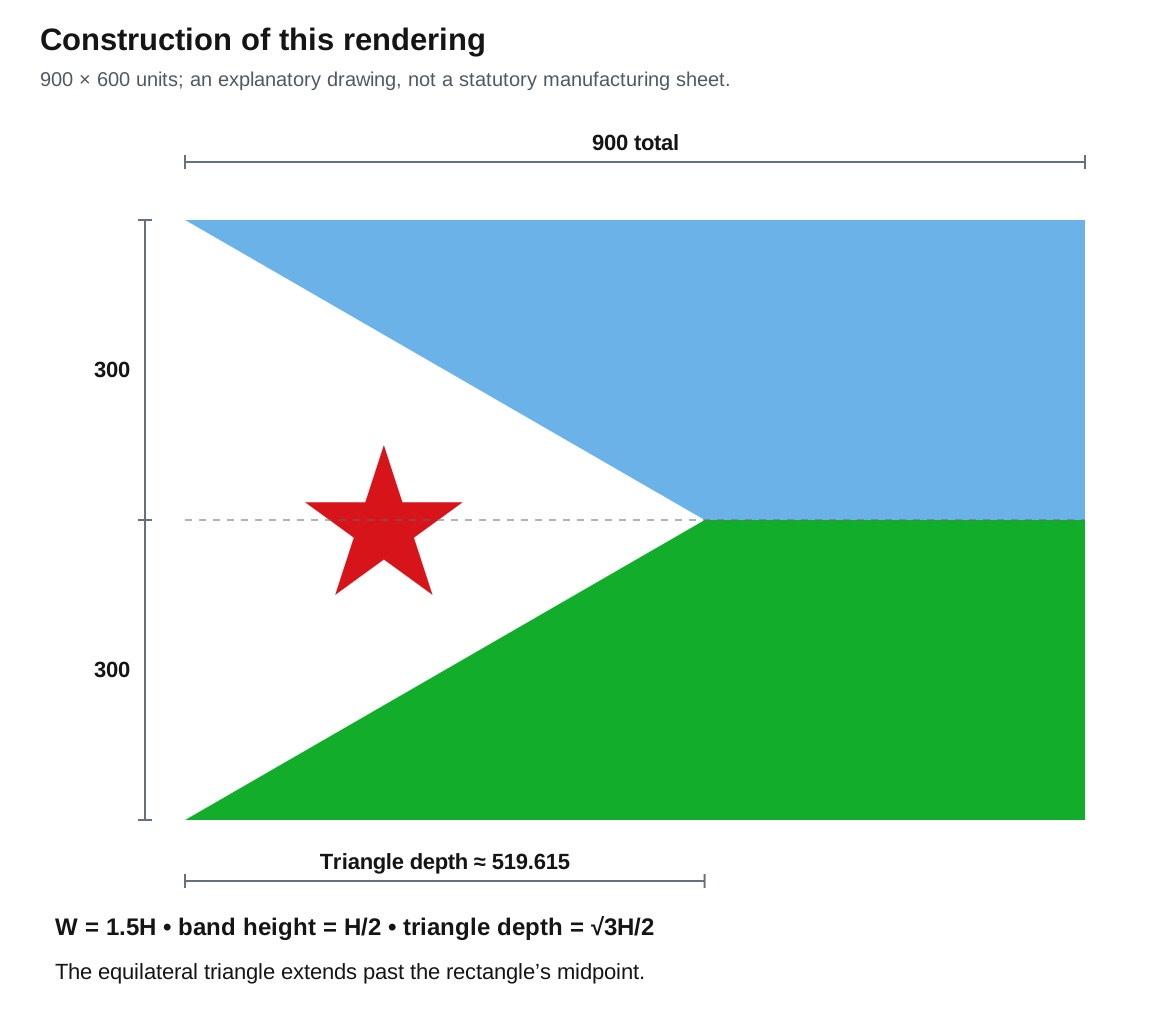
The downloadable reference has a 900 by 600 rectangle, bands 300 units high, and an equilateral hoist triangle extending about 519.615 units into the field.
GKBook explanatory vector using the public-domain Commons flag geometry; new diagram artwork dedicated to CC0. Source. CC0 1.0.Download image
At equal height, the commonly used 3:2 rectangle is shorter than a 38:21 rectangle also recorded in flag literature. Internal artwork is held fixed for this comparison.
GKBook explanatory vector using the public-domain Commons flag geometry; new diagram artwork dedicated to CC0. Source. CC0 1.0.Download image
Seen from opposite sides of the same horizontally flown flag, the white triangle appears at the left or the right because it remains beside the pole.
GKBook explanatory vector using the public-domain Commons flag geometry; new diagram artwork dedicated to CC0. Source. CC0 1.0.Download image
A normal raised position and a lowered mourning position are shown on matching poles. The drawing does not prescribe a legal distance or operating sequence.
GKBook explanatory vector using the public-domain Commons flag geometry; new diagram artwork dedicated to CC0. Source. CC0 1.0.Download image
Djibouti has blue and green bands, a white hoist triangle, and a red star. Somalia has a single light-blue field with a centered white star.
GKBook explanatory vector using the public-domain Commons flag geometry; new diagram artwork dedicated to CC0. Source. CC0 1.0.Download image
Djibouti’s flag flying beside the sea, photographed on May 4, 2017.
Skilla1st, CC BY-SA 4.0; full-frame WebP conversion and responsive resizing. Source. CC BY-SA 4.0.Download image
Uniformed personnel handling Djibouti’s flag during Exercise Bull Shark in Djibouti, May 5, 2024.
Sgt. Lark Sine / U.S. National Guard, via DVIDS and Wikimedia Commons; public domain in the United States. Full-frame WebP conversion and resizing. Source. Public domain in the United States.Download imageFrequently asked questions
What does the Djibouti flag look like?
Djibouti’s flag has a light-blue upper band and a green lower band, with a white triangle along the hoist. A red five-pointed star sits inside the triangle. In an ordinary horizontal view, the star has one point upward and the triangle points toward the free end.
When was the Djibouti flag adopted?
The national flag was adopted on June 27, 1977, when Djibouti became independent from France. That date marks its use as the flag of the sovereign republic. Earlier independence-movement associations should be distinguished from national adoption, and the independence referendum took place earlier, on May 8.
What do the colors of Djibouti’s flag mean?
Common interpretations connect blue with the sea and sky, green with the earth, and white with peace. The red star expresses unity and remembrance of the independence struggle. Blue and green also carry historical associations with the Issa Somali and Afar communities within the country.
What does the red star represent?
The red star is commonly understood as a symbol of national unity and the struggle for independence. It has five outer points, with one point upright in the usual horizontal flag. The Constitution names the five-pointed red star without assigning a separate meaning to every point.
Does each star point represent a region of Djibouti?
The constitutional description does not assign individual star points to administrative regions. A five-pointed star should not automatically be read as a map or a list of provinces. Regional and historical interpretations need their own evidence; the principal explanation used here is unity and the independence struggle.
Why is there a white triangle on the flag?
The white triangle provides the setting for the red star and is commonly associated with peace. Its base runs along the hoist, so it touches the upper and lower corners beside the pole. Its point reaches into the blue and green field toward the fly.
Is Djibouti’s flag ratio 2:3 or 3:2?
Those numbers describe the same common rectangle when their order is stated. A height-to-width ratio of 2:3 equals a width-to-height ratio of 3:2. This article uses width first. Some specialist references also record longer formats, so a ratio should always be read with its stated convention.
Is the white triangle equilateral?
The downloadable flag here uses an equilateral white triangle. Official and specialist illustrations are not fully consistent, and Article 2 of the Constitution does not supply triangle measurements. An equilateral triangle is therefore a disclosed choice for this rendering, not a universal legal requirement established by that article.
What are the Djibouti flag’s hex colors?
The supplied artwork uses blue #6AB2E7, green #12AD2B, white #FFFFFF, and red #D7141A. These values reproduce the selected digital reference. They are useful for matching these downloads, but they should not be treated as a statutory textile standard or an authoritative Pantone conversion for every manufacturer.
Who designed the Djibouti flag?
A specialist flag reference attributes the design to Mahamoud Harbi, but the primary design commission or signed construction document was not verified for this article. The attribution is therefore qualified. Designing a flag, promoting an independence movement, and raising a flag at independence are different historical roles.
What does Article 2 of the Constitution say about the flag?
Article 2 identifies the republic’s emblem as a flag in blue, green, and white bearing a red five-pointed star. It establishes those identifying elements without publishing a detailed construction grid, numerical color codes, or a list of meanings for each individual part of the design.
Is the national coat of arms printed on the flag?
The ordinary national flag carries only the red star inside its white triangle; it does not include the coat of arms. Djibouti’s seal uses a separate arrangement involving a shield, spear, star, laurel branches, and hands holding traditional daggers. The seal and the flag should not be combined.
When is Djibouti’s Flag Day?
June 27, Independence Day, is the principal national occasion discussed here for displaying Djibouti’s flag. Official celebrations connect the date with sovereignty and national unity. A separate nationwide statutory observance formally named Flag Day was not verified, so June 27 is identified accurately as Independence Day.
Can people display the Djibouti flag at home?
Photographic reporting of Independence Day describes national flags and colors on homes, shops, vehicles, and public buildings. This establishes ordinary public use in that setting. For a particular installation or formal ceremony, follow the organizer’s directions and applicable local requirements rather than assuming the same arrangements apply everywhere.
When is Djibouti’s flag flown at half-staff?
Djibouti has used official orders to lower the national flag for mourning. One decree dated June 11, 2000 ordered a period of half-staff display after Syrian President Hafez El-Assad died. A current display should follow the relevant order’s dates and scope; that historical decree is not a permanent calendar.
Does half-staff mean the flag must sit exactly halfway down?
The mourning illustration here shows a lowered position schematically, without prescribing a numerical distance. The reviewed Djiboutian decree sets a mourning period but does not provide a pole-height formula. Follow the instructions for the particular institution or ceremony instead of converting an explanatory picture into a binding placement rule.
What does the reverse of the Djibouti flag look like?
When viewed from the other side of a horizontally flown flag, the white triangle appears beside the pole on the viewer’s right. Blue remains above green, and the star remains upright. This is the reverse of the same cloth, not a different national flag with a new design.
How should the Djibouti flag be shown vertically?
First establish the intended attachment and the organizer’s approved artwork. Rotating the ordinary horizontal image also rotates the star and moves the triangle to a different edge. This article does not prescribe a universal Djiboutian vertical-display rule or silently redraw the star to create a supposedly official vertical variant.
How is Djibouti’s flag different from Somalia’s?
Djibouti uses blue and green bands with a white hoist triangle containing a red star. Somalia uses a plain light-blue field with a white star at its center. Looking at the star’s color and the surrounding field distinguishes the two flags without relying on subtle differences in blue shades.
Does the flag contain a crescent or any writing?
The ordinary Djibouti flag contains neither a crescent nor lettering. Its only emblem is the red five-pointed star within the white triangle. The national motto is a separate constitutional expression. Adding a motto, seal, or religious inscription would create an altered graphic rather than reproduce the plain national flag.
Can the flag be made in different physical sizes?
The supplied drawing can be scaled uniformly to any practical size while preserving its proportions. For this 3:2 rendering, a flag 60 centimeters high is 90 centimeters wide. Finished visible dimensions should be distinguished from cutting dimensions, which also depend on seams, hems, and the chosen attachment method.
Are the colors sampled from photographs?
The downloadable vectors use explicit color values from the selected SVG reference, not colors sampled from the photographs. Light, shadows, folds, camera processing, and image compression can change the appearance of cloth. The documentary images show flags in use; they are not manufacturing color-control samples.
Can I download the flag and its construction diagram?
Yes. The picture gallery links to the actual local SVG diagrams and WebP photographs used in this article. SVG files remain sharp when scaled. Check the credit and license shown with each image, because the original diagrams and documentary photographs do not all have the same reuse terms.
How should a worn or historic flag be cared for?
Follow the maker’s care instructions for an ordinary modern flag, check seams and attachments, and store the cloth clean and dry. A historic flag may need textile-conservation advice before cleaning or repair. No countrywide mandatory washing method, fabric requirement, or flag-disposal ceremony is established by this article.
Explore all general-knowledge topics and the A-to-Z lists.



We Value Your Opinion Comments