
Denmark flag picture
Explore the construction sheet, the white cross, and the historical sequence.
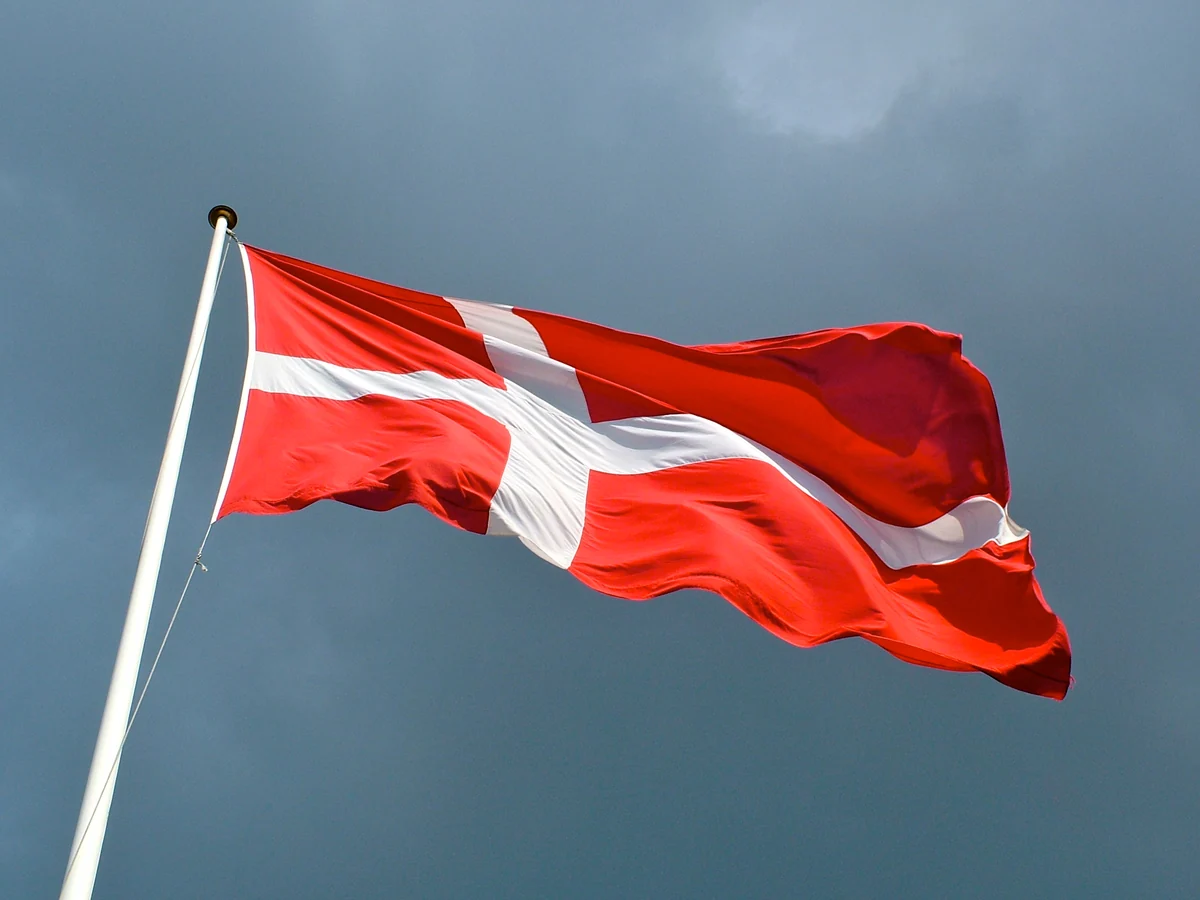
| Country | DenmarkThe ordinary national flag is called Dannebrog. |
|---|---|
| Documented history | Late fourteenth centuryThe 1219 origin belongs to legend, not a verified adoption record. |
| Current flag law | January 1, 2025Act No. 1449 of December 10, 2024 took effect on this date. |
| Designer | No single known designerA medieval cross-banner tradition developed over centuries. |
| Proportions | 37 : 28 — width:heightCommon modern rectangular form; 28:37 when height is written first. |
| Colors | Red and whiteThe ordinary flag has no coat of arms or lettering. |
| Flag observance | June 15 — ValdemarsdagAlso Reunification Day; September 5 honors deployed personnel. |
| Principal forms | Stutflag and splitflagRectangular ordinary flag; restricted swallow-tailed flag. |
Dannebrog brings a red field and white cross into an offset design. The cross reaches the edges; the upright arm leaves shorter red panels beside the hoist and longer ones toward the fly. Its medieval roots and modern everyday use tell different parts of the same flag’s history.
What is the flag of Denmark?
The flag of Denmark is Dannebrog, a red flag with a white Nordic cross extending to its edges. The upright arm sits closer to the hoist than the fly. The familiar rectangular flag is called the stutflag; the swallow-tailed splitflag belongs to restricted official and specially authorized uses.
Dannebrog connects medieval royal history with a much broader modern life. It can mark a state occasion, a birthday, a sporting celebration, or a moment of mourning. Those uses share a recognizable design, but they do not all follow the same institutional rules.
The name is often translated as Danish cloth or the banner of the Danes. Its etymology is debated, so an English gloss should be understood as an explanation rather than a literal official name. The Nordic cooperation flag reference identifies the modern pattern and numerical color guidance.
The white cross and its placement
The cross is the flag’s central identifying feature. It is formed by one horizontal and one vertical white band of equal thickness, meeting without a border, outline, disk, or added emblem. The horizontal band divides the height equally; the vertical band leaves more red cloth toward the free end.
The ordinary Dannebrog has no royal arms, crown, stars, motto, or lettering. A royal standard may add a central emblem to a different flag form, but that does not change the plain national design.
In the common 37-by-28 construction, the hoist-side red panels are squares measuring 12 by 12 units. Each fly-side red panel is 21 by 12. This provides a useful visual check: a centered cross or four equal red panels would change the design.
Dannebrog colors and digital values
Dannebrog uses red and white. The table follows the numerical values published by Nordic cooperation, which describes its digital values as approximate correspondences to the red reference. The hexadecimal entry is a direct conversion of the stated RGB numbers, not a separately enacted Danish legal specification.
| Color | Digital values | Published print reference | Use |
|---|---|---|---|
| Red | HEX #D21034 RGB 210, 16, 52 | Pantone 186C / 032C CMYK 11, 100, 85, 2 | The field of the ordinary flag |
| White | HEX #FFFFFF RGB 255, 255, 255 | Unprinted white or a production-specific white | The full cross |
The 2024 flag act names Dannebrog without adding a hex, RGB, or Pantone schedule. The Nordic Flag Society’s color discussion distinguishes ordinary Dannebrog red from darker naval red, commonly referenced as Pantone 194C. A darker naval ensign is therefore a context-specific form, not evidence that any faded or shadowed photograph defines a new national shade.
Color appearance changes with light, cloth, printing, and screen settings. Compare an approved physical sample when manufacturing flags; do not derive a fabric standard by sampling a compressed photograph. The decorative red-and-white gradients around this article are page styling, not additional flag colors.
What do the Danish flag’s colors and cross symbolize?
Dannebrog’s white cross belongs to the Christian banner tradition from which the flag developed, while the red field is part of its historic identity. Today the whole flag represents Denmark in both public and personal life. Separate official meanings such as red for courage and white for peace are not established here.
The Christian origin and the flag’s current social meaning answer different questions. The design emerged in a medieval religious and royal setting. Its use at a modern birthday or sporting event can express celebration and belonging without functioning as a statement of religious belief.
Likewise, the short and long red panels are not provinces, kingdoms, or a coded count of historic territories. Their unequal lengths follow the construction of an offset cross. Attaching a separate territorial or moral meaning to each rectangle would add a symbolism system that the evidence does not support.
Construction, measurements, and scale
Use one consistent unit to draw the rectangular reference flag. Across the width, divide the cloth into 12 units of red, 4 of white, and 21 of red. Down the height, use 12 red, 4 white, and 12 red. The cross is therefore four units thick in both directions.
For an arbitrary height H, the width is 37H/28, and the cross thickness is H/7. With the top-left corner as the origin, the vertical white band occupies x = 3H/7 to 4H/7, and the horizontal band occupies y = 3H/7 to 4H/7. These are direct calculations from the reference grid.
| Finished height | Finished width | Cross thickness | Hoist-side red square |
|---|---|---|---|
| 28 cm | 37 cm | 4 cm | 12 × 12 cm |
| 56 cm | 74 cm | 8 cm | 24 × 24 cm |
| 112 cm | 148 cm | 16 cm | 48 × 48 cm |
The white area is the sum of the two bands minus their overlap: (37 × 4) + (28 × 4) − (4 × 4) = 244 square units. The entire rectangle has 1,036 square units, so white occupies 61/259, approximately 23.55%, and red the remaining 76.45%. Avoid counting the intersection twice.
A sewing pattern must account separately for seams, hems, and attachment material. The dimensions above describe the visible finished design, not raw cutting pieces. Adding seam allowance to the cross but not the surrounding panels would distort the intended proportions.
Why do some references show 34:28?
The shorter 34:28 rectangle reflects an older merchant-flag construction, with horizontal divisions of 12:4:18. The familiar 37:28 version lengthens the fly panels to 21 units while retaining the same height and cross width. Both figures occur in flag literature; neither should be silently reversed into width:height 28:37.
Flags of the World’s specialist account links the shorter pattern to the 1748 merchant specification and the longer allowance to 1893. The Nordic cooperation reference uses 12:4:21. The article’s downloadable ordinary flag consistently follows that modern reference, while showing the historical difference explicitly.
Flags are frequently described with height first. Thus “28:37” in a catalog can refer to the same rectangle as “37:28 width:height” here. Check the stated order before deciding that two sources disagree.
Dannebrog history: from royal banner to national flag
Dannebrog’s history is a history of continuity and changing use, not a succession of completely different national designs. Medieval royal evidence, maritime regulations, the growth of popular nationalism, and modern flag legislation describe different stages. Dates attached to those stages should not all be labeled “adoption.”
The legendary descent
Tradition places the flag’s arrival at the Battle of Lyndanise, near present-day Tallinn, on June 15. This is the legendary origin, not a surviving contemporary adoption document.
Medieval documentary evidence
The Armorial Gelre associates a red cross banner with Danish royal arms. Its evidence is separate from stories written centuries later about a flag falling from heaven.
A royal seal
The cross banner appears on a seal of Erik of Pomerania. Medieval evidence concerns royal symbols; it should not be mistaken for a modern specification of every flag dimension.
Different flags at sea
Rules distinguished ships in the king’s service using the splitflag from merchant ships using the rectangular stutflag. The divided fly became an important sign of authorized use.
Merchant-flag proportions
A merchant-flag regulation belongs to the development of a standardized rectangular Dannebrog. Its shorter reference proportions are discussed separately from the common modern 37:28 rendering.
Private use restricted
A royal decision in 1833, communicated in 1834, restricted private flag use. Dannebrog had not always been the freely displayed household symbol familiar today.
The flag becomes more popular
The First Schleswig War helped spread national flag use. In 1854, private display was formally permitted, marking a major change in who could use Dannebrog without replacing its cross design.
Valdemarsdag celebrations
Danmarks-Samfundet began its annual June 15 observance in 1913. The celebration helped strengthen the flag’s place in civic life and its association with the medieval legend.
A new legal framework
Act No. 1449 took effect on January 1. It identifies Dannebrog as Denmark’s national flag and regulates splitflag and foreign-flag use. It does not redesign the ordinary red-and-white flag.
The historical account is informed by Stefan Pajung’s history of Dannebrog and Torben Kjersgaard Nielsen’s study of its popular remembrance. Both help separate the royal banner’s early history from later everyday national use.
The 1219 legend and surviving medieval evidence
The familiar story describes King Valdemar II’s army in danger during its Estonian campaign. Archbishop Anders Sunesen prays with uplifted arms; a red flag bearing a white cross descends from the sky, restoring the Danes’ courage. The tale is part of Denmark’s cultural memory rather than an eyewitness report preserved from 1219.
Early sixteenth-century writers recorded versions of the story long afterward. Christiern Pedersen’s account was uncertain about the setting, and Peder Olsen helped connect the tradition to Lyndanise. The development of the story matters: a memorable precise date does not by itself prove that the present flag was formally adopted on that day.
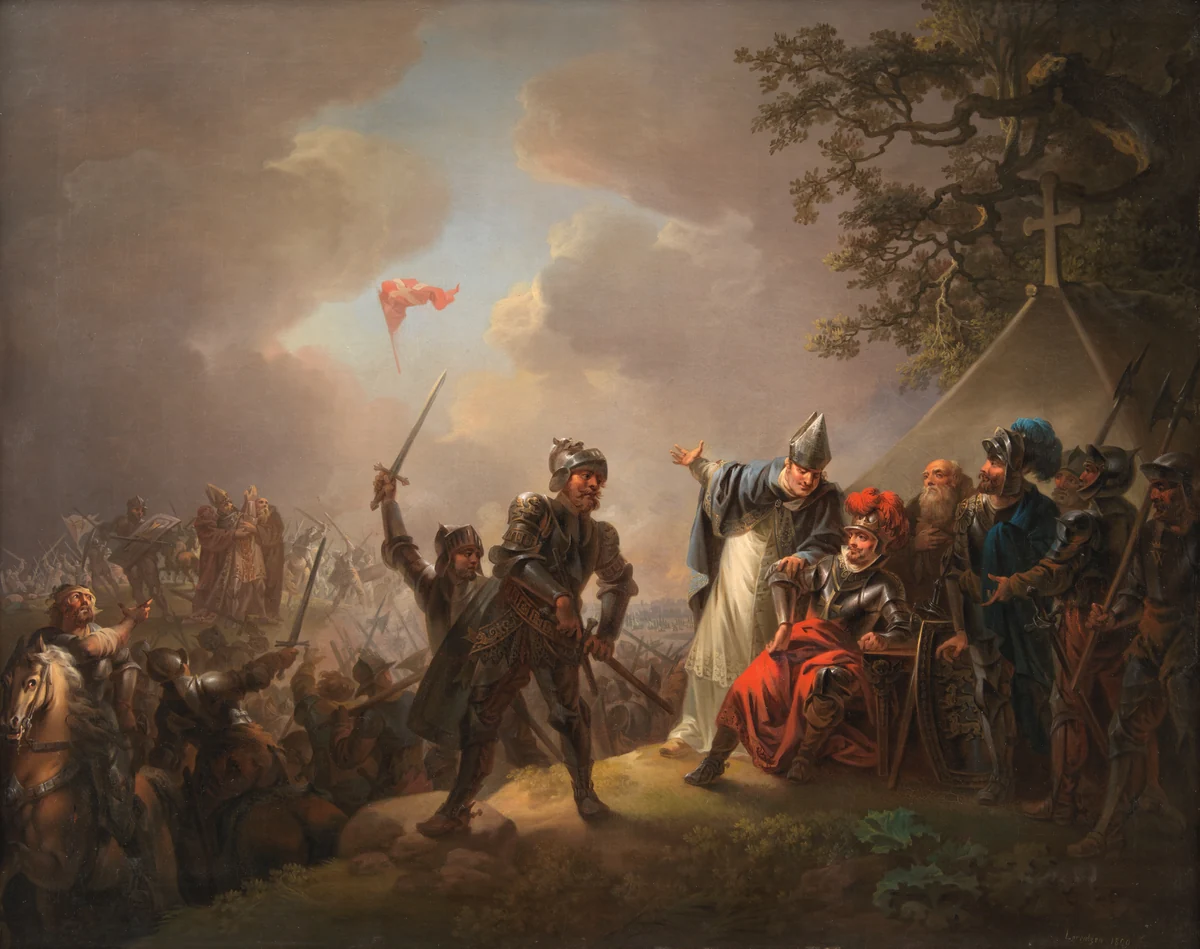
Lorentzen’s painting was made in 1809, nearly six centuries after the battle it imagines. It is valuable evidence of how the legend was represented in art, not evidence that the painter saw the event. The earlier manuscript image below answers a different question: whether the red-and-white cross banner was associated with Danish royalty in the medieval period.
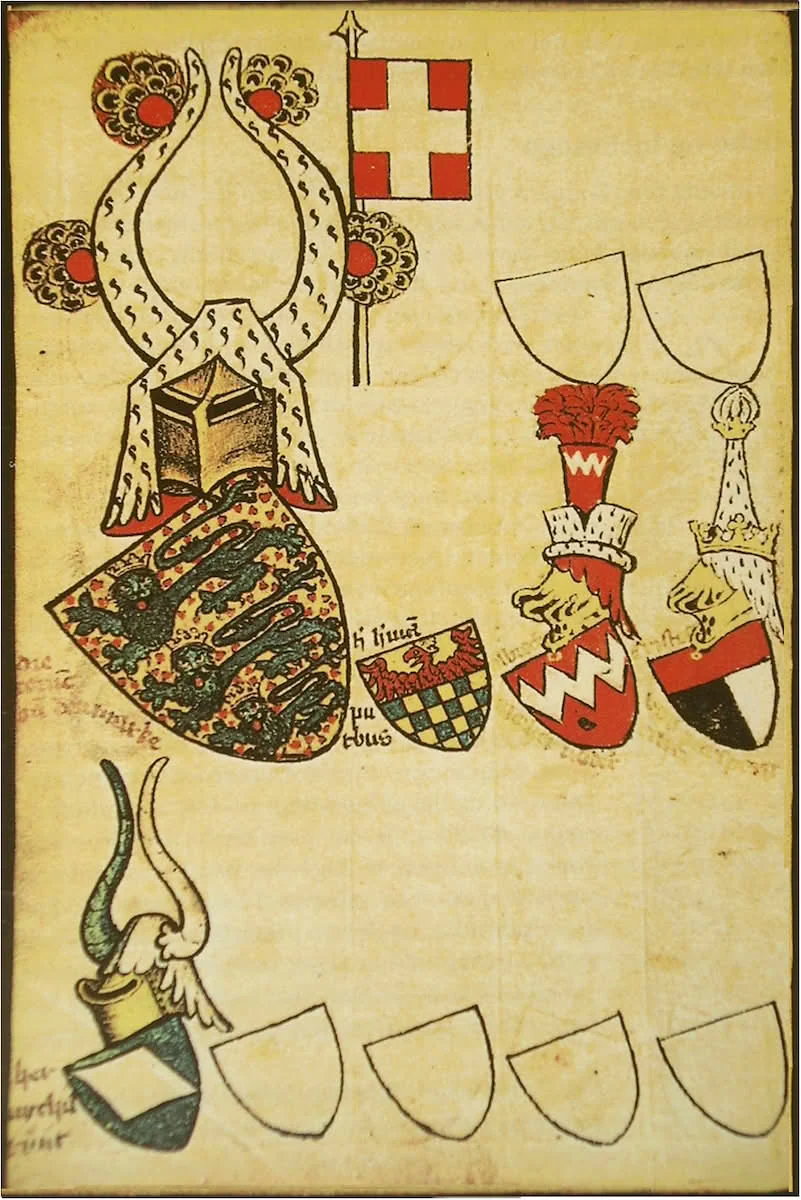
The tiny banner in the manuscript should not be measured as a factory drawing for today’s rectangular flag. Its significance is the historical association of the colors, cross, and royal identity. The phrase “oldest national flag still in use” describes a long tradition; it does not erase uncertainty about the original cloth, designer, or exact starting date.
Who designed Dannebrog?
No single designer of Dannebrog is securely known. The flag developed in the medieval tradition of Christian and royal cross banners, and its present uses and proportions accumulated over time. Valdemar II is central to the origin legend, but he cannot be credited as the documented designer of today’s rectangular national flag.
Separating design from regulation avoids several common errors. A monarch’s connection to a banner does not establish personal authorship. A decree about merchant ships can standardize usage without inventing the cross. A modern act recognizing the national flag can clarify law without creating a new national symbol.
The red-and-white cross was also used elsewhere in medieval Europe. Similarity alone does not prove a single direct transfer from one particular order, dynasty, or army to Denmark. Where competing origin theories go beyond the surviving evidence, they remain theories.
Rectangular, swallow-tailed, naval, and royal flags
The national design appears in several forms with different functions. Use the outline and any central emblem to identify the form before applying a rule about it. A royal standard, a naval ensign, and a household rectangular flag are related, but they are not interchangeable.
| Form | Appearance | Use and distinction |
|---|---|---|
| Stutflag | Rectangular red flag with a white cross | The ordinary form used by private people and in merchant-flag contexts. |
| Splitflag | Dannebrog with a swallow-tailed fly | Reserved for the Royal House, Parliament, state authorities, courts, and other authorized users. |
| Orlogsflag | Swallow-tailed naval ensign in darker red | A naval form; ordinary screen-red artwork should not be labeled its exact color master. |
| Royal standards | Splitflag forms with special central emblems | Identify royal presence or authority; the emblem distinguishes a standard from the plain flag. |
| Vimpel / stander | Long tapered pennant / shorter pennant form | Used under separate customary guidance; not a rectangular national flag at half-staff. |
The Justice Ministry’s splitflag guidance explains the restricted-use principle. The diagram is an educational rendering of the shape in ordinary reference red, not a naval procurement drawing.

The Royal House describes its special flags as modified splitflags. It announced new royal flags on January 1, 2025, following the revised royal arms. Those changes concern particular royal standards, not a replacement of the plain Dannebrog. An older royal-standard picture should therefore carry a date rather than be passed off as the current design.
Manufacturing and choosing the finished size
The ordinary flag’s recognizable design depends on its finished geometry and colors, not on one universal fabric. The 2024 act does not prescribe a single textile for every Dannebrog. As a documented commercial example, Langkilde & Søn describes a sewn flag in woven 175 g/m² spun polyester; that is a product specification, not a national requirement.
When making a flag from separate cloth pieces, calculate the finished red panels and the cross first. Add the required allowance at each seam, choose an appropriate hoist reinforcement, and verify the visible rectangle after sewing. For a printed version, preserve the same geometry in the artwork and check the finished print rather than the untrimmed sheet.
The distinction between finished and cut dimensions is especially important around the intersection. A four-unit cross must stay four units wide after assembly. Reinforcement and attachments should not be counted as an additional visible red panel when comparing the design with a drawing.
Flag size also has to suit the pole and surroundings. Clearances, wind exposure, the weight of cloth, and the maker’s hardware instructions affect the practical choice. The example measurements above make scaling reproducible; they do not replace installation advice or prove that every commercial size follows an exact unrounded mathematical ratio.
Displaying Dannebrog with care
Danish display practice combines law, institutional instructions, and custom. State authorities must follow their applicable instructions, while private people commonly choose the ordinary rectangular flag for personal occasions. Keep those contexts distinct: a flag society’s etiquette recommendation is not automatically a criminal-law provision.
Practical flag care
- Raise a clean, intact flag with the hoist properly secured.
- Keep the cloth clear of the ground while attaching and lowering it.
- Allow a damp flag to dry before storing it.
- Check the pole, halyard, and fittings before use.
Details to check
- Use the rectangular form unless splitflag use is authorized.
- Check the current calendar or ceremony instructions.
- Use separate poles for separate flags in a formal display.
- Keep personal decoration separate from an unaltered national-flag illustration.
Daylight and nighttime display
Customary daytime practice is to raise the flag at 8 a.m., or at sunrise when that is later, and lower it by sunset. Dannebrogs-Samfundet’s January 2026 guidance also permits nighttime display if the flag itself is directly illuminated. A lit finial or ambient street lighting should not be confused with lighting the cloth.
For a formal multi-flag arrangement in Denmark, the society gives Dannebrog the position of honor and recommends raising it first and lowering it last. The precise layout depends on the number and arrangement of poles. International events may follow their own agreed protocol, so identify the actual event rules before arranging a ceremonial display.
Denmark’s flag law effective in 2025
Act No. 1449 of December 10, 2024 took effect on January 1, 2025. It names Dannebrog as Denmark’s national flag, reserves splitflag use to the specified authorized categories, and establishes a general restriction on flying foreign national, territorial, and equivalent flags, subject to exemptions and permissions.
The named exemptions include the flags of Finland, the Faroe Islands, Greenland, Iceland, Norway, Sweden, and Germany. The Justice Ministry’s current foreign-flag page also identifies Ukraine’s flag as permitted under a separate rule. Police can grant permission in special cases; diplomatic representations and Parliament have additional provisions under the act.
The legal concept is flag-flying, not every appearance of a foreign flag. The bill’s explanatory notes discuss poles attached to property and distinguish handheld displays. They also warn that smaller poles can fall within the concept, depending on their character. “Anything below four meters is exempt” is therefore an unsafe simplification.
The act does not extend to the Faroe Islands or Greenland. Its recognition of exempt flags is a different question from its territorial application. Likewise, identifying a national flag in an educational diagram does not establish that it can be flown from a particular pole without meeting the applicable conditions.
When is Danish Flag Day?
June 15 is Valdemarsdag, the day most closely associated with Dannebrog and its legendary arrival in 1219. The official calendar also names it Reunification Day. Denmark has several flag observances, and September 5 separately honors deployed Danish personnel. Private homes are not required to fly a flag on official flag days.
The Justice Ministry’s 2026 calendar distinguishes national occasions and special instructions. State authorities have duties on these days; private people, businesses, and organizations may choose whether to participate. The selection below is not the complete calendar.
| 2026 date | Occasion | Calendar instruction or distinction |
|---|---|---|
| April 3 | Good Friday | Half-staff throughout the day. |
| April 9 | Occupation Day | Half-staff until noon, then full staff. |
| June 5 | Constitution Day | A separate national observance. |
| June 15 | Valdemarsdag and Reunification Day | The date especially associated with Dannebrog. |
| June 21 | Greenland’s national day | State authorities fly Erfalasorput. |
| July 29 | The Faroese national feast, Ólavsøka | State authorities fly Merkið. |
| September 5 | Denmark’s deployed personnel | Distinct from the June 15 flag tradition. |
June 15 combines more than one historical memory. The flag legend belongs to the medieval narrative, while reunification refers to the return of Northern Schleswig to Denmark in 1920. Treating every Danish flag day as the anniversary of the same event would miss that distinction.
Half-staff, mourning, and funerals
Lowering Dannebrog marks mourning, including private funerals and officially directed observances. The customary handling sequence begins at the top of the pole: raise the flag fully, pause, then lower it. Before the final descent, bring it to the top once more. A pennant is not used for this half-staff display.
The flag society’s 2021 general guidance places the flag’s center approximately midway along the pole. Other ceremonial descriptions use a different reference point. The illustration consequently shows the order of movements rather than presenting one marked height as a universal legal measurement.
For church funerals, the society’s 2026 answers direct attention to arrangements made by the parish council and clergy. There is no single national starting time for every funeral. Official calendar instructions remain specific: in 2026, Good Friday calls for half-staff all day, while April 9 changes to full staff at noon.
Mourning is a change of presentation, not a change of the national design. Do not redraw the cross, replace the flag with a black version of Dannebrog, or assume that a decorative black ribbon creates an equivalent official flag form.
Front, reverse, and vertical presentation
The cross stays near the physical hoist, whichever side of a real flag is visible. A reverse view therefore places the hoist on the viewer’s right. This is a normal consequence of looking through the cloth from the other side, not a different Danish flag.
For the vertical illustration, rotating the ordinary flag makes the shorter red panels uppermost. The shape remains an offset cross; no new emblem or lettering is added. Because the ordinary flag has no asymmetric words or arms, there is no separate text element to reverse.
A mounted banner, a flag on a horizontal staff, and a flat wall graphic can use different attachment systems. Establish which edge is the hoist before judging orientation. A cropped photograph that hides the pole may not give enough information to decide how the actual cloth is attached.
How does Denmark’s flag differ from Switzerland’s?
Denmark’s ordinary flag is rectangular and has an offset white cross reaching all four edges. Switzerland normally uses a square red flag with a centered white cross that stops before the edges. The colors are similar, but the flag outline, cross placement, and space around the cross make the designs easy to distinguish.
The Swiss federal description specifies equal cross arms that are one-sixth longer than their width. Its ordinary square flag is the comparison shown here; special Swiss maritime and sporting formats should not be used to erase that normal distinction.
Within the Nordic family, Norway uses a blue cross edged in white on red, and Sweden uses a yellow cross on blue. These are separate national flags sharing a cross arrangement. Adding a colored inner cross to Dannebrog would change its identification, not merely decorate the Danish design.
Dannebrog in everyday Danish life
The Danish Ministry of Foreign Affairs’ feature on Dannebrog describes a flag embedded in ordinary celebration. Small flags can appear on birthday tables, in welcoming decorations, and among Christmas ornaments. At sporting events, the same red-and-white pattern can identify supporters and celebrate a team.
That everyday use grew historically. During the nineteenth century, the royal banner became a much more popular national symbol. Permission for private display in 1854 helped separate household flag use from the earlier restriction to royal and official contexts. The shape endured while its audience expanded.
An Aarhus University discussion of Danish flag culture explains why festive and national meanings can coexist. A birthday flag may express affection for one person, while still relying on a shared national symbol. Neither a universal political motive nor a complete absence of national meaning can be assumed from every small flag.
Such decorative objects should be described accurately. A paper flag on a cake is not a naval ensign; a string of party flags is not a formal state display. The context changes what the object is doing, even when the familiar cross makes it immediately recognizable.
Care, storage, and historical textiles
Inspect a frequently flown flag for wear at its fly edge, seams, and attachments. Follow the maker’s washing instructions, let the cloth dry, and store it away from unnecessary moisture and light. The flag society’s January 2026 guidance emphasizes clean, presentable cloth and sound pole equipment.
An old association banner can have historical value beyond its fabric. Embroidery, names, dates, and documented ownership may justify keeping it in an archive or museum. The society recommends specialist textile assessment for aged embroidered material rather than assuming a modern washing method is suitable.
Flag-society literature describes burning as a traditional retirement method. That recommendation is not a disposal requirement written into the 2024 flag act. Fabric type and local waste or fire arrangements matter; seek an appropriate retirement route for an ordinary worn flag and conservation advice for a historical one.
The gallery gathers the actual diagrams, photographs, and artwork used here. The historical images retain their dates and identities, and downloadable illustrations are labeled by purpose. A construction drawing, documentary photograph, and later painting each communicate a different kind of evidence.
Denmark flag pictures
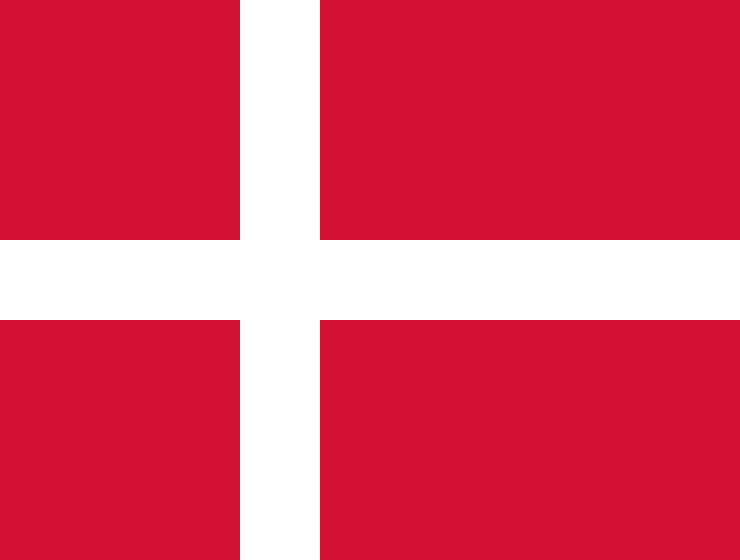
Red rectangular Dannebrog with a white cross shifted toward the hoist; width:height 37:28.
GKBook original vector illustration; explanatory artwork dedicated to CC0. Source. CC0 1.0.Download image
The red panels beside the hoist are 12 by 12 units; fly-side panels are 21 by 12. The white cross is 4 units wide.
GKBook original vector illustration; explanatory artwork dedicated to CC0. Source. CC0 1.0.Download image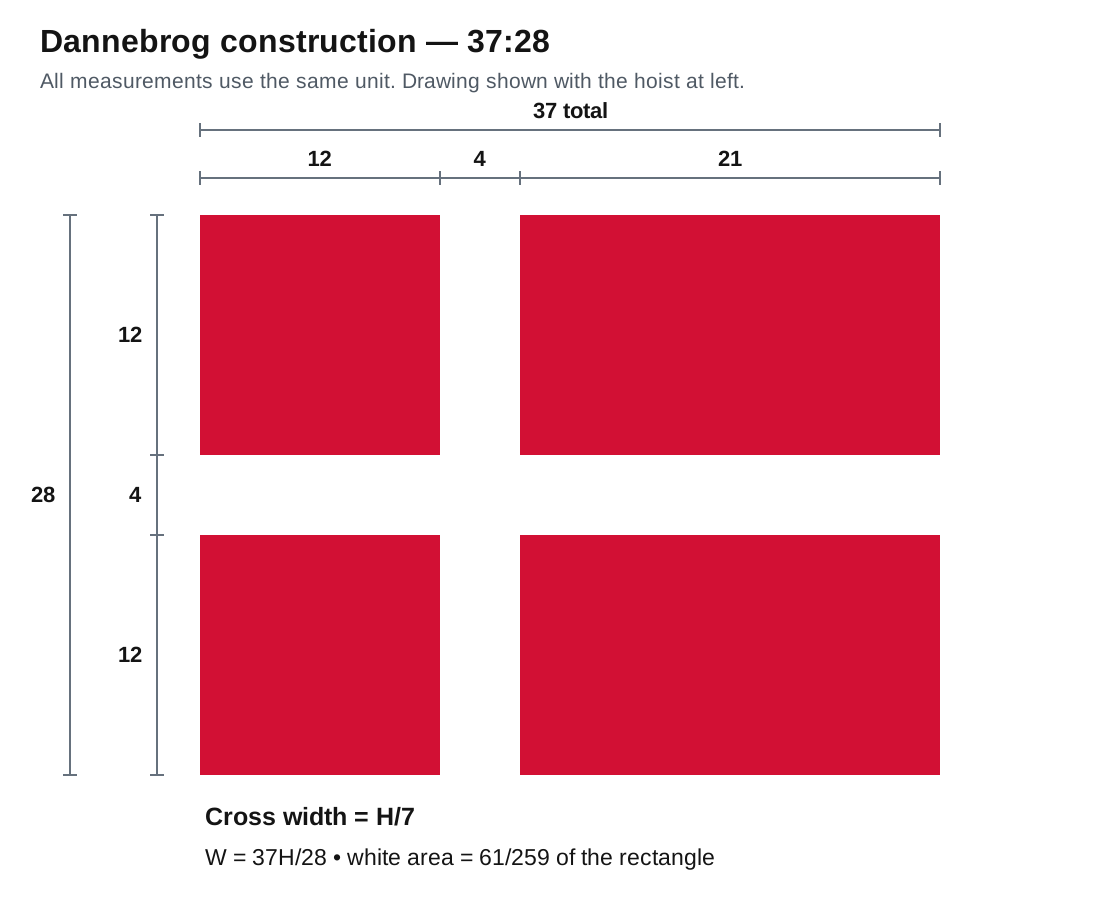
The modern reference rectangle uses horizontal divisions 12:4:21 and vertical divisions 12:4:12, giving width:height 37:28.
GKBook original vector illustration; explanatory artwork dedicated to CC0. Source. CC0 1.0.Download image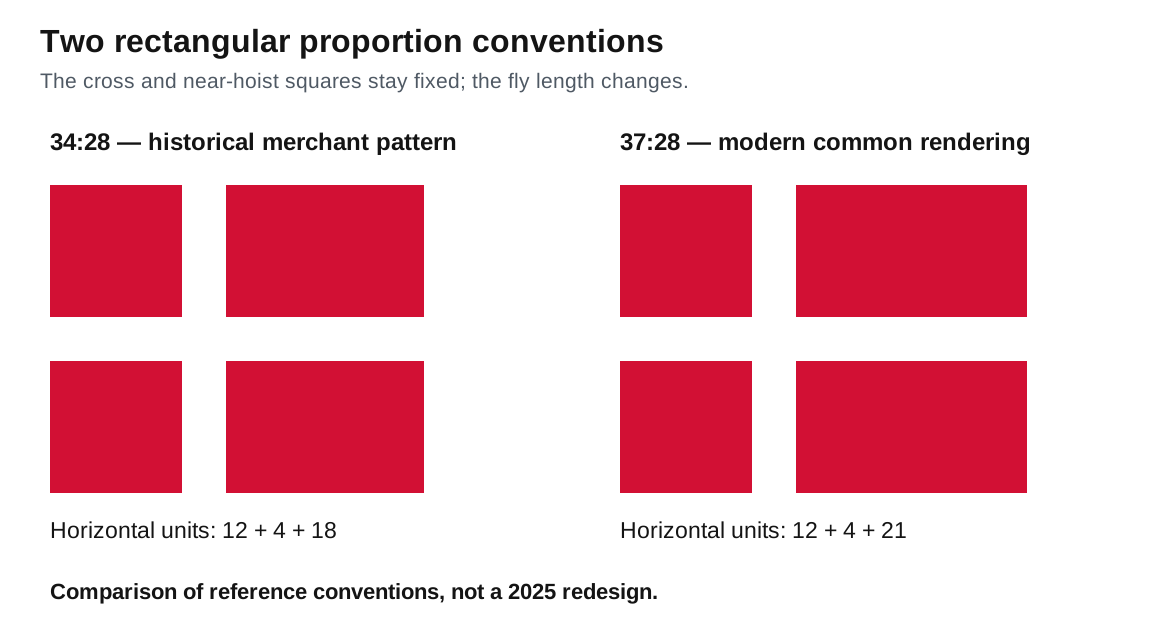
The historical 34:28 rectangle and the common modern 37:28 rendering share a four-unit cross and 28-unit height; the fly-side red panels differ in length.
GKBook original vector illustration; explanatory artwork dedicated to CC0. Source. CC0 1.0.Download image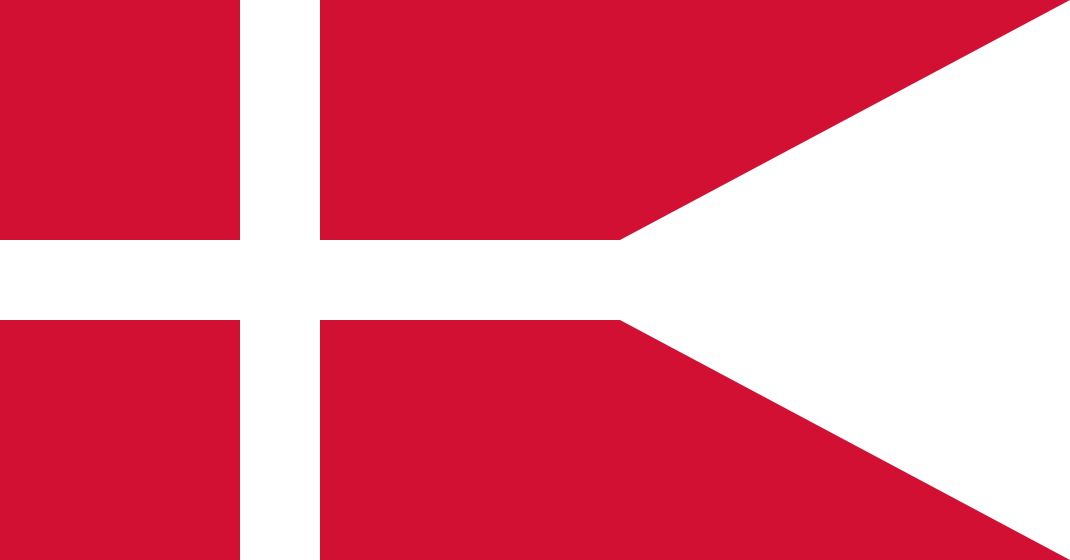
The swallow-tailed Danish splitflag, shown in the ordinary red screen approximation. Its use is restricted to authorized users.
GKBook original vector illustration; explanatory artwork dedicated to CC0. Source. CC0 1.0.Download image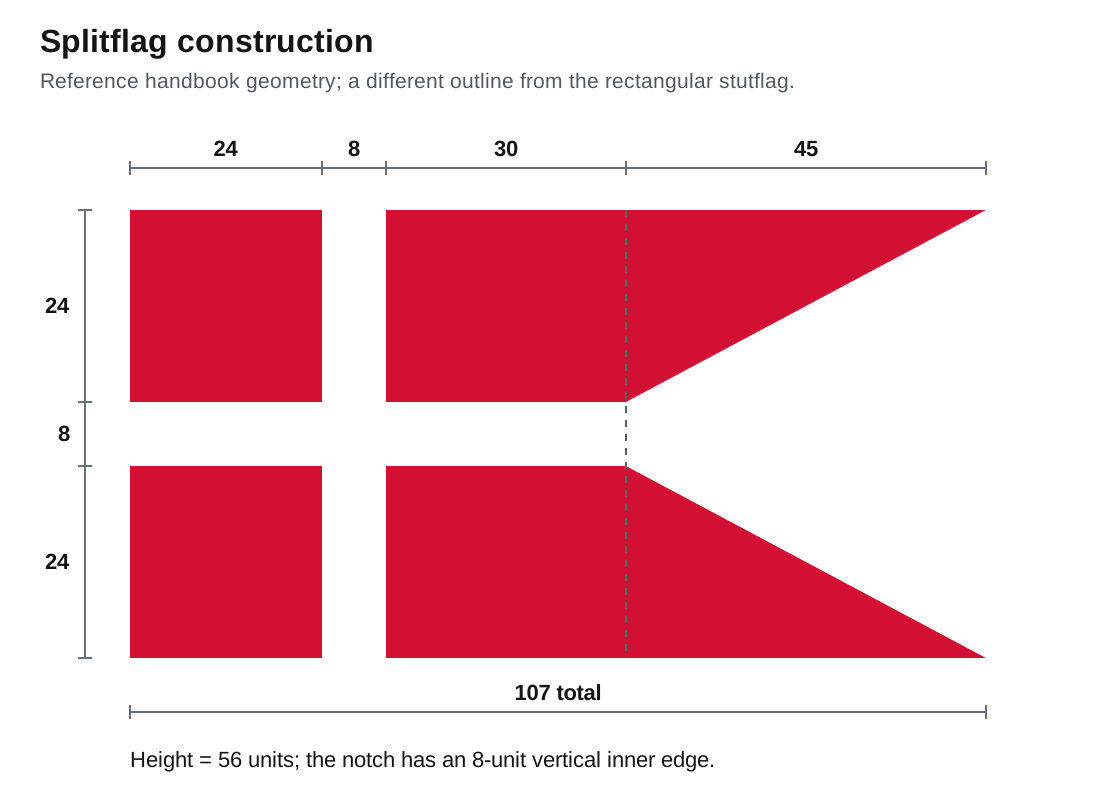
The handbook splitflag outline is 107 units long and 56 high: 24:8:30:45 horizontally and 24:8:24 vertically. The inner notch ends at the cross edges.
GKBook original vector illustration; explanatory artwork dedicated to CC0. Source. CC0 1.0.Download image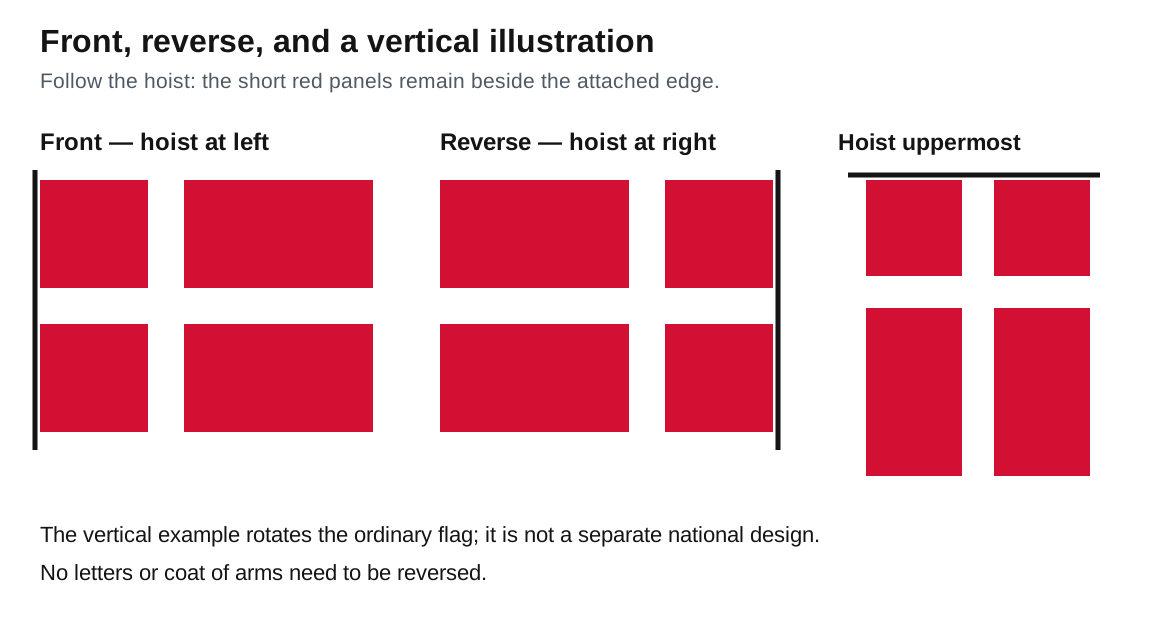
Front and reverse views keep the upright cross near the physical hoist. A rotated illustration has the short red panels at the upper edge.
GKBook original vector illustration; explanatory artwork dedicated to CC0. Source. CC0 1.0.Download image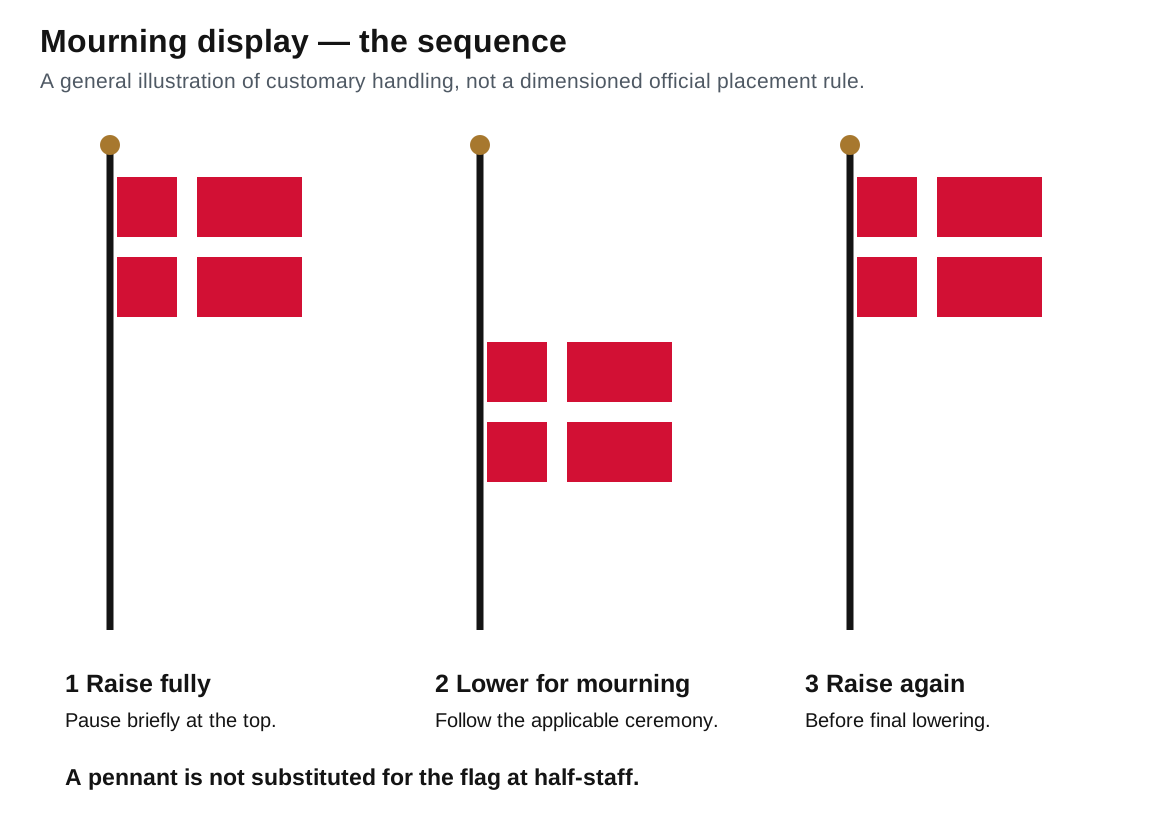
Customary sequence: raise the flag to the top, lower it for mourning, then raise it to the top before the final descent. Placement is schematic.
GKBook original vector illustration; explanatory artwork dedicated to CC0. Source. CC0 1.0.Download image
Denmark has a rectangular flag with an offset cross extending to the edges. Switzerland normally uses a square flag with a centered free-standing cross.
GKBook original vector illustration; explanatory artwork dedicated to CC0. Source. CC0 1.0.Download image
A rectangular Dannebrog flying against a blue sky; the folds show the white cross and red cloth.
Per Palmkvist Knudsen. Resized and converted to WebP; full frame retained. Source. CC BY-SA 2.5.Download image
A swallow-tailed Danish flag at the stern of the royal yacht Dannebrog, moored in Aarhus on April 23, 2018.
Ciara Ní Riain. Resized and converted to WebP; full frame retained. Source. CC BY-SA 4.0.Download image
Christian August Lorentzen’s 1809 painting imagines the Dannebrog descending during the 1219 battle at Lyndanise. It is a later artistic interpretation.
Christian August Lorentzen; digital reproduction: Statens Museum for Kunst. Resized and converted to WebP; full frame retained. Source. Public domain / CC0.Download image
A medieval Armorial Gelre detail shows the Danish royal arms and a small red banner with a white cross.
Claes Heynensoon / Armorial Gelre; reproduction via Lex. Resized and converted to WebP; full frame retained. Source. Public domain.Download imageFrequently asked questions
What is the flag of Denmark called?
Denmark’s flag is called Dannebrog. The name is commonly explained as Danish cloth or the banner of the Danes, although scholars discuss other possible roots. It identifies the red flag with a white cross, whether discussing the familiar rectangular form or an authorized swallow-tailed version.
What does the Danish flag mean?
Dannebrog represents Denmark through a medieval red-and-white cross tradition that later became a widely used national symbol. The cross has Christian historical associations. Modern use also expresses celebration, belonging, remembrance, or hospitality; its meaning depends on the occasion and is not limited to religious observance.
What colors are on Denmark’s flag?
The ordinary Danish national flag uses red and white. Red forms the field, and white forms a cross that reaches all four edges. The cross is shifted toward the hoist, leaving longer red panels on the fly side. A coat of arms is not part of this ordinary design.
Why is the Danish cross off center?
The upright arm of the Danish cross is nearer the hoist than the fly, producing the arrangement usually called a Nordic cross. The offset is part of the flag’s established geometry. It should not be corrected by centering the cross or confused with Switzerland’s separate, free-standing white cross.
What are the proportions of Dannebrog?
A common modern rectangular Dannebrog has a width-to-height ratio of 37:28. Its horizontal divisions are 12, 4, and 21 units, while the vertical divisions are 12, 4, and 12. Historical references also describe a shorter 34:28 rectangle, so the order and context of dimensions matter.
What is the hex code for the Danish flag?
The Nordic cooperation website publishes RGB 210, 16, 52 for Dannebrog red, equivalent to hexadecimal #D21034. White is represented here as #FFFFFF. These are useful digital reference values; the 2024 flag act does not itself prescribe a hex code, and screen colors are not textile manufacturing tolerances.
When was the Danish flag adopted?
Dannebrog has a medieval history rather than one securely established modern adoption date. June 15, 1219 is its legendary origin, while late medieval evidence documents the cross banner. Later regulations defined uses and forms; the law effective in 2025 recognized the national flag without introducing a new design.
Is Denmark’s flag the oldest national flag?
Dannebrog is widely described as the oldest national flag still in use, reflecting the long continuity of its red-and-white cross. That description should not turn the 1219 legend into documentary proof. Surviving medieval evidence is later, and the flag’s proportions, uses, and social meanings developed over time.
Did Dannebrog really fall from the sky?
The story that Dannebrog fell from heaven at Lyndanise on June 15, 1219 is a national legend. Accounts were written down centuries after the battle and developed over time. They explain a cherished tradition, but they do not establish a witnessed supernatural event or an exact manufacturing origin.
Who designed Denmark’s flag?
No single designer of Dannebrog is securely identified. It emerged from the medieval world of royal and Christian cross banners, long before modern national-flag design competitions. King Valdemar II belongs to its origin legend; that association is not evidence that he drew or commissioned the present rectangular design.
Do red and white officially mean courage and peace?
The sources used here do not establish an official Danish rule assigning courage to red and peace to white. Those are familiar generic flag interpretations, but applying them to Dannebrog would blur symbolism and evidence. Its documented explanation centers on the historical red field and Christian cross tradition.
Did Denmark change its flag in 2025?
Denmark did not replace the ordinary Dannebrog design in 2025. A new flag law took effect on January 1 and set rules for flag use. Separately, new royal flags reflected revised royal arms. Changes to those special standards do not add royal arms to everyone’s national flag.
What is the difference between stutflag and splitflag?
A stutflag is the familiar rectangular Danish flag. A splitflag has a divided, swallow-tailed fly and is reserved for the Royal House, Parliament, state authorities, courts, and other authorized users. Its shape signals a different use category; it is not simply a decorative alternative for any private flagpole.
Why is the Danish naval flag darker?
Danish flag guidance distinguishes ordinary Dannebrog red from the darker red associated with the naval ensign, or orlogsflag. The naval flag also has a swallow-tailed outline. Photographs can shift apparent color with light and exposure, so a pictured shade alone is an unreliable way to classify every flag.
Does the Danish flag have a coat of arms?
The ordinary national flag has no coat of arms. Certain royal standards combine a swallow-tailed Dannebrog with a special central emblem, identifying royal presence or authority. The Royal House introduced updated flags in 2025. Those are separate standards and should not be substituted for a plain national-flag illustration.
Can ordinary people fly Dannebrog?
Private people can use the ordinary rectangular Dannebrog, and it is commonly flown for family celebrations as well as national occasions. The Justice Ministry says private people, companies, and organizations are not obliged to fly flags on official flag days. Restricted splitflag use is a separate question.
When is Danish Flag Day?
June 15, Valdemarsdag, is the observance most closely associated with Dannebrog and its origin legend. The official calendar also calls it Reunification Day. Denmark has several flag days during the year, and September 5 separately honors Danish personnel deployed abroad rather than commemorating the flag’s legendary arrival.
Must every home fly a flag on official flag days?
No. Official flag days impose flag-flying duties on state authorities, not a universal obligation on private homes, companies, or organizations. Private display remains a choice. The official calendar also includes special instructions for particular days, including mourning arrangements and the use of Greenlandic or Faroese flags by state authorities.
Can the Danish flag stay up at night?
Danish etiquette normally follows daylight flag times, but Dannebrogs-Samfundet’s 2026 guidance allows nighttime display when the flag itself is directly illuminated. A light somewhere nearby is not the same thing. Treat this as flag-practice guidance and distinguish it from the specific legal rules governing authorized flag use.
How is Dannebrog flown at half-staff?
The customary sequence is to raise Dannebrog fully, pause briefly, and then lower it for mourning. Before taking it down, raise it fully again and pause before the final descent. Follow the relevant ceremony or official instruction for placement and duration; a Danish pennant is not flown at half-staff.
Can Danish families use the flag for a funeral?
Danish flag custom includes mourning for private deaths and funerals, as well as officially directed mourning. The flag is lowered for the relevant occasion and handled respectfully. For church ceremonies, local arrangements are set with the church; the national flag-day calendar does not settle every family funeral detail.
Can foreign flags be flown in Denmark?
The law effective in 2025 generally restricts flying foreign national and territorial flags, with important exemptions. Nordic flags and Germany’s flag are exempt, Ukraine’s is separately permitted, and police can grant special permissions. This is not a blanket ban on every foreign-flag picture, garment, or handheld display.
Which way should the Danish flag face vertically?
For the simple vertical illustration here, rotate the ordinary flag so its hoist edge is uppermost. The shorter red panels then sit above the crossing. This explains the geometry of a rotated Dannebrog; particular ceremonial banners or mounting arrangements may have their own specifications and should be checked separately.
How is Denmark’s flag different from Switzerland’s?
Denmark’s ordinary flag is rectangular, with a white cross extending to every edge and shifted toward the hoist. Switzerland normally uses a square flag with a centered white cross that stops before reaching the edges. Both use red and white, but their outlines and cross geometry are different.
Is a Danish pennant the same as the national flag?
A Danish pennant, or vimpel, is a long tapered red-and-white flag form used on a pole between ordinary flag occasions. It is not the rectangular stutflag. Flag-society guidance allows pennants to remain up day and night, but says they should not be used for half-staff mourning display.
What fabric is Dannebrog made from?
There is no single fabric specified by the flag act for every ordinary Dannebrog. Modern examples include woven spun-polyester flags, such as products described by Danish maker Langkilde & Søn. Fabric, stitching, reinforcements, and fittings depend on the product and setting; none of these changes the flag’s basic cross design.
How should an old Danish flag be cared for?
Keep an ordinary flag clean, dry, and in good repair, following the maker’s care instructions. Replace badly frayed display cloth. Historically important or embroidered association banners deserve specialist assessment before cleaning or disposal; flag-society guidance recommends considering an archive, museum, or appropriate conservation route for those objects.
Explore all general-knowledge topics and the A-to-Z lists.



We Value Your Opinion Comments