
Cuba flag picture
Explore the construction sheet, the lone star, and the historical sequence.
| Country | CubaRepublic of Cuba; Spanish: República de Cuba. |
|---|---|
| Name | Flag of the Lone StarBandera de la estrella solitaria. |
| First raised in Cuba | May 19, 1850Cárdenas, during the expedition led by Narciso López. |
| Adopted | April 11, 1869Assembly of Guáimaro; the date recorded in Law 128, Article 5. |
| Republic inaugurated | May 20, 1902The existing Cuban flag became the flag of the new Republic. |
| Proportions | 2 : 1 — width:heightFive equal horizontal stripes; a red equilateral triangle at the hoist. |
| Emblem | One white five-pointed starCentered in the triangle; its circumcircle diameter equals one-third of the flag height. |
| National Day | January 1Anniversary of the triumph of the Revolution in 1959. |
Cuba’s flag alternates three blue stripes with two white stripes. A red equilateral triangle at the hoist contains a white five-pointed star. Law 128 defines the meanings summarized below; the star represents the sovereign republic and Cuban unity.
An overview of the Cuba flag
The flag of Cuba has five equal horizontal stripes in the order blue, white, blue, white, blue. A red equilateral triangle fills the hoist, the edge attached to the pole. A single white five-pointed star stands upright at the triangle’s center. The flag is twice as wide as it is high.
Its Spanish name, bandera de la estrella solitaria, means “flag of the lone star.” That name identifies the national flag in both Cuba’s Constitution and its national-symbols law. The star is the flag’s central emblem; Cuba’s separate coat of arms is not placed on the national flag.
Several dates answer different questions about its age. The design emerged among Cuban exiles in New York in 1849. It was first raised on Cuban soil at Cárdenas on May 19, 1850. The Assembly of Guáimaro adopted it on April 11, 1869, and the Republic inaugurated on May 20, 1902 used the same basic design. Later legislation standardized and regulated it.
This distinction matters when a reference calls the flag an “1850 flag,” an “1869 flag,” or a “1902 flag.” Those dates refer to its public appearance in Cuba, revolutionary adoption, and use by the new Republic. They are not three entirely different modern national flags.
The lone star and the red triangle
Article 6 of Law 128/2019 gives the star a defined meaning: the free, independent, sovereign republic and the unity of Cubans. It is not a map of an island, a count of provinces, or an ornament borrowed from Cuba’s coat of arms.
The surrounding triangle is equilateral: all three sides are equal. One side forms the flag’s entire hoist edge, while the opposite vertex points toward the fly. Article 6 associates the triangle with liberty, equality, and fraternity. Its red color recalls blood shed in the struggle.
In normal horizontal display, one point of the star faces upward. The star is centered on the triangle itself, not halfway across the whole flag and not halfway along the triangle’s depth. Because the triangle narrows toward the fly, its geometric center lies closer to the hoist than its right-hand tip.
Colors: the legal names and digital reproduction
The law specifies azul turquí, white, and red. Azul turquí describes a deep blue; it should not be translated as turquoise. Three stripes are blue and two are white. Red belongs to the triangle, while the star is white. The top and bottom stripes are both blue.
| Element | Legal color description | This page’s sRGB rendering |
|---|---|---|
| Blue stripes | Azul turquí — deep blue | #002A8F · RGB 0, 42, 143 |
| White stripes and star | White | #FFFFFF · RGB 255, 255, 255 |
| Hoist triangle | Red | #CF142B · RGB 207, 20, 43 |
The legal text and construction annex examined here do not give Pantone, CMYK, or numerical colorimetric coordinates. A screen value should therefore not be promoted into an official textile specification. A photographed flag also changes appearance with sunlight, shade, fabric, exposure, and the display on which the picture is viewed.
There is a genuine historical reason to distinguish light blue from deep blue. The January 6, 1906 law authorized the executive to replace azul celeste with azul turquí in the flag and arms. The associated presidential decree is dated April 24, 1906. The surviving printed plate is documentary evidence; its aged ink is not a modern color-calibration target.
Symbolism and meaning
Cuba’s flag has more than a familiar popular interpretation: Article 6 of the 2019 national-symbols law expressly describes its meanings. The blue and white stripes, red triangle, and white star each have a stated role. These are the official meanings used in the factbox and the rows below.
The three blue stripes recall the colonial administrative division of the island at the time the flag was designed. They do not enumerate Cuba’s present-day provinces. Article 6 also connects blue with the aspirations of the patriots. White is linked to the ideals and virtue of Cubans, while the red triangle combines the memory of sacrifice with the ideals represented by its three equal sides.
The star’s official meaning joins independence with unity. The adjective “lone” describes a single star, but it does not mean that Cuba rejects relations with other countries. Nor does the national flag’s red triangle make the flag a design created in 1959: its form belongs to the nineteenth-century history described below.
Historical interpretations and present legal meanings should be read at their own dates. López’s expedition belonged to a political setting that included plans for U.S. annexation. The later independence movement adopted the flag, and modern Cuban law defines its star in terms of a sovereign republic. A symbol can acquire a broader national meaning than the ambitions of one early sponsor.
Construction and exact proportions
Let H be the flag’s height. Its fly length is 2H, each stripe has height H/5, and the triangle has three sides of length H. The star’s imaginary circumcircle has diameter H/3. These relationships scale together, whether the flag is drawn on a screen or made as a large textile.
| Feature | Formula using flag height H | Example when H = 600 mm |
|---|---|---|
| Overall width | 2H | 1,200 mm |
| Each stripe’s height | H/5 | 120 mm |
| Each triangle side | H | 600 mm |
| Triangle depth toward the fly | √3H/2 | About 519.615 mm |
| Star center from the hoist | √3H/6 | About 173.205 mm |
| Star center from the top | H/2 | 300 mm |
| Star circumcircle diameter | H/3 | 200 mm |
The triangle’s center is its centroid, where its medians meet. In an equilateral triangle this is also the center of the inscribed and circumscribed circles. Its horizontal coordinate is one-third of the triangle’s depth. Placing the star at half the depth would shift it visibly toward the tip.
A practical drawing order is to make the 2H-by-H rectangle, divide it into five equal horizontal stripes, overlay the equilateral red triangle, and then place the white star at the triangle’s center. Keep the star’s upper point vertical. The official construction sheet contains guides, but those guide lines are not part of the finished flag.
Adoption, constitutional recognition, and later law
Article 2 of the 2019 Constitution identifies the lone-star flag, the Bayamo anthem, and the royal-palm coat of arms as national symbols. It leaves their identifying characteristics, use, and conservation to legislation. The detailed instrument examined here is Law 128, approved July 13, 2019.
The law was published in Gaceta Oficial No. 71 on September 19, 2019. Its final provisions say that it takes effect 180 days after publication. Approval, publication, and entry into force are separate events; none is the historical adoption of the flag. Article 5 explicitly records adoption at Guáimaro on April 11, 1869.
| Instrument or event | What it establishes |
|---|---|
| Guáimaro, April 11, 1869 | Adoption of the lone-star flag, as recorded in Article 5 of Law 128. |
| Republic inaugurated, May 20, 1902 | Use of the existing national flag by the new Republic. |
| Law and decree of 1906 | Republican regulation of the flag, arms, and seal; authorization of deep blue and a detailed flag description. |
| Law 42 of December 27, 1983; Decree 143 of April 13, 1988 | Earlier national-symbols law and regulation, expressly repealed by the 2019 law. |
| Law 128/2019 and Annex II | Meaning, design, dimensions, materials, use, honors, conservation, and associated construction drawings. |
The 2019 law applies in Cuban territory, on Cuban vessels and aircraft, and at Cuban missions abroad enjoying privileges and immunities. Its text addresses both institutions and individuals. The sections below identify the relevant provisions rather than importing another country’s flag code.
The flag’s historical development
The Cuban flag predates both the twentieth-century Republic and the Revolution of 1959. Its story moves from an exile-led expedition to a symbol adopted by an independence movement, then to republican law and later national-symbols legislation. The timeline distinguishes changes in political authority from changes in flag design.
1849
The design takes shape in New York
The lone-star design emerged in the exile circle around Narciso López. Miguel Teurbe Tolón drew it, and Emilia Teurbe Tolón made an early sewn example. The flag’s creation therefore involved a political initiative, graphic work, and textile work rather than one interchangeable act.
1850
The flag is raised at Cárdenas
On May 19, 1850, López’s expedition raised the flag at Cárdenas. This is its first raising on Cuban soil. The expedition failed to secure control of the island; displaying the banner did not establish an independent Cuban state.
1868
Céspedes raises a different flag

Carlos Manuel de Céspedes began the uprising at La Demajagua on October 10, 1868, using another red-white-blue flag. Its design has a red canton with a white star and a blue lower half. The illustration shows the present legal form, not the original surviving textile.
1869
Guáimaro adopts the lone-star flag
The Assembly of Guáimaro chose the lone-star flag on April 11, 1869. The Céspedes flag retained historical honor. Law 128 records both the adoption date and the continuing special status of the Céspedes banner.
1902
The Republic is inaugurated
The inauguration on May 20, 1902 included the lowering of the U.S. flag and raising of the Cuban flag, documented in the Library of Congress catalog. The event gave the older independence emblem its role as the flag of the new Republic.
1906
Deep blue and republican specifications
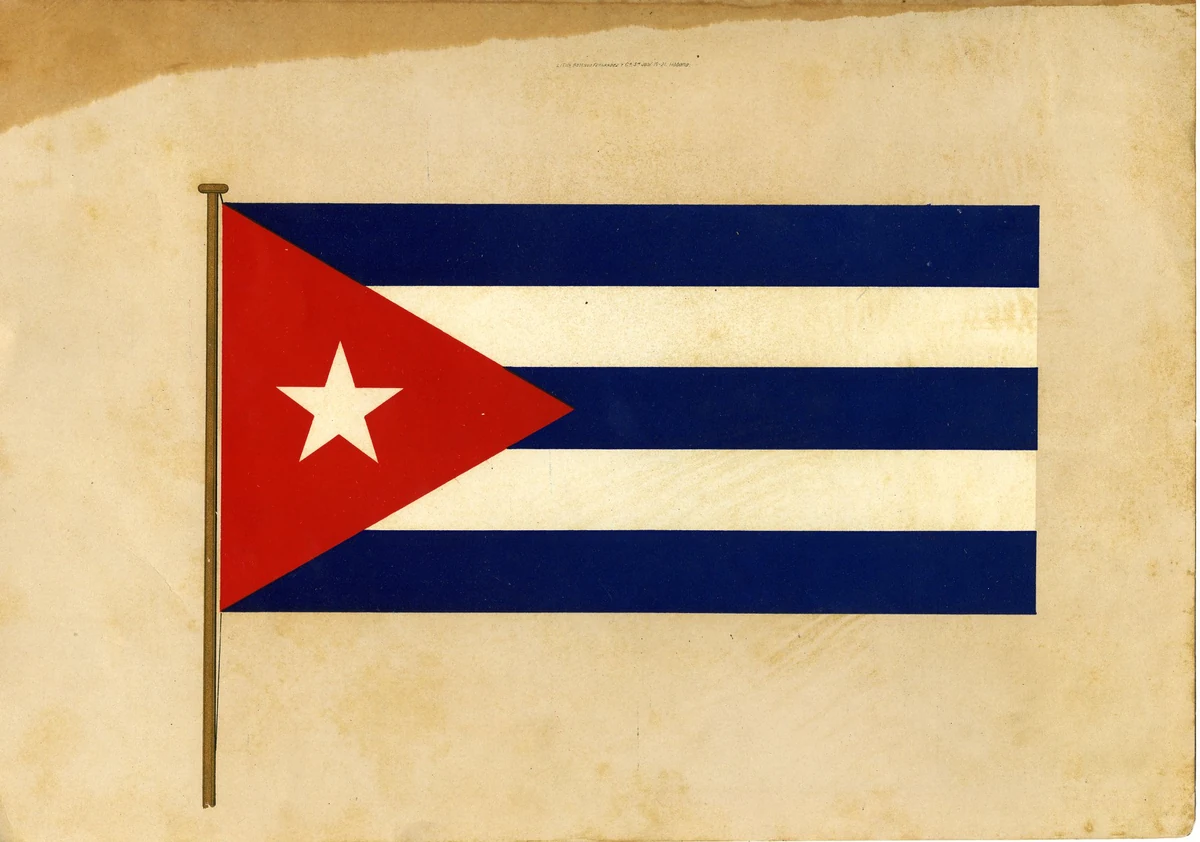
The January 6 law authorized the change from light blue to deep blue. The April 24 presidential decree described a rectangle twice as long as high, five equal stripes, a red equilateral triangle, and an upright white star. The accompanying official plate documents the period’s rendering.
1959
Political revolution, continuing national flag
January 1, 1959 marks the triumph of the Revolution commemorated by Cuba’s National Day. It is not the origin of the lone-star design. The flag’s earlier history and the continuity of its basic form are visible in the 1906 plate and modern legal description.
1983–1988
A symbols law and its regulation
Law 42 of December 27, 1983 and Decree 143 of April 13, 1988 formed the earlier regulatory framework. Their existence and subsequent repeal are stated in the 2019 law. These are legal milestones, not evidence of a newly designed national flag.
2019
A consolidated national-symbols law

Law 128 combines detailed rules for the national symbols with their official meanings and construction annexes. It expressly allows respectful individual display at residences, workplaces, public events, and on vehicles, and sets conditions for representations on clothing and other objects.
The early political setting deserves care. The U.S. Department of State’s Office of the Historian describes López as seeking annexation to the United States and connects that project with preserving slavery in Cuba. His expeditions were privately organized armed ventures, commonly called filibustering. Treating their aims as identical to the later sovereign republic would flatten an important part of the history.
The Guáimaro adoption and the meanings now prescribed in Cuban law show a different stage in the flag’s national life. The article’s historical account distinguishes that later role from López’s own program; it does not treat either episode as a reason to erase the other.
Who designed the flag of Cuba?
Miguel Teurbe Tolón is credited with drawing the Cuban flag in New York in 1849 from ideas associated with Narciso López. Emilia Teurbe Tolón sewed an early example. These roles distinguish the design’s graphic creation, its political sponsorship, and the work of making it in cloth.
Accounts preserved by Cuban historians place the design in a circle of exiles that included the writer Cirilo Villaverde. A drawing can establish an arrangement of stripes and symbols, while a sewn flag turns that arrangement into an object that can be carried and raised. Crediting Emilia’s work preserves that distinction.
Authorship is also different from adoption. The Assembly of Guáimaro’s later choice made the lone-star design the flag of the independence movement. Twentieth- and twenty-first-century legal descriptions then governed reproduction and use. No new individual designer is named here for the current statutory specifications.
The Céspedes flag: historical symbol and naval jack
The flag of Carlos Manuel de Céspedes, often called the flag of La Demajagua or Yara, is distinct from the national lone-star flag. Law 128 recognizes its historical importance because it was raised at Céspedes’s sugar mill when he began the October 10, 1868 uprising against Spanish colonial rule.
Its modern legal rectangle is also 2:1 width:height. The lower half is deep blue. The upper half contains a red rectangle next to the hoist and white toward the fly. Annex II makes the red rectangle’s length the height of that upper half multiplied by the golden ratio, approximately 1.618. A centered white star fits a circle of diameter H/3.
The law requires this flag beside the national flag in the National Assembly’s meeting room, and permanently alongside it in Bayamo and La Demajagua. It also prescribes a replica beside the national flag at Céspedes’s mausoleum. At the bows of warships, the Céspedes flag is flown under the rules of the armed-forces ministry; this is its naval-jack role.
A jack is not the same thing as the national ensign at the stern. Article 20 says Cuban civilian vessels and warships use the national flag at the stern when approaching or arriving at a foreign port. The two flags therefore have distinct, documented functions.
Specialist historical accounts credit Candelaria Acosta, known as Cambula, with sewing the 1868 Céspedes flag. The current legal construction drawing should not be treated as a measurement record for that original handmade object. Historical textiles can preserve details that differ from a later standardized drawing.
Cuba and Puerto Rico: similar pattern, different colors
Cuba and Puerto Rico both use five horizontal stripes, a hoist triangle, and a white five-pointed star. The fastest distinction is the placement of red and blue: Cuba has blue stripes and a red triangle; Puerto Rico has red stripes and a blue triangle. Both have two white stripes.
| Identification clue | Cuba | Puerto Rico |
|---|---|---|
| Top, middle, and bottom stripes | Blue | Red |
| Hoist triangle | Red | Blue |
| Other two stripes | White | White |
| Star | One white five-pointed star | One white five-pointed star |
The Céspedes flag is another possible source of confusion. It uses the same three colors and a white star, but has a rectangular canton and a blue lower half instead of five alternating stripes. A Cuban coat of arms shown separately is also not an additional national-flag variant: the legal flag’s emblem is the lone star.
Materials, manufacture, and prescribed sizes
Article 9 states a preference for polyamide fabric, while also permitting silk, silk satin, and another suitable fabric or material that allows proper construction, durability, and use. The law does not make a single artisanal process, weave, or commercial maker mandatory. Article 8 requires the prescribed elements to be respected when the flag is sewn, painted, engraved, or drawn.
For manufacturing, the critical visual checks follow directly from the design: five equal stripe heights, the correct blue-white order, equal triangle sides, an upright centered star, and the 2:1 finished proportion. Seams and mounting details should preserve those relationships. These are practical checks derived from the legal design, not a separate certification scheme.
| Use identified in Article 10 | Specified fly length | Corresponding height at 2:1 |
|---|---|---|
| Exterior wall-mounted staff at specified institutional buildings | 3 m | 1.5 m |
| Indoor institutional staff | 3 m or 1.8 m | 1.5 m or 0.9 m |
| Specified hanging, wall, educational, and decorative contexts | 3 m, 1.8 m, or 1.2 m | 1.5 m, 0.9 m, or 0.6 m |
| Military units: gala / everyday / storm | 6 m / 3 m / 1.8 m | 3 m / 1.5 m / 0.9 m |
| Official parades, acts, or ceremonies | 1.5 m or 1.9 m | 0.75 m or 0.95 m |
| Vehicles of the head of state and diplomatic mission heads | 0.4 m | 0.2 m |
| Official negotiation or visitor tables | 0.3 m | 0.15 m |
| Civilian vessels: large / medium / smaller | 6 m / 3 m / 1.8 m or 1.2 m | 3 m / 1.5 m / 0.9 m or 0.6 m |
The parade and ceremony provision includes 6 cm gold fringe, a 3 m staff including its fittings, and a 2.10 m braided cord in deep blue, white, and red with two tassels. Gold fringe is a ceremonial accessory, not a fourth color added to the national design.
| Warship category | Gala flag length per meter of vessel length | Everyday flag length per meter |
|---|---|---|
| Large displacement | 4 cm | 2 cm |
| Medium displacement | 4.5 cm | 2.5 cm |
| Small displacement | 5.5 cm | 3.5 cm |
Article 11 requires the relevant staff length, measured from the halyard cleat to the pulley, to be at least three times the flag’s fly length. The purpose stated in the provision is to prevent the flag from touching the ground. This should not be confused with the separate half-mast distance explained below.
National Day and flag anniversaries
Cuba’s National Day is January 1, commemorating the triumph of the Revolution in 1959. It is listed that way in official diplomatic information. This date belongs to Cuba’s political calendar; it is not the date on which the lone-star flag was designed or first raised.
| Date | What it commemorates or identifies |
|---|---|
| January 1 | National Day: the triumph of the Revolution in 1959. |
| May 19 | Anniversary of the first raising of the lone-star flag on Cuban soil in 1850. |
| April 11 | Anniversary of the Guáimaro adoption recorded by Law 128. |
| May 20, 1902 | Inauguration of the Republic and its flag-raising ceremonies. |
| October 10, 1868 | Céspedes’s uprising at La Demajagua and the historic flag associated with it. |
Flag use is not confined to anniversaries. The law covers working-day display at specified institutions, daily school ceremonies during the teaching period, public ceremonies, national monuments, and private use. An individual’s right to display the flag respectfully at home or work is stated separately from rules for official buildings.
Display, respect, and everyday use
Under Article 33, individuals may use the flag on vehicles, carry it at public events, and display it at residences or workplaces, observing the law’s requirements of respect and care. That article sets no specific size. A rule limiting vehicle flags solely to high officials would therefore misstate the Cuban provision.
Respectful display
- Give the flag a visible position of honor; do not dip it to another flag, emblem, or person.
- Raise it vigorously and lower it slowly and solemnly, keeping it clear of the ground, water, and objects below.
- With other nations’ flags, use separate staffs of equal height and raise and lower them together.
- At a podium, place it at the presiding party’s right, which is the observer’s left.
Uses prohibited by the law
- Do not write, paint, stamp, or sign on the flag itself.
- Do not fly a torn, deteriorated, or faded flag.
- Do not use it as a table covering, podium covering, or a covering that prevents it from unfolding freely; authorized funeral use is a stated exception.
- Do not cross it with another national flag. The separate crossed-staff provision concerns a different kind of ensign.
When the other flags do not represent nations, the Cuban flag occupies the upper position on a shared staff. On adjacent staffs it is raised first and lowered last, at greater height and in the position of honor. In a group with an odd number of flags, Article 18 identifies the center; with an even number, it identifies the center position on the observer’s left. These rules should not be merged with the equal-height rule for other national flags.
Clothing requires a further distinction. Article 80 allows respectful representations of national symbols on clothing and other objects, but specifies placement and excludes items such as underwear, swimwear, towels, handkerchiefs, aprons, and footwear. It does not authorize cutting up a flag, signing it, or using it as an unrestricted covering.
Commercial use is also qualified. Article 44 prohibits flag use in advertising and commercial communication products, while Article 81 permits national symbols in advertising messages whose purpose is to promote patriotic values and respect, without changing their elements or degrading their image. The latter is a specific exception, not a blanket commercial license. Article 82 extends the applicable rules to virtual spaces.
The law sets different display schedules for different settings. Operational vessels normally fly the flag from sunrise to sunset; Cuban diplomatic premises abroad display it permanently. Schools raise it daily during the teaching period. During dangerous weather, Article 36 calls for lowering or not raising the flag, with stated institutional exceptions that use a storm flag. One universal “daytime only” rule would miss those distinctions.
At the raising, lowering, or ceremonial passing of the flag, Article 47 requires people to face it at attention, stand if seated, stop if walking, and uncover their heads. It specifies separate military and uniformed-pioneer salutes. These are the Cuban law’s provisions; they should not be replaced by a salute borrowed from another country.
Horizontal, vertical, and street display
For horizontal ceremonial display, Article 22 places the red triangle at the observer’s left with the star’s upper point facing up. For vertical display, the triangle’s base must be at the top and that original upper star point faces the observer’s right. This is achieved by rotating the whole flag 90 degrees clockwise.
The five stripes become vertical lines when the whole flag is rotated. The red triangle remains intact at the top; it is not moved to a corner. The white star is asymmetric under a quarter-turn, so checking the direction of its original upper point is more reliable than judging the stripes alone.
Article 23 also addresses public spaces and marches. A suspended vertical flag has the triangle’s base at the top. When the flag is carried horizontally over a street during a parade or march, the base of the triangle faces the direction of travel, and the flag is held securely above the ground.
Folding, storage, and retirement
Article 25 describes a triangular fold, preferably performed by two people. They take the flag lengthwise at opposite ends, fold it in half across its height, and fold it in half again in the same direction with the visible star face downward. Triangular folding then starts from the striped fly end and continues toward the hoist.
The important distinction is between the flag’s normal rectangular shape and its shape when folded for storage or presentation. The final folded triangle is not a different flag design. The folding process follows lowering and collecting the flag while keeping it clear of the ground and water.
Article 45 calls for secure indoor storage when the flag is not in use. Article 46 addresses a flag that is torn, deteriorated, or has lost its original colors: if it will not be preserved as a historical object, it is respectfully incinerated. The historical-object exception matters for museums and archives; deterioration alone does not justify destroying an important surviving artifact.
The 1906 plate illustrates why documentary records should be retained with their dates. It records an official historical rendering. Its paper, printing, and digitization affect the colors seen today, so it belongs in the history of the flag rather than in a modern color-matching chart.
Half-mast, mourning, and funeral use
Article 26 requires half-masting on days decreed as national or official mourning. Cuba’s definition is unusually precise: the half-mast position lies one flag-height below the top of the staff. It does not automatically mean the midpoint of the pole. First raise the flag fully, then lower it slowly to the prescribed position.
| Situation | Rule in Law 128 |
|---|---|
| Decreed national or official mourning | Fly at half-mast under Article 26. |
| Initial movement | Raise vigorously to the top, then lower slowly to the mourning position. |
| Defined mourning position | A distance below the top equal to the flag’s height. |
| Final lowering | Raise briefly to the top again, then lower solemnly. |
| Additional mourning indication | Two black streamers or ribbons may be attached below the spearhead. |
Funeral draping is separately regulated by Articles 39 and 40. Eligible cases include people with recognized patriotic, revolutionary, leadership, scientific, educational, cultural, sporting, or public-service merits; people who die while carrying out a state mission; and armed-institution members under the applicable ministry rules. The first two categories require prior authorization from the municipal assembly president or the head of the diplomatic mission, as appropriate.
| Funeral stage | Required position or action |
|---|---|
| Coffin on public view | Place the triangle over the deceased’s chest, with the star’s upper point toward the deceased’s left shoulder. |
| Transport of the coffin | Place the triangle over the head, keep the same star orientation, and secure the ends against wind. |
| Display or transport of an urn | Place the flag over the urn. |
| Before lowering into the grave | Remove and fold the flag in the prescribed manner. |
The law also gives a specific continuing role to the national flag over José Martí’s funerary urn at his mausoleum in Santa Ifigenia Cemetery, Santiago de Cuba. That named provision should not be generalized into an unrestricted right to use the flag as a permanent covering for any object.
Cuba flag pictures
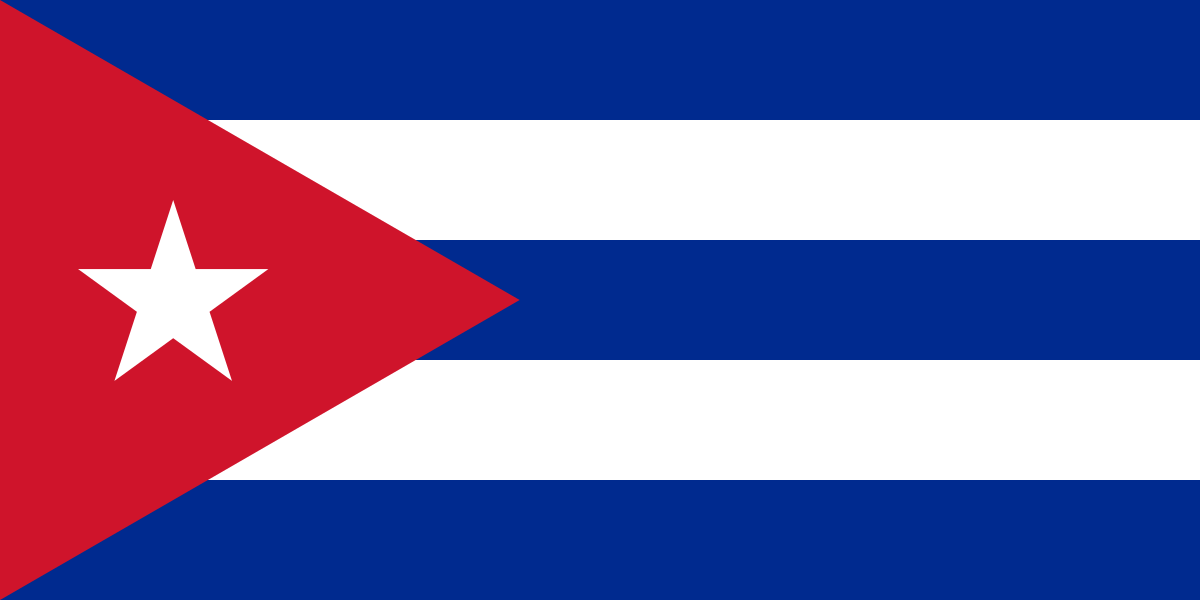
Cuba’s national flag: five equal blue-and-white stripes, a red equilateral triangle, and one white five-pointed star.
GKBook original vector drawing; geometry from the cited source. Digital colors are editorial renderings.Download image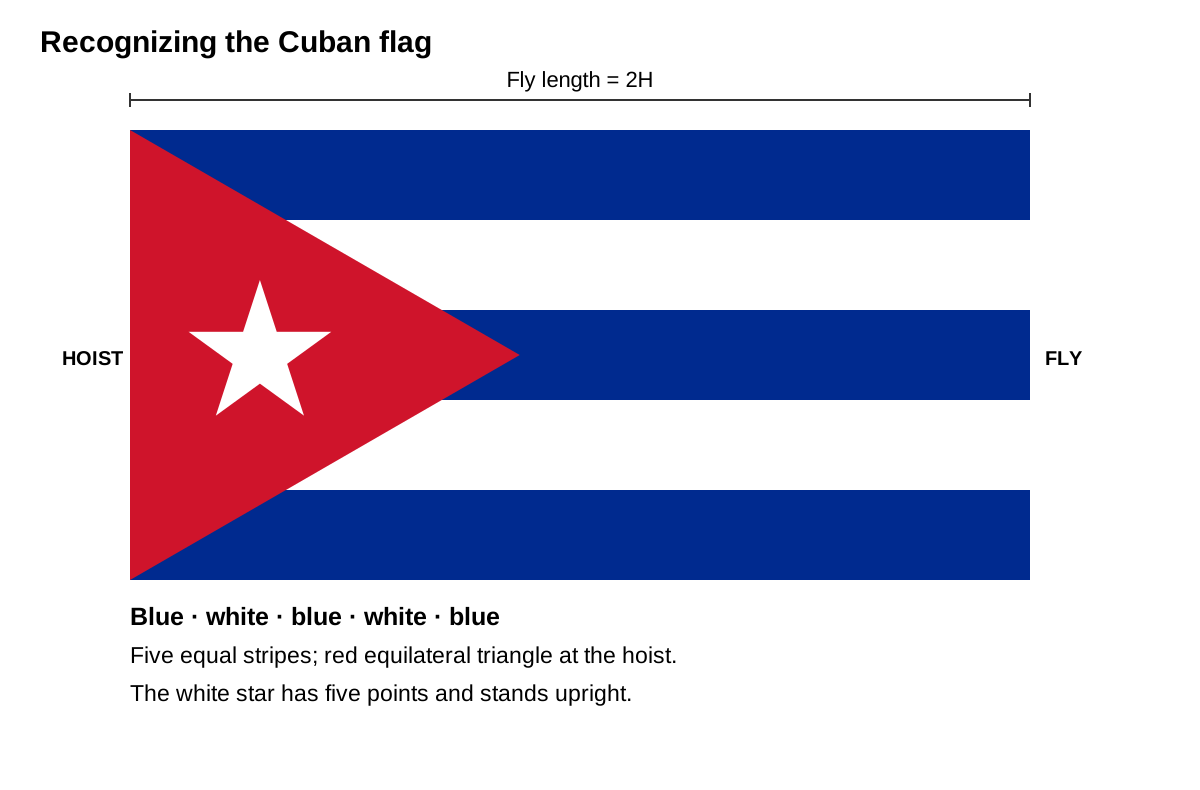
The hoist is the attached edge; the fly is the free end. Blue stripes occupy the top, center, and bottom.
GKBook original vector drawing; geometry from the cited source. Digital colors are editorial renderings.Download image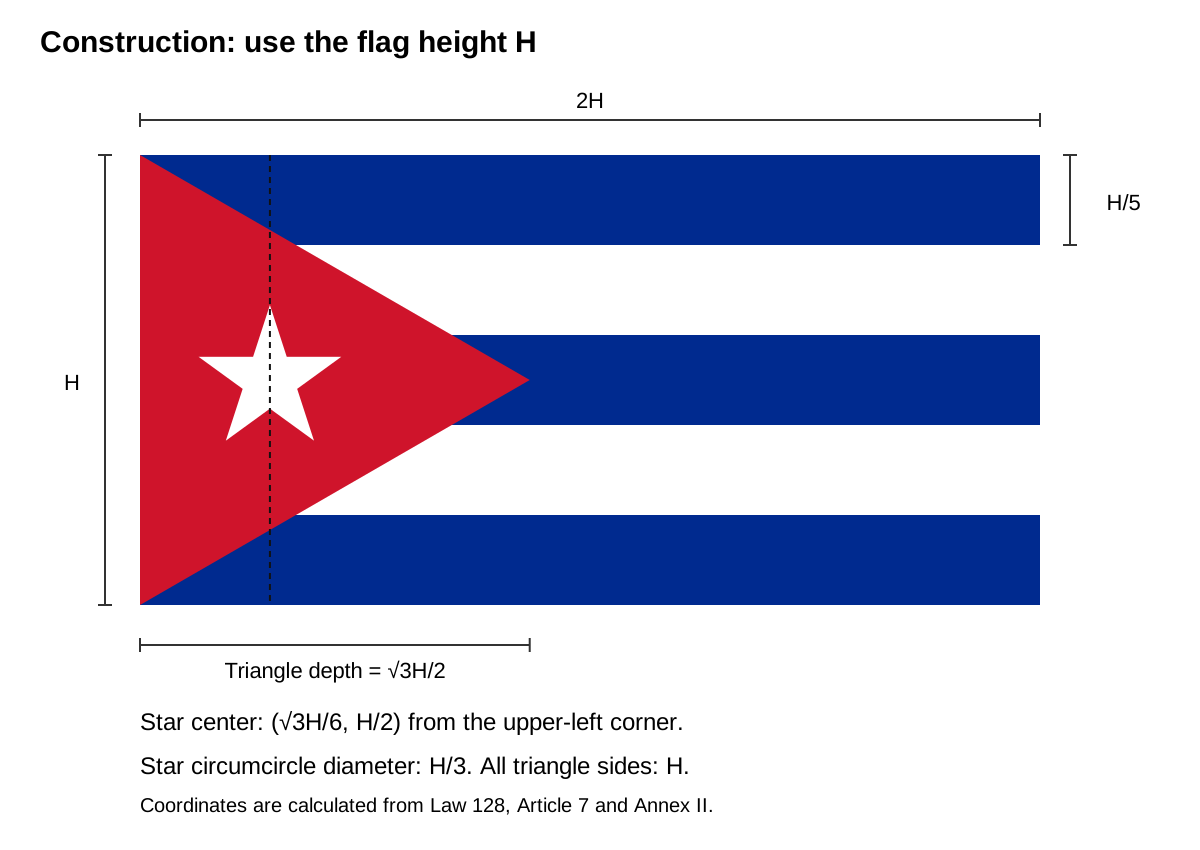
Exact proportions from Law 128, Article 7 and Annex II. The coordinate formulas are calculated consequences of the prescribed geometry.
GKBook original vector drawing; geometry from the cited source. Digital colors are editorial renderings.Download image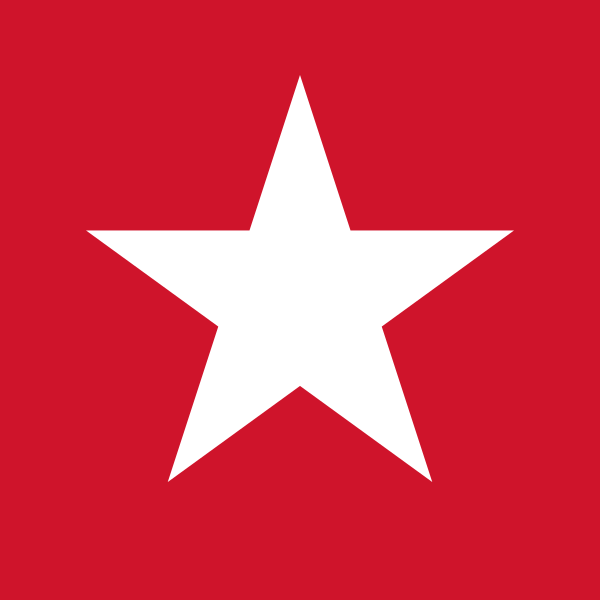
A regular white five-pointed star on the flag’s red background; one point faces upward.
GKBook original vector drawing; geometry from the cited source. Digital colors are editorial renderings.Download image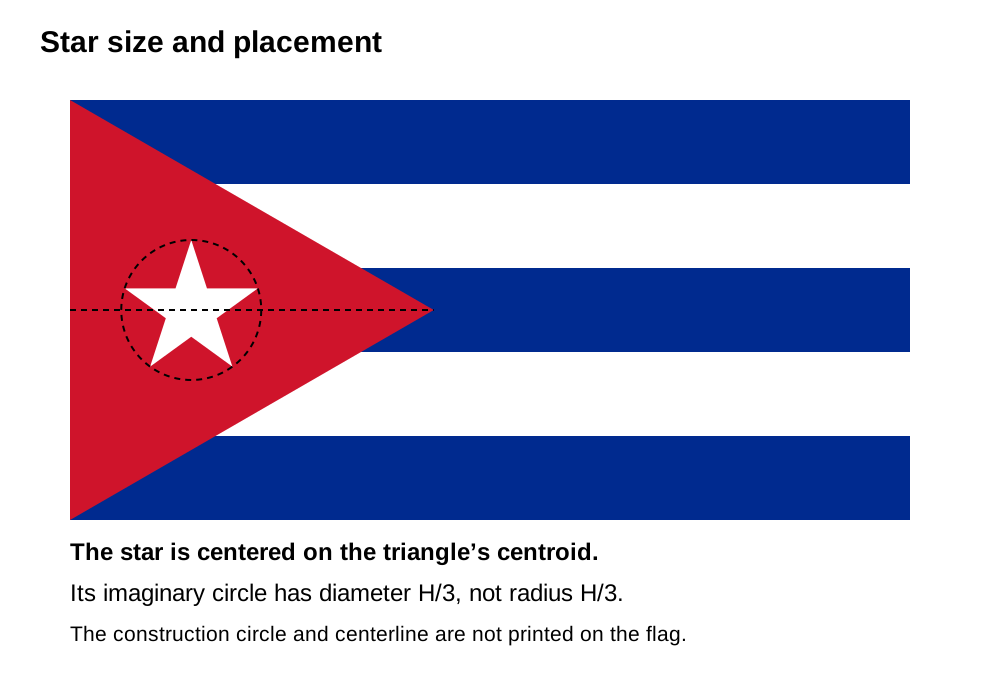
The dashed guides explain the legal star diameter and the center of the equilateral triangle; they are not part of the national flag.
GKBook original vector drawing; geometry from the cited source. Digital colors are editorial renderings.Download image
The Céspedes flag in its 2019 legal form: a red canton with a white star, white upper fly, and blue lower half.
GKBook original vector drawing; geometry from the cited source. Digital colors are editorial renderings.Download image
Annex II defines the Céspedes canton using the golden ratio. This drawing follows the present legal model, not an asserted reconstruction of the 1868 textile.
GKBook original vector drawing; geometry from the cited source. Digital colors are editorial renderings.Download image
Cropped hoist details show the reversed red-and-blue arrangement. This identification graphic does not prescribe Puerto Rican overall proportions or star dimensions.
GKBook original vector drawing; geometry from the cited source. Digital colors are editorial renderings.Download image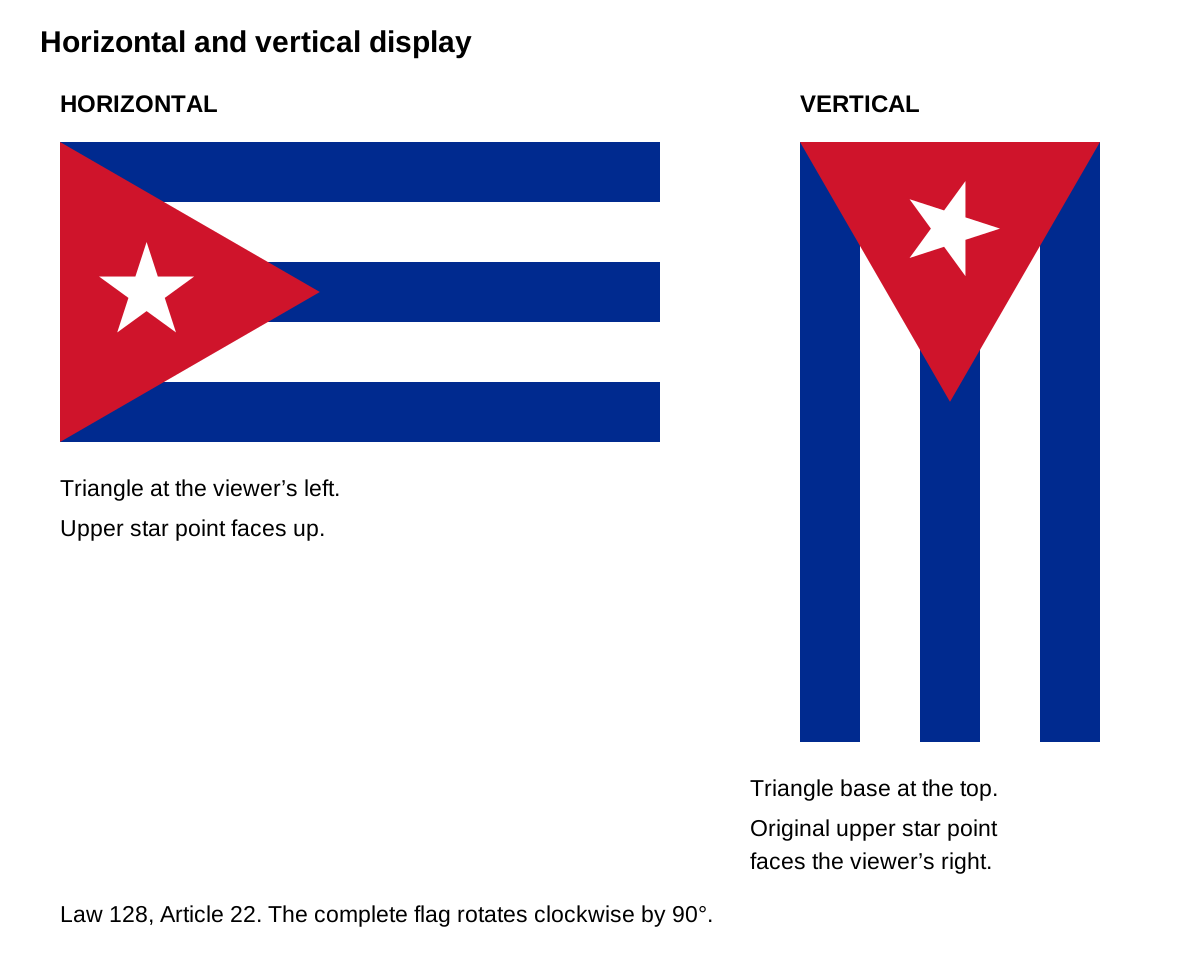
Article 22 requires the triangle base at the top in vertical display and the original upper star point facing the viewer’s right.
GKBook original vector drawing; geometry from the cited source. Digital colors are editorial renderings.Download image
Cuban law places the half-mast position one flag-height below the pole’s top; the diagram’s pole length is illustrative.
GKBook original vector drawing; geometry from the cited source. Digital colors are editorial renderings.Download image
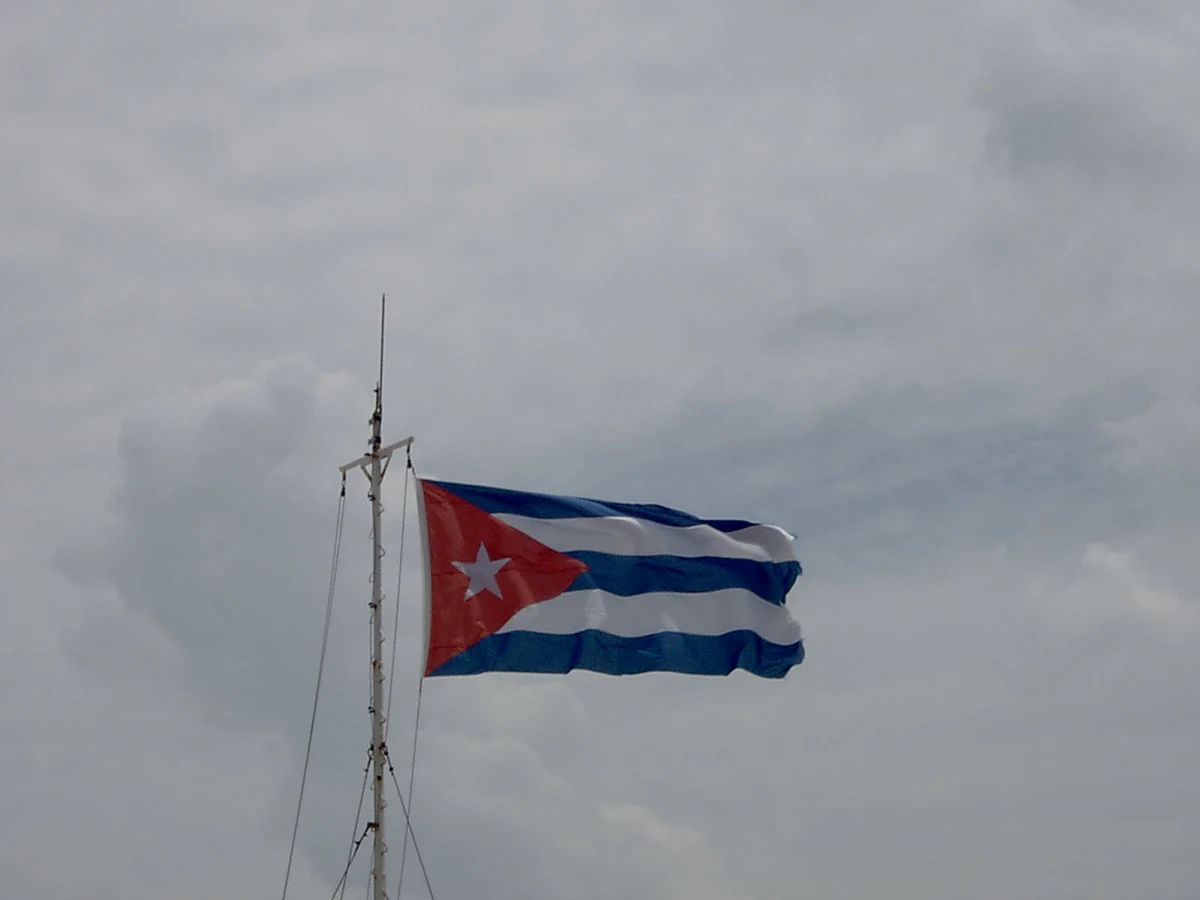
Cuba’s flag flies at El Morro castle in Havana, photographed by Angelo Lucia in August 2006.
Angelo Lucia (Lucha), CC BY-SA 3.0. Resized and converted to WebP; no crop. Image credit and license.Download image
An official Cuban flag plate associated with the January 6, 1906 law and April 24, 1906 presidential decree.
Departamento de Estado de la República de Cuba, 1906; public-domain source via Wikimedia Commons. Resized and converted to WebP. Image credit and license.Download image
Page 1603 of Cuba’s Official Gazette, September 19, 2019, shows the national and Céspedes flag construction diagrams.
Asamblea Nacional del Poder Popular / Gaceta Oficial, 2019. Official legal-document facsimile; resized and converted to WebP. Image credit and license.Download imageFrequently asked questions
What does the flag of Cuba look like?
Cuba’s flag has five equal horizontal stripes, alternating blue and white, with blue at the top, center, and bottom. A red equilateral triangle occupies the hoist. One white five-pointed star sits at its center. The flag is twice as wide as it is high.
When was the Cuban flag adopted?
Cuba’s Law 128 records adoption at the Assembly of Guáimaro on April 11, 1869. The first raising on Cuban soil occurred earlier, on May 19, 1850. May 20, 1902 marks the inauguration of the Republic using the existing flag, rather than the creation of its design.
Where was the Cuban flag first raised in Cuba?
The lone-star flag was first raised on Cuban soil at Cárdenas on May 19, 1850, during Narciso López’s expedition. That event is distinct from the design’s origin among exiles in New York and from its later adoption by the Assembly of Guáimaro in 1869.
Who designed and sewed the Cuban flag?
Miguel Teurbe Tolón is credited with drawing the design in New York in 1849 from ideas associated with Narciso López. Emilia Teurbe Tolón sewed an early example. Political sponsorship, graphic design, sewing, and later legal adoption are separate contributions to the flag’s history.
What does the white star mean?
Article 6 of the 2019 national-symbols law associates the white five-pointed star with a free, independent, sovereign republic and the unity of Cubans. It is a single star, which explains the name “Flag of the Lone Star.” It does not count provinces or administrative districts.
What do the three blue stripes represent?
The blue stripes recall the colonial administrative division of Cuba when the flag was designed. Article 6 also links them to the aspirations of Cuban patriots. They do not represent the country’s current number of provinces, and their meaning should not be inferred from a modern administrative map.
What do the red triangle and white stripes symbolize?
The red color recalls blood shed in the struggle, while the equilateral triangle expresses liberty, equality, and fraternity. The white stripes signify purity of ideals and the virtue of Cubans. These meanings appear in Article 6 of Law 128; they are not merely an unsourced modern interpretation.
What is the Cuban flag’s aspect ratio?
The Cuban national flag has a width-to-height ratio of 2:1, equivalent to 1:2 when written height first. Its five stripes each occupy one-fifth of the height. Article 7 prescribes these relationships, and the construction annex illustrates how the elements fit together within the rectangle.
How large is the star on the Cuban flag?
The star fits inside an imaginary circle whose diameter equals one-third of the flag’s height. The diameter is not the radius. The circle is centered in the equilateral triangle, and one star point faces upward in normal horizontal display. The circle itself is not printed on the flag.
Where exactly should the star be centered?
The star is centered on the equilateral triangle’s centroid. If the flag height is H, that point lies √3H/6 from the hoist and H/2 below the top. These coordinates are calculated from the legal triangle geometry; the star is not centered across the whole flag.
Does Cuban law prescribe official Hex or Pantone colors?
The examined 2019 law and its annex name deep blue, white, and red but do not supply Hex, RGB, CMYK, or Pantone specifications. This page identifies its own digital color choices explicitly. Those screen values should not be described as official textile standards or legally mandated color coordinates.
Was the Cuban flag invented in 1959?
No. Its design emerged in the nineteenth century, and Law 128 records adoption in 1869. The 1906 official plate also predates the Revolution. January 1, 1959 is the political event commemorated by Cuba’s National Day, not the origin of the red-triangle and blue-striped national flag.
How does Cuba’s flag differ from Puerto Rico’s?
Cuba has three blue stripes and a red triangle; Puerto Rico has three red stripes and a blue triangle. Both have two white stripes and one white five-pointed star. Checking those color positions is more dependable than comparing the brightness of photographs or different digital renderings.
What is the flag of Carlos Manuel de Céspedes?
The Céspedes flag is a separately recognized historical flag associated with the October 10, 1868 uprising at La Demajagua. Its present legal form has a red canton with a white star, white upper fly, and blue lower half. It is honored alongside the national flag in specified settings.
Why are two Cuban flags displayed in Parliament?
Law 128 requires the flag of Carlos Manuel de Céspedes to appear in a place of honor alongside the national flag in the National Assembly’s meeting room. This preserves the historical status of the flag raised at La Demajagua without replacing the lone-star flag as the national flag.
Is the Céspedes flag used as a naval jack?
Yes. The law prescribes the Céspedes flag at the bows of warships under the armed-forces ministry’s rules. It has a different function from the national flag at the stern. Article 20 separately covers national-flag display by Cuban civilian vessels and warships approaching or arriving at foreign ports.
Is May 19 the same as Cuba’s National Day?
No. May 19 is the anniversary of the first raising of the lone-star flag on Cuban soil in 1850. Cuba’s National Day is January 1, commemorating the Revolution’s triumph in 1959. This article does not present the first-raising anniversary as a separately verified statutory Flag Day.
Can individuals display Cuba’s flag at home or on a vehicle?
Article 33 allows individuals to display the flag at residences and workplaces, carry it in public events, and use it on vehicles, subject to respect and care. That provision sets no specific size. It is separate from Article 10’s specified sizes for certain official vehicles and institutional settings.
What material is used to make the Cuban flag?
Article 9 prefers polyamide fabric but also permits silk, silk satin, and another suitable fabric or material meeting the law’s requirements for construction, durability, and use. It does not require one exclusive traditional weave or supplier. The prescribed geometry and placement of the elements must still be respected.
Are only certain Cuban flag sizes allowed?
Article 10 lists sizes for particular institutional, ceremonial, vehicle, and maritime contexts, but its final paragraph permits other sizes appropriate to the space. Article 33 sets no specific size for individuals’ use. The overall 2:1 proportion and the correct internal design remain separate requirements.
How should the Cuban flag hang vertically?
The base of the red triangle must be at the top, and the star’s original upper point must face the observer’s right. Article 22 states both conditions. Rotate the entire horizontal flag clockwise by 90 degrees; do not rotate the star independently within the triangle.
Can the Cuban flag be displayed alongside other nations’ flags?
Yes. Article 15 requires separate staffs of equal height and simultaneous raising and lowering when Cuba’s flag appears with other national flags. Other provisions define its position of honor. Rules placing organizational flags below the Cuban flag should not be mistaken for rules governing other nations’ flags.
Can a Cuban flag be flown at night?
The law sets rules by context rather than one universal night-display prohibition. Diplomatic premises abroad display it permanently, while operational vessels normally fly it from sunrise to sunset. Schools and public events have their own provisions. Individuals’ use is separately addressed in Article 33.
Can Cuba’s national symbols appear on clothing?
Article 80 permits respectful representations on clothing but limits placement and excludes items including underwear, swimwear, towels, handkerchiefs, aprons, and footwear. This is not unrestricted permission to alter the flag itself or use it as any kind of covering. The context and dignity of the representation matter.
Can people write or sign messages on the Cuban flag?
No. Article 44 prohibits stamping, writing, painting, or signing on the national flag. It also prohibits using a torn, deteriorated, or faded flag. A separate written message displayed near a correctly reproduced flag should not be confused with adding words or signatures to the flag itself.
What does half-mast mean under Cuban law?
Article 26 defines the position as one flag-height below the top of the staff on decreed national or official mourning days. Raise the flag fully before lowering it to that position. Before the final lowering, raise it briefly to the top again. It is not automatically half the pole’s height.
How is the Cuban flag folded?
Article 25 preferably assigns the task to two people. They fold the flag in half across its height, then in half again with the visible star face downward. Triangular folds proceed from the striped end until the flag forms a triangle. Keep it clear of the ground and water throughout.
Can the Cuban flag cover a coffin?
Yes, in the authorized cases specified by Articles 39 and 40. The triangle lies over the chest during viewing and over the head during transport, with the star’s upper point toward the deceased’s left shoulder. The flag is removed and folded before the coffin or urn is lowered into the grave.
How should a damaged Cuban flag be retired?
Article 46 says a torn, deteriorated, or faded flag is respectfully incinerated if it will not be preserved as a historical object. Article 45 separately requires secure indoor storage when a flag is not in use. The historical-object exception protects the possibility of conserving important surviving textiles.
Explore all general-knowledge topics and the A-to-Z lists.

We Value Your Opinion Comments