
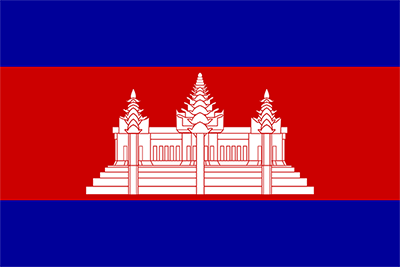
Cambodia flag picture

| Name | Tung Cheat Kampuchea (ទង់ជាតិកម្ពុជា — the national flag) |
|---|---|
| Adopted | October 29, 1948 (the kingdom) Restored June 30, 1993 — in the Constitution of September 24, 1993 |
| Designer | Not recorded |
| Proportion | 25 : 16 (fly : hoist) |
| Law | Constitution of 1993, Article 4 |
The Cambodian flag is a red band between two of blue, with the towers of Angkor Wat in white at its center — the nation in red, the King in blue, religion in the white temple — the flag of the kingdom of 1948, restored with the monarchy in 1993, and the only national flag whose emblem is a building.
An overview
The national flag of Cambodia is a red band between two bands of blue, in the proportion 1:2:1, with the temple of Angkor Wat in white at the center of the red. It is the only national flag whose emblem is a building, and the Constitution fixes it, by drawing, at 16:25.
A temple has stood on the flag longer than anything else on it. The French protectorate put Angkor Wat at the center of a red-and-blue flag in the 1870s; the kingdom rearranged the colors into blue, red and blue on October 29, 1948, and flew that flag to independence in 1953 and through the Sihanouk years. Then came seven others: Lon Nol’s republic with its three stars, the Khmer Rouge’s red with a yellow temple, the Vietnamese-backed republic’s five towers, the State of Cambodia’s red over blue, and the United Nations’ light blue with a map. In 1993 the elected assembly restored the flag of 1948, and the Constitution of September 24 restored the monarchy with it.
Red for the Nation, white for Religion, blue for the King — the three words of the national motto on one cloth.
Angkor Wat
At the center of the flag stands a building: the temple of Angkor Wat, seen from the front in white with a black outline — three towers, the tallest in the middle, on a stepped base. The real temple has five; from the causeway only three show, and the flag draws what the pilgrim sees. Built by Suryavarman II in the first half of the 12th century as the state temple of the Khmer Empire, it is the largest religious monument in the world, and in Khmer cosmology its towers are Mount Meru, the axis of the universe, with the gods’ sanctuary at the summit.
A temple has been on Cambodia’s flag since the French protectorate put one there around 1875, and every regime since has kept it — the kingdom in white, Lon Nol’s republic in a canton, the Khmer Rouge in yellow with three towers, the Vietnamese-backed republic in yellow with five. Only the United Nations’ transitional flag of 1992 had a map instead. The three colors around the temple are the three words of the national motto: red for the Nation, white for Religion, blue for the King. Together with Portugal, Spain and San Marino, whose arms hold castles and towers, Cambodia’s is one of four national flags to show a building — and the only one on which the building is the whole emblem.
Official color specification
The Constitution shows the flag as a drawing and names no shade; the Ministry of Foreign Affairs publishes the colors in CMYK for printers and flagmakers, and those values are the nearest thing to a standard. The hex values below are the common matches.
| Color | Hex | Standard | RGB |
|---|---|---|---|
| Blue | #032EA1 | CMYK 100-58-0-57 (Ministry of Foreign Affairs) | 3, 46, 161 |
| Red | #E00025 | CMYK 0-100-100-0 (Ministry of Foreign Affairs) | 224, 0, 37 |
| White | #FFFFFF | CMYK 0-0-0-0 — the temple | 255, 255, 255 |
| Black | #000000 | CMYK 0-0-0-100 — the temple's outline | 0, 0, 0 |
Symbolism and meaning
The flag is the national motto made visible — Nation, Religion, King — and the readings below are the ones the government gives.
Red and blue have been the colors of Cambodia since the protectorate; the temple has been on the flag since the 1870s.
Design and official specification
The Constitution’s drawing is 16:25 — an unusual proportion that most manufacturers round to 2:3 — in bands of 1:2:1, with the temple centered on the red and drawn from the front: three towers on a three-tiered base, the central tower tallest, in white with a black outline. The ceremonial flag hangs the bands vertically with the temple upright.
| Element | Specification | Reference |
|---|---|---|
| Hoist (height) | 16 | 96 cm (37.8 in) on the reference flag |
| Fly (length) | 25 | 150 cm (59.1 in) |
| Ratio | 16 : 25 | The Constitution's drawing; 2:3 in common manufacture |
| Bands | Three horizontal — blue, red, blue — in the proportion 1 : 2 : 1 | Blue 24 cm (9.4 in), red 48 cm (18.9 in), blue 24 cm |
| The temple | Angkor Wat seen from the front, in white with a black outline, centered on the red band — three towers, the central one tallest, on a three-tiered base | About three-quarters of the red band's height |
| The description in law | The Constitution shows the flag as a drawing, without text | Constitution of September 24, 1993, Article 4 |
| Vertical flag | The ceremonial flag hangs the three bands vertically, the temple upright | — |
How the flag evolved
A temple on every flag but one, through a protectorate, a kingdom, a republic, three red regimes and the United Nations — the story in five moves.
1863
The protectorate's temple

Before the French, the kings of Cambodia flew a yellow pennant bordered in green. Under the protectorate of 1863 the kingdom took a flag of red bordered in blue, and from about 1875 the white silhouette of Angkor Wat stood at its center — the first temple on the flag. The French tricolor flew beside it, and the design lasted through the Japanese occupation of 1941–45.
1948
Blue, red, blue

On October 29, 1948, in the last years before independence, the kingdom rearranged its colors into three horizontal bands — blue, a double band of red, blue — with the temple in white on the red. Independence came on November 9, 1953, under this flag; King Norodom Sihanouk abdicated to rule as head of state, and the flag flew for 22 years.
1970
The republic's stars

General Lon Nol deposed Sihanouk in March 1970 and proclaimed the Khmer Republic on October 9; its flag, fixed by Article 4 of the constitutional law of October 7, moved the old flag into a red canton and set three white stars on a blue field — for the nation, religion and republic, the three powers of the state, and the three regions of the land.
1976
Three red flags

The Khmer Rouge took Phnom Penh on April 17, 1975, under a plain red flag; the constitution of Democratic Kampuchea of January 1976 set a yellow three-towered temple on the red. The Vietnamese-backed People's Republic of Kampuchea of January 1979 gave the temple five towers, and the State of Cambodia of May 1, 1989, made the lower half of the flag blue. Between them the three red flags flew for seventeen years.
1993
The kingdom restored
The Paris Peace Accords of 1991 put Cambodia under a United Nations transitional authority, whose light-blue flag with a white map of the country flew from 1992 beside the State of Cambodia's. After the election of May 1993 the Constituent Assembly restored the flag of 1948 on June 30, and the Constitution of September 24, 1993, restored the monarchy and fixed the flag, by drawing, in Article 4. The temple's outline, once red, is now black.
Who designed the Cambodian flag?
No one is recorded, because the flag was assembled rather than designed. The temple came from the protectorate’s flag of the 1870s, whose author is unknown; the red and blue were the kingdom’s colors already; the royal government of 1948 rearranged them into the three bands of today; and the Constituent Assembly of 1993, restoring the monarchy, restored the flag of 1948 rather than commissioning a new one. The one change the restoration made was small — the temple’s outline, once drawn in red, is now black.
The designer of the flag the world saw for eighteen months, the United Nations’ light blue with a white map, is unrecorded too.
November 9 and September 24
Cambodia keeps no flag day. The flag’s great days are Independence Day, November 9 — the independence of 1953, kept with a ceremony and a parade at the Independence Monument in Phnom Penh, the King presiding — and Constitution Day, September 24, the anniversary of the day in 1993 that restored the flag and the monarchy together. The King’s birthday in May and the Water Festival in November fill the boulevards with it; and every school morning begins with the flag and “Nokor Reach.”
Legal status and display rules
The flag rests on Article 4 of the Constitution of 1993, which fixes it by a drawing together with the anthem, the motto and the arms, and on the Ministry of Foreign Affairs’ color standard. Cambodia has no separate flag code; the rules of display are the Royal Government’s protocol, tabled here.
| Provision | The rule |
|---|---|
| The instruments | Article 4 of the Constitution of 1993, which fixes the flag, the anthem "Nokor Reach," the motto "Nation, Religion, King" and the arms; the Ministry of Foreign Affairs' color standard; the protocol of the Royal Government |
| Where it flies | On the Royal Palace, the National Assembly and the Senate, the ministries, the provincial halls, the schools, the pagodas on national days, the embassies, and the Angkor temples themselves |
| Ceremony | Raised in the morning and lowered in the evening at public institutions; the flag-raising with the anthem at schools each morning, restored as a national habit in the 2000s |
| Precedence | The national flag in the place of honor; the royal standard flies where the King is present; the ASEAN flag beside it on state buildings since 1999 |
| Respect | Not used as a covering or in commerce; its desecration an offense; the temple must be drawn correctly, three towers to the front |
| The arms | The royal arms — two lions bearing parasols on either side of a sword and the royal crown, over the motto — reserved to the King and the government |
| Standardization | No Pantone in law; the Ministry of Foreign Affairs' CMYK sheet and the Constitution's 16:25 drawing are the standards |
Half-mast and mourning
Mourning is declared by royal decree, and the longest of recent memory was for the King Father.
| Provision | The rule |
|---|---|
| When | In periods of national mourning declared by royal decree — seven days for King Father Norodom Sihanouk in October 2012, and for Queen Mother Norodom Monineath; after disasters and the border fighting of 2025 |
| How | The flag is flown at half-mast on public buildings for the days the decree names; black ribbons on the flag at the Royal Palace |
Things you may not know
Three towers for a temple with five. Angkor Wat has five towers, but from the causeway only three are seen — and the flag, like the pilgrim, shows three.
Eight flags in a lifetime. A Cambodian born in 1940 has lived under the protectorate’s flag, the kingdom’s, the republic’s, the Khmer Rouge’s, the People’s Republic’s, the State of Cambodia’s, the United Nations’ and the kingdom’s again.
A proportion nobody uses. The Constitution’s drawing is 16:25; almost every flag actually made is 2:3.
Frequently asked questions
What does the flag of Cambodia look like?
Three horizontal bands — blue, a double-width red, blue — with the temple of Angkor Wat in white, outlined in black, at the center of the red band. The Constitution's drawing gives it a proportion of 16:25; flags for hand and window are usually made at 2:3. It is the flag of the kingdom of 1948, restored with the monarchy in 1993.
What do the colors of the Cambodian flag mean?
They are the three words of the national motto, Nation, Religion, King: red for the nation and the bravery of its people; white — the temple — for religion, and for the integrity, justice and heritage of the nation; blue for the King and the monarchy that surrounds the nation, and for liberty, cooperation and brotherhood.
What building is on the flag of Cambodia?
Angkor Wat, the temple built by Suryavarman II in the early 12th century as the state temple of the Khmer Empire — the largest religious monument in the world and a World Heritage site since 1992. The flag draws it from the front, so three of its five towers show. A temple has been on the flag since the 1870s, and every regime since has kept one, in white or in yellow.
Is Cambodia's the only flag with a building on it?
It is the only national flag whose emblem is a building by itself. Three others show buildings inside their coats of arms — the castles of Portugal and Spain and the towers of San Marino — but only Cambodia's puts the building alone at the center of the cloth.
When was the Cambodian flag adopted?
In its present form on October 29, 1948, for the kingdom in the last years of the French protectorate. It was replaced by the Khmer Republic in October 1970, by the Khmer Rouge in 1975–76, by the People's Republic of Kampuchea in 1979 and by the State of Cambodia in 1989, and restored by the Constituent Assembly on June 30, 1993, and in Article 4 of the Constitution of September 24, 1993.
What was the Khmer Rouge flag?
A plain red flag in 1975, and from the constitution of Democratic Kampuchea of January 1976 a red flag with a yellow three-towered silhouette of Angkor Wat. The Vietnamese-backed People's Republic of Kampuchea that replaced the Khmer Rouge in 1979 used a red flag with a five-towered yellow temple, taken from the Khmer Issarak of the 1940s.
Who designed the Cambodian flag?
No designer is recorded. The temple on the flag dates from the protectorate of the 1870s, and the arrangement of blue, red and blue from the royal government of 1948; the Constituent Assembly of 1993 restored the design rather than commissioning one.
What are the official colors of the Cambodian flag?
The Constitution shows the flag as a drawing without naming shades. The Ministry of Foreign Affairs gives them in CMYK — blue 100-58-0-57, red 0-100-100-0, with the temple in white and its outline in black; the common hex matches are blue #032EA1 and red #E00025.
Does Cambodia have a flag day?
No. The flag's great days are Independence Day, November 9 — the independence of 1953, kept with a ceremony at the Independence Monument in Phnom Penh — and Constitution Day, September 24, the day the flag and the monarchy were restored in 1993. The King's birthday, May 14, and Water Festival fill the streets with it too.
Explore all general-knowledge topics and the A-to-Z lists.

We Value Your Opinion Comments