
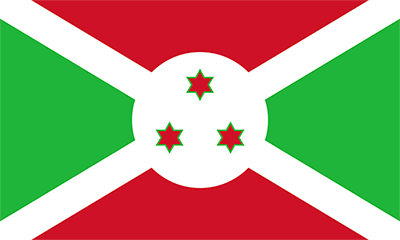
Burundi flag picture

| Name | Ibendera ry'Uburundi (the national flag) |
|---|---|
| Adopted | June 28, 1967 (the three stars) September 27, 1982 (3:5) |
| First flag | July 1, 1962 — with the royal drum |
| Proportion | 5 : 3 (fly : hoist) |
| Law | Constitution of 2018, Article 8; decree of 1982 |
The Burundian flag is a white saltire dividing red above and below from green at the hoist and fly, with a white disc at the center bearing three red six-pointed stars — peace between the struggle and hope, and three stars for Unity, Work, Progress, and for the Hutu, Tutsi and Twa.
An overview
The national flag of Burundi is a white saltire — a diagonal cross from corner to corner — dividing the field into four triangles, red above and below and green at the hoist and fly, with a white disc at the crossing that bears three red six-pointed stars outlined in green. The proportion is 3:5. It is one of only a handful of national flags built on a saltire, and the only one in Africa.
The saltire has flown since independence on July 1, 1962, when the disc held the karyenda, the sacred drum of the kings, and a sorghum plant. The monarchy fell in 1966 and the drum came off; on June 28, 1967, the republic put three stars in its place — for the motto Unity, Work, Progress, and by the reading everyone gives them, for the Hutu, the Tutsi and the Twa. The decree of September 27, 1982, stretched the flag from 2:3 to 3:5, and the Constitution of 2018 names it, with the arms, the anthem and the motto, in Article 8.
White for peace, red for the suffering of the struggle, green for hope: the readings have held through a civil war and three constitutions, and so has the flag.
The three stars
In the white disc at the crossing of the saltire stand three six-pointed stars — red, outlined in green, one above and two below. Officially they are the three words of the national motto, Unité, Travail, Progrès — Unity, Work, Progress — written in Kirundi on the arms as Ubumwe, Ibikorwa, Iterambere. By the reading every Burundian gives them, they are also the three peoples of the country: the Hutu, the Tutsi and the Twa, set in one circle of white.
The stars replaced a drum. The flag of independence in 1962 carried in its disc the karyenda, the sacred drum of the mwami — the king — with a sorghum plant for prosperity; when the monarchy fell in November 1966 the drum came off, and the stars came on in June 1967. Around them the flag kept its old form: a white saltire, a device the Belgians may have brought from the Burgundian cross of their own past, dividing the red of the struggle from the green of hope. The proportion was fixed at 3:5 in 1982, and nothing has changed since.
Official color specification
No Burundian instrument fixes the shades: the Constitution names the flag, and the decree of 1982 its proportion. The values below are those the standard references carry — a clear red and a bright green, with the same green outlining the stars.
| Color | Hex | Pantone | RGB |
|---|---|---|---|
| Red | #CE1126 | not fixed in law | 206, 17, 38 |
| Green | #1EB53A | not fixed in law | 30, 181, 58 |
| White | #FFFFFF | White | 255, 255, 255 |
Symbolism and meaning
The meanings were given with the flag in 1962 and have not changed; the stars added their own in 1967.
The stars are six-pointed, red with a green edge — the country’s two colors held together in each.
Design and official specification
The decree of 1982 fixes the proportion at 3:5; the rest of the geometry is the convention of the construction sheets — a saltire of arms about a ninth of the height, a disc of about half the height at the crossing, and three stars in a triangle within it. The flag is one of the few national flags whose central device sits on a saltire rather than a field.
| Element | Specification | Reference |
|---|---|---|
| Hoist (height) | 3 | 90 cm (35.4 in) on the reference flag |
| Fly (length) | 5 | 150 cm (59.1 in) |
| Ratio | 3 : 5 | The decree of September 27, 1982 — 2:3 before |
| The saltire | A white diagonal cross from corner to corner, each arm about one-ninth of the height wide | About 10 cm (3.9 in) |
| The fields | Red in the upper and lower triangles, green in the hoist and fly triangles | — |
| The disc | A white circle at the center, its diameter about half the height, merging with the saltire | About 45 cm (17.7 in) |
| The stars | Three red six-pointed stars outlined in green, one above and two below, in a triangle | Since June 28, 1967 |
| The description in law | The flag with its saltire, disc and three stars, as the emblem of the nation | Constitution of 2018, Article 8 — in substance |
How the flag evolved
A king’s drum, a plant alone, three stars, and a decree that lengthened the cloth — the flag’s story in four moves.
1962
The king's drum

Authorized by Mwami Mwambutsa IV on March 30, 1962, and hoisted at independence from Belgium on July 1, the first flag set the karyenda — the sacred drum of the kings, believed to hold divine power — and a sorghum plant, for prosperity, in a white disc at the crossing of a white saltire, on red and green. The saltire itself may have come from Belgium's own past, the Burgundian cross of the Spanish Netherlands.
1966
The drum removed

The monarchy fell twice in 1966 — Prince Ntare V deposed his father in July, and Captain Michel Micombero deposed Ntare on November 28 and proclaimed a republic. The royal drum was taken off the flag in September, leaving the sorghum plant alone in the disc for a few weeks; with the republic, the plant went too.
1967
Three stars

On June 28, 1967, the republic placed three red six-pointed stars, outlined in green, in the disc — for the motto Unity, Work, Progress, and, by the common reading, for the Hutu, the Tutsi and the Twa. The flag was made at 2:3, as it had been since independence, and it flew at that shape for fifteen years.
1982
Fixed at 3:5
The decree of September 27, 1982, under President Jean-Baptiste Bagaza, reconfirmed the design and fixed its proportion at 3:5. The flag has flown unchanged through the war of 1993–2005, the Arusha peace, and the constitutions of 2005 and 2018, which name it in Article 8 as the emblem of the nation.
Who designed the Burundian flag?
No one is recorded. The saltire flag of 1962 was prepared by the kingdom’s government in the months before independence and authorized by Mwami Mwambutsa IV on March 30 that year; the vexillological references list its designer as unknown, and Britannica notes only that the saltire may have been borrowed from Belgium’s own heraldic past — the Burgundian cross that the Spanish Netherlands flew from the 17th century. The stars of 1967 were the republic’s, and the decree of 1982 President Bagaza’s.
What is known is what the flag chose to keep: through a monarchy, two republics and a war, the white cross and the red and green of the first day.
July 1
Burundi keeps no flag day. The flag’s day is Independence Day, July 1 — the anniversary of the first hoisting in 1962 — kept with a parade before the president at Gitega and the drummers of Burundi, whose royal drums the flag once carried. Unity Day, February 5, marks the Charter of National Unity of 1991; and the flag is lowered on the memorial days of the presidents Melchior Ndadaye, October 21, and Cyprien Ntaryamira, April 6.
Legal status and display rules
The flag rests on Article 8 of the Constitution of 2018, which names it with the arms, the anthem and the motto as the symbols of the state, and on the decree of September 27, 1982, which fixed its proportion. Burundi has no separate flag code; the rules of display are the state’s protocol, tabled here.
| Provision | The rule |
|---|---|
| The instruments | Article 8 of the Constitution of June 7, 2018 (as of the constitutions of 1992 and 2005 before it), which names the flag, the arms, the anthem and the motto; the decree of September 27, 1982, on the proportions; the state's protocol |
| Where it flies | On the Presidency at Gitega and the offices in Bujumbura, the National Assembly and the Senate, the ministries, the provincial and communal offices, the schools, the courts and the embassies |
| Ceremony | Raised in the morning and lowered at nightfall at public institutions; hoisted to the anthem, "Burundi Bwacu," at formal ceremonies; the flag-raising in schools each week |
| Precedence | The national flag in the place of honor; the flag of the East African Community beside it on state buildings since 2007 |
| Respect | Not used as a covering or in commerce; its desecration punishable under the Penal Code |
| The arms | The lion's head on a red shield before three crossed spears, over the motto — adopted with the republic in 1966; the flag and the arms carry the same motto |
| Standardization | No Pantone or construction sheet is fixed in law beyond the 3:5 of 1982 |
Half-mast and mourning
Mourning is the President’s to decree; two days of it return each year.
| Provision | The rule |
|---|---|
| When | In periods of national mourning decreed by the President — after disasters and on the death of former heads of state; and on the memorial days of Ntaryamira, April 6, and Ndadaye, October 21 |
| How | The flag is flown at half-mast on public buildings for the days the decree names |
Things you may not know
Africa’s only saltire. Diagonal crosses carry Scotland’s and Jamaica’s flags; Burundi’s is the only saltire among the flags of Africa, and among the few in the world to hold a device at the crossing.
The flag once carried a drum you could not touch. The karyenda of 1962 was beaten only for the king and kept in a sacred enclosure; the flag of a republic could not keep it, and the stars took its place.
Six points, not five. Burundi’s stars are six-pointed — rare on national flags, shared only with Israel’s Star of David and a few others — and each is red edged in green, the flag’s two colors in one.
Frequently asked questions
What does the flag of Burundi look like?
A white diagonal cross — a saltire — dividing the flag into four triangles, red above and below and green at the hoist and fly, with a white disc at the center bearing three red six-pointed stars outlined in green, one above and two below. The proportion is 3:5. The stars date from June 28, 1967, and the proportion from the decree of September 27, 1982.
What do the colors of the Burundian flag mean?
White for peace — the saltire and the disc; red for the suffering of the nation in its struggle for independence, and the blood shed for it; green for hope, the hopes placed in the country's development. The readings are Britannica's and the state's alike.
What do the three stars on the Burundian flag mean?
Officially, the three words of the national motto — Unité, Travail, Progrès, Unity, Work, Progress. By the reading Burundians give them, also the country's three peoples, the Hutu, the Tutsi and the Twa, set together in one white circle. The stars are six-pointed, red, and outlined in green.
When was the Burundian flag adopted?
The first flag — with the royal drum and a sorghum plant in the disc — was authorized on March 30, 1962, and hoisted at independence on July 1. The three stars replaced the drum on June 28, 1967, after the monarchy fell; the decree of September 27, 1982, fixed the proportion at 3:5. The Constitution of 2018 names the flag in Article 8.
Why did the Burundian flag have a drum?
The karyenda was the sacred drum of the mwami — the king — believed to carry divine power and beaten only for him; the first flag of 1962 carried it, with a sorghum plant for prosperity, as the emblem of a kingdom. When Captain Micombero overthrew the last king in November 1966, the drum came off; the drums of Burundi live on as the country's great tradition, recognized by UNESCO in 2014.
Who designed the Burundian flag?
No designer is recorded — Wikipedia and the vexillological references list the designer as unknown. The saltire design of 1962 was the work of the kingdom's government in the months before independence; the stars of 1967, of the republic's.
What are the official colors of the Burundian flag?
No Burundian law fixes shades. The values in common use are red #CE1126 and green #1EB53A, with white. The green of the stars' outlines is the same green as the fields.
Why is the flag's proportion 3:5?
Because the decree of September 27, 1982, under President Bagaza, fixed it so. From 1962 to 1982 the flag had been made at 2:3, the proportion of the Belgian flag; the decree reconfirmed the design of 1967 and lengthened the flag to 3:5.
Does Burundi have a flag day?
No. The flag's day is Independence Day, July 1 — the anniversary of the first hoisting in 1962 — kept with a parade before the president in Gitega. Unity Day, February 5, marks the Charter of National Unity of 1991; the flag flies at half-mast on the memorial days of the presidents Ndadaye, October 21, and Ntaryamira, April 6.
Explore all general-knowledge topics and the A-to-Z lists.

We Value Your Opinion Comments