
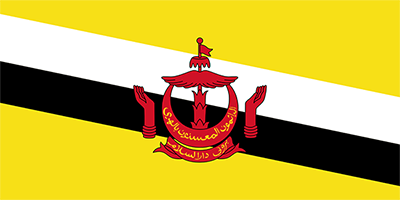
Brunei flag picture

| Name | Bendera Brunei Darussalam (the national flag) |
|---|---|
| Adopted | September 29, 1959 (the crest, with the Constitution) 1906 (the stripes) |
| Designer | Pengiran Muhammad Yusuf (the 1959 form) |
| Proportion | 2 : 1 (fly : hoist) — 36 by 72 inches |
| Kept at | Independence, January 1, 1984 — unchanged |
The Bruneian flag is the yellow of the sultans crossed by two diagonals — white for the Pengiran Bendahara, black for the Pengiran Pemancha, the ministers who signed the treaty of 1906 — with the red crest of 1959 at its heart: crescent, parasol, wings, hands, and the name of the state.
An overview
The national flag of Brunei is a yellow field crossed by two diagonal stripes — white above, black below, running from the upper hoist toward the lower fly — with the national crest in red at the center. The ratio is 1:2. It is a flag assembled in three layers over six centuries, and every layer names someone.
The yellow was the Sultan’s own standard, the color of royalty in the Malay world, in the years when Brunei had no national flag at all. The stripes came in 1906, when the agreement with Britain that installed a Resident called for a flag: white for the Pengiran Bendahara and black for the Pengiran Pemancha, the two wazirs who signed beside the Sultan. The crest came with the Constitution of September 29, 1959 — the crescent of Islam with the motto, the parasol of the monarchy, the wings, the hands, and the name Brunei Darussalam.
The flag did not change when Brunei declined to join Malaysia in 1963, nor at independence on January 1, 1984. It is one of the few national flags that is older than its nation’s sovereignty.
The crest
The red crest at the center is the national emblem, and it is a sentence in symbols. At its heart is the crescent of Islam, the state religion, inscribed in yellow Arabic with the motto — al-dāʾimūn al-muḥsinūn bi-l-hudā, “Always render service with God’s guidance.” Above the crescent stands the royal parasol, the payung ubur-ubur of the Sultan’s regalia, topped by a small flag on its pole; on either side spread wings of four feathers each, for the protection of justice, tranquility, prosperity and peace; two upraised hands hold the whole, the government’s pledge to serve the people; and the banner beneath reads Brunei Darussalam — Brunei, the Abode of Peace — in Jawi script.
The emblem was fixed with the Constitution of September 29, 1959, and placed on the flag that the sultanate had flown since 1906. Everything else on the flag is older: the yellow of Malay royalty, and the white and black diagonals that record, unusually literally, a treaty and the three men who signed it.
Official color specification
No Bruneian instrument fixes the shades. The yellow is the bright royal yellow of the Malay courts — lighter than the gold of most flags — and the red is the crest’s alone; the values below are those the standard references carry.
| Color | Hex | Pantone | RGB |
|---|---|---|---|
| Yellow | #F7E017 | not fixed in law | 247, 224, 23 |
| White | #FFFFFF | White | 255, 255, 255 |
| Black | #000000 | Black | 0, 0, 0 |
| Red | #CF1126 | not fixed in law | 207, 17, 38 |
Symbolism and meaning
The government explains the flag in three parts — the field, the stripes, and the crest — and each part is a person or an office before it is an idea.
The motto on the crescent — “Always render service with God’s guidance” — is the state’s, and appears on the emblem, the flag and the coins alike.
Design and official specification
The official flag is 36 inches by 72 — 1:2. The two stripes are parallelograms, cut by the flag’s edges as they run from the upper hoist toward the lower fly, the white nearly twice the width of the black; the crest sits at the exact center, its lettering in yellow. Hung vertically, the flag is rotated so that the crest reads upright and the stripes keep their direction.
| Element | Specification | Reference |
|---|---|---|
| Hoist (height) | 91 cm (36 in) | The official flag size |
| Fly (length) | 183 cm (72 in) | — |
| Ratio | 1 : 2 | The national flag and civil ensign |
| The stripes | Two diagonal parallelograms from the upper hoist toward the lower fly — white above, black below, the white nearly twice the width of the black | Added 1906 |
| The crest | The national emblem in red at the center, its lettering in yellow | Added September 29, 1959 |
| The crest's parts | A crescent with the motto, a royal parasol above with a small flag and its pole, wings of four feathers on each side, two upraised hands, and a banner beneath reading Brunei Darussalam | Five elements |
| Colors | Yellow, white, black, red — shades not fixed in law | — |
| Vertical display | Hung vertically, the flag is rotated so that the stripes still run from the upper hoist and the crest reads upright | Government protocol |
How the flag evolved
A sultan’s standard, two stripes for two ministers, and a crest that came with a constitution — the flag’s story in three moves, and not one change since 1959.
1300s
The sultan's yellow

For six centuries Brunei had no national flag. The Sultan and his wazirs flew personal standards, and the Sultan's was plain yellow — the color of royalty across the Malay world, flown by a sultanate that at its height in the 16th century ruled the coasts of Borneo and the southern Philippines.
1906
Two ministers, two stripes

Brunei had been a British protectorate since 1888; the agreement of 1905–06 installed a British Resident and, with it, the need for a flag in the international manner. The yellow standard took two diagonal stripes — white for the Pengiran Bendahara, black for the Pengiran Pemancha, the two chief ministers who signed the agreement beside Sultan Hashim — so that the flag recorded the signatories' solidarity.
1959
The crest, and a constitution
On September 29, 1959, Sultan Omar Ali Saifuddien III promulgated Brunei's first written constitution, and the national crest was placed at the center of the flag in red — the design credited to Pengiran Muhammad Yusuf, who also wrote the words of the anthem. The flag did not change when Brunei declined to join Malaysia in 1963, nor at independence on January 1, 1984; it has flown unaltered for 67 years.
Who designed the Bruneian flag?
The 1959 form is credited to Pengiran Muhammad Yusuf — Pengiran Haji Mohamed Yusuf bin Pengiran Abdul Rahim, the court poet and official who also wrote the words of the national anthem, “Allah Peliharakan Sultan,” in 1947. He placed the red crest at the center of a flag the state had flown since 1906, and that flag had no named designer: its yellow was the Sultan’s standard, and its stripes the colors of the two wazirs, laid across it when a treaty required a flag.
The crest itself descends from the emblem of Sultan Ahmad Tajuddin’s reign, revised for the Constitution of 1959 under Sultan Omar Ali Saifuddien III, the architect of modern Brunei.
February 23
Brunei keeps no flag day. The flag’s great day is National Day, February 23 — the anniversary of the public celebration of independence in 1984 — when thousands parade before the Sultan on the Taman Haji Sir Muda Omar Ali Saifuddien in the capital and the flag flies from every building. The flag’s own anniversary is September 29, the day of the Constitution of 1959; the Sultan’s birthday, July 15, is the other day of flags.
Legal status and display rules
Brunei has no single flag statute. The Constitution of 1959 fixed the crest and reduced the flags flown in the state; the Emblems and Names (Prevention of Improper Use) Act protects the flag and the crest; the government’s protocol governs their display. The rules are tabled here.
| Provision | The rule |
|---|---|
| The instruments | The Constitution of September 29, 1959, which added the crest and consolidated the flags flown in the state; the Emblems and Names (Prevention of Improper Use) Act, which protects the flag and emblem from misuse; the government's flag protocol |
| Where it flies | On government buildings, schools and public institutions; on the embassies; at the national ceremonies of National Day, the Sultan's birthday and the Islamic feasts |
| Respect | Never allowed to touch the ground; not used as a covering or in a manner that degrades it; kept clean and whole |
| Precedence | The national flag above or to the right of other flags; the Sultan's royal standard, yellow with the crest, flies in his presence |
| Personal standards | Since 1959 only the descendants of sultans and wazirs keep personal banners, so that fewer flags fly on state occasions |
| Commercial use | Reproduction of the flag and crest on goods requires permission under the Emblems and Names Act |
| Vertical hoisting | Rotated so that the crest stands upright and the stripes keep their direction |
Half-mast and mourning
Mourning is the Sultan’s to declare.
| Provision | The rule |
|---|---|
| When | In periods of mourning declared by the Sultan or the government — on the death of a member of the royal family or a friendly sovereign |
| How | The flag is flown at half-mast on government buildings for the period declared |
Things you may not know
The stripes are signatures. Few flags record a single diplomatic event; the white and black stand for the two ministers who signed the 1906 agreement with Britain, in the order and the colors of their offices.
The flag is older than independence by 25 years. Adopted in 1959 as the flag of a British-protected state, it flew unchanged through the refusal to join Malaysia and through independence in 1984 — the same cloth for three constitutional lives.
The crest spells the state. The banner beneath the crescent carries the country’s formal name, Brunei Darussalam, in Jawi — the flag names the nation as well as showing it.
Frequently asked questions
What does the flag of Brunei look like?
A yellow field crossed by two diagonal stripes from the upper hoist toward the lower fly — white above and black below, the white nearly twice as wide — with the national crest in red at the center. The ratio is 1:2, and the official flag measures 36 by 72 inches. It has flown in this form since September 29, 1959.
What do the colors of the Bruneian flag mean?
Yellow is the color of the Sultan and of Malay royalty. The white and black stripes stand for the two chief ministers, the Pengiran Bendahara (white) and the Pengiran Pemancha (black), who signed the 1906 agreement with Britain beside the Sultan — the three colors marking the solidarity of the signatories. The red crest is the national emblem, with the crescent of Islam at its heart.
What is the crest on the Bruneian flag?
The national emblem of 1959: a crescent for Islam, inscribed with the motto "Always render service with God's guidance"; the royal parasol above it for the monarchy; wings of four feathers on each side for justice, tranquility, prosperity and peace; two upraised hands for the government's pledge to the people; and a banner beneath reading Brunei Darussalam — Brunei, the Abode of Peace.
When was the Bruneian flag adopted?
In stages. The Sultan's standard was plain yellow; the white and black diagonals were added in 1906, when Brunei accepted a British Resident; and the red crest was placed at the center on September 29, 1959, the day the Constitution was promulgated. The flag was kept unchanged at independence on January 1, 1984.
Who designed the Bruneian flag?
The 1959 form is credited to Pengiran Muhammad Yusuf — Pengiran Haji Mohamed Yusuf bin Pengiran Abdul Rahim — the court poet who also wrote the words of the national anthem, "Allah Peliharakan Sultan." The stripes of 1906 have no named designer; they were the state's answer to the need for a flag in the international style.
What are the official colors of the Bruneian flag?
No Bruneian law fixes shades. The values in common use are yellow #F7E017 and red #CF1126, with white and black. The yellow is a bright, warm royal yellow, lighter than the gold of most flags.
Why does the flag have diagonal stripes?
Because the sultanate needed a national flag in 1906 and chose to build it from the personal standards that already existed — the Sultan's yellow, and the colors of his two wazirs laid across it. The parallelograms cut by the flag's edges are unusual among national flags; only Brunei's and a few others carry stripes that run corner to corner.
What are the rules for flying the Bruneian flag?
The government's protocol: the flag flies on government buildings, schools and institutions and at the national ceremonies; it never touches the ground; it takes precedence over other flags except the Sultan's standard in his presence; hung vertically, it is rotated so the crest reads upright; and it is flown at half-mast in mourning declared by the Sultan. The Emblems and Names Act protects the flag and crest from improper use.
Does Brunei have a flag day?
No. The flag's great day is National Day, February 23 — the anniversary of the celebrations of independence in 1984 — when it flies from every building and thousands parade in the capital; its own anniversary is September 29, the day of the Constitution of 1959. The Sultan's birthday, July 15, is the other day of flags.
Explore all general-knowledge topics and the A-to-Z lists.

We Value Your Opinion Comments