
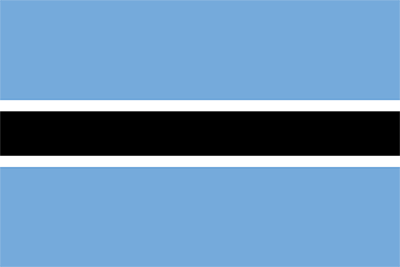
Botswana flag picture

| Name | Folaga ya Botswana (the national flag) |
|---|---|
| Adopted | September 30, 1966 (independence, at midnight) |
| Designer | George Winstanley (colonial administrator, Bechuanaland) |
| Proportion | 3 : 2 (fly : hoist) — stripes 9:1:4:1:9 |
| Law | The Emblems law; Penal Code §91 |
The Botswana flag is a field of sky blue for the rain a dry country prays for, cut by a black band framed in white for people of every color living as one — a flag made in 1966 with none of the colors of pan-Africanism or of any party, as an answer to apartheid across the border.
An overview
The national flag of Botswana is a field of sky blue cut across the center by a black band framed in thin white — five stripes in the proportions 9:1:4:1:9, on a 2:3 flag. It is one of the very few African flags that carry neither the pan-African colors nor the colors of the party that led the country to independence.
That was the point. Bechuanaland became independent on September 30, 1966, as the northern neighbor of apartheid South Africa, and its founders wanted a flag that would say the opposite of what the flag across the border said: black beside white, at the center, on a field that belonged to all. The blue is the rain — Pula, the motto, the blessing, and the currency — in a country that is mostly Kalahari. A British administrator of the Protectorate, George Winstanley, drew it to that brief, and it was raised at midnight as the Republic of Botswana was born.
Sixty years on, the flag has never been changed — and it is, unusually, a protected emblem that the government’s rules require permission to fly.
The stripe
The flag carries no device — one black band framed in two thin white ones, across a field of blue — and the band is a statement. Bechuanaland became independent in September 1966 as a neighbor of South Africa at the height of apartheid, and its founders chose to say in cloth what their constitution said in law: that people of different races would live here in harmony and as equals. Black beside white, in the center, on a field that belongs to everyone.
The same stripes are the zebra’s, the animal that supports the national coat of arms, and the zebra was read the same way — black and white together on one creature. The blue is the rain: Botswana’s motto is the single word Pula, rain, which is also a blessing, a greeting, and the name of the currency. Almost alone among the new flags of 1960s Africa, this one used neither the pan-African red, gold and green nor the colors of the party that won independence — a flag for the country and not for a movement.
Official color specification
The Emblems law names the colors and stops: azure blue, black, and white, without shades. The Botswana Bureau of Standards specifies the blue — a true sky blue, lighter than almost any other national flag’s — and the values below are the standard references’ matches.
| Color | Hex | Pantone | RGB |
|---|---|---|---|
| Sky blue | #75AADB | 2925 C | 117, 170, 219 |
| Black | #000000 | Black | 0, 0, 0 |
| White | #FFFFFF | White | 255, 255, 255 |
Symbolism and meaning
The government’s reading of the flag has been the same since 1966, and it is one of the clearest of any flag.
Pula is the currency too: a Botswana coin carries, in its name, what the flag’s blue means.
Design and official specification
The Emblems law divides the depth of the flag into twenty-four parts and gives each stripe its share: nine of blue, one of white, four of black, one of white, nine of blue — the 9:1:4:1:9 that every flagmaker follows. The ratio is 2:3. Nothing else is on the flag; the coat of arms, with its zebras, cogwheels, waves and bull’s head, stays on the arms.
| Element | Specification | Reference |
|---|---|---|
| Hoist (height) | 24 parts | 120 cm (47.2 in) on the reference flag |
| Fly (length) | 36 parts | 180 cm (70.9 in) |
| Ratio | 2 : 3 | The Emblems law |
| Upper blue | 9/24 of the depth | 45 cm (17.7 in) |
| Upper white | 1/24 of the depth | 5 cm (2.0 in) |
| Black band | 4/24 of the depth | 20 cm (7.9 in) |
| Lower white | 1/24 of the depth | 5 cm (2.0 in) |
| Lower blue | 9/24 of the depth | 45 cm (17.7 in) — the proportions 9:1:4:1:9 |
| Colors | Named in law without shades; the blue specified by the Botswana Bureau of Standards | Pantone 2925 C the usual match |
How the flag evolved
Eighty-one years under a borrowed flag, a midnight of independence, and sixty years without a change — the flag’s story in three moves.
1885
The Protectorate

When the Tswana chiefs sought British protection against the Boer republics in 1885, the Bechuanaland Protectorate was created — and given no flag, badge or arms of its own. For 81 years the only flag was the Union Jack; the territory had a seal, and nothing more.
1966
Midnight, September 30
The new flag was designed before independence, so that it could fly from the country's first hour — by George Winstanley, a British administrator of the Protectorate, to a brief that it should stand apart from the apartheid flag of South Africa and from the pan-African colors alike. It was raised at midnight on September 30, 1966, as the Republic of Botswana was born and Seretse Khama became its first president; the coat of arms had been granted on January 25 that year.
2016
Fifty years unchanged

The flag has never been altered. At the golden jubilee of 2016 it flew over a country that had gone from one of the poorest on Earth to an upper-middle-income democracy on diamonds and good government — and in 2024 it presided over the first change of ruling party in the nation's history, without a change to itself.
Who designed the Botswana flag?
George Winstanley, a British administrator in the Bechuanaland Protectorate’s government in the last months before independence, to a brief from the incoming leaders: a flag that would stand apart from the apartheid flag of South Africa and from the pan-African colors the other new states were taking up. The flag was ready before the country was, so that it could be raised at the first stroke of independence on September 30, 1966.
The coat of arms, granted on January 25, 1966, followed designs by Isabel Fawcus: two zebras supporting a shield of cogwheels, waves and a bull’s head, one holding an elephant’s tusk and the other a stalk of sorghum, over the single word Pula.
September 30
Botswana keeps no flag day. The flag’s day is Botswana Day, September 30 — the anniversary of the midnight of 1966 — kept as a two-day holiday with October 1, when the flag flies from every government building and school and the President addresses the nation. The country also keeps Sir Seretse Khama Day on July 1, the birthday of its first president, and Presidents’ Day in the third week of July.
Legal status and display rules
The flag rests on the Emblems law, whose schedule fixes its stripes; on Section 91 of the Penal Code, which makes insulting it an offense; and on the Office of the President’s rules for the use of national emblems, which — unusually — require permission to fly it. The rules are tabled here.
| Provision | The rule |
|---|---|
| The instruments | The Emblems law, whose schedule sets the flag's five stripes in twenty-fourths; Section 91 of the Penal Code, which makes insulting the flag an offense; the Office of the President's "Use of National Emblems" and the national flag etiquette |
| Permission | The flag is a protected emblem: a formal request to the Permanent Secretary to the President is required to fly it or to reproduce it — Botswana is one of very few countries where flying the national flag needs the government's leave |
| Hours | By tradition hoisted at dawn and lowered at dusk |
| Respect | Never allowed to touch the floor; kept upright and in good condition |
| Retirement | A damaged flag is destroyed in a burning ceremony, or otherwise disposed of respectfully |
| Occasions | Flown on all government buildings and schools, and on Botswana Day, September 30, across the country |
| Commercial use | Use of the flag and the arms on goods requires the same permission, under the emblems protection |
Half-mast and mourning
The etiquette names half-mast as the flag’s sign of mourning and respect.
| Provision | The rule |
|---|---|
| When | In mourning declared by the President — for a former president or a national tragedy — and as a mark of respect on the etiquette's own terms |
| How | The flag is lowered to half-mast on government buildings for the period declared |
Things you may not know
You need permission to fly it. The flag is a protected emblem, and the government’s rules require a request to the Permanent Secretary to the President before it is flown or reproduced — a rule almost no other country has.
The colony had no flag at all. For 81 years the Bechuanaland Protectorate flew the Union Jack alone — no badge, no ensign, no arms — so the flag of 1966 was the country’s first.
The blue is a coin. Pula — rain — is the motto on the arms, the greeting Batswana exchange, and the name of the currency; the flag’s field means what the money is called.
Frequently asked questions
What does the flag of Botswana look like?
A field of light sky blue cut across the center by a black horizontal band with a thin white edge above and below. The five stripes are in the proportions 9:1:4:1:9 and the flag is 2:3. It has flown, unchanged, since midnight on September 30, 1966.
What do the colors of the Botswana flag mean?
The blue is water — the rain that a dry Kalahari country depends on, and that its motto Pula asks for. The black band and its white frame stand for the harmony and equality of the country's peoples of different races, proclaimed in 1966 against apartheid in neighboring South Africa; the stripes also recall the zebra, the national animal on the coat of arms.
Who designed the Botswana flag?
George Winstanley, a British colonial administrator of the Bechuanaland Protectorate, designed it in the months before independence in 1966. The coat of arms, granted in January that year, followed designs by Isabel Fawcus.
When was the Botswana flag adopted?
On September 30, 1966, when the flag was raised at midnight as Bechuanaland became the Republic of Botswana. It replaced the Union Jack, the Protectorate's only flag for the previous 81 years, and it has never been changed.
Why doesn't the Botswana flag use the pan-African colors?
By design. Most African flags of the 1960s took the red, gold and green of Ethiopia and Ghana, or the colors of the party that won independence. Botswana chose neither: its founders wanted a flag for the whole country, and one whose black-and-white stripe would answer the racial separation of South Africa next door. It is one of the very few African flags with no pan-African and no party colors.
What are the official colors of the Botswana flag?
The Emblems law names the colors without shades. The Botswana Bureau of Standards specifies the blue, for which Pantone 2925 C (#75AADB) is the usual match, with black and white. The flag's blue is a true sky blue, lighter than the blue of most national flags.
Do you need permission to fly the Botswana flag?
Yes — unusually among nations. The flag is a protected emblem, and the government's rules require a formal request to the Permanent Secretary to the President before it is flown or reproduced; using it on goods needs the same permission. Insulting the flag is an offense under Section 91 of the Penal Code.
What are the rules for flying the Botswana flag?
The etiquette published by the government: hoist it at dawn and lower it at dusk, by tradition; never let it touch the floor; keep it upright and in good repair; lower it to half-mast in mourning or as a mark of respect; and when it is damaged, retire it in a burning ceremony or dispose of it respectfully.
Does Botswana have a flag day?
No. The flag's day is Botswana Day, September 30 — the anniversary of the midnight of 1966 — kept as a two-day holiday with October 1, when the flag flies from every government building and school. The country also keeps Sir Seretse Khama Day on July 1 and Presidents' Day in the third week of July.
Explore all general-knowledge topics and the A-to-Z lists.

We Value Your Opinion Comments