
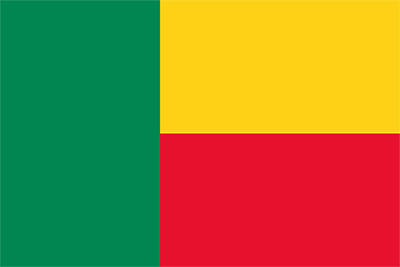
Benin flag picture

| Name | Drapeau du Bénin (the national flag) |
|---|---|
| Adopted | November 16, 1959 (the Republic of Dahomey) August 1, 1990 (restored) |
| Proportion | 3 : 2 (fly : hoist) |
| Replaced | 1975–1990 by a green flag with a red star |
| Law | Constitution of 1990, Article 25 |
The Beninese flag is a green vertical band at the hoist with yellow over red on the fly — the pan-African colors chosen by Dahomey in 1959, set aside for a red star under the Marxist republic and restored on August 1, 1990.
An overview
The national flag of Benin is a green vertical band at the hoist, two-fifths of the length, with the fly divided into two horizontal bands — yellow above, red below. The ratio is 2:3. The colors are the pan-African colors; the arrangement is Benin’s alone.
The flag is older than the state and outlived a regime. Dahomey, a self-governing republic within the French Community, adopted it on November 16, 1959, and carried it into independence on August 1, 1960. When Mathieu Kérékou’s Marxist-Leninist government renamed the country the People’s Republic of Benin in November 1975, it replaced the flag with a green field and a red star. The National Conference of 1990 dismantled the one-party state, and on August 1, 1990 — independence day, thirty years on — the flag of 1959 came back, with the coat of arms and the anthem.
The Constitution of December 11, 1990, wrote it into Article 25. The anthem, L’Aube Nouvelle, sings what its colors mean.
The three colors
The flag carries no device — its meaning is in its colors and their arrangement. Green, yellow and red are the pan-African colors: Ethiopia’s, the oldest independent state in Africa, taken up by Ghana in 1957 and Guinea in 1958 and by the deputies of the African Democratic Rally who represented French West Africa in Paris. Dahomey chose them in November 1959, a year before independence, and set them in an order no other flag uses — a green band standing at the hoist, yellow over red lying across the fly.
Benin’s own reading is geographic and historical: yellow for the savannas of the north, green for the palm groves of the south, red for the blood of the ancestors who defended the land — and for the bond between the north and the south the other two colors describe. The national anthem, L’Aube Nouvelle, sings the colors’ meanings in its verses, which is why they are so widely and so consistently known.
Official color specification
The Constitution names the colors and stops there; no Beninese instrument fixes a Pantone or a construction sheet. The values below are the matches the standard references carry — the pan-African set shared, in other arrangements, by Ghana, Guinea, Mali, Senegal and Cameroon.
| Color | Hex | Pantone | RGB |
|---|---|---|---|
| Green | #008751 | 355 C | 0, 135, 81 |
| Yellow | #FCD116 | 116 C | 252, 209, 22 |
| Red | #E8112D | 186 C | 232, 17, 45 |
Symbolism and meaning
Benin gives its colors two readings at once — a geography of the country and a history of its people — and its anthem carries both.
The three are also the pan-African colors of Ethiopia and of the African Democratic Rally, the parliamentary group of French West Africa’s deputies after 1945.
Design and official specification
A 2:3 flag in three fields: the green band standing at the hoist across two-fifths of the length, and the yellow and red lying in equal horizontal halves across the remaining three-fifths. Article 25 of the Constitution describes it in words; the proportions are the convention that flagmakers and the state have followed since 1959.
| Element | Specification | Reference |
|---|---|---|
| Hoist (height) | 2 | 100 cm (39.4 in) |
| Fly (length) | 3 | 150 cm (59.1 in) |
| Ratio | 2 : 3 | The conventional proportion |
| Green band | A vertical band at the hoist, two-fifths of the length | 60 cm (23.6 in) on the reference flag |
| Yellow and red | Two equal horizontal bands on the fly — yellow above, red below | Each 50 cm (19.7 in) high, 90 cm (35.4 in) long |
| The description in law | "The emblem of the Beninese nation is a flag of green, yellow and red: a green band along the hoist, and two horizontal bands of yellow above and red below" | Constitution of December 11, 1990, Article 25 — in substance |
| Uses | National flag and ensign, on land and at sea | — |
How the flag evolved
A republic’s first flag, a revolution’s red star, and a restoration on the state’s own birthday — the flag’s story in three moves.
1959
Dahomey's flag

France had forbidden its colonies their own flags, but when Dahomey became a self-governing republic within the French Community on December 4, 1958, a flag could be sought. It was adopted on November 16, 1959 — the pan-African colors in a design of the republic's own — and flew unchanged when Dahomey became independent on August 1, 1960.
1975
The red star

Mathieu Kérékou's regime, Marxist-Leninist from 1974, renamed the country the People's Republic of Benin on November 30, 1975, and on December 1 replaced the flag with a green field bearing a red star in the canton — green for the farming that fed the country, the star for unity and revolution. The ruling party's own flag was the reverse: red with a green star.
1990
The restoration
The National Conference of February 1990 dismantled the one-party state, and on August 1, 1990 — the thirtieth anniversary of independence — the flag of 1959, the coat of arms and the anthem were restored. The Constitution of December 11, 1990, wrote the flag into Article 25, where it has stayed through the amendments of 2019 and 2025.
Who designed the Beninese flag?
No designer’s name has come down. The flag was the work of the government of the autonomous Republic of Dahomey in the months after December 1958, when France first permitted its African republics their own flags, and the record preserves the date of adoption — November 16, 1959 — rather than a hand. What the design shows is a choice: the colors of the pan-African movement, which Dahomey’s neighbors were taking up one after another, set in an arrangement none of them used.
The men who brought it back are better known — the delegates of the National Conference of February 1990, whose settlement restored the flag, the arms and the anthem on August 1 that year.
August 1
Benin keeps no flag day on record. The flag’s day is Independence Day, August 1 — the anniversary of independence in 1960 and, to the day, of the flag’s restoration on the thirtieth anniversary in 1990. The flag also flies for Vodun Day on January 10, a national holiday since 1998, when the country’s traditional religion is celebrated at Ouidah.
Legal status and display rules
The flag rests on Article 25 of the Constitution of 1990, which describes it as the emblem of the nation alongside the anthem, the motto and the arms, and on the law of 1990 that restored the symbols. Benin has no separate flag code; the rules of display are the state’s protocol, tabled here.
| Provision | The rule |
|---|---|
| The instruments | Article 25 of the Constitution of December 11, 1990, describes the flag; the law of 1990 restoring the symbols of the Republic re-established it, with the coat of arms and the anthem, from August 1, 1990 |
| Where it flies | On the presidential palaces, the National Assembly, the ministries, the courts, the prefectures and town halls, the schools, the frontier posts and the embassies |
| Ceremony | Raised in the morning and lowered at nightfall at public institutions, to the national anthem at formal hoistings — the Monday flag-raising in schools and offices a national habit |
| Precedence | The national flag takes the place of honor; the flags of ECOWAS and the African Union fly beside it, lower or to its left |
| Respect | Its desecration is punishable under the Penal Code |
| Standardization | No Pantone or construction sheet is fixed in law; the 2:3 proportion and the two-fifths band are the convention |
Half-mast and mourning
Mourning is the President’s to decree.
| Provision | The rule |
|---|---|
| When | In periods of national mourning decreed by the President — for the death of a former head of state, or a national tragedy |
| How | The flag is flown at half-mast on public buildings for the days the decree names |
Things you may not know
The flag came back on its own birthday. Independence fell on August 1, 1960; the restoration of the flag fell on August 1, 1990 — the same day, thirty years on, chosen so that the republic’s renewal and its founding would share an anniversary.
The anthem explains the flag. L’Aube Nouvelle, written by Father Gilbert Dagnon and adopted in 1960, gives the colors their meanings in its verses — one of few anthems that gloss a national flag.
The lost flag had a mirror. Under the People’s Republic the state flew green with a red star while the ruling party flew red with a green star — one design, two flags, swapped.
Frequently asked questions
What does the flag of Benin look like?
A vertical green band at the hoist, two-fifths of the length, with the rest of the flag divided into two horizontal bands — yellow above, red below. The ratio is 2:3. It is the flag Dahomey adopted on November 16, 1959, restored on August 1, 1990, after fifteen years under a different flag.
What do the colors of the Beninese flag mean?
Green for hope and renewal, and for the palm groves of the south; yellow for the country's wealth, and for the savannas of the north; red for the courage of the ancestors and the blood shed in defense of the land. The colors are also the pan-African colors, shared with Ghana, Guinea, Cameroon and others, and the anthem L'Aube Nouvelle sings their meanings.
When was the Beninese flag adopted?
On November 16, 1959, by the Republic of Dahomey, a year before independence; it flew unchanged from independence on August 1, 1960. Replaced on December 1, 1975, by the green flag with a red star of the People's Republic of Benin, it was restored on August 1, 1990, and written into Article 25 of the Constitution that December.
Why did Benin change its flag in 1975?
Because the state changed. Mathieu Kérékou's government adopted Marxism-Leninism in 1974, renamed Dahomey the People's Republic of Benin on November 30, 1975, and gave it a new flag the next day — a green field with a red five-pointed star in the canton, the green for agriculture and the star for the revolution. The flag lasted as long as the system, until 1990.
Why is the flag arranged the way it is?
No other national flag places a vertical band at the hoist beside two horizontal bands. The design set Dahomey's flag apart from its pan-African neighbors, all of them tricolors of vertical or horizontal stripes; the green upright at the pole and the yellow and red lying across the fly have been read as the south, the north and the blood that binds them.
What are the official colors of the Beninese flag?
No Beninese instrument fixes a Pantone — the Constitution names the colors only. The values commonly used are green #008751 (Pantone 355 C), yellow #FCD116 (116 C) and red #E8112D (186 C), the pan-African set.
What does the law say about the Beninese flag?
Article 25 of the Constitution of December 11, 1990, describes the flag — a green band at the hoist and yellow over red on the fly — as the emblem of the nation, alongside the anthem, the motto and the arms. Benin has no separate flag code: the flag flies on public buildings and at the frontier, is raised to the anthem at formal hoistings, and its desecration is an offense under the Penal Code.
How is the Beninese flag flown at half-mast?
On the days of national mourning the President decrees — for the death of a former head of state or a national tragedy — the flag is lowered to half-mast on public buildings for the period named.
Does Benin have a flag day?
No flag day is on record. The flag's day is Independence Day, August 1 — the anniversary of independence in 1960 and, to the day, of the flag's restoration in 1990, when the flag rose again over Porto-Novo and Cotonou on the thirtieth anniversary of the state.
Explore all general-knowledge topics and the A-to-Z lists.

We Value Your Opinion Comments