
Belize flag picture

| Adopted | September 21, 1981 (independence) August 28, 2019 (the drawing standardized) |
|---|---|
| Origin | The People's United Party flag of February 2, 1950 (blue, with the arms in a white disc) |
| Proportion | 5 : 3 (fly : hoist) |
| Colors | Twelve — the most of any national flag |
| Use | National flag and ensign |
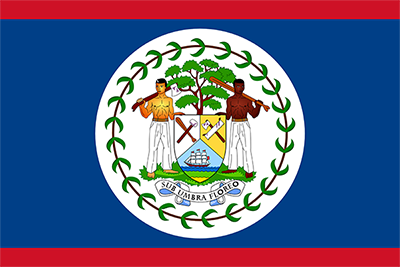
The Belizean flag is the coat of arms on a white disc on royal blue between two red stripes — the two woodcutters, the mahogany tree and the 50 leaves of the independence movement, in one party's blue between the other party's red; the most colorful national flag in the world.
An overview
The national flag of Belize is a royal blue field with a narrow red stripe along each of its long edges and, at its center, a white disc bearing the coat of arms — two woodcutters beneath a mahogany tree, a shield of tools and a ship, a motto, and a wreath of 50 leaves. The ratio is 3:5. With twelve colors it is the most colorful national flag in the world, and with its two woodcutters one of only two to depict human beings.
It is a party flag made national. The People’s United Party adopted the blue flag with the arms in a white disc on February 2, 1950, the year of its founding — the 50 leaves count that year — and flew it, unofficially, over public buildings from the coming of self-government in 1964. At midnight on September 21, 1981, when Belize became independent, the flag went up with two changes: the Union Jack gone from the shield, and two red stripes added for the opposition United Democratic Party, so that the national flag would belong to both sides of Belizean politics.
On August 28, 2019, after decades in which every flagmaker drew the arms his own way, the Cabinet fixed a single standard drawing and its colors.
The coat of arms
The flag is an escutcheon with a flag around it. The arms were granted to British Honduras on January 28, 1907, and they tell the colony’s founding story — mahogany. The shield is divided into three: a paddle and a squaring axe, a saw and a beating axe, and below them a ship under full sail carrying the timber to sea. Behind the shield rises a mahogany tree; on either side stands a woodcutter, one with a beating axe on his shoulder, the other with a paddle. The motto beneath reads Sub Umbra Floreo — under the shade I flourish.
Independence changed two things. The Union Jack that had filled one quarter of the colonial shield came out, and one of the two Black woodcutters became a mestizo, so that the arms would show the country’s two largest peoples side by side. The wreath of 50 leaves around them is the independence movement’s own date — 1950, the year the People’s United Party was founded and the struggle began. Belize’s flag is one of only two national flags to depict human beings, and with twelve colors it has more than any other.
Official color specification
Belize publishes its colors as values, not Pantone: the 2019 standard fixed the royal blue, the red, the white disc and the green of the wreath, together with the browns, yellow and light blue of the arms. The four that carry the design are tabled here; the full flag has twelve.
| Color | Hex | Pantone | RGB |
|---|---|---|---|
| Royal blue | #171696 | — | 23, 22, 150 |
| Red | #D90F19 | — | 217, 15, 25 |
| White | #FFFFFF | White | 255, 255, 255 |
| Green (the wreath) | #338A00 | — | 51, 138, 0 |
Symbolism and meaning
The government explains the flag in two layers — the colors, which are political, and the arms, which are historical.
The wreath is the flag’s calendar: 50 leaves for the year the People’s United Party was founded and, in the government’s words, Belizeans began the struggle for independence.
Design and official specification
The 2019 standard fixed what four decades of flagmakers had left loose: a 3:5 rectangle, red stripes of one-tenth of the height at each edge, a white disc centered on the blue, and one drawing of the arms — the shield divided per pale and per chevron, the tree, the two men, the scroll and the wreath — in fixed colors.
| Element | Specification | Reference |
|---|---|---|
| Hoist (height) | 3 | 90 cm (35.4 in) |
| Fly (length) | 5 | 150 cm (59.1 in) |
| Ratio | 3 : 5 | The standardized proportion of 2019 |
| Red stripes | One-tenth of the height each, at the top and bottom edges | 9 cm (3.5 in) each on the reference flag |
| The disc | A white circle centered on the blue field | Bearing the coat of arms |
| The arms | A shield divided per pale and per chevron — a paddle and squaring axe, a saw and beating axe, a ship under sail — before a mahogany tree, supported by two woodcutters, on a motto scroll, within a wreath of 50 leaves | The arms of 1907 as revised at independence and redrawn in 2019 |
| Colors | Twelve — blue, red, white, the wreath's green, the browns of the men and the tree, yellow, a light blue, black | The most of any national flag |
How the flag evolved
A colony’s arms, a party’s flag, a midnight of independence, and a Cabinet that finally fixed the drawing — the flag’s story in four moves.
1907
The colonial arms

British Honduras received its coat of arms on January 28, 1907 — two woodcutters, the mahogany tree, the shield of tools and the ship, with a Union Jack in the shield's upper quarter. Set in a white disc on the Blue Ensign, it flew as the colony's flag for the next seventy years.
1950
The party flag

On February 2, 1950, the People's United Party adopted a blue flag with the arms in a white disc, ringed by a wreath of 50 leaves for the year of its founding — believing, as Whitney Smith records, that the arms had once appeared just so on a blue field. After self-government in 1964 the unofficial flag flew over public buildings for seventeen years.
1981
Independence, and two red stripes

Belize became independent at midnight on September 21, 1981, and the flag raised that night was the party flag made national: the Union Jack removed from the shield, one woodcutter redrawn as a mestizo, and two red stripes added at the top and bottom for the opposition United Democratic Party — so that the national flag would not be the flag of a single party.
2019
One drawing for all
For nearly four decades the arms were drawn differently by every flagmaker — the men, the tree and the shades varied from flag to flag. On August 28, 2019, the Cabinet approved a single standardized drawing with fixed colors, the flag flown officially since.
Who designed the Belizean flag?
A committee of heralds, a political party, and a Cabinet. The arms were drawn for the colonial government and granted by royal warrant in 1907; the People’s United Party set them on blue in a white disc in 1950 and ringed them with 50 leaves; the independence settlement of 1981 removed the Union Jack, redrew one woodcutter as a mestizo and added the red stripes; and the Cabinet of 2019 chose the single drawing that flies today. No one person is credited with the design.
The flag’s one signature is collective — the only national flag whose two main colors are, openly, those of its two great parties.
September 10 and September 21
Belize keeps no flag day. The flag’s days are the September Celebrations: St George’s Caye Day on September 10, the anniversary of the battle of 1798 in which the settlers turned back a Spanish fleet, and Independence Day on September 21, the anniversary of the midnight of 1981 when the flag first rose. Between the two the country flies it from every public building and most private ones.
Legal status and display rules
Belize has no flag statute. The Constitution of 1981 recognizes the flag among the national symbols, the Cabinet fixed its drawing in 2019, and the government publishes an etiquette of display. Its rules are tabled here.
| Provision | The rule |
|---|---|
| The instruments | The Constitution of 1981 recognizes the flag among the national symbols; the Cabinet fixed the standard drawing and colors on August 28, 2019; the government publishes a flag etiquette rather than a flag statute |
| Hours | Flown from sunrise to sunset; at night only when lit |
| Position | The national flag is hoisted first and lowered last, and flies highest or in the position of honor among other flags |
| Respect | Never allowed to touch the ground or water; not used as drapery, a covering or an item of clothing |
| Condition | Kept clean and whole; a faded or torn flag is replaced and retired with dignity |
| The holidays | Flown on all public buildings through the September Celebrations — St George's Caye Day, September 10, to Independence Day, September 21 |
| Standardization | Since 2019 flags are to follow the fixed drawing — earlier flags varied in the disc, the arms and the shades |
Half-mast and mourning
Mourning is the government’s to declare, and the etiquette fixes the movement.
| Provision | The rule |
|---|---|
| When | In periods of national mourning declared by the government — for a former prime minister or governor-general, or a national tragedy |
| How | Raised to the peak first, then lowered to half-mast; raised to the peak again before lowering at sunset |
Things you may not know
Twelve colors, two people. No national flag carries more colors than Belize’s, and only Malta’s, with St George on its cross, joins it in showing human figures.
The red stripes are a peace treaty. The flag of 1950 was a party’s. Independence added the opposition’s red so that neither side could call the national flag its own — the rare flag whose colors are openly those of two rival parties.
The arms are older than the nation by 74 years. Granted in 1907 with a Union Jack in the shield, they lost the Jack and gained a mestizo woodcutter in 1981, and were not drawn to a single standard until 2019.
Frequently asked questions
What does the flag of Belize look like?
A royal blue field with a narrow red stripe along the top and bottom edges and, at the center, a white disc carrying the coat of arms — two woodcutters, a mahogany tree, a shield of tools and a ship, the motto Sub Umbra Floreo, and a wreath of 50 leaves. The ratio is 3:5. It has flown since independence on September 21, 1981.
What do the colors of the Belizean flag mean?
They are the colors of the two parties: blue for the People's United Party, which led Belize to independence, and red for the United Democratic Party, added at independence so the flag would belong to the whole nation. Within the arms, the green wreath of 50 leaves stands for 1950, when the independence movement began.
What is the coat of arms on the Belizean flag?
The arms granted to British Honduras in 1907, revised at independence: a shield with a paddle and squaring axe, a saw and beating axe, and a ship under sail — the mahogany trade — before a mahogany tree, held by two woodcutters, a mestizo and a Creole, above the motto "Sub Umbra Floreo," under the shade I flourish. A wreath of 50 leaves surrounds them.
Why does the Belizean flag have people on it?
Because its arms do: the two woodcutters have supported the shield since 1907, recalling the men who cut the mahogany that made the colony. Belize and Malta are the only countries whose national flags depict human beings.
When was the Belizean flag adopted?
At independence, on September 21, 1981. The design descends from the People's United Party flag of February 2, 1950 — blue, with the arms in a white disc and the wreath of 50 leaves — to which the red stripes were added. The Cabinet fixed a single standardized drawing and colors on August 28, 2019.
How many colors does the Belizean flag have?
Twelve — more than any other national flag: the blue field, the red stripes, the white disc, the green of the wreath and the tree, the browns of the men, the tree and the tools, yellow, a light blue in the sea and sky, and black. Most flags manage with two or three.
What are the official colors of the Belizean flag?
The 2019 standard fixes them as color values rather than Pantone: royal blue #171696, red #D90F19, white, green #338A00 for the wreath, with the browns, yellow and light blue of the arms specified alongside. Before 2019 the shades varied from maker to maker.
What are the rules for flying the Belizean flag?
Belize has no flag statute; the government publishes an etiquette. The flag flies from sunrise to sunset, or lit at night; it is raised first and lowered last among other flags and takes the position of honor; it never touches the ground and is not used as drapery or clothing; it is replaced when worn. In national mourning it flies at half-mast as the government directs.
Does Belize have a flag day?
No. The flag's days are the September Celebrations — St George's Caye Day, September 10, recalling the battle of 1798, and Independence Day, September 21 — when it flies from every public building and the country turns blue, red and white.
Explore all general-knowledge topics and the A-to-Z lists.

We Value Your Opinion Comments