
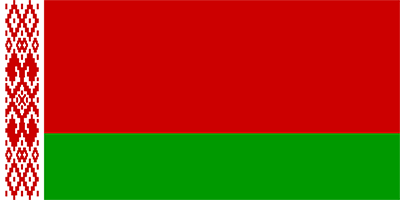
Belarus flag picture

| Name | Dzyarzhauny stsyah Respubliki Belarus (Дзяржаўны сцяг — the State Flag) |
|---|---|
| Adopted | June 7, 1995 (Decree No. 214, after the referendum of May 14) February 10, 2012 (the ornament redrawn) |
| Designer | The Soviet flag of 1951 by Nikolai Gusev; the ornament by Matrona Markevich, 1917 |
| Proportion | 2 : 1 (fly : hoist) |
| Law | Decree No. 214 (1995); Law on State Symbols (2004); STB 911-2008 |
The Belarusian flag is red over green, two-thirds to one-third, with a red-on-white woven ornament in a column at the hoist — the Soviet flag of 1951 without its hammer, sickle and star, returned by the referendum of 1995 and redrawn in 2012.
An overview
The national flag of Belarus is a bicolor of red over green — two-thirds and one-third of the height — in a 1:2 ratio, with a column at the hoist, one-ninth of the length, that carries a red woven ornament on white. It is the only European flag that quotes a piece of embroidery.
It is also, to within two details, the flag of the Byelorussian Soviet Socialist Republic of 1951. Independent Belarus first flew the white-red-white of 1918; in May 1995 President Alexander Lukashenko put the symbols to a referendum, and the official count returned three to one for a return to the Soviet design without its hammer, sickle and star, and with the hoist ornament reversed to red on white. Decree No. 214 of June 7, 1995, fixed it; the standard STB 911-2008 gave it exact colors; and on February 10, 2012, the pattern was redrawn to fill its column.
The referendum’s standing is disputed, and the white-red-white flag remains the symbol of the opposition. Both facts belong to the flag’s history, and this page records them.
The ornament
The column at the hoist is a piece of weaving. Its pattern was embroidered in 1917 on a rushnyk — the ceremonial towel of Belarusian life, laid under bread and salt for guests and over the hands of a bride — by Matrona Markevich, a village woman of Sianno in the Vitsebsk region. The rhombs and hooks are drawn from plants and flowers, and read in the folk idiom as signs of the sun, of sown fields, of fertility and good fortune.
Her brother, the ethnographer Mikhail Katsar, sat on the commission that made the flag of the Byelorussian SSR in 1951 and set her pattern in white on red at the hoist. The flag of 1995 turned it to red on white; the revision of 2012 widened it to fill its column. Markevich herself never saw any of it — her husband was shot in the purges of 1937 and the original towel was lost. A monument to her was raised in Sianno in 2015.
Official color specification
The decree of 1995 named the colors and left their shades open; the standard STB 911-2008 closed the question in the language of colorimetry, fixing red and green as CIE chromaticity coordinates under daylight illuminant D65 — red x 0.553, y 0.318, with a luminance of 14.8; green x 0.297, y 0.481, luminance 29.6. The Pantone values below are the matches used for the flag since 2012.
| Color | Hex | Pantone | RGB |
|---|---|---|---|
| Red | #D22730 | 1795 C | 210, 39, 48 |
| Green | #009739 | 355 C | 0, 151, 57 |
| White | #FFFFFF | White | 255, 255, 255 |
Symbolism and meaning
The law gives the flag no meaning. What exists is the President’s reading, offered at the opening of State Flag Square in 2013, and an older common one.
The Soviet flag’s own gloss — red for the Revolution, green for the forests of Belarus — is the source of the common reading.
Design and official specification
Decree No. 214 fixes the proportions — a 1:2 rectangle, red over green at two to one, the ornament column one-ninth of the length — and the standard STB 911-2008 fixes the rest, down to the drawing of the pattern. The 2012 revision changed one thing: the red pattern, which had taken one-twelfth of the length inside a white margin, now fills the whole column. The Regulations add the staff, gold and three times the flag’s width, and the diamond finial with its five-pointed star — a Soviet inheritance.
| Element | Specification | Reference |
|---|---|---|
| Hoist (height) | 1.0 | 100 cm (39.4 in) |
| Fly (length) | 2.0 | 200 cm (78.7 in) |
| Ratio | 1 : 2 | Decree No. 214, 1995 |
| Red stripe | Two-thirds of the height | 66.7 cm (26.2 in) on the reference flag |
| Green stripe | One-third of the height | 33.3 cm (13.1 in) |
| Ornament column | One-ninth of the length, at the hoist — a red pattern on white | 22.2 cm (8.7 in); since 2012 the pattern fills the whole column, where before it took 1/12 with a white margin |
| Colors | CIE D65 coordinates in STB 911-2008 — red 0.553 / 0.318, green 0.297 / 0.481 | Pantone matches 1795 C and 355 C |
| Staff and finial | A gold (ocher) staff three times the flag's width; a diamond finial in yellow metal bearing a five-pointed star | The Regulations of 1995 |
| Presidential standard | The national flag with the state emblem in gold and red, at 5:6 | Decree of 1997 |
How the flag evolved
A republic of months, a Soviet banner made for a UN seat, the old colors restored, and a referendum that took them back — the flag’s century in four moves.
1918
White, red, and white

The Belarusian People's Republic, proclaimed in March 1918 in the last months of the German occupation, flew a horizontal white-red-white — the colors of the Pahonia, the mounted knight of the old Grand Duchy of Lithuania. The republic lasted months; its flag became the emblem of the national movement, of the Slutsk uprising of 1920, and later of collaborationist formations under the German occupation of 1943–44.
1951
The Soviet flag

Because the Byelorussian SSR held its own seat at the United Nations from 1945, it needed a flag of its own; on December 25, 1951, the artist Nikolai Gusev's design was adopted — red over green in a 1:2 ratio, a gold hammer and sickle under a red star in the canton, and Matrona Markevich's ornament in white on red at the hoist. The red was the Revolution, the green the forests of Belarus.
1991
The old colors return

On September 19, 1991, three weeks after declaring independence, the Supreme Soviet restored the white-red-white flag and the Pahonia as state symbols. They flew for less than four years. Alexander Lukashenko, elected president in 1994, put the symbols to a referendum on May 14, 1995 — the vote, disputed by the opposition and criticized by observers, returned 75 percent for a new flag.
1995
The referendum flag
Decree No. 214 of June 7, 1995, fixed the new flag: the Soviet design without its hammer, sickle and star, the ornament reversed to red on white. The standard STB 911-2008 gave it exact colors, and on February 10, 2012, the pattern was redrawn to fill its column. The white-red-white flag lives on as the opposition's — carried in the protests of 2020 and declared extremist by a Minsk court in 2021.
Who designed the Belarusian flag?
Three hands across three regimes. The pattern is Matrona Markevich’s, embroidered on a towel in 1917. The flag is Nikolai Gusev’s, the artist who drew the Byelorussian SSR’s banner of 1951 with her pattern at the hoist — placed there by her brother, the ethnographer Mikhail Katsar, who sat on the flag commission. The flag of 1995 is that design edited: the communist emblems removed and the ornament’s colors reversed, by the decision of President Lukashenko after the referendum.
No single designer, then, but a village embroiderer, a Soviet painter, and a president.
Flag Day: the second Sunday of May
Belarus keeps a flag day. The Day of the State Emblem and State Flag was established in 1998 for the second Sunday of May — the anniversary week of the referendum of May 14, 1995 — and in 2023 the anthem was added to its name. Its ceremonies center on State Flag Square in Minsk, opened by the President on July 2, 2013, where a staff 70 meters (230 feet) high carries a flag of 14 by 7 meters (46 by 23 feet) above a granite map of the country and its regions.
Legal status and display rules
Article 19 of the Constitution names the flag, emblem and anthem as the symbols of the state and leaves them to law. The law is Decree No. 214 of 1995 with its Regulations on the State Flag, the Law on State Symbols of July 5, 2004, and the standard STB 911-2008. The rules of display are tabled here.
| Provision | The rule |
|---|---|
| The instruments | Decree No. 214 of June 7, 1995, with its Regulations on the State Flag; the Law on State Symbols of the Republic of Belarus of July 5, 2004; the standard STB 911-2008 |
| Flown daily | On the residence of the President, the buildings of the National Assembly and the Council of Ministers, the courts, the offices of local executive bodies, military units and ships, the embassies and consulates, and the border checkpoints and posts |
| On occasions | On buildings where local councils sit, during their sessions; at polling places on election days; at sports arenas during competitions; at ceremonies of public organizations, companies and families |
| On vehicles | The cars of the President, the Prime Minister and diplomats |
| The staff | Gold, three times the width of the flag, with the diamond-and-star finial |
| Respect | The flag is kept clean and whole; its misuse and desecration are offenses under the Criminal Code |
| Standardization | STB 911-2008 fixes the geometry and the colors; the pattern was redrawn to fill its column on February 10, 2012 |
Half-mast and mourning
Mourning is declared by the President, and the flag follows.
| Provision | The rule |
|---|---|
| When | On days of national mourning declared by the President — as after the Minsk metro bombing of 2011 |
| How | The flag is lowered to half-mast, or a black ribbon is fastened to the top of the staff where it cannot be lowered |
Things you may not know
The pattern outlived its maker’s world. Matrona Markevich embroidered it in 1917; her husband was shot in 1937 and the towel itself was lost — confiscated or burned in the war — yet her brother carried the design onto the flag of 1951, and a monument to her stands in Sianno since 2015.
The colors are written as coordinates. STB 911-2008 specifies the red and green not as Pantone but as points in the CIE color space under standard daylight — one of the few national flags defined by chromaticity.
The flag existed because of a UN seat. The Byelorussian SSR was a founding member of the United Nations in 1945 alongside the Soviet Union itself, and needed a flag distinguishable from the all-red Soviet banner — hence the green stripe and the ornament of 1951, which the present flag inherits.
Frequently asked questions
What does the flag of Belarus look like?
A red stripe over a green one — two-thirds and one-third of the height — in a 1:2 ratio, with a vertical column at the hoist, one-ninth of the length, carrying a red woven ornament on white. It has flown since June 7, 1995, and in its present form, with the ornament widened, since February 10, 2012.
What do the colors of the Belarusian flag mean?
No official interpretation exists in the law. President Lukashenko, opening State Flag Square in 2013, called the red freedom and the sacrifice of the forefathers and the green life. The common readings are older: red for the banners of Grunwald in 1410 and of the Red Army, green for the forests and hope, and the ornament for the people's culture and unity.
What is the pattern on the Belarusian flag?
A rushnyk ornament — the traditional woven design of the Belarusian ceremonial towel — embroidered in 1917 by Matrona Markevich of Sianno. Her brother, the ethnographer Mikhail Katsar, placed it on the Soviet flag of 1951 in white on red; the flag of 1995 reversed it to red on white, and in 2012 it was widened to fill its column.
When was the Belarusian flag adopted?
On June 7, 1995, by Presidential Decree No. 214, after a referendum on May 14, 1995, in which the official count gave 75 percent to the new symbols. The design descends from the flag of the Byelorussian SSR of December 25, 1951. The current drawing dates from February 10, 2012.
How is the Belarusian flag different from the Soviet one?
In two ways. The gold hammer and sickle and the red star were removed from the canton, and the ornament at the hoist was reversed — white on red in 1951, red on white since 1995. The proportions, the two stripes and the pattern itself are the same.
What is the white-red-white flag?
The flag of the Belarusian People's Republic of 1918, restored as the national flag from September 1991 until the referendum of 1995. It remains the symbol of the opposition and the diaspora and was carried through the protests of 2020; the government prohibits its display, and a Minsk court declared the symbolism extremist in March 2021. Critics of the 1995 vote hold that it remains the lawful flag.
What are the official colors of the Belarusian flag?
The standard STB 911-2008 fixes them as CIE chromaticity coordinates under daylight illuminant D65 — red x 0.553, y 0.318; green x 0.297, y 0.481. The Pantone matches used for the 2012 flag are 1795 C for the red (#D22730) and 355 C for the green (#009739).
Where must the Belarusian flag fly?
The Regulations of 1995 require it daily on the President's residence, the National Assembly, the Council of Ministers, the courts, local executive offices, military units and ships, the embassies and the border posts; on polling places and sports arenas on occasion; and on the cars of the President, the Prime Minister and diplomats. The staff is gold, three times the flag's width, with a diamond finial bearing a star.
Does Belarus have a flag day?
Yes. The Day of the State Emblem, State Flag and State Anthem falls on the second Sunday of May, kept since 1998; the anthem was added to its name in 2023. Its ceremonies center on State Flag Square in Minsk, opened on July 2, 2013, where a 70-meter (230-foot) staff carries a flag of 14 by 7 meters (46 by 23 feet).
Explore all general-knowledge topics and the A-to-Z lists.

We Value Your Opinion Comments