
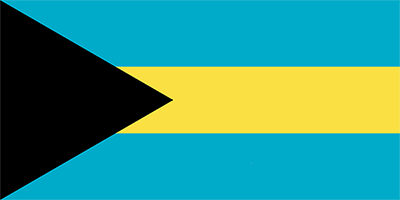
Bahamas flag picture

| Adopted | July 10, 1973 (independence) March 1, 2006 (design and colors standardized) |
|---|---|
| Designer | Hervis Bain (credited; elements of several competition entries) |
| Proportion | 2 : 1 (fly : hoist) |
| Law | Flags and Coat of Arms (Regulation) Act, 1973 (Chapter 32) + Regulations, 1991 |
| Use | National flag; civil, state and naval ensigns carry it in the canton |
The Bahamian flag is a triband of aquamarine, gold, and aquamarine with a black triangle at the hoist — the sea, the sun and sand, and the strength of a united people; first raised at midnight on July 10, 1973.
An overview
The national flag of The Bahamas is a horizontal triband of aquamarine, gold, and aquamarine with a black equilateral triangle at the hoist, its base the whole hoist edge and its point driving into the bands. The ratio is 1:2.
It was born with the country. A national competition sought a flag for independence, and rather than crown one entry the government combined elements of several into a single design, credited to the artist Hervis Bain. At midnight on July 10, 1973, the Union Jack came down at Clifford Park in Nassau and the new flag went up — the moment the Bahama Islands became The Bahamas. The Flags and Coat of Arms (Regulation) Act, assented to six days earlier, came into force the same day.
The design has never changed. What changed, on March 1, 2006, was its precision: the government standardized the exact proportions and colors, and the flag flown officially today is that version — though flags in the older, slightly different shades remain everywhere.
The black triangle
The flag carries no device — its one unusual element is the black equilateral triangle whose base is the whole hoist edge and whose point drives into the bands. In the government’s own reading it stands for the strength, vigor, and force of a united people, and its direction for their enterprise and determination to develop the rich resources of land and sea.
The Act blazons it in the language of heraldry — a pile issuing from the dexter — on a field of aquamarine with a gold fess. The triangle also makes the flag one of a small family of hoist-triangle designs in the Caribbean and beyond, but it is the only national flag whose triangle points into aquamarine.
Official color specification
For its first three decades the flag was made in whatever aquamarine and gold the maker had to hand. The standardization of March 1, 2006, fixed the shades: Pantone 3145 for the aquamarine — the color of the water over the Bahama Banks — and Pantone 123 for the gold.
| Color | Hex | Pantone | RGB |
|---|---|---|---|
| Aquamarine | #00778B | 3145 | 0, 119, 139 |
| Gold | #FFC72C | 123 | 255, 199, 44 |
| Black | #000000 | Black | 0, 0, 0 |
Symbolism and meaning
The government states the flag’s meanings itself, and they read as a map of the islands.
The triangle’s direction has a meaning of its own — pointing into the bands, it stands for the enterprise and determination of Bahamians to develop the rich resources of land and sea.
Design and official specification
The Act describes the flag in the language of heraldry — “Azure a Fess Or issuing from the dexter a Pile Sable”: a blue field, a gold horizontal band, a black wedge from the hoist. The 2006 standardization fixed the rest: equal bands, a 1:2 ratio, and the exact shades. Three ensigns carry the national flag in their canton — a white cross on red for merchant ships, a blue cross on white for the state, a red cross on white for the Royal Bahamas Defence Force.
| Element | Specification | Reference |
|---|---|---|
| Hoist (height) | 1.0 | 100 cm (39.4 in) |
| Fly (length) | 2.0 | 200 cm (78.7 in) |
| Ratio | 1 : 2 | Standardized March 1, 2006 |
| Bands | Three equal horizontal — aquamarine, gold, aquamarine | Each 33.3 cm (13.1 in) on the reference flag |
| Triangle | Black, equilateral, its base the full hoist edge, its point toward the fly | The blazon: "issuing from the dexter a Pile Sable" |
| Blazon | "Azure a Fess Or issuing from the dexter a Pile Sable" | Flags and Coat of Arms (Regulation) Act, Schedule Part I |
| Ensigns | Civil: a white cross on red; state: a blue cross on white; naval: a red cross on white — each with the national flag in the canton | All 1:2 |
How the flag evolved
A pirate hunt on a Blue Ensign, a competition with no single winner, a midnight hoisting, and thirty-three years to fix the colors — the flag’s story in four moves.
1869
The pirate-ship ensign

As a crown colony the Bahama Islands flew the British Blue Ensign with a badge of their own: a British ship chasing two pirate vessels out to sea, ringed by the motto "Expulsis piratis restituta commercia" — pirates expelled, commerce restored — a memory of Woodes Rogers' clearance of Nassau in 1718. The badge dates from about 1850, and the crown above the scene changed with each reign; the design did not receive formal approval until 1964.
1953
The last colonial flags

For Elizabeth II's accession the badge took the St Edward's crown, and this version — the Blue Ensign for government use, the Red Ensign for merchant ships — flew through internal self-government in 1964 and the independence negotiations that followed the 1972 election.
1973
Midnight at Clifford Park

A national competition sought the new flag, and no single entry won: elements of several submissions were combined into the aquamarine-gold-aquamarine triband with the black triangle, and the artist Hervis Bain is credited with the design. It was hoisted at midnight on July 10, 1973, at Clifford Park in Nassau as the Union Jack came down — the moment the Bahama Islands became The Bahamas.
2006
The colors, standardized
For three decades the flag was made in varying shades. On March 1, 2006, the government standardized the design and colors — Pantone 3145 aquamarine and Pantone 123 gold — the flag flown officially today. The earlier makes remain widely used unofficially, and the flag itself has never changed in design since 1973.
Who designed the Bahamian flag?
Hervis Bain — an artist and, later, a minister of religion — is credited with the design, and the story of how it came about says something about the country: the independence competition produced no single winner, and the government chose instead to combine elements of several entries into one flag, so that the new nation’s symbol belonged to more than one hand. Bain had already designed the coat of arms, granted in 1971, with its marlin, flamingo, and conch shell.
The result was raised at midnight on July 10, 1973 — and has not changed a line since.
July 10
The Bahamas keeps no flag day. The flag’s day is Independence Day, July 10 — the anniversary of the midnight of 1973 when it first rose at Clifford Park in Nassau, and the day the Act that governs it came into force. The flag flies on every public holiday under the Regulations, and on any other day the Minister gazettes.
Legal status and display rules
The flag rests on two instruments: the Flags and Coat of Arms (Regulation) Act — Chapter 32 of the statute law, assented to on July 4, 1973 and in force from Independence Day — and the Flags and Coat of Arms Regulations of 1991, in force from November 1, 1991, which set out when and how the flag is flown. The rules are tabled here.
| Provision | The rule |
|---|---|
| The Act | The Flags and Coat of Arms (Regulation) Act — assented July 4, 1973, in force from Independence Day, July 10 — blazons the flag in its Schedule and makes insulting or improperly using it an offense |
| Commercial use | Defacing the flag, or using it or the arms commercially, requires the permission of the Minister of National Security |
| When it flies | On public holidays and on days the Minister notifies in the Official Gazette; on government buildings, schools, ships and aircraft as the Regulations set out |
| Hours | From sunrise to sunset; illuminated if flown at night |
| Precedence | In the position of prominence above other flags; a foreign flag is not flown in The Bahamas without the national flag beside it |
| Care | Kept clean and in repair; a worn flag is retired by burning |
| Standardization | The exact design and colors fixed on March 1, 2006; earlier makes, in slightly different shades, remain in wide unofficial use |
Half-mast and mourning
The Regulations fix the flag’s part in mourning, and the Cabinet Office restates the movement each time it declares a period of national mourning.
| Provision | The rule |
|---|---|
| When | In periods of official mourning declared by the Cabinet Office — from sunrise on the first day to sunset on the last |
| The movement | The flag is hoisted to the top of the staff for an instant, then lowered to the half-mast position; before lowering for the day it is raised to the top again |
| Other flags | Flags on the same stand of poles fly at half-mast beneath the national flag, or not at all; foreign flags are not half-masted unless their own countries are in mourning |
Things you may not know
The old flag showed a pirate hunt. The colonial badge — a British ship chasing two pirate vessels under the motto “pirates expelled, commerce restored” — commemorated the end of Nassau’s pirate republic in 1718, and flew for more than a century before anyone formally approved it, in 1964.
The flag flies on thousands of ships that never see Nassau. The Bahamas runs one of the largest open ship registries in the world; under the Merchant Shipping Act of 1976 vessels of any ownership may register, and the aquamarine-gold-black flies at the stern of tankers and cruise liners across every ocean.
It took 33 years to fix the colors. The design of 1973 came with no Pantone; makers used the aquamarine and gold they had. The standardization of March 1, 2006, ended the drift — and left a generation of slightly different flags still flying.
Frequently asked questions
What does the flag of The Bahamas look like?
Three equal horizontal bands — aquamarine at top and bottom, gold in the middle — with a black equilateral triangle at the hoist whose point reaches into the bands. The ratio is 1:2. It has flown since independence on July 10, 1973, and its design and colors were standardized on March 1, 2006.
What do the colors of the Bahamian flag mean?
Aquamarine stands for the waters surrounding the islands, gold for the sun, the sand and the land's natural resources, and black for the strength, vigor and force of a united people. The triangle's direction — pointing into the bands — represents the enterprise and determination of Bahamians to develop the rich resources of land and sea.
Who designed the Bahamian flag?
The design is credited to Hervis Bain, a Bahamian artist, but it was not a single winning entry: the government held a national competition before independence and combined elements of several submissions into the final flag. Bain also designed the country's coat of arms, granted in 1971.
When was the Bahamian flag adopted?
It was first hoisted at midnight on July 10, 1973, at Clifford Park in Nassau, as The Bahamas became independent from the United Kingdom. The Flags and Coat of Arms (Regulation) Act, assented to on July 4, came into force the same day. The exact design and colors were standardized on March 1, 2006.
What are the official colors of the Bahamian flag?
Pantone 3145 for the aquamarine (#00778B, RGB 0-119-139), Pantone 123 for the gold (#FFC72C, RGB 255-199-44) and black. These are the standardized values of 2006; flags made before then, in slightly different shades, remain common.
What flag did The Bahamas fly before 1973?
The British Blue Ensign with the colony's badge: a British warship chasing two pirate ships, encircled by the Latin motto "Expulsis piratis restituta commercia" — pirates expelled, commerce restored. The badge dates from about 1850 but was only formally approved in 1964. Merchant ships flew the same badge on the Red Ensign.
What are the rules for flying the Bahamian flag?
The Flags and Coat of Arms (Regulation) Act of 1973 and the Regulations of 1991 govern it: the flag flies from sunrise to sunset, or illuminated at night; it takes the position of prominence over other flags; it is kept clean and in repair and retired by burning when worn; commercial use or defacement needs the permission of the Minister of National Security.
How is the Bahamian flag flown at half-mast?
In periods of official mourning declared by the Cabinet Office the flag is hoisted to the top of the staff for an instant, then lowered to the half-mast position, and raised to the top again before it is lowered for the day. Other flags on the same stand fly at half-mast beneath it or not at all.
Why is the Bahamian flag seen on so many ships?
The Bahamas runs one of the world's largest open ship registries: under the Merchant Shipping Act of 1976 vessels of any ownership may register there, so thousands of merchant ships and cruise liners fly the Bahamian flag as a flag of convenience — far more than the country's own fleet.
Explore all general-knowledge topics and the A-to-Z lists.

We Value Your Opinion Comments