

Australia flag picture
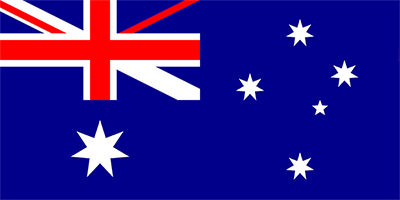
| Name | Australian National Flag (the Australian Blue Ensign) |
|---|---|
| Adopted | September 3, 1901 (first flown) December 8, 1908 (current design) February 14, 1954 (Flags Act assent) |
| Designers | Five competition winners (1901; £40 each from 32,823 entries) |
| Proportion | 2 : 1 (fly : hoist) |
| Stars | Commonwealth Star (7 points) + Southern Cross (4 × 7-point, 1 × 5-point) |
| Flag Day | September 3 (official since 1996) |
The Australian flag is the Blue Ensign under the Southern Cross: the Union Jack in the canton, the seven-pointed Commonwealth Star beneath it — chosen by competition in 1901 and the national flag by law since the Flags Act 1953.
An overview
The national flag of Australia is a blue ensign in a 1:2 ratio: the Union Jack in the upper hoist quarter, the large seven-pointed Commonwealth Star centered below it, and the Southern Cross — four seven-pointed stars and a small five-pointed one — in the fly half. Six stars, forty points in all.
The design came from the public: a merged government-and-magazine competition in 1901 drew 32,823 entries, and five nearly identical ones shared the prize. The flag first flew on September 3, 1901; royal approval was gazetted in 1903; the Commonwealth Star took its seventh point in 1908; and the Flags Act 1953 made the blue ensign the Australian National Flag, with precedence over the Union Jack.
The Act settled a long ambiguity — for half a century, the flag most Australians actually flew on land was the red merchant version, with public use of the blue officially discouraged.
Star, cross, and Jack
The Commonwealth Star — the Federation Star — sits with one of its seven points aimed at the center of St George’s Cross in the Union Jack. Six points stand for the six federating states; the seventh, added in 1908, for the Territory of Papua and every territory since. The star is heraldic, not astronomical: it has no official relation to any real star.
The Southern Cross is the opposite — the southern sky’s most distinctive constellation, an emblem of Australia since the early days of British settlement, rendered with the schedule’s precision: Alpha through Delta Crucis at seven points each, little Epsilon at five. Ivor Evans, the schoolboy among the designers, intended the four main stars to carry a second meaning — the virtues Dante ascribed to them: justice, prudence, temperance, and fortitude.
Official color specification
The Flags Act names only blue and white; the working color standards come from the government’s own style authorities. The Department of the Prime Minister and Cabinet specifies the Pantone values, and the Australian Government Style Manual adds RGB for screens and CMYK for print.
| Color | Hex | Pantone | RGB |
|---|---|---|---|
| Blue | #001B69 | 280 C | 0, 27, 105 |
| White | #FFFFFF | — | 255, 255, 255 |
| Red (canton) | #E50027 | 185 C | 229, 0, 39 |
Symbolism and meaning
The flag reads as three layers of identity — federation, sky, and heritage.
One designer added a private layer: Evans meant the four main stars of the Cross to stand for Dante’s four virtues — justice, prudence, temperance, fortitude.
Design and official specification
The construction rules live in the Flags Act’s schedule, measured in fractions of the flag’s width — the hoist edge. The Commonwealth Star spans three-tenths of it, the four large Southern Cross stars one-seventh each, the small fifth star one-twelfth, and every star’s position is fixed to the fraction.
| Element | Specification | Reference |
|---|---|---|
| Hoist (width) | 1.0 | 100 cm (39.4 in) — the Act measures by the hoist |
| Fly (length) | 2.0 | 200 cm (78.7 in) |
| Ratio | 1 : 2 | Flags Act 1953, schedule |
| Union Jack | The upper hoist quarter (canton) | — |
| Commonwealth Star | Seven points; outer diameter 3/10 of the width — 30 cm (11.8 in) | Centered in the lower hoist quarter, one point directed at the center of St George's Cross |
| Southern Cross | Four seven-pointed stars, outer diameter 1/7 of the width — 14.3 cm (5.6 in) | Alpha, Beta, Gamma, Delta Crucis, in the fly half |
| Fifth star | One five-pointed star, outer diameter 1/12 of the width — 8.3 cm (3.3 in) | Epsilon Crucis |
| Star positions | Fixed by the schedule | E.g., Alpha Crucis directly below the fly's midpoint, 1/6 up from the bottom edge; Delta Crucis 2/9 right and 31/240 above it |
How the flag evolved
Australians flew a National Colonial Flag as early as 1823, a Federation Flag from 1831, and the Eureka Stockade’s starred cross after 1854 — but the national flag itself was born whole in 1901, and has changed only by a point and a statute since.
1901
A flag from 32,823 entries

After federation, the new government merged its flag competition with a magazine's and drew 32,823 entries — each contestant submitting a blue government ensign and a red merchant one. The judges took six days and chose five nearly identical designs; the £200 prize was split £40 each among a Melbourne schoolboy of fourteen, a Sydney optician's apprentice, an architect, a Perth artist, and a ship's officer from Auckland. The flag first flew on September 3, 1901, with a six-pointed Commonwealth Star.
1903
The King approves

The winning design went to the Colonial Secretary in 1902, and on February 11, 1903, Prime Minister Edmund Barton announced in the Commonwealth Gazette that King Edward VII had approved it. The published version tidied the Southern Cross: the four large stars became seven-pointed and equal, beside the small five-pointed fifth.
1908
A seventh point
On December 8, 1908, the Commonwealth Star gained its seventh point — for the Territory of Papua and any territories to come — completing the design flown today. From May 22, 1909, the blue ensign was the flag for government vessels; the public, meanwhile, was steered toward the red.
1954
The national flag by law

For half a century the red ensign was the flag most Australians actually flew on land, with officialdom discouraging public use of the blue. The Flags Act 1953 settled it: the blue ensign became the Australian National Flag, with precedence over the Union Jack, and Queen Elizabeth II gave royal assent in person on February 14, 1954, during her visit. By the 1970s the blue was the national flag in most Australians' eyes as well as in law.
Who designed the Australian flag?
Five entrants who had never met, whose sketches were so alike the judges declared them joint winners: Ivor Evans, a 14-year-old Melbourne schoolboy; Leslie John Hawkins, a Sydney teenager apprenticed to an optician; Egbert John Nuttall, a Melbourne architect; Annie Dorrington, a Perth artist; and William Stevens, a ship’s officer from Auckland, New Zealand. Each took £40 of the £200 prize — a pool built from the two merged competitions plus £50 from the Havelock Tobacco Company.
The entries — one from an unnamed colonial governor among them — went on display at the Royal Exhibition Building in Melbourne, and the judges deliberated for six days before settling on the five.
Australian National Flag Day, September 3
September 3 — Australian National Flag Day, official since 1996 — marks the day in 1901 when the winning design first flew over the Royal Exhibition Building in Melbourne. The flag may be flown every day of the year, in daylight unless illuminated.
Legal status and display rules
The Flags Act 1953 declares the blue ensign the Australian National Flag and gives it precedence over the Union Jack; Queen Elizabeth II gave the Act royal assent in person on February 14, 1954, during her Australian visit, after opening the new session of Parliament. The protocol follows the government’s “Australian Flags” booklet. Both are tabled here.
| Provision | The rule |
|---|---|
| The Flags Act 1953 | Declares the blue ensign the Australian National Flag, with precedence over the Union Jack; royal assent given in person by Queen Elizabeth II on February 14, 1954 |
| Section 8 | Expressly preserves anyone's right to fly the Union Jack |
| Section 5 | The governor-general may proclaim additional flags of Australia — five have been, including the Australian Aboriginal Flag and the Torres Strait Islander Flag in 1995 |
| The 1998 amendment | A plebiscite is required before the national flag can be changed |
| When it flies | Every day of the year, in daylight unless illuminated; on government buildings, and where possible at polling places during national votes |
| Position | Always aloft and free, and in the superior position in Australia |
| Never | Flown upside down — not even in distress; placed on the ground or used as a covering; a faded or damaged flag comes down |
Half-mast and mourning
The booklet also fixes half-masting — including the one day a year the flag is lowered by the calendar rather than by a death.
| Provision | The rule |
|---|---|
| When | On the death of the Sovereign, the Governor-General, the Prime Minister and others the government names, and on Anzac Day until noon |
| The movement | The flag is raised to the peak first, then lowered to a position recognizably at half-mast — at least a flag's width from the top |
| Lowering | It is raised to the peak again before being lowered at the end of the day |
Things you may not know
A schoolboy co-designed it. Ivor Evans was 14 when his sketch tied with four strangers’ near-identical entries among 32,823 — one of which came from an unnamed colonial governor.
Dante is on the flag. Evans intended the Southern Cross’s four main stars to carry the virtues Dante ascribed to them — justice, prudence, temperance, and fortitude.
The people’s flag was red. For decades after federation, officialdom steered the public to the red merchant ensign and away from the blue — the design was identical, only the field differed. The Flags Act 1953 made the blue everyone’s flag.
Frequently asked questions
What does the flag of Australia look like?
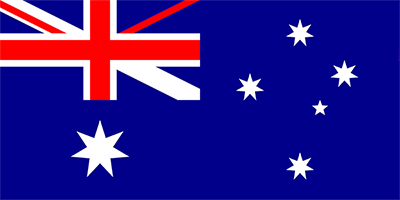
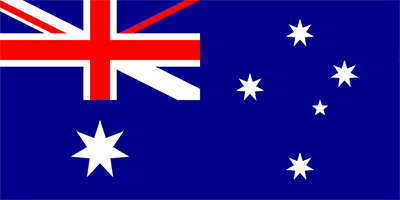
It is a blue ensign in a 1:2 ratio: the Union Jack in the upper hoist quarter, the large seven-pointed white Commonwealth Star below it, and the Southern Cross — four seven-pointed stars and one five-pointed — in the fly half. Six stars, forty points in all.
When was the Australian flag adopted?
In layers: the competition-winning design first flew on September 3, 1901; King Edward VII's approval was gazetted on February 11, 1903; the Commonwealth Star took its seventh point on December 8, 1908; and the Flags Act 1953 — given royal assent by Queen Elizabeth II on February 14, 1954 — made it the Australian National Flag by statute.
Who designed the Australian flag?
Five people who never met submitted nearly identical entries to the 1901 competition and shared the £200 prize at £40 each: Ivor Evans, a 14-year-old Melbourne schoolboy; Leslie John Hawkins, a Sydney teenager apprenticed to an optician; Egbert John Nuttall, a Melbourne architect; Annie Dorrington, a Perth artist; and William Stevens, a ship's officer from Auckland.
What does the Commonwealth Star mean?
Also called the Federation Star, it sits below the Union Jack with one point aimed at the center of St George's Cross. Six of its seven points stand for the six federating states; the seventh, added on December 8, 1908, stands for the Territory of Papua and all territories since.
What does the Southern Cross on the flag mean?
The constellation is the southern sky's most distinctive, used as an emblem of Australia since the early days of British settlement. Ivor Evans, one of the designers, also intended its four main stars to recall the four virtues Dante ascribed to them — justice, prudence, temperance, and fortitude.
What are the official colors of the Australian flag?
The Flags Act names only blue and white; the working standards come from government style authorities. The Department of the Prime Minister and Cabinet specifies Pantone 280 C for the blue and 185 C for the red, and the government Style Manual gives blue #001B69 and red #E50027 for screens, with official CMYK values for print.
What is the difference between the blue and red Australian flags?
Same design, different field: the blue ensign is the Australian National Flag; the Australian Red Ensign is for merchant ships. For decades after federation the red was the flag private citizens mostly flew on land — official practice discouraged public use of the blue until the Flags Act 1953 settled the blue as the national flag.
Can the Australian flag be changed?
Not easily. A 1998 amendment to the Flags Act requires a plebiscite before the flag can be replaced — though, like any statute, the amendment itself could be repealed by a future Parliament. Section 8 of the Act also preserves anyone's right to fly the Union Jack.
When is Australia's Flag Day?
September 3 — Australian National Flag Day, official since 1996 — marking the day in 1901 when the winning design first flew. The flag may be flown every day of the year, in daylight unless illuminated.
Explore all general-knowledge topics and the A-to-Z lists.

We Value Your Opinion Comments