

Argentina flag picture
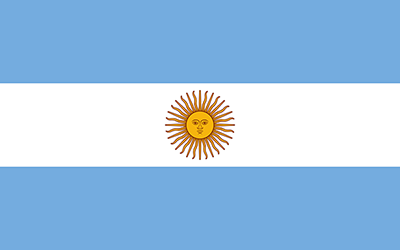
| Name | Bandera de Argentina (la celeste y blanca) |
|---|---|
| Adopted | February 27, 1812 (first raised, Rosario) 1816 (national flag) February 25, 1818 (sun added) |
| Designer | General Manuel Belgrano |
| Proportion | 8 : 5 (fly : hoist) |
| Sun | Sun of May — golden, 32 rays (16 straight, 16 wavy; after the 1813 coin) |
| Flag Day | June 20 (Belgrano's death; Law 12.361, 1938) |
The Argentine flag is the celeste y blanca — light blue, white, light blue — under the golden Sun of May: Belgrano's banner of 1812, made national in 1816 and specified today down to CIE colorimetry.
An overview
The national flag of Argentina — la celeste y blanca — is a horizontal triband of light blue, white, and light blue, with the golden Sun of May centered on the white band. The ratio is 5:8, and the sun carries a face and 32 rays, 16 straight and 16 wavy.
General Manuel Belgrano created it in the colors of the patriots’ cockade and first raised it at Rosario on February 27, 1812. The Congress of Tucumán made it the national flag in 1816, the year of independence, and added the sun in 1818. Two versions coexist by law: the Official Ceremony Flag with the sun, and the sunless Ornamental Flag, which is always hoisted below it — both equally the national flag.
Few flags traveled further: the standard references credit the Argentine design with influencing the flags of El Salvador, Guatemala, Honduras, Costa Rica, and Nicaragua, along with neighboring Uruguay, which flies a Sun of May of its own.
The Sun of May
The sun commemorates the May Revolution of 1810, when — by the tradition the flag preserves — the sun broke through the clouds over Buenos Aires as the new government took power. Its design is exact: a replica of the sun engraved on the first Argentine coin, approved in 1813, with 16 straight and 16 wavy rays around a face.
Rules from 1978 fix its color as golden yellow and its diameter at five-sixths of the white band’s height, embroidered on the ceremony flag. The historian Diego Abad de Santillán read the emblem as the Inca sun god Inti — an interpretation, not a statute, but one the sun’s Andean face invites.
Official color specification
Argentina defines its flag colors scientifically: the IRAM norms, published through the National Belgrano Institute, specify them in CIE 1976 colorimetry — the celeste, the sun’s yellow, and the brown of its lines each pinned to L*a*b* coordinates. The values below are the institute’s published Pantone and screen equivalents.
| Color | Hex | Pantone | RGB |
|---|---|---|---|
| Sky blue (celeste) | #74ACDF | 284 C | 116, 172, 223 |
| White | #FFFFFF | — | 255, 255, 255 |
| Yellow (sun) | #F6B40E | 1235 C | 246, 180, 14 |
| Brown (sun lines) | #85340A | 483 C | 133, 52, 10 |
Symbolism and meaning
Argentine law fixes the flag’s form with unusual precision — and leaves its meaning alone. Historians say the origin of the colors cannot be established with certainty; what is certain is where they were first worn.
Even the first flag’s exact shade is contested — historians and Belgrano’s own descendants disagree over blue versus pale blue.
Design and official specification
The modern specification came in layers: rules of 1978 set an official size of 0.9 by 1.4 meters (35.4 by 55.1 inches), the standards institute IRAM fixed the proportions at 5:8 in 2002, and a presidential decree of November 2010 standardized the exact colors, proportions, and aspect ratio in force today. Argentina shares the 5:8 ratio with only four other national flags — Guatemala, Palau, Poland, and Sweden.
| Element | Specification | Reference |
|---|---|---|
| Hoist (height) | 1.0 | 100 cm (39.4 in) |
| Fly (length) | 1.6 | 160 cm (63.0 in) |
| Ratio | 5 : 8 | IRAM, 2002 (9:14 was official from 1978) |
| Bands | Three equal horizontal — light blue, white, light blue | — |
| Sun | The golden Sun of May, 16 straight and 16 wavy rays, centered on the white band | A replica of the 1813 coin engraving |
| Sun diameter | 5/6 of the white band's height | 1978 rules; embroidered on the ceremony flag |
| With the sun | The Official Ceremony Flag | Since 1985, for everyone |
| Without the sun | The Ornamental Flag — always hoisted below the ceremony flag | Both are equally the national flag |
How the flag evolved
The design has barely changed since 1818; nearly everything else about it has — who could fly it, at what size and shade, and under whose law. The story runs from a refused war banner to a flag defined in colorimetry.
1812
Belgrano's banner

The light blue and white came from the patriots' cockade; why those colors were chosen has never been settled — theories run from Bourbon ribbons to the Buenos Aires arms to the plumes of the Patricios of 1806. General Manuel Belgrano proposed a flag to the government on February 26, 1812, and raised it at Rosario the next day, February 27. The Triumvirate refused it; the Assembly of Year XIII allowed it as a war flag.
1818
The Sun of May

The Congress of Tucumán made the triband the national flag in 1816, and on February 25, 1818, added the golden Sun of May — a replica of the engraving on the first Argentine coin of 1813, recalling the May Revolution of 1810. Provinces long flew flags of their own; the 1861 victory at Pavón united the republic, and with it the flag — though its exact shade and ratio drifted for more than a century.
2010
Specified to the decimal
The modern era pinned the flag down. Decree 10.302 of 1944 named the sun flag the Official Flag but reserved it to governments; Law 23.208 of 1985 gave it to every citizen. IRAM fixed the proportions at 5:8 in 2002, and a presidential decree of November 2010 standardized the exact colors — defined in CIE colorimetry — the proportions, and the aspect ratio in force today.
Who designed the Argentine flag?
General Manuel Belgrano — lawyer, economist, and one of the leaders of the war of independence. He had already created the national cockade in light blue and white; on February 26, 1812, he proposed a flag in the same colors to the government, and raised it at Rosario the next day. The First Triumvirate refused to approve it, and Belgrano carried it anyway; the Assembly of Year XIII later allowed it as a war flag.
The country keeps his date, not the government’s: Flag Day is June 20, the anniversary of Belgrano’s death in 1820, and its ceremonies center on the National Flag Memorial in Rosario — a 10,000-square-meter (108,000-square-foot) complex built where he first raised the flag.
Flag Day, June 20
Día de la Bandera falls on June 20, the anniversary of Belgrano’s death in 1820 — a national holiday since Law 12.361 of 1938. Since 1957 the official ceremonies have centered on the National Flag Memorial in Rosario, raised where Belgrano first hoisted the flag in 1812; schoolchildren across the country swear their oath to the flag that day.
Legal status and display rules
Decree 10.302 of 1944 names the flag with the sun — the design approved in 1818 — the Official Flag of the Nation; Law 23.208 of 1985 gave it to every citizen; and the decree of November 2010 completed the modern framework by fixing the flag’s exact colors, proportions, and aspect ratio. The instruments, in order:
| Instrument | The rule |
|---|---|
| 1869 | President Sarmiento authorizes the flag on homes and buildings during national holidays, ending an outright ban on private display |
| 1938 — Law 12.361 | June 20, the anniversary of Belgrano's death, made Flag Day and a national holiday |
| 1944 — Decree 10.302 | The flag with the sun named the Official Flag of the Nation — and, by Article 3, reserved to federal and provincial governments; citizens fly the sunless version |
| 1985 — Law 23.208 | The restriction repealed: governments and individuals alike may fly the Official Flag |
| The two flags | The Ornamental Flag, without the sun, remains in use and is always hoisted below the ceremony flag |
| 2002 — IRAM | The standards institute fixes the proportions at 5:8 |
| 2010 — decree | A presidential decree of November 2010 standardizes the exact colors (in CIE colorimetry), proportions and aspect ratio in force today |
Things you may not know
The colors are defined in colorimetry. The IRAM norms pin the celeste, yellow, and brown to CIE 1976 L*a*b* coordinates — the flag’s shades are a matter of measurement, not of eye.
Only five flags are 5:8. Since IRAM set the ratio in 2002, Argentina has shared its proportions with just Guatemala, Palau, Poland, and Sweden.
The sun was government-only for 41 years. From the 1944 decree to the 1985 law, ordinary Argentines could fly only the sunless flag; the Sun of May belonged to the state. Since 1985, it belongs to everyone.
Frequently asked questions
What does the flag of Argentina look like?
It is a horizontal triband of light blue, white, and light blue — the celeste y blanca — with the golden Sun of May centered on the white band. The sun has a face and 32 rays, 16 straight and 16 wavy, and the flag's ratio is 5:8.
When was the Argentine flag adopted?
General Manuel Belgrano first raised it at Rosario on February 27, 1812. The Congress of Tucumán designated it the national flag in 1816, and the Sun of May was added on February 25, 1818. The exact colors and proportions in force today were standardized by decree in November 2010.
Who designed the Argentine flag?
General Manuel Belgrano, a leader of the independence movement, who had earlier created the national cockade in the same colors. He proposed the flag to the government on February 26, 1812, and raised it the following day. Flag Day, June 20, marks the anniversary of his death in 1820.
What do the colors of the Argentine flag mean?
No official meaning is on record, and historians say the origin of the colors cannot be established with certainty. The light blue and white came from the patriots' cockade of the May Revolution; theories trace them to the ribbon of the Bourbon Order of Charles III, to the Buenos Aires arms — blue for the sky, white for the waters of the Río de la Plata — or to the plumes worn against the British invasions of 1806–07.
What does the Sun of May on the Argentine flag mean?
It commemorates the May Revolution of 1810, when — by tradition — the sun broke through the clouds over Buenos Aires. The design is a replica of the sun engraved on the first Argentine coin of 1813, with 16 straight and 16 wavy rays; the historian Diego Abad de Santillán read it as the Inca sun god Inti.
What are the official proportions and colors of the Argentine flag?
The ratio is 5:8, set by the Argentine standards institute IRAM in 2002 (from 1978 it had been 9:14). The colors are officially defined in CIE 1976 colorimetry through the IRAM norms; the published equivalents are celeste Pantone 284 C (#74ACDF), sun yellow Pantone 1235 C (#F6B40E), and brown Pantone 483 C (#85340A) for the sun's lines.
Why do some Argentine flags have the sun and some not?
Both are the national flag. The version with the sun is the Official Ceremony Flag; the version without is the Ornamental Flag, which must always be hoisted below the ceremony flag. From 1944 the sun flag was reserved to federal and provincial governments; Law 23.208 of 1985 gave every citizen the right to fly it.
When is Argentina's Flag Day?
June 20 — Día de la Bandera — a national holiday established by Law 12.361 in 1938, on the anniversary of Belgrano's death in 1820. Since 1957 the official ceremonies have centered on the National Flag Memorial in Rosario, built where Belgrano first raised the flag.
Which flags did the Argentine flag influence?
Its blue and white spread widely: Britannica credits it with influencing the national flags of five Central American states — El Salvador, Guatemala, Honduras, Costa Rica, and Nicaragua — as well as neighboring Uruguay, which also carries a Sun of May.
Explore all general-knowledge topics and the A-to-Z lists.

We Value Your Opinion Comments